📺 Watch the Full Video Analysis
This article was automatically generated by the NFC Market Live AI analysis system. (Updated: 2026-08-03 23:33 JST)
📄 Primary Source
Banco Central do Brasil
https://www.bcb.gov.br/content/focus/focusmarketreadout/R20260731.pdf
Deep dive into Brazil’s Central Bank (BCB) weekly Focus Market Readout survey (July 31, 2026).
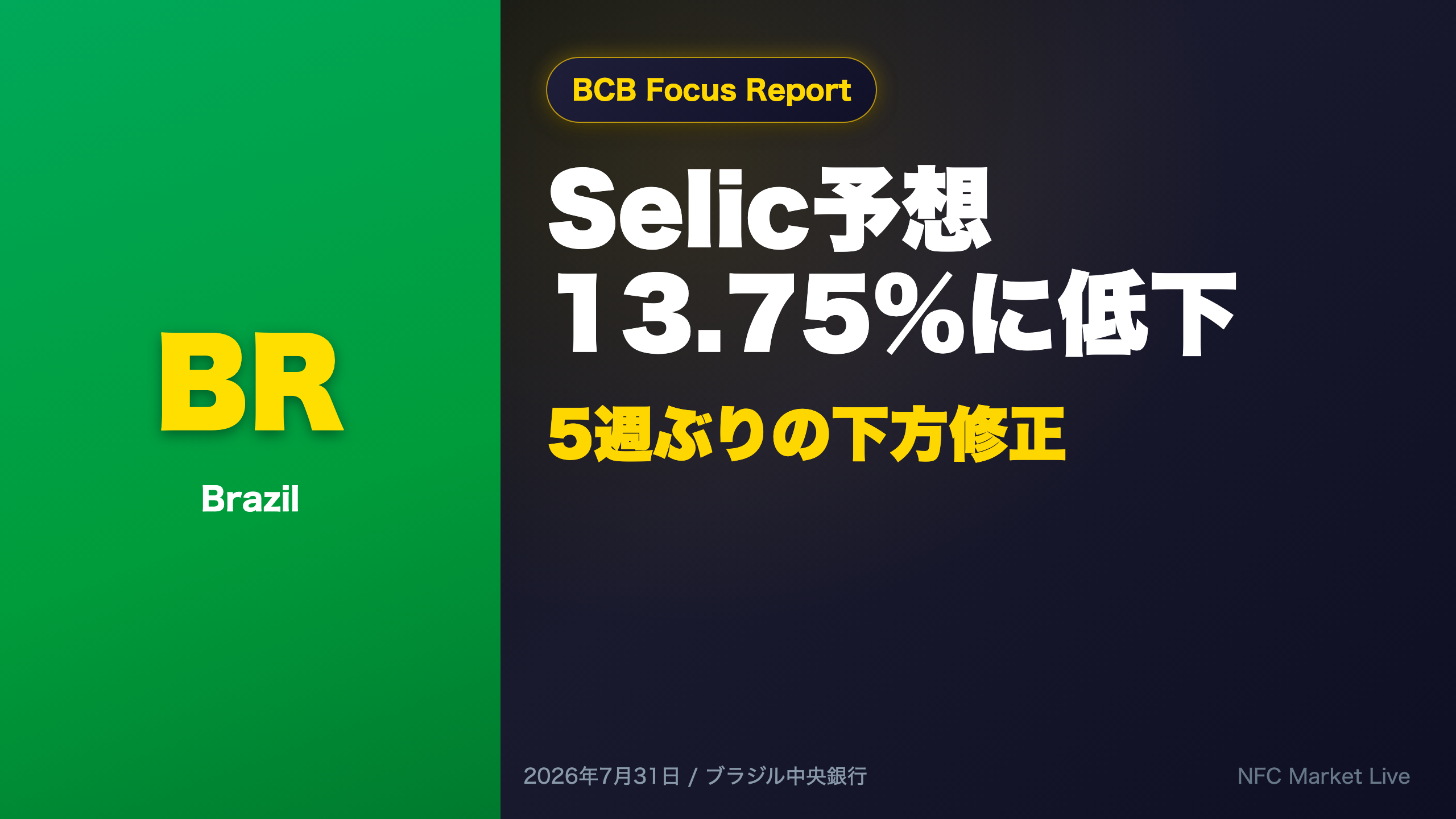
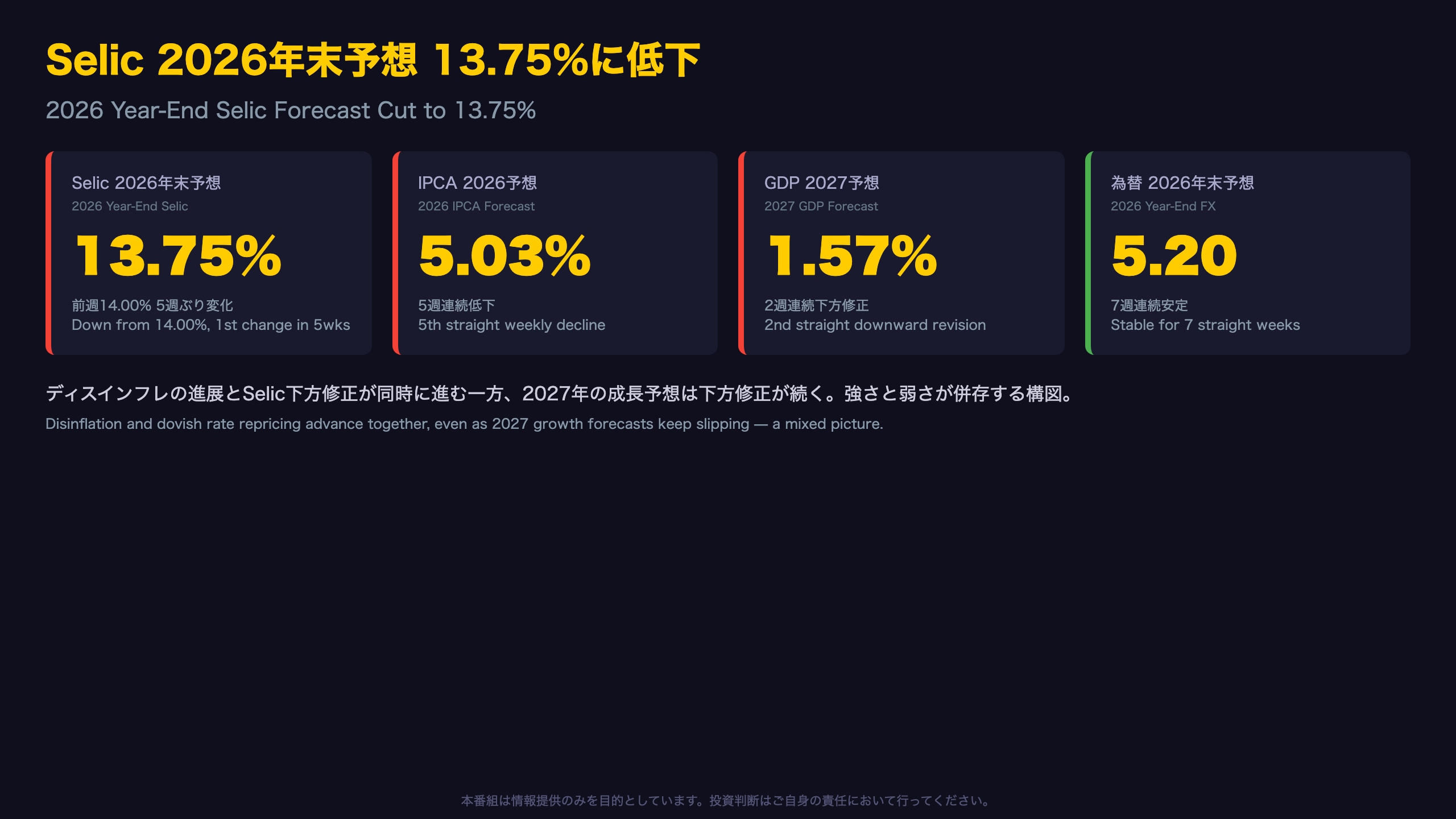
📊 2026 year-end Selic forecast cut from 14.00% to 13.75%, first change in 5 weeks
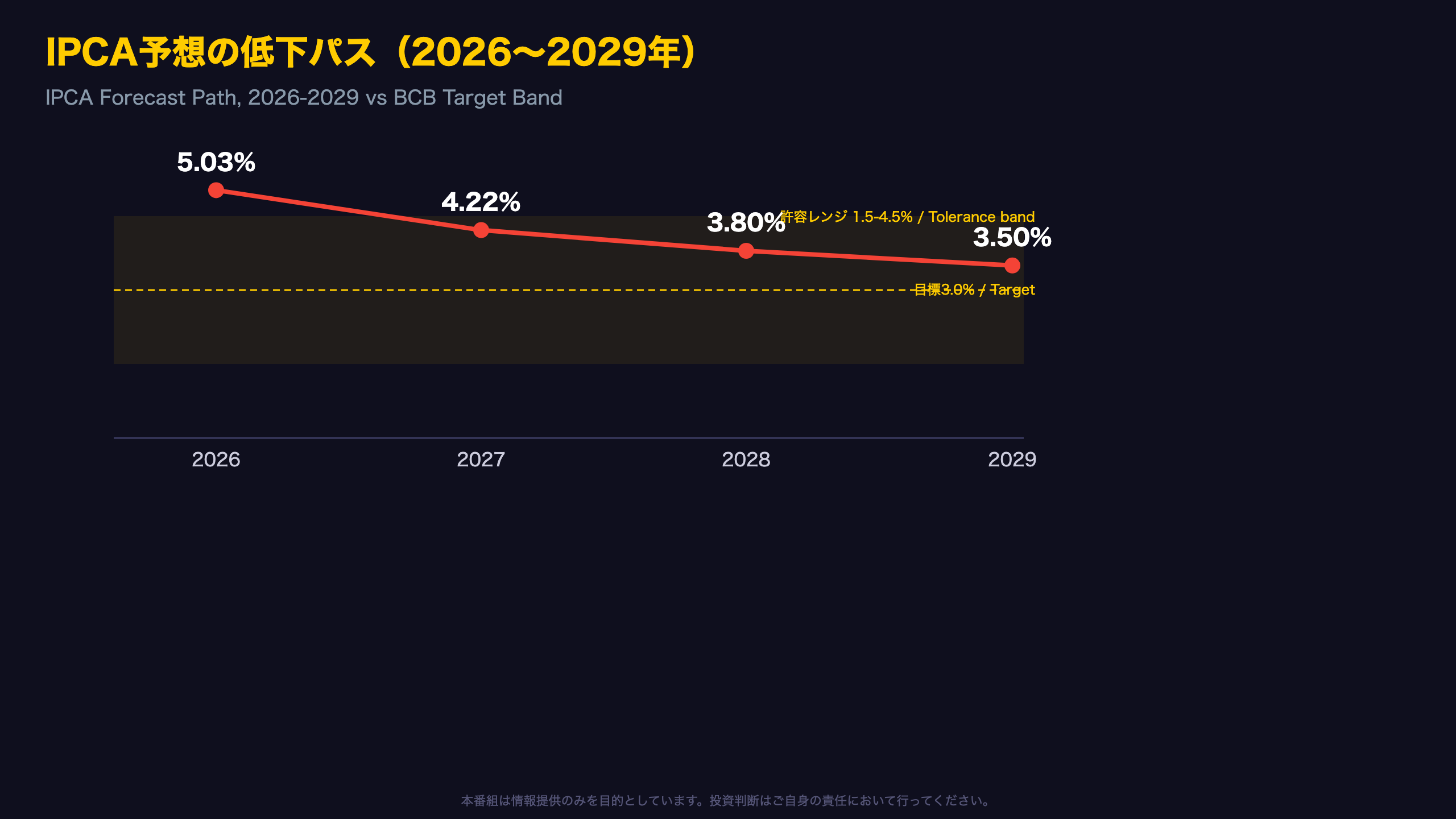
📉 IPCA inflation forecast falls for a 5th straight week to 5.03%
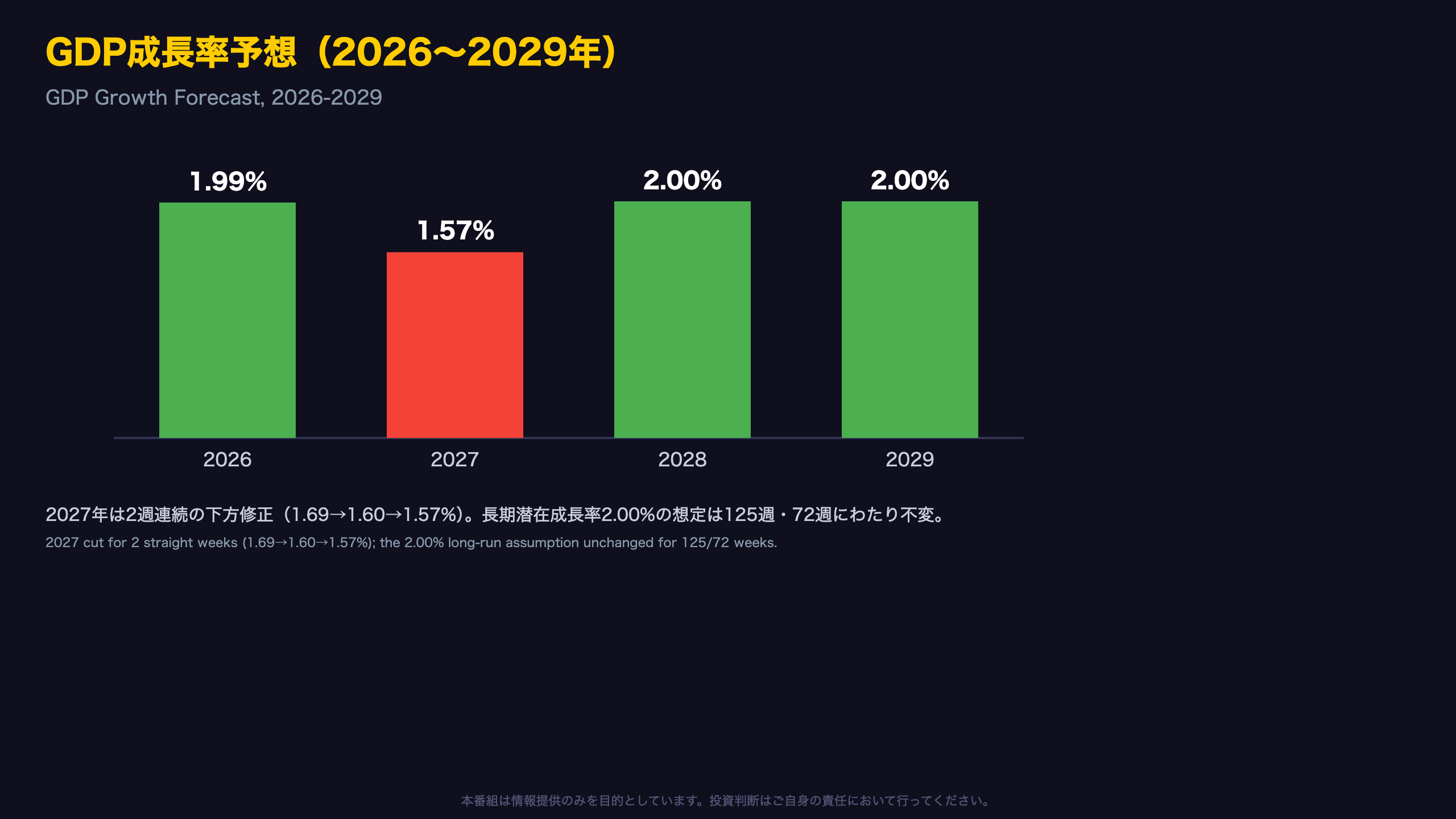
⚠️ 2027 GDP growth forecast cut for a 2nd straight week to 1.57%
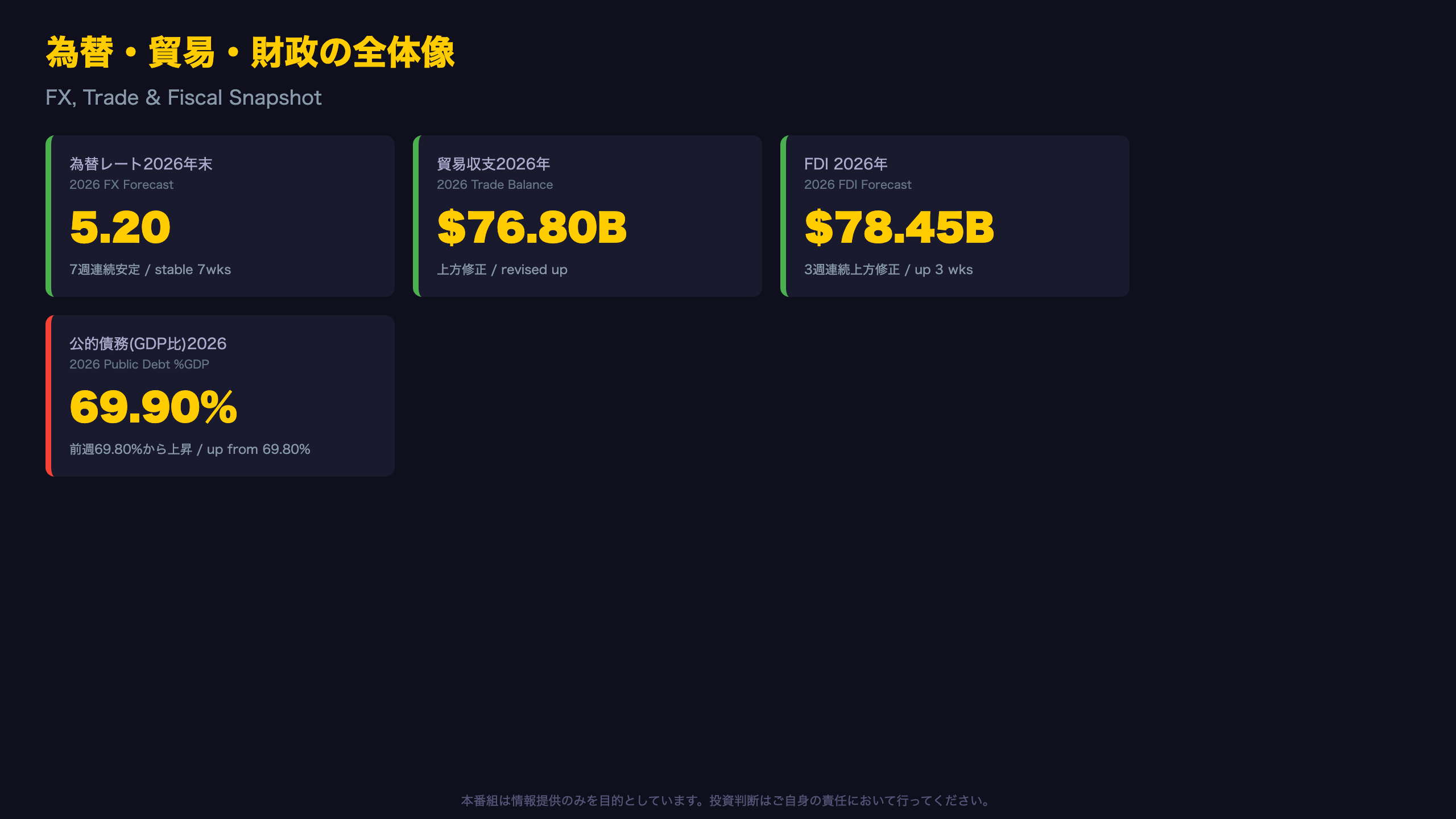
💹 Exchange rate steady at 5.20 for 7 weeks; trade balance and FDI forecasts revised up
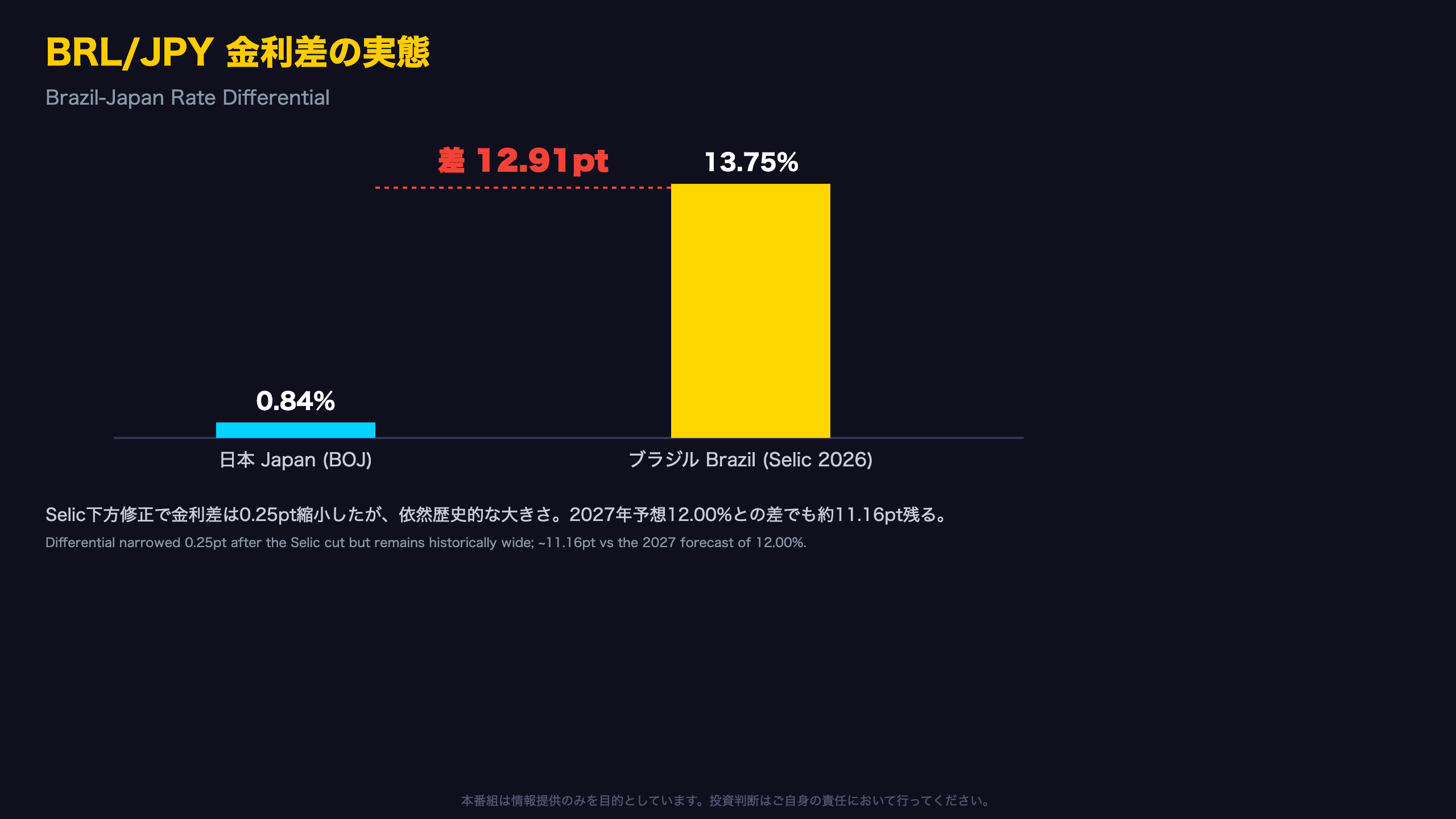
🇯🇵 Rate differential vs Japan’s 0.84% policy rate remains huge at ~12.91pts
A balanced look at disinflation progress colliding with growth deceleration signals.
Selic 2026年末予想13.75%に低下 ― ディスインフレと成長減速が同時進行
What Is the Focus Report?
The Focus Market Readout is a weekly survey published every Monday by the Banco Central do Brasil (BCB), aggregating forecasts from more than 130 financial institutions and analysts. Unlike the Fed’s dot plot, which reflects the central bank’s own view, Focus is a market-based consensus that BCB’s rate-setting committee (COPOM) directly references when deciding on the Selic rate — a genuine window into ‘the market’s view of the market.’
Why This Week’s Move Matters
The year-end 2026 Selic forecast had been frozen at 14.00% for five consecutive weeks through July 24. This week’s drop to 13.75% follows five straight weeks of downward revisions to IPCA inflation forecasts (5.30% → 5.12% → 5.03%), suggesting the disinflation trend has finally fed through to rate-path expectations.
Original data: \”Selic Target (% p.a) 14.00 14.00 13.75 ▼ (1) 152 13.75 100\”
A Nuance Worth Watching
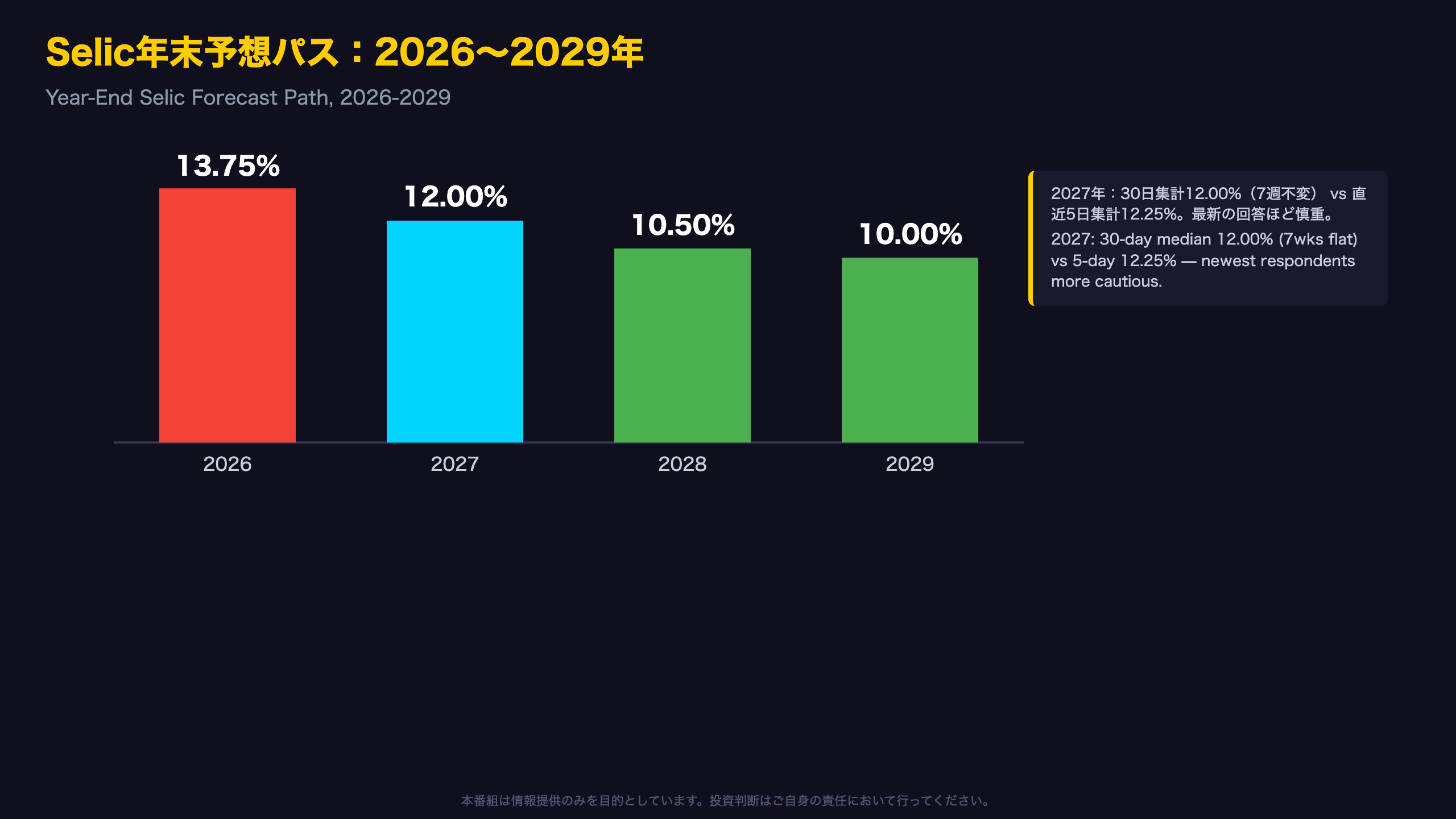
The 30-day aggregate for 2027 Selic held at 12.00%, but the most recent 5-business-day responses came in higher at 12.25% — hinting the freshest forecasters are slightly less dovish on 2027 than the broader panel.
Looking Ahead
This print offers a real-time read on how professional Brazil-watchers are recalibrating the rate trajectory of one of the world’s most-watched carry-trade currencies, ahead of the next Focus release (exact date not specified in source).
Selic金利パス:2026年は下方修正、2027年は隠れた慎重論
Two Ways to Read the Same Survey
The Focus Report publishes two medians: one based on all responses over the trailing 30 days, and another using only the most recent 5 business days. The 30-day figure is smoother but lags; the 5-day figure reacts faster but is noisier — similar to comparing a 30-day and 5-day moving average.
For 2027, the 30-day median has held at 12.00% for seven straight weeks. But the 5-business-day median just ticked up to 12.25% from 12.00% the prior week — a signal that the newest respondents may be nudging toward a less aggressive easing path for 2027 than the broader panel currently reflects.
Source data: \”12.00 12.00 12.00 (7) 147 12.25 97\”
Where the 2026 Move Came From
The drop to 13.75% for 2026 followed five consecutive weeks of falling IPCA inflation forecasts (5.30% → 5.03%). This lag pattern, where inflation forecasts move first and Selic forecasts catch up, recurs frequently in the Focus Report’s weekly cadence.
What to Watch Next
If the 2027 5-day median (12.25%) persists for multiple weeks, it could eventually pull the 30-day aggregate higher — a key signal for how confident the market remains in continued 2027 easing, directly relevant for anyone pricing BRL forward curves or NDFs.
IPCA予想5週連続低下 ― それでも目標3.0%からは遠い
Measuring the Distance to Target
BCB operates an inflation-targeting regime centered on 3.0%, with a tolerance band of 1.5% to 4.5% — comparable in spirit to the Fed’s 2% target, but with a wider band reflecting Brazil’s historically higher inflation volatility. The 2026 year-end IPCA forecast of 5.03% sits above even the upper edge of that band, meaning the market itself does not expect BCB to hit its official target this year.
The Significance of a 48-Week Anchor
The 2029 forecast has sat at 3.50% for forty-eight consecutive weeks — one of the longest unchanged streaks in the dataset. That persistence suggests participants have settled into a view that inflation will structurally stabilize half a point above target long-term, rather than fully converging to 3.0%.
Source: \”3.50 3.50 3.50 (48) 114\”
Near-Term Momentum vs. Long-Run Anchoring
By contrast, the 2026 forecast has moved for five straight weeks: 5.30% (4 weeks ago) → 5.12% (1 week ago) → 5.03% (today), roughly a 27-basis-point downward revision in a month — faster near-term improvement than the frozen long-run figure suggests.
A Caveat
This is a median-based reading; the source does not disclose dispersion across respondents, so we cannot claim the panel has become more unified — only that the central estimate shifted.
GDP成長率:2026年は底堅く、2027年は2週連続下方修正
“Resilient This Year, Slower Next Year”
The 2026 GDP forecast has been frozen at 1.99% for five straight weeks — notable given that the 2026 year-end Selic forecast still sits at a restrictive 13.75%. This suggests near-term real activity has broadly tracked expectations even under tight monetary policy.
2027, however, tells a different story: two consecutive weekly downward revisions bring the forecast to 1.57%.
Source: \”1.69 1.60 1.57 ▼ (2) 116 1.50 61\”
The 5-business-day median is even lower, at 1.50%, versus the 30-day median of 1.57% — implying the most recent respondents are marginally more cautious about 2027 growth.
The Long-Run Anchor Hasn’t Moved
2028’s forecast has sat at 2.00% for 125 weeks, and 2029’s at 2.00% for 72 weeks — both extraordinarily long unchanged streaks, telling us the market’s implicit long-run potential growth assumption remains intact.
A Note on Causality
One plausible read is that restrictive rates are starting to bite with a lag, showing up more in 2027 than 2026. But the source data offers no explicit causal mechanism, and other factors — fiscal policy, external demand — could equally be at play. This should be read as one possible interpretation, not a confirmed causal claim.
為替は7週連続安定、外部収支は改善、公的債務にわずかな上昇
The Exchange Rate’s “Surprising Stability”
Even as the 2026 year-end Selic forecast was cut from 14.00% to 13.75% — theoretically reducing BRL’s rate-differential appeal — the exchange rate forecast has stayed frozen at 5.20 reais per dollar for seven straight weeks. This stability likely reflects more than just rate differentials; steady expected capital inflows via trade and FDI may be providing an offsetting support.
External Accounts Are Improving
The 2026 trade balance forecast was revised up to $76.8 billion from $76.2 billion, while FDI forecasts have been raised for three consecutive weeks, reaching $78.45 billion, up from $76.0 billion four weeks ago.
Source: \”76.00 77.85 78.45 ▲ (3) 40 77.58 20\”
Fiscal Picture: Stable, With a Small Crack
Public sector debt ticked up to 69.90% of GDP from 69.80% — its first uptick in a while. The primary balance forecast has been rock-steady at -0.50% of GDP for twenty-four weeks. But the nominal balance’s 5-day median came in at -8.80%, slightly worse than the 30-day median of -8.70% — a small crack in an otherwise stable fiscal narrative.
A Caveat
A single week’s uptick in public debt is not sufficient on its own to call a trend reversal — it bears watching over coming weeks rather than treating as confirmed.
BRL/JPYキャリー:金利差は依然巨大、だが縮小の兆し
The Arithmetic of Carry
A BRL/JPY carry trade involves borrowing in low-yielding yen and investing in higher-yielding Brazilian real assets to capture the rate differential. Based on this week’s data, the 2026 year-end Selic forecast of 13.75% compares to Japan’s policy rate of 0.84% (FRED series IRSTCI01JPM156N, as of June 2026) — a simple differential of roughly 12.91 percentage points, among the widest of any major EM/DM pair.
Narrowing, But Still Enormous
The cut in the Selic forecast from 14.00% to 13.75% mechanically narrows this differential by 0.25 points. Still, in absolute terms, it remains one of the largest carry opportunities among major emerging markets.
FX Stability Is a Double-Edged Sword
The exchange rate forecast holding at 5.20 for seven straight weeks suggests limited near-term risk of the kind of sharp BRL depreciation that typically triggers carry unwinds. But this reflects current market expectations, not a guarantee — actual price action can shift rapidly on news flow, domestic politics, or global risk sentiment.
Considerations for Japanese Retail Investors
Brazilian government bonds and BRL-denominated assets remain attractive on rate-differential grounds, but this week’s data also flagged an uptick in public debt (to 69.90% of GDP) and continued downward revisions to 2027 growth — both potential future triggers for carry unwind risk. Investors should avoid anchoring on the rate differential alone and track the fuller basket of fiscal and growth indicators highlighted in this report.
総合的な含意:ディスインフレは進むが、綱引きは続く
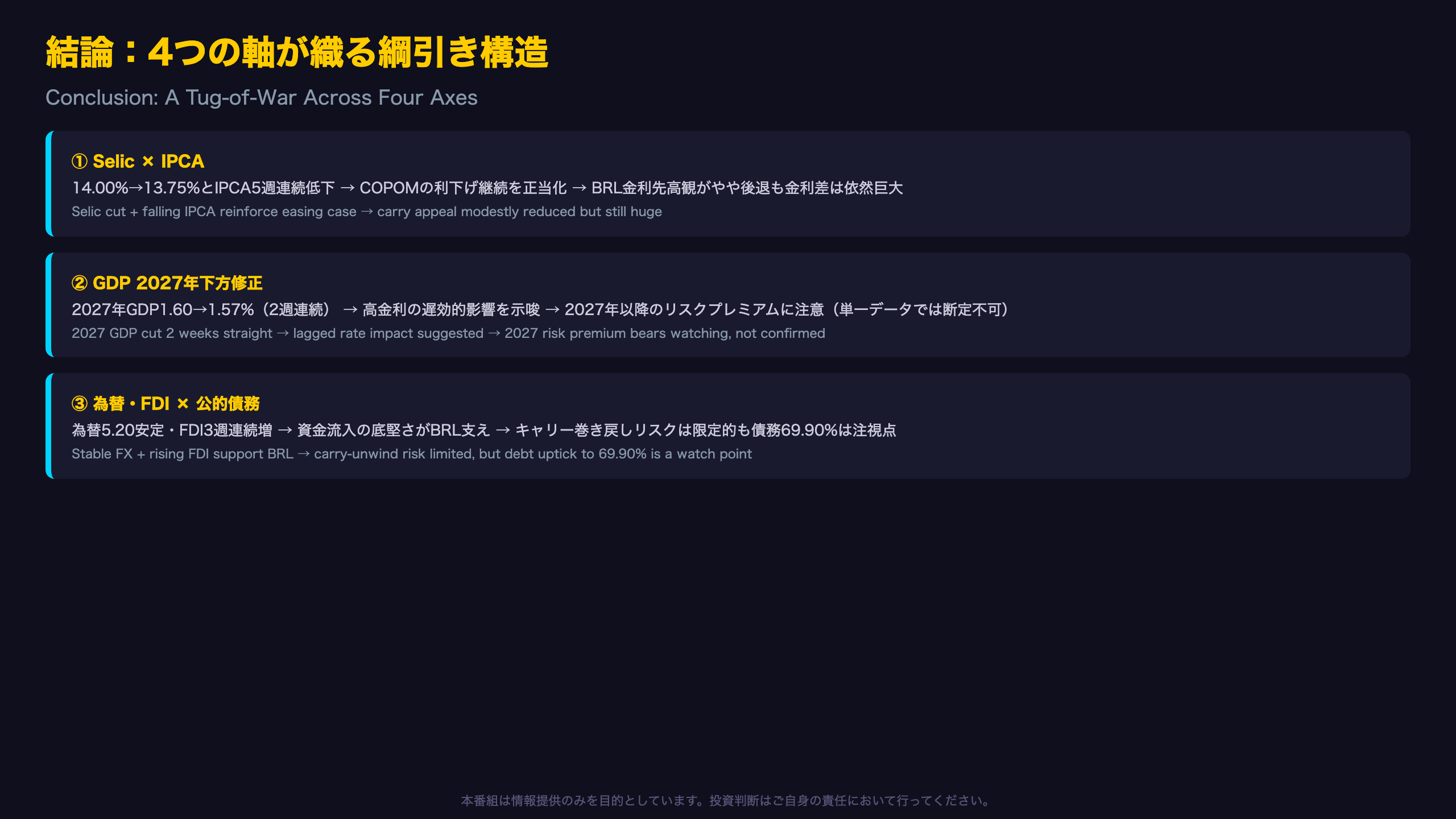
Reading the Implications Through a Chain of Logic
① Selic × IPCA
[2026 year-end Selic forecast cut from 14.00% to 13.75%, IPCA forecast falling for a 5th straight week] → [Disinflation progress strengthens the case for BCB to continue easing] → [This may modestly reduce BRL’s rate-differential appeal, though the absolute differential remains enormous]
② 2027 GDP Downward Revision
[2027 GDP growth forecast cut for a 2nd straight week, to 1.57%] → [Suggests high rates may be weighing on the real economy with a lag] → [It’s commonly argued this raises the risk premium on Brazil-linked assets into 2027, though this single data point alone cannot confirm that causal claim]
③ FX & FDI vs. Public Debt
[Exchange rate forecast stable at 5.20 for 7 weeks, FDI forecast raised for a 3rd straight week] → [Resilient expected capital inflows may be underpinning BRL] → [Near-term carry-unwind risk appears limited, but the uptick in public debt to 69.90% of GDP is a fiscal signal worth monitoring]
Looking Ahead
The source does not specify the exact date of the next Focus Report release. Key questions for coming weeks: does the IPCA downgrade extend to a sixth straight week, and does the GDP downgrade extend to a third?
Disclaimer: This article is for informational purposes only. All investment decisions are made solely at your own risk.