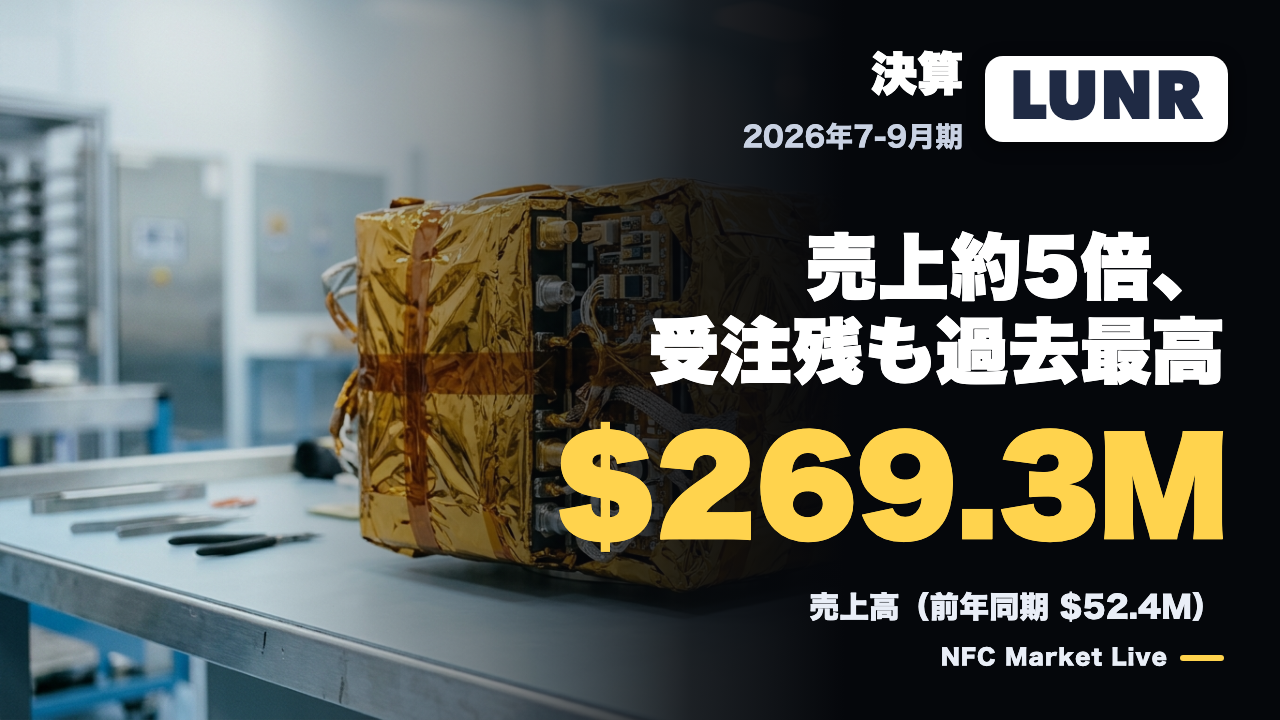
This article was automatically generated by the NFC Market Live AI analysis system. (Updated: 2026-11-12 22:15 JST)
📊 A look at Intuitive Machines (LUNR) third-quarter 2026 results.
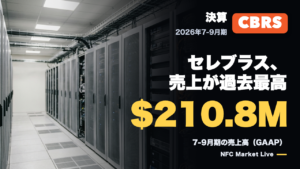
📈 Revenue was $269M, about 5x a year earlier, and backlog reached a record of roughly $1.9B. Adjusted EBITDA turned positive and operating cash flow was positive.
⚠️ Operating loss persists. The narrower net loss was helped by a gain on warrant liabilities, and gross margin included one-time favorable adjustments.
💡 FY2026 revenue guidance is $920-950M. Next up: Q4 results and the Altus-1 lunar satellite, planned for around March-April.
決算サマリー:売上は約5倍、受注残も過去最高
Intuitive Machines Q3 2026: record top line, still an operating loss
Who and what. Intuitive Machines (Nasdaq: LUNR) builds lunar landers and, since its January 2026 acquisition of Lanteris, satellites. The figures come from an SEC Form 8-K, Exhibit 99.1, the standard filing US listed companies use to publish earnings.
Headline numbers
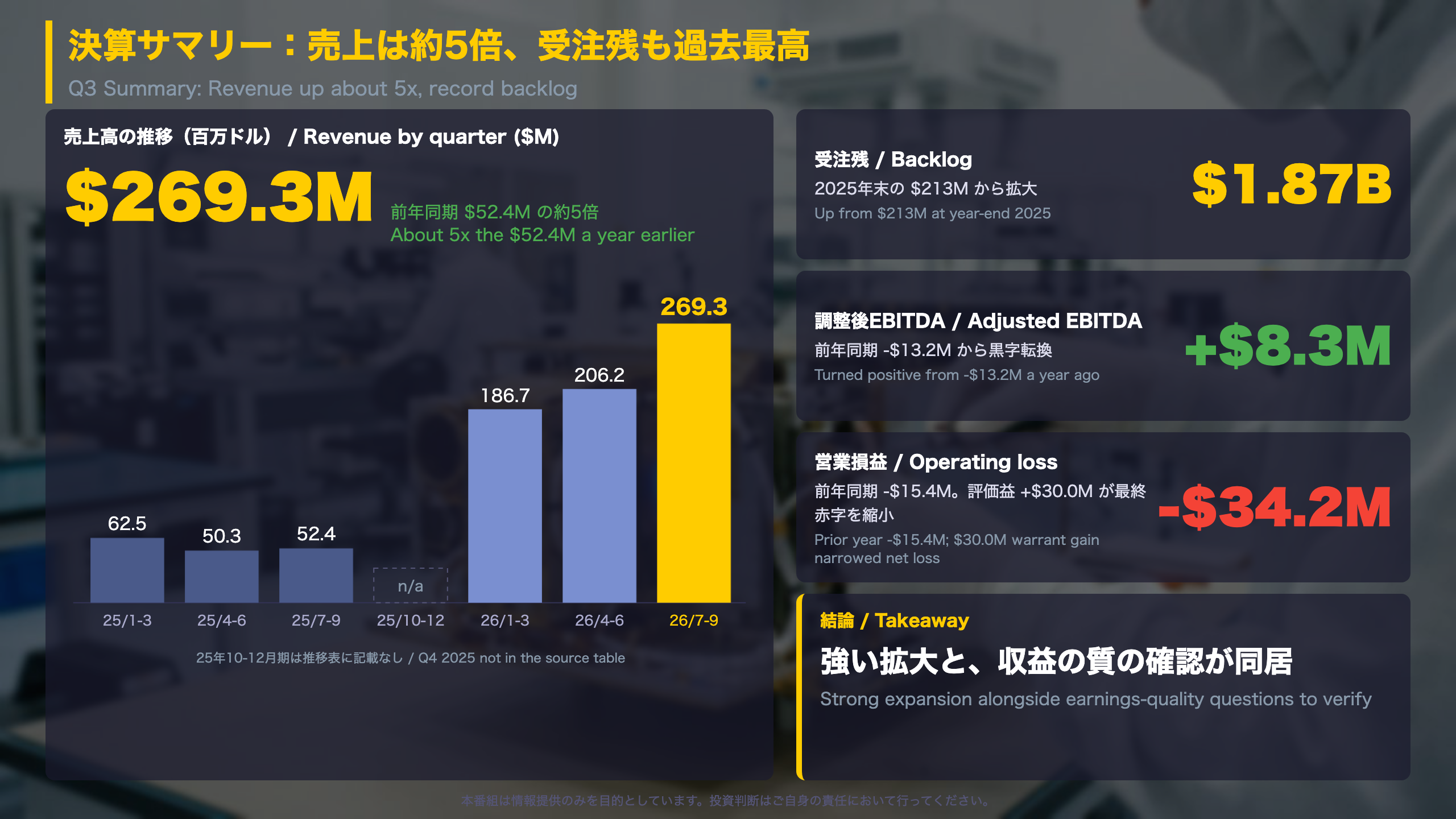
- Revenue: $269.3M versus $52.4M a year earlier, and up about 31% from $206.2M in Q2 2026.
- GAAP net loss: $3.4M versus $10.0M; loss per share $0.02 versus $0.06.
- Operating loss: $34.2M versus $15.4M, so it widened.
- Adjusted EBITDA: +$8.3M versus -$13.2M. This is a non-GAAP measure that strips out items such as acquisition costs and stock compensation, so definitions differ across companies.
Why the net loss looks better than operations
The $30.0M gain on warrant liabilities, a non-cash revaluation of rights to buy shares, narrowed the net loss. Weighted-average shares also rose to 173.4M from 117.8M, about 47% more, which helps per-share figures.
Balance sheet context
Total assets reached $2.24B from $757M at year-end 2025, with goodwill at $407M after acquisitions. Cash fell to $464M from $583M.
How to read it
A company whose revenue rises about fivefold mostly through an acquisition is hard to compare with organic growers. The useful test is whether record backlog of roughly $1.87B converts into revenue at healthy margins. No earnings date for the next quarter is given in the release, and the company’s FY2026 guidance is revenue of $920-950M with positive adjusted EBITDA.
深掘り1:売上の中身は「製品売上」の立ち上がり
Where the revenue came from
Mix
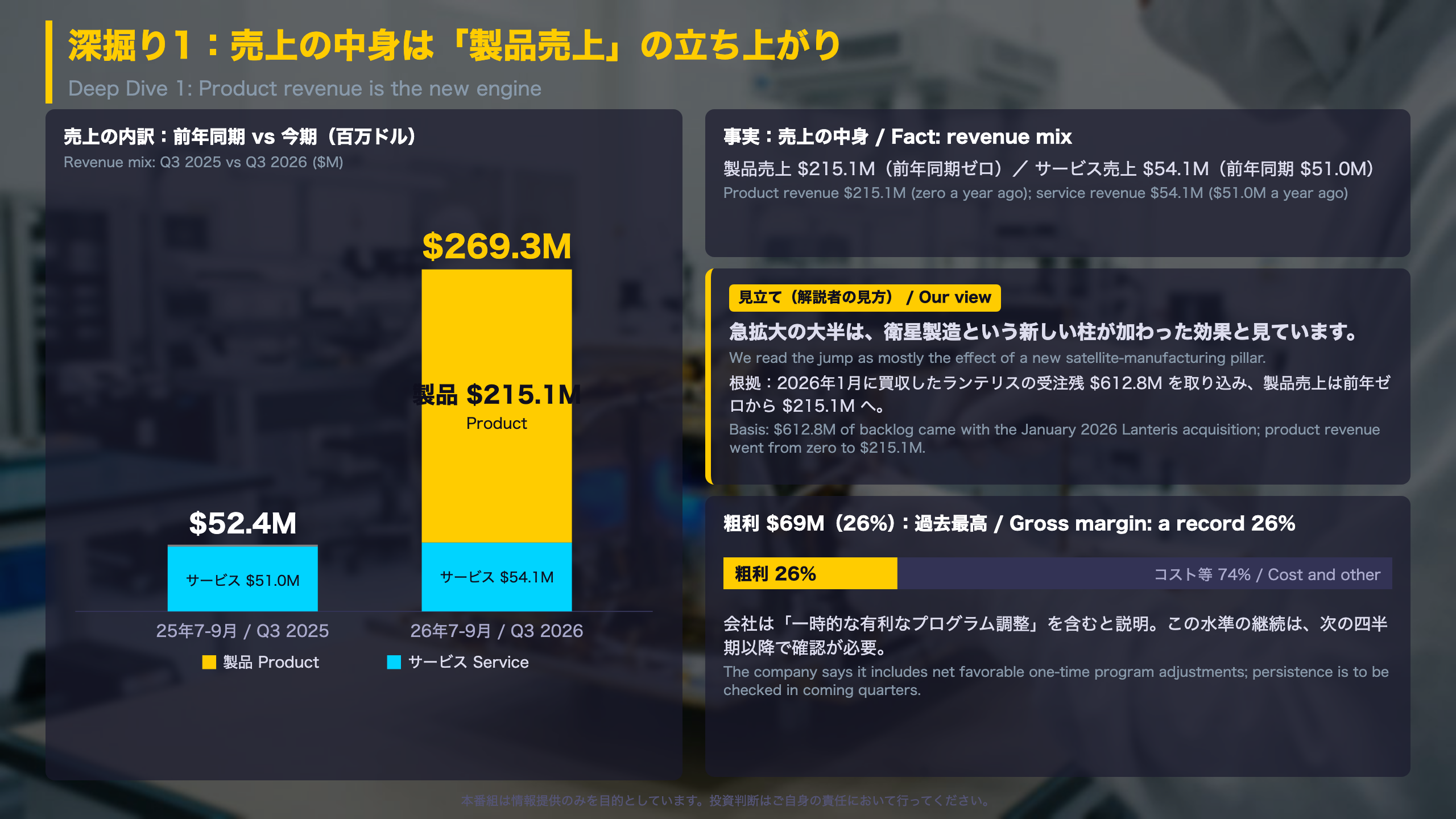
- Product revenue: $215.1M versus zero a year ago; nine-month product revenue is $523.4M.
- Service revenue: $54.1M versus $51.0M, up about 6%.
- Grant revenue: $0.1M versus $1.5M.
Gross margin, computed from the filing
Using revenue less cost of revenue (excluding depreciation and amortization): product gross profit is about $62.5M (29%), service about $6.8M (12.5%), total $69.3M (25.7%). In other words, roughly nine-tenths of gross profit comes from product sales. The company attributes the record margin to satellite production, higher volume and “net favorable one-time program adjustments,” which include estimate-at-completion (EAC) changes on long-term contracts. The size of those adjustments is not disclosed.
Why the acquisition matters
Intuitive Machines closed the Lanteris acquisition in January 2026 and brought in $612.8M of backlog. Goodwill rose to $406.7M and intangible assets to $274.9M, which explains depreciation and amortization of $13.2M against $0.8M a year ago. Product revenue starting from zero in the prior-year quarter is consistent with that deal, although the release does not itemize it.
International and peer context
US space and defense primes often report EAC adjustments, which can swing margins from quarter to quarter. A single quarter with favorable adjustments is not a run rate, so investors typically watch several quarters of margin before drawing conclusions.
Takeaway
The growth is real, but organic growth in legacy businesses cannot be separated from the filing; service revenue grew only about 6%.
深掘り2:黒字転換と、その質の確認点
The profit turnaround and what to verify
What adjusted EBITDA leaves out
The company reconciles a $3.4M net loss to +$8.3M adjusted EBITDA by adding back depreciation and amortization ($13.2M), acquisition and integration costs ($9.6M), a non-recurring legal expense ($10.3M), stock compensation ($10.6M) and net interest, and subtracting non-cash gains on warrant liabilities ($30.0M) and contingent consideration ($3.6M). Because the definition is company-specific, peers may not be comparable.
Cash flow
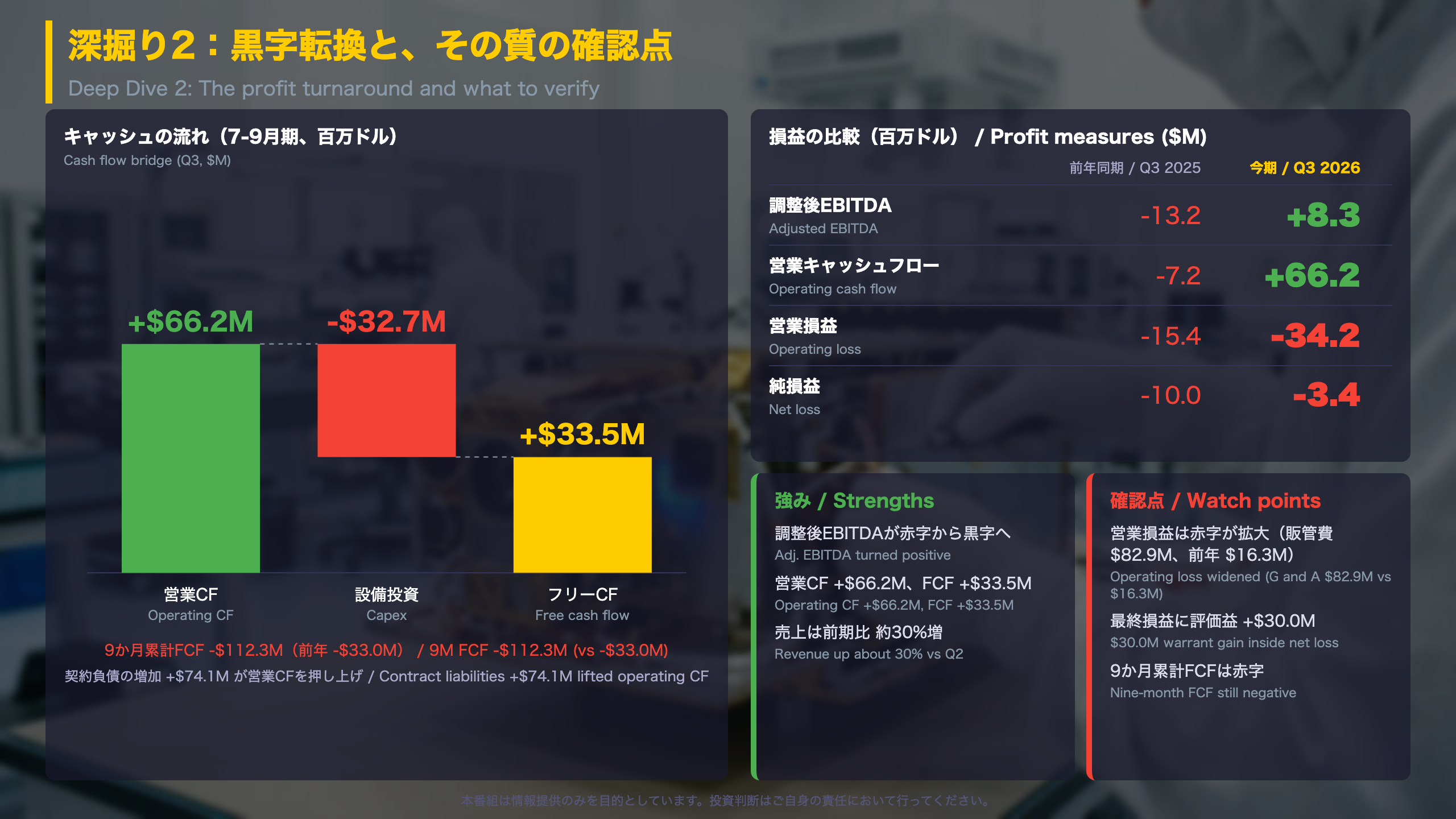
- Operating cash flow was +$66.2M and capital expenditure $32.7M, so free cash flow was about +$33.5M.
- Working capital moved sharply: contract liabilities (customer prepayments) rose $74.1M and other liabilities $98.7M, while contract assets (-$69.0M) and other assets (-$72.9M) absorbed cash.
- Nine-month free cash flow is still -$112.3M versus -$33.0M a year earlier.
Why it matters
For project-based space and defense contractors, milestone billings and advance payments can make one quarter’s cash flow look unusually strong, so a single positive quarter is not a trend. Operating loss widened to $34.2M, with general and administrative expense at $82.9M versus $16.3M, which includes integration activity after the acquisitions.
Funding
The company raised $98.1M from securities issuance in Q3 and ended with $463.8M of cash. The release does not specify a next earnings date. FY2026 guidance calls for positive adjusted EBITDA; nine-month adjusted EBITDA is -$3.0M.
質疑で深める:受注残の中身と通期見通し
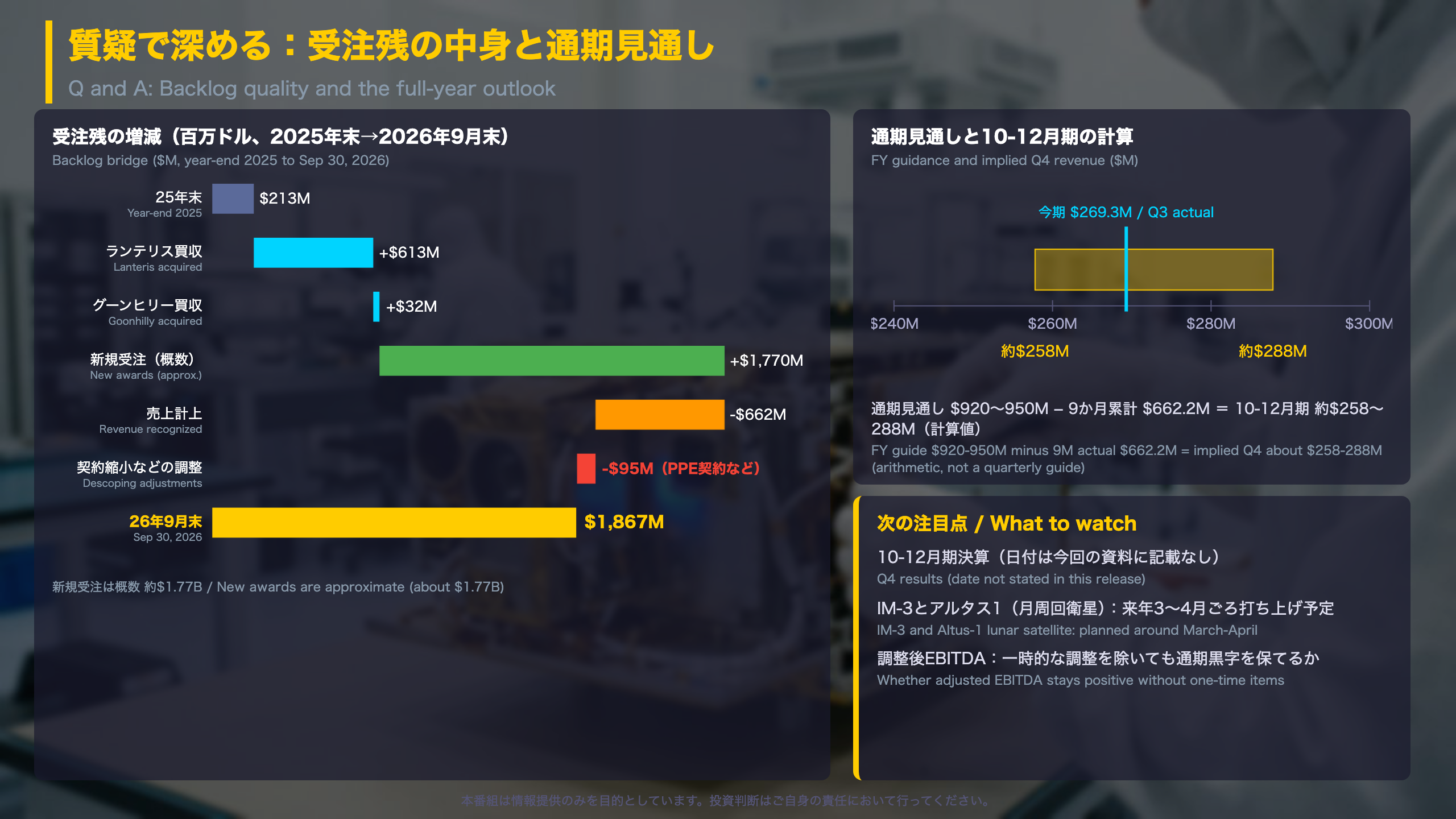
Backlog quality and the full-year arithmetic
What is backlog?
Backlog is the revenue the company expects from signed contracts, minus revenue already recognized. It is a non-GAAP, forward-looking metric defined by the company. At September 30, 2026 it was $1,866.8M versus $213.1M at year-end 2025.
The bridge
- Acquired: $612.8M from Lanteris (January 2026) and $31.7M from Goonhilly (August 2026)
- New awards: about $1.77B, including a three-satellite commercial program, the Space Development Agency tracking layer, AMDT3, JPL’s EAGLE-VSWIR and the Hartford IM-300 platforms
- Burn-down: $662.2M of revenue recognized
- Adjustments: -$94.7M, mainly descoping of the remaining Power Propulsion Element contract and part of an IM-4 rideshare contract
Government context
NASA’s Commercial Lunar Payload Services program buys lunar deliveries from commercial vendors. The company was selected as a vendor under CLPS 2, an IDIQ (indefinite delivery, indefinite quantity) contract with a $10B ceiling plus a $5B option. An IDIQ ceiling is a program-wide figure, and the release does not say how much is booked in backlog.
Guidance arithmetic
FY2026 revenue guidance of $920-950M less nine-month revenue of $662.2M implies roughly $258-288M for Q4, a range that brackets Q3’s $269.3M. This is arithmetic, not company guidance by quarter.
Risks the company lists
Launch delays or failures, customer concentration and reliance on US government funding. Next catalysts: Q4 results (date not given) and the IM-3 mission with the first Altus-1 satellite, planned around March-April.
Disclaimer: This article is for informational purposes only. All investment decisions are made solely at your own risk.