This article was automatically generated by the NFC Market Live AI analysis system. (Updated: 2026-11-10 16:14 JST)
📄 Primary Source
Statistics Norway
https://www.ssb.no/en/priser-og-prisindekser/konsumpriser/statistikk/konsumprisindeksen
📊 Statistics Norway (SSB) released the October 2026 Consumer Price Index on November 10.
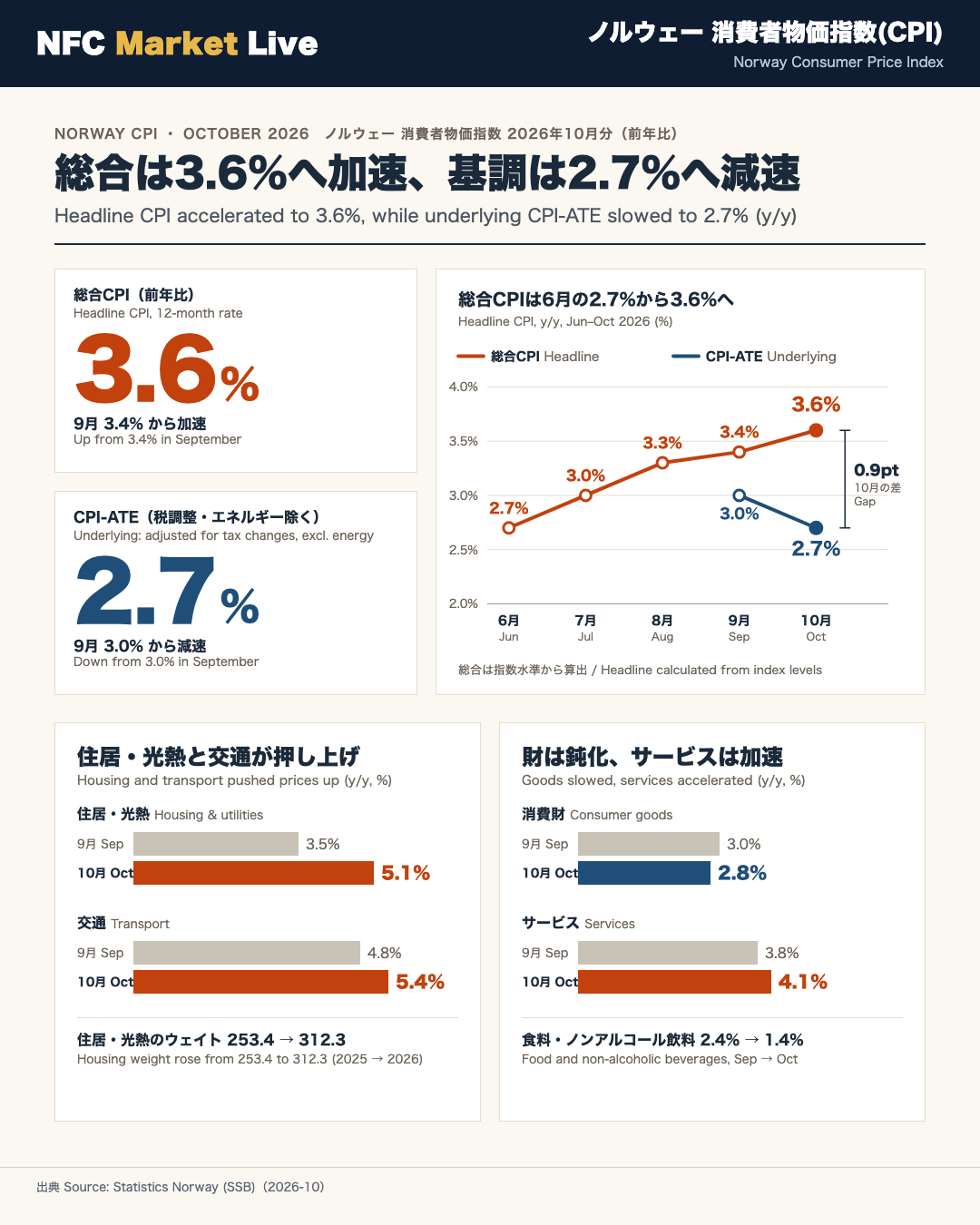
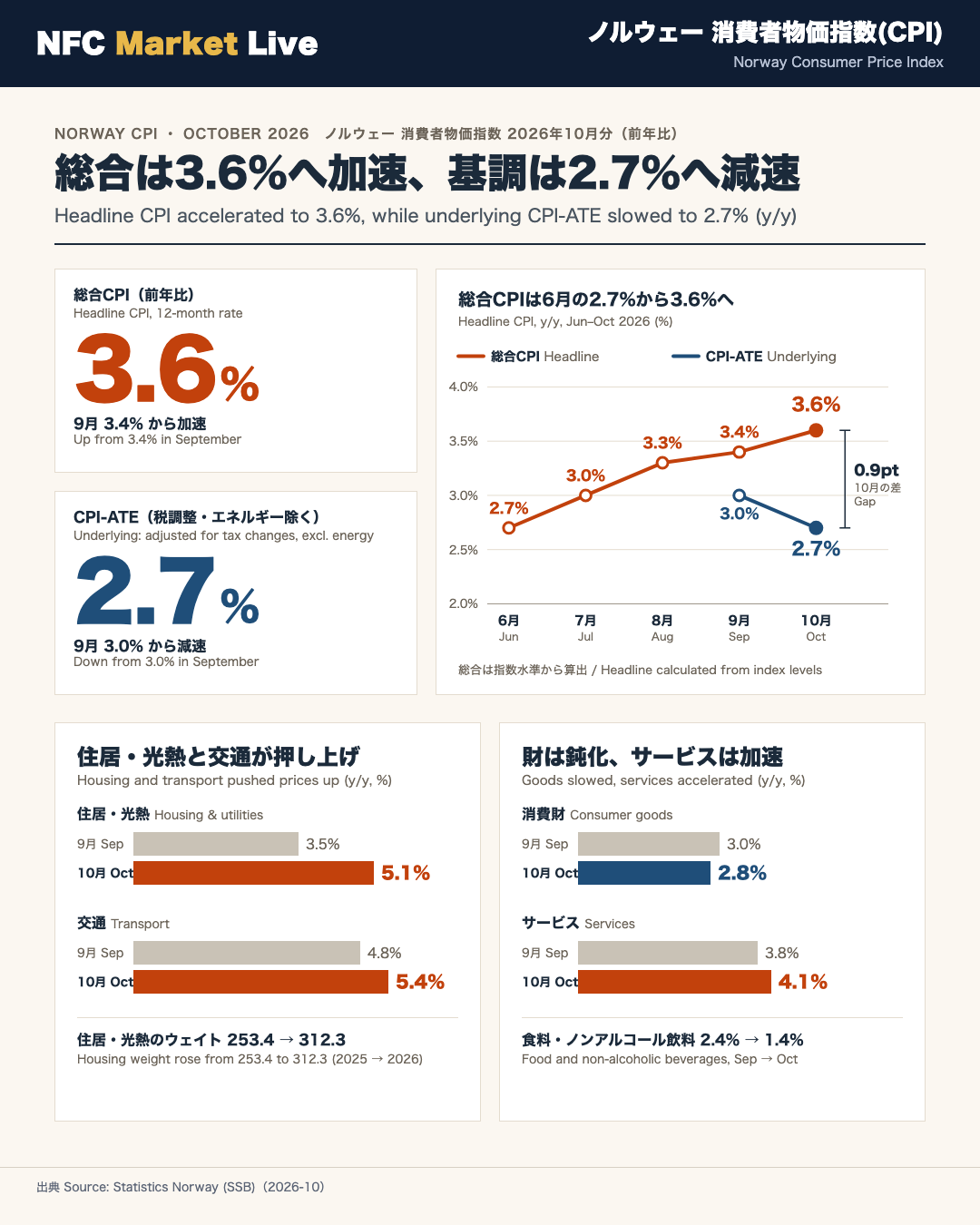
📈 Headline CPI rose 3.6% year on year, up from 3.4% in September, and 0.3% month on month.
📉 The CPI-ATE, adjusted for tax changes and excluding energy products, rose 2.7% year on year, down from 3.0%, and 0.3% on the month.
🏠 Housing, water, electricity, gas and other fuels climbed 5.1% (September: 3.5%), and transport rose 5.4% (4.8%).
🛒 Food and non-alcoholic beverages slowed to 1.4% (2.4%), and clothing and footwear to 0.4% (2.2%).
🔍 By delivery sector, goods prices rose 2.8% (3.0%) while services accelerated to 4.1% (3.8%). The tax-adjusted CPI-AT stood at 5.1%.
📅 November data is due on December 10, 2026.
総括:総合は3.6%へ加速、基調は2.7%へ減速 ― 二つの物価が逆方向に
October CPI: Headline and Core Move in Opposite Directions
Statistics Norway (SSB), the national statistics agency, publishes the Consumer Price Index around the 10th of each month. Alongside the headline CPI, Norway’s central bank, Norges Bank, closely watches the CPI-ATE – the CPI adjusted for tax changes and excluding energy products. It plays a role similar to ‘core CPI’ in the US, but it also strips out the effect of tax changes, which matters in Norway where electricity and excise taxes are frequently adjusted.
The numbers
- Headline CPI: +3.6% YoY (September: +3.4%), +0.3% MoM
- CPI-ATE: +2.7% YoY (September: +3.0%), +0.3% MoM
- CPI-AT (tax-adjusted, incl. energy): +5.1% YoY (September: +5.2%)
Why it matters
In June both measures stood at 2.7%. Four months later they have diverged sharply. The headline acceleration is concentrated in energy-sensitive categories such as housing and utilities, while the core gauge cooled. Note also a base effect: the index barely moved in October 2025 (100.6 to 100.7), making this October’s year-on-year comparison easier to push higher.
Market perspective
For investors, core cooling is generally the measure central banks emphasize, while headline strength can affect household expectations and wage talks. One month is not a trend, so the December 10 release will be key.
押し上げの中心:住居・光熱と交通、そして税調整後CPI-AT
What Pushed the Headline Up: Housing, Utilities and Transport
Two broad categories drove October’s headline acceleration:
– Housing, water, electricity, gas and other fuels: +5.1% YoY, up from +3.5%
– Transport: +5.4% YoY, up from +4.8%, with a +0.9% monthly gain
The weighting story
Norway’s CPI weights are updated every January and held fixed for the year. In 2026 the housing group’s weight jumped to 312.3 from 253.4, mainly because imputed rent for owner-occupiers rose from 138.5 to 206.0. Electricity and fuels, by contrast, fell from 46.8 to 36.9. This means housing-related prices carry far more influence on this year’s headline than last year’s. Note that the EU-style HICP excludes owner-occupied housing, so Norway’s national CPI and its HICP can diverge.
The tax lens
The tax-adjusted CPI-AT rose 5.1%, above the 3.6% headline. Because CPI-AT removes the effect of real tax changes, a higher reading suggests tax measures are currently holding down shelf prices. SSB does not specify which taxes drive this.
Implications
The gap between CPI-AT (5.1%) and CPI-ATE (2.7%) points to energy as a major upward force. Energy prices are volatile, so investors may treat this headline strength as less persistent than core dynamics, while watching whether it feeds into broader prices.
財は鈍化、サービスは加速:食料1.4%と労働集約型サービス4.0%
Goods Cool, Services Firm Up
SSB also classifies prices by delivery sector, a useful lens for separating imported and domestic price pressures.
Goods
Consumer goods inflation slowed to +2.8% from +3.0%, falling 0.1% on the month. Key drivers:
– Food and non-alcoholic beverages: +1.4% (from +2.4%); non-alcoholic beverages fell 2.6% MoM after a 4.0% jump in September
– Clothing and footwear: +0.4% (from +2.2%)
– Information and communication: turned negative at −0.6%
Services
Services inflation rose to +4.1% from +3.8%. However, labour-dominated services – the category most tied to wages – eased slightly to +4.0%, or +4.2% excluding administered prices. Restaurants and accommodation stayed high at +6.1%.
International comparison
The pattern of cooling goods and sticky services mirrors what investors have seen in the US and the euro area in recent years, where services inflation has typically been the last component to normalise.
Two readings
- Constructive: wage-sensitive services are not accelerating, consistent with the softer CPI-ATE.
- Cautious: services remain in the 4% range, well above goods, and could keep core inflation from falling quickly.
With single-month volatility in food and beverages, the December release will help clarify which reading holds.
質疑で深める:基調の減速は本物か、次回12月10日の注目点
Q&A: Is Core Disinflation Real, and What to Watch on December 10
Is the core slowdown genuine?
SSB describes CPI-ATE as a measure of underlying price growth, and it fell to 2.7% from 3.0%. That is encouraging. But the monthly CPI-ATE gain was +0.3%, slightly above September’s +0.2%, so part of the annual decline may reflect comparison with last year’s monthly moves rather than a sharp loss of momentum.
What does it mean for Norges Bank?
Norges Bank, Norway’s central bank, targets inflation of around 2% over time and uses CPI-ATE as a key gauge of underlying inflation. A core reading moving closer to target supports the case that price pressures are easing, while the 3.6% headline and 4%+ services inflation argue for patience. For NOK and Norwegian rates, the market reaction to such mixed data typically depends on whether core softness is confirmed over several months.
Household view
Food inflation is just 1.6%, but housing and utilities (+5.1%), transport (+5.4%) and restaurants (+6.1%) remain elevated, so price pressure feels uneven across budgets.
What to watch
The November CPI is due on December 10, 2026. Key checks: whether CPI-ATE stays below 3%, whether labour-dominated services ease below 4%, and whether housing and utility prices keep climbing. CPI weights will also be reset in January 2027.
Disclaimer: This article is for informational purposes only. All investment decisions are made solely at your own risk.