This article was automatically generated by the NFC Market Live AI analysis system. (Updated: 2026-11-09 20:45 JST)
📄 Primary Source
Banco Central do Brasil
https://www.bcb.gov.br/content/focus/focusmarketreadout/R20261106.pdf
📊 We break down the Central Bank of Brazil’s Focus Market Readout (data as of Nov 6, published Nov 9).
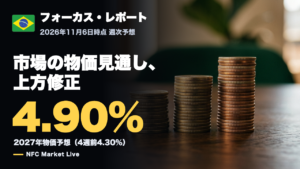
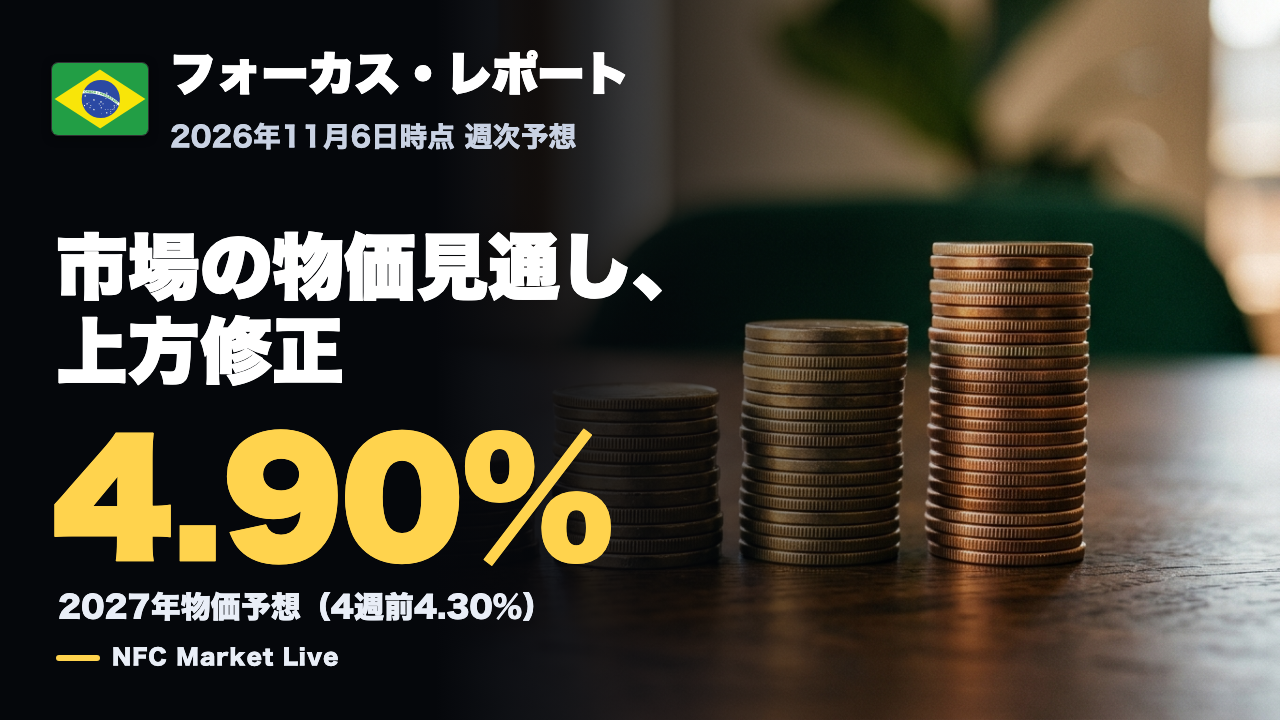
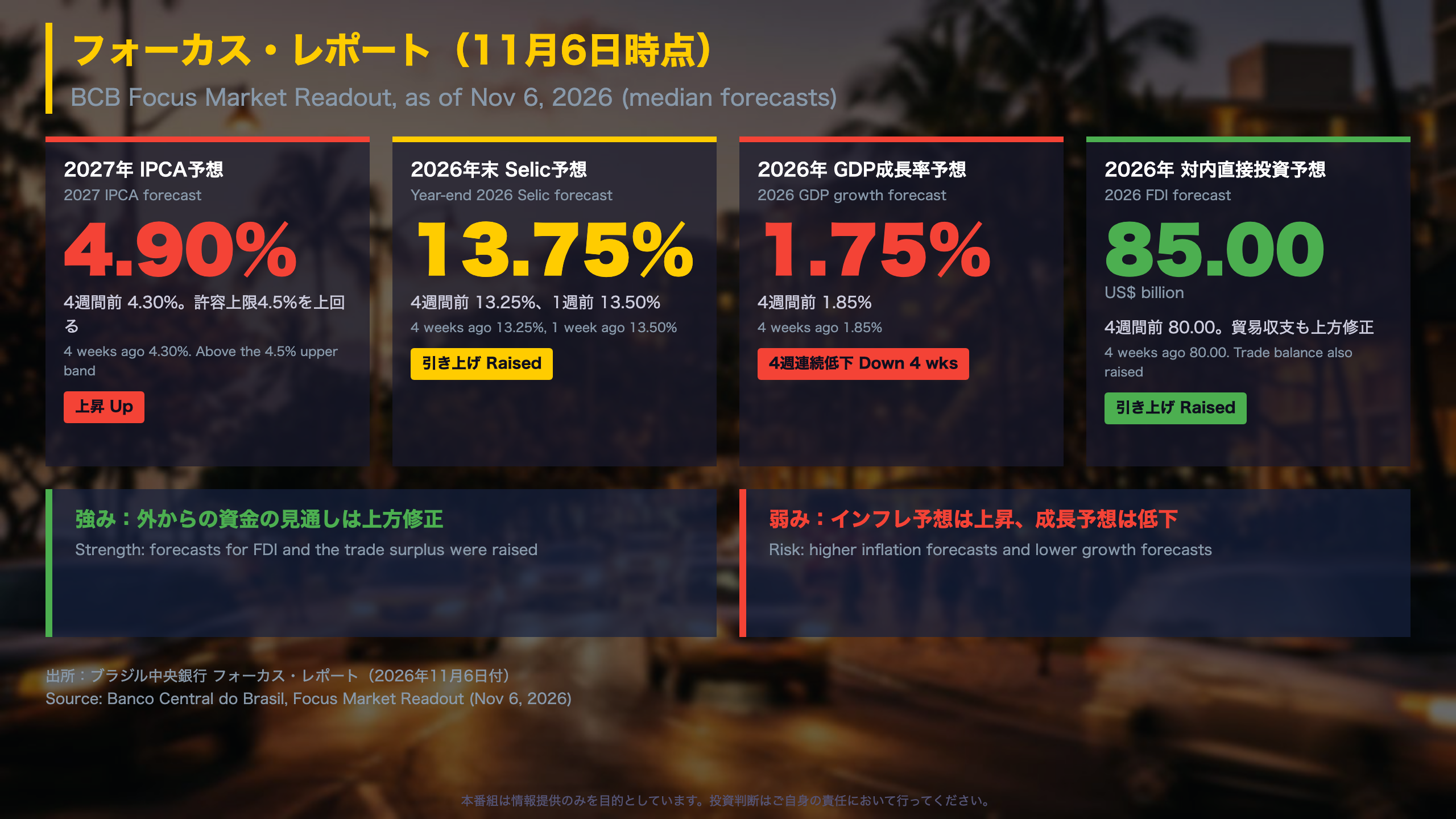
📈 The 2027 IPCA forecast is 4.90%, above the 4.5% upper tolerance band, and the year-end 2026 Selic forecast was raised to 13.75%.
📉 The 2026 GDP growth forecast slipped to 1.75%, while FDI and trade surplus forecasts were raised: a week of mixed signals.
💡 The year-end 2026 FX forecast is R$5.35/US$. We also lay out the rate gap versus Japan for yen-based investors, separating facts from our interpretation.
サマリー:物価・金利予想は上昇、成長予想は低下
Reading This Week’s Focus Report at a Glance
The Focus Market Readout is a weekly compilation of median forecasts from more than 130 Brazilian market participants, published by the Banco Central do Brasil (BCB). Think of it as Brazil’s closest analogue to a consensus survey that the central bank itself monitors when it weighs monetary policy. This edition reflects data as of November 6, released on November 9.
Headline moves vs. four weeks ago
- 2027 IPCA forecast: 4.90% (from 4.30%), above the BCB’s 4.5% upper tolerance band around its 3.0% target.
- Year-end 2026 Selic: 13.75% (from 13.25%).
- 2026 GDP growth: 1.75% (from 1.85%); 2027 slipped to 1.15% (from 1.40%).
- Year-end 2026 FX: R$5.35/US$ (from R$5.15), a weaker real.
The offsetting positives
Forecasts for 2026 foreign direct investment (US$85.00 billion) and the trade surplus (US$80.00 billion) were both nudged higher, and the current account forecast has sat at -US$60.00 billion for 18 straight weeks.
International comparison
Unlike the US Fed, which targets 2% inflation, the BCB aims for 3.0% with a symmetric band; a forecast above 4.5% for 2027 is outside that band. Meanwhile Japan’s policy rate stands near 1%, so Brazil’s rate backdrop is structurally very different.
Why it matters
The report shows inflation expectations drifting higher in the outer years and growth expectations drifting lower. That mix is the central tension of this release, and it is balanced by resilient external-sector forecasts. These are survey medians, not official projections, so treat them as a snapshot of sentiment rather than an outcome.
解説1:インフレ予想と政策金利予想の上方修正
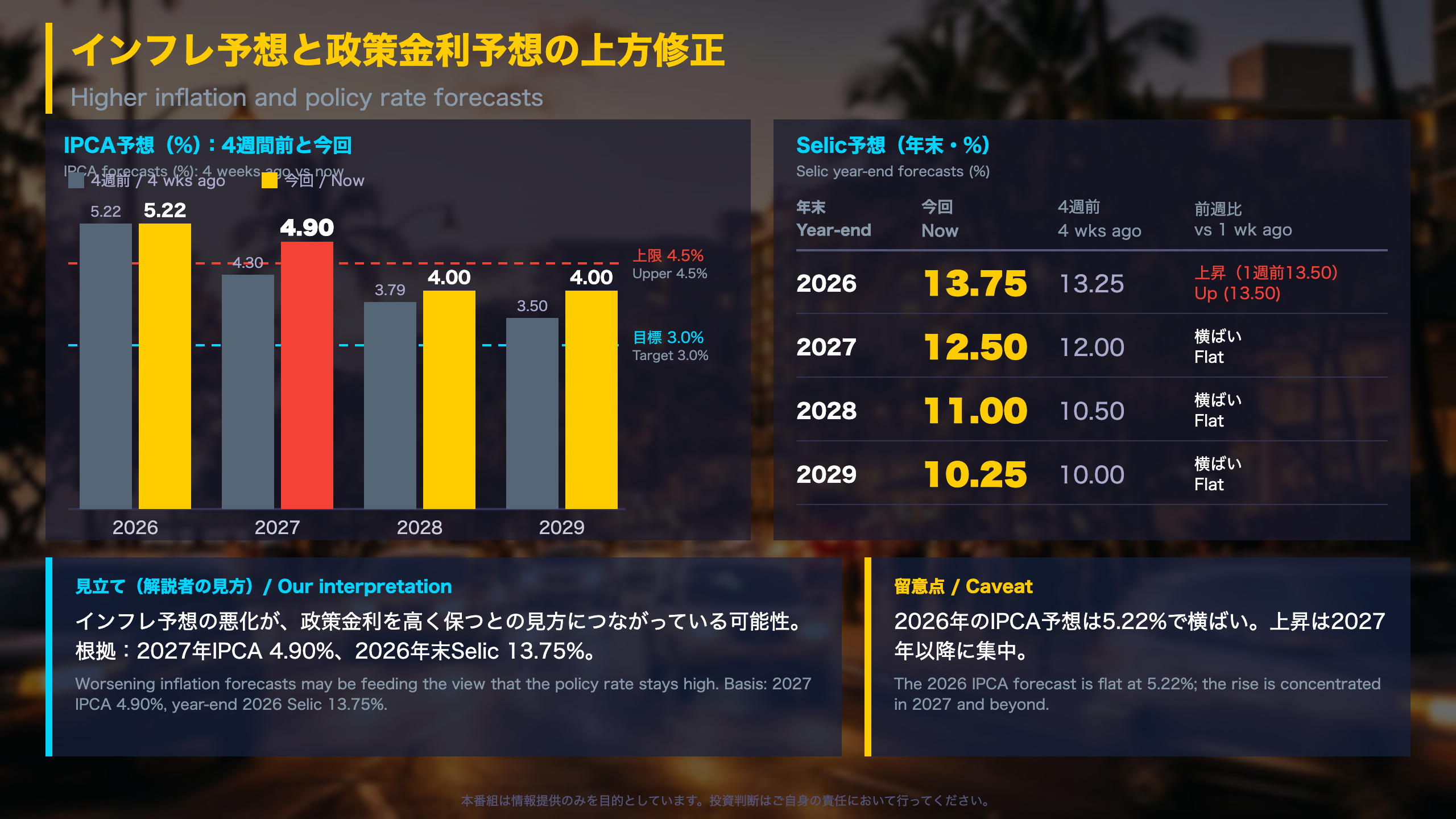
Inflation and Selic Paths in the Focus Report
Brazil’s inflation target is 3.0% with a tolerance band of 1.5% to 4.5%, set by the National Monetary Council. The Focus survey is the gauge the Banco Central do Brasil uses to see how the market views the path of prices and the policy rate (Selic), roughly comparable to the Fed funds rate in its role.
IPCA forecasts (median, %)
| Year | Now | 1 wk ago | 4 wks ago |
|---|---|---|---|
| 2026 | 5.22 | 5.22 | 5.22 |
| 2027 | 4.90 | 4.76 | 4.30 |
| 2028 | 4.00 | 4.00 | 3.79 |
| 2029 | 4.00 | 3.98 | 3.50 |
The smoothed next-12-month figure is 5.01%, versus 4.48% four weeks ago.
Selic year-end forecasts (%)
2026: 13.75 (13.25 four weeks ago); 2027: 12.50 (12.00); 2028: 11.00 (10.50); 2029: 10.25 (10.00).
What stands out
Two weeks ago (Oct 23 edition) the 2026 year-end Selic stood at 13.25% and 2027 at 11.75%. The whole path has since shifted upward. Unlike the US, where long-run inflation expectations are generally anchored near 2%, Brazil’s outer-year forecasts (2027 to 2029) at 4.0% to 4.9% still sit above the 3.0% target.
Balanced reading
The bearish reading is that unanchored expectations could keep policy tight longer. The calmer reading is that the 2026 inflation forecast has been flat for weeks and most Selic points beyond 2026 were unchanged this week. Because these are survey medians, a single week should not be over-interpreted.
解説2:レアル安方向の為替予想と円建て投資の視点
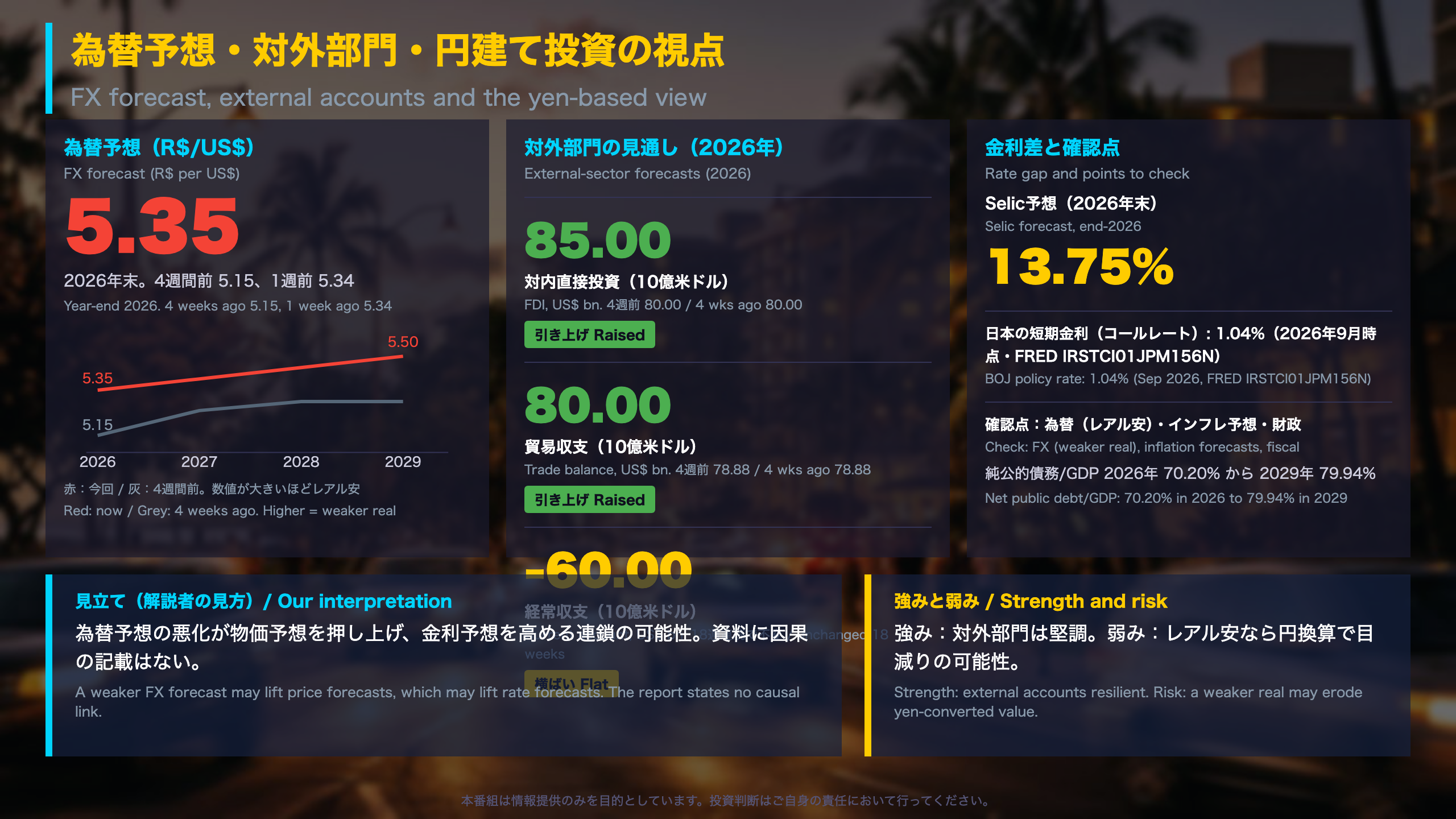
FX, External Accounts and Fiscal Picture
What the Focus survey says about the real
The year-end 2026 exchange rate forecast is R$5.35 per US$, against R$5.15 four weeks ago and R$5.05 two weeks ago (Oct 23 edition). Out-year forecasts also drift weaker: R$5.40 (2027), R$5.45 (2028), R$5.50 (2029). A higher number means a weaker real.
External accounts look resilient
- FDI (2026): US$85.00 billion, up from US$80.00 billion four weeks ago.
- Trade balance (2026): US$80.00 billion (from US$78.88 billion).
- Current account (2026): -US$60.00 billion, unchanged for 18 weeks.
Fiscal watch
Net public debt is forecast at 70.20% of GDP in 2026 and 79.94% by 2029. The 2026 primary result is -0.50% of GDP (from -0.41% four weeks ago), and the nominal result is -8.97%.
Why this matters for a yen-based investor
Japan’s policy rate is shown as 1.04% (Sep 2026, FRED IRSTCI01JPM156N), whereas the Focus year-end 2026 Selic forecast is 13.75%. That is a very large gap and the traditional basis of BRL/JPY carry. The flip side is currency risk: if the real weakens as the FX forecast implies, the yen-converted return can shrink. Compared with the US or Euro area, where policy rates are far closer to Japan’s, Brazil offers higher yield but also higher currency and fiscal sensitivity.
Caveat
The idea that weaker FX feeds inflation expectations and then rate expectations is an interpretation; the report states no causal link. These are survey medians, not outcomes, and this is not investment advice.
質疑:予想の動きをどう読むか
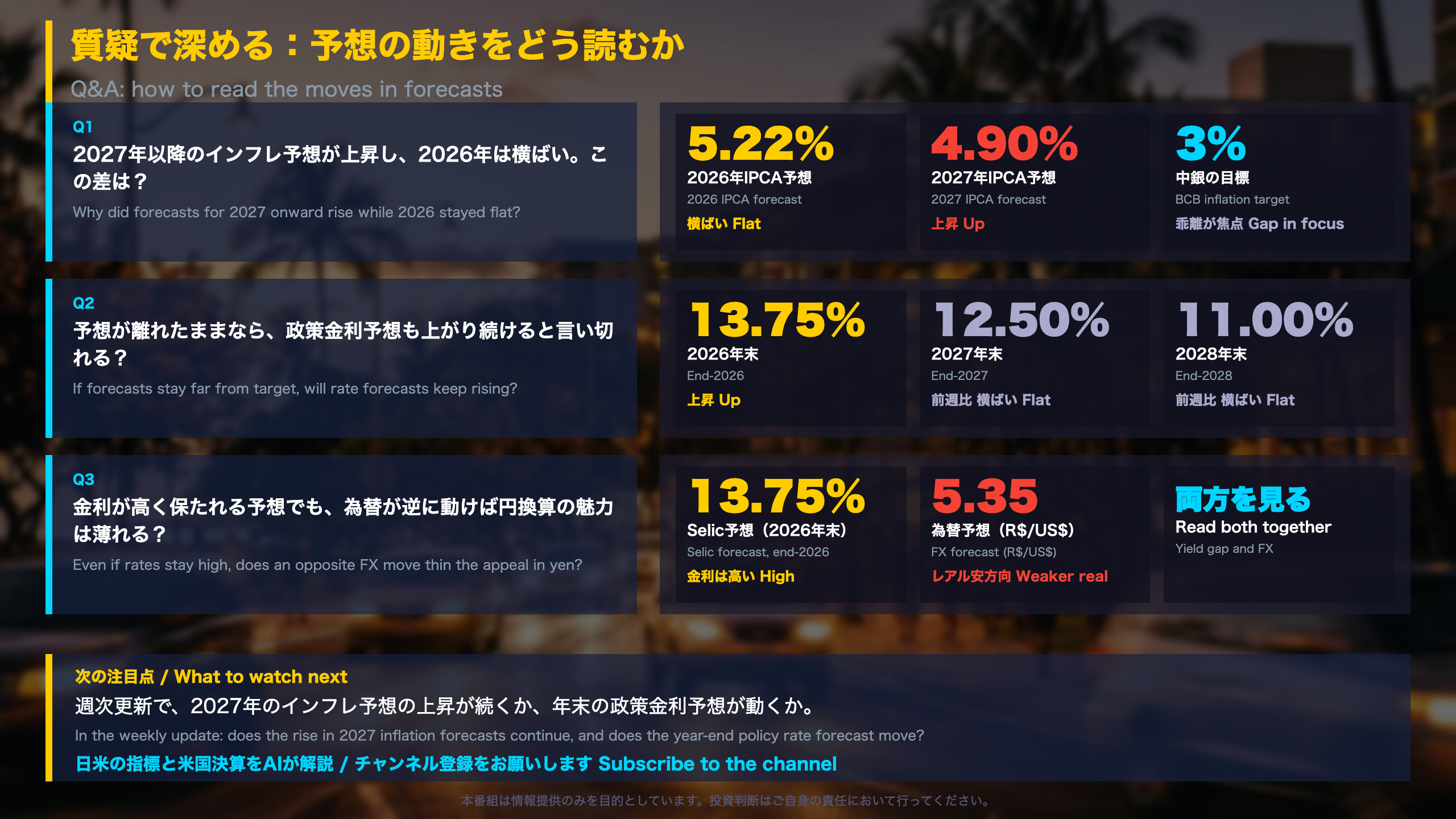
Q&A Add-On: How Broad Is the Move?
Sample size matters
The Resp. columns show how many institutions contributed. For the 2026 Selic forecast, 144 respondents answered in the last 30 days and 102 in the last five business days; for 2026 IPCA, 146 respondents. Participation thins out in outer years (122 for 2029 IPCA, 116 for 2029 Selic), so the farther-out medians carry somewhat less weight.
Many lines did not move this week
- 2027 Selic: 12.50% (unchanged vs. last week)
- 2028 Selic: 11.00% (unchanged)
- 2028 IPCA: 4.00% (unchanged)
- 2027 nominal fiscal result: -8.50%, unchanged for 10 weeks
This is why the weekly change should not be over-read: the headline shift is concentrated in the 2026 year-end Selic (13.75%) and the 2027 IPCA (4.90%).
Context versus two weeks ago
On the Oct 23 edition, year-end 2026 Selic was 13.25% and 2027 was 11.75%. Over a two-week window the repricing is large, which is why a multi-week view is more informative than a single-week change.
Two ways to read it
The cautious reading pairs higher inflation and rate forecasts with weaker 2026-2027 growth (1.75% and 1.15%), a stagflation-like mix. The calmer reading notes that 2026 inflation forecasts are flat, external forecasts improved, and 2028-2029 growth forecasts (1.80% and 2.00%) hold steady.
What to watch
The Focus survey is weekly. Key markers: whether 2027 IPCA stays above the 4.5% band, whether the 13.75% year-end Selic forecast moves, and whether the FX forecast keeps drifting above R$5.35. For a yen-based investor, the yield gap and the currency forecast must be read together. This is analysis of survey data, not investment advice.
Disclaimer: This article is for informational purposes only. All investment decisions are made solely at your own risk.