📺 Watch the Full Video Analysis
This article was automatically generated by the NFC Market Live AI analysis system. (Updated: 2026-10-28 09:14 JST)
📊 A deep dive into Brazil’s central bank (BCB) fiscal statistics for August 2026.
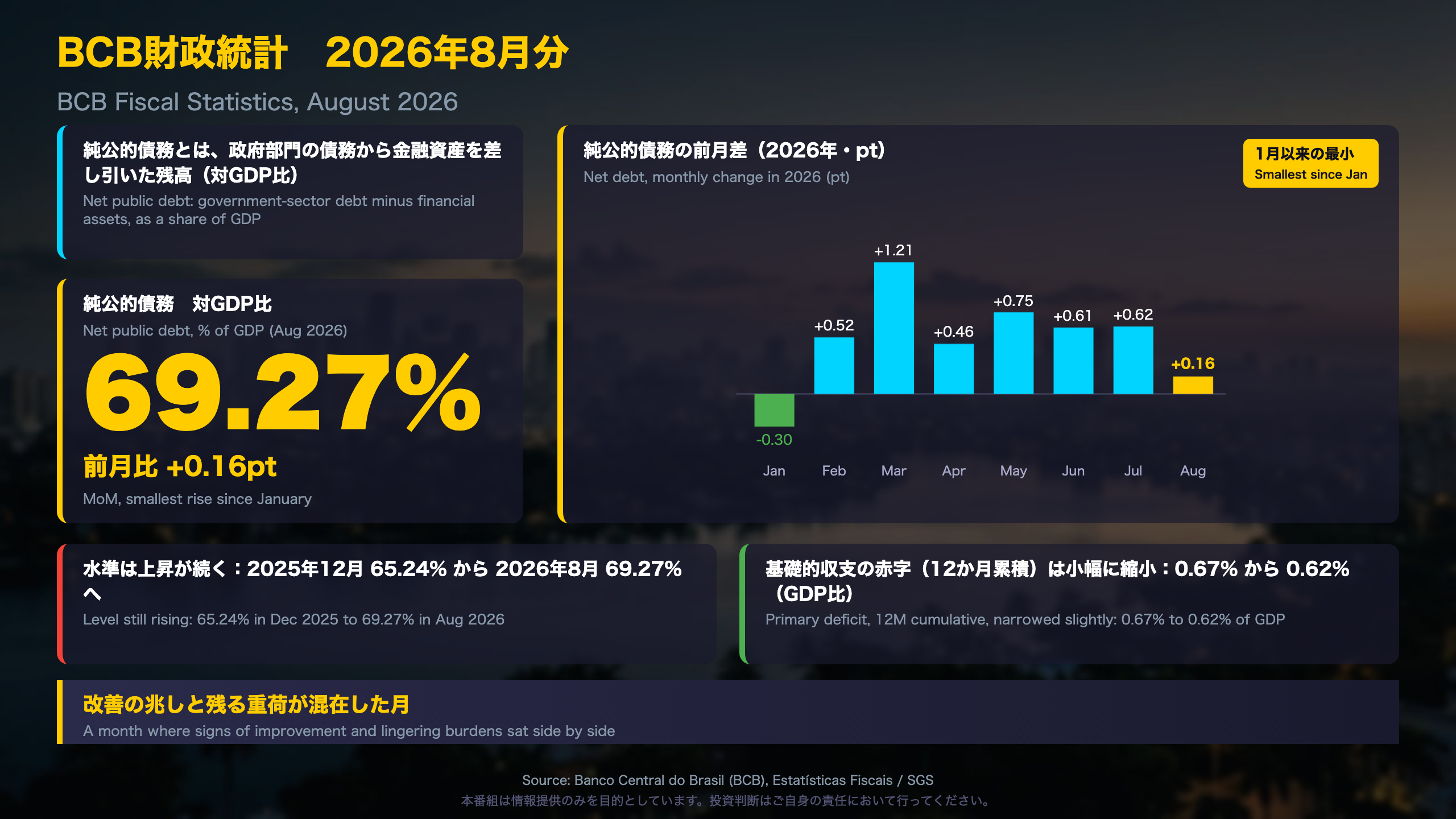
Net public debt reached 69.27% of GDP, up 0.16 points from July, the smallest monthly rise since January. Gross debt stood at 82.87%.
📉 The 12-month primary deficit narrowed slightly to 0.62% of GDP, while the nominal deficit, which includes interest, remained large at 9.48%.
💡 We weigh both the signs of improvement and the burdens that remain. States and municipalities were nearly balanced in August.
⚠️ Next focus: September data and whether the rise in the debt ratio stays small.
サマリー:純公的債務の上昇幅は縮小、水準は上昇が続く
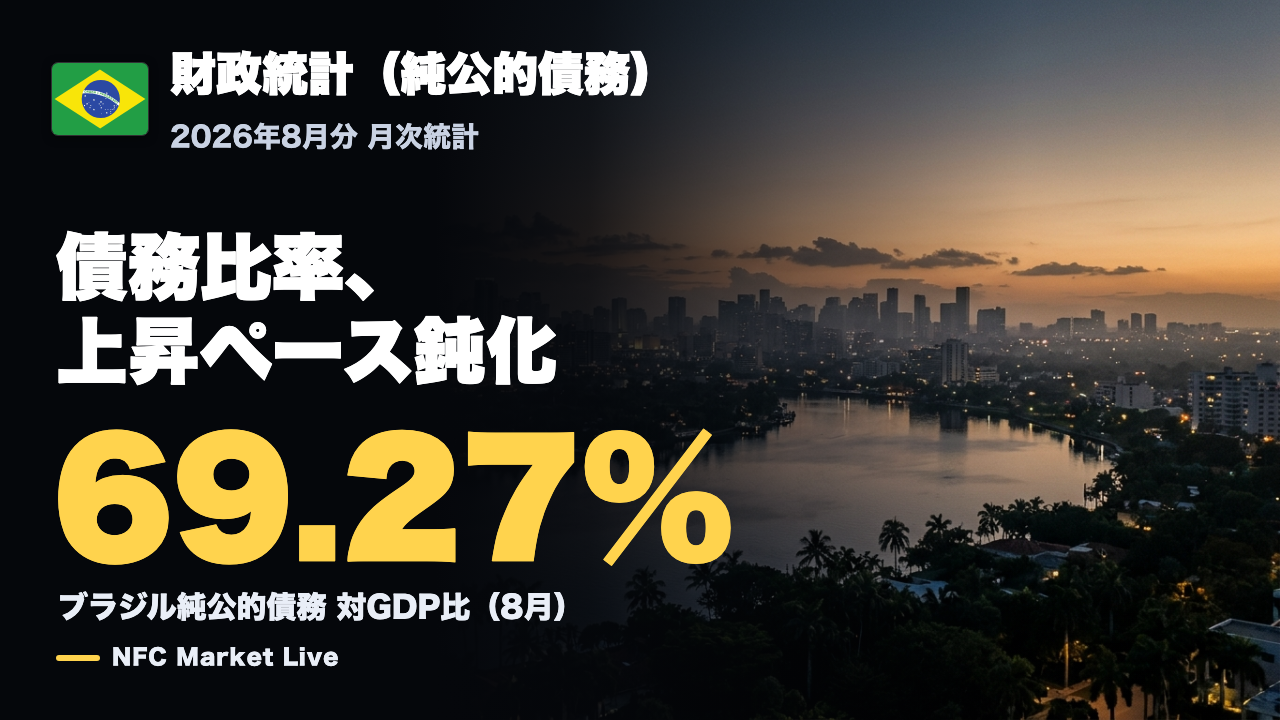
Brazil’s net public debt: 69.27% of GDP in August
What the series measures
The Banco Central do Brasil (BCB) publishes fiscal statistics through its SGS time-series system. The headline series, DLSP (net public sector debt), is the debt of the public sector minus its financial assets, expressed as a share of GDP. Brazil’s official debt discussion typically uses two lenses: this net figure and a gross general-government figure. Japan’s debate leans more on gross debt, so the two countries are not directly comparable without checking definitions.
The numbers
- Net debt/GDP: 69.27% (July revised to 69.11%)
- Up 5.22 points from 64.05% a year earlier and 4.03 points from December 2025
- Stock: R$9.24 trillion, up about R$75.8 billion on the month
Pace versus level
Monthly increases ranged from +0.46 to +1.21 points between February and July. August’s +0.16 is the smallest since January, when the ratio fell by 0.30. That supports a reading that momentum faded, but one month is thin evidence, and the data do not break the change into GDP, exchange-rate or deficit effects.
Why investors watch it
In the framework used for this program, a rising debt ratio can feed through to credit ratings, long-term yields and the real, while visible consolidation can lower the country risk premium. These are channels that may operate, not forecasts. The next release, covering September, will show whether the slower pace holds.
深掘り1:粗公的債務82.87%と純債務との差
Gross public debt at 82.87% of GDP: reading the gross-net gap
Two measures of the same burden
The BCB reports both gross general-government debt (SGS 13762) and net public sector debt (SGS 4513). Gross debt is the total stock of liabilities, while net debt subtracts financial assets such as international reserves and domestic claims. The difference between them is therefore a rough gauge of the asset cushion. That distinction matters when comparing Brazil with advanced economies: US and euro-area discussions typically center on gross general-government debt, whereas Brazilian commentary frequently tracks the net figure as well.
What changed in August
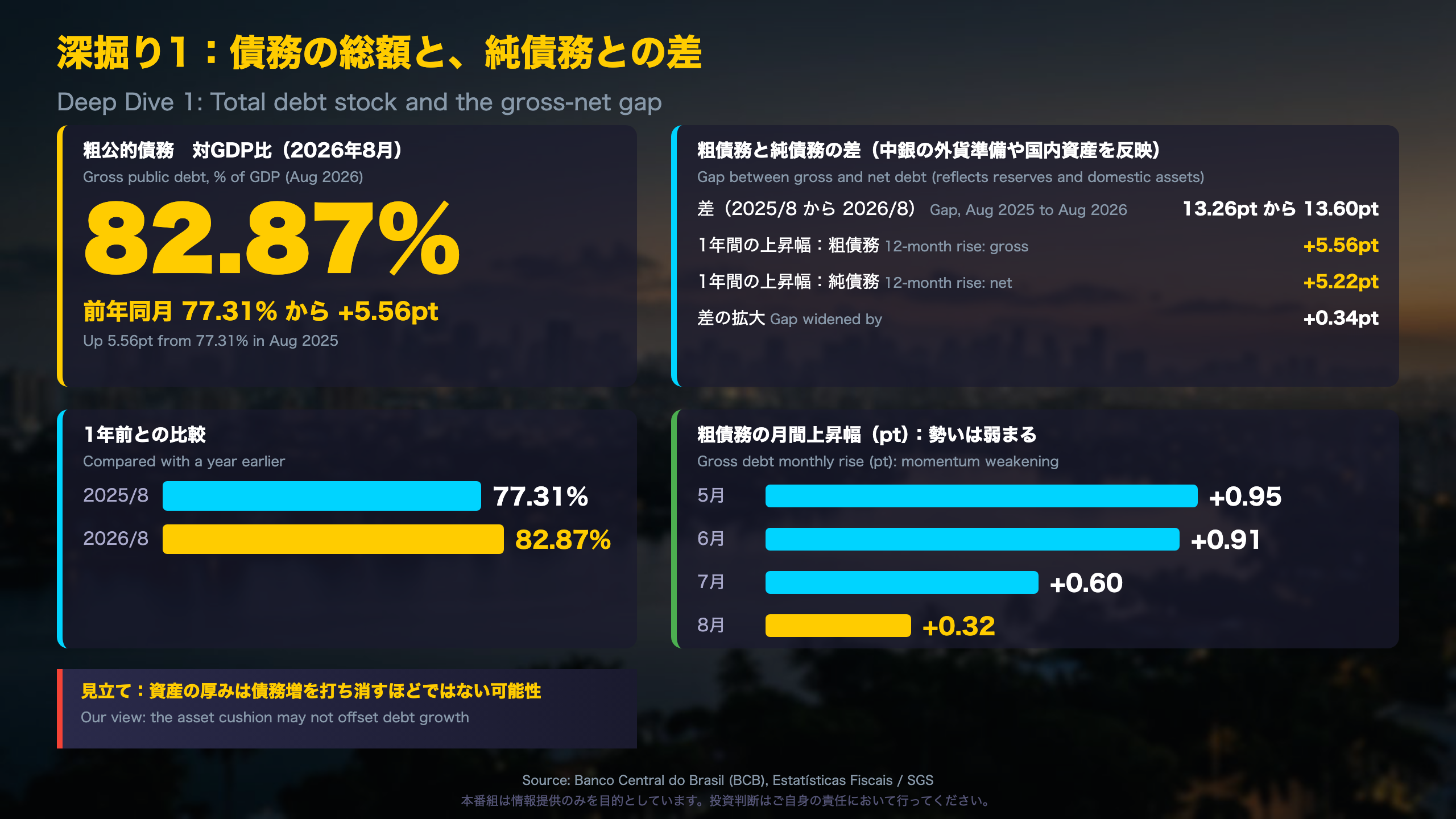
- Gross debt: 82.87%, +0.32 points on the month, +5.56 points on a year earlier
- Gross-net gap: 13.60 points versus 13.26 a year earlier (+0.34)
- Net debt over the same year: +5.22 points
Monthly gross increases were +0.95 in May and +0.91 in June, then +0.60 in July and +0.32 in August.
Two readings
The optimistic reading is that the pace has clearly eased. The cautious reading is that the asset cushion widened by only 0.34 points while net debt rose by more than five. The data do not say which assets drove the gap. Under the channels described in the program’s framework, a persistently high debt ratio may weigh on credit perceptions and the real, though this is a possibility, not a forecast.
深掘り2:基礎的収支の赤字は縮小、名目赤字は大きいまま
Primary deficit narrows, nominal deficit stays near 9.5% of GDP
A note on sign conventions
The BCB’s SGS public-sector financing series follow the net financing requirement convention, in which positive values mean deficits. The data are internally consistent with this: nominal minus primary is positive every month, and debt keeps rising. This is similar in spirit to how the US Treasury or Eurostat separate primary from headline balances, but Brazil’s interest bill is far larger relative to GDP.
12-month picture
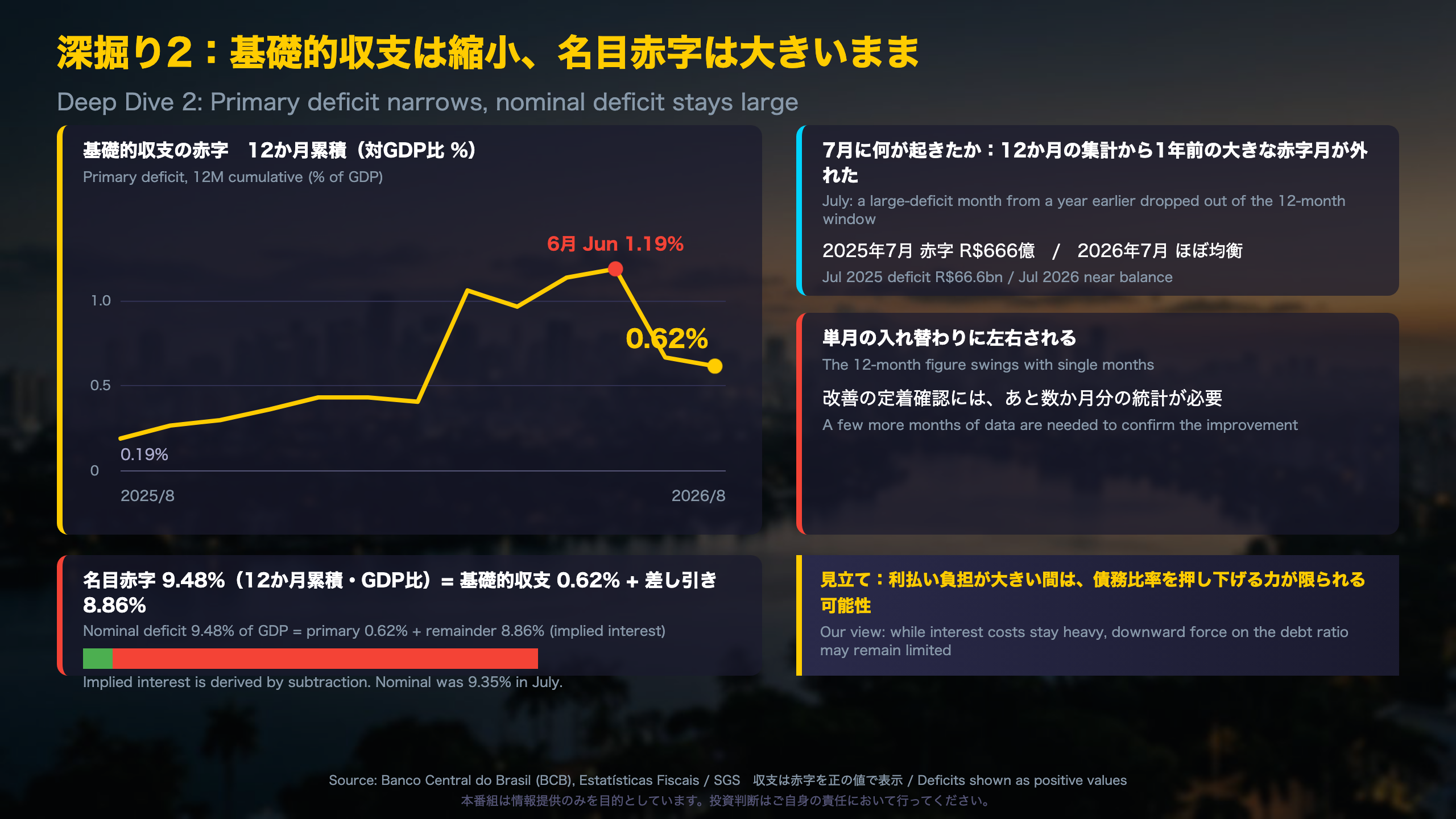
- Primary deficit: 0.62% of GDP (July 0.67%, June peak 1.19%, Aug 2025 0.19%)
- Nominal deficit: 9.48% of GDP (July 9.35%, June 9.99%, Aug 2025 7.79%)
The March jump from 0.41% to 1.06% reflects a R$80.7 billion deficit month. July’s drop reflects base effects: a R$66.6 billion deficit month from 2025 left the window and July 2026 was roughly balanced.
Interest, by subtraction
The release shows no separate interest line. Subtracting primary from nominal gives roughly R$106 billion in August 2026 versus R$74 billion a year earlier, and 8.86% of GDP over twelve months versus 7.60% a year ago. That is a derived figure, not a reported one.
Reading both sides
The primary deficit is trending better and August’s monthly deficit was smaller than a year ago. But the nominal gap is more than ten times larger, so improvement in the primary balance alone may have limited power over the debt ratio. A few more months are needed to separate trend from base effects.
質疑で深める:改善と言えるか、利払い、部門別の収支
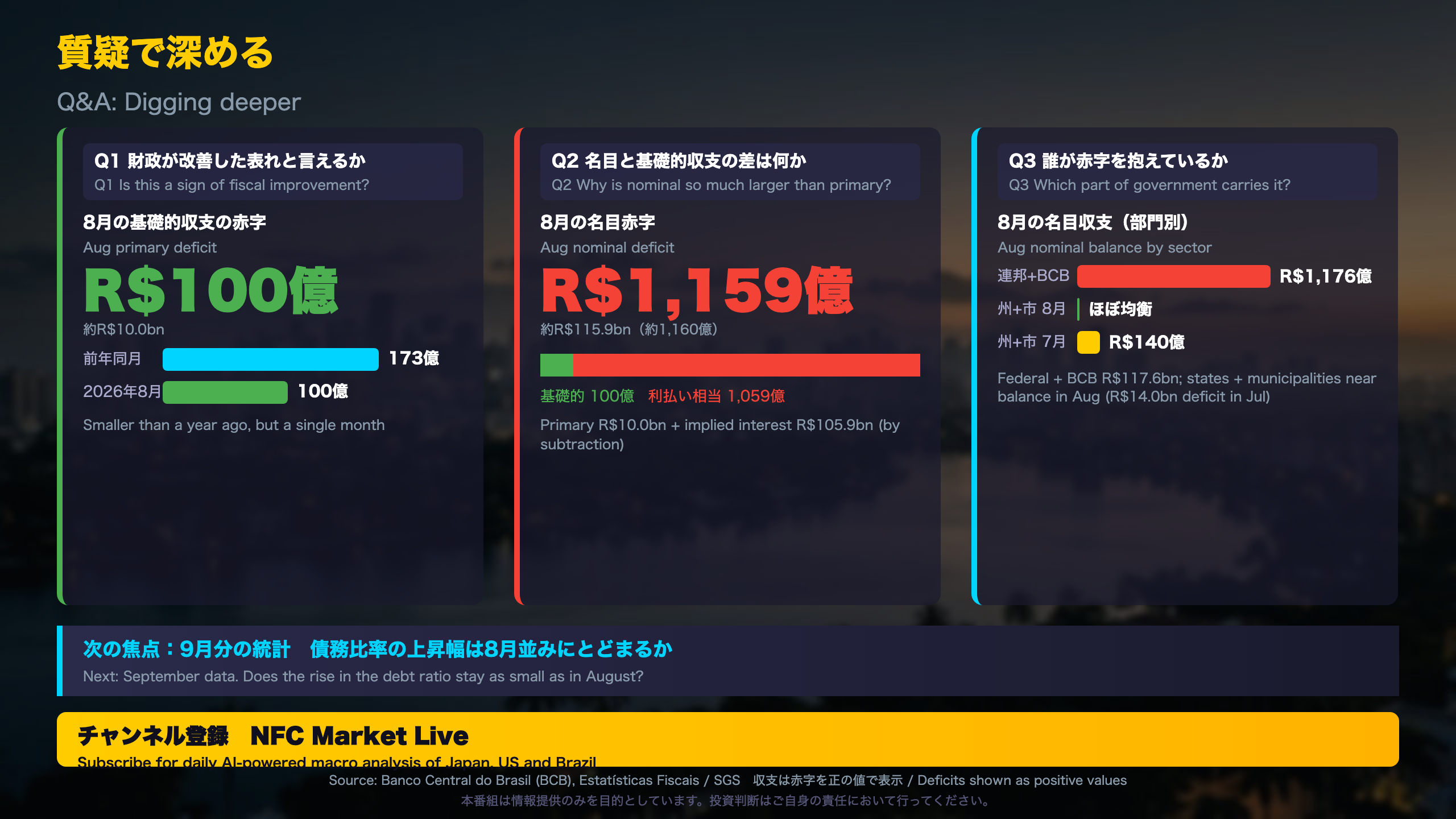
Q&A add-on: who carries the nominal deficit?
Sector split (R$ million, positive = deficit)
| Month | Federal + BCB | States + municipalities | Total nominal |
|---|---|---|---|
| Aug 2025 | 80,726 | 10,359 | 91,516 |
| Jun 2026 | 147,688 | 16,205 | 165,966 |
| Jul 2026 | 81,842 | 14,042 | 97,602 |
| Aug 2026 | 117,568 | -124 | 115,946 |
For English-speaking readers: the BCB’s ‘federal government plus central bank’ line is broader than the US Treasury’s budget balance because it includes the central bank, while the ‘states and municipalities’ line is comparable to US state and local government finances. Subnational deficits matter in Brazil because they can offset progress at the federal level.
What the table says
States and municipalities moved from a R$14.0 billion deficit in July to near balance in August. The federal-plus-BCB deficit rose by about R$35.7 billion from July and by R$36.8 billion year on year. The two lines sum to R$117.4 billion versus a reported total of R$115.9 billion; the release does not itemize the R$1.5 billion difference.
Independent reading
The August primary deficit (R$10.0 billion versus R$17.3 billion a year earlier) is encouraging, yet the nominal deficit is larger than a year ago, which by subtraction points to a higher interest component. Single-month sector data are noisy, so the next release matters more than any one print. In the channels sketched in this program’s framework, persistent deficits may add pressure on bond supply and the real, but that remains a possibility and not a forecast.
Disclaimer: This article is for informational purposes only. All investment decisions are made solely at your own risk.