📺 Watch the Full Video Analysis
This article was automatically generated by the NFC Market Live AI analysis system. (Updated: 2026-10-21 15:12 JST)
📄 Primary Source
Office for National Statistics
https://www.ons.gov.uk/economy/inflationandpriceindices/bulletins/producerpriceinflation/september2026includingservicesjulytoseptember2026
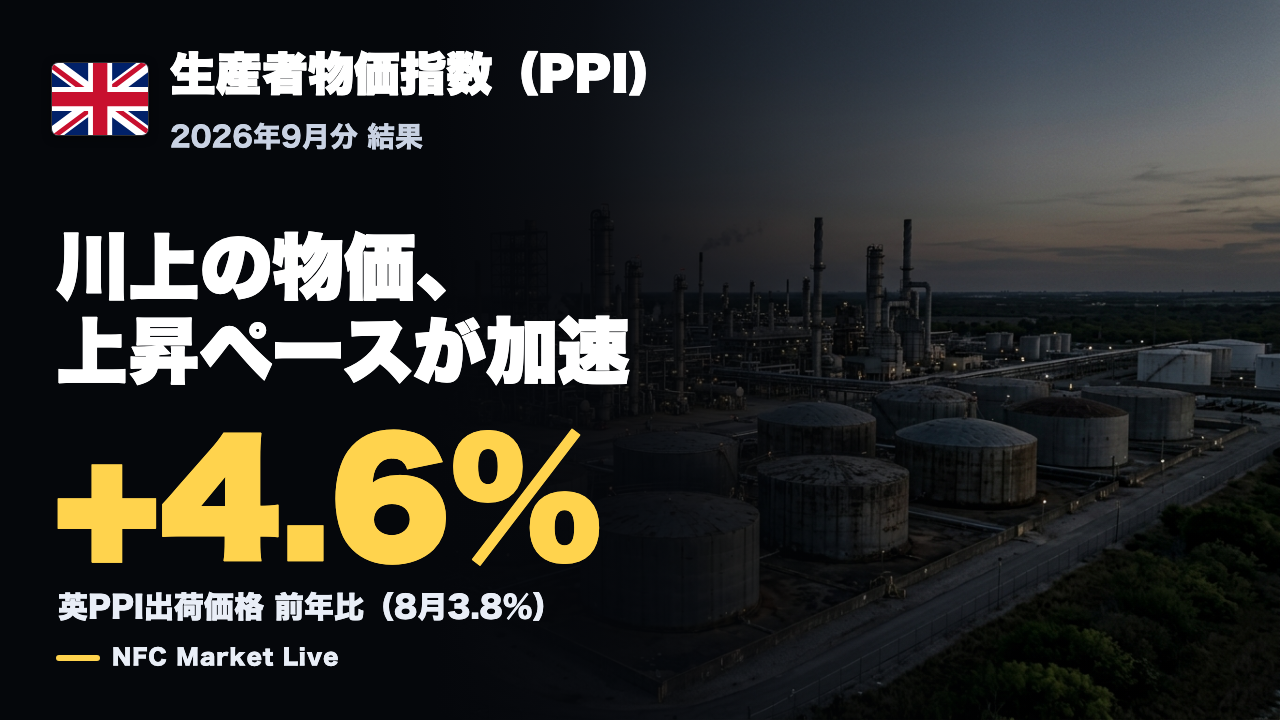
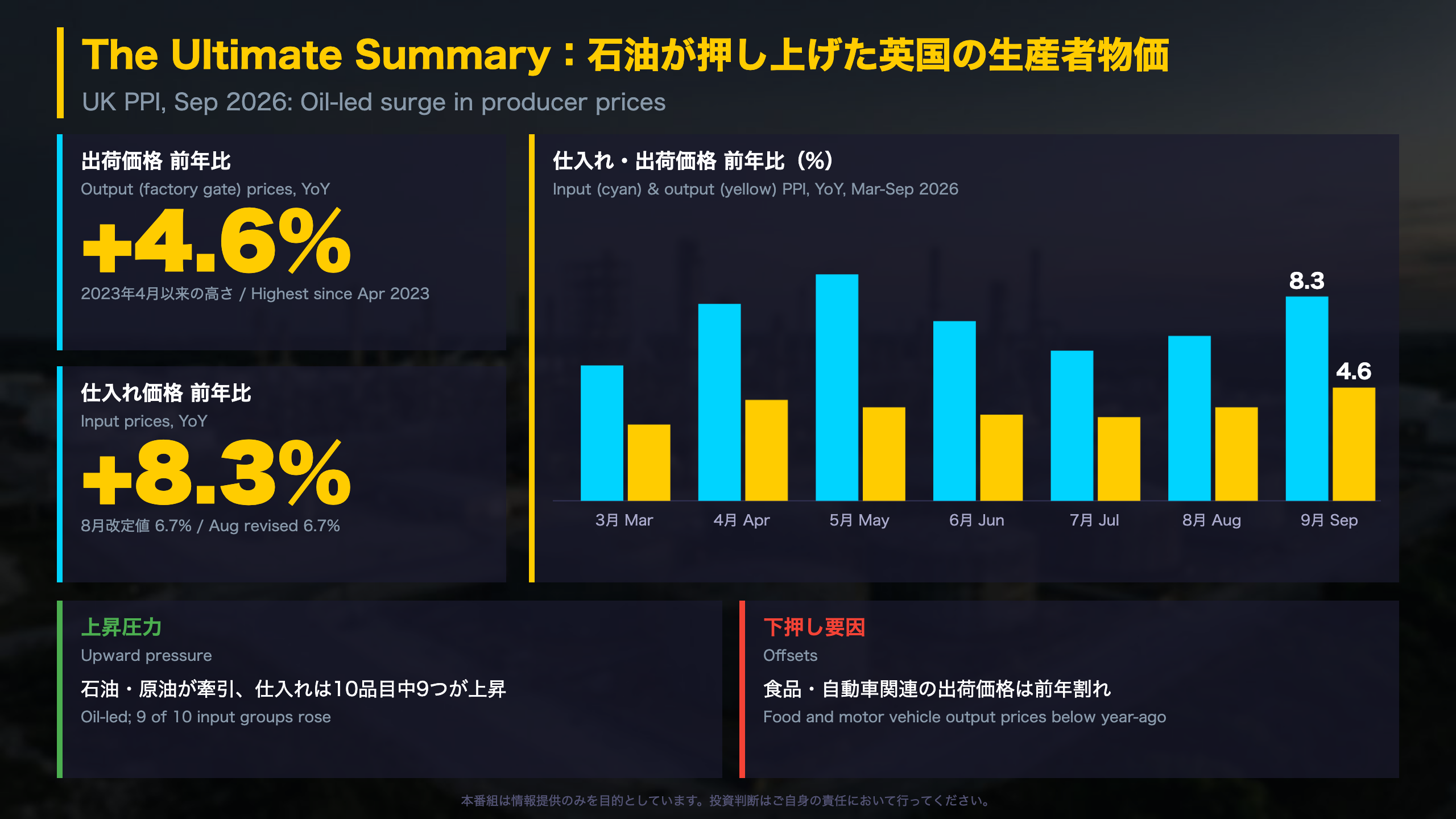
📊 The ONS reported on Oct 21 that UK factory gate prices rose 4.6% year on year in September, the highest since April 2023.
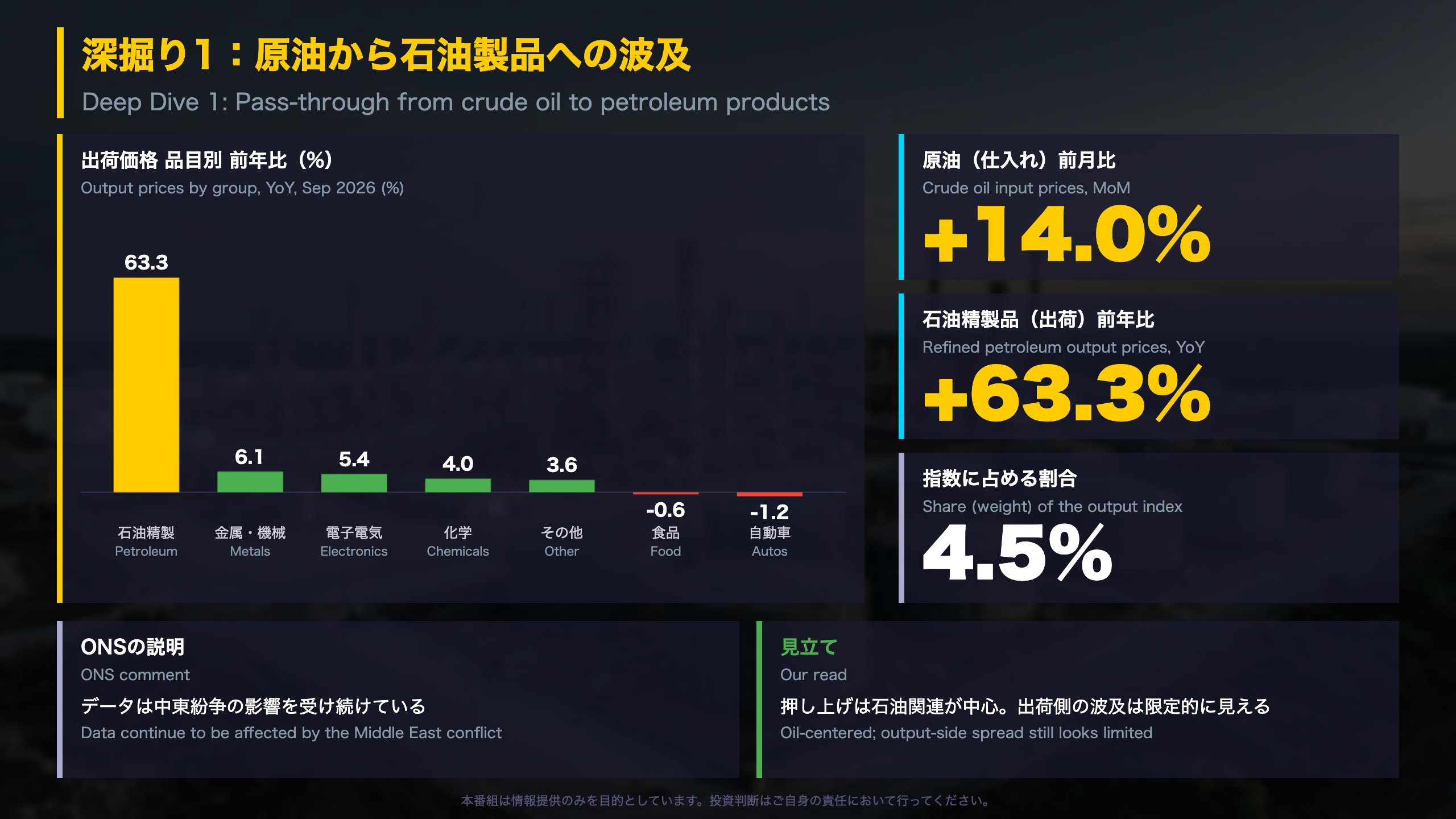
📈 Input prices climbed 8.3%. Crude oil rose 14.0% on the month and refined petroleum output prices rose 63.3% on the year, with the ONS pointing to the Middle East conflict.
💡 Nine of ten input groups rose, and services prices are up 4.5% annually, but the quarterly services rate slowed to 0.9%.
⚠️ Oil and energy data are revised after one to two months. Next release: Nov 18 (October data).
The Ultimate Summary:石油が押し上げた英国の生産者物価
UK PPI: Oil Pushes Factory Gate Inflation to the Highest Since April 2023
What is the PPI? Published by the Office for National Statistics (ONS), the Producer Price Index measures what UK manufacturers pay for materials and fuel (input prices) and what they charge for finished goods (output or factory gate prices). It sits earlier in the supply chain than the Consumer Prices Index (CPI), the measure the Bank of England (BoE) targets at 2%.
The September snapshot
- Output prices: +4.6% year on year, up from a revised 3.8% in August.
- Input prices: +8.3%, up from a revised 6.7%, after peaking at 9.2% in May.
- Monthly moves: input +1.5%, output +0.8%.
- Services (Q3): +4.5% year on year, the highest since Q2 2023.
Why it matters
The ONS says the increases were “mainly caused by oil-related products” and that the data continue to be affected by the conflict in the Middle East. Unlike the US PPI, which covers goods and services together every month, the UK goods PPI and the services index (SPPI) are published separately, and services only quarterly.
Balanced reading
- Upward pressure: nine of ten input groups rose, so the increase reaches beyond energy to metals and chemicals.
- Offsets: food (-0.6%) and motor vehicle (-1.2%) output prices remain below year-ago levels.
What to watch
The October PPI arrives on November 18. The September CPI was published on the same day as this bulletin, giving a direct read-across from producer to consumer prices.
深掘り1:原油から石油製品への波及
From Crude to Pump: How Oil Drove the September PPI
Context. The ONS builds its oil series from the four UK crude refiners, using purchase volumes and values from roughly the first week of the month plus the refiners’ own estimates for the remainder. The mix of spot and futures prices makes first estimates prone to revision, which the ONS says arrives after one to two months.
Input side
- Crude petroleum, natural gas and metal ores (6.9% weight): +14.0% month on month, +51.0% year on year, versus a revised +29.9% in August.
- Import Price Index: +9.9% year on year, driven by non-EU crude petroleum imports.
- Sterling effective exchange rate: -0.6% on the month, which may have added slightly to sterling-denominated import costs.
Output side
| Group | YoY | MoM |
|---|---|---|
| Coke & refined petroleum (4.5% weight) | 63.3% | 9.1% |
| Basic metals & machinery | 6.1% | 0.1% |
| Electronics | 5.4% | 0.4% |
| Food | -0.6% | 0.2% |
| Motor vehicles | -1.2% | 0.4% |
Interpretation
A group with only a 4.5% weight provides the largest contribution because its annual rate is extreme. Outside petroleum, output inflation is moderate, which argues for limited pass-through into manufactured goods so far. The counter-view is that input costs for metals and chemicals keep rising, and the bulletin offers no outlook on pass-through. Compared with the US, where producer price indices also swing with energy, the UK series is unusually exposed to a handful of refiners’ reported data, so revision risk deserves attention.
深掘り2:サービス価格は高水準、勢いは鈍化
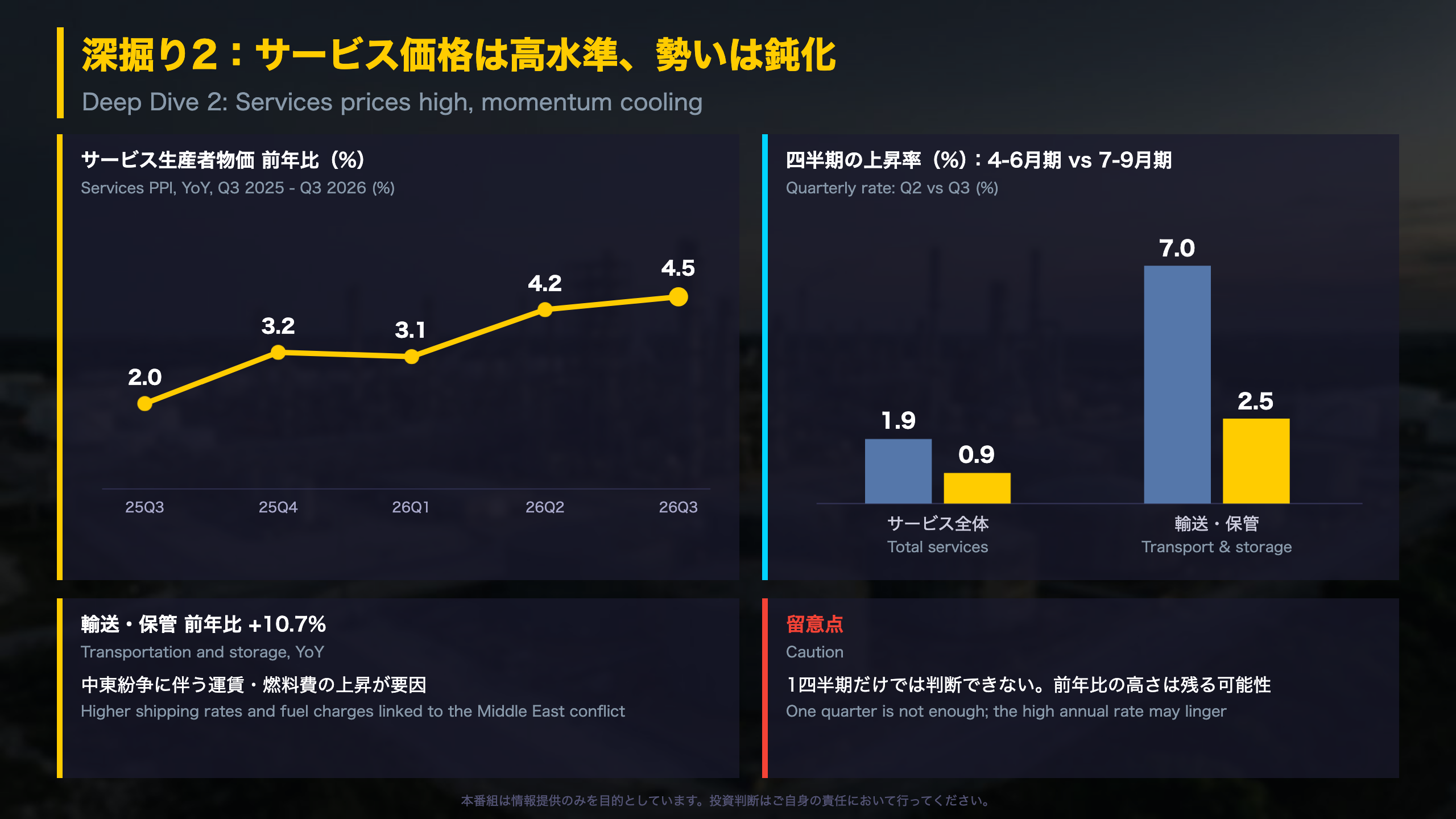
UK Services Producer Prices: High Annual Rate, Fading Quarterly Momentum
Background. The Services Producer Price Index (SPPI) is the ONS’s quarterly gauge of what UK service providers charge their customers. Because the weight of services in the UK economy is large, it complements the goods-focused PPI. The US publishes its services producer prices monthly, so the UK quarterly cadence means signals arrive with a lag.
The trend
| Quarter | YoY | QoQ |
|---|---|---|
| Q3 2025 | 2.0% | 0.6% |
| Q4 2025 | 3.2% | 1.1% |
| Q1 2026 | 3.1% | 0.6% |
| Q2 2026 | 4.2% | 1.9% |
| Q3 2026 | 4.5% | 0.9% |
Sub-indices
- Transportation and storage (14.0% weight): +10.7% YoY, versus 8.7% in Q2. Quarterly growth cooled to 2.5% from a revised 7.0%.
- Professional, scientific and technical (26.2% weight): +5.7% YoY.
- Information and communication: only +1.3%, so the pressure is not uniform.
- All nine service groups rose year on year.
Balanced reading
The annual rate is the highest since Q2 2023, and the ONS ties the transport surge to shipping rates and fuel charges from the Middle East conflict. Yet the quarterly rate roughly halved, suggesting the pace of increase is easing even as the year-on-year level stays high. A single quarter cannot confirm a trend, so the next SPPI release is the checkpoint.
質疑:波及の広がり、転嫁、改定の注意点
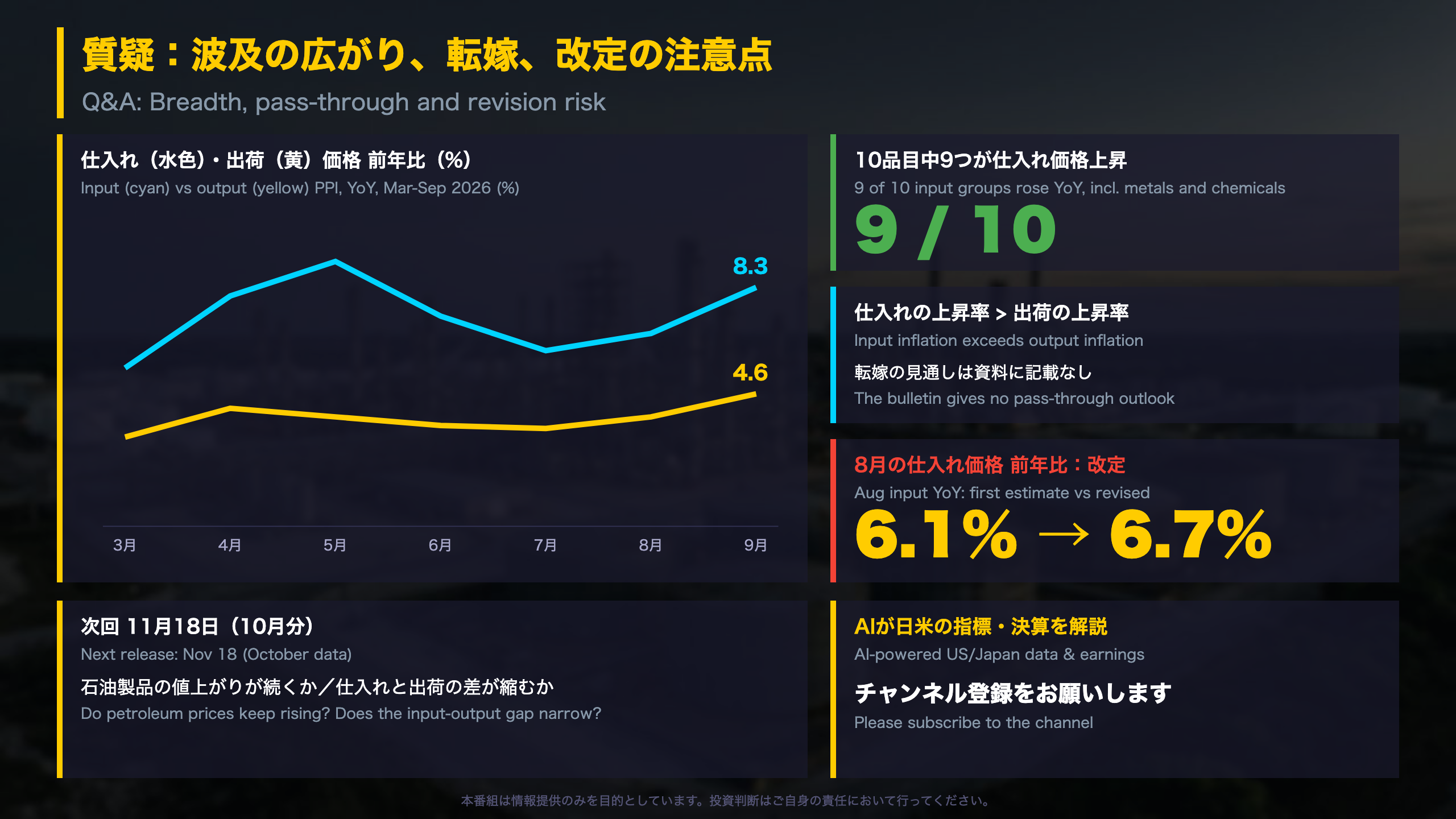
Q&A: Breadth, Pass-Through and Revision Risk in the UK PPI
Input versus output inflation
| Month | Input YoY | Output YoY |
|---|---|---|
| Mar | 5.5% | 3.1% |
| May | 9.2% | 3.8% |
| Jul | 6.1% | 3.4% |
| Aug | 6.7% | 3.8% |
| Sep | 8.3% | 4.6% |
Input inflation has run well above output inflation all year. In principle this gap could mean margin compression or delayed pass-through, but the ONS bulletin gives no outlook on pass-through, so it should not be read as a forecast of higher selling prices.
Revision history matters
August figures were all revised up: input inflation from 6.1% to 6.7%, output from 3.7% to 3.8%, and crude oil from 26.7% to 29.9%. The ONS notes that oil and energy data are revised after one to two months, as they rest on early-month purchases plus supplier estimates.
Data quality
September effective response rates were 82.2% for domestic PPI, 83.2% for import prices and 85.5% for export prices, all above a year earlier. The ONS is also working through the Office for Statistics Regulation’s quality requirements before seeking re-accreditation.
Read-across and what to watch
The September CPI was released the same day, so readers can compare producer and consumer pricing. For the BoE, which targets 2% CPI, producer prices are one upstream input among many. Key checkpoints: the October PPI on November 18, whether refined petroleum prices stay elevated, and whether the input-output gap narrows.
Disclaimer: This article is for informational purposes only. All investment decisions are made solely at your own risk.