📺 Watch the Full Video Analysis
This article was automatically generated by the NFC Market Live AI analysis system. (Updated: 2026-11-01 10:15 JST)
📊 NFC Weekly Programming Review (Oct 26-31)
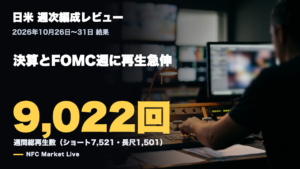
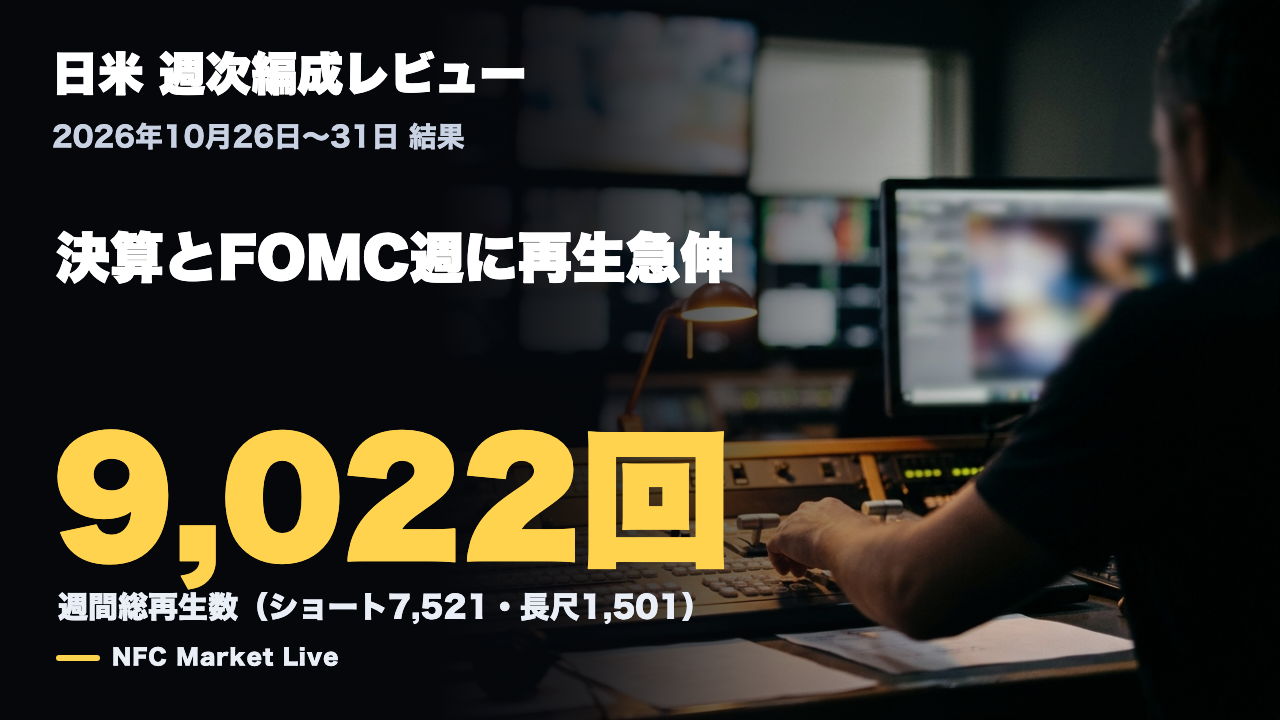
Total weekly views reached 9,022 (Shorts 7,521 / Long-form 1,501), up from 5,732 in the prior 7 days.
📈 Seven new Shorts generated about 98% of all Shorts views.
💰 Weekly production cost was 16,890 JPY, or 221 JPY per viewing hour (live 151 / regular 315).
⚠️ Key issues: the costly BOJ live, a long silence in the FOMC live, and mid-video drop-off on the US GDP Short.
💡 Next week: keep event-day flash coverage and improve live operations.
オープニング:今週の編成サマリー
Week at a glance (Oct 26-31)
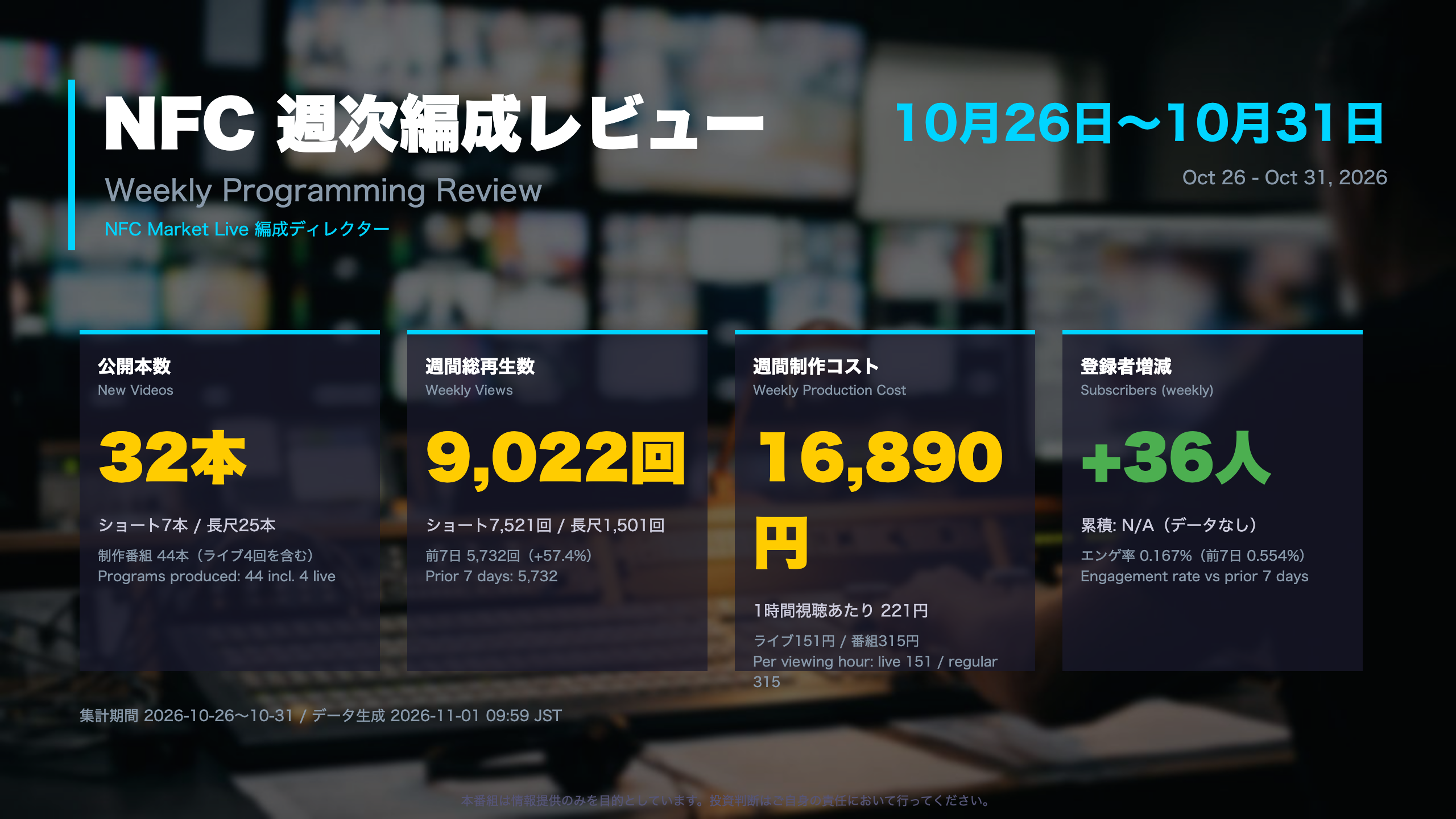
- Output: 7 new Shorts, 25 new long-form videos, 44 programs produced including 4 live broadcasts.
- Views: 9,022 in total (Shorts 7,521 / long-form 1,501), about 57% above the prior 7 days (5,732).
- Cost: 16,890 JPY, or 221 JPY per viewing hour (live 151 / regular programs 315).
- Subscribers: +36.
- Engagement rate: 0.167% over the last 7 days versus 0.554% the week before.
Views rose while the engagement rate fell. One possible reading is that a heavy event calendar attracted new viewers who did not interact; a single week of data cannot confirm this.
今週新規ショート動画 成績リスト
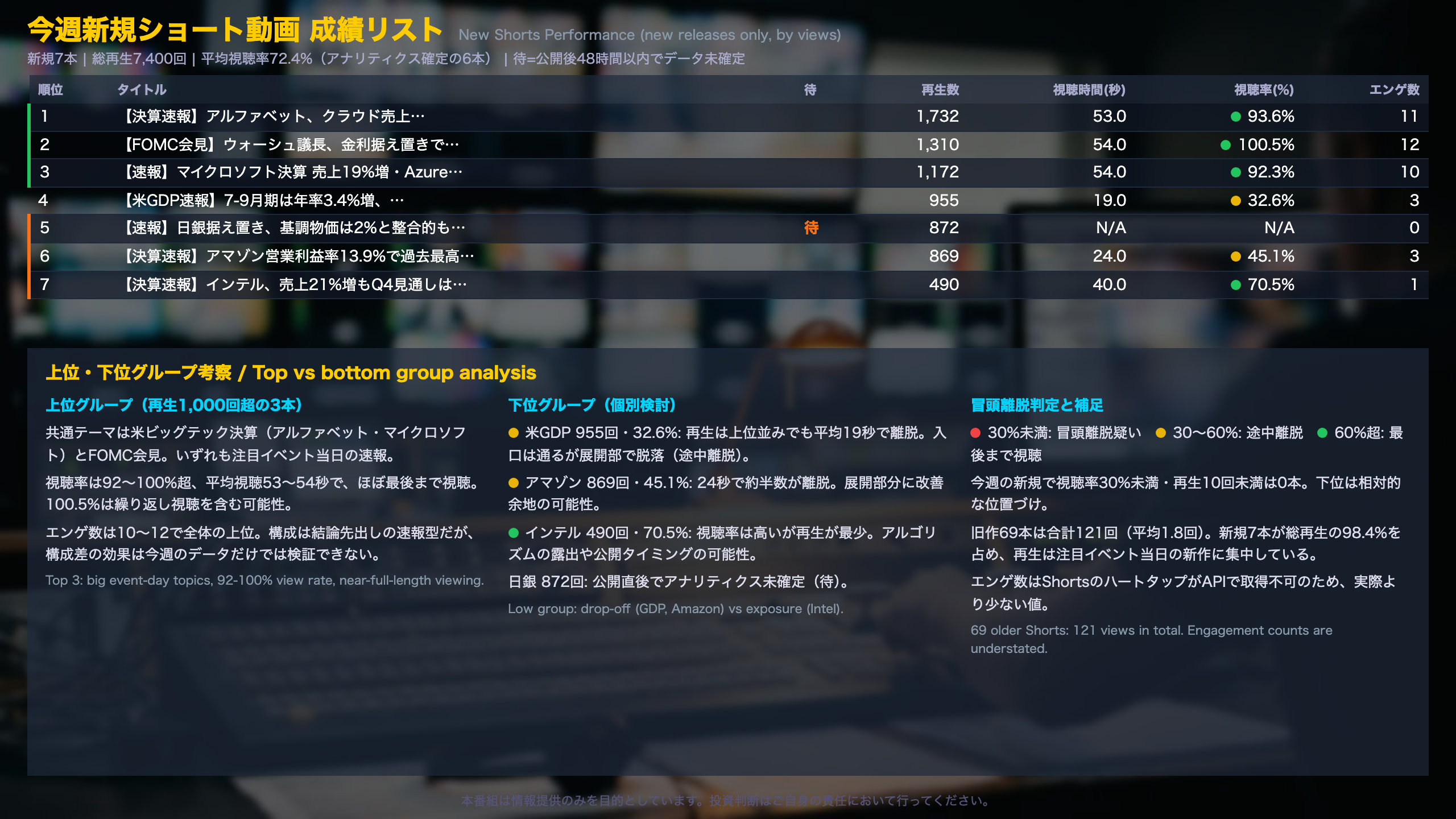
Seven new Shorts at a glance
The seven new Shorts produced 7,400 of 7,521 total Shorts views (98.4%). The remaining 69 older Shorts combined for just 121 views, an average of 1.8 each.
- Top tier: Alphabet (1,732 views, 93.6% view rate), FOMC press conference (1,310, 100.5%) and Microsoft (1,172, 92.3%). Average watch time was 53-54 seconds, close to the full runtime. A rate above 100% can include repeat viewing.
- Mid-video drop-off: US GDP (955 views, 32.6%) and Amazon (869, 45.1%).
- Exposure gap: Intel had a strong 70.5% view rate but the fewest views among the seven.
- Pending: the Bank of Japan Short had no analytics yet.
Note for overseas readers: the FOMC is the US Federal Reserve’s rate-setting committee, and its chair’s press conference is a high-interest event. Heart taps on Shorts are not exposed through the YouTube API, so engagement counts are understated. With only seven videos, these patterns are indicative, not conclusive.
今週新規長尺動画 成績リスト
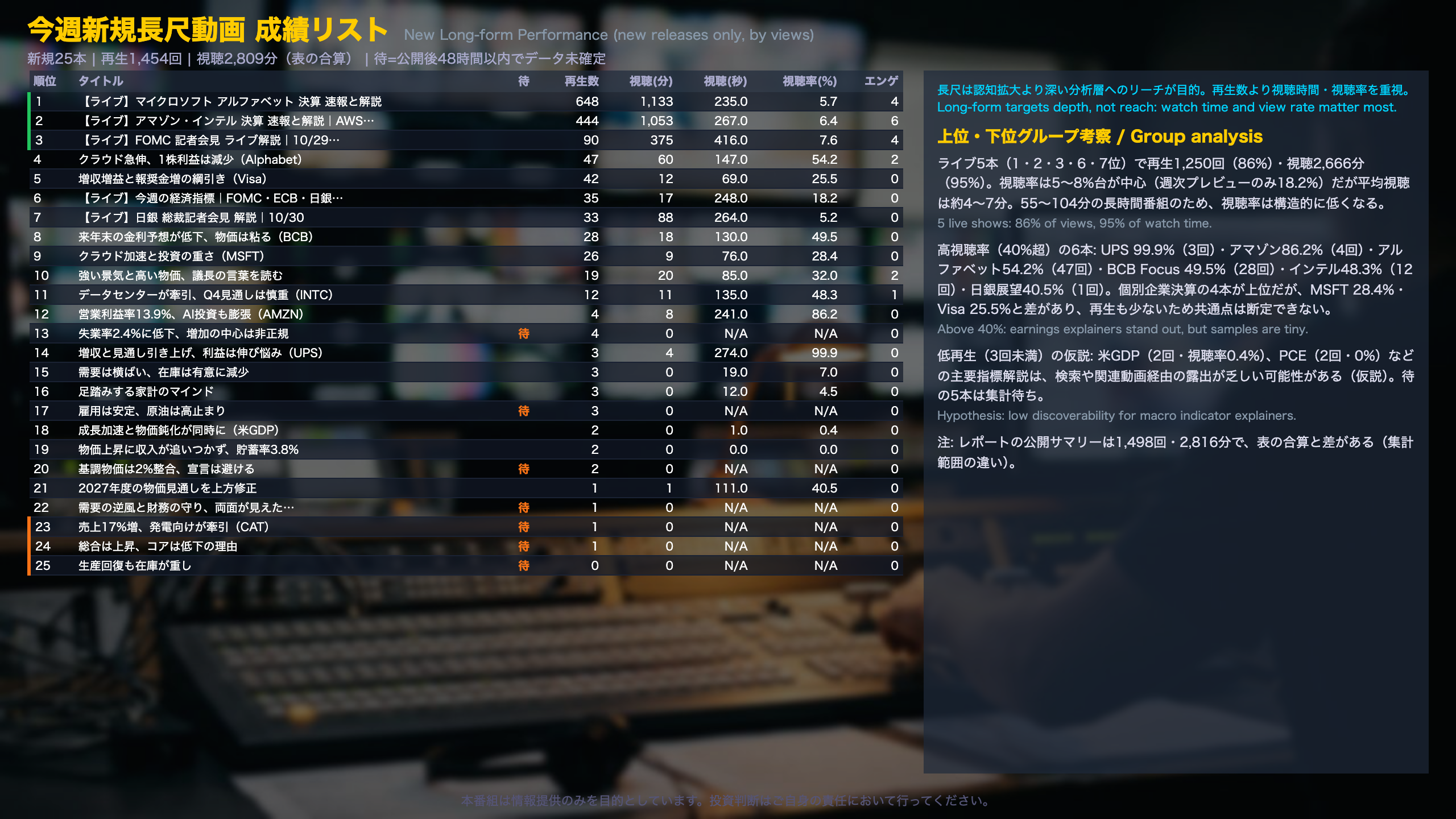
Long-form performance: live carries the load
The 25 new long-form videos totaled 1,454 views and 2,809 watch minutes (the report’s public summary shows 1,498 and 2,816, a small difference in aggregation scope).
- Five live broadcasts delivered 86% of views and 95% of watch time. Live view rates are low (5-8%) because the programs run 55-104 minutes, but average viewing of 4-7 minutes is meaningful.
- High view rate (above 40%): UPS 99.9% (3 views), Amazon 86.2% (4), Alphabet 54.2% (47), Brazil central bank Focus survey 49.5% (28), Intel 48.3% (12). Individual earnings explainers stand out, but Microsoft (28.4%) and Visa (25.5%) do not, and sample sizes are tiny.
- Discoverability gap: explainers on US GDP and PCE (personal consumption expenditures, the Fed’s preferred inflation gauge) got two views each.
The goal of long-form is depth rather than reach, so watch time and view rate matter more than raw views. Five videos are still waiting for analytics (published within 48 hours).
ライブ配信の詳細分析
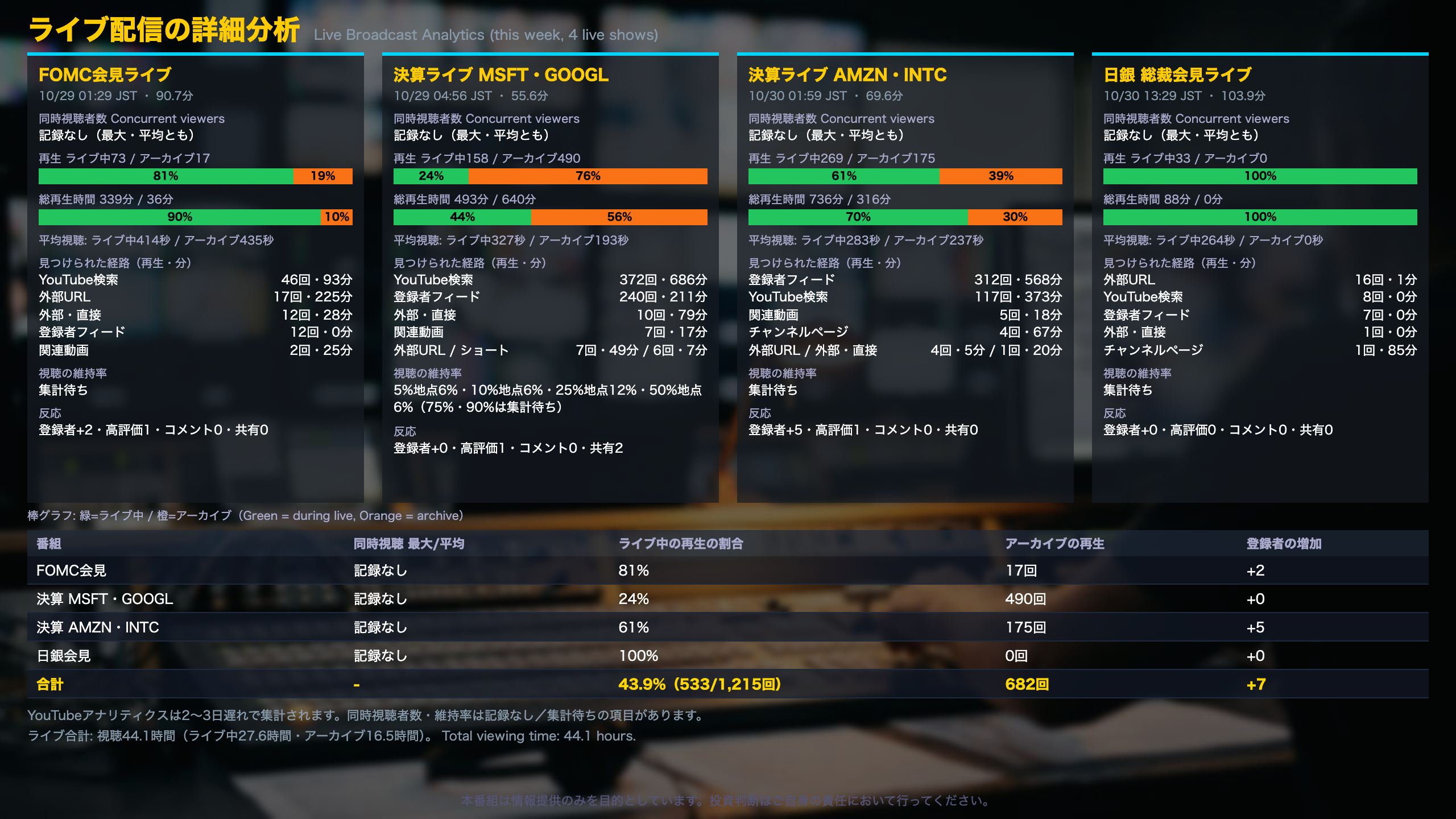
How the four live shows were watched
Live broadcasts of 55-104 minutes produced 1,215 views and 44.1 viewing hours in total.
- FOMC press conference live (Fed rate decision): 81% of views occurred during the live broadcast, with average live viewing of 414 seconds.
- Microsoft/Alphabet earnings live: 76% of views were archive plays, and discovery came mainly from YouTube search (372) and the subscriber feed (240).
- Amazon/Intel earnings live: the subscriber feed drove 312 of 444 views, and the show added 5 subscribers.
- Bank of Japan press conference live: only 33 views and no subscriber gain.
Concurrent viewer counts were not recorded for any show, and retention curves are mostly pending, so segment-level interest cannot yet be identified. Compared with typical US financial live streams, these are small audiences; the early signal is that scheduled mega-events (earnings and the FOMC) pull both live and replay demand, while central bank events outside the US are harder to surface.
28日間 チャンネル成長トレンド
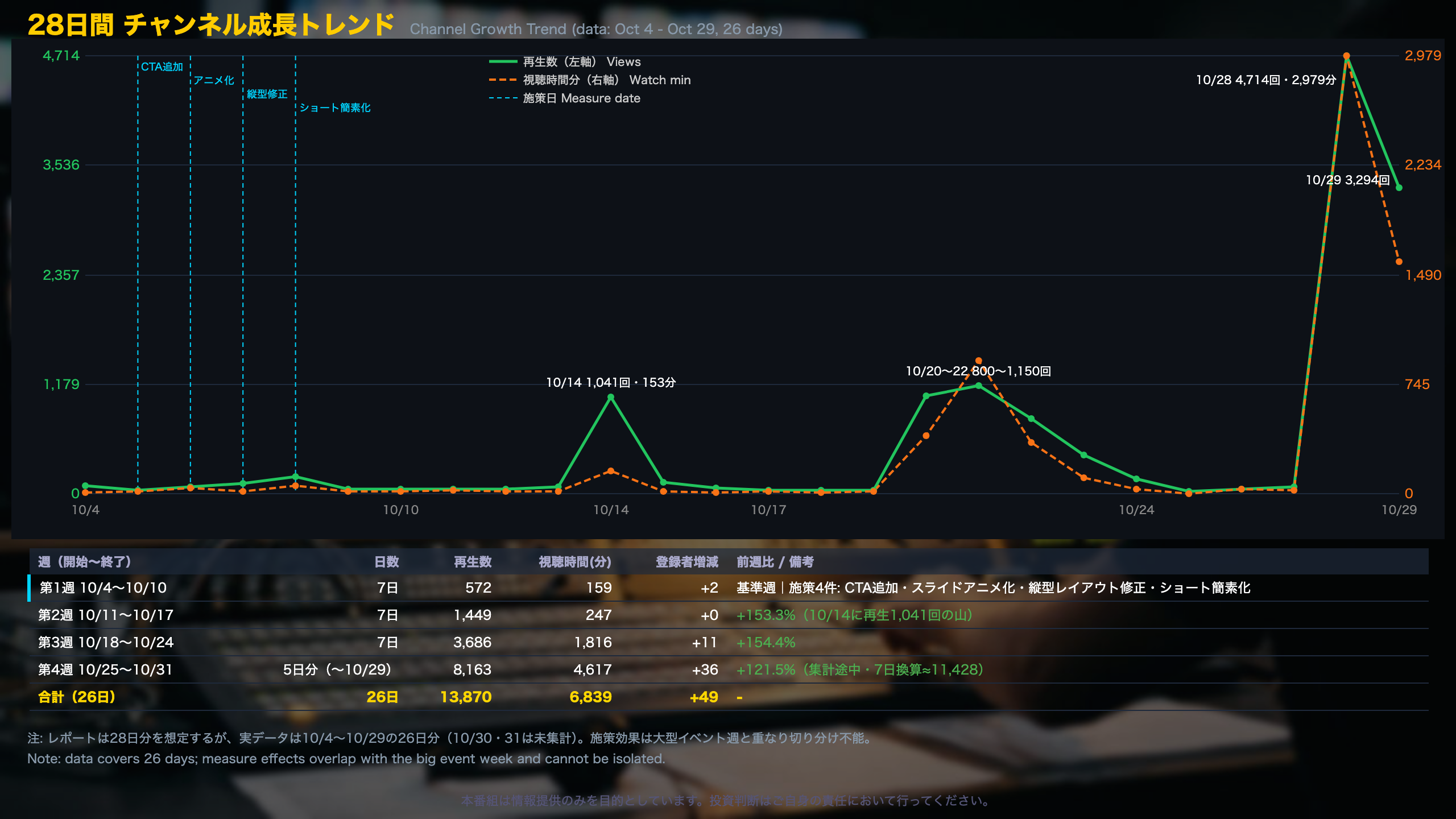
Reading the 26-day trend
The report assumes 28 days, but the data covers 26 days (Oct 4-29); the last two days are not yet aggregated.
- Watch time per view shows the quality of each spike: Oct 14 had 1,041 views and 153 minutes (about 0.15 min per view, short viewing), while Oct 28 had 4,714 views and 2,979 minutes (about 0.63 min per view).
- Weekly views grew from 572 to 1,449, 3,686 and 8,163 (the latest week covers only 5 days; the 7-day equivalent is about 11,428). Subscribers: +2, +0, +11, +36.
- Concentration: 36 of 49 subscribers gained over the period (73%) arrived on Oct 28-29, the days of the FOMC and big-tech earnings.
- Measures introduced Oct 5-8 (CTA copy, animated slides, vertical layout fixes, simpler Shorts) coincide with a small bump on Oct 8 (181 views) and then a return to roughly 50 views a day.
For context, the FOMC is the US central bank’s rate-setting committee and earnings from Microsoft, Alphabet, Amazon and Intel are among the most-watched market events. Because the biggest peaks coincide with such events, causation from our measures cannot be established.
今週の番組制作コスト分析
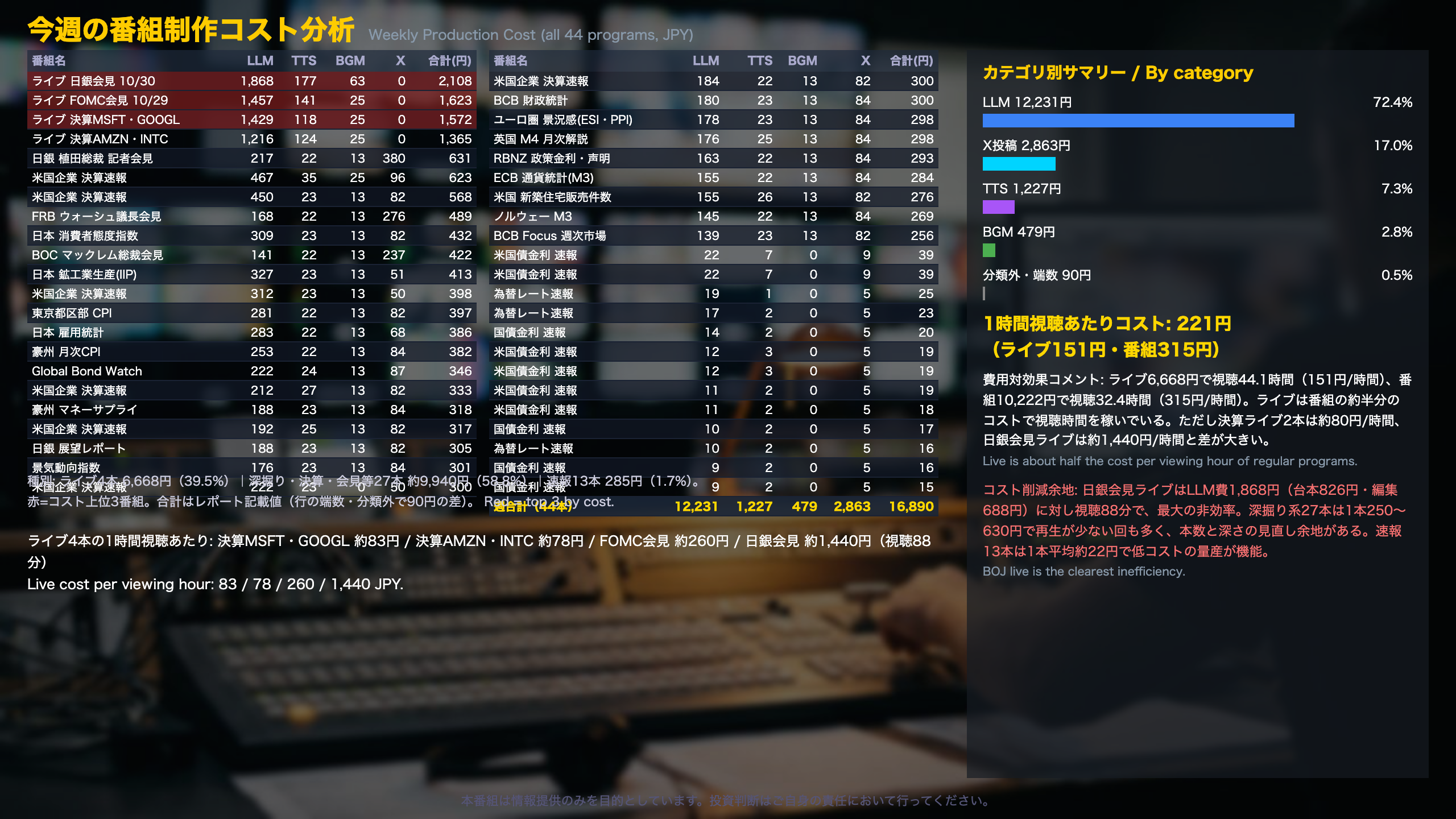
Cost breakdown
Total cost was 16,890 JPY across 44 programs (the sum of the four categories is 16,800; 90 JPY is rounding or uncategorized).
- By category: LLM 12,231 (72.4%), X posting 2,863 (17.0%), TTS 1,227 (7.3%), BGM 479 (2.8%).
- By type: 4 live shows 6,668 JPY (39.5%), 27 deep-dive, earnings and press-conference programs about 9,940 JPY (58.8%), 13 rate and FX flash items 285 JPY (1.7%).
- Cost per viewing hour: overall 221 JPY; live 151; regular programs 315.
Live efficiency
MSFT/GOOGL earnings live cost about 83 JPY per viewing hour and AMZN/INTC about 78 JPY. The FOMC live cost about 260 JPY, and the Bank of Japan live about 1,440 JPY because it drew only 1.5 viewing hours, while its script-writing and editing LLM costs were the highest of the week (826 and 688 JPY).
For context, flash items at 15-39 JPY are almost free to scale, whereas deep dives cost 10-20 times more per item; the review question is whether views justify that depth.
今週のライブ配信の振り返り(舞台裏)
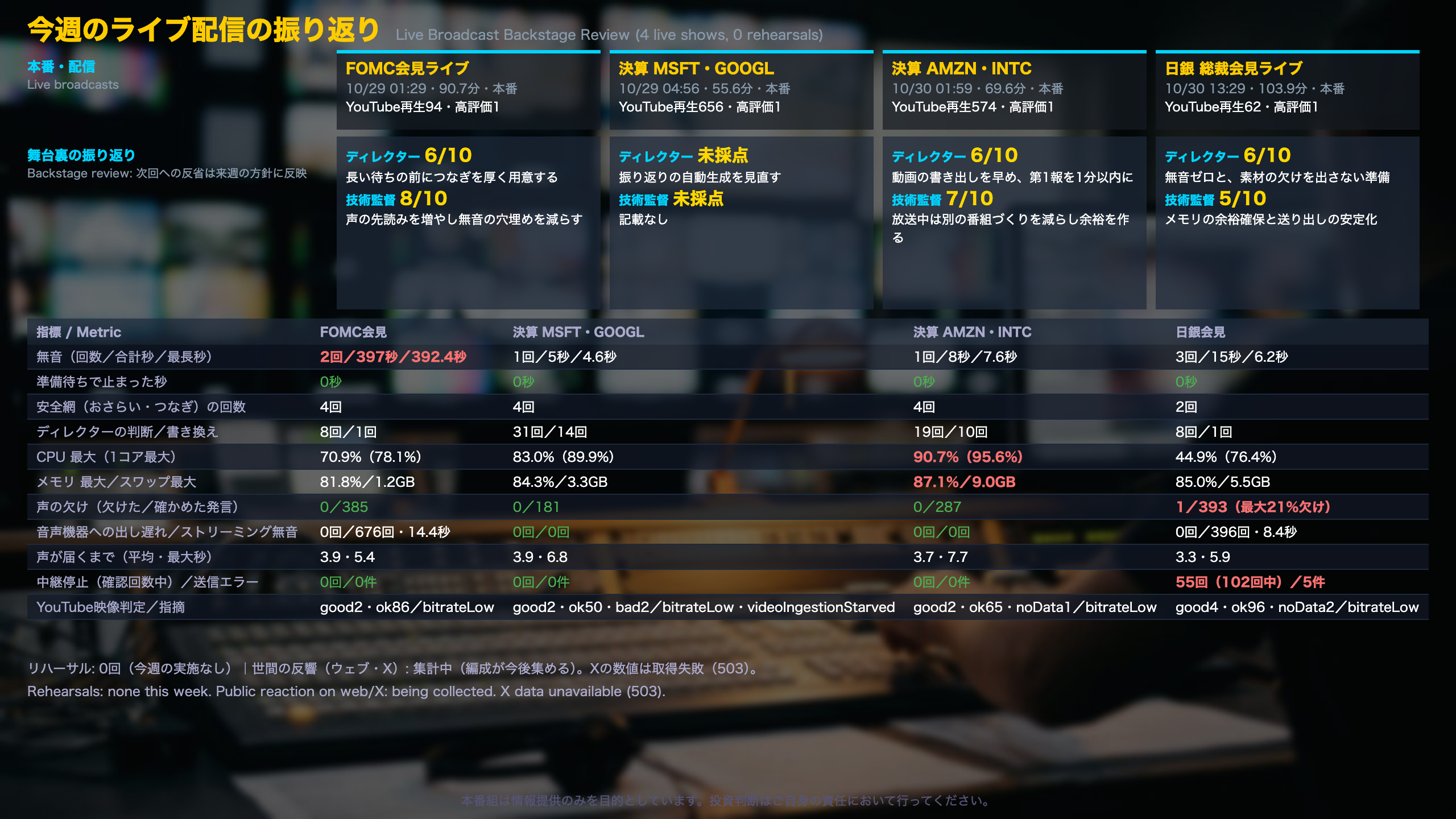
Backstage review of this week’s live shows
Four live broadcasts and zero rehearsals.
- Self-scoring: director 6/10 for the FOMC, AMZN/INTC and BOJ lives; the MSFT/GOOGL review was not generated. Technical director: 8/10 (FOMC), 7/10 (AMZN/INTC), 5/10 (BOJ).
- FOMC live: two silent gaps totaling 397 seconds, the longest 392.4 seconds (about 6.5 minutes), in a 90.7-minute show. Lesson: prepare more filler ahead of long waits.
- BOJ live: 55 of 102 minute-by-minute checks found the relay stopped, five send errors, and one voice segment 21% inaudible. Memory peaked at 85% with 5.5 GB of swap.
- AMZN/INTC live: CPU peaked at 90.7% and swap at 9.0 GB, hence the lesson to reduce parallel production during live.
- Positives: zero seconds stalled waiting for preparation in all four shows; zero audio device drop-outs; only 5-8 seconds of silence in the two earnings lives.
For reference, the FOMC and BOJ lives cover central-bank press conferences whose timing is set by the institutions, so the production team cannot control waiting periods; the safety net of recap and filler segments fired 2-4 times per show.
来週の番組制作方針(まとめ)
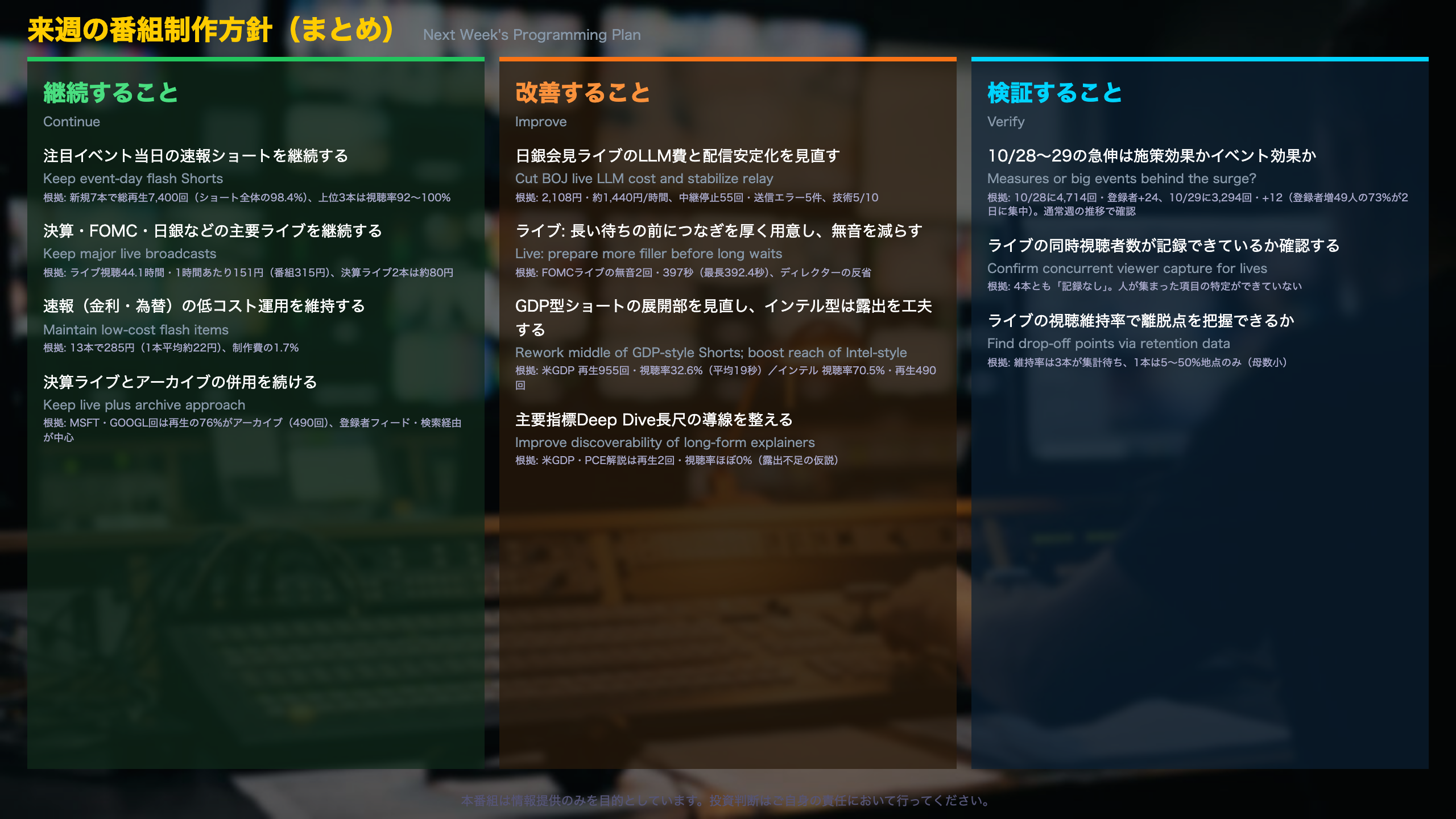
Next week’s action plan
Continue
– Event-day flash Shorts: the seven new Shorts produced 98.4% of Shorts views and the top three had view rates above 92%.
– Major live broadcasts: 151 JPY per viewing hour versus 315 for regular programs.
– Ultra-low-cost flash items: 13 items for 285 JPY.
Improve
– BOJ live: LLM cost of 1,868 JPY for only 1.5 viewing hours, plus 55 relay-down checks.
– FOMC live: longest silence of 392 seconds; prepare more filler before long waits.
– US GDP-style Shorts: 32.6% view rate suggests mid-video drop-off; Intel-style Shorts: strong view rate but low reach.
– Discoverability of long-form macro explainers (1-3 views each).
Verify
– Whether the Oct 28-29 surge reflects event demand or our recent changes; compare with a normal week.
– Whether concurrent viewer data is captured for live shows.
– Where viewers leave during live broadcasts once retention data arrives.
This week’s data is skewed toward a mega-event week (FOMC, BOJ, big-tech earnings), so comparison with an ordinary week is the key test.
Disclaimer: This article is for informational purposes only. All investment decisions are made solely at your own risk.