📺 Watch the Full Video Analysis
This article was automatically generated by the NFC Market Live AI analysis system. (Updated: 2026-09-27 08:39 JST)
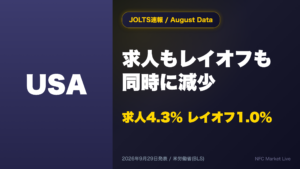
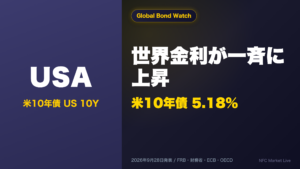
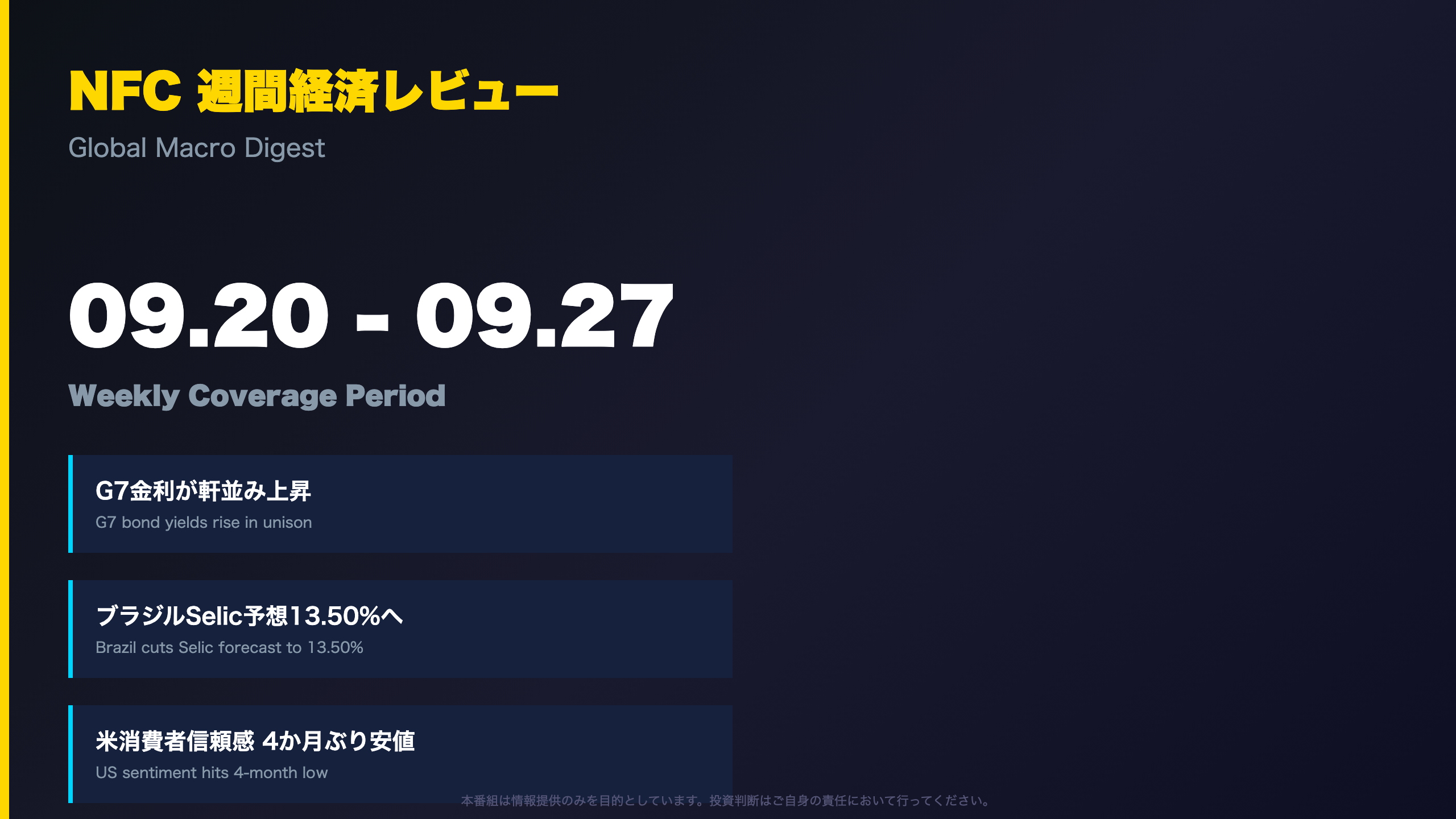
This week (Sep 20-27) saw G7 bond yields rise in unison even as US consumer sentiment plunged to a four-month low.
📊 G7 long-term yields broadly higher (Japan 10Y +8bp, Germany +12bp)
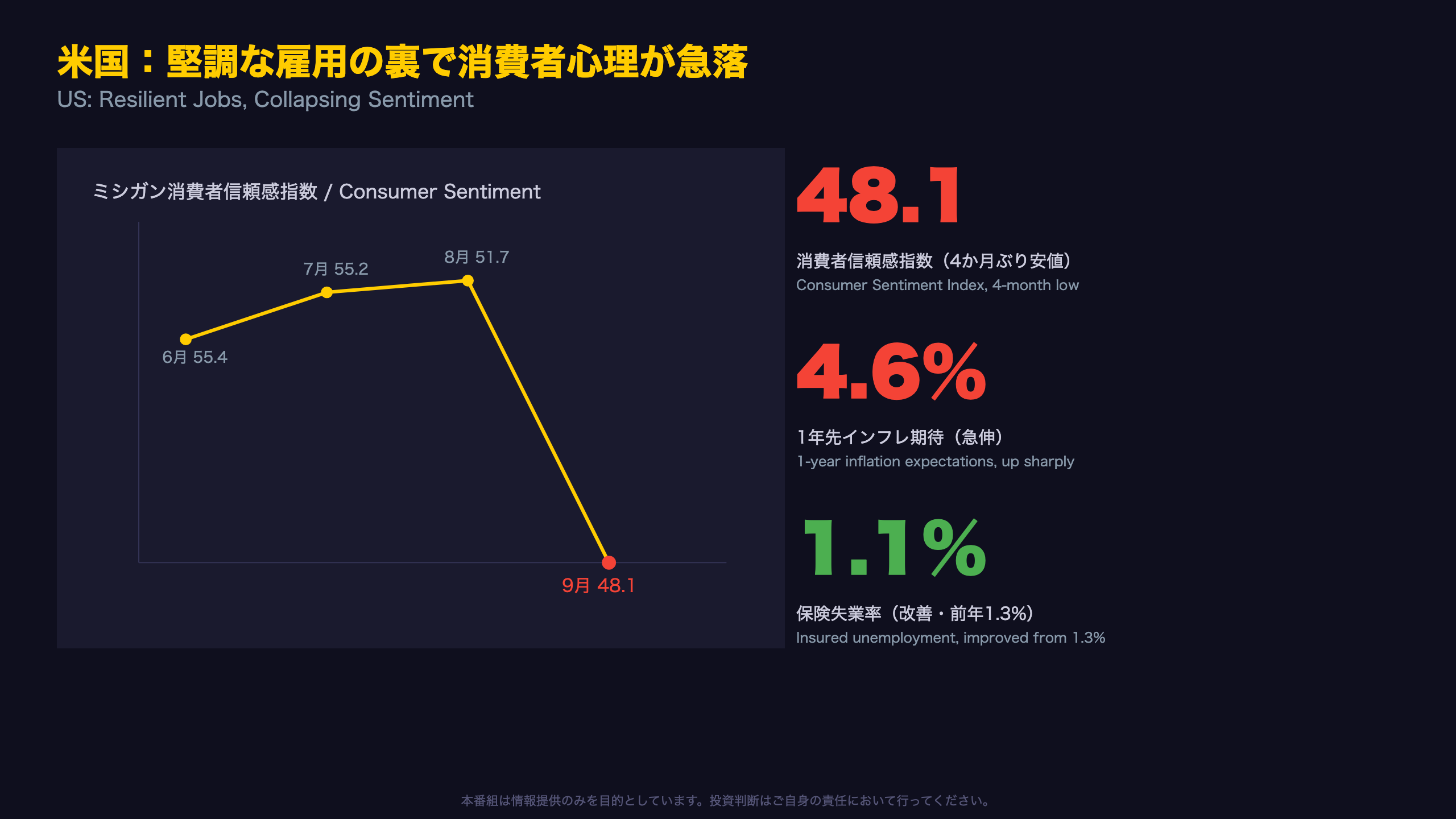
📉 Michigan Consumer Sentiment fell to 48.1, a 4-month low, while 1-year inflation expectations jumped to 4.6%
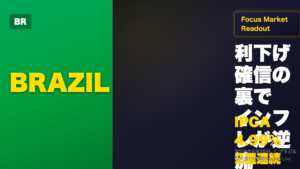
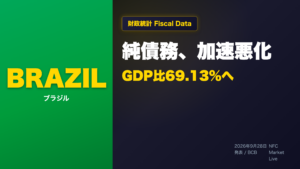
🇧🇷 Brazil’s Focus survey cut its Selic forecast to 13.50%, the first change in six weeks
🇲🇽 Banxico held rates but quietly softened its forward guidance language
🇪🇺 ECB’s M3 money supply accelerated for a third straight month
We break down this week’s crosscurrents and preview next week’s key events including US payrolls, Japan’s Tankan survey, and Eurozone flash CPI.
週間経済レビュー / Weekly Economic Review
This Week’s Overview
Covering September 20-27, 2026, this week featured two seemingly contradictory trends unfolding in parallel: rising long-term interest rates worldwide and deteriorating U.S. consumer sentiment.
Key Themes
- Rates: Long-term yields rose broadly across the U.S., Japan, Germany, and the U.K.
- Latin America: Brazil’s central bank (BCB) Focus survey cut its Selic rate forecast for the first time in six weeks; Mexico’s Banxico held rates but softened its forward guidance
- Sentiment: The University of Michigan’s Consumer Sentiment Index fell to 48.1 even as inflation expectations rose
- Liquidity: The ECB’s M3 money supply growth accelerated for a third consecutive month
- External balance: The U.S. current account deficit widened by 15.7%
For readers unfamiliar with these institutions: BCB’s Focus survey is a weekly median forecast compiled from over 130 market participants, used directly by Brazil’s monetary policy committee (COPOM). Banxico is Mexico’s central bank. The University of Michigan survey is one of the two primary gauges of U.S. consumer sentiment (alongside the Conference Board index), closely watched by the Federal Reserve for inflation expectation signals.
At least eight data-driven programs were produced this week, covering the Fed, ECB, BEA, BCB, Banxico, and the University of Michigan. The following slides examine both the resilient and fragile threads running through this week’s data.
今週の総括:金利上昇とインフレ期待の再燃、割れる消費者心理
Surprises vs. Consensus
The week’s biggest surprise was the simultaneous plunge in the University of Michigan’s sentiment index (51.7 → 48.1, -7.0%) alongside a jump in one-year inflation expectations (4.0% → 4.6%). Typically, weakening growth sentiment coincides with cooling inflation expectations — this week moved in the opposite direction, a pattern reminiscent of stagflation-era dynamics that U.S. investors haven’t seen much of in recent years.
On the “in-line” side: Banxico’s rate hold at 6.50% matched expectations, and the ECB’s M3 growth continued its known acceleration trend. But beneath these unsurprising headlines, subtle shifts emerged — a topic we unpack in the following slides.
Balance Sheet of the Week
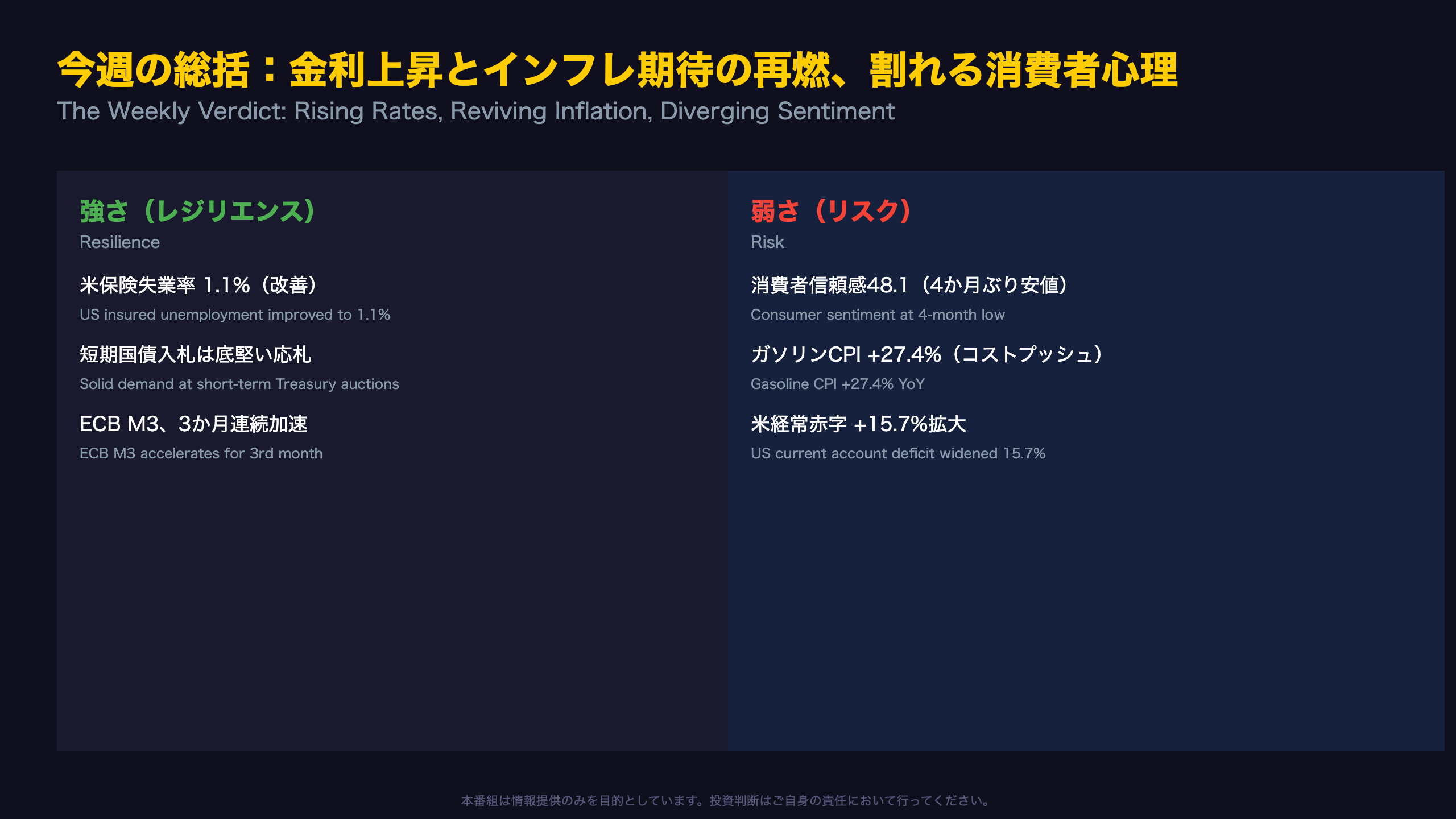
| Resilience | Risk |
|---|---|
| US insured unemployment at 1.1% (improved) | Consumer sentiment at 48.1 (4-month low) |
| Steady demand at short-term Treasury auctions | Gasoline CPI +27.4% YoY (cost-push pressure) |
| ECB M3 accelerating (easier liquidity) | US current account deficit widened 15.7% |
For U.S.-focused investors, this dual narrative echoes debates last seen during 1970s-style stagflation fears, though current data does not yet confirm a structural trend — it remains a single-month signal requiring confirmation.
米国:堅調な雇用の裏で消費者心理が急落
Expectations, Not Current Conditions, Drove the Decline
The University of Michigan survey splits into a Current Conditions Index and an Expectations Index. This month, the Expectations Index fell 10.1%, more than five times the 1.9% drop in Current Conditions — signaling that anxiety about the future, not present hardship, drove the headline decline. Notably, on a year-over-year basis the pattern reverses: Current Conditions fell more (-15.7%) than Expectations (-10.4%), suggesting different dynamics operate over different time horizons.
A Bipartisan Downturn
Both political camps grew more pessimistic since January — Republicans down 20%, Democrats down 13%. Survey director Joanne Hsu noted “broad agreement across the political spectrum that the outlook for the economy has weakened since the beginning of the year,” a notable departure from the sharp partisan sentiment gaps typically seen in U.S. surveys.
The Energy Angle
EIA data show refinery utilization at a four-week average of 96.6%, well above last year’s 93.9%, suggesting demand-side strength rather than supply disruption. Jet fuel supply rose 4.4% YoY, reflecting resilient travel demand, even as total petroleum products supplied slipped 0.6% YoY — a mixed signal on aggregate demand.
For context, U.S. consumer sentiment gauges (Michigan and the Conference Board) are closely watched by the Fed as leading indicators of household inflation expectations, which feed into wage-setting and spending decisions. The next Michigan preliminary reading is expected in mid-October.
世界の金利上昇と新興国中銀の分岐
The Illusion of Narrowing Spreads
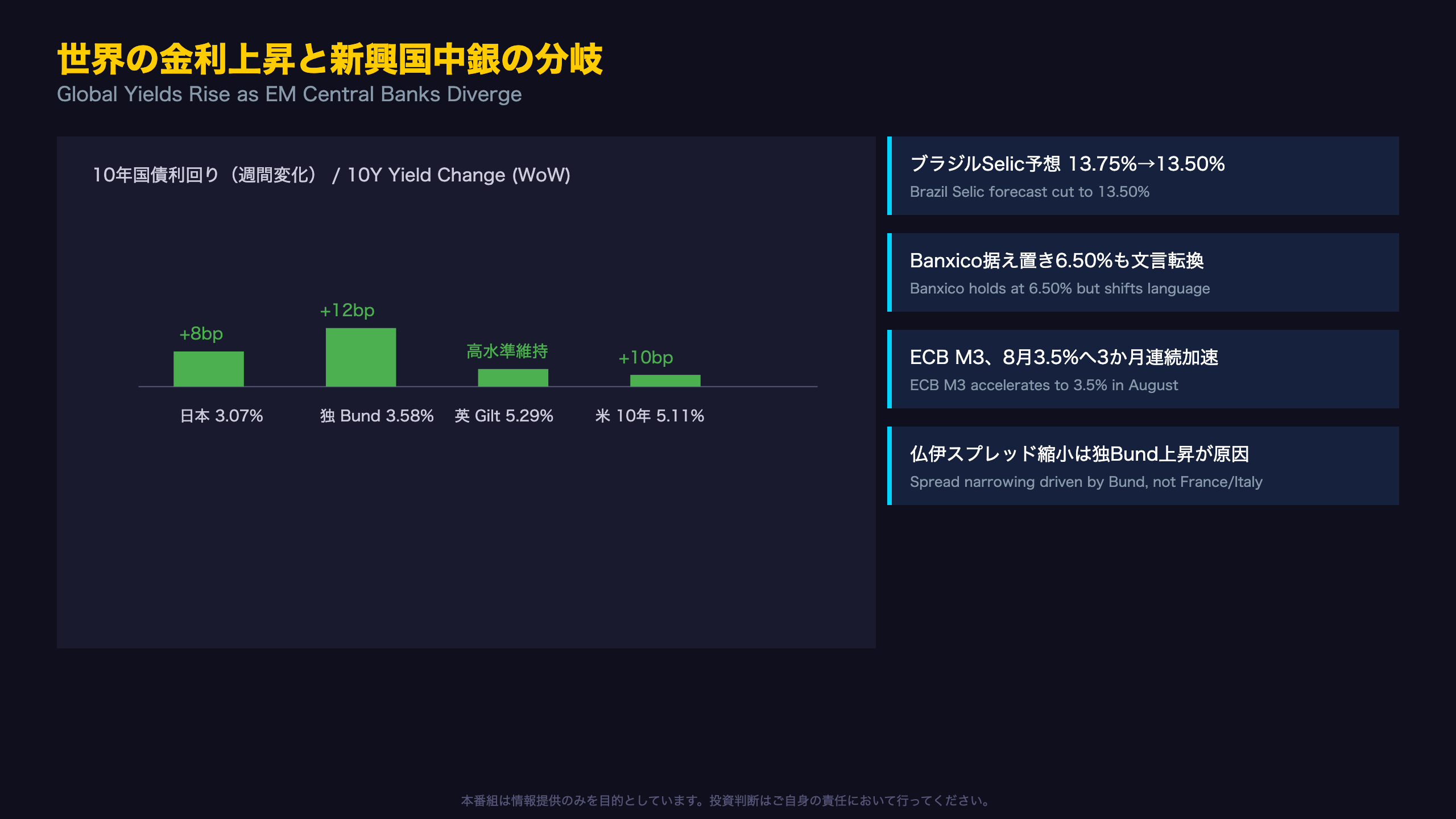
One of the week’s subtler findings: both the OAT-Bund and BTP-Bund spreads narrowed by 12bp. At first glance, this looks like improving French and Italian credit conditions, but the reality is the opposite — it was entirely driven by German Bund yields rising (3.46% → 3.58%), while French and Italian yields (reported monthly, still reflecting August data) remained unchanged. This is a case of “statistical illusion” rather than genuine risk repricing, worth flagging for readers accustomed to interpreting spread moves as sovereign risk signals.
Japan’s Auction Quality Improves
The “tail” (stop yield minus average yield) on Japan’s 10-year JGB auction narrowed sharply from 6.0bp in August to 1.6bp in September, suggesting more orderly price discovery. However, the 2-year tail widened from 0.4bp to 1.7bp, showing uneven demand across maturities.
Banxico’s Guidance Shift
Mexico’s central bank (Banxico) replaced its prior commitment to “maintain the reference rate at its current level” with language emphasizing it “would not have to react mechanically” to Fed moves — inserted just after the Fed’s September hike. For context, Banxico operates independently of the Fed but historically has moved in loose correlation with U.S. rates given close trade and capital market ties; this language explicitly asserts policy independence.
Brazil’s next Focus survey update is due September 28, when markets will watch whether the 13.50% Selic forecast holds.
中央銀行政策スタンスの現在地
Reading the 10-Bank Regime Model
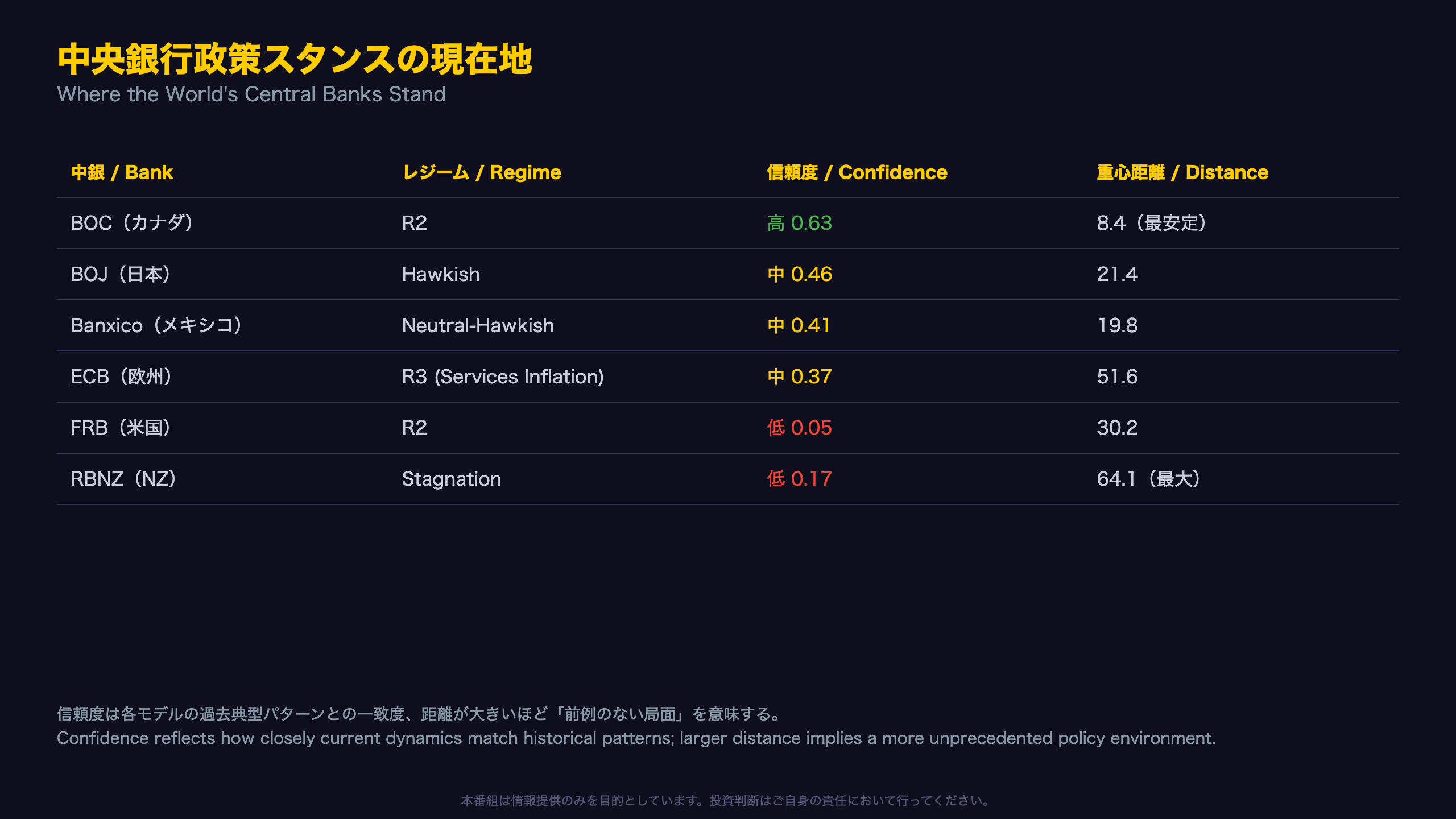
Our analytics track ten central banks using a regime-classification model that measures how closely current policy/inflation dynamics resemble historical patterns (“regimes”). Rather than the regime labels themselves, what matters most for readers is confidence level and distance from the historical centroid — a proxy for how well-understood the current situation is.
| Model | Regime | Confidence | Distance |
|---|---|---|---|
| BOC (Canada) | R2 | High (0.63) | 8.4 (lowest) |
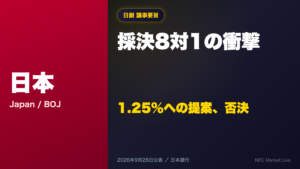
| BOJ (Japan) | Hawkish | Medium (0.46) | 21.4 |
| Banxico (Mexico) | Neutral-Hawkish | Medium (0.41) | 19.8 |
| ECB | R3 | Medium (0.37) | 51.6 |
| RBNZ (New Zealand) | Stagnation | Low (0.17) | 64.1 (highest) |
Canada’s model shows the highest confidence, implying its current rate/inflation trajectory closely matches historical precedent — useful context for CAD-denominated positioning. By contrast, RBNZ, BOE, and RBA sit furthest from their historical centroids, meaning the current cycle looks genuinely unprecedented for these economies, and model-based signals there should be treated with more caution.
The week’s aggregate signal count was 2 long / 4 short across currency pairs, a modestly bearish tilt. This is a mechanical output that should not be read as investment advice, particularly given several underlying models carry low confidence scores. The next regime update is scheduled for Monday.
今週の番組制作費
Production Cost Breakdown (Confirmed Data)
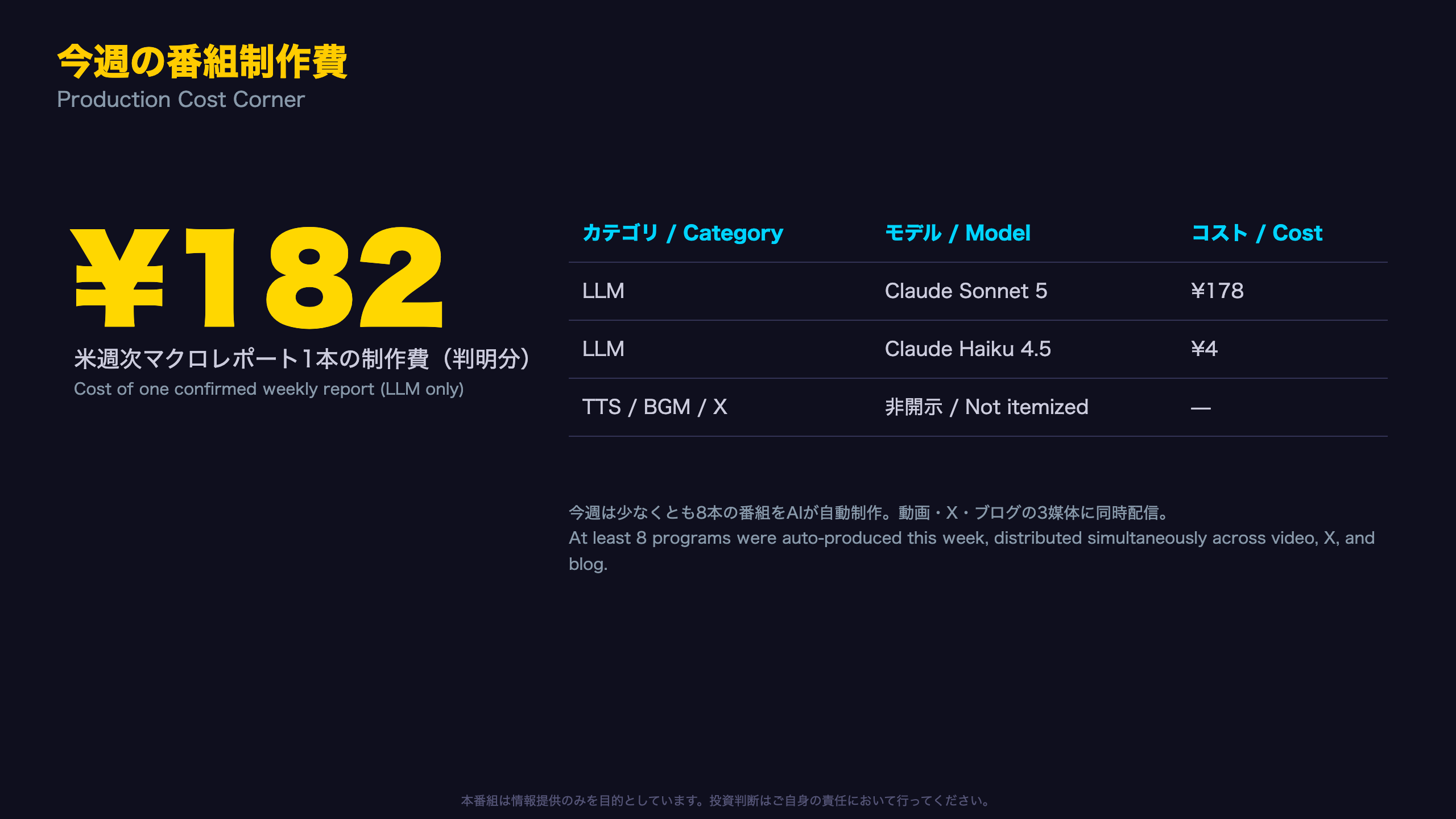
Not every program’s cost breakdown was disclosed this week, but one confirmed example — the U.S. weekly macro report — shows:
| Category | Model | Input Tokens | Output Tokens | Cost |
|---|---|---|---|---|
| LLM | Claude Sonnet 5 | 50,027 | 102,270 | ¥178 |
| LLM | Claude Haiku 4.5 | 22,549 | 238 | ¥4 |
| Total | ¥182 |
Converted at 1 USD = 158.7 JPY, this equals roughly $1.15 for a full research report. Notably, this example only itemizes LLM costs — TTS (text-to-speech), BGM generation, and X (Twitter) posting costs were not broken out in the available data for this particular program.
Scale of This Week’s Output
Beyond this example, at least eight distinct reports were generated and distributed this week, spanning global bond markets, Brazil’s Focus survey, the BEA’s current account release, Banxico’s policy statement, ECB money supply data, and University of Michigan sentiment — each simultaneously published across video, X, and blog formats.
For context, traditional financial research production (analyst time, editing, video production) typically costs orders of magnitude more per report. NFC Market Live’s fully automated, AI-driven pipeline demonstrates that low-cost, high-frequency macro coverage is increasingly feasible — though disclosure of full cost breakdowns (including TTS/BGM/distribution) remains a work in progress across all programs.
来週の注目イベントカレンダー(9/28〜10/2)
Next Week’s Logic Chains
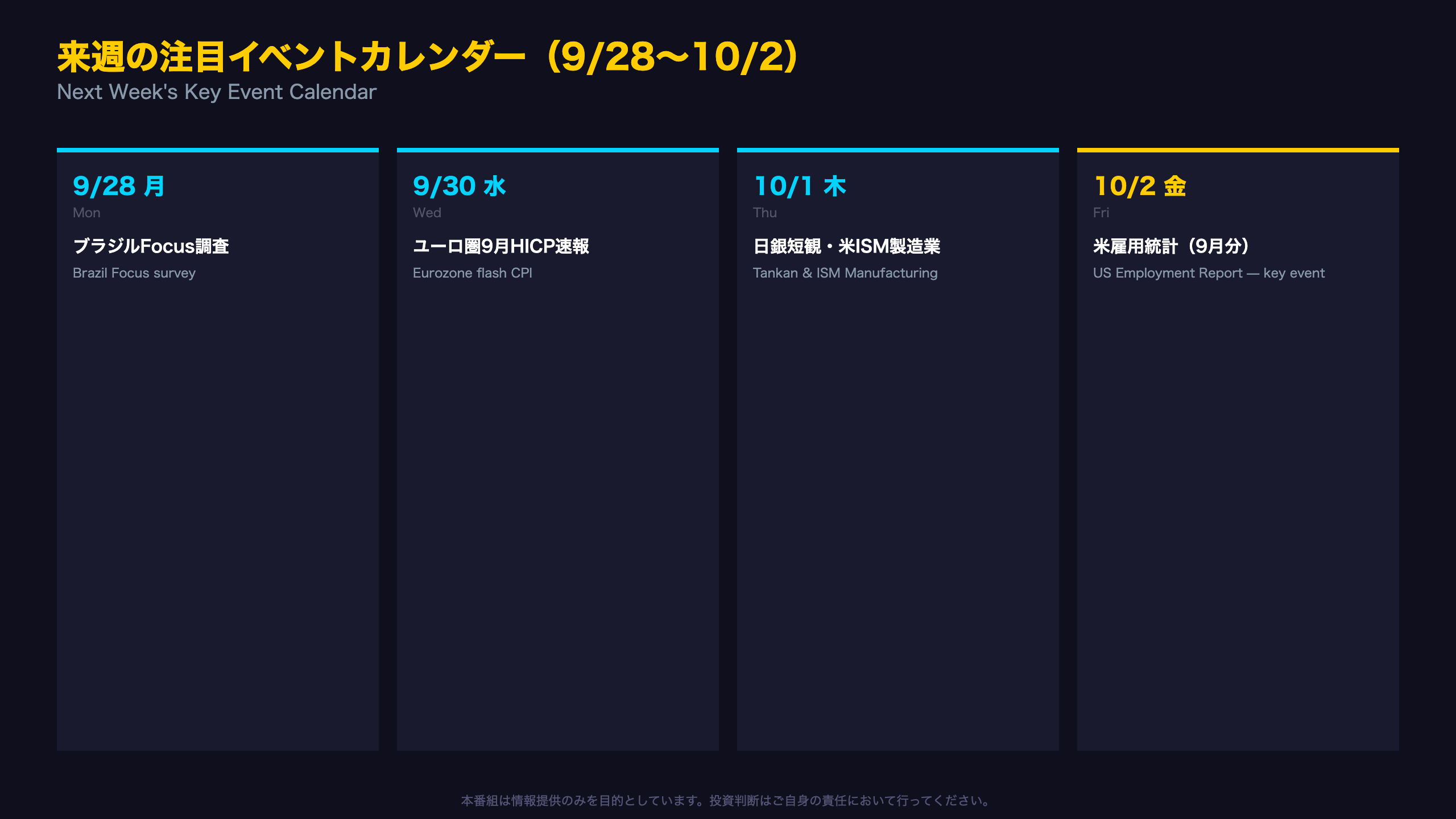
Sep 28 (Mon): Brazil’s Focus Survey
Fact: This week’s Selic forecast shifted from 13.75% to 13.50%. Mechanism: Brazil’s central bank (BCB) compiles this weekly median forecast from over 130 market participants, feeding directly into its monetary policy committee (COPOM)’s deliberations. Implication: If 13.50% holds, rate-cut expectations solidify; a rebound would suggest this week’s move was a temporary blip.
Sep 30 (Wed): Eurozone Flash HICP (September)
Fact: ECB M3 money growth accelerated to 3.5% in August, a third straight month. Mechanism: Faster money supply growth can eventually feed through to demand and price pressures, though usually with a lag. Implication: An accelerating HICP would reinforce the M3 signal; a deceleration would point to a longer transmission lag.
Oct 1 (Thu): Japan’s Tankan Survey and US ISM Manufacturing
Fact: The Bank of Japan’s policy rate has risen steadily, from 0.84% in June to 0.98% in August. Mechanism: If the Tankan survey shows weakening corporate sentiment, it may signal that BOJ tightening is becoming a burden on business confidence. Implication: A resilient large-manufacturer index would support expectations of further BOJ hikes — a key variable for JPY positioning.
Oct 2 (Fri): US Employment Situation (September)
Fact: This week’s data showed a split signal — improving insured unemployment (1.1%) versus deteriorating Michigan sentiment (48.1). Mechanism: The nonfarm payrolls and unemployment rate headline figures will help determine which signal better reflects underlying labor market health. Implication: Strong payrolls would suggest sentiment weakness is a leading indicator not yet confirmed in hard data; weak payrolls would suggest the labor market is also beginning to soften.
The single most important release next week is the October 2 U.S. jobs report — the tie-breaker between this week’s conflicting signals of resilient employment and eroding consumer confidence.
Disclaimer: This article is for informational purposes only. All investment decisions are made solely at your own risk.