📺 Watch the Full Video Analysis
This article was automatically generated by the NFC Market Live AI analysis system. (Updated: 2026-08-06 06:41 JST)
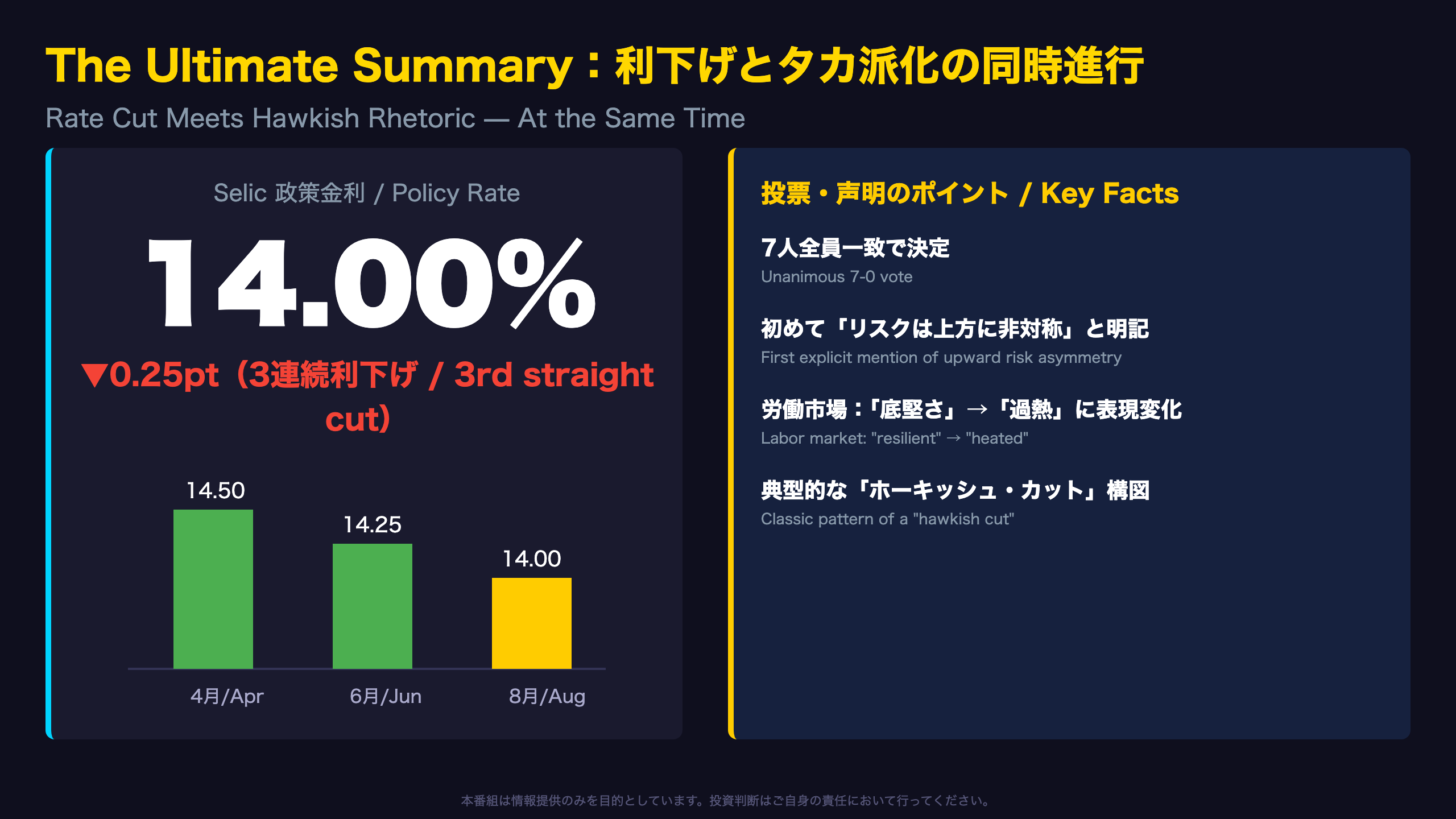
Brazil’s central bank (BCB) cut the Selic rate by 25bps to 14.00% on Aug 5, 2026 — the third consecutive cut, decided unanimously by all 7 Copom members. 📉
But a word-by-word comparison with the June statement reveals a striking divergence: headline and core inflation both decelerated, with core now just below the target’s upper bound — a clear dovish justification. ✅
Yet the labor market description shifted from “resilient” to “heated,” and for the first time, the Committee explicitly flagged an “upward risk asymmetry.” ⚠️
A classic “hawkish cut” — easing in action, hardening in rhetoric. We break down exactly what changed in the text and what it means for the pace of future cuts. 💡
The Ultimate Summary:利下げとタカ派化の同時進行
Third Consecutive Cut, But a Change in Tone
On August 5, 2026, Brazil’s Copom (Monetary Policy Committee of the Banco Central do Brasil, BCB) cut the Selic rate by 25bps to 14.00%, following cuts in April (to 14.50%) and June (to 14.25%). The decision was unanimous among all seven voting members, including Chair Gabriel Muricca Galípolo. The pace itself — a third straight quarter-point cut — matched market expectations for a gradual easing cycle.
The Rhetoric Diverges from the Action
What stands out is the gap between the policy action and the language used to justify it. The statement explicitly states inflation risks “remain more elevated than usual, with an upward asymmetry” (com assimetria altista) — a phrase that did not appear in the June statement. Simultaneously, the labor market description hardened from “still showing signs of resilience” to “heated” (aquecido).
Context for International Readers
Unlike the Fed’s dot-plot framework, the BCB’s Copom statement functions similarly to an FOMC statement but with an explicit numerical inflation target (3% with a tolerance band) and a Focus survey of market expectations embedded directly in the text — a level of transparency Western central banks often lack.
Balanced Read
- Bullish for disinflation: headline and core inflation both decelerated in the latest readings.
- Cautionary flag: risk language and labor-market framing turned more hawkish even as the rate was cut — a classic “hawkish cut” pattern also seen periodically at the RBNZ and Banxico.
The next meeting will reveal whether this rhetorical hardening translates into an actual slowdown in the cutting pace.
The Red-line Analysis:削除・追加された決定的文言
Side-by-Side: What Changed in the Text
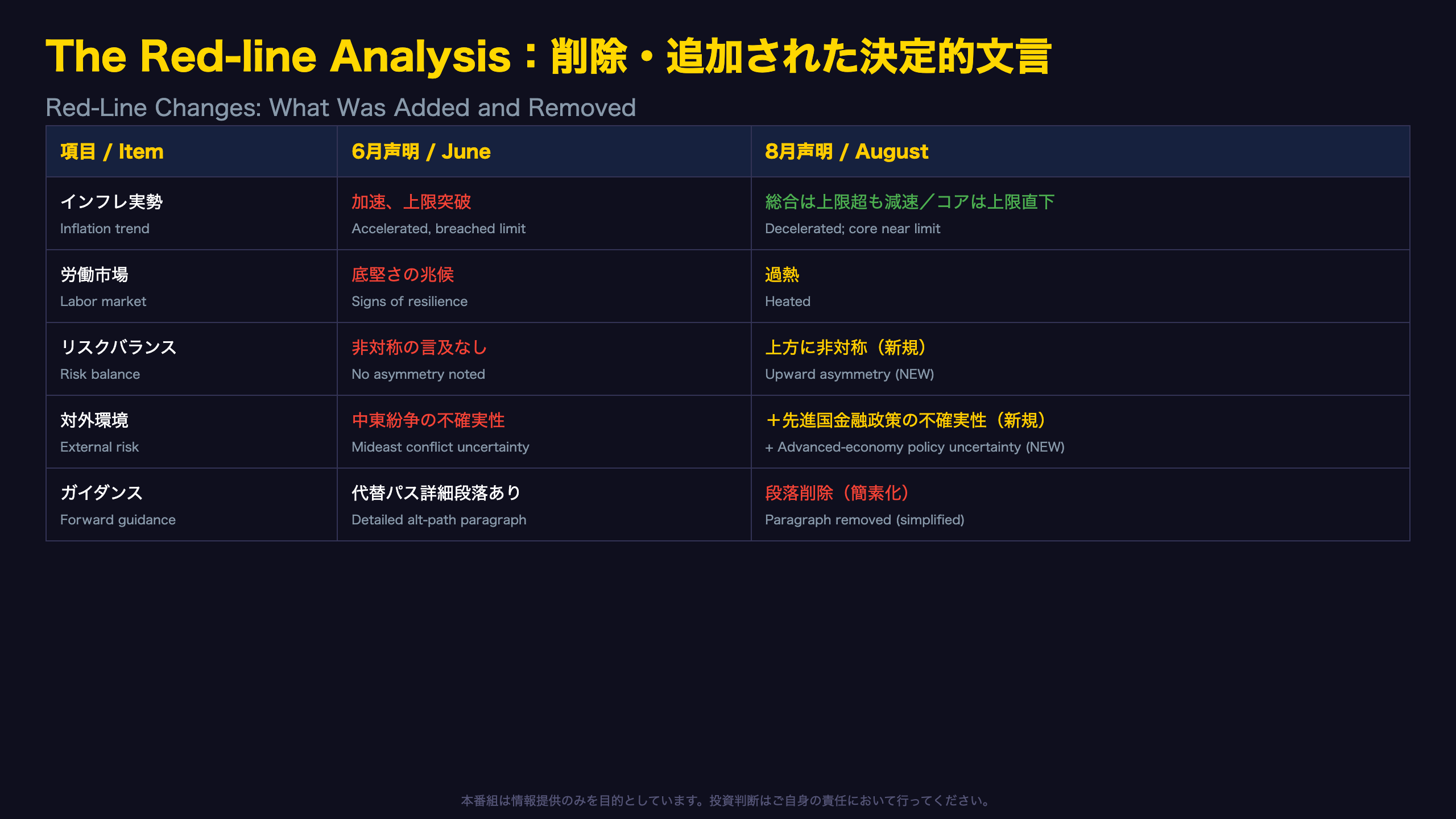
| Item | June Statement | August Statement |
|---|---|---|
| Inflation trend | Headline & core both “accelerated, breached upper limit” | Headline “decelerated but above upper limit”; core “decelerated to just below upper limit” |
| Labor market | “Still showing signs of resilience” | “Heated” (aquecido) |
| Risk balance | “Higher than usual” (no asymmetry mentioned) | “Higher than usual, with upward asymmetry“ |
| External environment | Uncertainty over Middle East conflict resolution terms | Middle East conflict plus new phrase: “uncertainty over monetary policy in some advanced economies” |
| Forward guidance | Detailed paragraph on alternative rate-path simulations | That paragraph removed entirely |
Reading the Signal (Level B inference)
The simultaneous occurrence of improving actual inflation data (Level A, explicit in text) and hardening risk/labor-market language (also Level A) suggests Copom’s stance is best described as “data is improving, but forward-looking upside vigilance has intensified” (Level B inference).
Why the Removed Paragraph Matters
The June statement’s elaborate discussion of “accumulated degree of monetary restriction” and “alternative rate paths consistent with convergence” — reminiscent of the Fed’s SEP dot-plot dispersion commentary — vanished entirely in August. This likely reflects (Level C) a deliberate simplification back toward standard meeting-by-meeting, data-dependent guidance, rather than a signal about the terminal rate itself.
For context, Brazil’s inflation target is centered at 3% with a tolerance band (upper limit 4.5%), making the phrase “just below the upper limit” for core inflation meaningfully different from breaching it, as was the case in June.
局所的ディテール:期待インフレと管理価格の綱引き
A Tale of Two Forecasts: Focus Survey vs. Copom’s Own Model
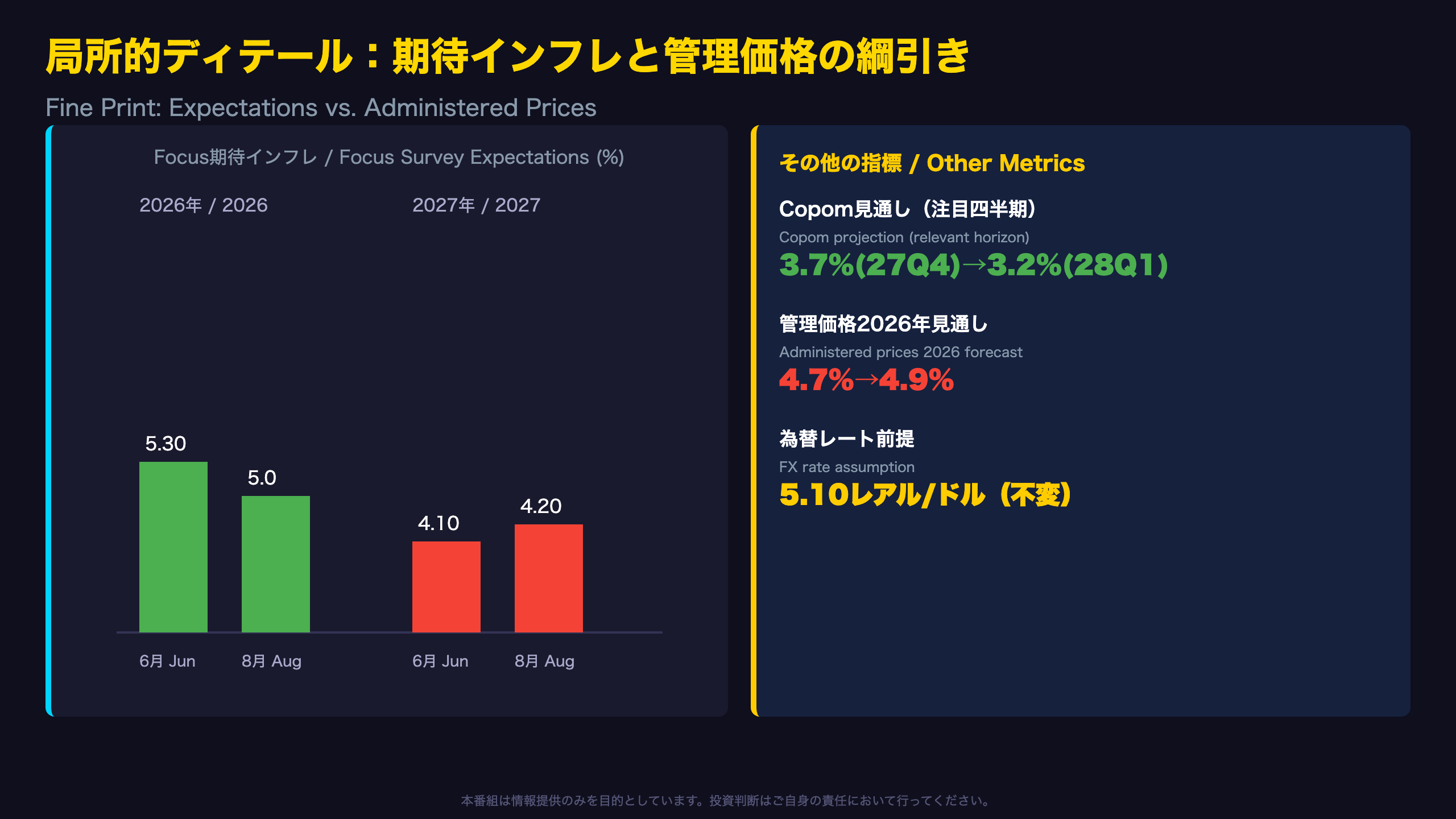
The Focus survey — Brazil’s equivalent of the Fed’s Survey of Professional Forecasters, but conducted weekly by the BCB and embedded directly into every Copom statement — showed diverging trends:
– 2026 inflation expectation: 5.30% → 5.0% (improved)
– 2027 inflation expectation: 4.10% → 4.20% (worsened slightly)
Meanwhile, Copom’s own reference-scenario projection rolled its “relevant horizon” forward by one quarter, from Q4 2027 to Q1 2028, with the forecast value falling from 3.7% to 3.2% — steadily converging toward the target’s 3.0% center.
The Blind Spot: Regulated Prices
An underappreciated upside contributor is “IPCA administrados” (regulated/administered prices) — utility tariffs, public transport fares, and similar items largely outside the central bank’s direct control. This forecast rose from 4.7% to 4.9% for 2026, even as market-set prices (IPCA livres) improved from 5.3% to 5.1%. This dynamic somewhat resembles how U.S. shelter costs or eurozone administered energy tariffs can offset broader disinflation trends in core CPI baskets.
A Stable FX Assumption
The reference-scenario USD/BRL assumption has held steady at 5.10 since June, unchanged from the prior meeting though weaker than April’s 5.00 assumption. This stability suggests the Committee’s oft-repeated concern about “a persistently more depreciated exchange rate” as an upside inflation risk is being monitored against a fixed baseline rather than a moving one — useful context for FX traders tracking BRL positioning around Copom meetings.
インプリケーション:利下げペース鈍化のリスク
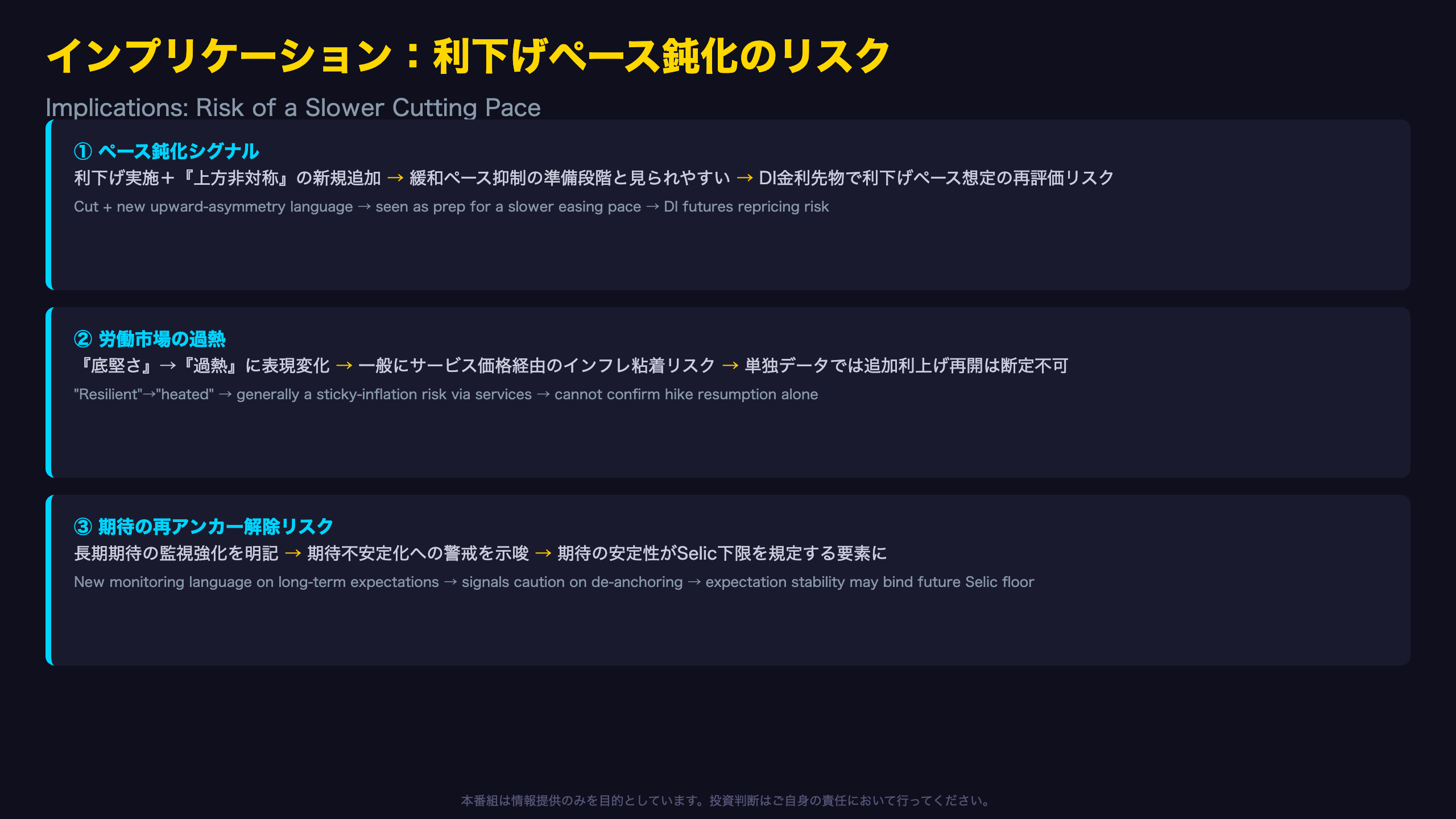
The Chain of Evidence: Three Market Implications
① Signal of a Slowing Pace
[Fact] A rate cut was delivered alongside a brand-new “upward risk asymmetry” phrase → [Mechanism] Central banks that introduce explicit risk-asymmetry language during an easing cycle are generally preparing markets for a slower pace of future cuts → [Market implication] Brazilian interest rate futures (DI contracts) may see repricing risk, with previously priced-in cut paths pushed further out.
② The Hot Labor Market
[Fact] The labor market description changed from “resilient” to “heated” (aquecido) → [Mechanism, general] A heated labor market is commonly viewed as a source of medium-term sticky inflation risk transmitted via services prices → [Caveat] However, this single data point alone cannot confirm that BCB will resume rate hikes.
③ Expectation De-Anchoring Risk
[Fact] A new sentence was added committing to monitor de-anchoring of long-term inflation expectations → [Mechanism, general] Central banks that emphasize expectation stability are typically guarding against a risk that unanchored expectations undermine policy transmission → [Market implication] The stability of inflation expectations could become a binding constraint on how low Selic can ultimately go.
Bridge to the Next Meeting
Copom typically meets roughly eight times a year, putting the next decision around late September to early October 2026. Three things to watch: (1) whether the Focus survey’s 2026/2027 inflation expectations continue improving, (2) whether administered prices (utilities, public tariffs) rise further, and (3) whether the “assimetria altista” (upward asymmetry) phrase is retained or dropped in the next statement — its removal would be a strong signal that the cutting cycle could reaccelerate. For international investors, this dynamic is comparable to watching whether the Fed retains or drops “data dependent” hawkish caveats in FOMC statements even while cutting rates.
Disclaimer: This article is for informational purposes only. All investment decisions are made solely at your own risk.