📺 Watch the Full Video Analysis
This article was automatically generated by the NFC Market Live AI analysis system. (Updated: 2026-07-31 14:28 JST)
📄 Primary Source
日本銀行
https://www.boj.or.jp/mopo/outlook/gor2607a.pdf
📊 A deep dive into the Bank of Japan’s July 31, 2026 Outlook Report.
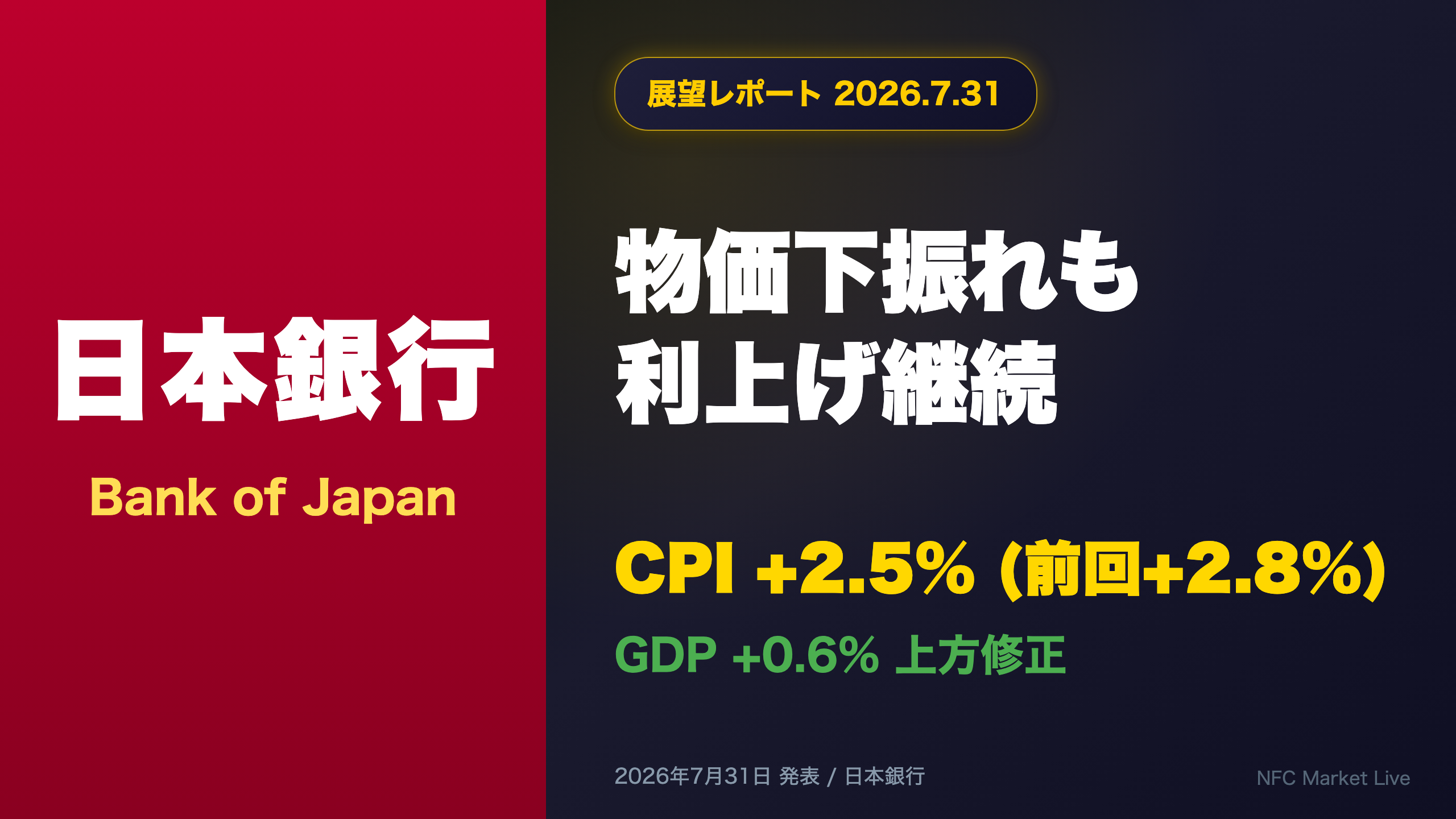
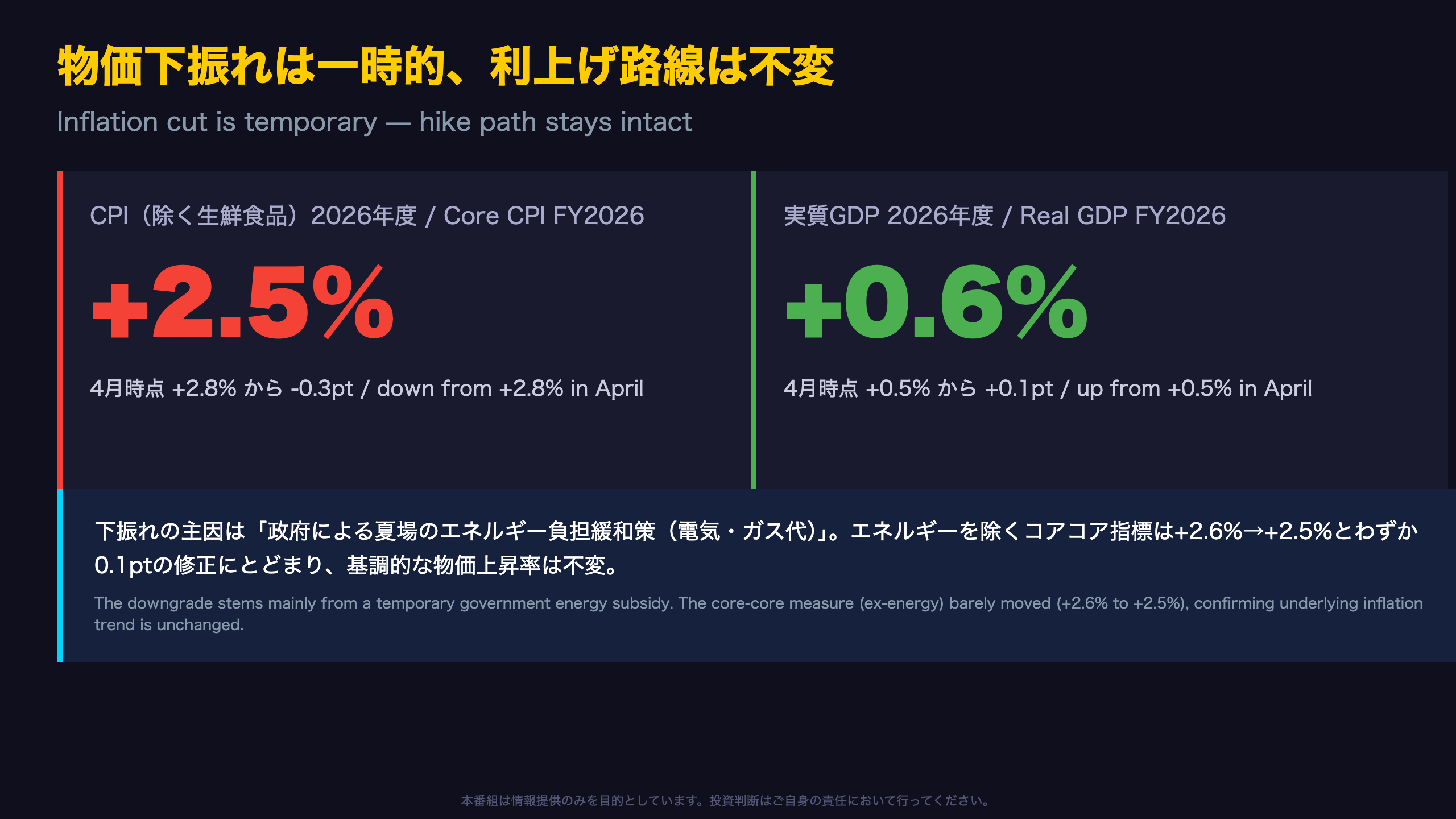
The FY2026 core CPI forecast was cut to +2.5%, down 0.3pt from April’s +2.8%.
📉 But the downgrade is driven by a temporary government energy subsidy — the core-core measure (ex-energy) was barely revised, down just 0.1pt.
📈 Meanwhile, real GDP was revised UP to +0.6%, supported by robust global AI-related demand.
💡 Crucially, the BOJ retained its pledge to “continue raising the policy rate.” We unpack what the numbers really mean for JGB yields and the yen.
総括:物価下振れは一時的、利上げ路線は不変
Beyond the Headline: What the BOJ Really Signaled
At first glance, the July 2026 Outlook Report reads as a dovish surprise: the fiscal 2026 core CPI forecast was cut from +2.8% (April) to +2.5%, a 0.3 point downgrade. A closer read suggests the opposite — this report reaffirms the BOJ’s hawkish rate-hike trajectory.
Context for international readers
The BOJ’s Outlook Report (Tenbo Report, 展望レポート) is published quarterly (Jan, Apr, Jul, Oct) and contains median forecasts from the nine-member Policy Board, comparable in function to the Fed’s Summary of Economic Projections, though the BOJ does not publish a rate “dot plot.”
Key comparison table
| Indicator | FY2026 (July) | FY2026 (April) | Revision |
|---|---|---|---|
| Real GDP | +0.6% | +0.5% | +0.1pt |
| Core CPI (ex-fresh food) | +2.5% | +2.8% | -0.3pt |
| Core-core CPI (ex-food & energy) | +2.5% | +2.6% | -0.1pt |
The report states plainly the downgrade stems from “the government’s summer energy subsidy program (electricity and gas),” not a change in underlying dynamics. The core-core measure — the BOJ’s preferred underlying gauge — was cut by just 0.1 point, confirming this is largely a fiscal artifact.
Meanwhile, GDP was revised up, driven by robust global AI-related capex demand, a detail investors tracking the AI capex supercycle should note.
Market read
Unlike the Fed, where soft CPI often triggers dovish repricing, the BOJ explicitly retained language committing to “continue raising the policy rate.” This decoupling of headline CPI from the policy signal is the single most important nuance for JGB and JPY positioning this quarter.
実質GDP:レンジ収斂とAI需要の押し上げ
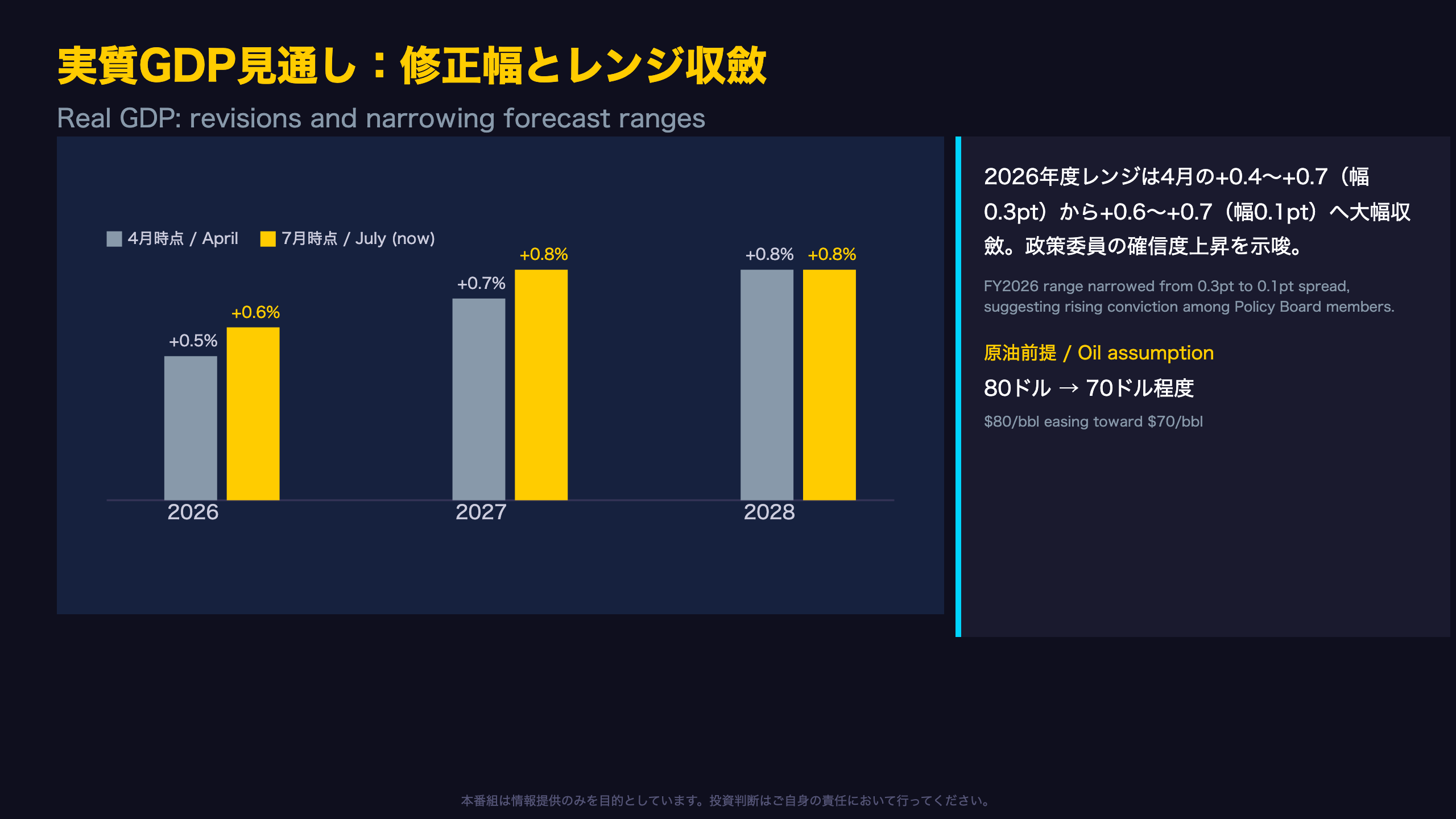
Real GDP: Forecast Ranges Narrow, Confidence Rises
The BOJ Policy Board publishes not just a median GDP forecast but a range reflecting dispersion among the nine members (after trimming the highest and lowest). Tracking how that range narrows or widens is often more informative than the median alone.
Range comparison
| Fiscal Year | July median (range) | April median (range) |
|---|---|---|
| FY2026 | +0.6% (+0.6 to +0.7) | +0.5% (+0.4 to +0.7) |
| FY2027 | +0.8% (+0.7 to +0.8) | +0.7% (+0.6 to +0.8) |
| FY2028 | +0.8% (+0.7 to +0.8) | +0.8% (+0.7 to +0.8) |
The FY2026 range compressed from a 0.3-point spread in April to just 0.1 point in July — signaling Policy Board members have converged on a more confident growth view despite persistent Middle East oil-price risk.
Oil price assumption — a transparent modeling input
Unlike the Fed, the BOJ explicitly discloses its crude oil (Dubai) price path: near $80/barrel initially, easing to around $70/barrel by the horizon’s end, based on futures curves — letting analysts stress-test the forecast against alternative scenarios.
Potential growth — a hedged estimate
A footnote estimates Japan’s potential growth at “mid-to-high 0% range,” cautioning this “must be viewed with considerable latitude” given estimation uncertainty — far more hedged than typical US potential-GDP estimates, reflecting Japan’s demographic and structural uncertainties.
Two-sided AI risk
The report flags that robust AI capex could lift global growth, but if “profit expansion does not match the investment,” a correction could occur — echoing US debates about AI capex ROI.
物価見通し:headline下振れとunderlying不変の乖離
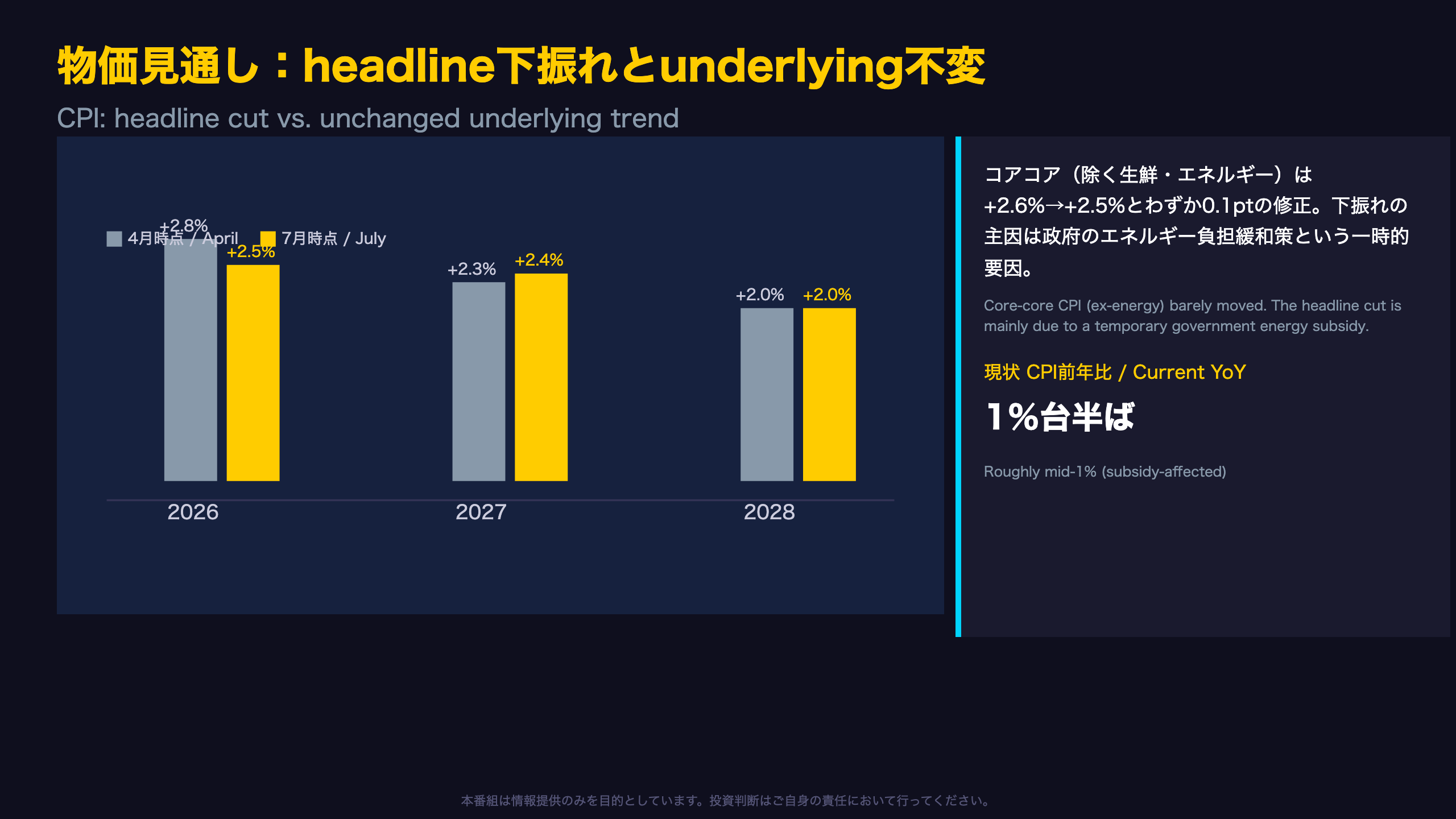
Headline vs. Underlying Inflation: Why the Gap Matters
For investors used to US or Eurozone CPI, Japan’s practice of publishing both a “core” (ex-fresh food) and “core-core” (ex-fresh food and energy) measure is a critical nuance. The core measure is the BOJ’s official policy target gauge; core-core is often seen as a cleaner read on demand-driven inflation.
Comparison table
| Metric | FY2026 (Jul) | FY2026 (Apr) | Revision |
|---|---|---|---|
| Core CPI (ex-fresh food) | +2.5% | +2.8% | -0.3pt |
| Core-core CPI (ex-food & energy) | +2.5% | +2.6% | -0.1pt |
| FY2027 Core CPI | +2.4% | +2.3% | +0.1pt |
| FY2028 Core CPI | +2.0% | +2.0% | unchanged |
The report states: “the year-on-year core CPI is expected to accelerate to clearly above 2% from H2 FY2026… before gradually converging back toward 2% as oil effects fade.” This path is essentially unchanged from April.
The subsidy distortion — a lesson for reading Japanese CPI
Unlike the US, Japan’s government has repeatedly used direct energy subsidies that mechanically suppress the reported CPI without changing underlying dynamics — more direct than, say, a US gasoline tax holiday. Readers should check for active subsidy programs before treating any single Japan CPI print as a clean signal.
Output gap and wage-price spiral
Japan’s output gap remains in “small positive territory,” and labor market tightness exceeds what the aggregate gap alone would suggest — a structural labor-shortage story somewhat unique versus other G7 economies.
Risk to watch
If the subsidy is extended, headline CPI could understate true inflation momentum longer than markets price in — an upside risk once subsidies eventually lapse.
リスク要因と政策運営:上振れリスク優勢
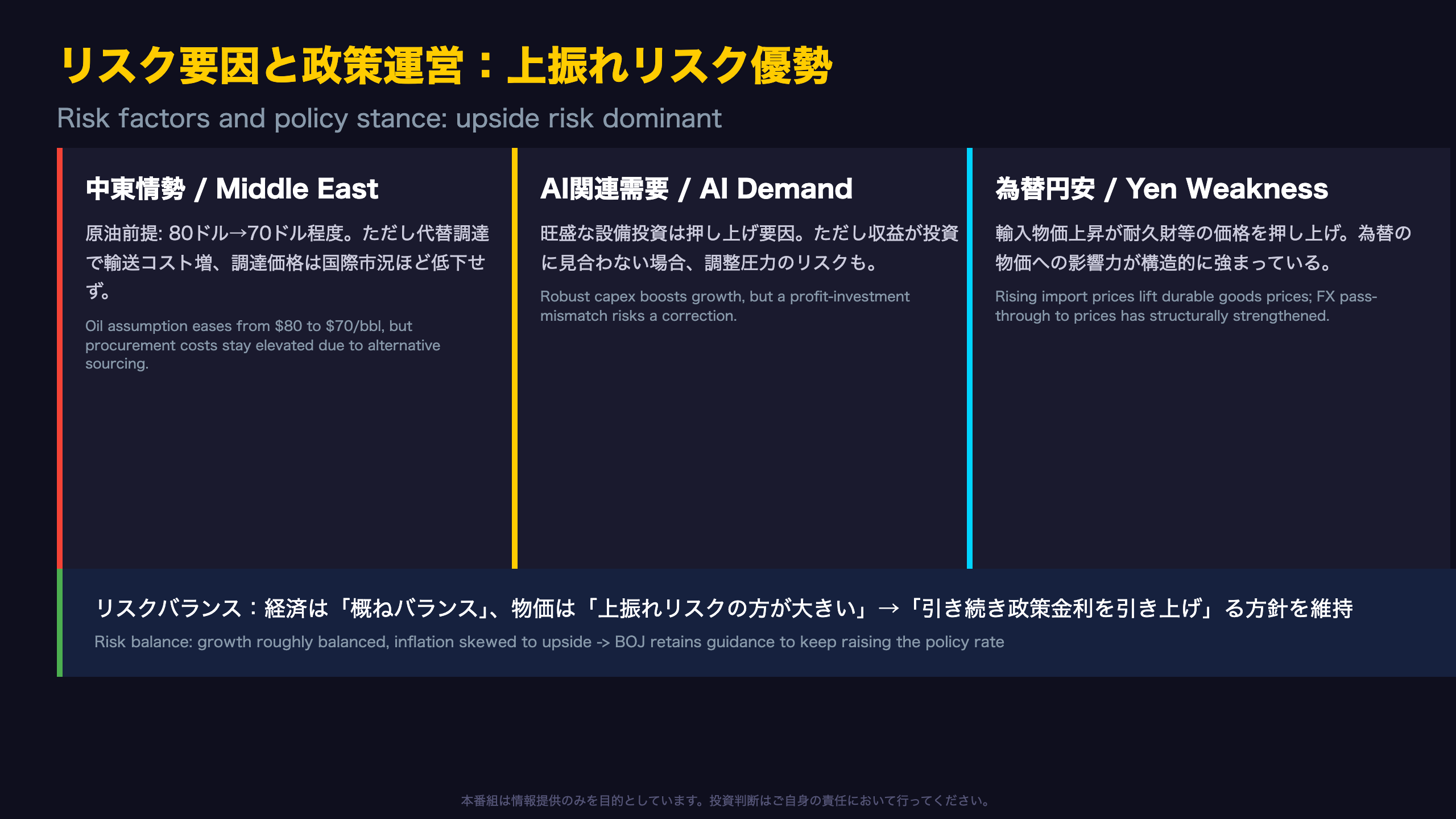
The Three Pillars of Risk — and Why Upside Inflation Risk Dominates
The BOJ’s risk assessment centers on three factors: Middle East geopolitical developments, global AI-related demand, and yen exchange-rate moves.
Middle East — risk receding but not gone
“The risk of a major supply chain disruption significantly affecting Japanese firms’ production has declined, partly due to progress in diversifying procurement of Middle East-dependent raw materials.”
Yet the Bank cautions that “the impact of oil price increases seen so far still warrants continued attention” — a nuanced two-sided framing rather than an all-clear.
AI capex — a two-way risk, mirroring US debates
Much like Wall Street’s ongoing debate over hyperscaler AI capex returns (Nvidia, Microsoft, Google), the BOJ flags: vigorous investment “could further boost the global economy,” but if “profit expansion does not match the investment,” adjustment pressures may arise, potentially via asset price corrections. Rising semiconductor and copper prices are expected to filter into consumer durable pricing.
Yen weakness — a structurally larger price channel
The report notes the recent sharp rise in import prices “will likely push up prices of a wide range of goods, led by durables,” and states exchange-rate movements have become “more likely to affect prices” as firms adopt more active wage/price-setting — a meaningful shift from the deflationary era’s weak pass-through.
The Two-Pillar policy framework
Consistent with its 2013 framework, the BOJ evaluates policy via a First Pillar (central forecast) and Second Pillar (risk assessment). The conclusion — inflation risks skewed to the upside — is the direct analytical basis for continued hawkish guidance.
インプリケーション:金利・為替への含意
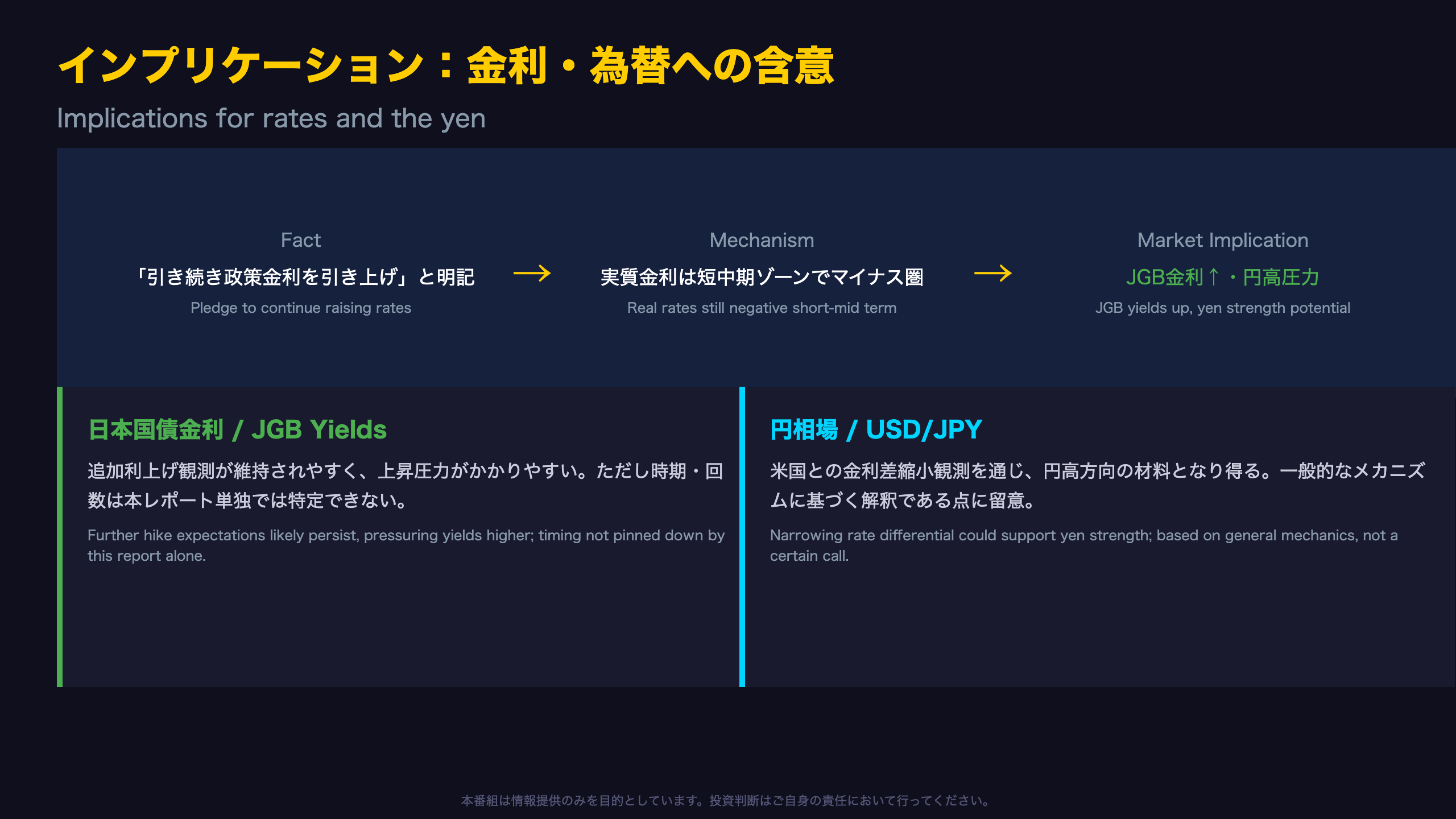
Forward Path: Scenario Thresholds and Market Mechanics
The BOJ publishes its Outlook Report quarterly (January, April, July, October); the next release is due in October 2026. International investors should track these specific thresholds:
Scenario branches
- Upside scenario: If core CPI accelerates to “clearly above 2%” in H2 FY2026 as projected, and core-core inflation holds in the low-2% range, confidence in additional rate hikes rises materially.
- Downside/distortion scenario: If the government extends or expands the energy subsidy, headline CPI could stay artificially subdued, raising the risk markets misjudge the true pace of underlying inflation.
- Base case: If Dubai crude eases toward $70/bbl as assumed and USD/JPY stabilizes near current levels, the BOJ’s baseline path holds, with policy “adjusted while monitoring conditions.”
The chain of reasoning — rates and FX
[Fact] -> [Mechanism] -> [Market implication]:
The BOJ’s pledge to “continue raising the policy rate” is grounded in its own finding that “real interest rates remain negative, especially in the short-to-medium maturity zone” -> which generally suggests markets can keep pricing in further hikes, supporting upward pressure on JGB yields and yen appreciation potential against the dollar. This is a general monetary-mechanics inference; the report alone does not pin down specific timing.
Why this matters for non-Japan investors
For global bond investors, a hawkish BOJ amid an easing Fed cycle narrows the US-Japan rate differential — directly relevant to carry-trade unwind risk that has periodically roiled global markets. For equity investors, rising JGB yields raise the discount rate on Japanese growth stocks, while yen strength is a headwind for exporters but a tailwind for import-heavy and domestic-demand sectors.
Practical read-through
Variable-rate mortgage costs and corporate borrowing costs in Japan may drift gradually higher in line with the policy path, while a strengthening wage-price cycle could support real household income gains.
Disclaimer: This article is for informational purposes only. All investment decisions are made solely at your own risk.