📺 Watch the Full Video Analysis
This article was automatically generated by the NFC Market Live AI analysis system. (Updated: 2026-07-29 00:07 JST)
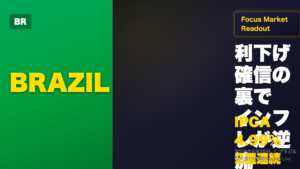
📊 Brazil’s June IPCA rose just 0.16% MoM, down sharply from May’s 0.58%.
📉 Core inflation (ex food & energy) also collapsed to 0.11%, hinting at broader disinflation.
⚠️ Yet the 12-month rate of 4.64% remains above the central bank’s 4.5% ceiling.
💡 Administered prices (electricity tariffs) and sticky labor-intensive services remain a risk.
We break down the real interest rate gap (Selic 14.25%) and what it means for BRL.
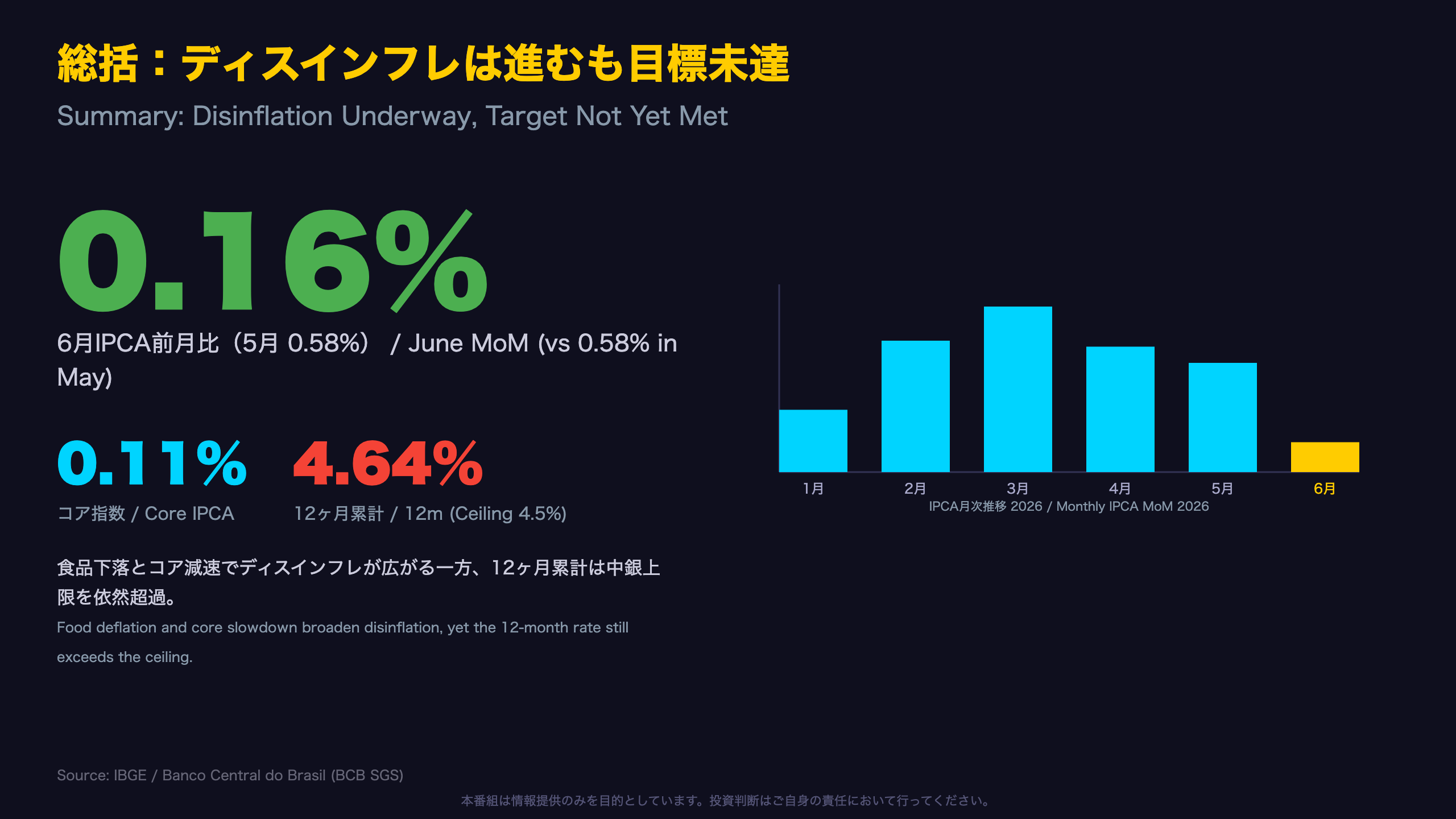
総括:ディスインフレは進むも目標未達
Context: What is IPCA and Why It Matters
IPCA (Índice Nacional de Preços ao Consumidor Amplo) is Brazil’s official consumer price index, published monthly by IBGE. It is the reference index for the Central Bank of Brazil’s (BCB) inflation target, similar in function to the U.S. CPI for the Federal Reserve, though Brazil’s framework uses a formal band (currently 3.0% ± 1.5%, i.e., a ceiling of 4.5%).
Six-month trajectory tells a clearer story
Looking at 2026 monthly prints — Jan 0.33%, Feb 0.70%, Mar 0.88% (the year’s peak), Apr 0.67%, May 0.58%, June 0.16% — inflation has decelerated for four straight months since March. June’s 0.16% appears to be the lowest monthly print in at least the past 13 months of available data.
INPC cross-check
The INPC (a parallel index tracking lower-income households) posted an even sharper deceleration to 0.14% from 0.65% in May, with food products falling -0.29%. This suggests the disinflation is not confined to upper-income consumption patterns.
Bull vs. bear read
Bulls will note core inflation cratering to 0.11% as evidence that underlying demand-driven pressure is genuinely easing. Bears will caution that a single month of food deflation and falling fuel prices doesn’t yet confirm a durable trend — Brazil’s 12-month rate (4.64%) remains above the BCB’s 4.5% ceiling.
What’s next
Markets will watch whether July’s IPCA confirms the deceleration or whether food/administered prices rebound, and whether the 12-month rate finally breaks below the 4.5% ceiling — a key threshold for any Copom rate-cut discussion.
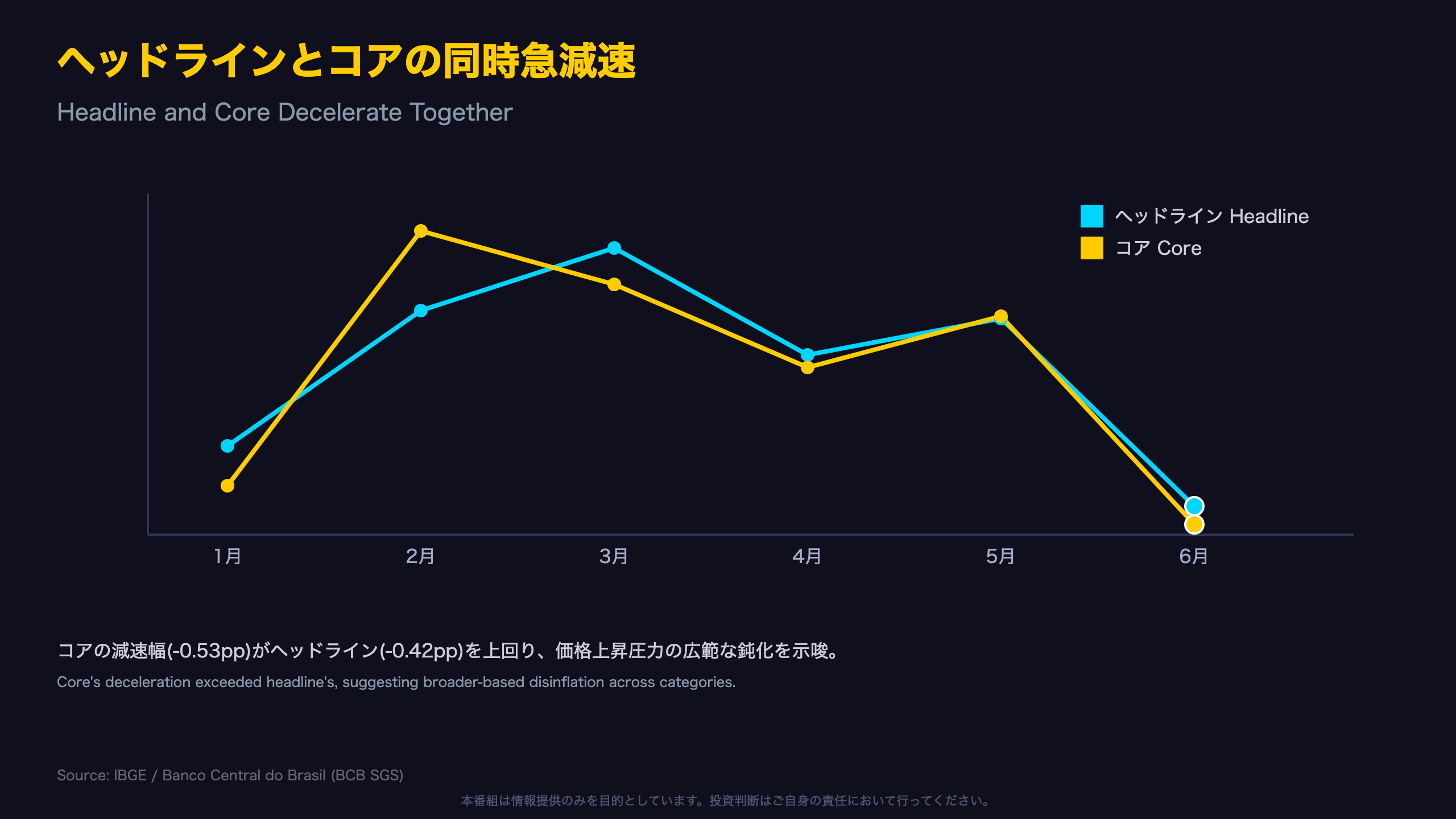
ヘッドラインとコアの同時急減速
Why Core Inflation Matters More Than Headline Here
Core IPCA (BCB series 11428) strips out food and energy to reveal the stickier trend in housing, services, and durable goods. Tracing the 2026 path: Jan 0.25%, Feb 0.89%, Mar 0.75%, Apr 0.55%, May 0.64%, June 0.11%. After accelerating into February-March, core inflation has now decelerated for three consecutive months, with June’s 0.11% the lowest print in the entire 13-month dataset provided.
An unusual reversal
Typically, headline CPI swings more than core because of volatile food and fuel prices. This month, the opposite happened: core decelerated by 0.53 percentage points versus the headline’s 0.42-point drop. That’s a meaningful signal — it implies categories beyond food and energy also lost momentum simultaneously, generally viewed as a sign of broader-based disinflation rather than a one-off food price swing.
The caveat
Education prices fell -0.02% in June, but education costs in Brazil carry strong seasonal patterns tied to the school calendar. A single month’s core reading, however striking, is not enough to confirm a structural turn — July and August data will be the real test.
Comparison to the Fed’s core PCE
For U.S.-based readers: Brazil’s core IPCA plays a role analogous to the Fed’s core PCE, serving as the central bank’s preferred gauge of underlying inflationary momentum, distinct from headline swings.
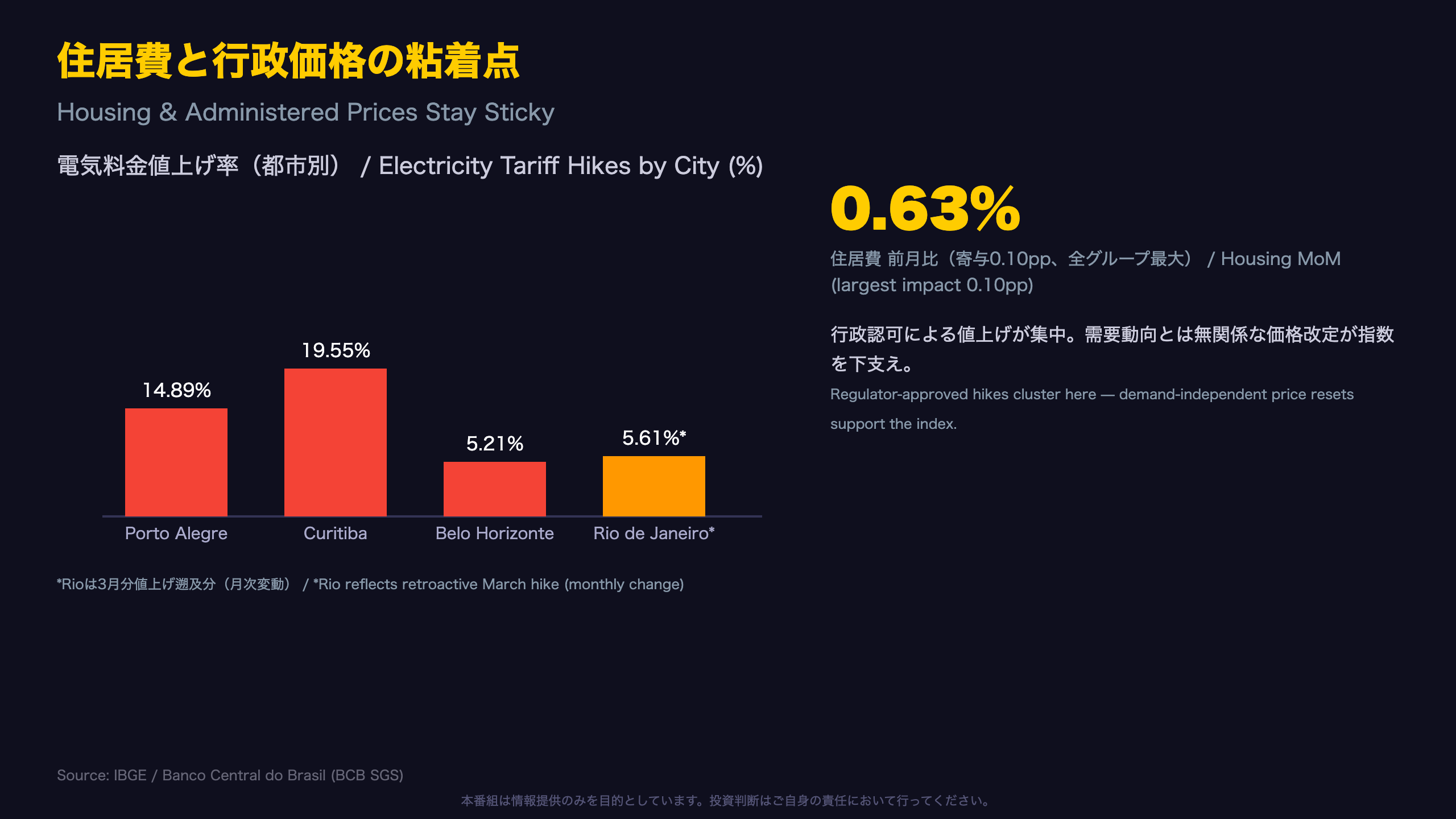
住居費と行政価格 — 見えにくいインフレの粘着点
Administered Prices: The Inflation Component Demand Can’t Explain
Brazil’s housing group rose 0.63% in June — decelerating from May’s 1.22%, but still the single largest positive contributor to the headline index (0.10 percentage points). The reason lies in what economists call administered prices — items whose rates are set by regulators or utility contracts rather than market supply and demand.
A city-by-city tariff story
According to IBGE, several regional utilities implemented rate hikes in June: 14.89% in one Porto Alegre utility (effective June 19), 19.55% in Curitiba (effective June 24), and 5.21% in Belo Horizonte (effective May 28). Rio de Janeiro’s 5.61% monthly move reflected a retroactive application of a 15.10% rate increase originally dated to March 2026, formalized by regulator ANEEL under dispatch order 2,129, issued June 11.
Water and gas moved in different directions
Water and sewage tariffs rose in Brasília (+3.72%) and Rio Branco (+5.91%), both effective June 1, while piped gas in Rio de Janeiro fell -1.84% — illustrating administered price movements aren’t uniformly upward.
Why this matters for investors
Administered prices are largely insulated from BCB rate decisions, since they respond to regulatory calendars, not credit conditions. Separating this non-market inflation from demand-driven inflation gives a cleaner read on whether Selic’s restrictive stance is actually working. Watch whether further municipal tariff resets appear in July’s data.
対人サービス価格の粘着性
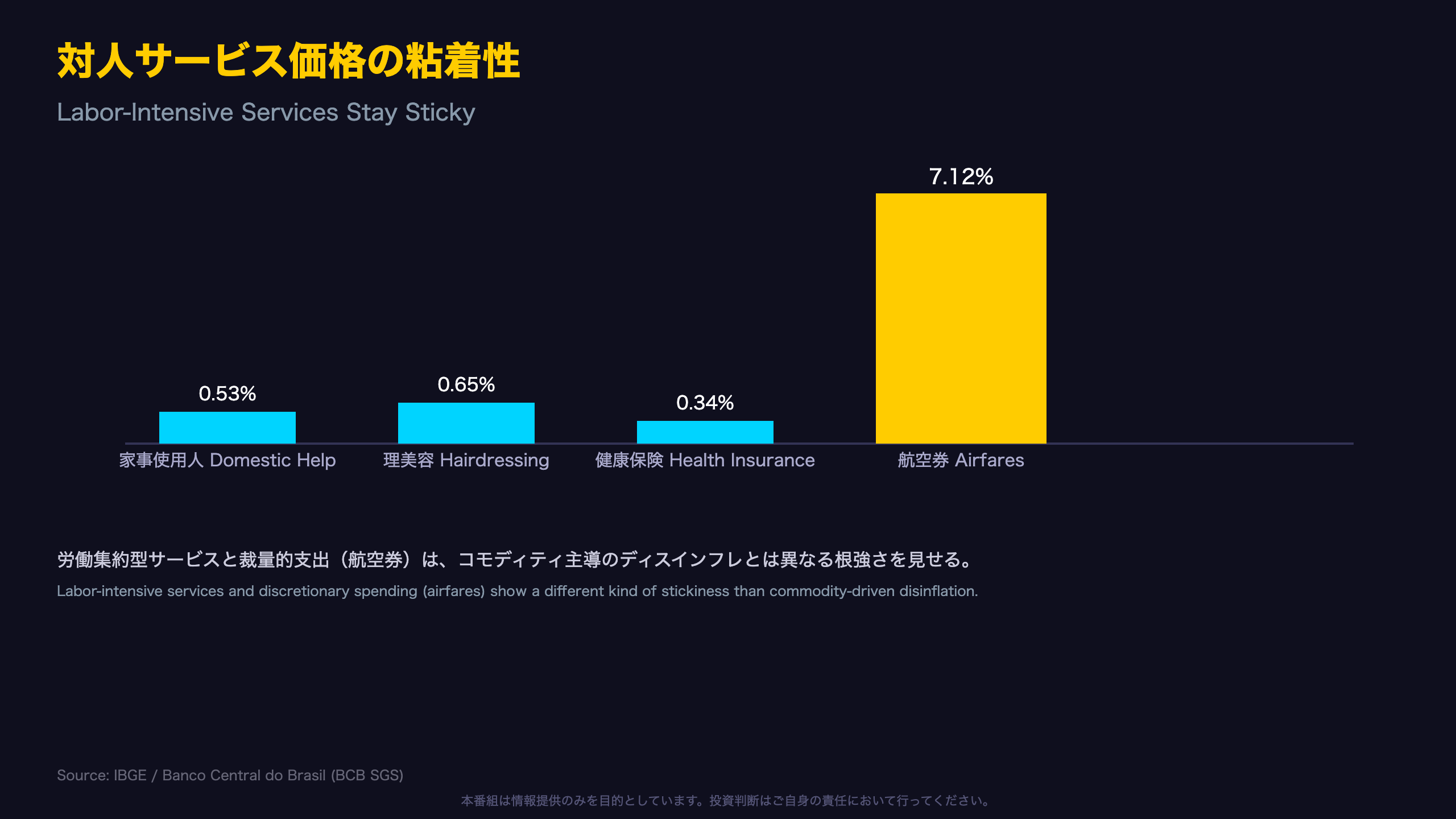
Sticky Service Prices: The Part of Inflation That Doesn’t Cool Quickly
While food deflation and falling fuel prices dominated the headline story, Brazil’s personal expenses group quietly posted the second-largest increase of any category at 0.25%, led by domestic workers’ wages (+0.53%) and hairdressing/barber services (+0.65%). These are classic examples of labor-intensive services where wage costs pass through directly to consumer prices — economists often treat this category as a proxy for labor market tightness, similar to how the U.S. Fed watches supercore services inflation.
Health insurance: a regulatory pass-through
Health insurance plans rose 0.34% in June, but this reflects a regulator-mandated adjustment: Brazil’s National Supplementary Health Agency (ANS) authorized a 5.11% rate hike, effective from May 2026 — an administered, non-market price movement layered on top of organic services inflation.
Airfares: a discretionary demand signal
Total transportation costs rose just 0.17%, masked by broad fuel declines (ethanol -3.09%, diesel -1.19%, gasoline -0.12%), but airfares alone jumped 7.12%. This divergence may point to resilient discretionary spending among higher-income consumers — a pattern some economists watch as a leading indicator of demand-side price pressure that could prove more persistent than commodity-driven inflation.
The debate ahead
Doves argue these are isolated categories that don’t threaten the broader disinflation trend. Hawks on the BCB’s rate-setting committee (Copom) may flag labor-intensive services stickiness as evidence that demand-pull pressures haven’t fully faded — a key variable for how long Selic stays restrictive.
12ヶ月累計と実質金利 — 目標回帰までの距離
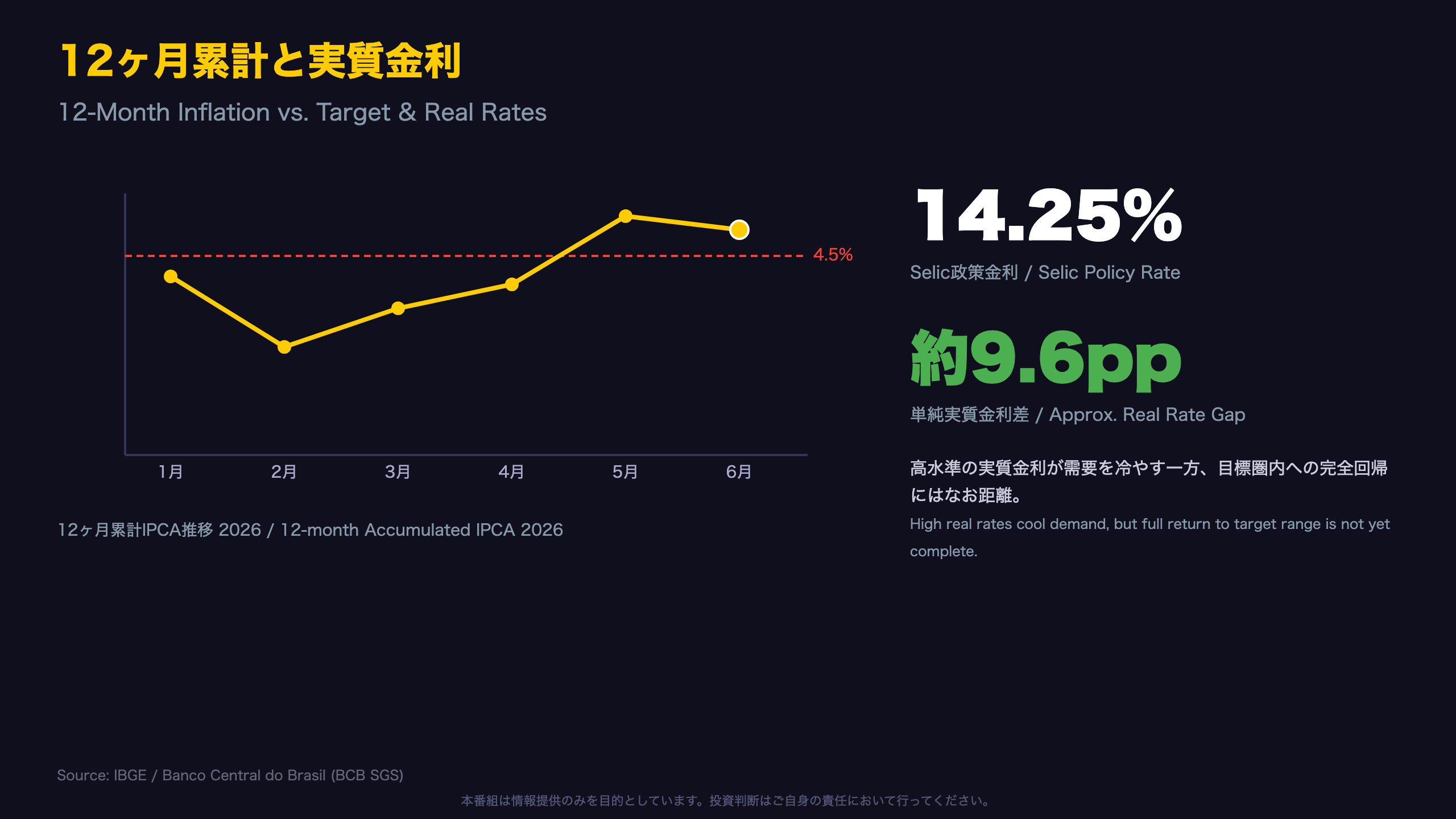
Measuring the Distance Back to Target
The BCB’s inflation target framework centers on 3.0%, with a tolerance band of ±1.5 percentage points — an effective ceiling of 4.5%. Tracing 2026’s 12-month path: January 4.44%, February 3.81% (the only month inside the ceiling), March 4.14%, April 4.39%, May 4.72% (the year’s peak), June 4.64%. After briefly dipping below the ceiling in February, the rate climbed back above it through May before finally reversing in June.
Real interest rates: Brazil’s other yardstick
The Selic policy rate sits at 14.25% (as of July 28, 2026). A simple subtraction against the 12-month IPCA of 4.64% yields an approximate real interest rate gap of 9.61 percentage points (roughly 9.2% on a compounded basis) — one of the highest real rates among major emerging markets. For context, this is a far more restrictive stance than the U.S. Federal Reserve’s real policy rate, which typically operates in the 1-2.5% range. This gap underscores the BCB’s continued commitment to bringing inflation back within target.
A word of caution on naive annualization
The first-half 2026 accumulated rate of 3.36% might tempt a rough doubling to 6.7% annualized, but this ignores seasonal patterns and monthly volatility and should not be treated as a forecast.
What to watch next
The key threshold for markets: does July’s 12-month IPCA fall clearly below 4.5%? A sustained break below that ceiling would be the strongest signal yet that Copom could begin discussing rate cuts.
市場へのインプリケーション
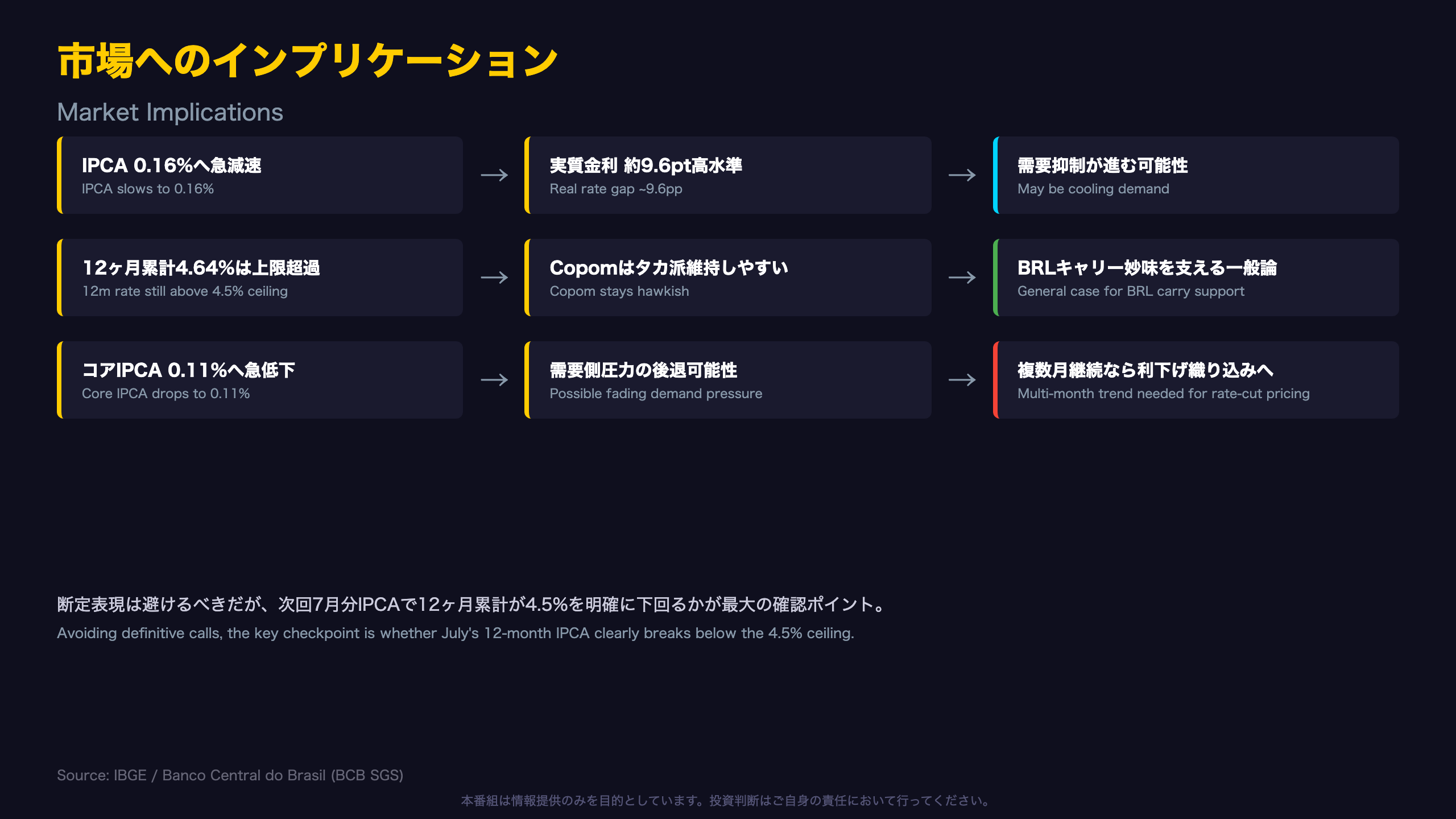
Chain-of-Reasoning: What This Data Means for Markets
June IPCA at 0.16% (down from 0.58% in May) → A real interest rate gap of roughly 9.6 percentage points (Selic 14.25% minus 12-month IPCA 4.64%) suggests monetary tightening may be cooling demand → It is generally believed that decelerating inflation combined with high real rates tends to build expectations for future rate cuts, though this single data point cannot confirm the timing of any Selic reduction.
Currency (BRL) implications
The 12-month accumulated rate of 4.64% remains above the BCB’s 4.5% ceiling → This makes it harder for Copom to pivot away from its hawkish stance in the near term → It is commonly thought that maintaining elevated real rate differentials supports carry-trade demand for high-yielding currencies like the BRL, but this is a general market principle — this single inflation report alone cannot determine the currency’s actual near-term direction.
Rates and bond market implications
Core IPCA collapsed to 0.11% → This may indicate underlying, demand-driven inflationary pressure is genuinely fading → Markets generally price in rate-cut expectations as such signals persist over multiple months, but one month’s core reading is insufficient to validate that pricing.
A note for Japanese investors
For those holding BRL/JPY exposure or Brazilian government bonds (such as NTN-B inflation-linked notes), the key checkpoints ahead are whether July’s 12-month IPCA falls clearly below the 4.5% ceiling, and whether core inflation sustains its move toward the 0.11% level. A single month of sharp deceleration is not, by itself, sufficient grounds to price in an imminent Selic rate cut.
Disclaimer: This article is for informational purposes only. All investment decisions are made solely at your own risk.