📺 Watch the Full Video Analysis
This article was automatically generated by the NFC Market Live AI analysis system. (Updated: 2026-07-28 09:12 JST)
📊 A deep dive into Brazil’s latest BCB fiscal statistics.
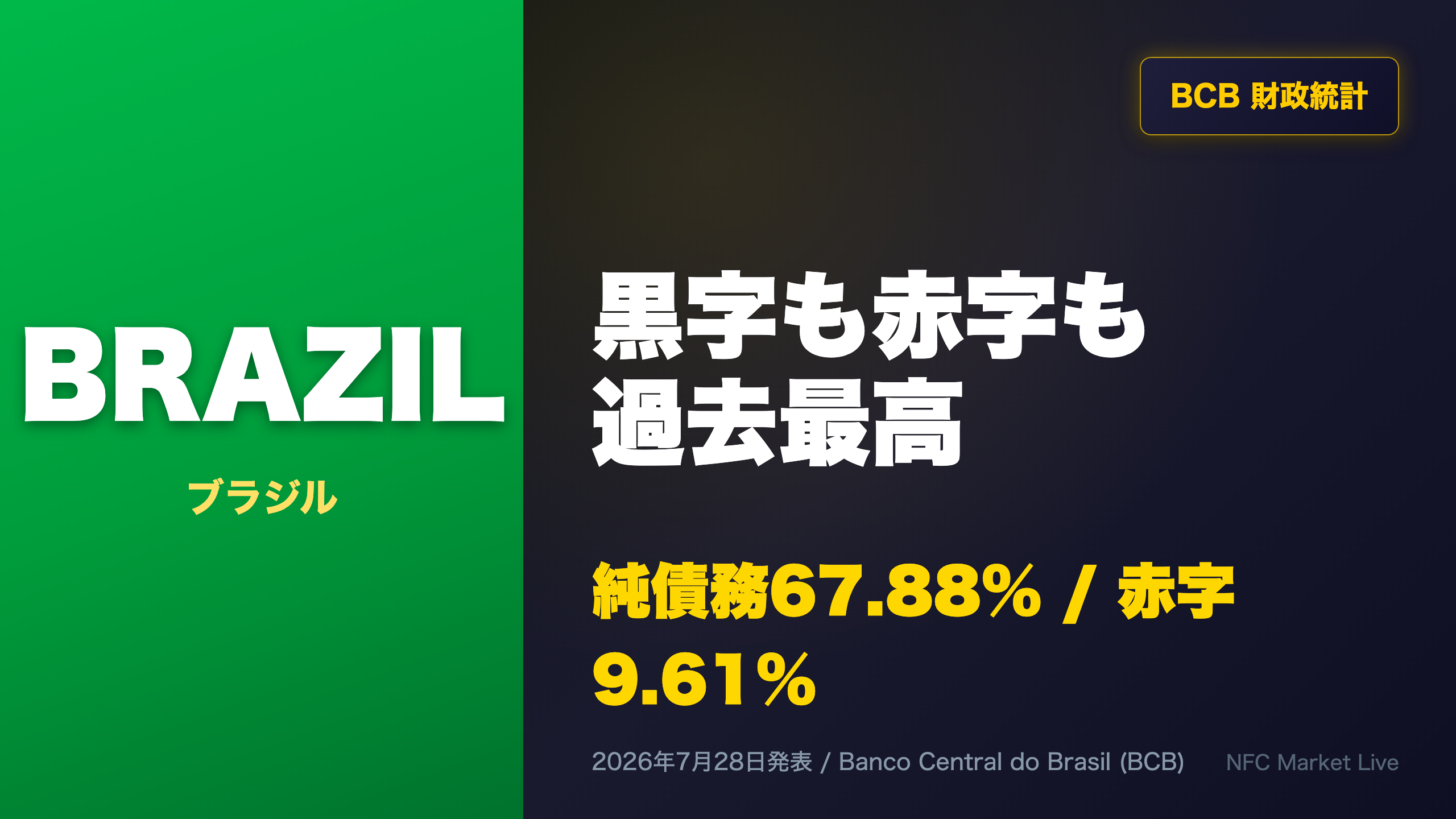
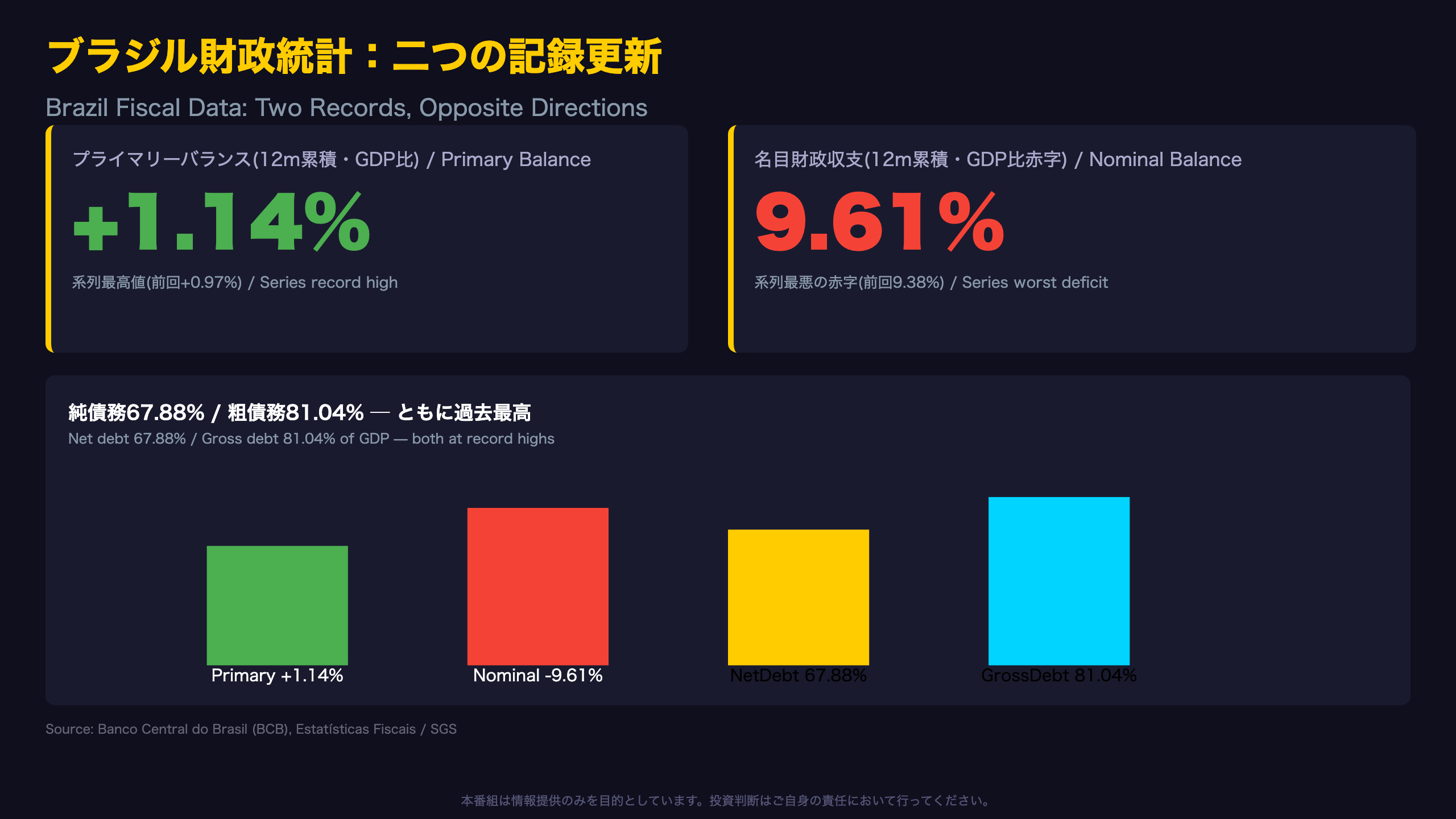
✅ The 12-month primary balance hit a record surplus of +1.14% of GDP — genuine fiscal discipline.
⚠️ Yet the nominal deficit widened to a record 9.61% of GDP over the same period.
📈 Net debt climbed to 67.88% of GDP and gross debt to 81.04%, both fresh records.
💡 High interest costs appear to be offsetting the primary improvement.
A balanced look at what this means for BRL and Brazilian government bonds going forward.
総括:黒字最高値と赤字最悪値、同時進行
Two Record Highs, One Contradiction
Brazil’s central bank (Banco Central do Brasil, BCB) publishes granular monthly fiscal data via its SGS database. The May 2026 release shows two series simultaneously hitting record extremes in opposite directions.
Primary balance (12-month rolling, % of GDP) improved to +1.14%, the strongest reading in this series, up from -0.20% in May 2025. Meanwhile the nominal balance (which nets interest expense against the primary result) deepened to a record 9.61% of GDP deficit, from 7.54% a year earlier.
Net vs. Gross Debt: A Primer
Brazil reports two distinct debt metrics: DLSP (net public debt) at 67.88% of GDP nets out government financial assets like FX reserves, while gross general government debt at 81.04% is the metric comparable to IMF cross-country data (against the U.S.’s ~120%+ or Japan’s ~250%+).
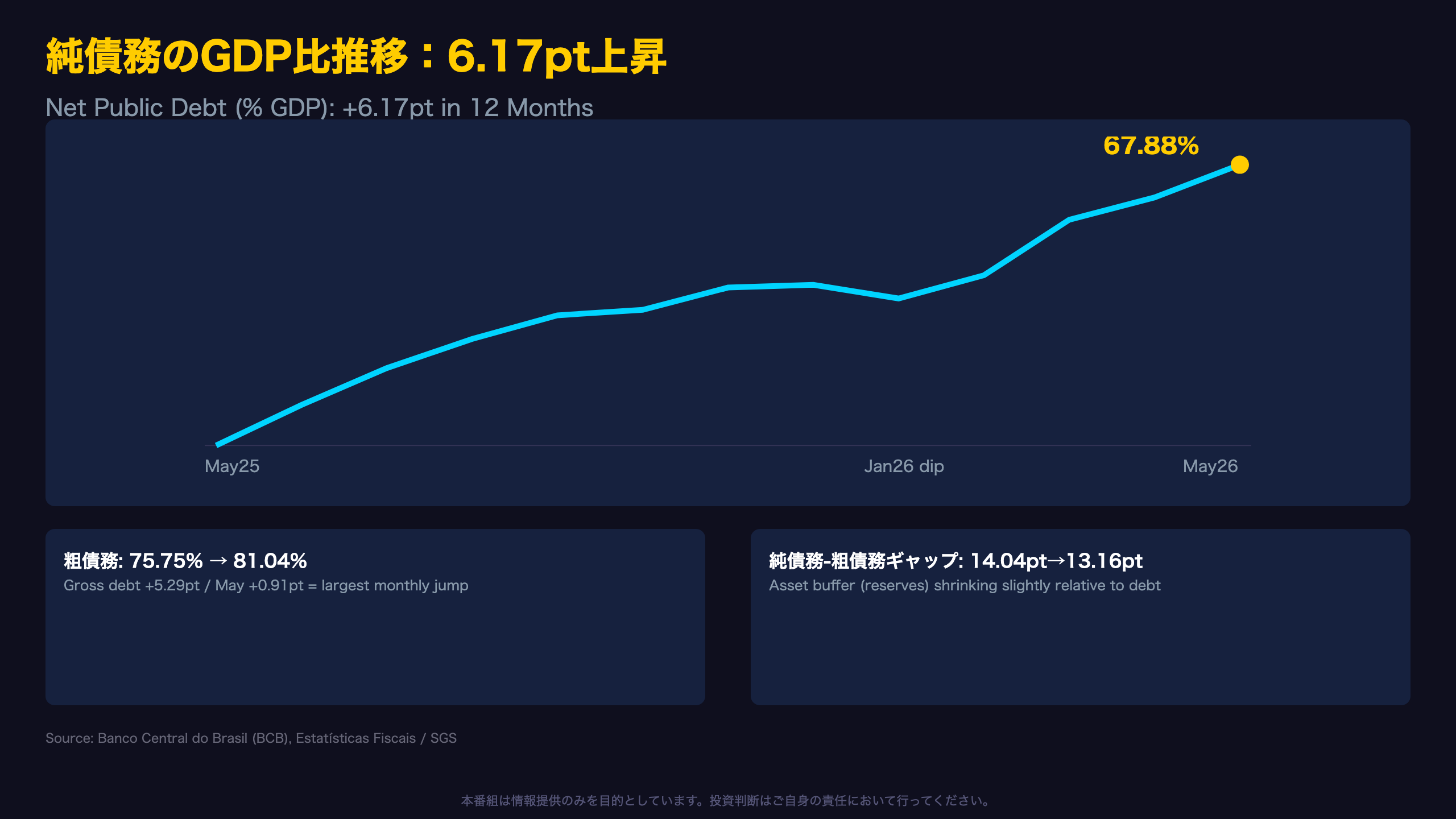
The gap between the two (13.16pp) narrowed from 14.04pp a year ago, a subtle signal the asset buffer isn’t growing as fast as liabilities.
Bull and Bear Cases
- Bull: Primary surplus at a series-high suggests fiscal discipline is bearing fruit.
- Bear: Nominal deficit and both debt ratios are simultaneously at series highs.
The next release is expected in late August 2026, covering June data.
純債務・粗債務、ともに過去最高を更新
Brazil’s Debt Ratios Hit Fresh Records, and the Pace Is Accelerating
Brazil’s net public debt (DLSP), tracked by BCB’s SGS series 4513, climbed from 61.71% of GDP in May 2025 to 67.88% in May 2026, a 6.17 percentage-point rise in twelve months. The pace has quickened: in the first five months of 2026 alone, the ratio rose 2.94pp.
A Record Single-Month Jump
Gross general government debt (SGS 13762), the metric comparable to IMF cross-country gross debt data, rose from 75.75% to 81.04% of GDP. May’s alone increase of 0.91pp is the largest single-month jump across the 13-month dataset.
Last month’s vintage (retrieved June 29) had shown April’s gross debt at 80.19%; this release (July 28) revised it down to 80.13%, a modest downward revision worth flagging for precision-focused trackers.
Was January a Turning Point? Apparently Not.
Net debt briefly dipped to 64.94% in January 2026 (-0.30pp MoM). But the subsequent four months each posted increases of 0.5-1.2pp, confirming the dip was a pause, not a reversal. For context, an 81% gross debt ratio sits above the emerging-market median, though still well below Japan’s (~250%+).
プライマリーバランス:記録的黒字への改善
From Deficit to Record Surplus, But Watch the Monthly Noise
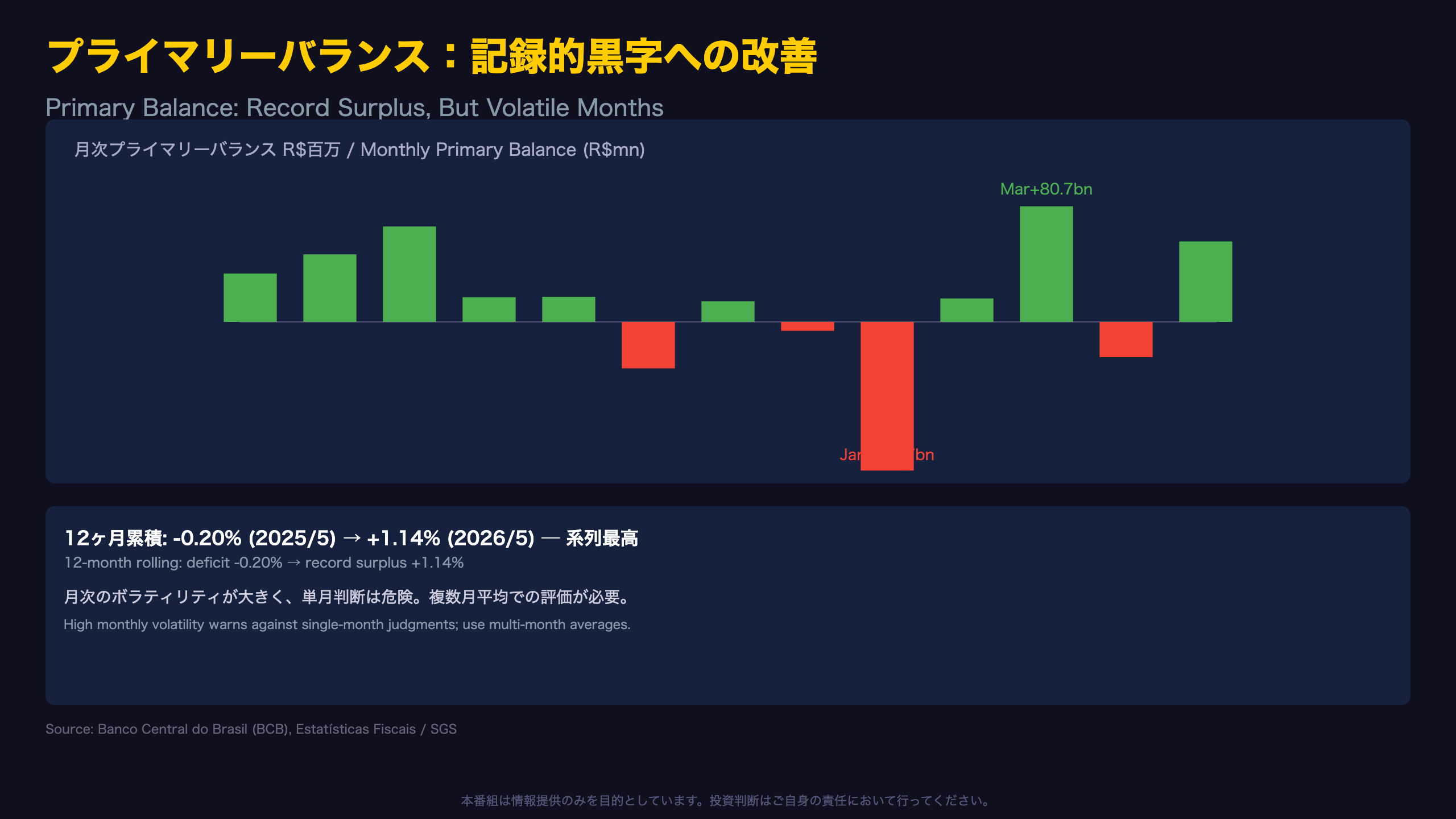
Brazil’s rolling 12-month primary balance (BCB SGS 5793, % of GDP) improved from -0.20% deficit in May 2025 to +1.14% surplus in May 2026, the strongest reading available. This is roughly analogous to the U.S. primary deficit/surplus concept used in CBO long-term outlooks.
The March Inflection
Progress was gradual through most of 2025 (0.2-0.4% range), before a sharp 0.65pp jump in March 2026 (0.41%→1.06%), driven largely by volatile monthly flows.
Monthly Data Is Genuinely Noisy
Series 4649 (\”Resultado Primário – Mensal\”) shows January 2026 posting a single-month deficit of R$103.7 billion, followed by a R$80.7 billion surplus in March, an enormous swing.
This volatility, likely tied to seasonal court-ordered payments (\”precatórios\”) and revenue timing, means the March acceleration partly reflects base effects rather than a discrete policy shift.
Bull vs. Bear
Bulls note thirteen consecutive months of directional improvement toward a record surplus. Bears caution a single volatile month could reverse the trend; June’s data (due late August) is the next test.
名目財政赤字が示す利払い負担の重さ
Interest Costs Are Eating the Primary Surplus
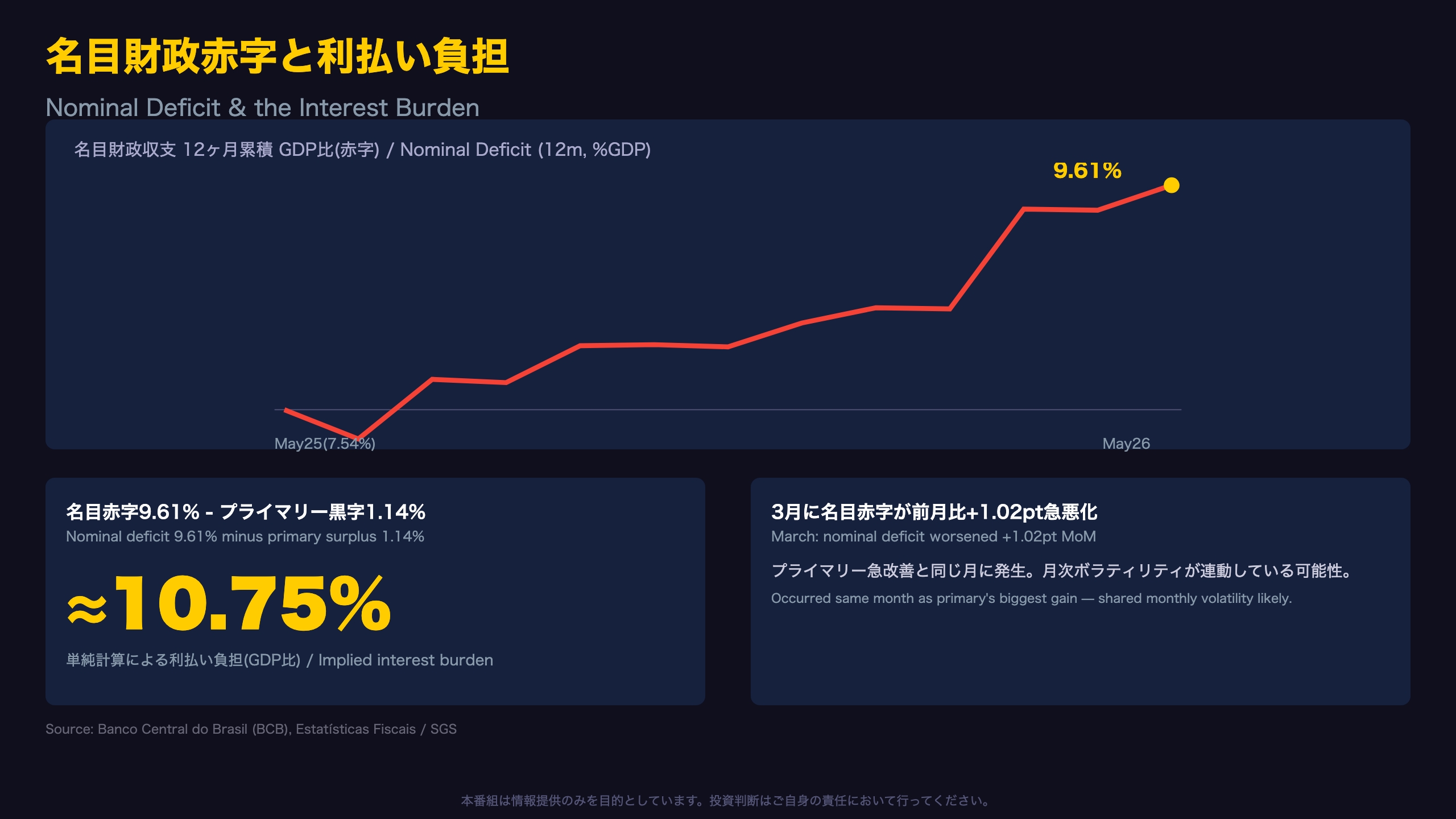
Brazil’s nominal fiscal balance (12-month, % of GDP, BCB SGS 5727), which nets interest expense against the primary result, deepened to a record deficit of 9.61% of GDP in May 2026, from 7.54% a year earlier. This is the widest nominal deficit in the dataset.
Why Nominal Deficit Differs From Primary Deficit
The primary balance excludes interest payments (roughly analogous to the U.S. primary deficit concept), while the nominal balance is the headline figure including them. The gap between the two is, by definition, the interest bill.
A Back-of-Envelope Interest Burden
Using only figures in this release: nominal deficit (9.61%) minus primary surplus (1.14%) implies an interest-expense burden of roughly 10.75% of GDP, up from about 7.74% a year ago on the same calculation. That would be among the highest sovereign interest burdens among major emerging markets, reflecting Brazil’s persistently elevated Selic policy rate relative to peers like Mexico or India.
Synchronized Deterioration
The nominal deficit widened sharply in March 2026 (8.47%→9.39%, +1.02pp) the very same month the primary balance posted its biggest improvement, suggesting shared underlying monthly volatility rather than a discrete policy shift.
連邦政府と地方政府、年始に共通する悪化
When Both Federal and Local Governments Stumbled Together
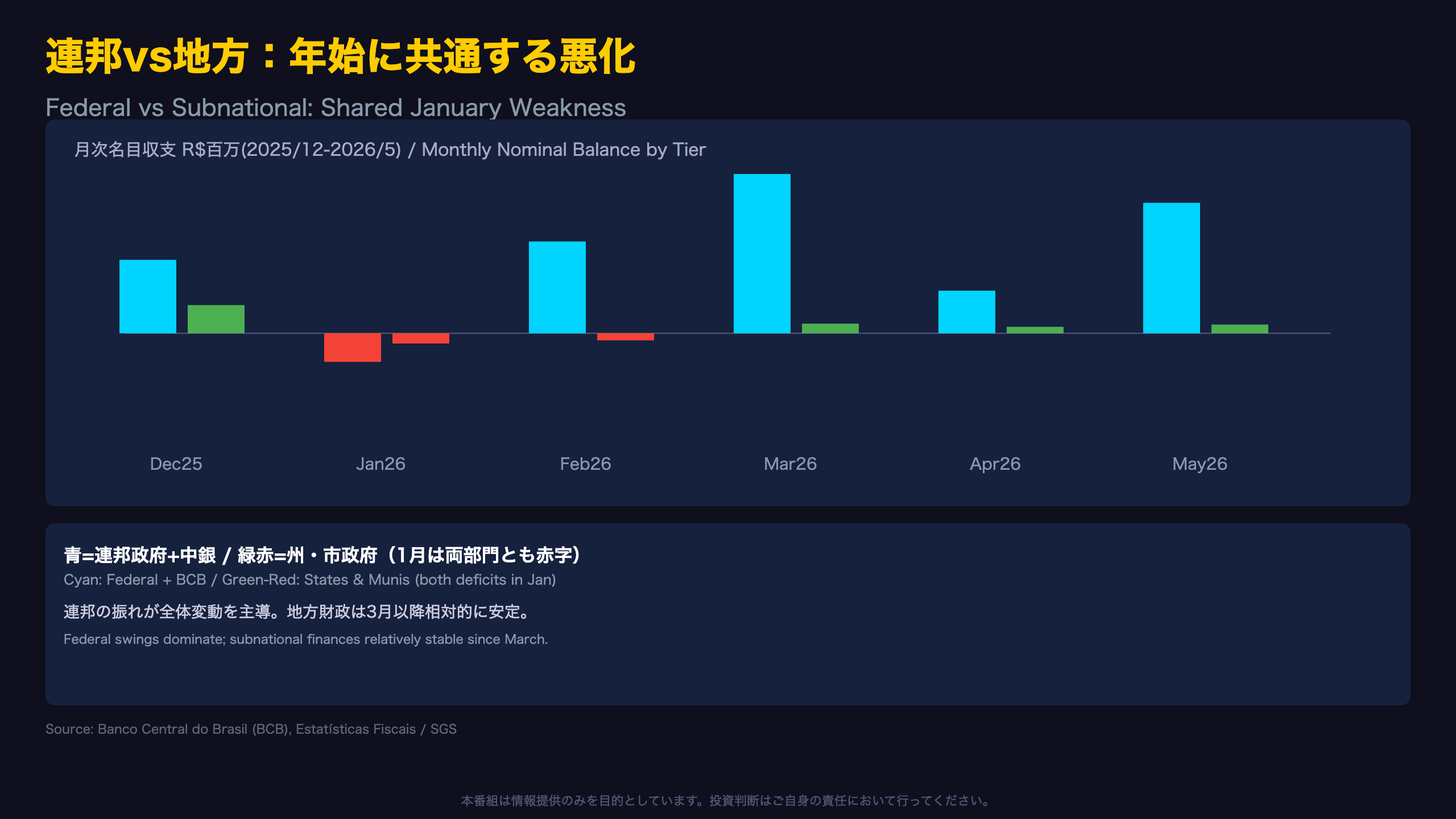
Breaking down Brazil’s monthly nominal balance by government tier reveals a striking coincidence: in January 2026, the federal government + central bank (SGS 4573) posted a deficit of R$33.5 billion, while state and municipal governments (SGS 4576) simultaneously posted a R$12.0 billion deficit. Within the available 13-month dataset, January 2026 is the only month where both tiers were in deficit at the same time.
Federal Volatility vs. Subnational Stability
The federal tier rebounded sharply, to a R$107.7 billion surplus in February and R$187.0 billion in March. Subnational governments lagged, posting a second consecutive deficit in February (-R$8.3bn) before turning positive in March (+R$11.3bn) and holding a steady R$7.6-10.3bn surplus through April and May.
Scale Matters
Federal-tier swings run into the tens or hundreds of billions of reais, while subnational flows are an order of magnitude smaller. Brazil’s aggregate nominal balance volatility is overwhelmingly a federal-government phenomenon; state and municipal finances have been comparatively stable and even resilient since March.
One Data Point, Not a Pattern
Whether the shared January weakness reflects a recurring seasonal pattern (e.g., year-end \”precatório\” settlements) or a structural concern cannot be determined from a single year of data.
市場へのインプリケーション:綱引きの行方
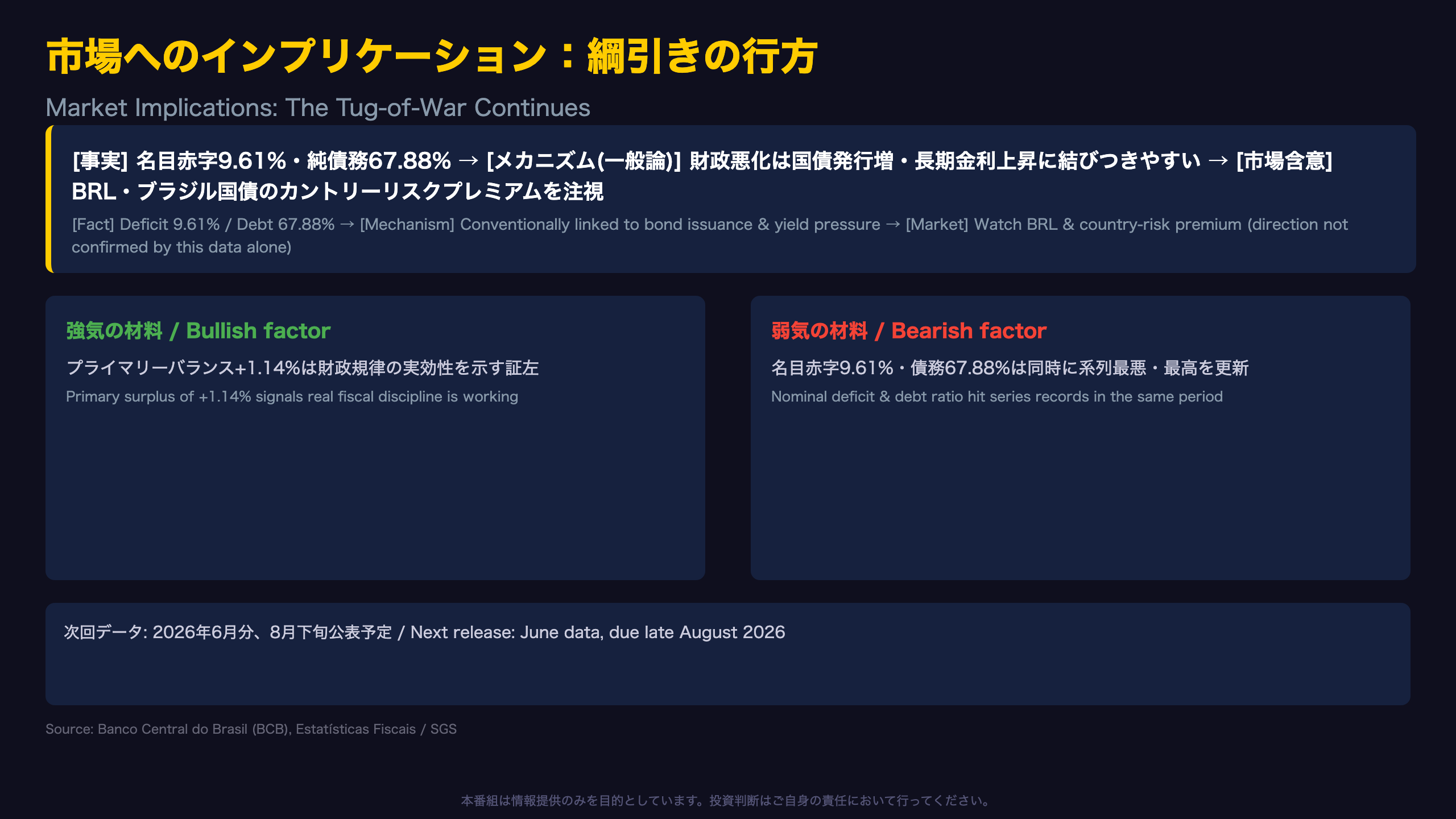
Two Trends, One Dataset, Neither Tells the Whole Story
This release captures two genuinely opposing trends: the primary balance improved (from -0.20% to +1.14% of GDP) while debt and the nominal deficit worsened (net debt: 61.71%→67.88%; nominal deficit: 7.54%→9.61%). Reading only one side would mean ignoring half the data.
What the Mechanism Would Suggest (With Caveats)
Conventionally, rising debt ratios and widening nominal deficits are associated with increased government bond issuance, upward pressure on domestic long-term yields, and effects on sovereign credit perception and country-risk premia. That said, this BCB fiscal dataset alone cannot determine the near-term direction of the BRL or Brazilian government bonds (such as NTN-B inflation-linked notes); fiscal data is one input among several, alongside monetary policy and global risk appetite.
What to Watch Next
The next release (June data, expected late August 2026) will show whether the primary surplus can be sustained and whether debt/deficit deterioration decelerates. Given the extreme monthly volatility already seen (-R$103.7bn in January vs. +R$80.7bn in March), investors should avoid over-reacting to any single month’s print.
Bottom Line
Brazil’s fiscal story is genuinely two-sided: real progress on primary discipline, but a debt burden still compounding under high interest costs. Both are simultaneously true.
Disclaimer: This article is for informational purposes only. All investment decisions are made solely at your own risk.