📺 Watch the Full Video Analysis
This article was automatically generated by the NFC Market Live AI analysis system. (Updated: 2026-07-16 17:28 JST)
📄 Primary Source
NFC Market Live
https://www.snb.ch/public/asset/en/www-snb-ch/publications/communication/summaries/zus_20260716/publications0_en/zus_20260716.en.pdf
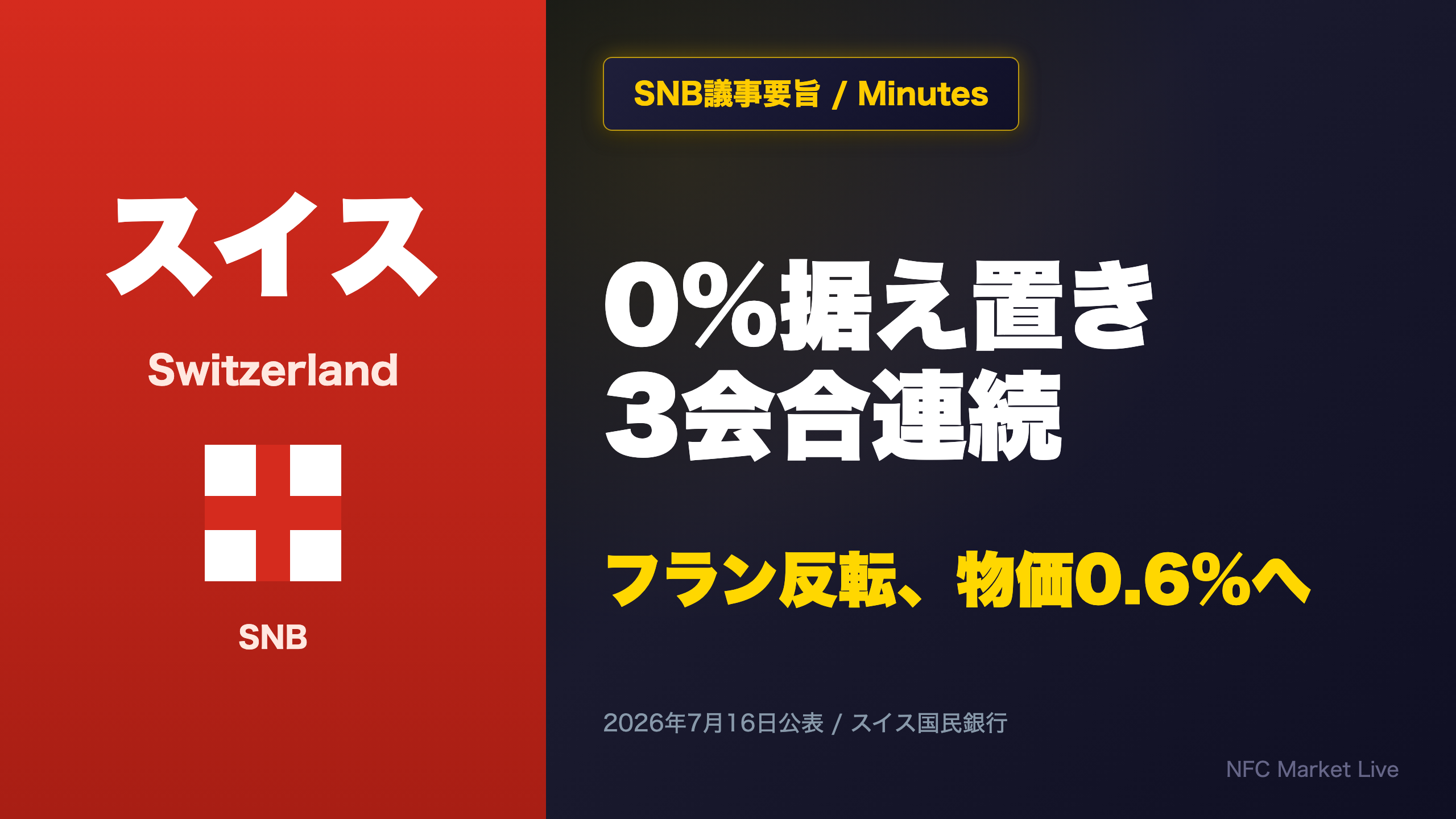
📊 A deep dive into the SNB’s June 2026 monetary policy minutes, released July 16, 2026.
The policy rate was held at 0% as markets expected — but the details reveal important shifts.
💱 Franc reversed from March’s surge, easing financial conditions
📈 Inflation accelerated from 0.1% to 0.6%, though core stayed flat
⚠️ Unemployment climbed to 3.1% as non-pharma manufacturing drove GDP
🛢️ Middle East tensions and the Strait of Hormuz remain the key wildcard
The Board says there’s ‘no immediate need for action,’ yet FX intervention readiness stays elevated. We unpack the balance of strength and fragility in this report.
総括:緩和と物価加速の綱引き
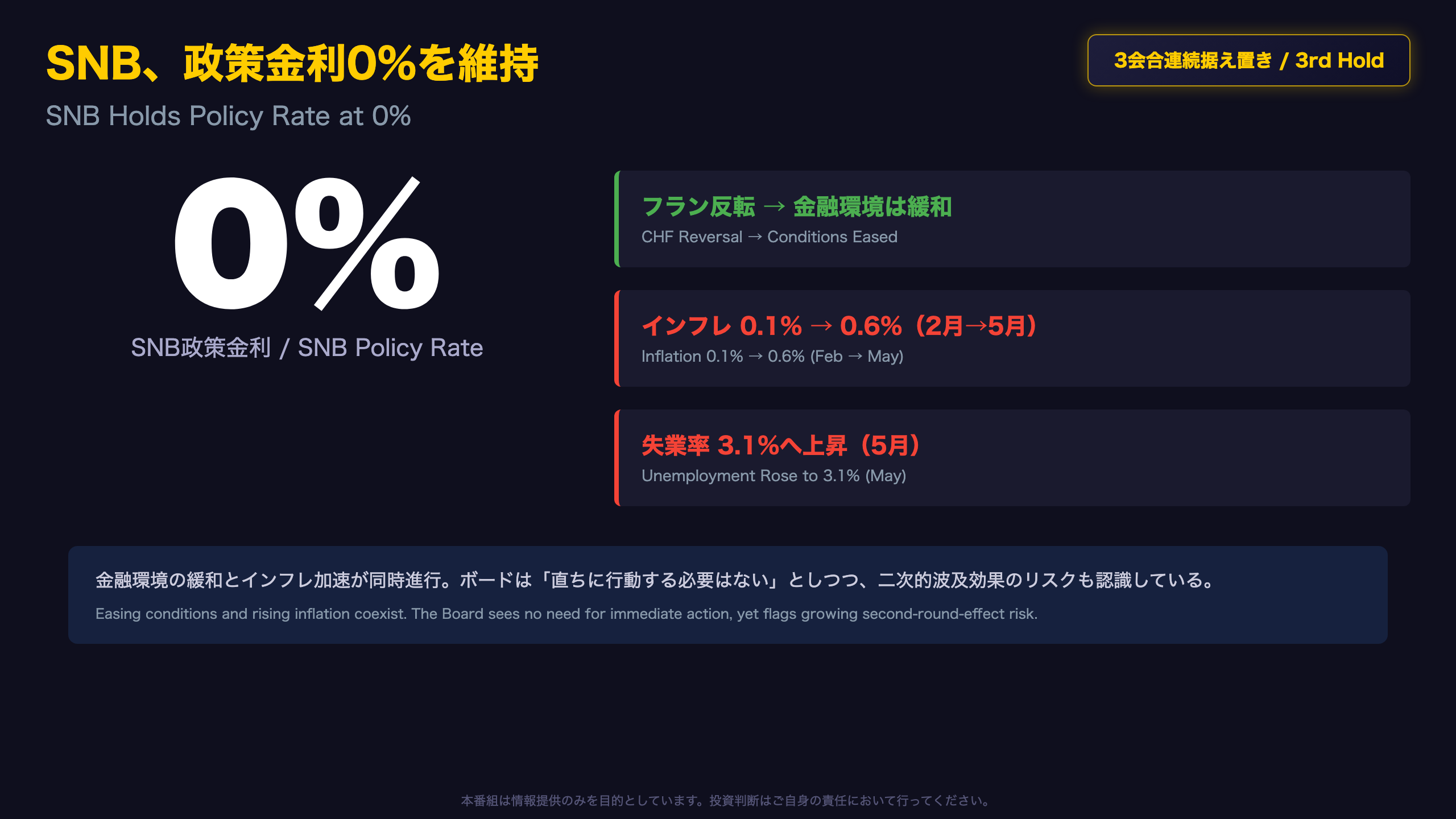
Three Consecutive Holds at Zero
December 2025, March 2026, and now June 2026 — the SNB has held its policy rate at 0% for three straight quarterly assessments. Unlike the Federal Reserve or ECB, the SNB meets only four times per year, making each assessment a comprehensive data checkpoint rather than a frequent policy pivot.
The biggest shift versus March is the currency reversal:
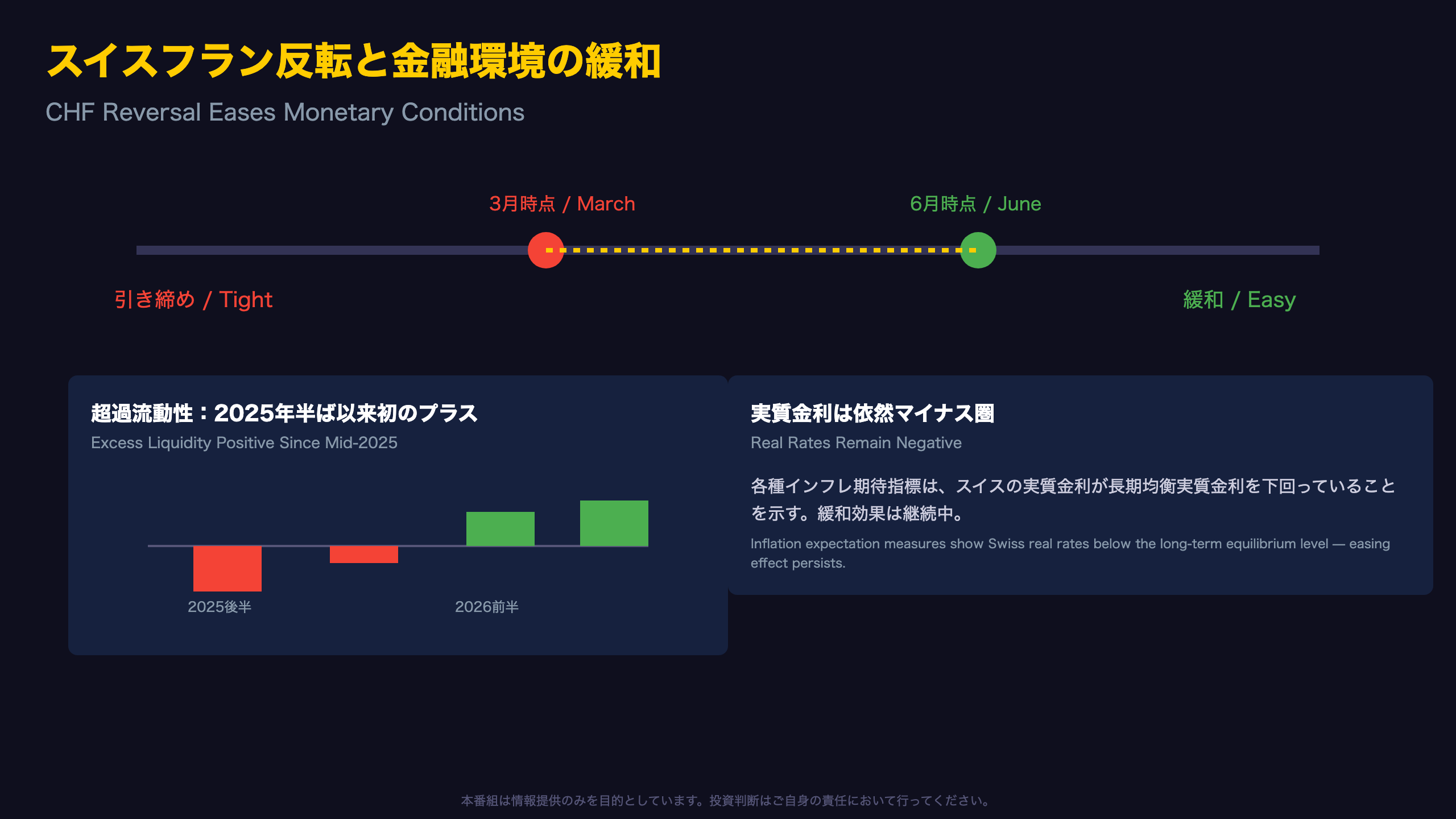
“With the depreciation of the Swiss franc since the monetary policy assessment in March, monetary conditions have become somewhat easier.”
In March, safe-haven flows into the franc (driven by Middle East escalation) were viewed as a tightening force. That dynamic has now fully reversed.
Key Metrics: March vs June
| Metric | March | June |
|---|---|---|
| Policy Rate | 0% | 0% |
| CHF | Appreciated | Depreciated |
| CPI | 0.1% (Feb) | 0.6% (May) |
| Core CPI (TM15) | 0.4% (Feb) | 0.5% (May) |
| Unemployment | Stable | 3.1% (May) |
For international readers: the SNB’s price stability range is 0-2% inflation, notably wider and lower than the Fed’s 2% target or ECB’s symmetric 2% goal — meaning 0.6% inflation is still comfortably within range, unlike in the US or Eurozone where such acceleration might prompt hawkish commentary. The next assessment is expected around September 2026.
スイスフラン反転と金融環境の緩和
Why Did the Franc Reverse?
The minutes trace March’s franc strength to safe-haven flows amid Middle East escalation. By June, a US-Iran Memorandum of Understanding eased geopolitical tension, and that safe-haven bid unwound.
A second driver was widening rate differentials:
“Strong economic data in the US and widespread optimism in the markets regarding artificial intelligence (AI) led to higher long-term interest rates in the US. Overall, there was a significant widening of the interest rate differentials between Switzerland and other countries.”
For context, the SNB’s policy rate of 0% sits far below the Fed’s and ECB’s levels — one of the widest gaps among G10 central banks. Rising US yields, partly fueled by AI-driven equity optimism, widened that gap further and likely encouraged franc-funded carry positioning.
The Excess Liquidity Turning Point
Perhaps the quietest but most important data point: excess liquidity turned positive for the first time since mid-2025, signaling that monetary easing is finally showing up in the real economy through credit and broad money growth. However, real rates remaining below their long-term equilibrium level suggests policy is still running on the accommodative side — a nuance that matters for anyone tracking eventual normalization risk for CHF-denominated assets.
インフレ0.6%への上昇 ― 二次的波及効果は限定的か
The Reality Behind a Single-Month Acceleration
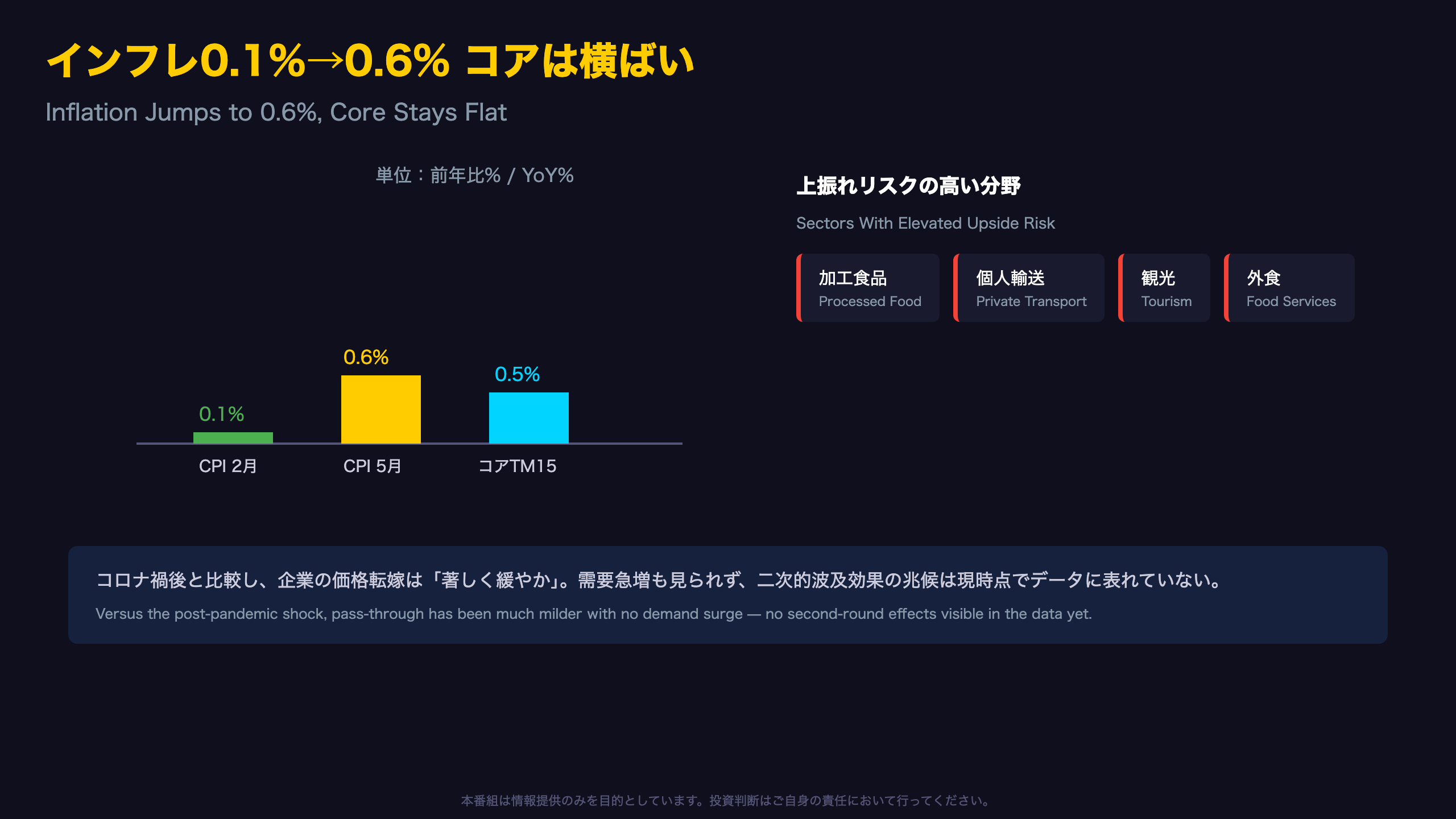
Going from 0.1% to 0.6% looks like a six-fold jump, but in absolute terms it’s still near the low end of the SNB’s 0-2% price stability range — a notably wider and lower band than the Fed’s 2% target or the ECB’s symmetric 2% goal.
“Inflation has risen as expected since the last monetary policy assessment, and stood at 0.6% in May. The increase was attributable to imported inflation, stemming from a significant increase in prices for oil products.”
The key phrase is “as expected” — this wasn’t a surprise, it was the anticipated trajectory flagged back in March.
An Unusual COVID-Era Comparison
Notably, the Board explicitly benchmarked the current energy shock against the post-pandemic price surge:
“companies’ price reactions to the conflict in the Middle East have so far been significantly less pronounced than they had been after the pandemic”
Reasons cited include less severe supply chain disruption, lower labor market tightness than during COVID, and the absence of pent-up demand spikes this time around.
Where the Upside Risks Sit
Four sectors were named as most directly exposed to energy costs: processed food, private transport, tourism, and food services. For investors tracking CHF rates and Swiss bonds, the pass-through progress in these specific categories will be the key data to watch ahead of the next assessment, expected around September 2026.
成長は底堅く、労働市場に陰り
Growth Driver Handoff: From Pharma to Non-Pharma
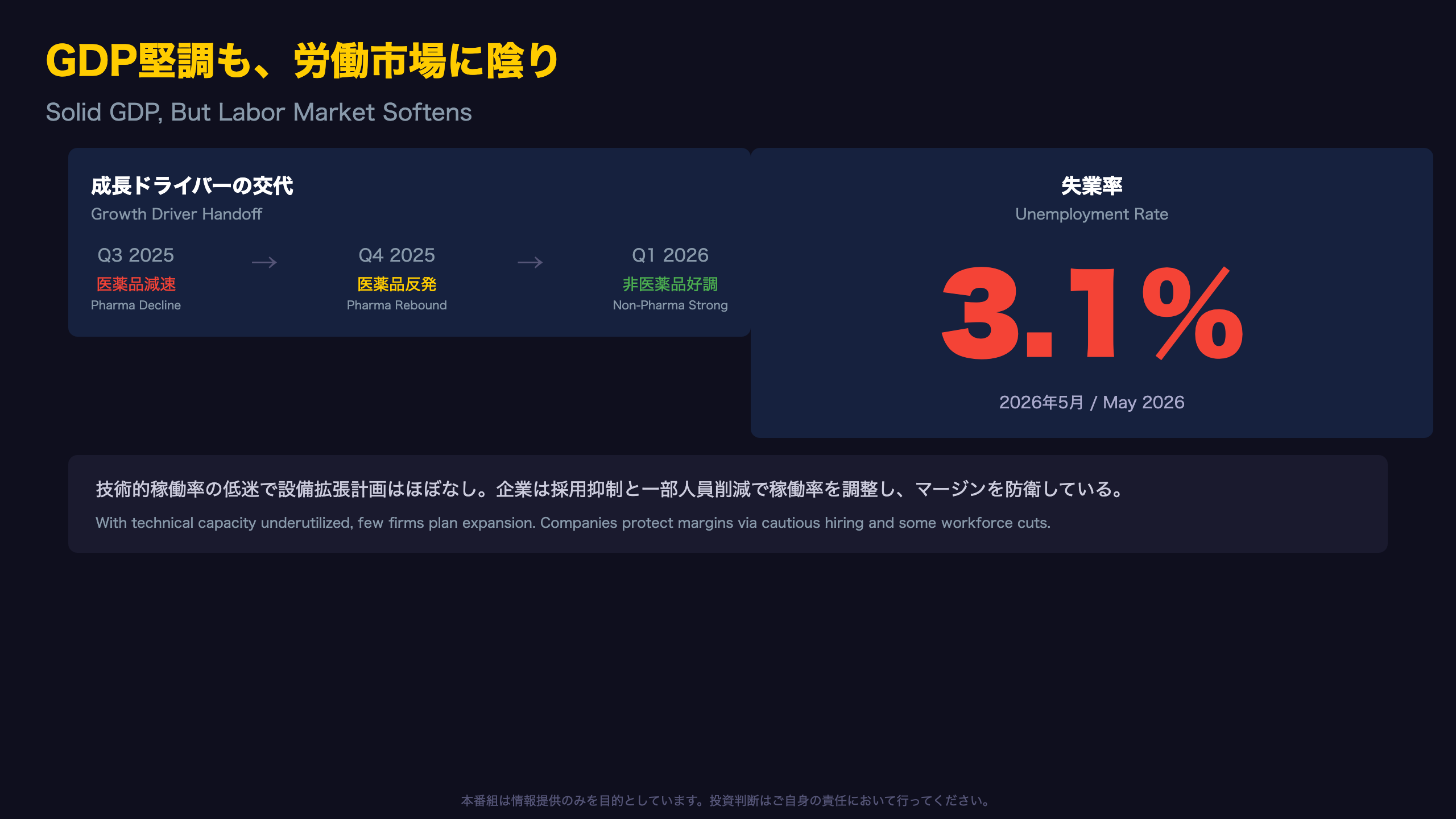
Q4 2025 GDP growth was carried by a pharmaceutical rebound; Q1 2026 saw non-pharmaceutical manufacturing take the lead role instead.
“GDP growth was solid in the first quarter of 2026. The main driver was value added in non-pharmaceutical manufacturing, which recorded strong growth.”
This could suggest the Swiss economy is broadening its growth base beyond its historically pharma-heavy export profile — though as a single-quarter data point, this shouldn’t yet be read as a structural trend.
A Quiet Softening in the Labor Market
Unemployment climbed to 3.1% in May. The minutes describe labor market signals as “currently subdued,” with employment growth below its long-term average — a notable contrast to the resilient GDP headline.
Company surveys reveal the mechanism:
“hardly any manufacturing companies are planning to expand capacity… attributable to a cautious stance on recruitment and, in part, to reductions in workforce”
In other words, firms are protecting margins through headcount adjustment rather than capital investment. For US/European investors used to reading unemployment as a lagging recession signal, it’s worth noting the SNB’s own economic staff still project unemployment stabilizing this year and declining in 2027 — a materially different read than a recessionary unemployment spiral. The realism of that stabilization call will be the key test at the next assessment, expected in September 2026.
中東情勢とホルムズ海峡 ― 最大の不確実性
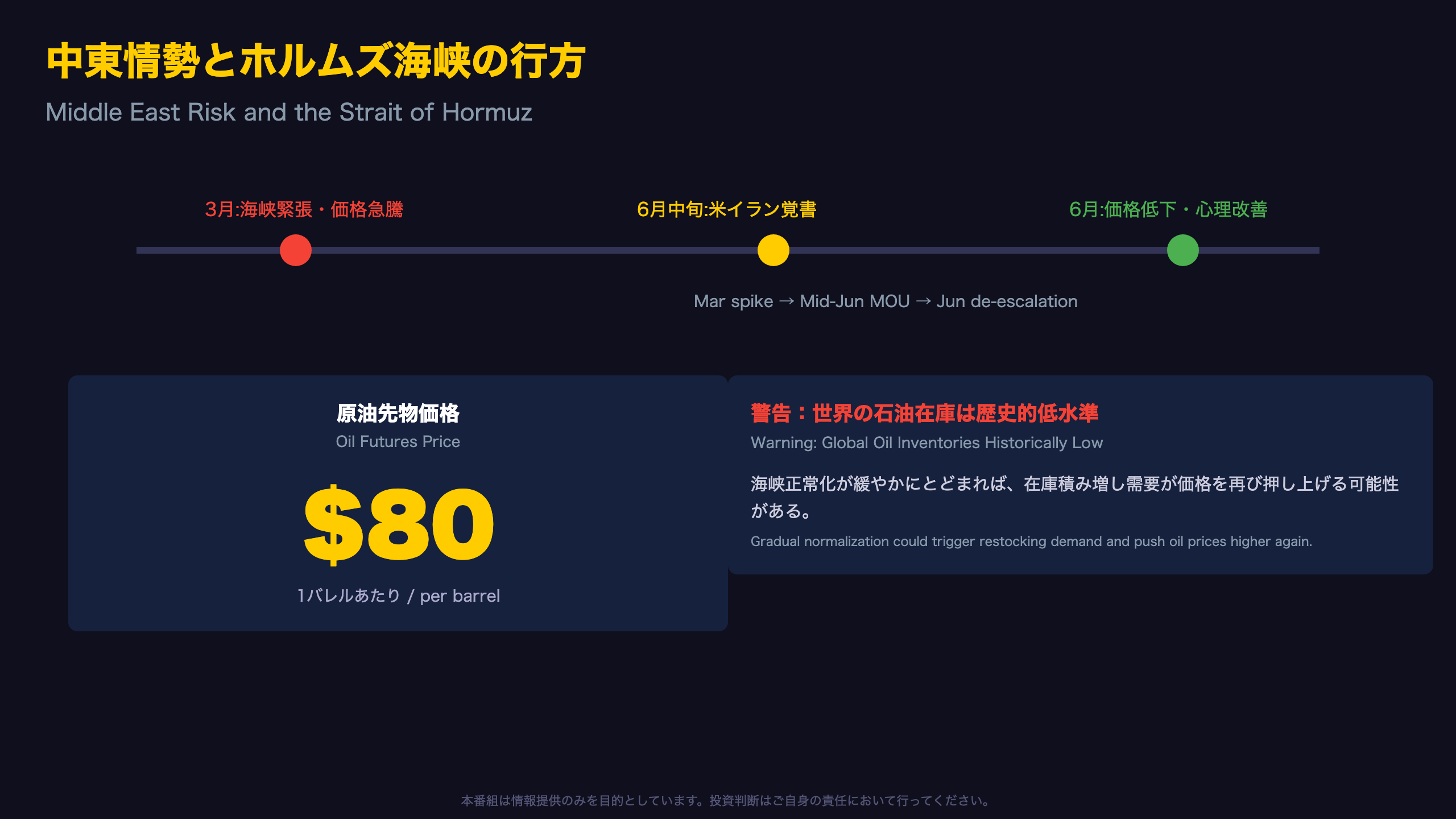
The Strait of Hormuz as the Key Variable
The minutes note that even freight companies are split on the reopening timeline:
“The assessment of the situation among freight companies varies greatly. While some assume that the strait will quickly be fully navigable, others expect a restricted opening to persist for longer.”
What stands out is the combination of calm pricing — oil futures around $80/barrel — with a warning that global oil inventories are historically low. Prices look settled, but the supply-demand buffer is thin. If the Strait normalizes only gradually, restocking demand alone could push prices higher again, independent of any new escalation.
A Different Kind of Shock Than COVID
As discussed in the inflation section, the Board explicitly compared this energy shock to the pandemic-era supply disruption. Differences include distinct transport routes, supply chains and affected product categories, plus lower capacity utilization today (especially in labor markets) than during COVID. This comparative framing suggests policymakers see this as a genuinely novel risk pattern, not a repeat of pandemic-era dynamics — a useful nuance for anyone modeling inflation pass-through scenarios.
The Currency Transmission Channel
A renewed escalation wouldn’t just push up energy costs — it could reignite safe-haven demand for the franc. This dual channel (inflation plus currency appreciation) is precisely why the SNB kept its FX intervention readiness elevated, a detail relevant to anyone positioning in CHF crosses.
インプリケーション:市場と政策への示唆
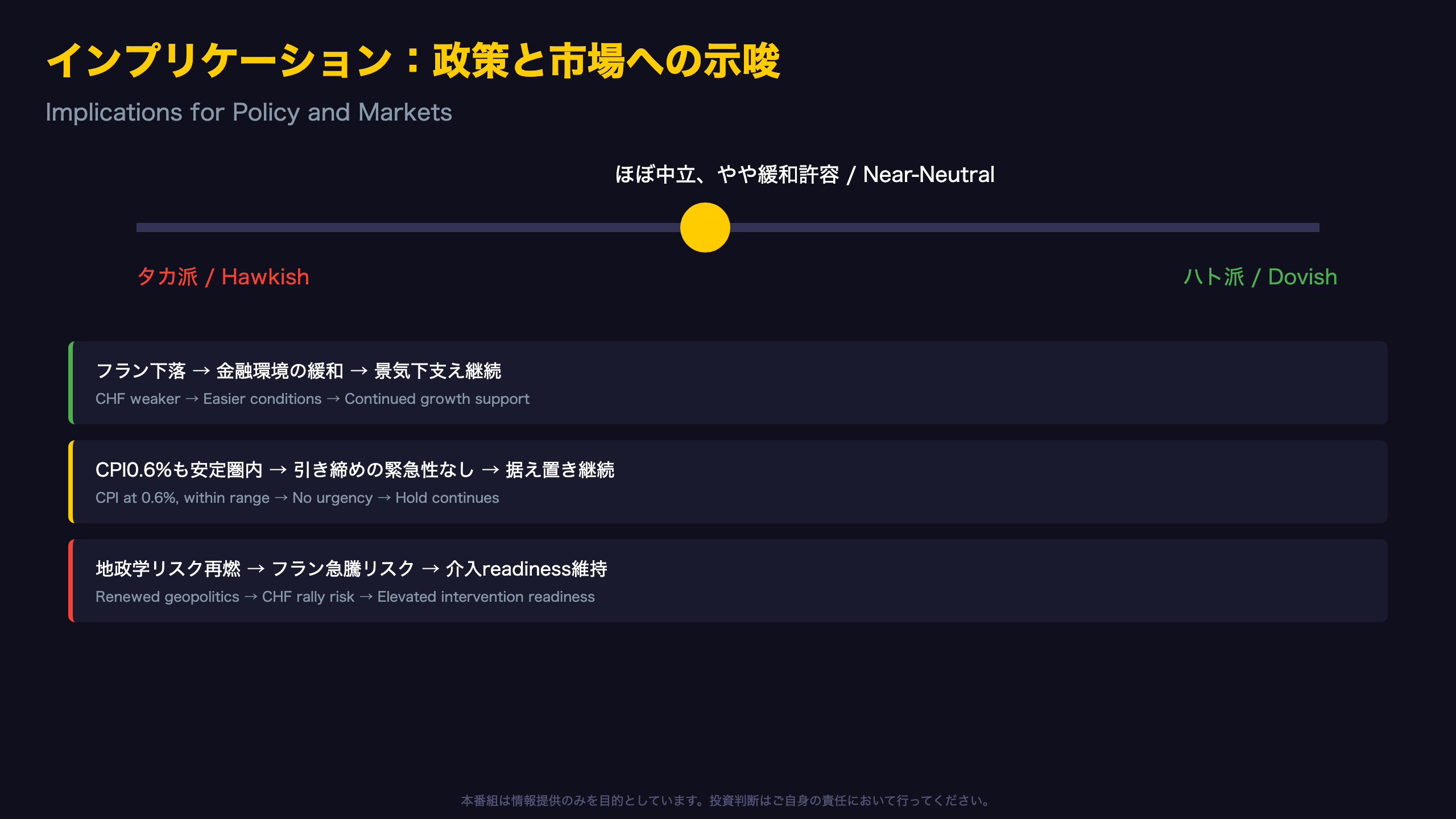
Breaking Down the Policy Logic
Using a chain-of-reasoning framework, the hold decision maps out as follows:
Franc depreciation → Easier monetary conditions → Continued growth support
The stated fact that “the depreciation of the Swiss franc since the monetary policy assessment in March, monetary conditions have become somewhat easier” is consistent with real rates staying in accommodative territory, suggesting the easing impulse persists for now.
Inflation at 0.6%, within price stability range → No urgency to tighten → Hold justified
The Board’s own words, “inflation cannot be expected to rapidly rise above 2% or fall into negative territory,” is the explicit justification for not rushing a policy change.
Renewed geopolitical risk → Franc rally risk → Elevated FX intervention readiness
This part draws on general market mechanics: renewed Middle East escalation could reignite safe-haven franc demand, a dynamic referenced repeatedly across recent SNB minutes — but this single dataset alone cannot confirm the probability of such an escalation occurring.
What to Watch Into September
The next assessment, expected around September 2026, likely hinges on three variables: (1) whether second-round effects show up in core inflation, (2) whether the unemployment-stabilization scenario the SNB staff project actually materializes, and (3) how the Strait of Hormuz situation evolves. For international investors, note the SNB’s uniquely low 0% policy rate versus Fed and ECB levels — any further widening of that gap, absent a geopolitical shock, would generally be read as franc-negative. But as this cycle has shown, safe-haven dynamics can override rate-differential logic entirely when tensions flare.
Disclaimer: This article is for informational purposes only. All investment decisions are made solely at your own risk.