📺 Watch the Full Video Analysis
This article was automatically generated by the NFC Market Live AI analysis system. (Updated: 2026-09-17 04:08 JST)
📄 Primary Source
NFC Market Live
https://www.youtube.com/watch?v=D_5bQnxxWAE
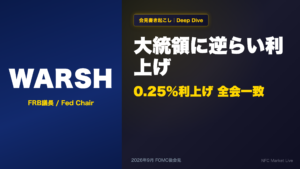
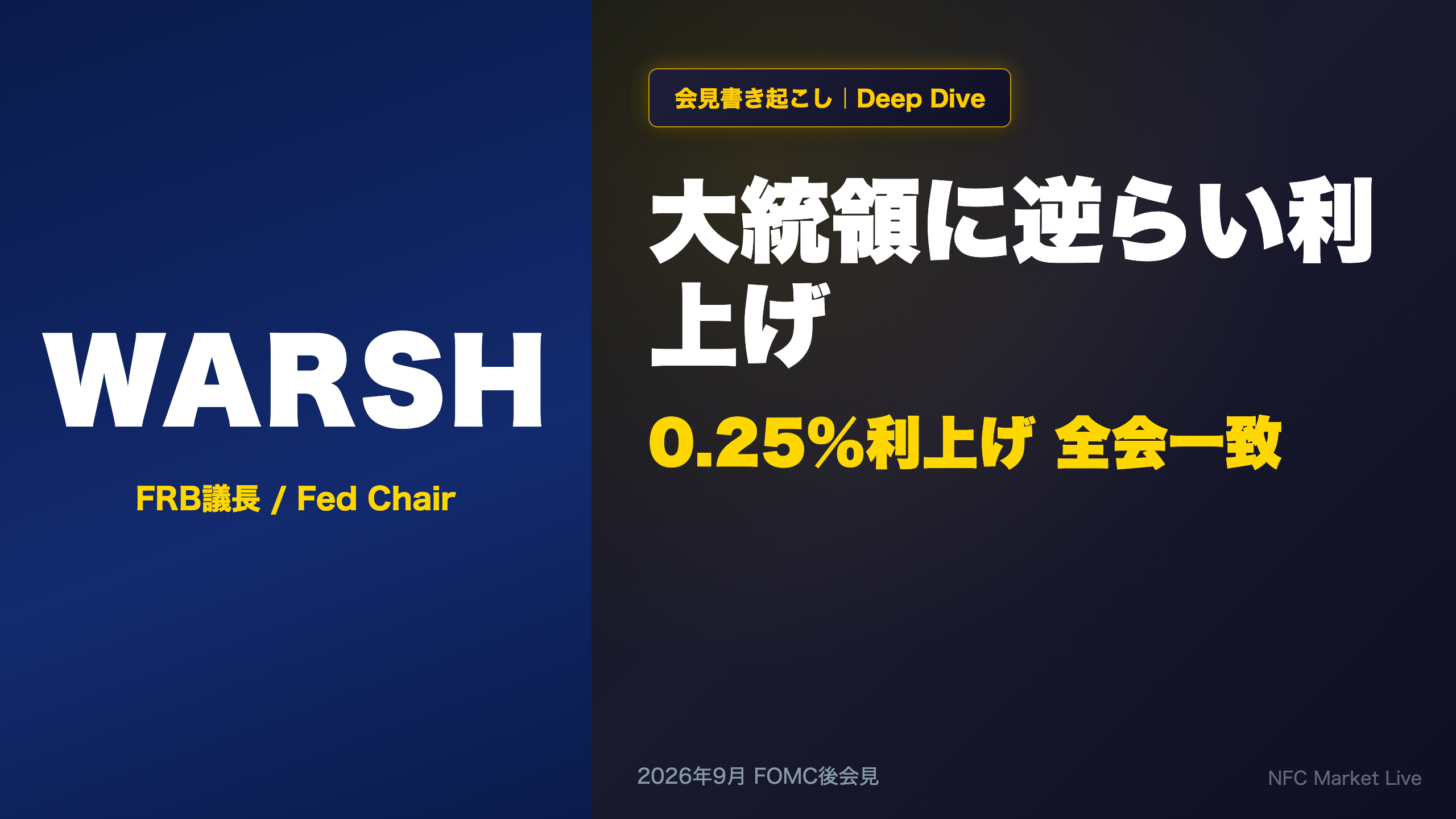
🏦 New Fed Chair Warsh delivers his first FOMC decision: a 25bp hike to 3.75-4.00%.
📊 Unanimous vote comes despite repeated pressure from President Trump to cut rates.
📈 Growth remains solid, but August PCE inflation ran hot at 3.6%.
⚠️ SEP median pushes the 2% inflation target out to 2029.
💬 Reporters grilled Warsh on Fed independence and market-driven timing.
We break down the tone and substance behind every key phrase.
利上げという抵抗 ー 独立性を賭けた全会一致
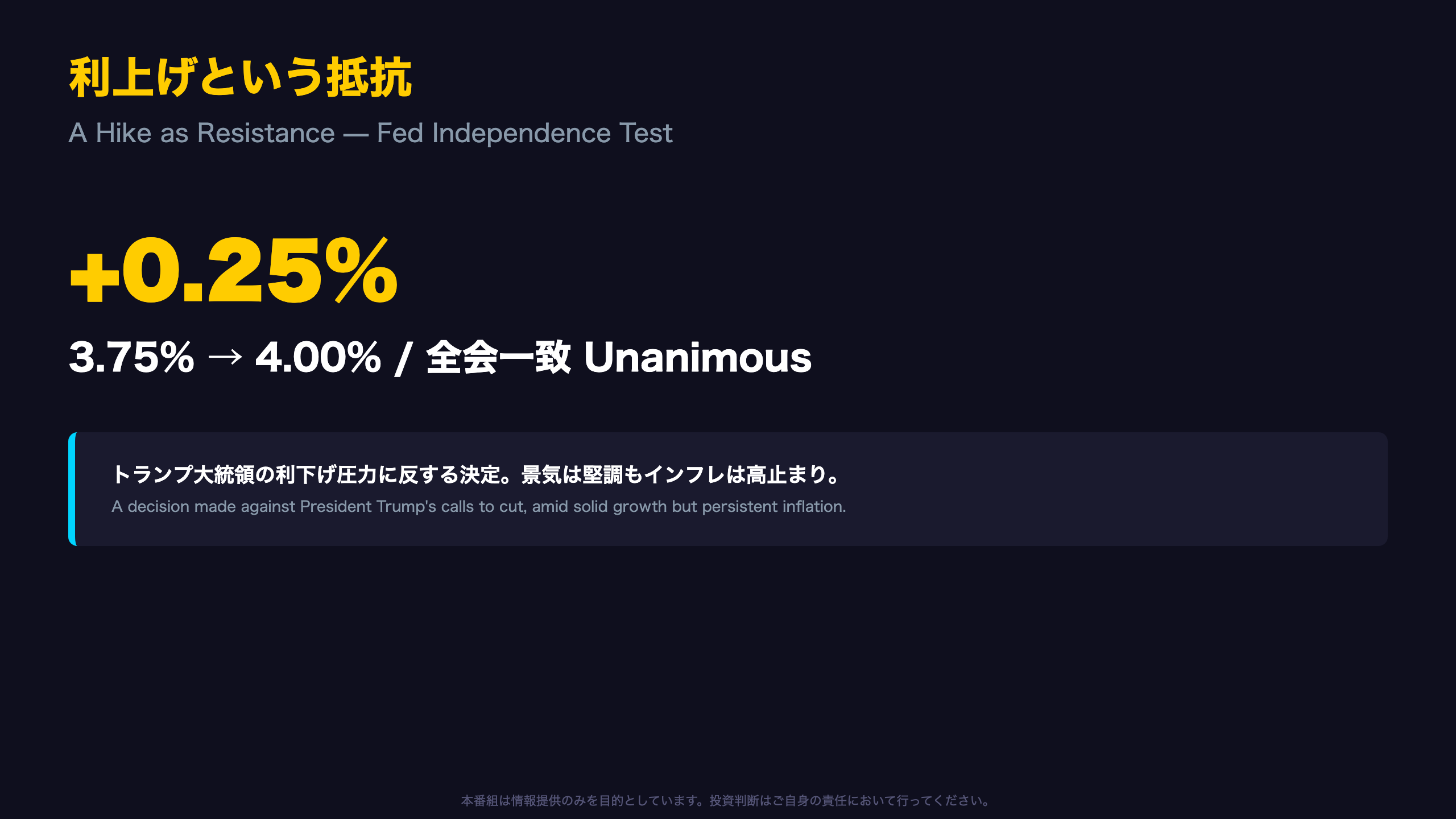
A New Chair’s First Test
Sworn in as FOMC Chair in June 2026, Warsh faced his first major policy test roughly 110-120 days into the job. Raising rates at this early stage sent a deliberate signal to both markets and Washington.
Navigating Political Pressure
Reporters revealed that President Trump had reportedly threatened to cut trade ties with certain countries unless rates were lowered. Warsh sidestepped direct comment (“I don’t have anything for you on discussions with the president”), instead asserting: “Independence is a two-way street,” emphasizing the Fed’s refusal to weigh in on trade or fiscal policy.
Priced In, But Not Trivial
According to Fox Business’s Edward Lawrence, markets had assigned a 90% probability to this hike beforehand — meaning the surprise element was low. Yet when asked if the Fed was simply following market expectations, Warsh insisted: “today was our decision,” reaffirming the FOMC’s independent judgment.
What U.S. readers should note
For context, the Fed’s dual mandate (price stability + maximum employment) differs from the ECB’s single price-stability mandate, making political independence debates especially salient in the U.S. Watch upcoming PCE/CPI prints and AI-driven capex trends as the next catalysts for long-term yields.
「a dose of accommodation」— 発言に見る政策姿勢
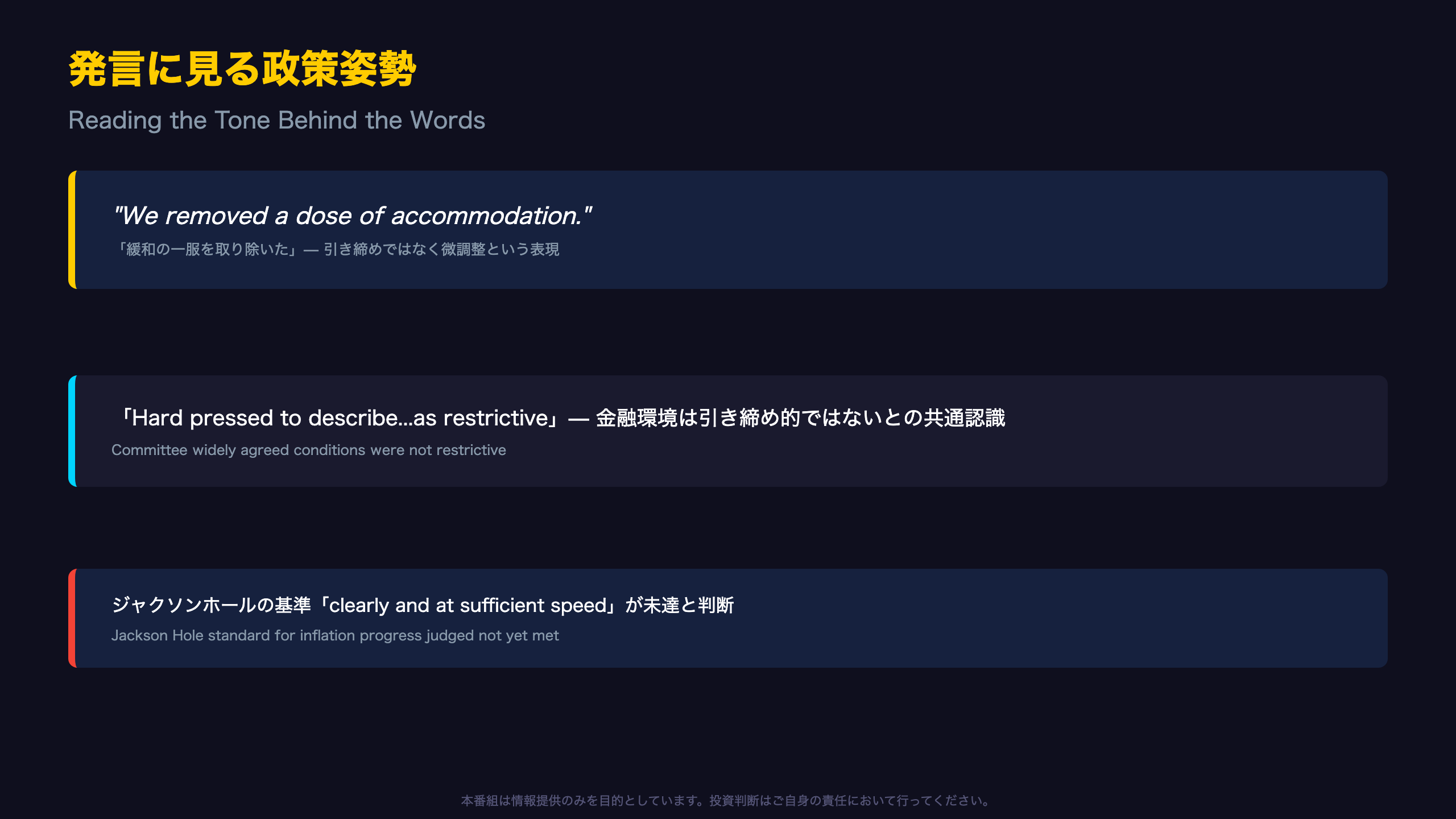
The Language of “Removing Accommodation”
Rather than framing the hike as a hawkish pivot, Warsh chose the softer phrase “removing a dose of accommodation” — signaling a calibration rather than a regime shift.
On Financial Conditions
Asked by the Financial Times’ Claire Jones whether conditions were now restrictive, Warsh reiterated: “I’ve described previously I found it difficult to describe financial conditions as restrictive,” adding that colleagues around the table shared that view.
The Jackson Hole Standard
Warsh explained that in July, “a good majority” of colleagues favored waiting for more data. His August Jackson Hole speech set a clear bar: confidence that underlying inflation is moving toward target “clearly and at sufficient speed.” Today’s vote reflects a judgment that this bar was not met.
Distancing from the Neutral Rate Debate
When CNBC’s Steve Leisman pressed him on neutral-rate estimates (a concept familiar to U.S. rates traders, akin to r-star), Warsh flatly answered “In a word, no,” dismissing its operational relevance — a notably academic, non-committal stance compared to past Fed communication styles under Powell or Yellen.
高止まるインフレ ー 2%目標は2029年へ後退
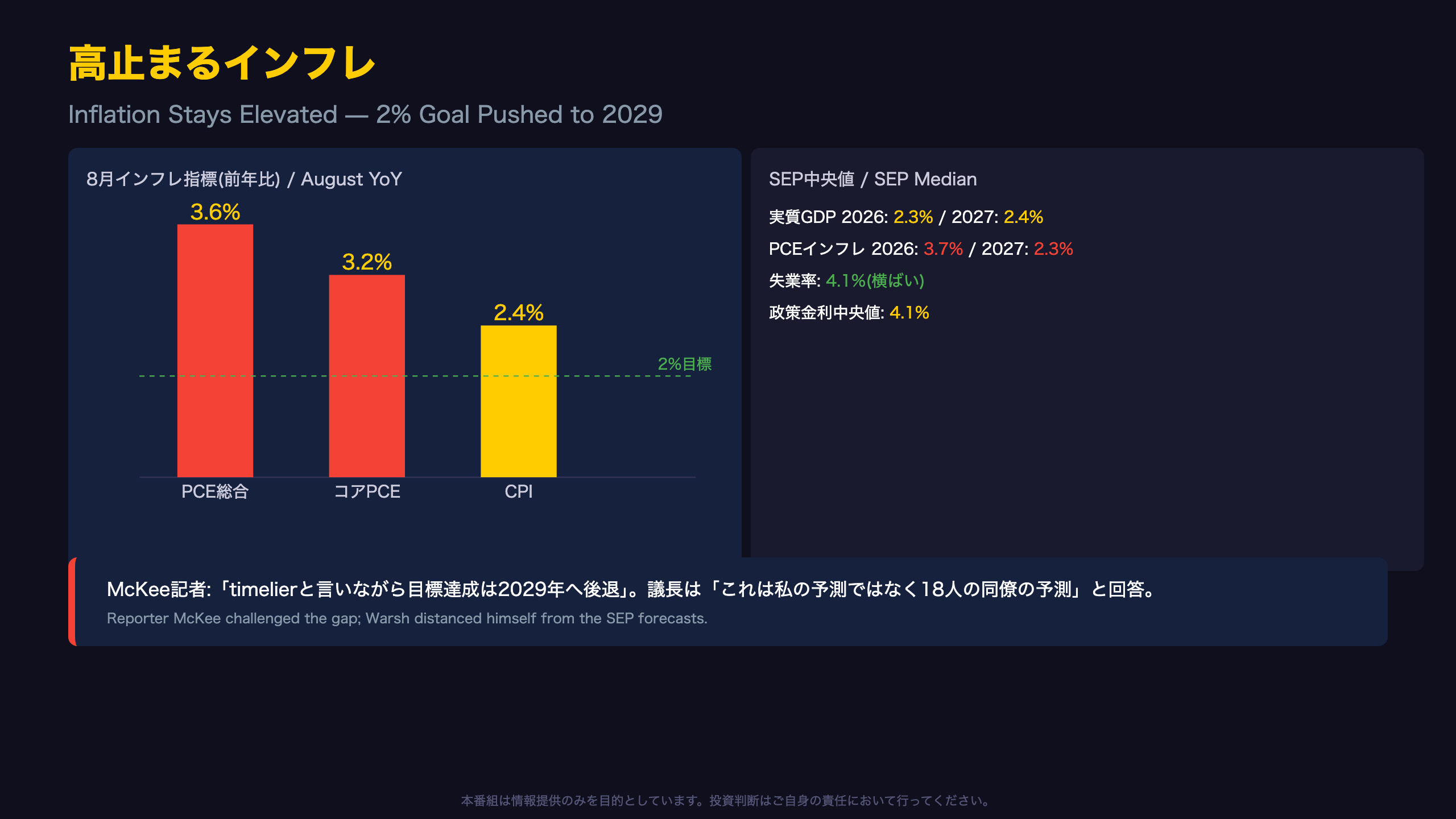
Inflation That Won’t Budge
August data showed headline PCE at 3.6%, core PCE at 3.2%, and CPI near 2.4% — all above the Fed’s 2% goal. Warsh noted that “too many categories are still posting increases above 3% on both a 6 and 12 month basis,” suggesting broad-based rather than one-off price pressure.
The SEP’s Sobering Timeline
| Metric | 2026 | 2027 |
|---|---|---|
| Real GDP growth | 2.3% | 2.4% |
| PCE inflation | 3.7% | 2.3% |
| Unemployment | 4.1% | 4.1% (flat) |
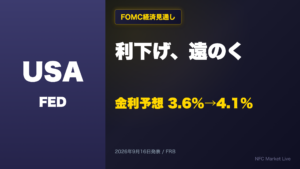
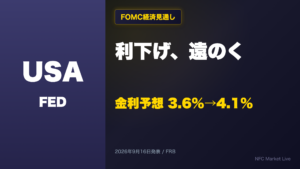
| Fed funds (median) | 4.1% | 4.1% |
For U.S. and international readers: the Summary of Economic Projections (SEP) is the median forecast of all 18 FOMC participants, released quarterly alongside the “dot plot.” It is not a binding policy path but a snapshot of committee thinking.
A Pointed Challenge
Bloomberg’s Michael McKee highlighted the tension between the statement’s “timelier return to 2 percent” language and a target now projected for 2029 — two years further out than previously implied. Warsh’s response — “those aren’t my forecasts… those are the forecasts of my 18 colleagues” — deliberately distanced himself from the SEP, preserving flexibility for future decisions.
Statistical Caveat
As a median of dispersed individual forecasts, the SEP carries meaningful uncertainty and can shift materially with incoming data — a key nuance for investors pricing in the Fed’s path.
独立性を巡る質問の集中砲火
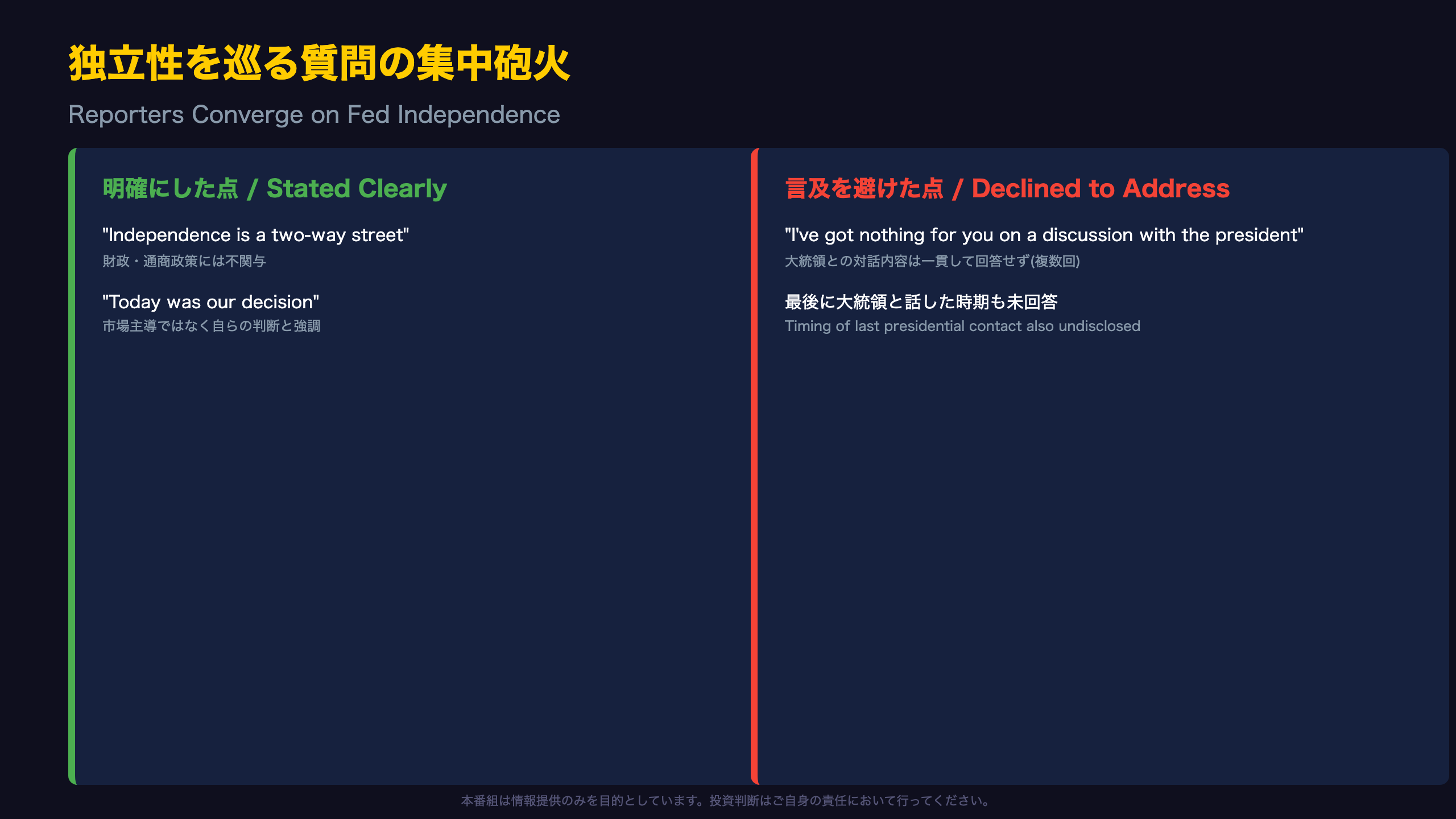
Where Reporters’ Attention Converged
At least three reporters — Zach Kalashek (Washington Examiner), Edward Lawrence (Fox Business), and Elizabeth Schulze (ABC News) — pressed Warsh on his relationship with the White House and whether markets were dictating Fed policy. This clustering signals that Fed independence, not the rate decision itself, was the market’s central concern.
What Warsh Stated Clearly
- “Independence is a two-way street” — a firm assertion that the Fed would not weigh in on trade or fiscal policy, and expected reciprocal restraint from other branches of government.
- “Today was our decision” — rejecting the notion that the Fed simply followed a 90%-priced-in market consensus.
What He Declined to Address
Warsh repeatedly deflected any specifics about conversations with President Trump (“I’ve got nothing for you on a discussion with the president”), including a direct question about when they last spoke.
Reading the Strategic Silence
For readers unfamiliar with U.S. central bank norms: Fed officials traditionally avoid commenting on private discussions with the executive branch to preserve the appearance of independence — a convention dating back to the Volcker and Greenspan eras. Warsh’s selective clarity (firm on principle, silent on specifics) suggests a deliberate communications strategy rather than evasiveness, though markets may read the repeated non-answers as a subtle acknowledgment of real political friction.
会見だけで語られた新情報 ー 長期金利上昇の3要因
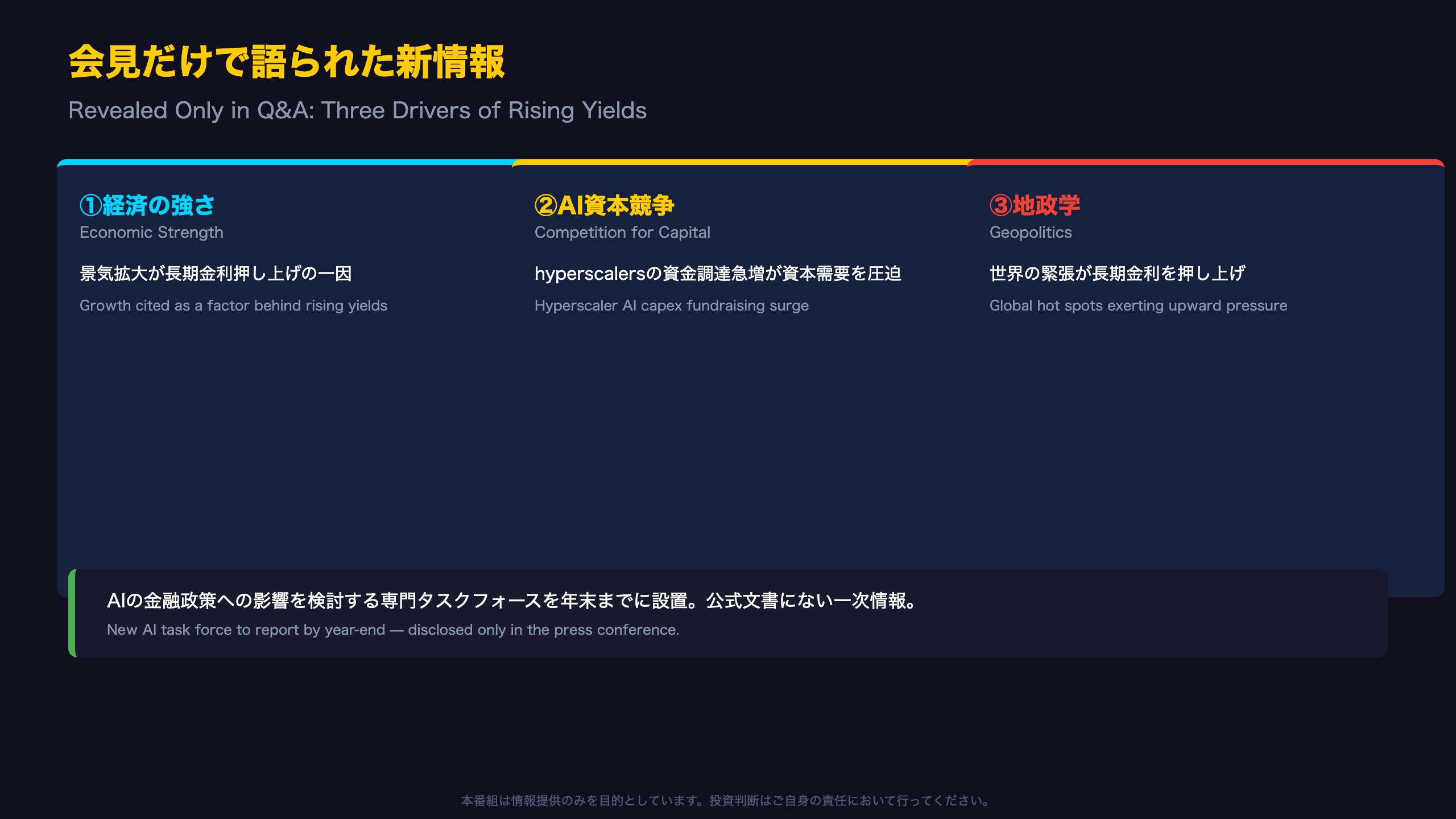
Information Found Nowhere in the Statement
The most striking new information from this press conference didn’t appear in the written policy statement at all — it surfaced only under questioning. Axios’s Neil Irwin asked what rising long-term yields signified, and Warsh offered three explanations:
- Economic strength — “part of the reason why we’ve seen…long term yields go up is the economy is strengthened.”
- Competition for capital — a surge in AI-related capital expenditure by “hyperscalers” (large cloud/AI infrastructure firms) actively raising funding in capital markets.
- Geopolitics — ongoing global hot spots exerting upward pressure on yields.
Warsh called the phenomenon “overdetermined,” a deliberately cautious framing that avoids attributing yield moves to any single cause — useful context for U.S. Treasury market watchers trying to disentangle growth-driven versus risk-driven yield increases.
A New AI Task Force
Responding to CNN’s Matt Egan on AI safety concerns, Warsh disclosed for the first time that the Fed “has to establish a task force that should report by the end of the year” to study AI’s implications for monetary policy — a governance detail with no prior public documentation.
Why This Matters for Investors
The framing of AI capex as a competitor for capital — pushing up yields on the 10-year Treasury, described by Warsh as “the risk-free asset upon which every price of virtually every asset in the world is related to” — offers a rare, unscripted window into how the Fed is thinking about the AI investment boom’s spillover into rates markets, distinct from anything in the FOMC statement or SEP.
総括 ー 「least well off」への言葉と次回への視点
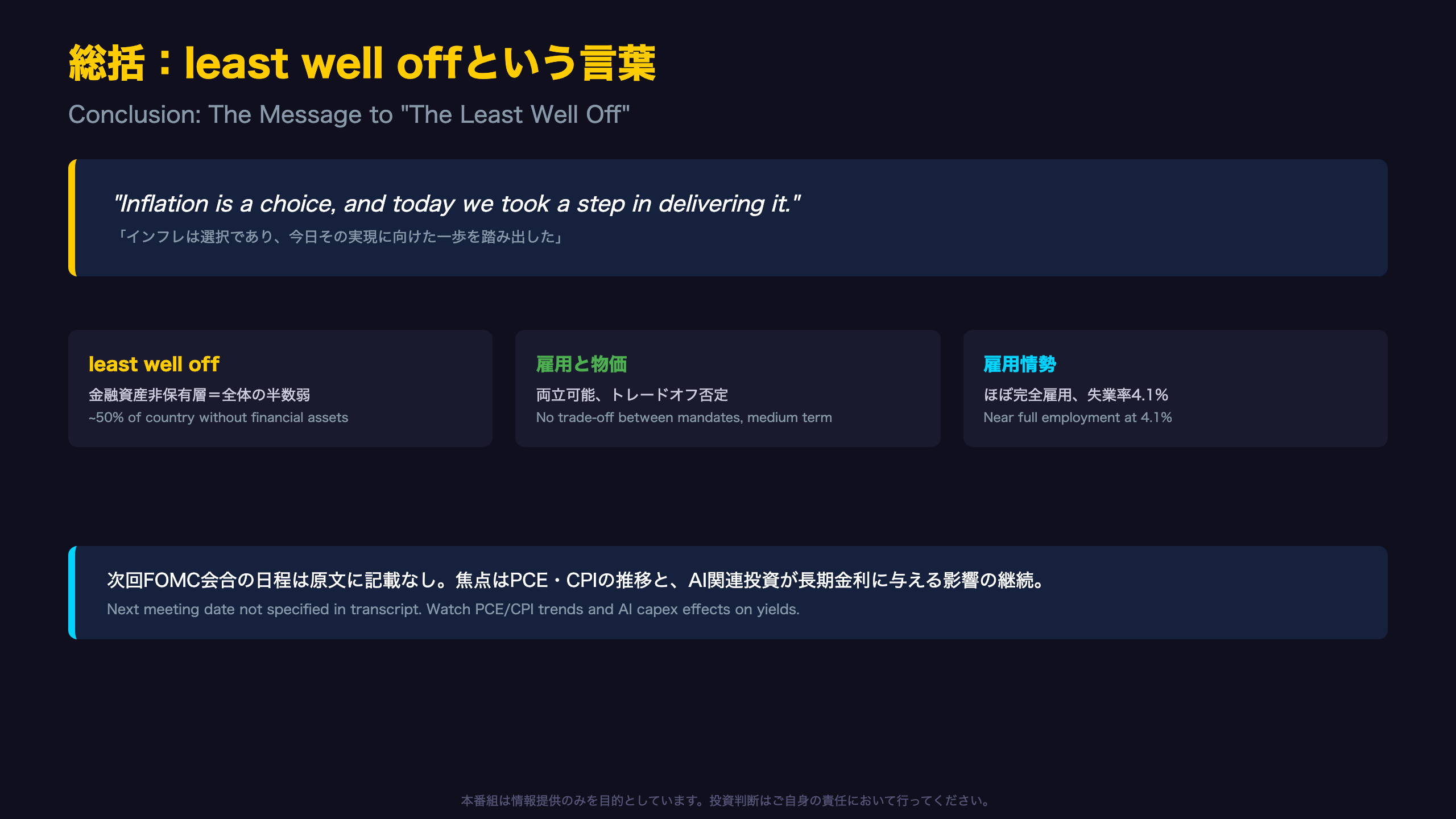
The Recurring Phrase: “The Least Well Off”
Warsh repeatedly invoked “the least well off” throughout the Q&A. Responding to NBC’s Brian Chung, he defined this group precisely: “people that don’t own financial assets, call that a bit less than 50% of the country” — those living paycheck to paycheck without home equity or 401(k) holdings.
Price Stability as the Best Tool for Equity
His reasoning: “In stable prices, an environment where inflation is running consistent with our 2% objective offers good news because that way when they get their wages they can put their head above water” — framing inflation control itself as the most effective anti-poverty policy available to the Fed.
No Trade-off Between Mandates
Asked by Yahoo Finance’s Jennifer Schoenberger whether the Fed intended to deliberately weaken the labor market to curb inflation, Warsh was unequivocal: “I don’t believe that we need to do harm to the labor markets to achieve our objective,” rejecting any dual-mandate trade-off in the medium term — a notably more optimistic framing than some past Fed communications during tightening cycles.
Looking Ahead
This transcript contains no explicit date for the next FOMC meeting. Given the roughly seven-week gap between the prior two meetings, the next decision is likely several weeks out, following the standard FOMC calendar. Key data to watch: incoming PCE and CPI prints (given August’s 3.6% headline reading), and whether AI-driven capex and geopolitical tensions continue to exert upward pressure on long-term Treasury yields, as Warsh described in this session.
Disclaimer: This article is for informational purposes only. All investment decisions are made solely at your own risk.