📺 Watch the Full Video Analysis
This article was automatically generated by the NFC Market Live AI analysis system. (Updated: 2026-09-25 04:09 JST)
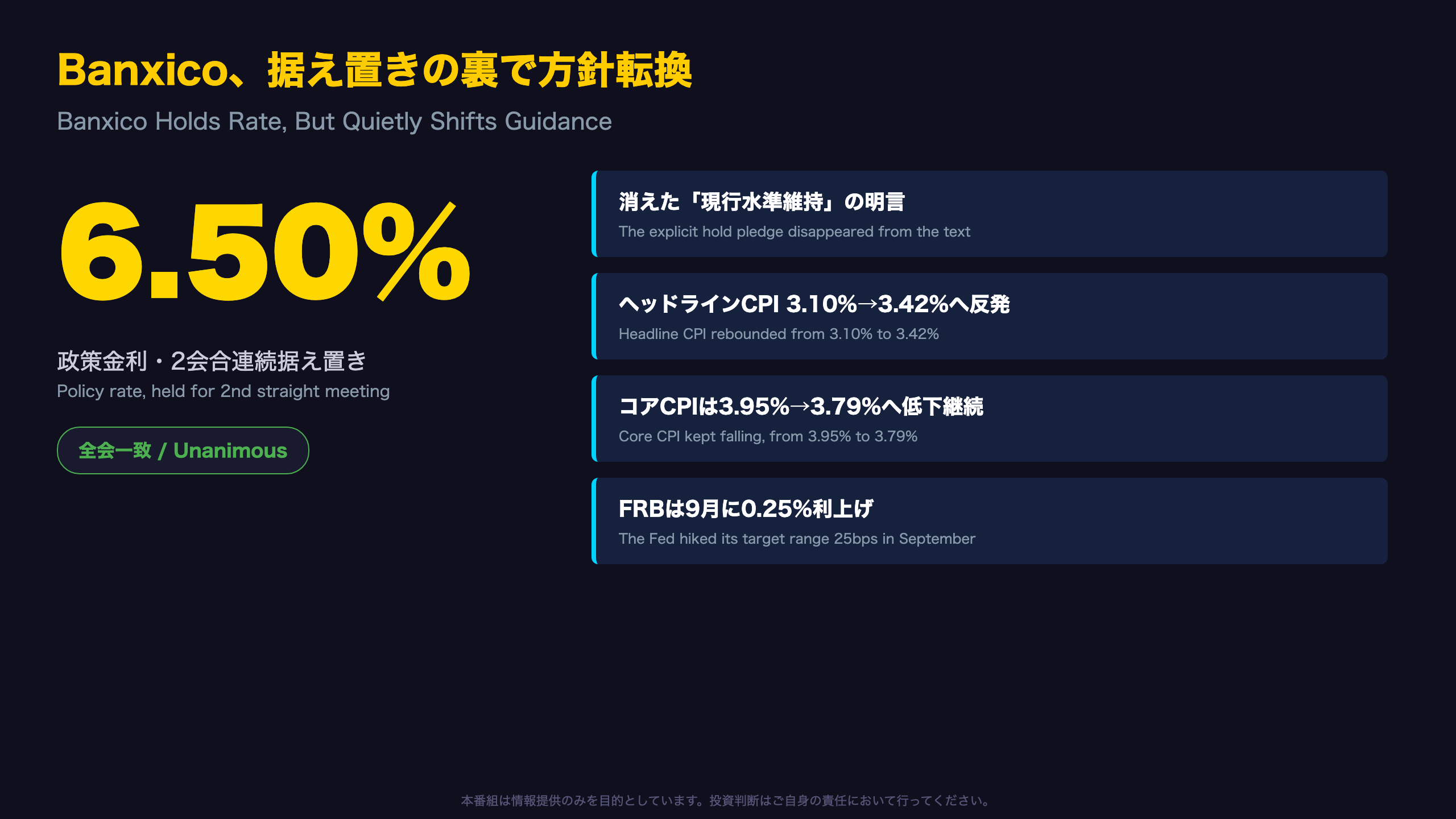
Banco de México (Banxico) held its policy rate at 6.50% on September 24, 2026, in a unanimous decision.
📊 On the surface, it looks like a repeat of the prior hold—but a close textual read reveals a meaningful shift.
💡 The explicit pledge to “maintain the rate at its current level” has vanished, replaced by data-dependent language.
📉 Headline inflation rebounded from 3.10% to 3.42%, while core inflation kept falling from 3.95% to 3.79%.
⚠️ The Fed hiked 25bps in September, yet Banxico explicitly stated it “would not react mechanically” to Fed moves.
We break down exactly what changed—and why it matters for the next decision.
The Ultimate Summary:据え置きの裏の方針転換
A Hold Everyone Expected, But Not the Same Hold
On September 24, 2026, Banco de Mexico (Banxico) held its policy rate at 6.50% for the second consecutive meeting, a widely expected outcome. The vote was unanimous with “the presence of all its members”—identical in form to August’s decision.
Context for international readers
Banxico, Mexico’s central bank, sets the overnight interbank rate as its main policy tool, similar to the Fed Funds Rate in the US. Unlike the Fed’s dual mandate, Banxico operates under a strict inflation-targeting mandate (3% +/-1pp), making its forward guidance language unusually literal and closely parsed by markets.
The real signal: guidance, not the rate
The August statement contained an explicit commitment: “the Governing Board estimates that it will be appropriate to maintain the reference rate at its current level.” That sentence is entirely absent from September’s statement. It has been replaced by data-dependent language: “monetary policy would not have to react mechanically to the anticipated adjustments to the federal funds rate.”
Why it matters for global investors
This timing is notable: the Fed hiked 25bps in September, and Banxico used that exact moment to explicitly decouple its policy path from the Fed’s. For USDMXN traders, this reopens optionality for a future cut that the August “pause” language had effectively closed off. The next slides dissect this shift phrase by phrase.
The Red-line Analysis:文言の書き換え
Phrase-by-Phrase: What Actually Changed
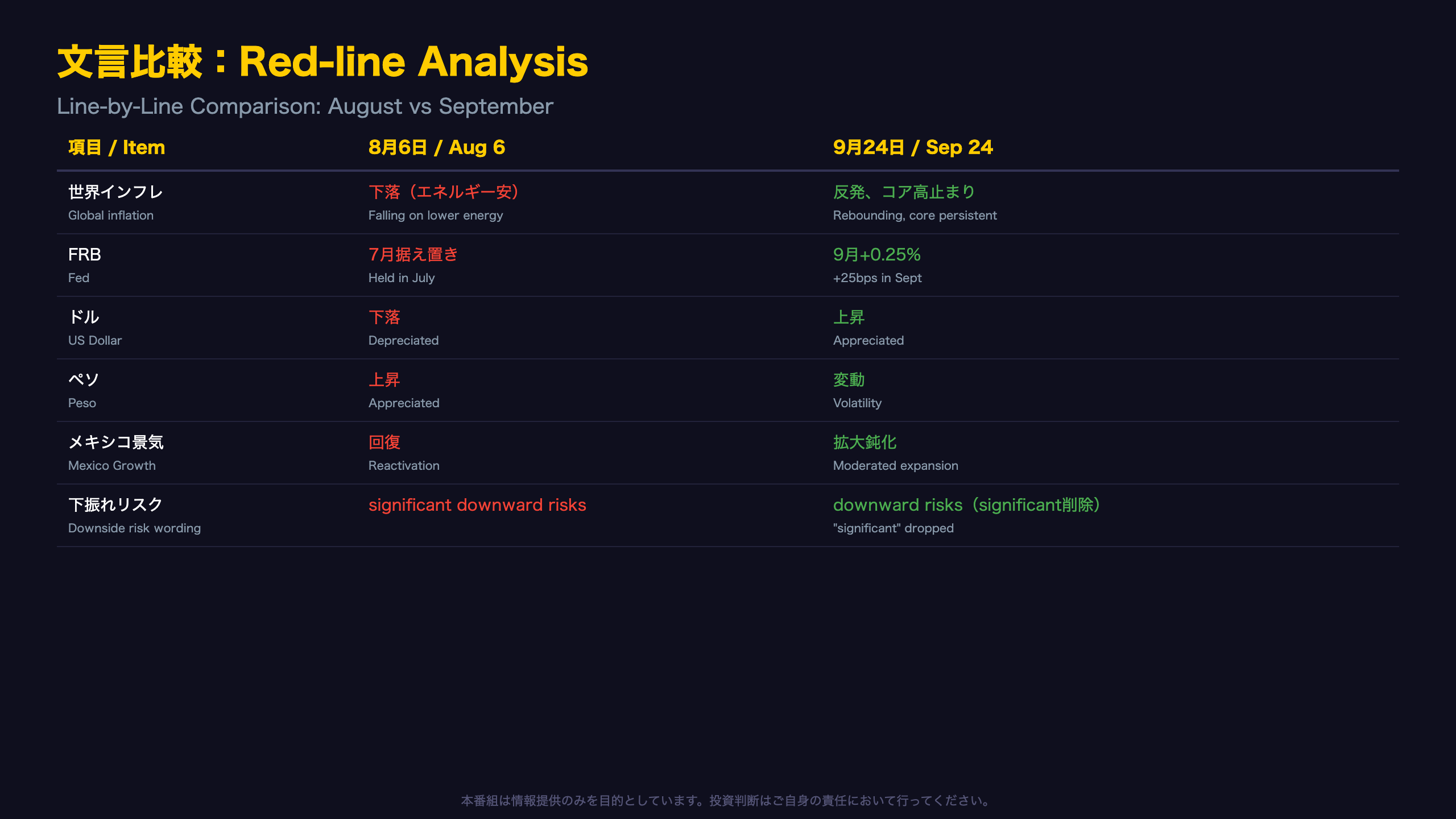
| Item | August 6 Statement | September 24 Statement |
|---|---|---|
| Global inflation | Falling, on lower energy prices | Rebounding, on higher energy prices; core “persistent” |
| Fed | Held in July | Hiked 25bps in September |
| US Dollar | Depreciated | Appreciated |
| Mexico gov’t yields | Minor moves short/medium, long-term up | Up across most maturities |
| Peso | Appreciated | “Registered some volatility” |
| Mexico growth | “Reactivation” | “Moderated expansion” |
| Downside risk language | “significant downward risks” | “downward risks” (word “significant” dropped) |
Why the missing word matters
The removal of “significant” from the downside growth-risk description is a single-word change (Level C evidence on its own). But combined with several other phrases softening in the same direction—peso language, growth language—it suggests (Level B) a modest, deliberate recalibration of tone rather than a random edit.
A brand-new evaluation criterion
For the first time, the Governing Board’s list of assessment factors includes “the differences in the stage of the economic cycle that the Mexican and US economies are undergoing.” This phrase did not exist in August’s statement. It functions as an explicit justification for why Banxico does not need to mirror the Fed’s tightening move—a textbook decoupling argument that international bond and FX investors should watch closely.
局所的ディテール:ヘッドラインとコアのねじれ
A Rare Divergence: Headline Up, Core Down
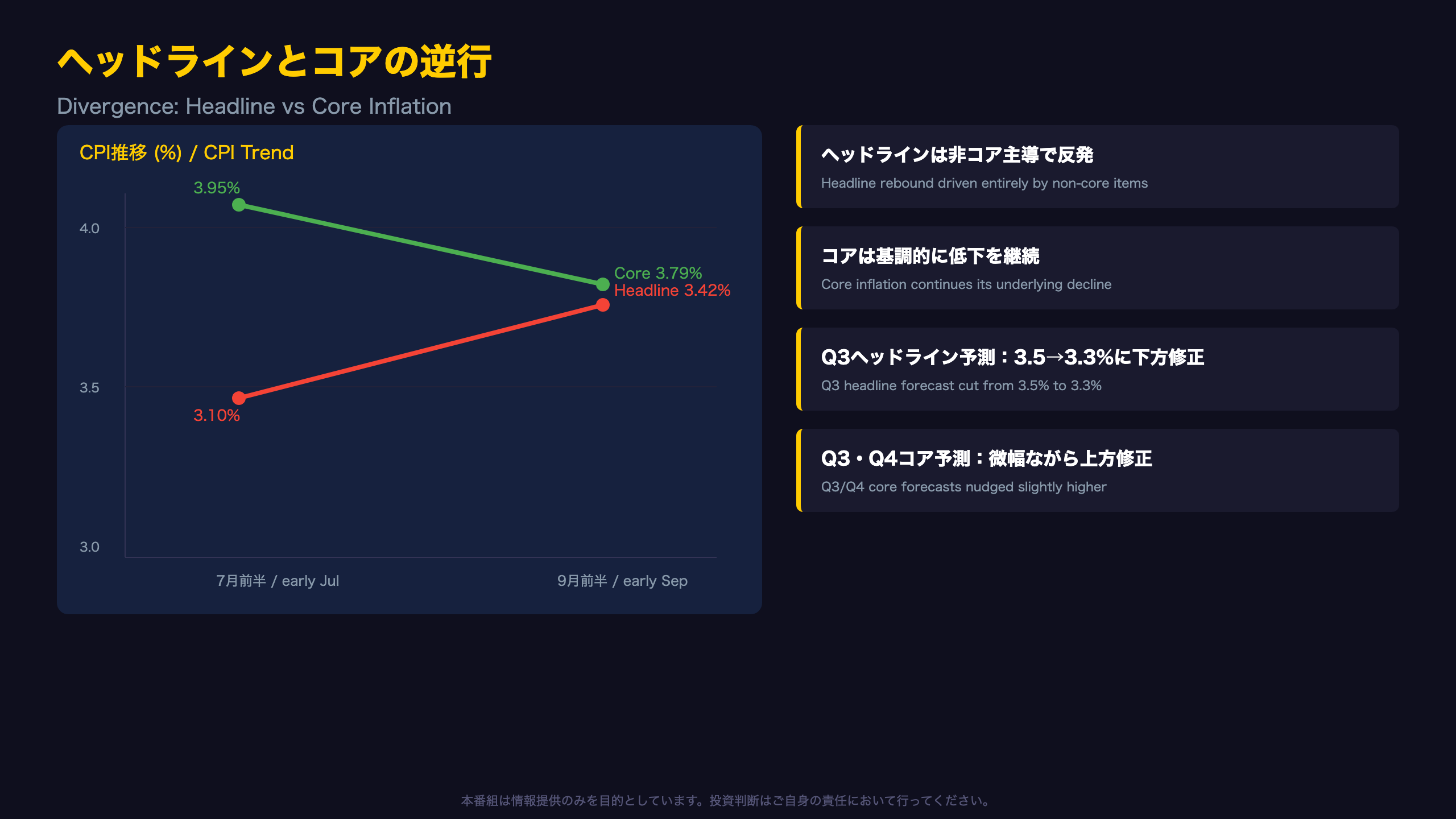
The most striking micro-detail in this statement is the split between headline and core inflation prints.
- Headline CPI: 3.10% (first half of July) → 3.42% (first half of September) — up
- Core CPI: 3.95% (first half of July) → 3.79% (first half of September) — continued falling
The statement is explicit about the driver: “headline inflation rose from 3.10 to 3.42% due to an increase in non-core inflation. Core inflation continued decreasing from 3.95 to 3.79%.” Non-core items—typically energy and agricultural prices, which are volatile and excluded from most central banks’ “core” measures—are the culprit, while the stickier underlying trend (core) is actually improving.
The forecast table tells the same story
The Q3 2026 headline forecast was revised down from 3.5% to 3.3%, while the core forecast was nudged up, from 3.8% to 3.9% for Q3 and from 3.5% to 3.6% for Q4 (directly stated in the report, Level A evidence). In other words, the near-term headline outlook improved mechanically because of a lower non-core assumption, even as the committee’s own model now sees slightly stickier core inflation ahead.
Why the new decoupling criterion matters
For US-based readers: the Fed’s dual mandate and meeting-by-meeting data dependence is a familiar framework. Banxico operates differently—its board explicitly lists the evaluation factors it considers each meeting. The addition of “differences in the stage of the economic cycle” between Mexico and the US, appearing for the first time immediately after the Fed’s September hike, functions as a textbook justification for policy divergence—something FX traders watching USDMXN carry dynamics should not overlook.
インプリケーション:次に何を見るか
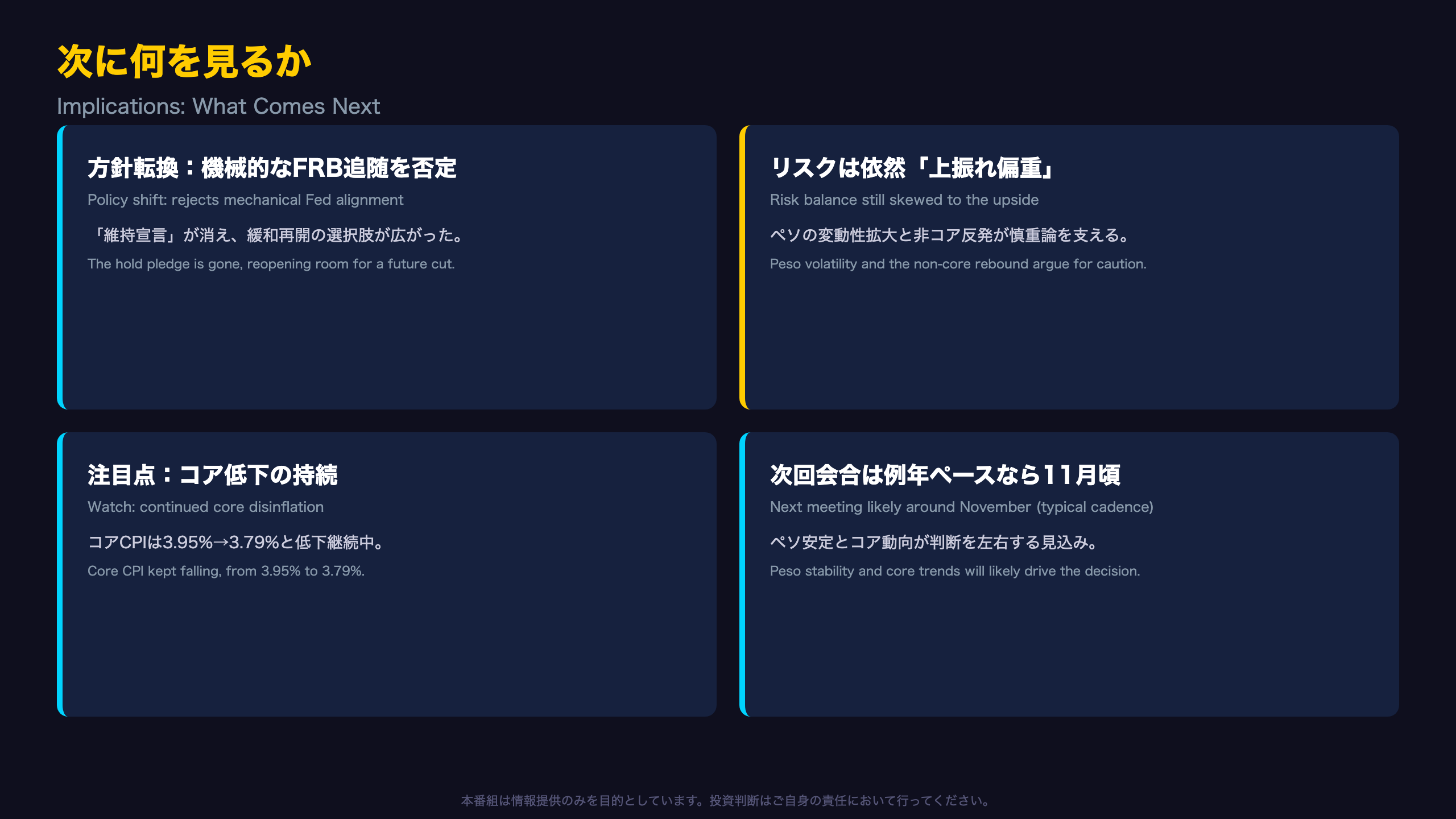
What the Removal of the Hold Pledge Really Means
The single most important analytical point in this statement is that the explicit commitment from August—“it will be appropriate to maintain the reference rate at its current level”—has been completely removed from September’s text. In central bank communication practice, dropping this kind of concrete forward commitment is a well-known technique for preserving optionality ahead of a future meeting (Level B inference, based on comparable central bank communication patterns).
Bull and bear cases, both grounded in the text
The dovish read: continued core disinflation (3.95% → 3.79%) combined with the new language rejecting mechanical alignment with the Fed suggests the door has reopened for a resumed rate-cutting cycle.
The hawkish read: the headline inflation rebound (3.10% → 3.42%), the unchanged assessment that risks remain “biased to the upside,” and rising peso volatility all argue for caution before restarting easing.
“The balance of risks for the trajectory of inflation within the forecast horizon remains biased to the upside.”
This sentence is copied verbatim from the prior statement—Banxico has not turned unambiguously optimistic.
What to watch next
Banxico typically holds around eight meetings a year; based on that standard cadence, the next decision is likely around November (Level C estimate—not stated explicitly in the source document). Key variables for that meeting will be whether core inflation keeps falling, whether peso volatility settles down, and whether the Fed delivers further hikes. For USDMXN traders, this statement effectively raises the probability of policy divergence risk becoming a live theme again.
Disclaimer: This article is for informational purposes only. All investment decisions are made solely at your own risk.