This article was automatically generated by the NFC Market Live AI analysis system. (Updated: 2026-11-12 10:33 JST)
📊 We break down the Ministry of Finance’s weekly cross-border securities data (Nov 1-7, released Nov 12).
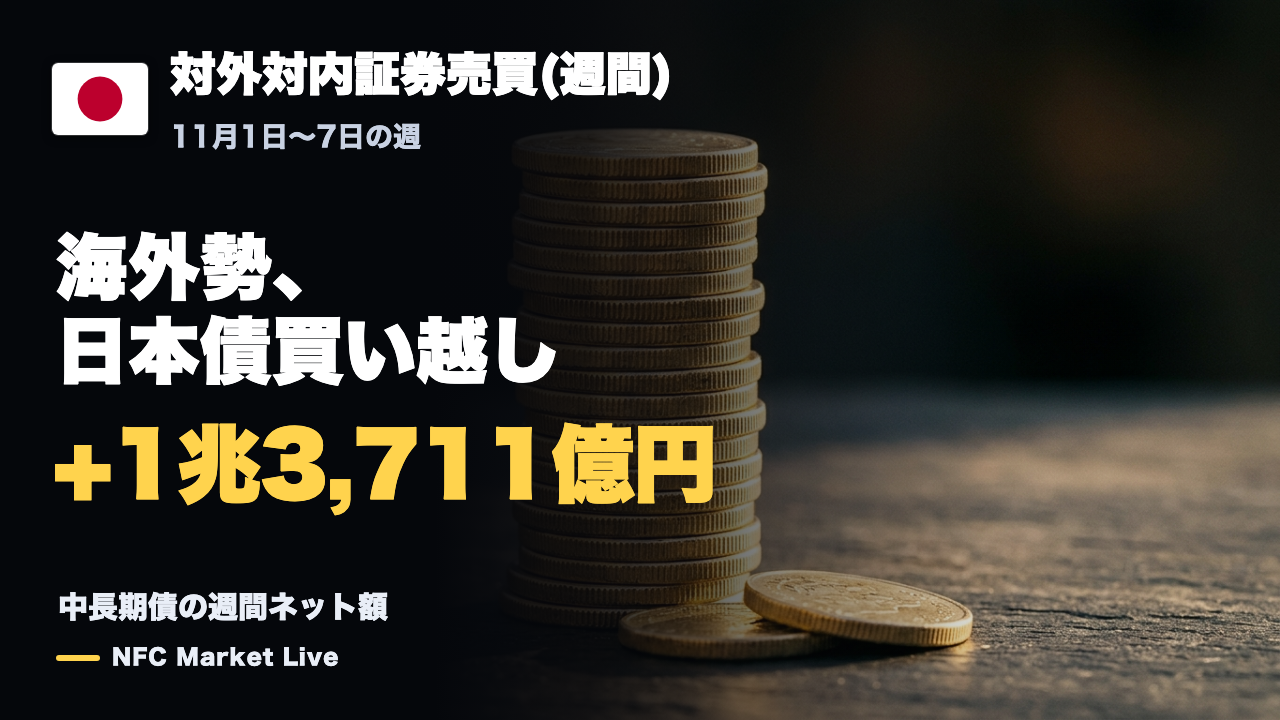
📈 Foreign investors net bought 1.37 trillion yen of Japanese long-term bonds, the sixth straight week of net buying.
📉 Foreign investors turned net sellers of Japanese stocks (-105 billion yen), and Japanese investors reversed from net buying to net selling of foreign stocks and long-term bonds.
💡 Short-term bond selling of about 1.5 trillion yen largely offset the long-term inflow. Weekly flows are volatile, so the multi-week trend matters.
⚠️ Next up: the week of Nov 8-14, due next week.
今週の全体像:債券買いは継続、株は小休止
What this report is
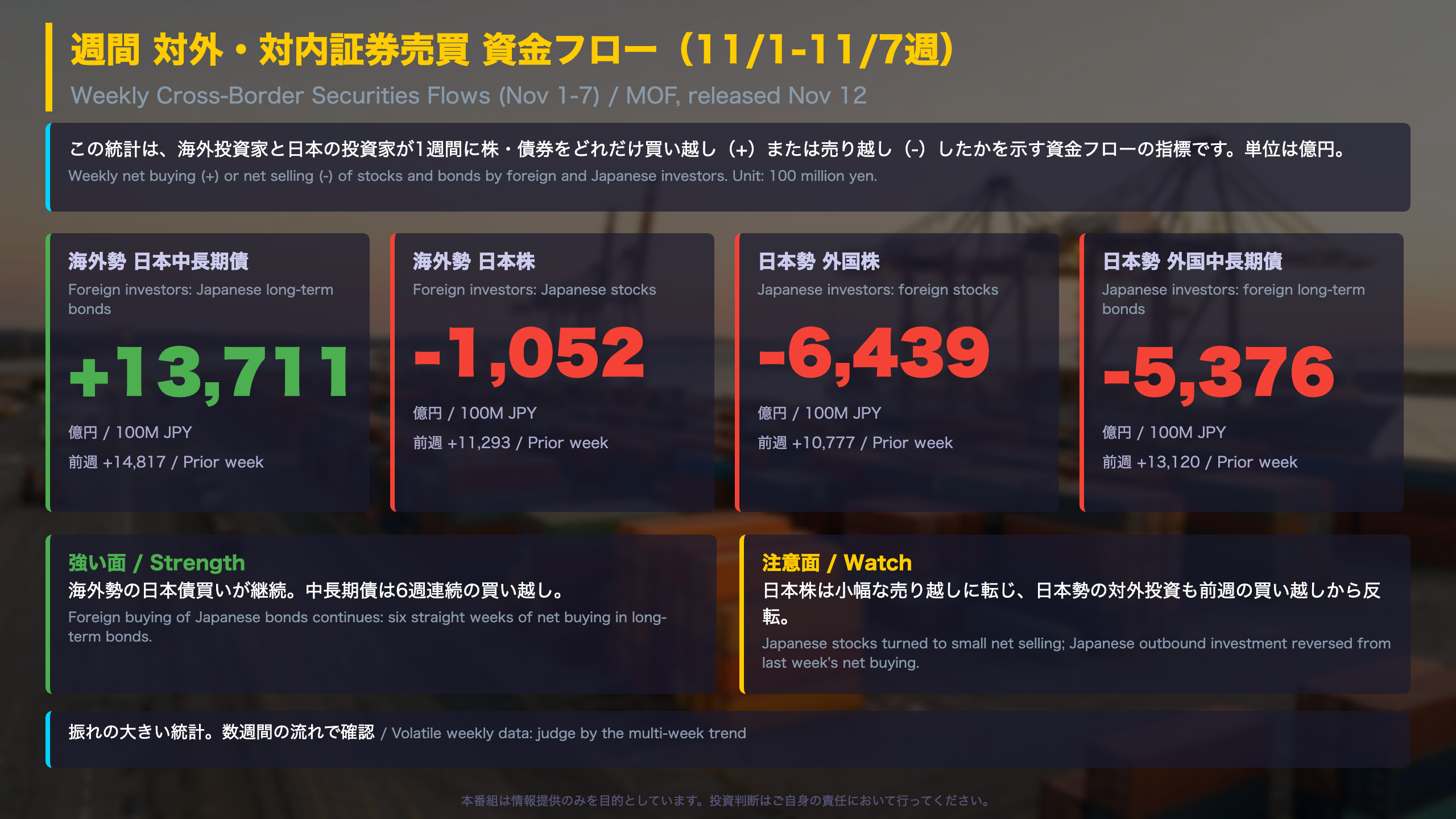
Japan’s Ministry of Finance (MOF) publishes a weekly report on cross-border securities transactions. It shows how much foreign investors net bought or net sold Japanese stocks and bonds, and how much Japanese investors net bought or sold foreign ones. It is the nearest Japanese counterpart to the US Treasury’s TIC data, but it is released weekly and is based on contracted trades. Plus means net buying, minus means net selling, and the unit is 100 million yen.
This week’s snapshot (Nov 1-7, released Nov 12)
| Item | This week | Prior week |
|---|---|---|
| Foreign investors: Japanese stocks | -1,052 | +11,293 |
| Foreign investors: Japanese long-term bonds | +13,711 | +14,817 |
| Foreign investors: Japanese short-term bonds | -14,983 | +8,747 |
| Japanese investors: foreign stocks | -6,439 | +10,777 |
| Japanese investors: foreign long-term bonds | -5,376 | +13,120 |
Context
- Over the 52 weeks in the data, foreign flows into Japanese stocks ranged from -49,425 (Sep 13-19) to +39,413 (Apr 5-11). This week’s -1,052 is small within that range.
- Foreign long-term bond buying now spans six consecutive weeks.
A balanced read
Strength: foreign demand for Japanese bonds is persistent, and stocks were net bought in four of the last six weeks.
Caution: stocks flipped to net selling, short-term bonds saw heavy selling, and Japanese outbound investment reversed from the prior week’s net buying.
What to watch
Weekly flow data is noisy. The next release covers Nov 8-14, and the key question is whether the multi-week bond trend holds. Currency moves such as USD/JPY (158.23 this week) are reported only as a reference in this data set.
海外勢の日本債:中長期債は6週連続買い越し、短期債は売り越し
Reading the six-week streak
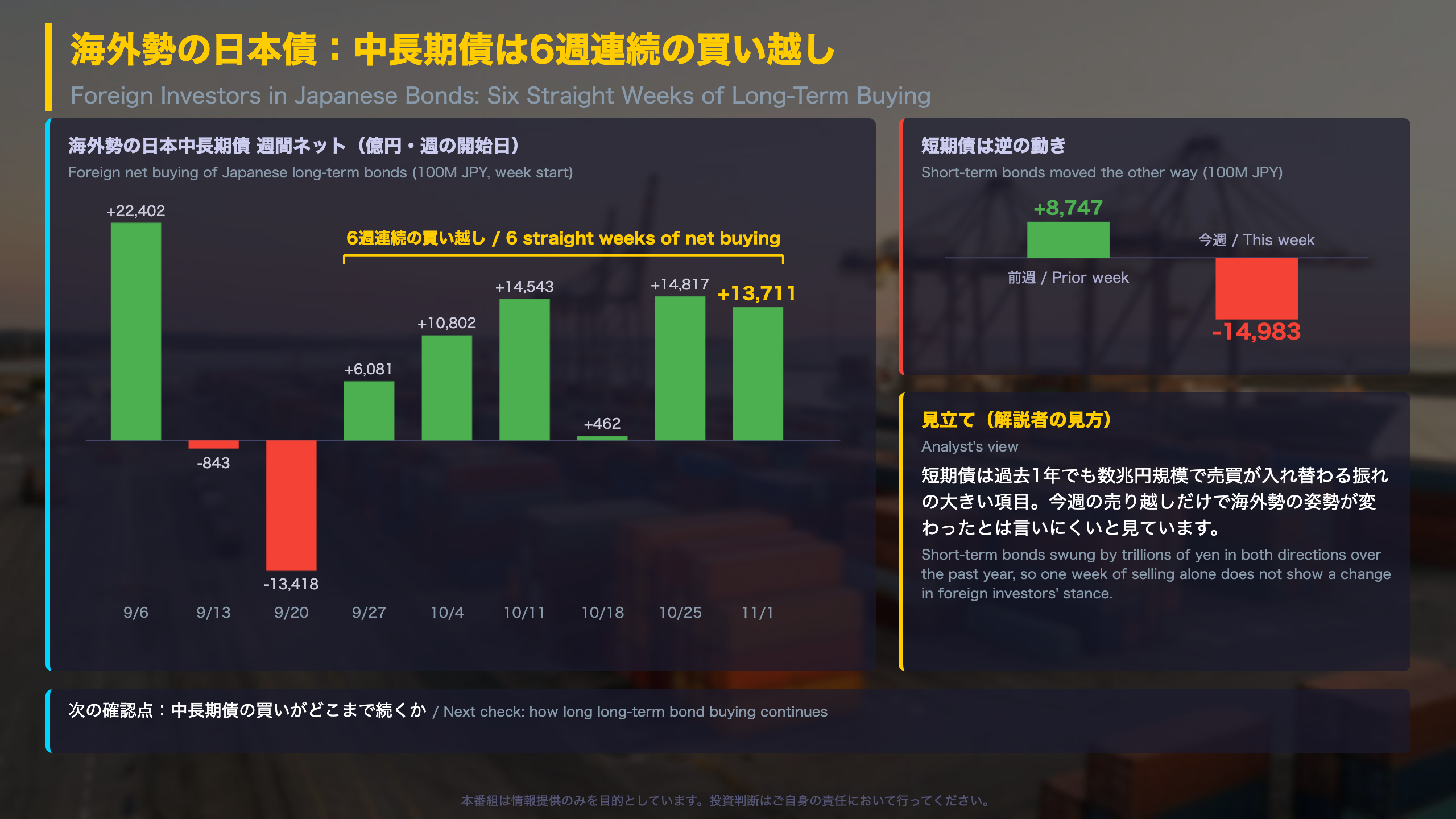
The Ministry of Finance (MOF) series on foreign investors’ net buying of Japanese long-term bonds has been positive since the week of Sep 27-Oct 3: +6,081, +10,802, +14,543, +462, +14,817 and now +13,711 (100 million yen). The streak is real but uneven, since the Oct 18-24 week was only +462.
How big is this week’s figure?
Of the 52 weeks in the table, only eight exceeded this week’s 13,711. The peak was +22,402 (Sep 6-12) and the largest net sale was -26,461 (Mar 22-28). So this is a strong reading, but not an outlier.
The short-term bond offset
Foreign investors net sold 14,983 of Japanese short-term bonds, versus net buying of 8,747 the week before. Adding the two maturities gives roughly -1,272, so the overall bond picture is close to flat. Over the past year this line has swung between -44,514 and +35,949, so the weekly figure is a noisy signal.
Two ways to read it
- Constructive: six weeks of long-term buying, with the prior week also large, suggests the inflow is not a one-off.
- Cautious: the short-term sale offsets the long-term inflow, and a single week is too little to say foreign positioning has changed.
Comparison and what to watch
Unlike the US TIC data, which is monthly and lagged, MOF’s weekly series gives a faster read on cross-border bond demand, though it is more volatile. The next release covers Nov 8-14. The questions are whether long-term buying extends to a seventh week and whether short-term bonds return to net buying.
日本勢の対外投資:前週の買い越しから反転
Japanese outbound investment: the last eight weeks
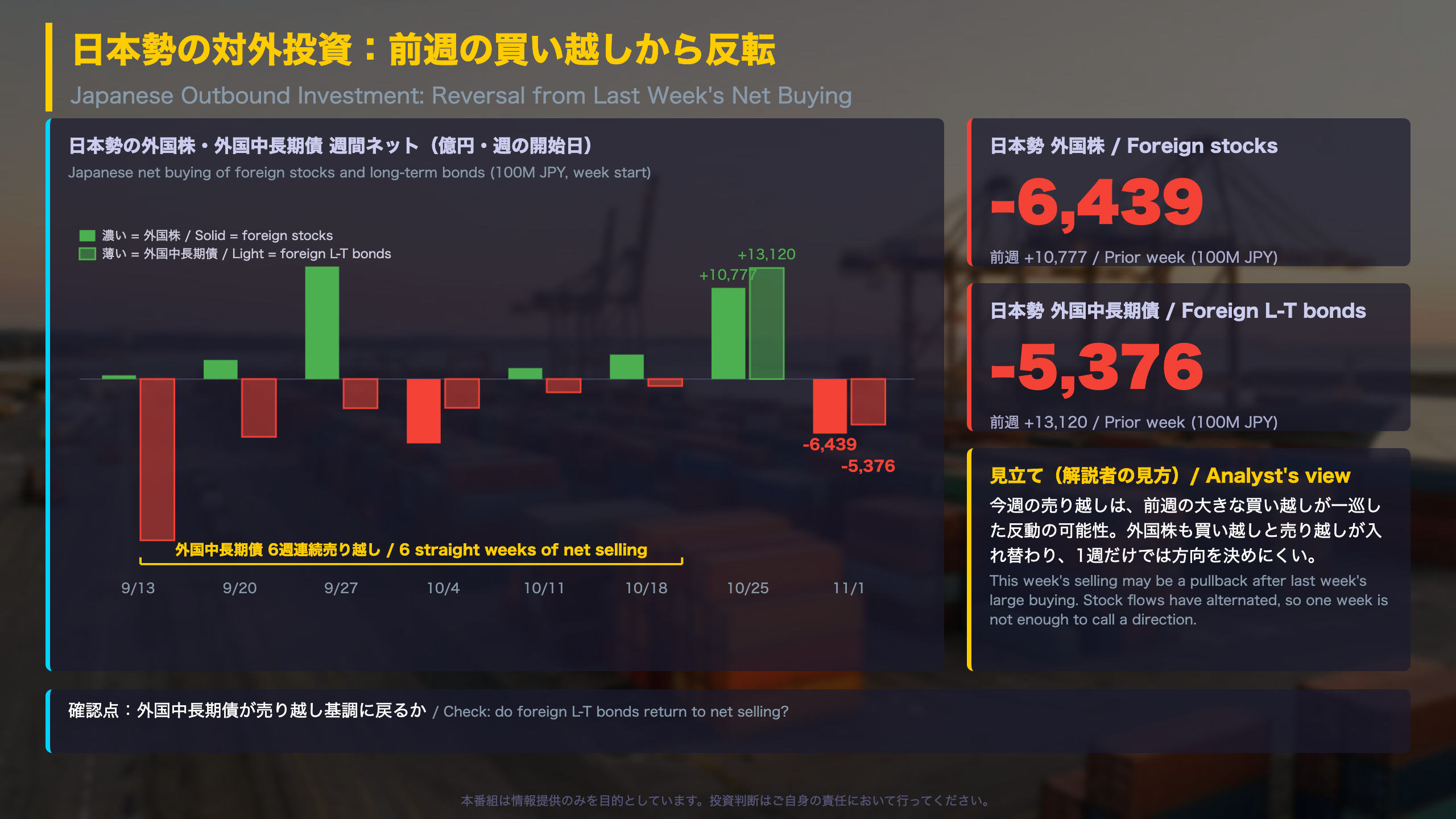
This part of the MOF report tracks Japanese residents buying or selling overseas securities. Plus means net buying of foreign assets (money leaving Japan), minus means net selling. Unit: 100 million yen.
| Week | Foreign stocks | Foreign long-term bonds |
|---|---|---|
| Oct 18-24 | +2,899 | -818 |
| Oct 25-31 | +10,777 | +13,120 |
| Nov 1-7 | -6,439 | -5,376 |
Foreign long-term bonds were net sold for six straight weeks (Sep 13-Oct 24), flipped to a large net purchase in the Oct 25-31 week, and returned to net selling this week.
A stock-bond seesaw in some weeks
Over the past year, Japanese investors sometimes moved stocks and bonds in opposite directions: the week of Mar 29-Apr 4 saw foreign stocks +14,343 and long-term bonds -24,789, while Apr 26-May 2 saw -24,252 and +24,064. This week both were net sold, so it does not fit that pattern.
Two readings
- Pullback: after an unusually large buying week, selling this week looks like a return to the normal range.
- Retreat from overseas assets: with both stocks and bonds sold, money flowing out of Japan may have weakened temporarily. Two weeks of data cannot separate the two views.
Why it matters and international comparison
Japanese investors, from life insurers to retail funds, are large holders of foreign securities. The US Treasury’s TIC data shows the other side of this trade, but only monthly and with a lag, which is why MOF’s weekly figures get attention. Short-term foreign bond flows were small (+663 vs -2,093 the prior week).
What to watch
The Nov 8-14 data will show whether foreign long-term bonds resume their net-selling pattern and whether foreign stocks return to net buying.
質疑で深める:株の売り越し、対外投資の反転、為替との関係
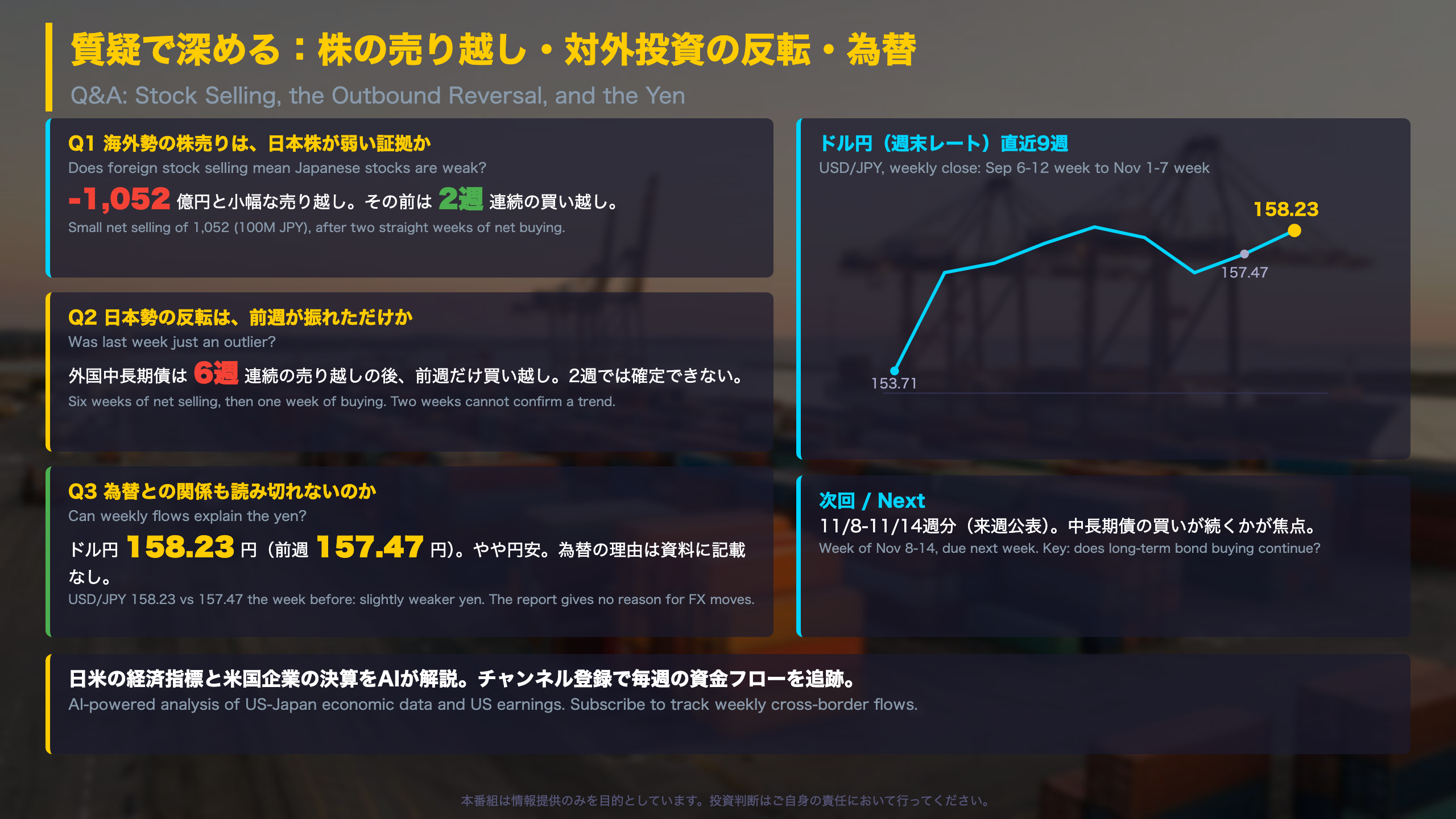
USD/JPY and weekly flows
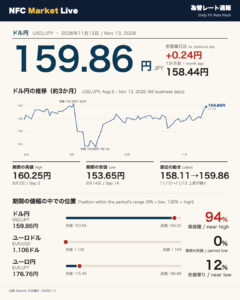
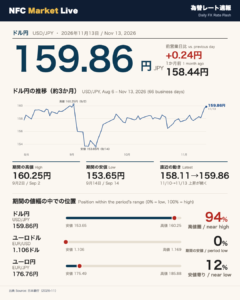
USD/JPY was 158.23 this week versus 157.47 the week before. Over the 52 weeks in the data, the high was 163.71 (Jul 19-25) and the low 152.77 (Feb 8-14), so 158.23 sits almost exactly at the midpoint.
Same flow, different currency reaction
- Sep 6-12: foreign investors net bought 22,402 (100 million yen) of Japanese long-term bonds, and USD/JPY fell to 153.71 from 156.11.
- This week: net buying of 13,711, yet USD/JPY rose to 158.23 from 157.47.
- The report gives no reason for either move.
The lesson is that weekly bond flows alone do not explain the yen. Foreign bond buying typically involves buying yen, but hedging, rate differentials, and other factors are outside this data set.
Reading the stock flow
Foreign investors net bought more than 1 trillion yen of Japanese stocks in each of the previous two weeks (+11,822 and +11,293), then net sold only 1,052 this week. Four of the last six weeks were net buying.
Two interpretations
- Constructive: the stock selling is small and bond inflows continue, so foreign interest in Japanese assets looks intact.
- Cautious: stock buying paused and short-term bonds were heavily sold, which could reflect a temporary reduction in foreign risk exposure. With one week of data, neither view can be confirmed.
International comparison and what to watch
The US TIC report shows foreign flows into US assets monthly; MOF’s weekly data is faster but noisier. For the Nov 8-14 data (due next week), the checks are: a seventh week of long-term bond buying, a return to net buying of Japanese stocks, and whether Japanese investors keep net selling foreign long-term bonds.
Disclaimer: This article is for informational purposes only. All investment decisions are made solely at your own risk.