This article was automatically generated by the NFC Market Live AI analysis system. (Updated: 2026-11-12 10:29 JST)
📄 Primary Source
日本銀行
https://www.boj.or.jp/statistics/pi/cgpi_release/cgpi2610.pdf
📊 Bank of Japan’s October preliminary Corporate Goods Price Index (released Nov 12).
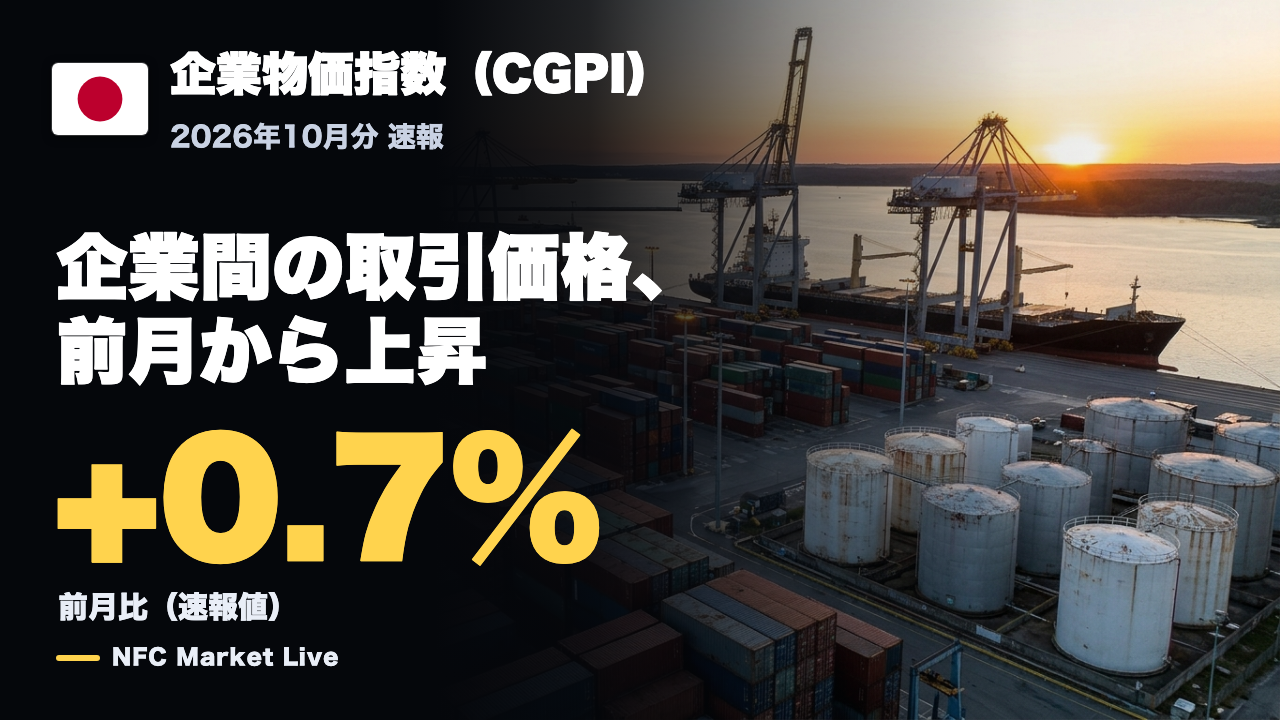
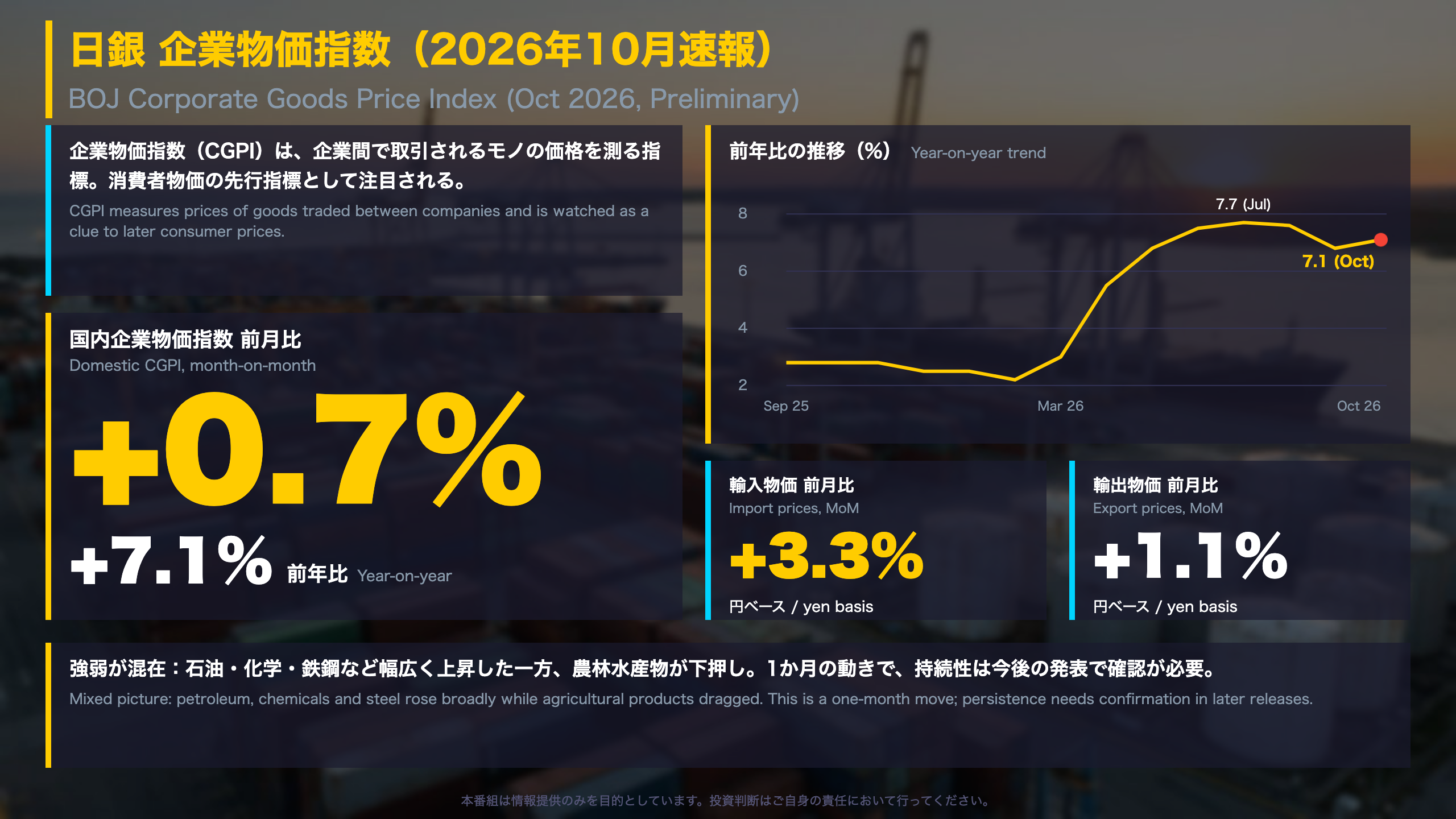
The domestic index rose 0.7% m/m and 7.1% y/y, reversing the m/m declines of August and September.
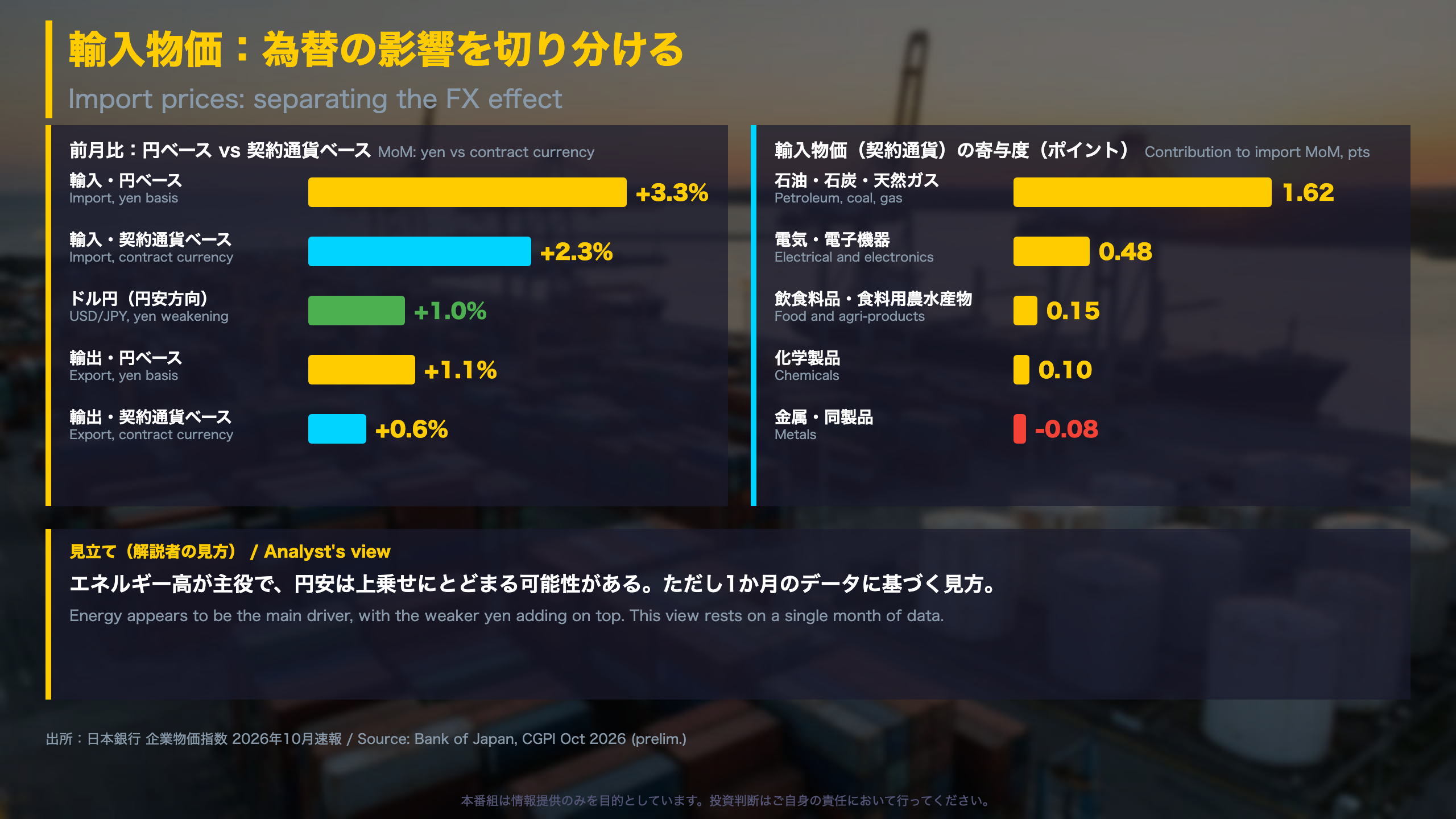
💡 Import prices rose 3.3% in yen terms and 2.3% in contract-currency terms; petroleum, coal and natural gas contributed 1.62 points.
📈 Petroleum products, chemicals and steel rose at home.
⚠️ Agricultural products fell 6.6% m/m, a drag on the headline.
🗓 Next release: Dec 10.
10月の企業物価指数:前月比プラスに転じる
What the October CGPI release is
The Corporate Goods Price Index (CGPI) is compiled by the Bank of Japan’s Research and Statistics Department. It measures prices of goods traded between companies (domestic, export and import), with 2020 average set to 100. It is the closest Japanese counterpart to the US Producer Price Index, but the CGPI covers goods only, not services, and the BOJ publishes it alongside separate services price indices.
Headline
- Domestic CGPI: +0.7% m/m, +7.1% y/y, index at 136.8
- Adjusted for the summer electricity surcharge: +0.9% m/m
- The m/m reading reverses declines of -0.3% (August) and -0.2% (September, revised)
Context
Year-on-year inflation stood at 2.2% to 2.5% in early 2026, then moved to 3.0% in March and 5.5% in April. It has hovered around 7% since, peaking at 7.7% in July. This release is a preliminary estimate, and the previous month has already been revised once.
Why it matters
Because producer-level prices sit upstream of retail prices, analysts watch the CGPI for hints about consumer inflation. The BOJ publishes data only; this release contains no commentary on monetary policy.
What to watch
The next release is on December 10. The key questions are whether the rebound holds and whether it spreads from materials to consumer-facing goods.
解説①:輸入物価は為替より外貨建て価格の上昇が大きい
Separating currency effects from underlying price moves
The BOJ reports import and export prices on two bases. The yen basis converts everything to yen, so it moves with the exchange rate. The contract-currency basis keeps prices in the currency of invoicing, typically the US dollar, and therefore strips out currency swings. The difference between them is a quick way to see how much of a move comes from the yen.
October figures
- Import prices: +3.3% m/m (yen) vs +2.3% m/m (contract currency)
- Export prices: +1.1% (yen) vs +0.6% (contract currency)
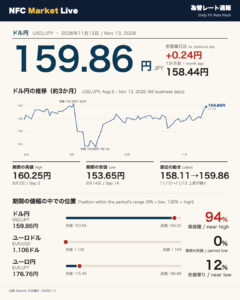
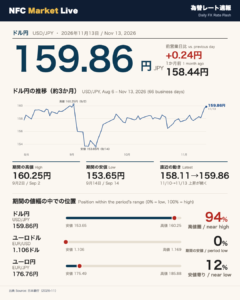
- USD/JPY averaged 158.0, up 1.0% m/m in yen-weakening terms
Sub-index detail
Petroleum, coal and natural gas rose 5.3% in contract-currency terms (+40.1% y/y), contributing 1.62 of the 2.3 points. Electronics, including memory chips, rose 2.7% and added 0.48 points. Metals were a small drag.
Comparison
Unlike the US PPI, which covers domestic producers’ output, Japan’s import index tracks prices at the border and is therefore sensitive to energy and the yen. Japan imports most of its energy, which is why oil moves feed through quickly to domestic prices.
What to watch
The release does not say why energy prices rose. The December 10 data will show whether the contract-currency gain persists or fades after a single strong month.
解説②:国内の上昇は広がる一方、農林水産物が下押し
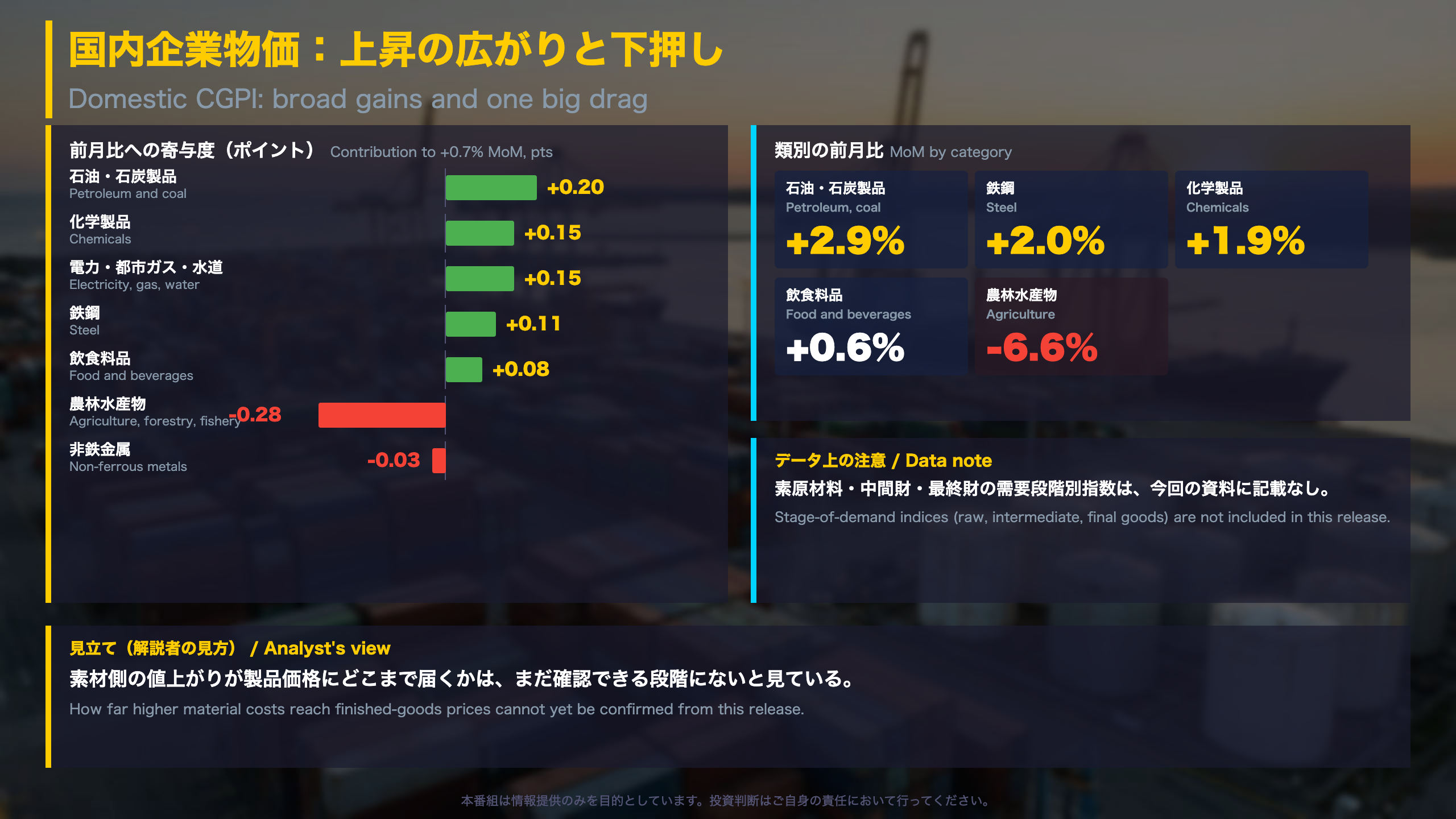
Domestic CGPI: broad gains, one big drag
The domestic CGPI weights 19 manufactured categories plus agriculture, mining, utilities and scrap. In October, 16 of the 19 manufacturing categories rose month on month.
Contributions to the +0.7% m/m
- Petroleum and coal products: +0.20 pts (heavy fuel oil, naphtha, jet fuel)
- Chemicals: +0.15 (xylene, ethylene)
- Electricity, gas and water: +0.15 (up 2.4% m/m, 15.8% y/y)
- Steel: +0.11 (up 2.0% m/m)
- Agriculture, forestry and fishery: -0.28 (down 6.6% m/m; rice and pork)
Reading the mix
Cost-sensitive upstream categories such as petroleum, chemicals and steel rose by 1.9% to 2.9%, while food and beverages rose 0.6%. Electrical machinery (+1.1%) and electronic components (+0.8%) also advanced. Only non-ferrous metals, business machinery and information and communication equipment fell.
Important gap in the data
The BOJ also publishes stage-of-processing indices (raw materials, intermediate goods, final goods), but these are not part of the material reviewed here. Without them, pass-through to finished goods cannot be measured directly.
Comparison
Similar to the US PPI, Japan’s CGPI is influenced by energy and food. Agricultural prices are volatile, so the sharp decline in rice and pork flattered the headline less than the broad gains elsewhere suggest.
Next release: December 10.
質疑で深める:円安か原油高か、単月か反動か
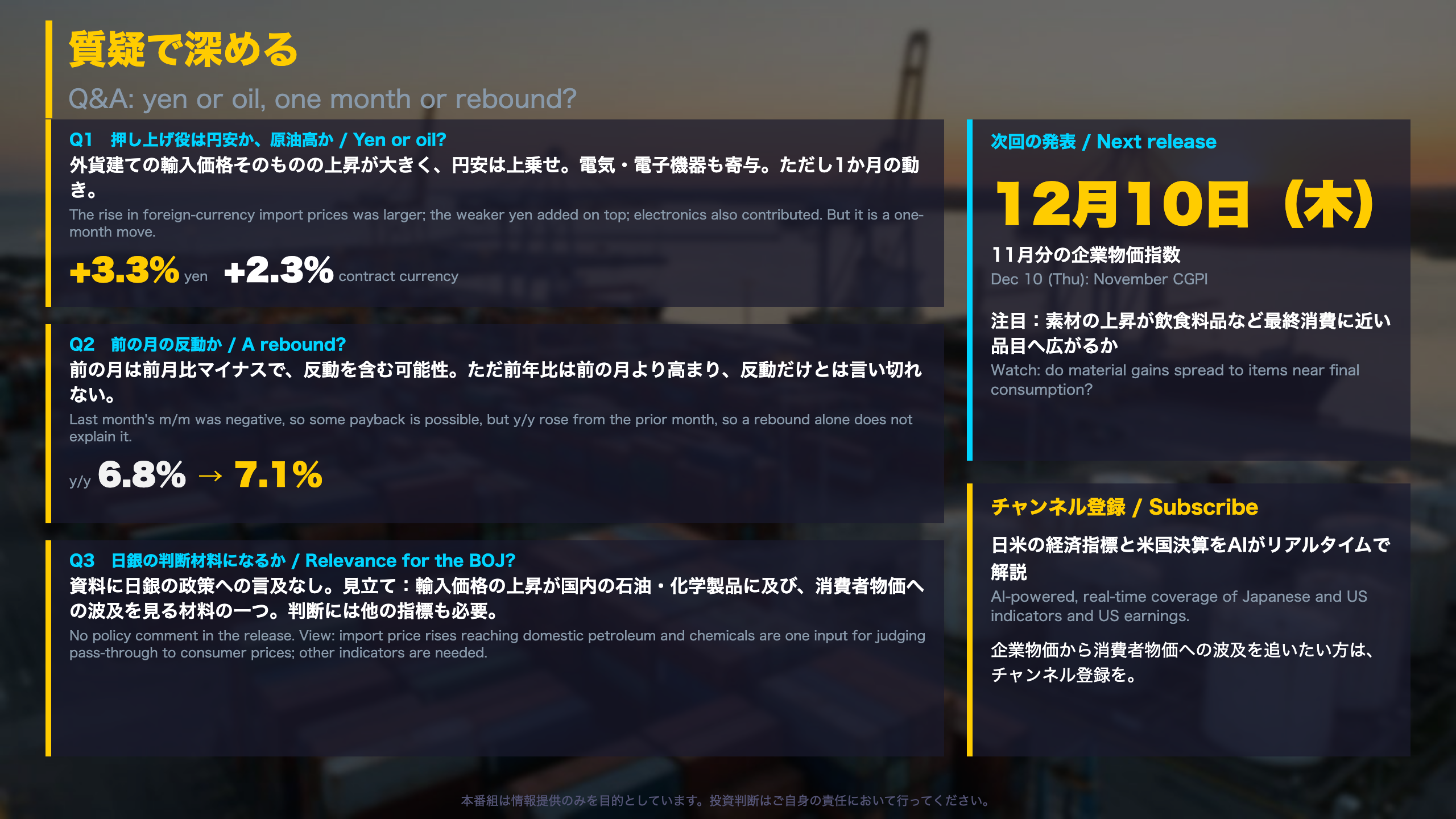
Three questions raised by the October CGPI
1. Yen or energy?
Import prices rose 3.3% in yen terms and 2.3% in contract-currency terms. The 1.0-point gap lines up with the 1.0% weaker yen, but the contract-currency rise is itself sizeable, with petroleum, coal and gas contributing 1.62 points. Both forces operated at once; the data suggest the underlying price rise was the larger piece.
2. Rebound or turn?
The index fell in August (-0.3%) and September (-0.2%, revised), so some payback is plausible. Yet y/y inflation rose from 6.8% to 7.1%, and the chain-weighted index rose 0.9% m/m. Year-on-year figures also reflect base effects from a year ago, so one month is not conclusive.
3. Why would the BOJ care?
The Bank of Japan watches whether cost increases at the producer level feed into consumer prices. This publication is a statistical release and contains no policy commentary. Investors should read it alongside consumer price data, which the material reviewed here does not include.
Comparison
In the US, the PPI plays a similar early-warning role for CPI, but Japan’s import-heavy energy mix makes the yen and oil especially visible in the CGPI.
What to watch
The November data arrive on December 10. Key checks: does the energy-led rise persist, and does it spread to food and other items near the consumer?
Disclaimer: This article is for informational purposes only. All investment decisions are made solely at your own risk.