📺 Watch the Full Video Analysis
This article was automatically generated by the NFC Market Live AI analysis system. (Updated: 2026-08-17 09:38 JST)
📄 Primary Source
内閣府経済社会総合研究所
https://www.esri.cao.go.jp/jp/sna/data/data_list/sokuhou/gaiyou/pdf/main_1.pdf
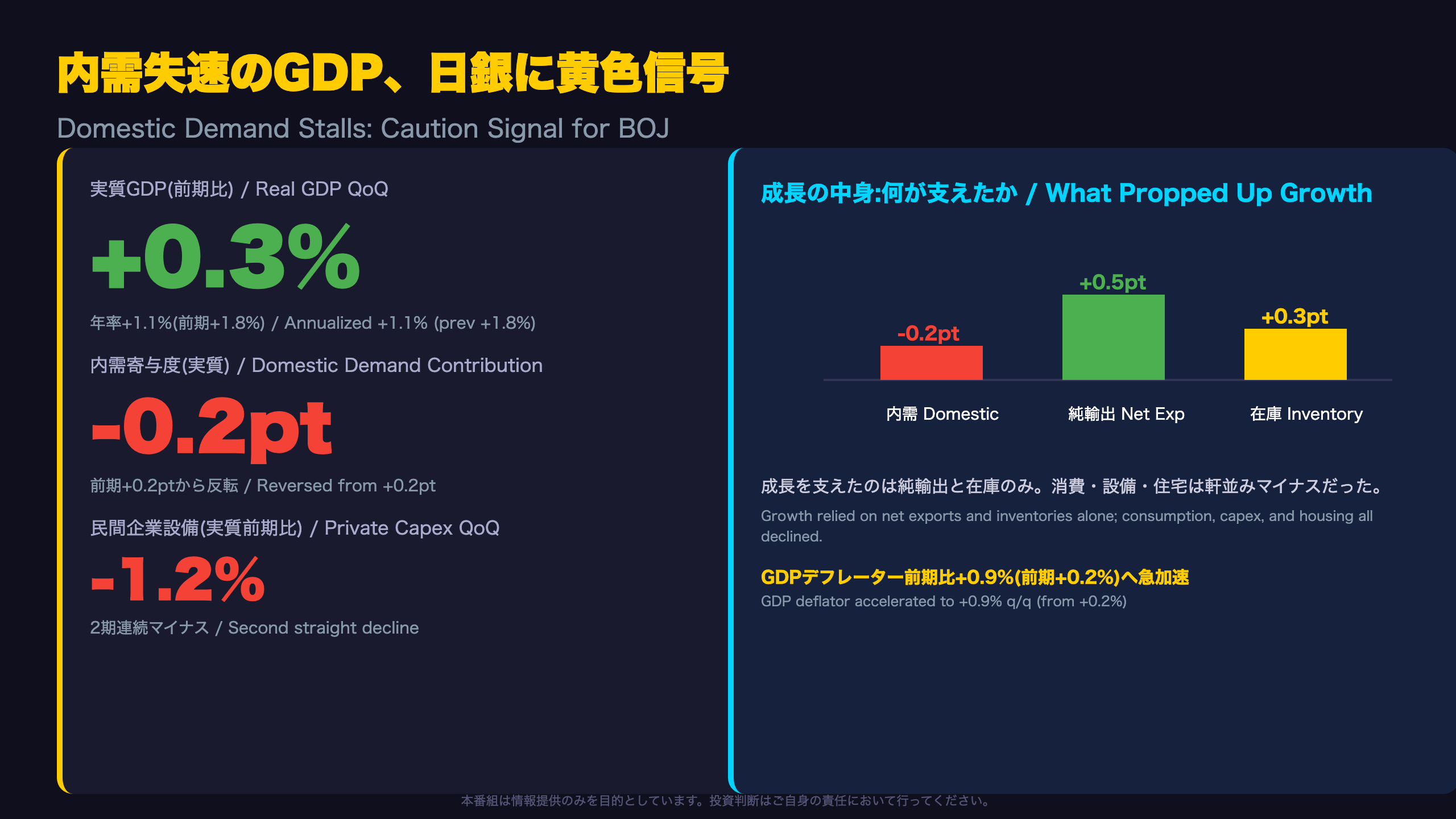
Japan’s real GDP grew +0.3% q/q (annualized +1.1%) in Q2 2026, extending its growth streak.
📊 But domestic demand’s contribution to GDP turned negative at -0.2pt, reversing from +0.2pt the prior quarter.
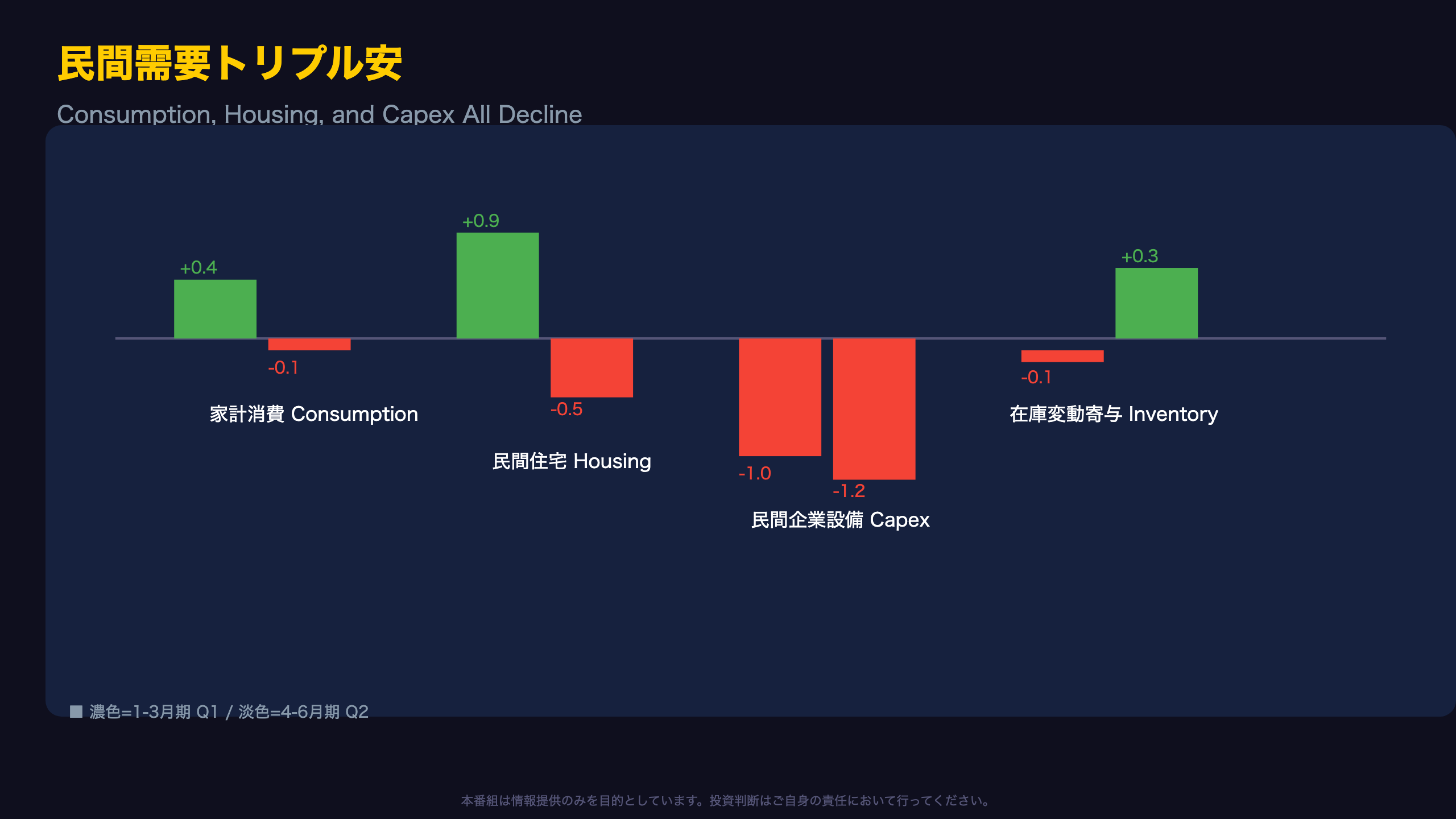
📉 Private capex fell -1.2% (2nd straight decline), household consumption slipped -0.1%.
📈 Growth was propped up almost entirely by net exports (+0.5pt) and inventory swings (+0.3pt).
💡 The GDP deflator accelerated sharply to +0.9% q/q, pushing nominal growth (+1.2%) far above real growth.
We break down what this ‘hollow growth’ means for the BOJ’s rate path, JGB yields, Japanese equities, and the yen.
⚠️ This video is for informational purposes only and does not constitute investment advice.
The Ultimate Summary: 内需失速のGDP、日銀に黄色信号
Behind the Headline: Domestic Demand Flips Negative
Japan’s GDP report, published by the Economic and Social Research Institute (ESRI) under the Cabinet Office, is Japan’s equivalent of the US BEA’s GDP release, but follows a two-stage ‘first/second preliminary’ revision cycle roughly six weeks apart.
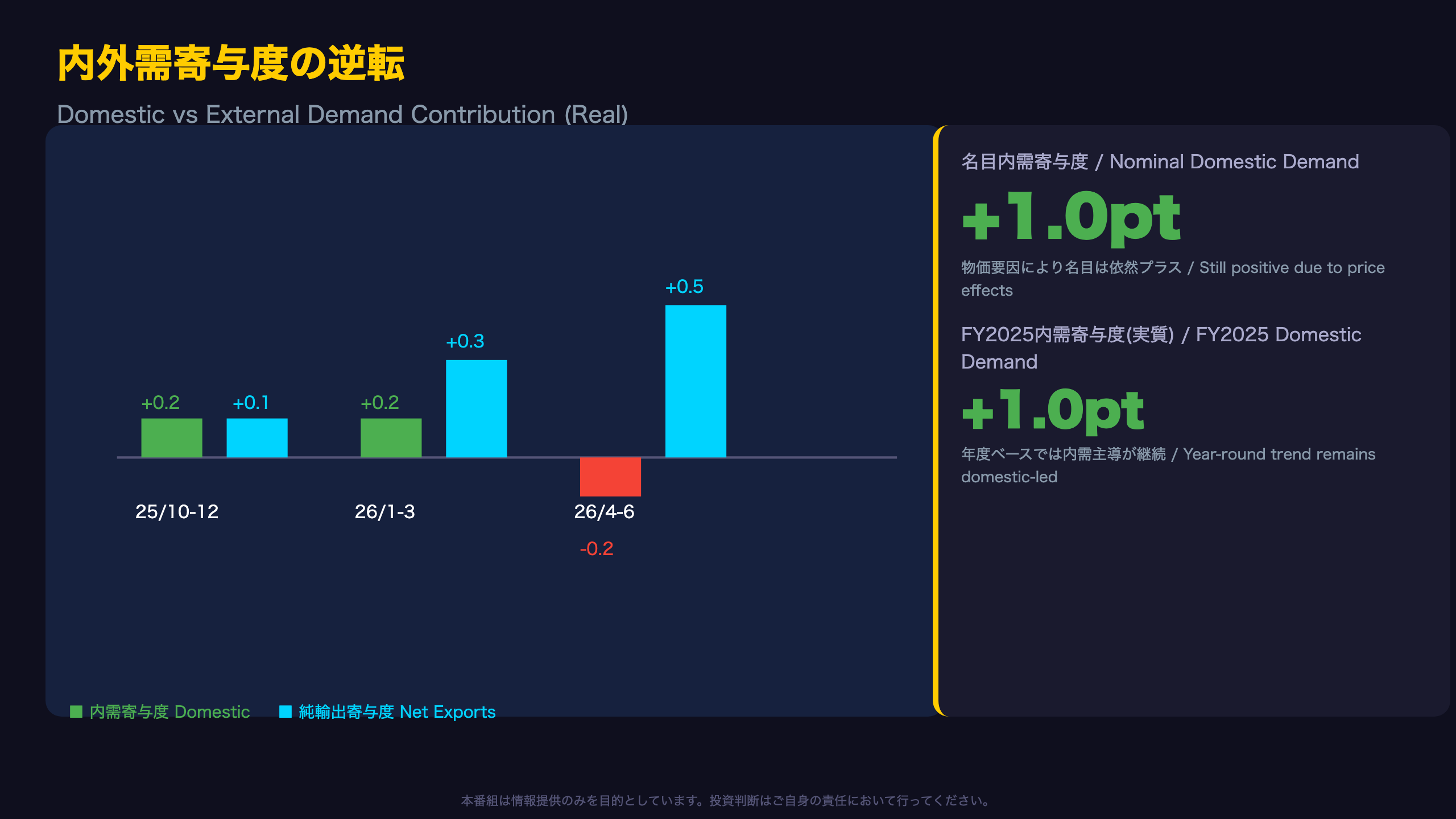
For fiscal year 2025 (April 2025-March 2026), real GDP grew 0.9% with domestic demand contributing +1.0 percentage point and net exports subtracting -0.1 point — a domestic-demand-led expansion. The April-June 2026 quarter reverses that pattern entirely: domestic demand’s contribution turned to -0.2 points while net exports contributed +0.5 points.
The Inventory Swing Risk
Private inventory contribution swung from -0.1 points in Q1 to +0.3 points in Q2, a 0.4-point swing that masked underlying demand weakness. Such swings historically tend to reverse, creating payback risk in the next quarter’s data.
Nominal-Real Divergence
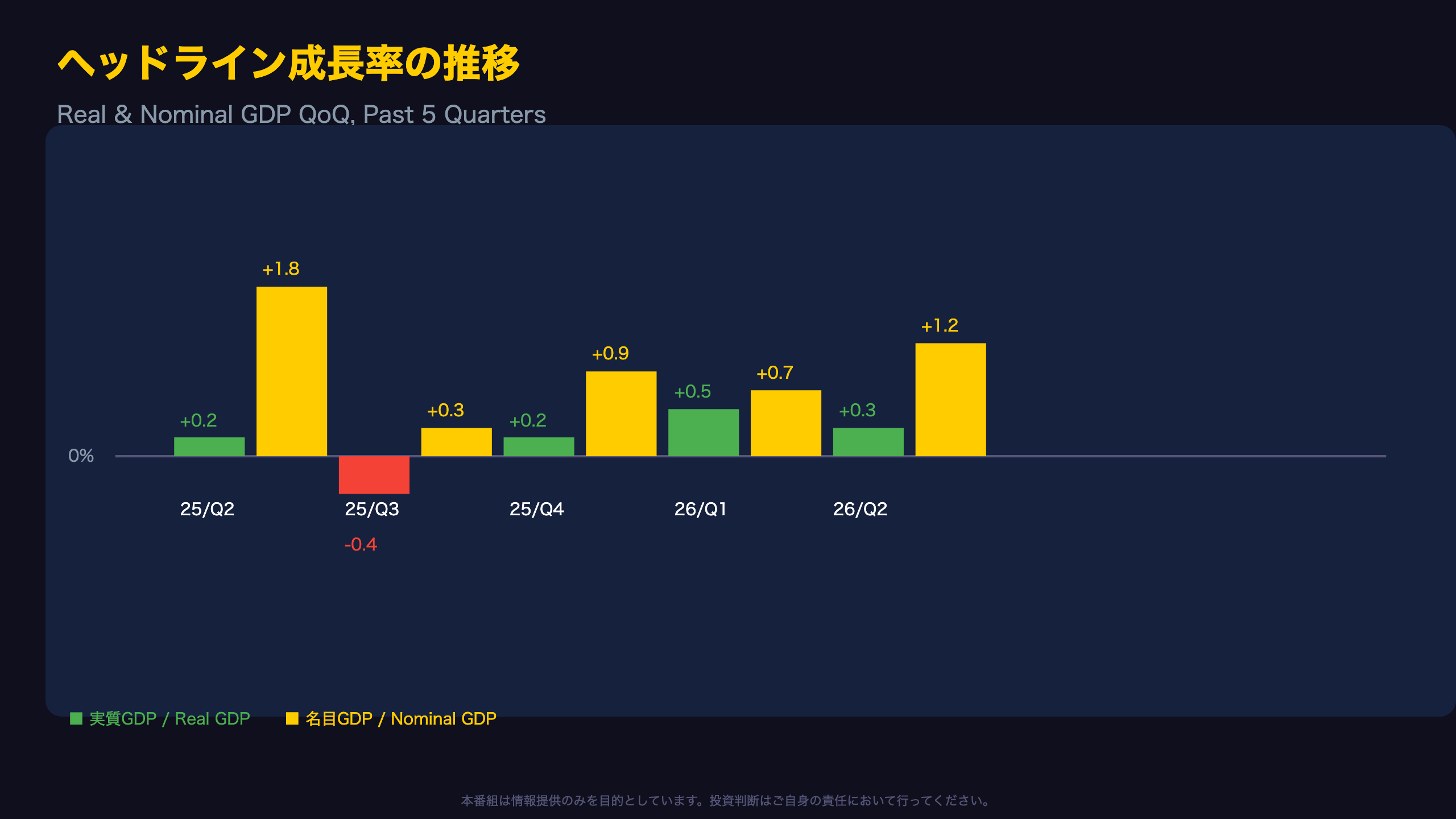
Nominal GDP grew 1.2% versus real GDP’s 0.3%, reflecting a GDP deflator acceleration to +0.9% q/q. For yen-based investors, this divergence complicates the read on whether inflation is demand-pull or cost-push, a distinction critical for gauging the BOJ’s next policy move.
ヘッドライン成長率の推移:実質・名目GDP
Revision Risk: First Preliminary vs. Second Preliminary
Japan’s GDP releases follow a two-stage revision cycle, unlike the US BEA’s three-stage advance/second/third system. The first preliminary estimate, released about 6 weeks after quarter-end, relies on incomplete corporate data; the second preliminary, released roughly 5 weeks later, incorporates the Ministry of Finance’s Corporate Statistics survey.
Looking at the January-March 2026 quarter as precedent: annualized real GDP growth was revised down from +2.1% (first preliminary) to +1.8% (second preliminary), even though the quarter-on-quarter rate held at +0.5%. Nominal growth saw a larger revision, from +3.4% annualized to +2.5%, driven largely by a swing in private capex from +0.3% to -0.7% q/q.
Why This Matters for Today’s Release
Today’s April-June 2026 figures are a first preliminary estimate, subject to revision in early September. Given that private capex (-1.2% q/q) and inventory swings (+0.3pt contribution) were pivotal this quarter — both historically revision-prone categories — investors should treat today’s composition, not just the headline, as provisional, much like a BEA ‘advance estimate.’
内外需寄与度の逆転:内需マイナスへの反転
Why Nominal Domestic Demand Stayed Positive While Real Demand Sank
While the real domestic demand contribution turned negative, the nominal contribution remained positive at +1.0 percentage point. The key to this divergence is the deflator: nominal private consumption grew +1.0% (versus real -0.0%), and nominal government consumption grew +2.6% (versus real +1.6%) — in both cases, price effects lifted the nominal figure well above the real one.
The Underlying Fiscal-Year Trend
For fiscal year 2025 as a whole, the real domestic demand contribution was a solid +1.0 percentage point, while net exports actually subtracted -0.1 point. In other words, Japan’s primary growth engine over the full year was domestic demand — making this quarter’s flip to negative domestic demand and positive net exports look like a deviation from the annual trend rather than a new structural pattern.
Still, it would be premature to declare domestic demand ‘structurally broken’ based on a single quarter. Confirmation should wait for the second preliminary estimate in September and the following October-December data.
民間需要トリプル安:消費・住宅・設備投資が同時減速
The Weight of a Second Straight Capex Decline
Private non-residential investment fell -1.2% q/q in real terms, following -1.0% the prior quarter — two consecutive quarters of decline, equivalent to an annualized -4.6%. On a nominal basis, capex was roughly flat at +0.1% (unchanged from +0.1% prior), reinforcing the picture of stalled corporate investment appetite in both real and nominal terms.
Year-on-Year Comparison Adds Nuance
On a year-on-year basis, real capex turned negative at -1.1%, a reversal from +1.3% growth the prior quarter — suggesting the deceleration may be more pronounced than the quarter-on-quarter figure alone implies. That said, full fiscal-year 2025 real capex grew a solid +2.0%, so it would be premature to extrapolate one weak quarter into a structural capex downturn.
Consumption Excluding Imputed Rent Looks Even Weaker
Household consumption excluding imputed rent on owner-occupied housing — a cleaner read on cash-based spending — fell -0.1% real q/q, down from +0.5% previously, underscoring genuine spending caution.
Interestingly, this consumption pullback occurred even as real employee compensation improved to +0.8% q/q (from +0.4%), hinting that precautionary saving amid inflation anxiety may be one contributing factor — though this remains a single-quarter observation, not a confirmed trend.
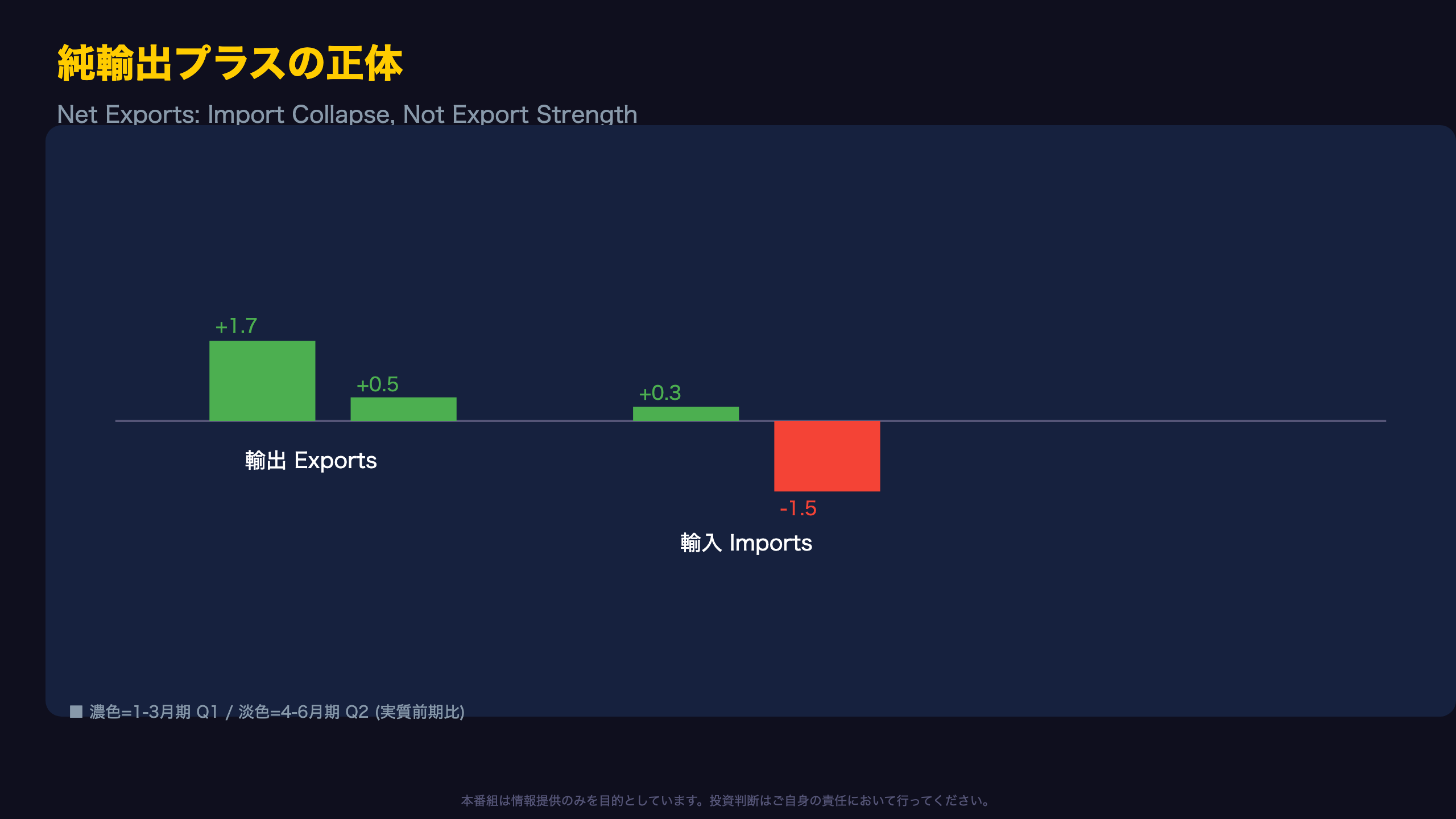
純輸出プラスの正体:輸出鈍化と輸入急減
Nominal Trade Data Reveals a Similar Twist
On a nominal basis, exports grew +3.9% q/q (down from +4.9%) and imports grew +3.3% (down from +4.6%) — both positive, unlike the real figures. The gap between real and nominal stems from deflator movements: the export deflator rose +3.4% q/q (from +3.1%) and the import deflator rose +4.9% q/q (from +4.3%), with rising prices masking underlying weakness in trade volumes.
The Year-on-Year Trade Picture
On a year-on-year basis, real exports grew just +1.3% (down from +2.3%) while real imports fell -1.9% (down from +1.3%) — the same ‘imports falling faster than exports slowing’ pattern repeats whether viewed quarterly or annually.
Why a Falling Import Bill Isn’t Necessarily Good News
Most imported goods feed into domestic consumption and production, so a sharp import decline can be a mirror image of weakening domestic demand, particularly for capital and intermediate goods — a dynamic distinct from, say, a US trade deficit narrowing due to strong domestic energy production.
Generally speaking, when a positive net-export contribution is driven by falling imports rather than rising exports, it is more likely to reflect weakening domestic spending power than strengthening export competitiveness — though this single data release cannot confirm whether the import decline is volume-driven or price-driven.
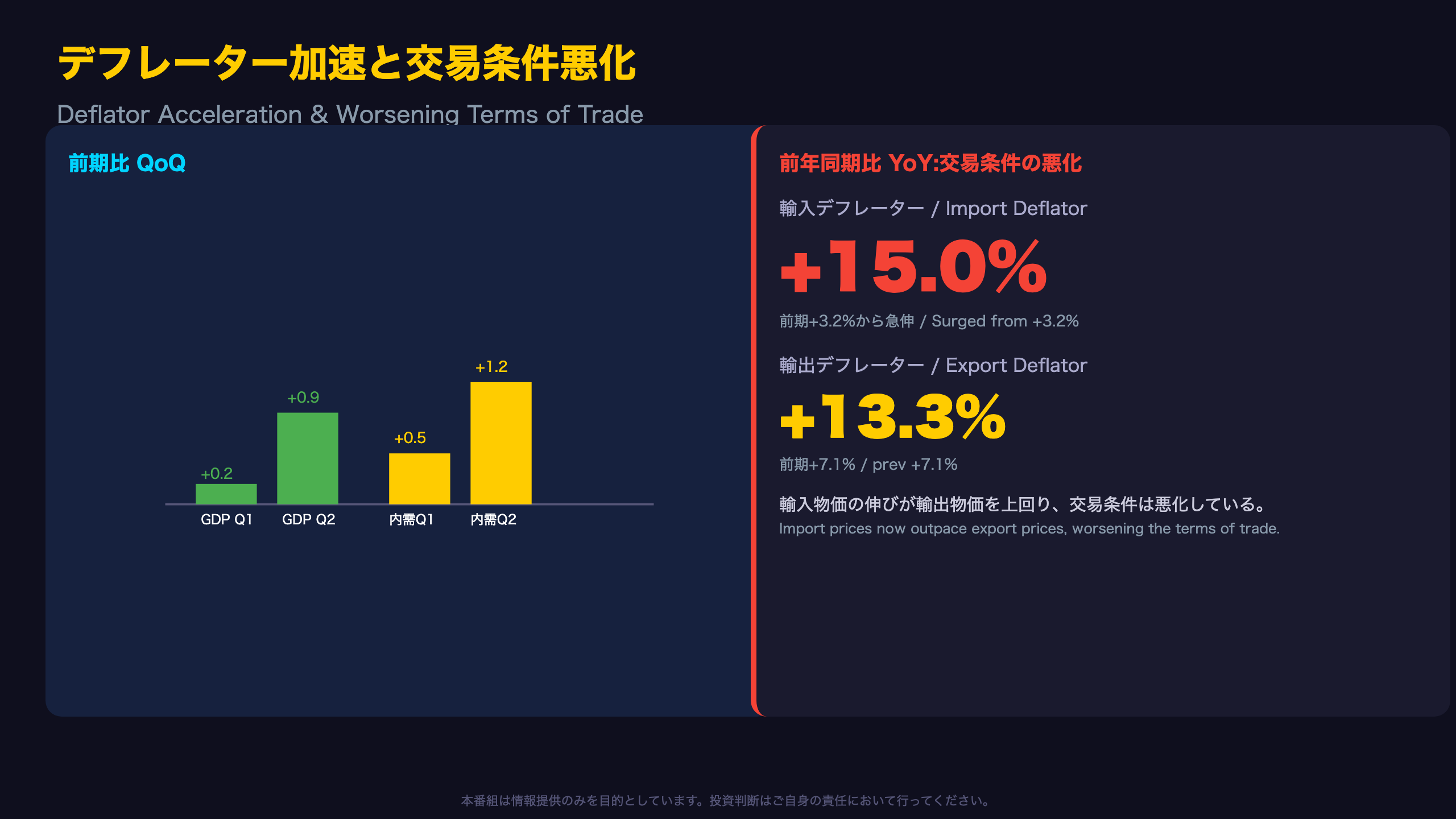
デフレーター加速と交易条件悪化
Deteriorating Terms of Trade Are Eating Into National Income
The 15.0% year-on-year surge in the import deflator, now exceeding the export deflator’s 13.3% growth, signals a deterioration in Japan’s terms of trade (the ratio of export prices to import prices). When import costs rise faster than export revenue, real purchasing power erodes even if trade volumes stay flat — a dynamic distinct from, say, a US trade story centered on tariff pass-through, since Japan’s terms-of-trade shock here appears tied to import price inflation (likely energy and raw materials, though the report does not itemize the cause).
Quarter-on-Quarter vs. Year-on-Year Divergence
The GDP deflator accelerated to +0.9% q/q but decelerated to +2.6% y/y (from +3.2%) — a divergence driven by base-year effects. Investors should avoid concluding that ‘inflation is reaccelerating’ from a single quarter-on-quarter print alone.
Domestic Demand Deflator Outpacing GDP Deflator
The domestic demand deflator (+1.2% q/q) outpaced the GDP deflator (+0.9% q/q), suggesting some of the domestic price pressure is being offset by the terms-of-trade dynamic in the overall GDP price measure.
Generally, when import price surges worsen the terms of trade, real Gross National Income (GNI) growth tends to lag real GDP growth — a hypothesis we test against this quarter’s GNI data on the next slide.
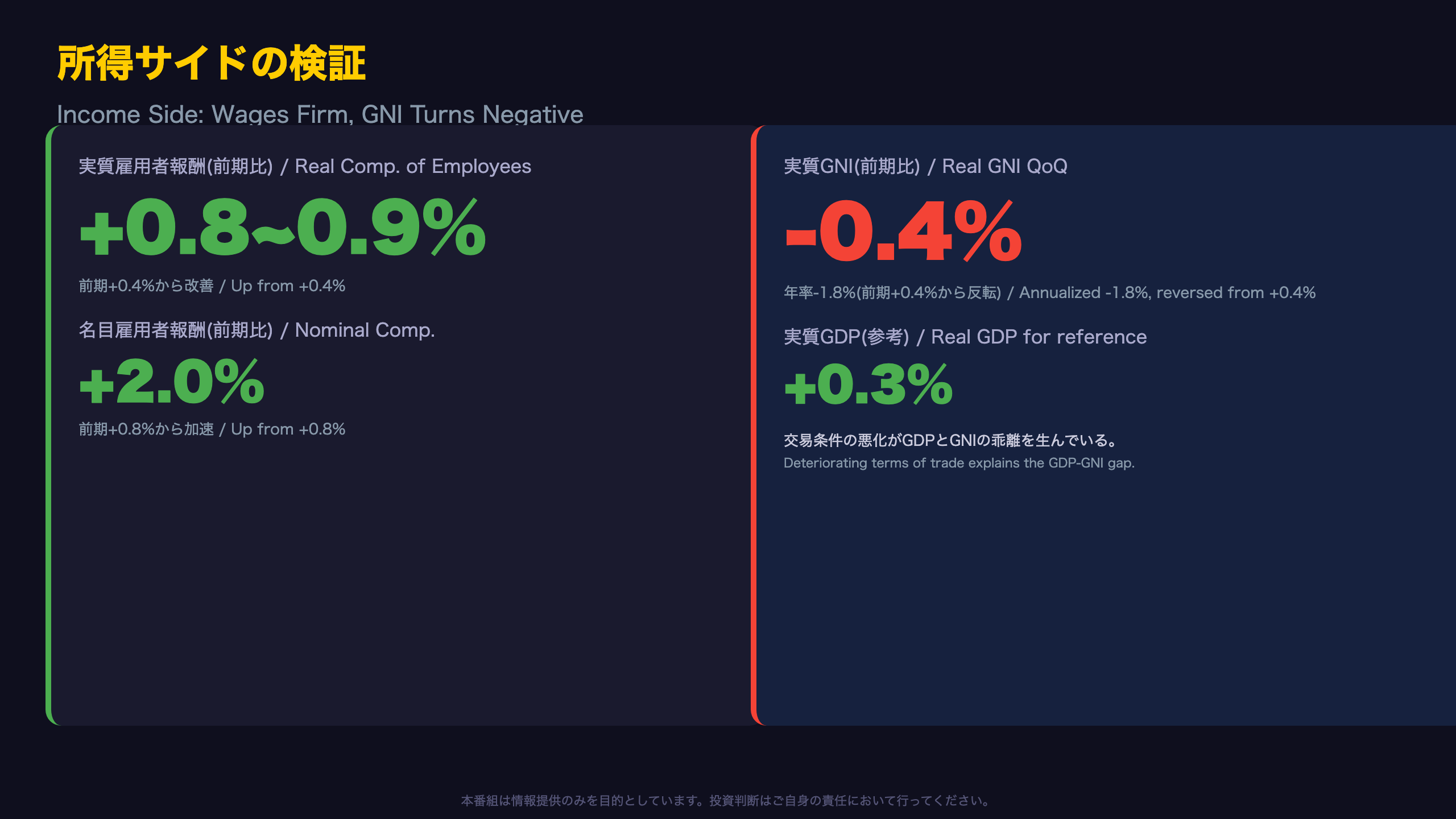
所得サイドの検証:雇用者報酬堅調もGNIはマイナス
What the GDP-GNI Gap Really Means
By definition, real GNI equals real GDP plus real net income from abroad plus trading gains (a terms-of-trade adjustment unique to Japan’s national accounts methodology, roughly analogous to the US concept of Gross National Product but with an explicit terms-of-trade term). This quarter’s -0.4% real GNI print implies that either net income from abroad declined, the terms-of-trade drag intensified, or both — offsetting the +0.3% real GDP growth. The import deflator’s surge to +15.0% y/y, noted on the previous slide, is a direct contributor to this trading-gain deterioration.
Nominal GNI Barely Stayed Positive
Nominal GNI grew a modest +0.7% q/q (down from +0.8%), meaning the negative print is confined to the real (inflation-adjusted) measure — a signal that the nation’s aggregate real purchasing power contracted, distinct from a nominal income story.
A Bright Spot: Employee Compensation
Real employee compensation improved to +0.8%/+0.9% q/q, up from +0.4%, indicating individual households’ real income conditions are not deteriorating — this quarter’s GNI weakness does not necessarily translate into a broad-based consumer income squeeze.
That said, a decline in aggregate national income (GNI), spanning the corporate and external sectors, could still have knock-on effects for tax revenue trends and the BOJ’s assessment of the output gap — a point worth revisiting when the second preliminary estimate arrives in September.
Implications:日銀・国債・株式・円相場への示唆
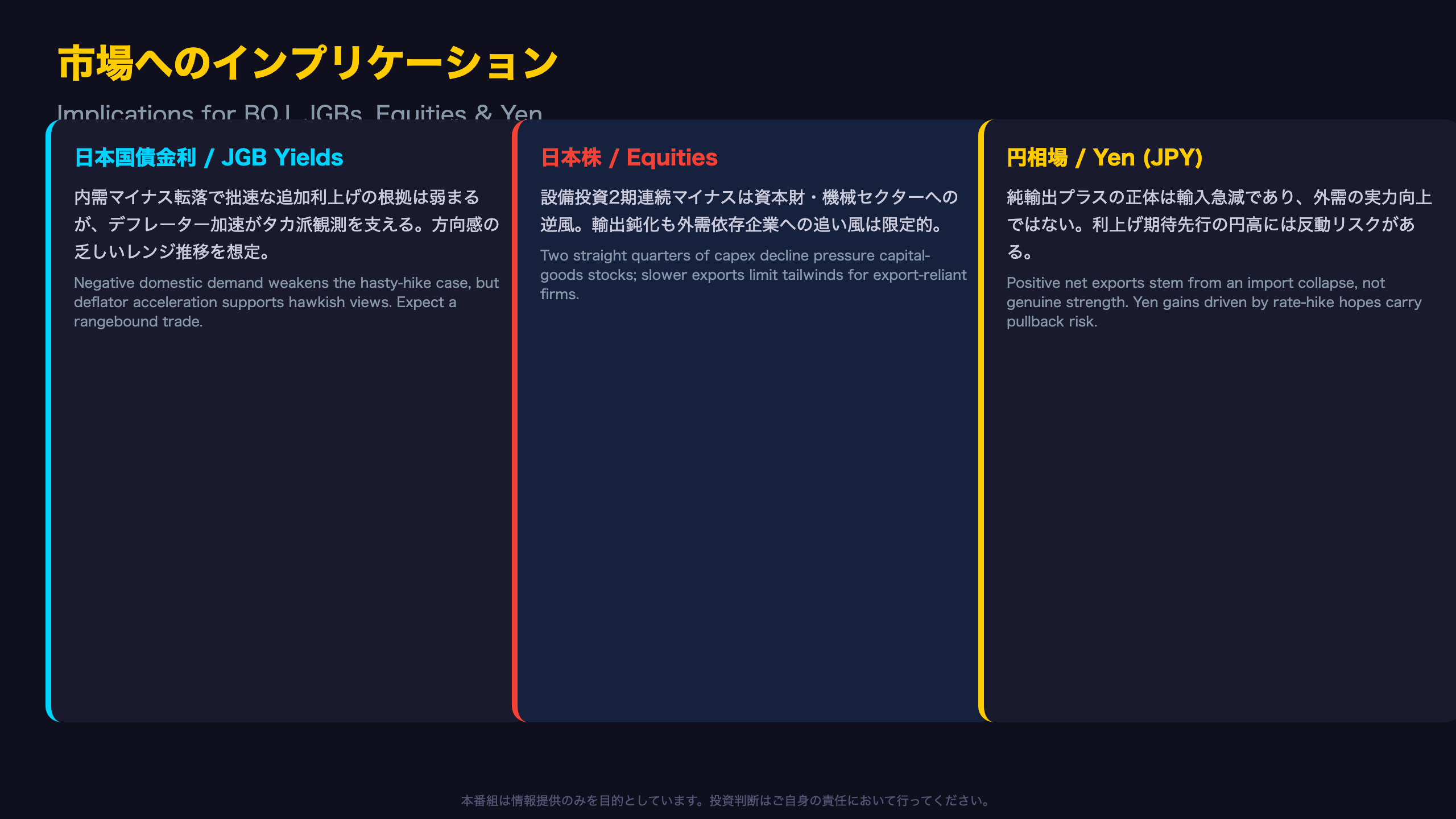
The Chain of Evidence: From Data to Market Implications
“Domestic demand’s real contribution fell to -0.2 percentage points” → Generally, weak domestic demand undermines the wage-and-consumption evidence the BOJ weighs most heavily in assessing sustainable price stability → JGB yields could see capped upside if rate-hike expectations recede, though this single data point cannot confirm the BOJ will pause.
“The GDP deflator accelerated to +0.9% q/q” → Firm price momentum can reinforce the case that inflation targets remain on track → This may support hawkish yen-rate expectations in the near term.
“Private capex fell -1.2% real q/q, a second straight decline” → Stalling capital investment is generally seen as a risk factor for capital-goods and machinery-sector earnings → Near-term caution warranted for related equities.
“Imports plunged -1.5% real q/q, driving the +0.5pt net export contribution” → Since falling imports mirror domestic demand weakness rather than export competitiveness, reading this as genuine external strength would be misleading → The yen’s rate-hike-driven upside should be treated cautiously, as it may be running ahead of underlying fundamentals.
What to Watch Next
The second preliminary estimate, due in early September 2026, will reveal whether this quarter’s capex and inventory figures are revised up or down. The October-December quarter’s data will also clarify whether the domestic demand contraction proves temporary or persistent — both are the next concrete checkpoints for validating or revising this quarter’s narrative.
Disclaimer: This article is for informational purposes only. All investment decisions are made solely at your own risk.