📺 Watch the Full Video Analysis
This article was automatically generated by the NFC Market Live AI analysis system. (Updated: 2026-09-26 00:18 JST)
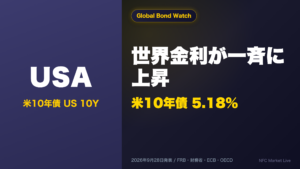
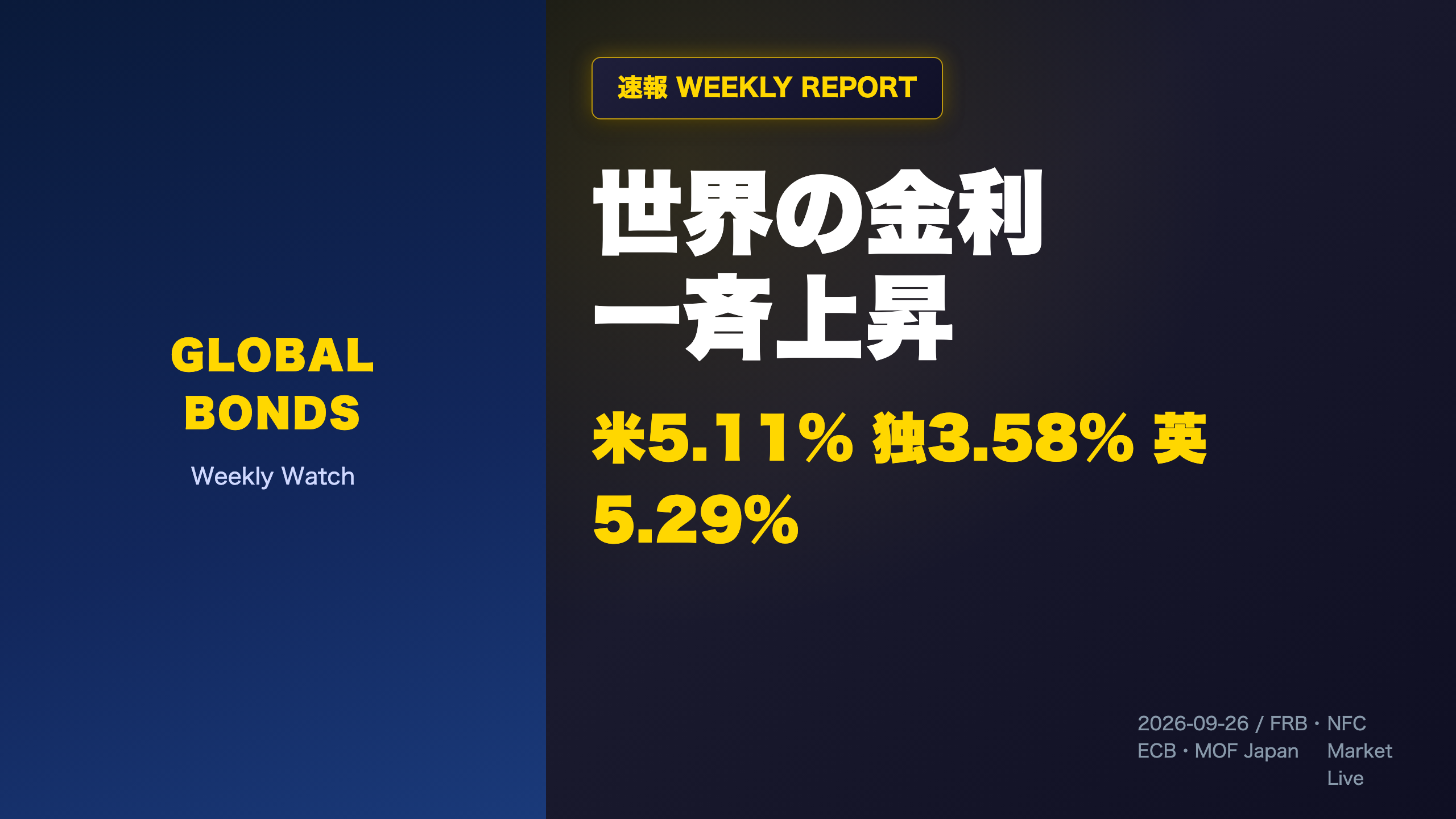
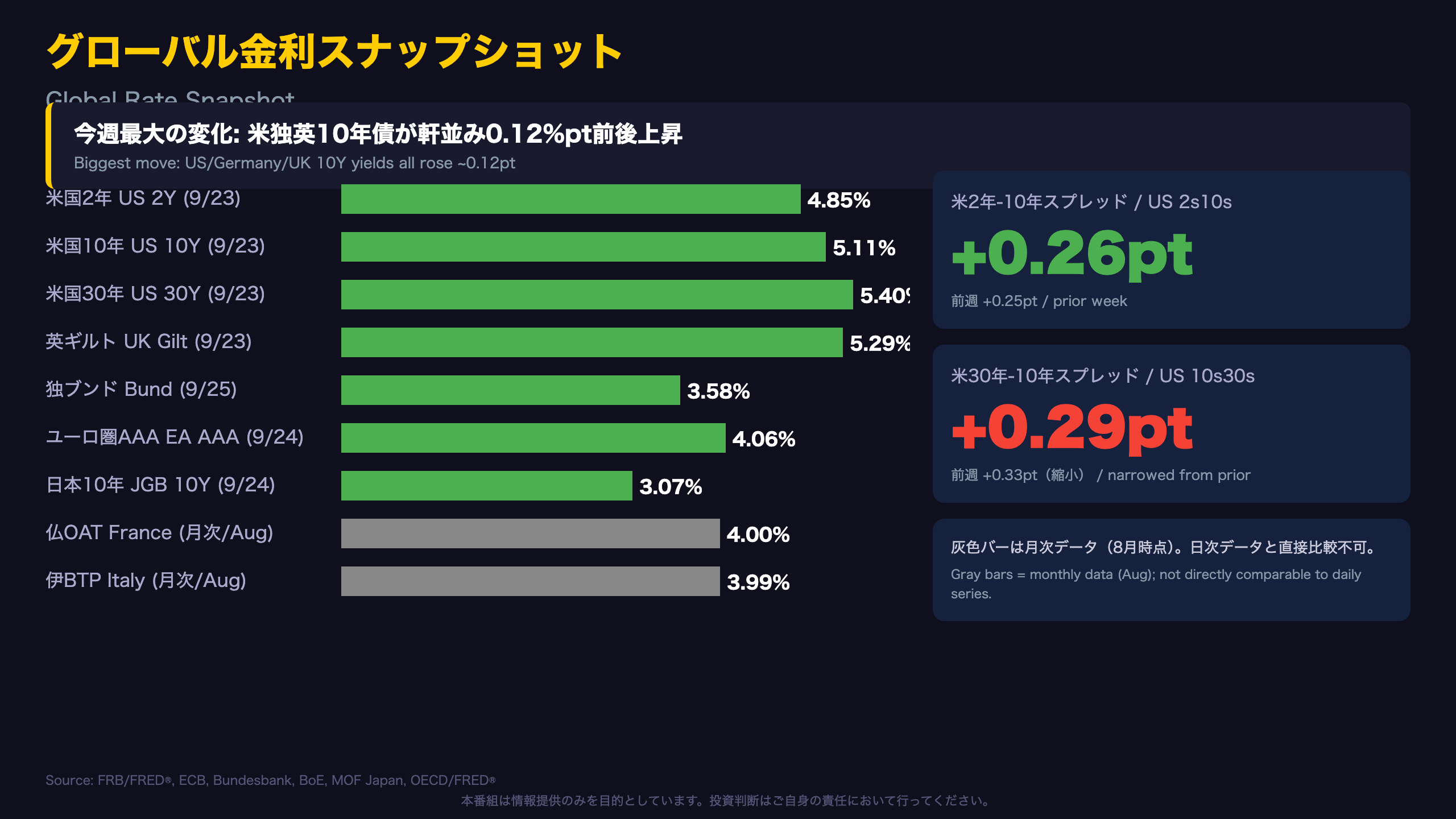
📊 Global bond yields rose broadly this week, with US 10Y at 5.11%, German Bund at 3.58%, and UK Gilt at 5.29%—each up roughly 12bps over five trading days.
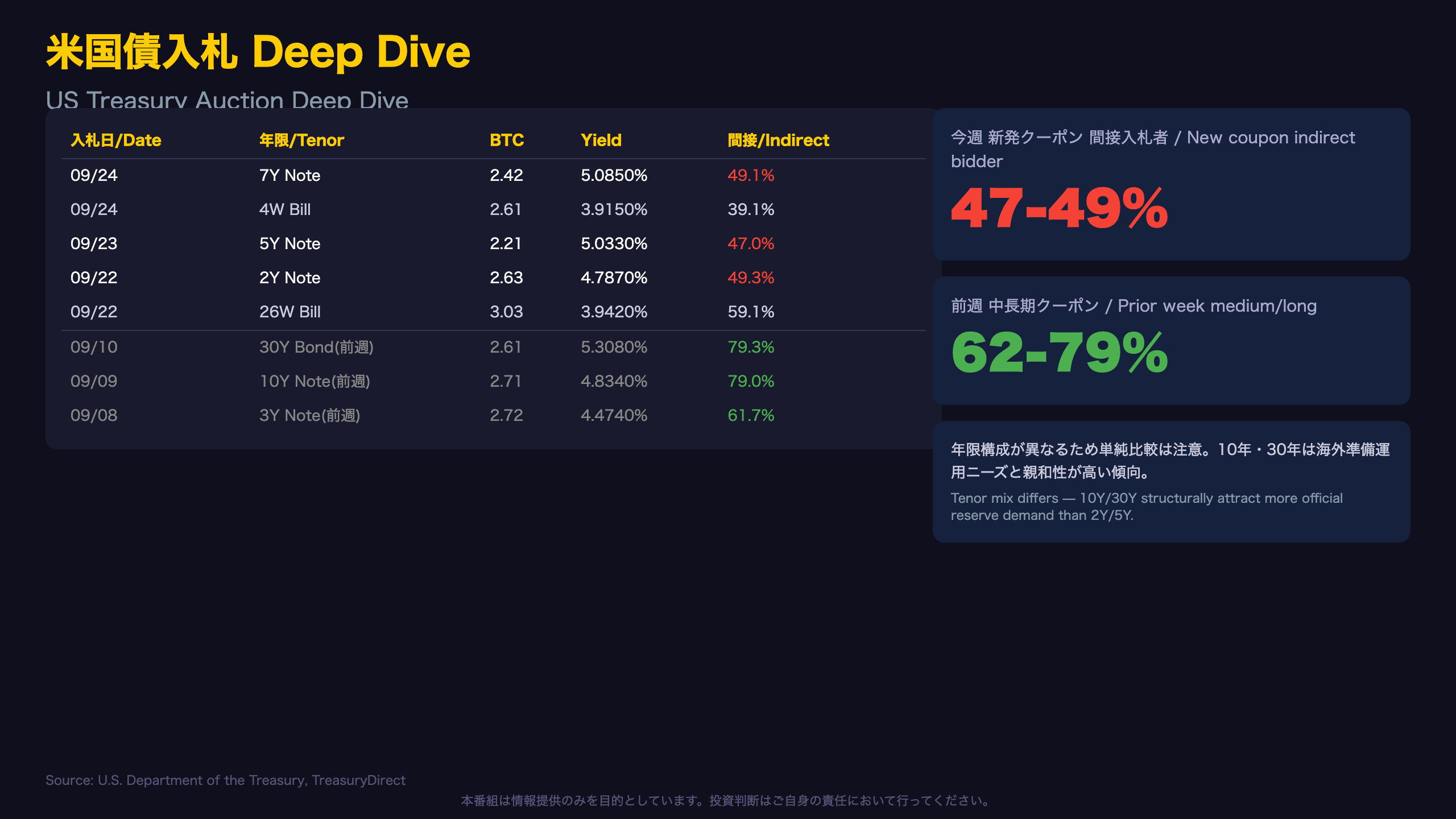
💡 Yet beneath the surface, indirect bidder participation at the latest US 2Y/5Y/7Y auctions slipped to 47-49%, down from 62-79% in the prior week’s 3Y/10Y/30Y sales.
📈 Japan’s 10Y-2Y spread widened to 1.16pt, consistent with the NFC HMM model’s “Hawkish” BOJ regime call.
⚠️ Full video covers HMM regime cross-checks, JGB auction tail-width trends, and key data-freshness caveats for European spreads.
グローバル金利スナップショット / Global Rate Snapshot
Beyond the Headline: A Complex Curve Shape
While the anchor script highlights the modest widening in the 2s10s spread (0.25% to 0.26%), the 10s30s spread actually compressed from 0.33% to 0.29% over the same period. The US 2-year rose 0.11pt, the 10-year 0.10pt, and the 30-year only 0.05-0.06pt — a pattern where yield increases shrink as maturity lengthens.
“10-Year minus 2-Year Term Spread: +0.26 percentage points (normal/upward-sloping curve)”
This suggests (Level B reasoning, based on multiple tenors moving in a consistent pattern) a coexistence of bear-flattening at the ultra-long end and bear-steepening in the belly of the curve — a nuance that a single headline spread number misses.
Context for International Readers
Unlike the US Treasury market, which most global investors track daily via FRED, several European yields in this dataset (France’s OAT, Italy’s BTP) are sourced from OECD monthly statistics and lag by up to a month. Readers comparing eurozone peripheral spreads to Bund should treat any narrowing with caution, since Bund itself is a daily series moving independently.
Japan’s 10-year JGB also rose 8bps to 3.07%, aligning directionally with the US, UK, and Germany — a genuinely globally synchronized upward yield move this week, not isolated to any single region.
The next data refresh will show whether this synchronized rise continues or stalls, particularly at the long end where the 10s30s compression bears watching.
米国債入札 Deep Dive / US Treasury Auction Deep Dive
Tenor Composition Matters
Comparing this week’s 47-49% indirect bidder ratios to last week’s 62-79% requires caution (Level C reasoning — single-period comparisons across different maturities shouldn’t be read as a definitive demand shift). Historically, 10-year and 30-year Treasuries attract more foreign central bank reserve-management demand than 2-year and 5-year notes, so part of this gap likely reflects structural tenor differences, not necessarily deteriorating appetite.
What is an Indirect Bidder?
For readers unfamiliar with US Treasury auction mechanics: “indirect bidders” are a category that includes foreign central banks and sovereign wealth funds bidding through primary dealers — it’s the closest available proxy for overseas official-sector demand for US government debt, something international bond investors watch closely as a signal of dollar-asset appetite from abroad.
Bills Remain the Bright Spot
Short-term bill auctions held bid-to-cover ratios of 2.61-3.16 this week, only modestly below the prior week’s 2.74-3.02 — suggesting broad money-market demand for US paper has not deteriorated, even as longer coupon demand metrics softened.
What to Watch Next
The next 10-year and 30-year note auctions, which occur on a monthly cycle, will be the cleaner test of whether foreign demand for long-duration Treasuries is genuinely cooling or whether this week’s reading is simply tenor-mix noise.
ヨーロッパ債券市場 / European Bond Markets
The Illusion of Spread Compression
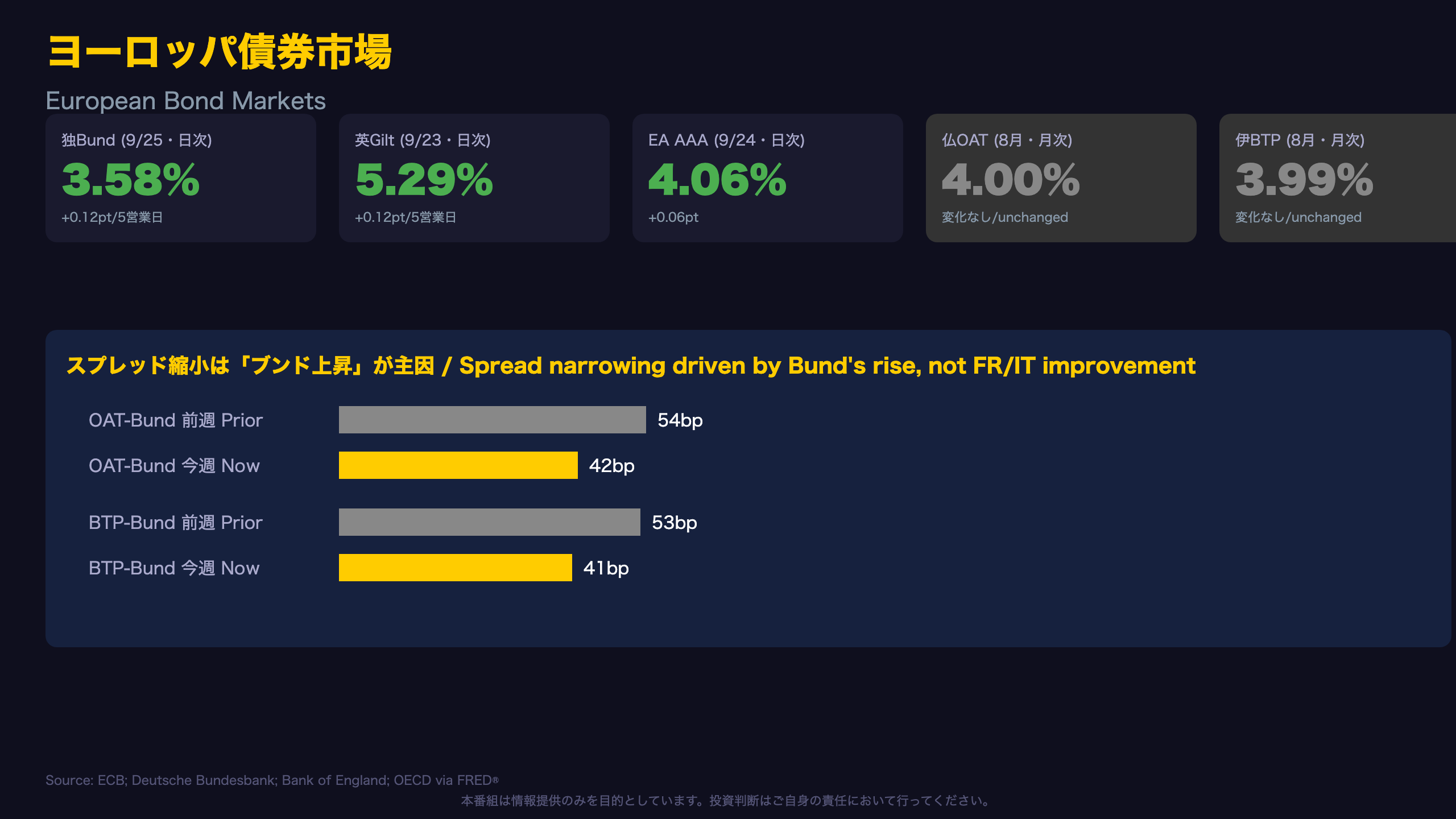
The OAT-Bund spread narrowed from 54bp to 42bp, and BTP-Bund from 53bp to 41bp — numbers that, taken at face value, might suggest improving French and Italian sovereign risk sentiment. But this is largely a statistical artifact (Level C caution — single-indicator causal claims should be avoided).
Why This Matters for International Readers
Unlike the German Bund and UK Gilt, which are tracked via daily central bank data (Bundesbank and Bank of England respectively), France’s OAT and Italy’s BTP in this dataset are sourced from OECD monthly statistics, which lag by up to a month. Both remained frozen at their August 1st readings (~4.00% and ~3.99%). The entire spread compression is mechanically explained by Bund’s daily yield rise from 3.46% to 3.58% — not by any actual improvement in French or Italian credit spreads.
UK Gilts: A Genuine Standout
The UK 10-year Gilt at 5.29% remains among the highest sovereign yields in the G7 — a level consistent with the NFC HMM model’s “High-Rate Pause” regime classification for the Bank of England, suggesting the market continues to price a prolonged hold rather than imminent cuts.
What to Watch
When France’s and Italy’s actual September data are eventually reported (likely with the next monthly OECD release), the true direction of OAT-Bund and BTP-Bund spreads — rather than this Bund-driven optical narrowing — will become clearer.
日本国債・日銀政策金利 / JGB & BOJ
What Tail Width Reveals About Auction Quality
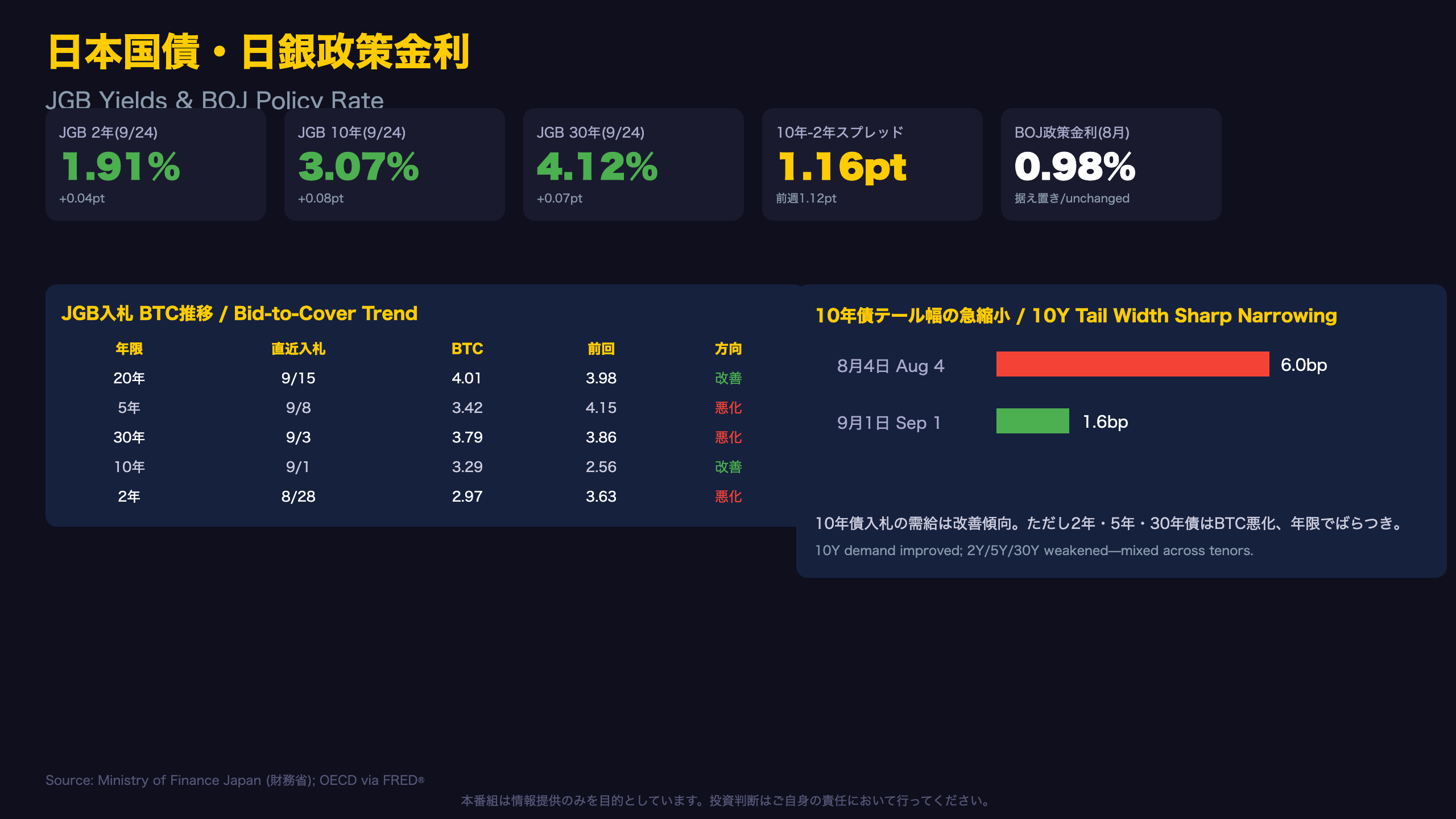
The 10-year JGB auction’s tail width — the gap between the stop-out yield and the average accepted yield — narrowed dramatically from 6.0bp on August 4th to just 1.6bp on September 1st. A tighter tail generally signals more consistent bidding and better price discovery (Level B reasoning, since both bid-to-cover improvement and tail narrowing point the same direction).
Background for International Readers
Japan’s Ministry of Finance conducts JGB auctions on a regular monthly calendar across tenors from 2-year to 40-year. Unlike US Treasury auctions where “indirect bidders” proxy foreign demand, JGB auction quality is more commonly assessed through the bid-to-cover ratio and the tail width — since Japan’s government bond market remains dominated by domestic institutional investors, including the Bank of Japan itself under its balance sheet operations.
A Mixed Picture Across Tenors
| Tenor | Latest Auction | BTC | Prior BTC | Direction |
|---|---|---|---|---|
| 20Y | Sep 15 | 4.01 | 3.98 (Aug 20) | Improved |
| 5Y | Sep 8 | 3.42 | 4.15 (Aug 18) | Weaker |
| 30Y | Sep 3 | 3.79 | 3.86 (Aug 6) | Weaker |
| 10Y | Sep 1 | 3.29 | 2.56 (Aug 4) | Improved |
| 2Y | Aug 28 | 2.97 | 3.63 (Jul 30) | Weaker |
This is not a uniformly improving or deteriorating trend — demand strengthened at the 10-year and 20-year points while softening at 5-year, 30-year, and 2-year tenors, an important nuance for investors tracking JGB supply absorption alongside BOJ policy normalization expectations.
Market Implications
The widening 10-2 year JGB spread (1.12pt to 1.16pt) aligns with the NFC HMM model’s “Hawkish” BOJ regime classification, though the BOJ’s policy rate itself remains unchanged at 0.98% as of August 2026.
FX・CFDへの含意 / Trade Implications
Cross-Checking HMM Regimes Against Rate Data
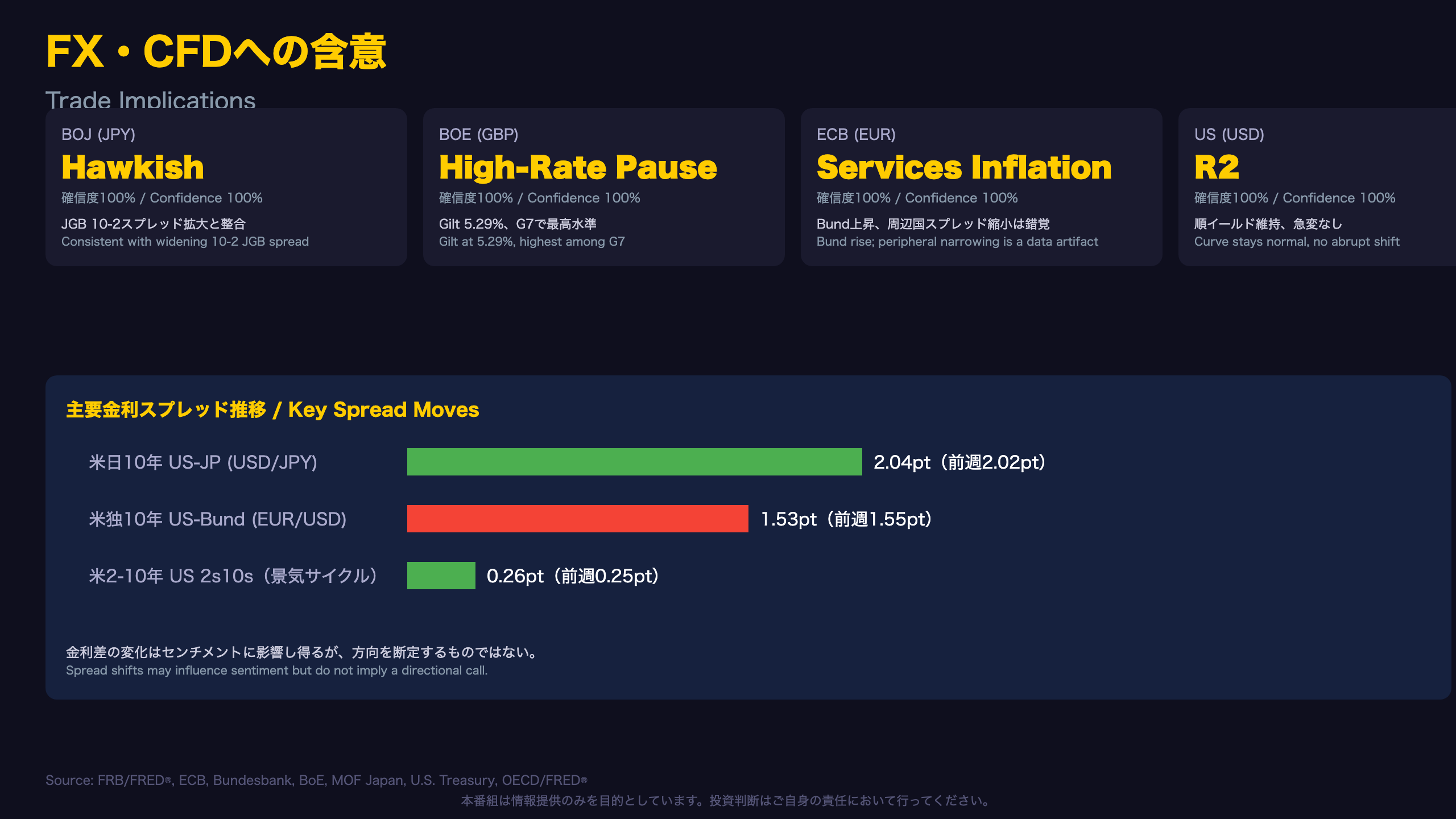
The standout feature this week is that all four NFC HMM models register 100% confidence in their current regime classifications — a useful cross-check against the raw yield data.
| Model | Currency | Regime | Consistent Rate Signal |
|---|---|---|---|
| BOJ | JPY | Hawkish | JGB 10-2 spread widened 1.12→1.16pt |
| BOE | GBP | High-Rate Pause | UK Gilt at 5.29%, highest among G7 peers |
| ECB | EUR | Services Inflation | Bund yield rising; narrower Bund spreads are a data artifact, not French/Italian improvement |
| US | USD | R2 (Regime 2) | Curve stays upward-sloping at +0.26pt; no acute recession repricing |
Understanding “R2” for US Readers
The US model’s Regime 2 classification, alongside a stable positively-sloped 2s10s curve, suggests markets aren’t aggressively pricing imminent Fed rate cuts or a sharp growth scare — a useful complement to headline yield-level moves for US-focused investors.
FX Implications — Handled with Care
The modest widening in the US-Japan 10-year spread (2.02pt to 2.04pt) may lend marginal support to carry-trade dynamics underpinning USD/JPY, though a 0.02 point move sits within normal weekly noise and shouldn’t be read as a directional signal on its own. The US-Germany spread similarly held roughly flat (1.55pt to 1.53pt), offering little clear read-through for EUR/USD this week.
What Global Investors Should Watch Next
For readers benchmarking against US Fed policy expectations or ECB inflation dynamics, the next Global Bond Watch update will be key to confirming whether foreign demand at US Treasury auctions rebounds, and whether JGB auction tail widths continue their recent divergence across tenors.
Disclaimer: This article is for informational purposes only. All investment decisions are made solely at your own risk.