📺 Watch the Full Video Analysis
This article was automatically generated by the NFC Market Live AI analysis system. (Updated: 2026-08-28 18:41 JST)
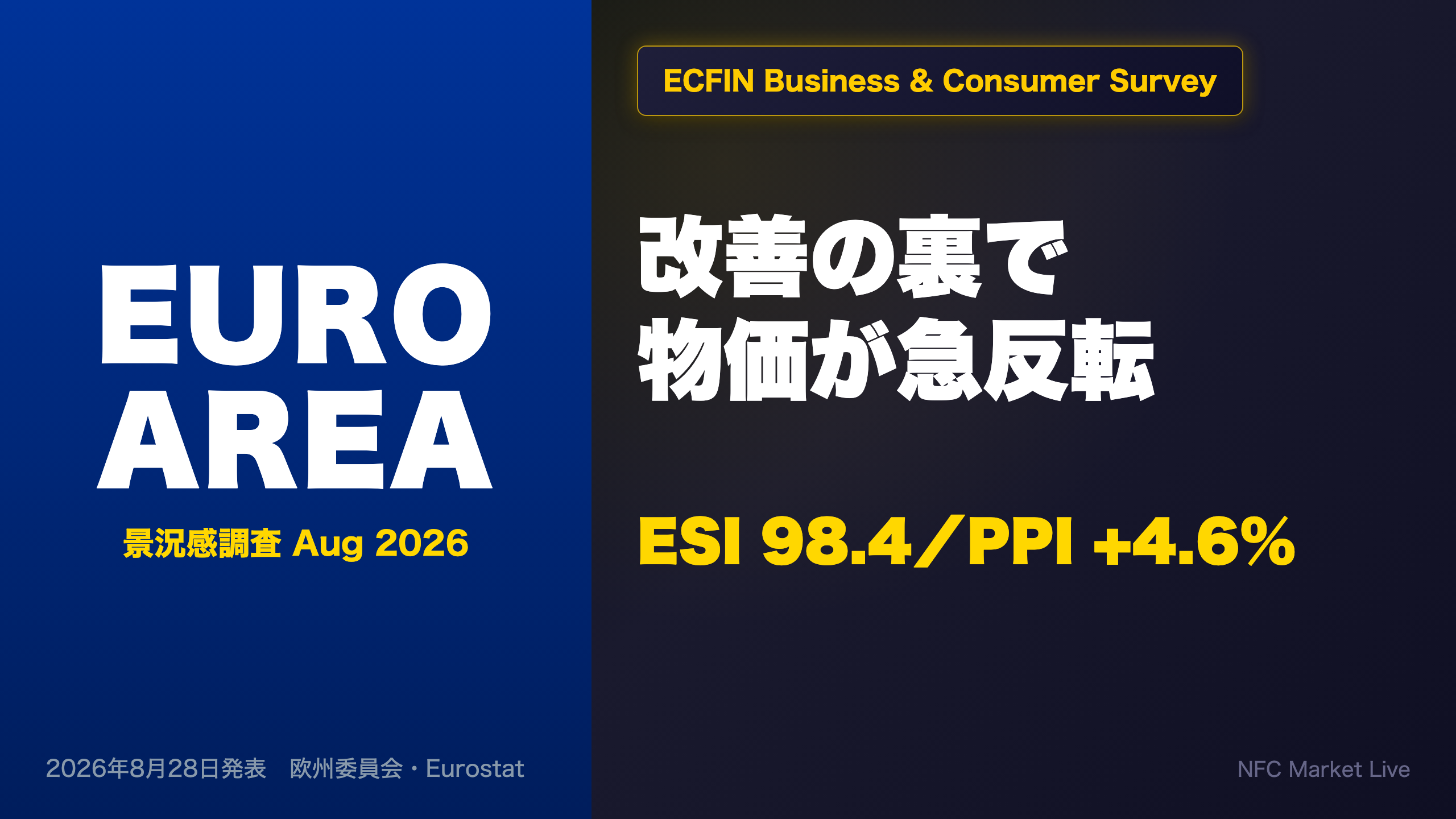
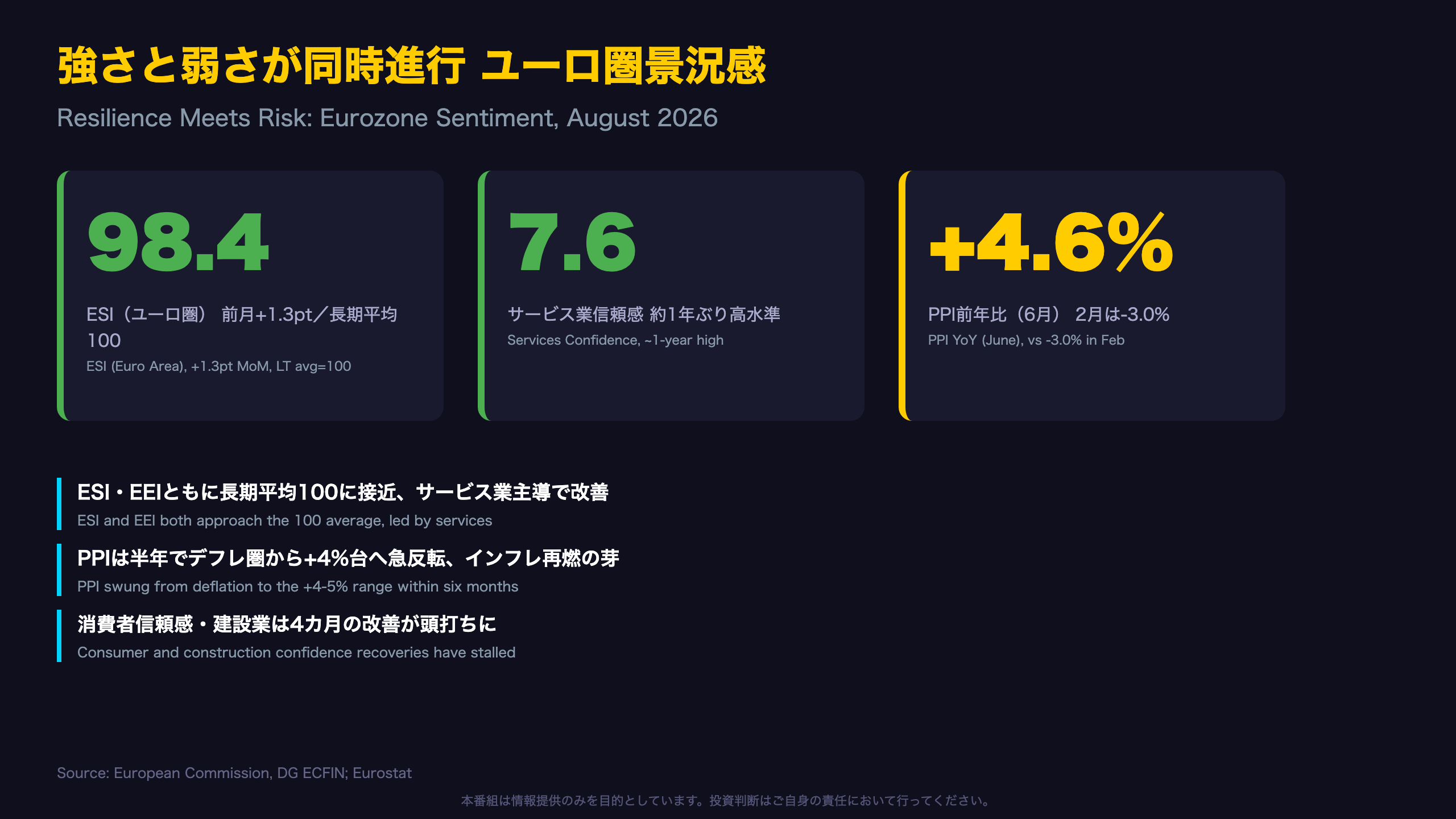
The European Commission’s August 2026 Business and Consumer Survey shows the euro area’s Economic Sentiment Indicator (ESI) rising to 98.4, nearing its long-term average of 100. 📈
Services confidence hit 7.6, a roughly one-year high, with France, Germany, and Italy all improving.
However, Producer Price Index (PPI) inflation swung sharply from -3.0% in February to +4.6% in June. ⚠️
Consumer and construction confidence, meanwhile, saw their recovery streaks stall in August.
We break down the resilience and the risks in euro-area data — and what it could mean for ECB policy and EUR/JPY positioning. 💡
強さと弱さが同時進行 ユーロ圏景況感
Understanding the ESI’s Approach to 100
The Economic Sentiment Indicator (ESI), compiled by the European Commission’s DG ECFIN, is standardized so that its 2000-2025 historical average equals 100. In August 2026, the euro area ESI rose to 98.4 and the EU-wide reading reached 98.2 — both improving but still shy of the long-run benchmark. For readers unfamiliar with EU surveys: this index aggregates confidence readings across industry, services, retail trade, construction, and consumers, making it the closest EU equivalent to a blend of the U.S. Conference Board Consumer Confidence Index and ISM surveys, though methodologically distinct.
What the Commission Actually Said
The official release states: “Both indicators have returned close to their long-term averages of 100.” Note the phrasing — “close to,” not “above.” This is a recovery-from-contraction signal, not confirmation of an expansionary phase.
Bull Case vs. Bear Case
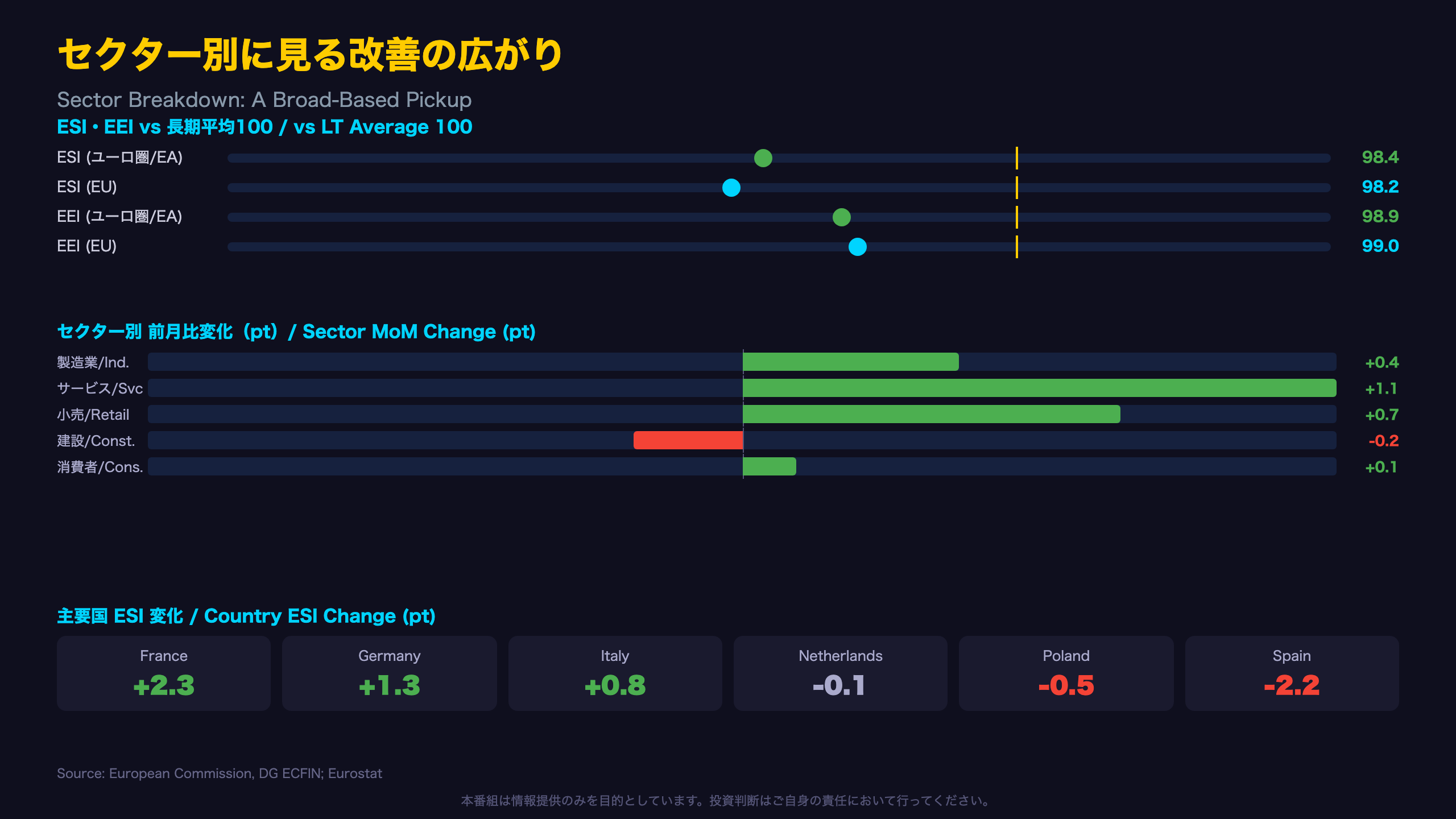
Bullish read: The Employment Expectations Indicator (EEI) climbed to 98.9 (euro area), suggesting hiring intentions in industry and services remain resilient — often a leading signal for wage growth, which the ECB monitors as its “second pillar” alongside HICP inflation.
Bearish read: Consumer confidence’s four-month improvement streak broke in August, and construction confidence fell for a fourth consecutive month. This suggests corporate-side optimism has not yet transmitted to household spending intentions — a gap worth watching for EUR-denominated asset holders.
Looking Ahead
The next Business and Consumer Survey release is due in late September 2026. Watch whether ESI clears the 100 threshold and whether consumer confidence resumes its earlier improvement trend.
セクター別に見る改善の広がり
Sector-Level Nuances Beyond the Headline
The industry confidence uptick (+0.4) masks mixed underlying signals. The European Commission’s release notes managers’ more negative view of “current order books” partly offset improved production expectations and lower finished-goods inventories, while export order assessments “deteriorated somewhat.” This survey functions somewhat like the new-orders and inventories subcomponents of the U.S. ISM Manufacturing PMI, though it is a confidence balance rather than a diffusion index.
Services confidence (+1.1) showed genuinely broad-based strength: the Commission explicitly cites improvement across “all three components” — past business situation, future demand expectations, and past demand assessment. This breadth matters because single-component gains often prove less durable.
Retail confidence (+0.7) was driven mainly by improved 3-month business expectations, while construction confidence (-0.2) was essentially flat as improved order-book assessments were offset by weaker employment plans — firms have work in hand but remain cautious on hiring.
Country Divergence: A Policy Headache for the ECB
France (+2.3), Germany (+1.3), and Italy (+0.8) improved, while Spain (-2.2) and Poland (-0.5) weakened. This resembles regional Fed surveys diverging in the U.S. (e.g., Philly Fed vs. Empire State), except the ECB must set one policy rate across 20 member states — the “one-size-fits-all” problem. Spain’s pullback, if sustained, would be notable given its recent tourism-led outperformance.
What This Means for EUR Positioning
Broad-based services strength is generally EUR-supportive, while widening intra-bloc divergence tends to raise uncertainty premium in EUR volatility. The next release (late September 2026) will clarify whether France’s gain and Spain’s drop are durable or one-month noise.
サービス業は約1年ぶり高水準、製造業はジグザグ
A Tale of Two Speeds: Services vs. Manufacturing
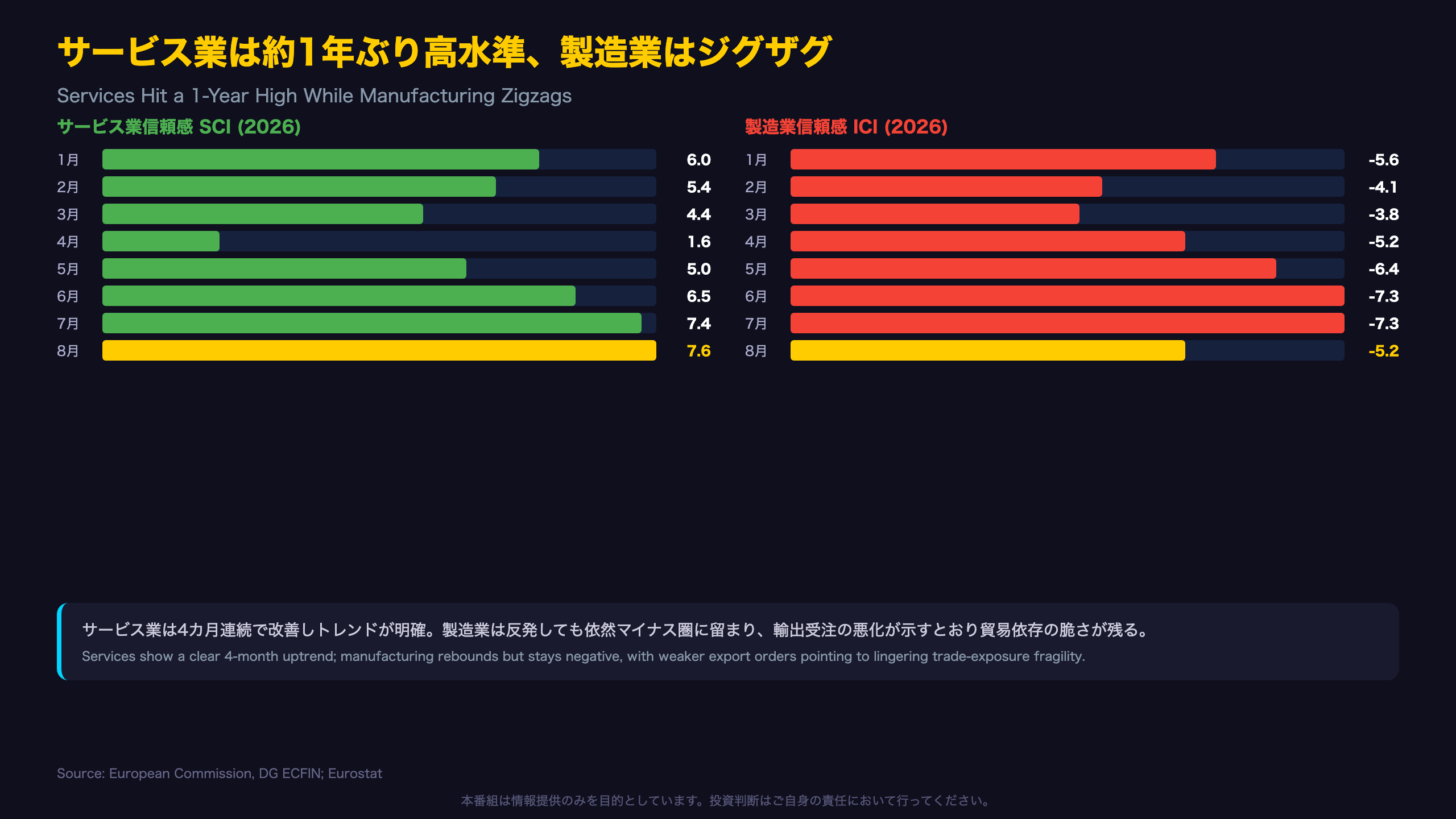
Manufacturing confidence has improved 4.7 points year-on-year (from -9.9 in August 2025 to -5.2 in August 2026), but the path was anything but linear. After a sharp rally from January to March 2026, sentiment relapsed for four straight months (April-July) before August’s rebound. This “double-dip” pattern is common in export-dependent manufacturing sectors sensitive to external demand shocks, echoing how Germany’s IFO Business Climate Index has whipsawed alongside Chinese demand and shipping-cost volatility.
Services confidence tells a cleaner story: up from 5.3 (Aug 2025) to 7.6 (Aug 2026), including a decisive 6.0-point climb between April and August alone. This survey’s services confidence balance functions similarly to the ISM Services PMI in gauging domestic demand health, though methodologically distinct (balance-of-opinion vs. diffusion index).
Why Manufacturing’s Fragility Matters for EUR Holders
Germany dominates euro-area manufacturing, and its export order books, per the Commission’s release, “deteriorated somewhat” in August. Given Germany’s trade exposure to China and the U.S., escalating tariff disputes or a China slowdown could reverse August’s rebound. Investors should treat the manufacturing improvement as tentative, not a confirmed trend change.
Bottom Line for EUR/JPY Watchers
A services-led, manufacturing-lagging economy means euro-area growth remains more consumption/services-sensitive than trade-sensitive — a dynamic worth noting when comparing ECB policy signals against trade-driven currencies like AUD or CAD.
消費者と建設、改善の連続性が途切れる
When the Recovery Stalls: Consumer & Construction Confidence
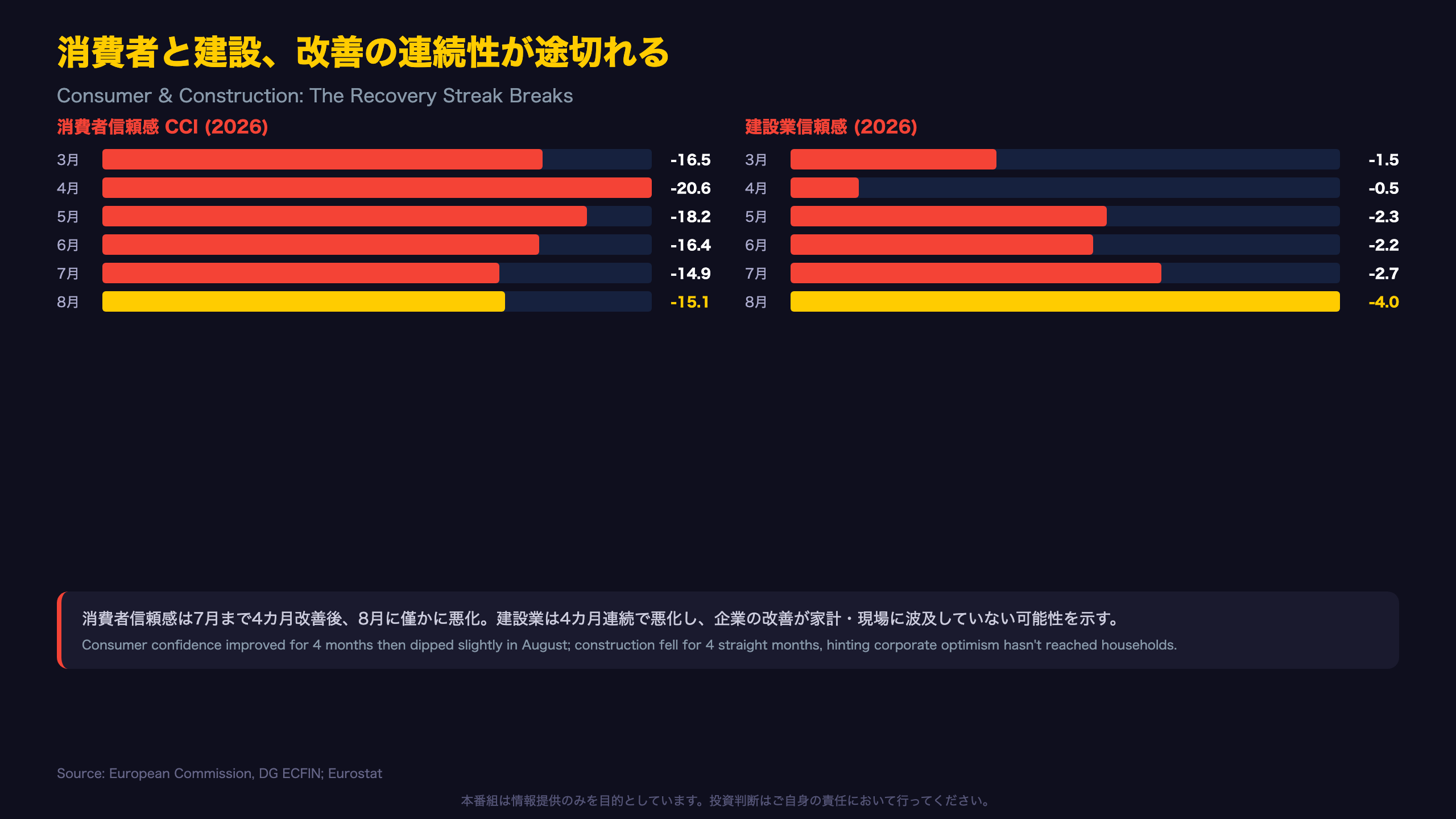
Euro-area consumer confidence had been on a clear four-month upswing, rising from a trough of -20.6 in April 2026 to -14.9 in July. August’s reading of -15.1 represents just a 0.2-point dip — arguably within normal survey noise — but it breaks an otherwise consistent improving trend. The Commission’s release explains the offset dynamic:
“these gains were almost entirely offset by small declines in their intentions to make major purchases over the next 12 months and in their assessment of the future general economic situation in their country.”
For international investors, this survey plays a role broadly analogous to the University of Michigan Consumer Sentiment Index or Japan’s Cabinet Office Consumer Confidence Index — a household-level gauge of spending willingness, distinct from hard retail sales data.
Construction confidence’s decline is more clear-cut: down for a fourth straight month, from -0.5 in April to -4.0 in August. Encouragingly, the underlying order-book assessment actually improved — the drag came specifically from weaker employment plans, suggesting builders have work but remain cautious about staffing.
Bull vs. Bear Interpretation
Bear case: Both indicators point to lingering household- and construction-sector caution even as corporate confidence improves — a disconnect between Main Street and boardroom sentiment.
Bull case: The consumer confidence dip is statistically minor (0.2 points), and the underlying pessimism-reduction trend on financial situation assessments remains intact.
Why This Matters for EUR Asset Holders
Sluggish consumer and construction sentiment, if it persists, could reinforce ECB doves’ case for continued accommodation — a potentially EUR-negative dynamic versus a BOJ on a tightening path. Watch the September release for confirmation.
PPI半年で急反転、ECBの判断は複雑化するか
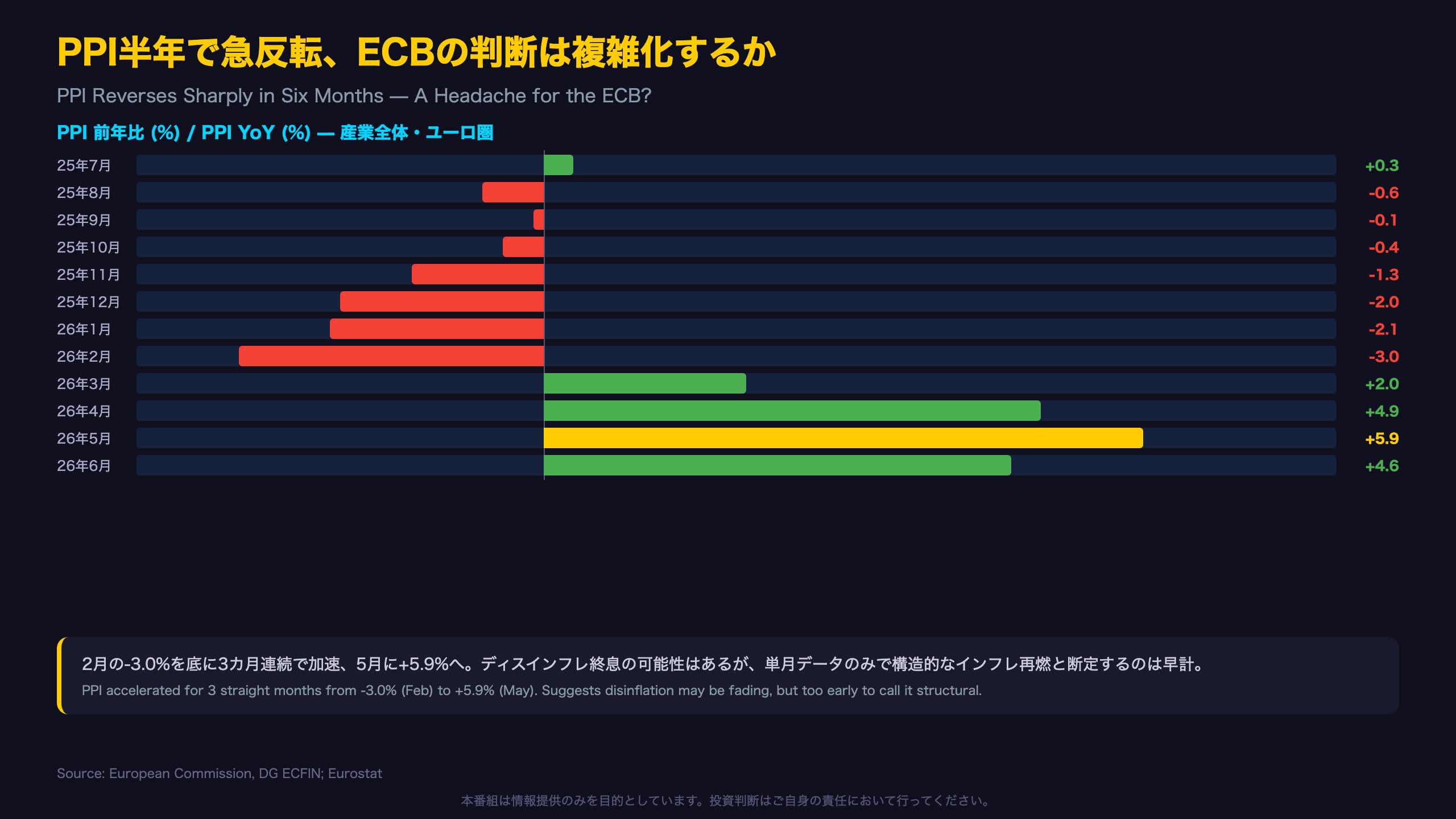
A Nine-Point Swing: What the PPI Reversal Really Tells Us
Euro-area Producer Price Index (PPI) inflation for total industry fell from +0.3% year-on-year in July 2025 into outright deflation, bottoming at -3.0% in February 2026. It then reversed sharply: +2.0% in March, +4.9% in April, +5.9% in May, before easing to +4.6% in June. A roughly nine-point swing over six months is unusually large for a producer-price series.
Notably, the source data here does not specify the drivers behind this reversal (energy base effects, supply constraints, etc.), so any causal explanation should be treated as speculative rather than confirmed.
Why PPI Matters to the ECB — and to EUR/JPY Traders
PPI is a leading indicator for consumer inflation (HICP), typically transmitting with a six-to-twelve-month lag, comparable to how U.S. PPI often foreshadows CPI trends the Fed watches. If the rebound persists, it would undercut the disinflation narrative the ECB has cited to justify its 2025-2026 rate-cutting cycle, since PPI effectively serves as a cross-check alongside HICP and wage growth.
Hawkish vs. Dovish Reads
Dovish: June’s deceleration to +4.6% from May’s +5.9% could mark a peak.
Hawkish: Even at +4.6%, producer-price inflation runs in a completely different regime than the negative readings of late 2025.
Cross-Currency Implications
For EUR/JPY, this matters due to policy asymmetry: the BOJ has been tightening while the ECB has been cutting. If PPI’s rebound forces the ECB to slow its cuts, a narrowing rate differential could be euro-supportive relative to the yen — a consideration, not a forecast. Conversely, if June’s deceleration continues, the ECB’s easing path likely persists.
What to Watch Next
The next Business and Consumer Survey release is due in late September 2026. Key focus points: whether PPI’s deceleration continues, and whether German manufacturing order books stabilize.
Disclaimer: This article is for informational purposes only. All investment decisions are made solely at your own risk.