This article was automatically generated by the NFC Market Live AI analysis system. (Updated: 2026-11-11 03:36 JST)
📄 Primary Source
Bank of Canada
https://www.bankofcanada.ca/2026/11/summary-of-governing-council-deliberations-fixed-announcement-date-of-october-28-2026/
The Bank of Canada published the summary of Governing Council deliberations behind its October 28, 2026 policy decision on November 11, 2026.
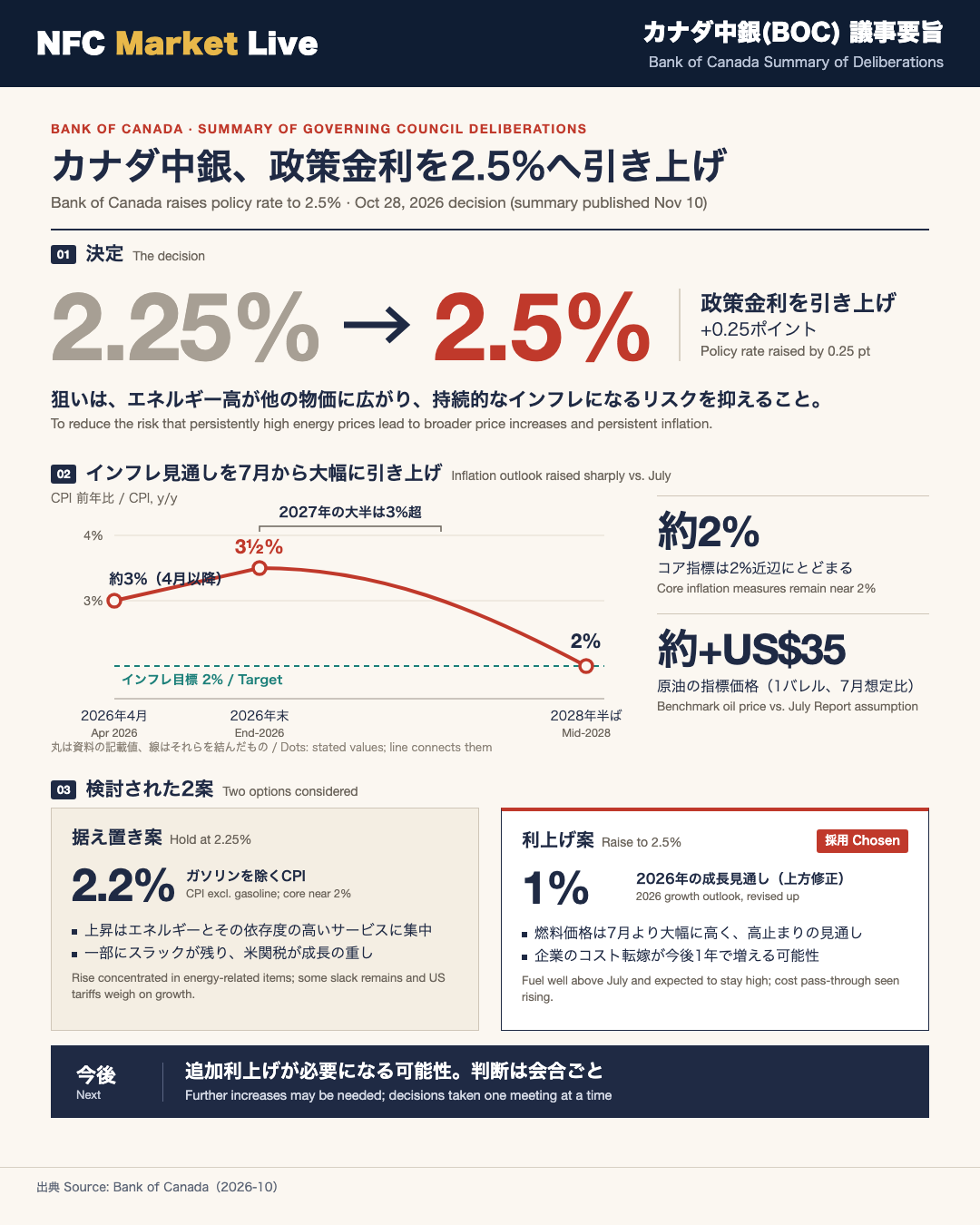
Governing Council weighed two options: holding the policy rate at 2.25% or raising it to 2.5%. It chose to raise the rate to 2.5% to reduce the risk that persistently high energy prices spread into other goods and services and turn into persistent inflation.
Key points from the deliberations: the war in the Middle East is in its eighth month, and the benchmark oil price is about US$35 per barrel higher than assumed in the July Report. CPI inflation has been around 3% since April, while core measures remain near 2% and CPI excluding gasoline is 2.2%. Cost pressures are building, and Bank surveys show businesses expect to pass on more of their cost increases over the next year. The October Report raised the 2026 growth outlook to 1%, with 2% growth expected in 2027 and 2028. CPI inflation is projected to reach 3.5% at the end of 2026 and return to the 2% target by mid-2028.
The case for holding rested on inflation being concentrated in energy-related items, CPI excluding gasoline at 2.2%, remaining slack, and the drag from new US tariffs.
On the path ahead, members agreed there could be a need to raise the policy rate further, but said they would decide one meeting at a time given the considerable uncertainty.
総括:2案を比較し、政策金利を2.5%へ引き上げ
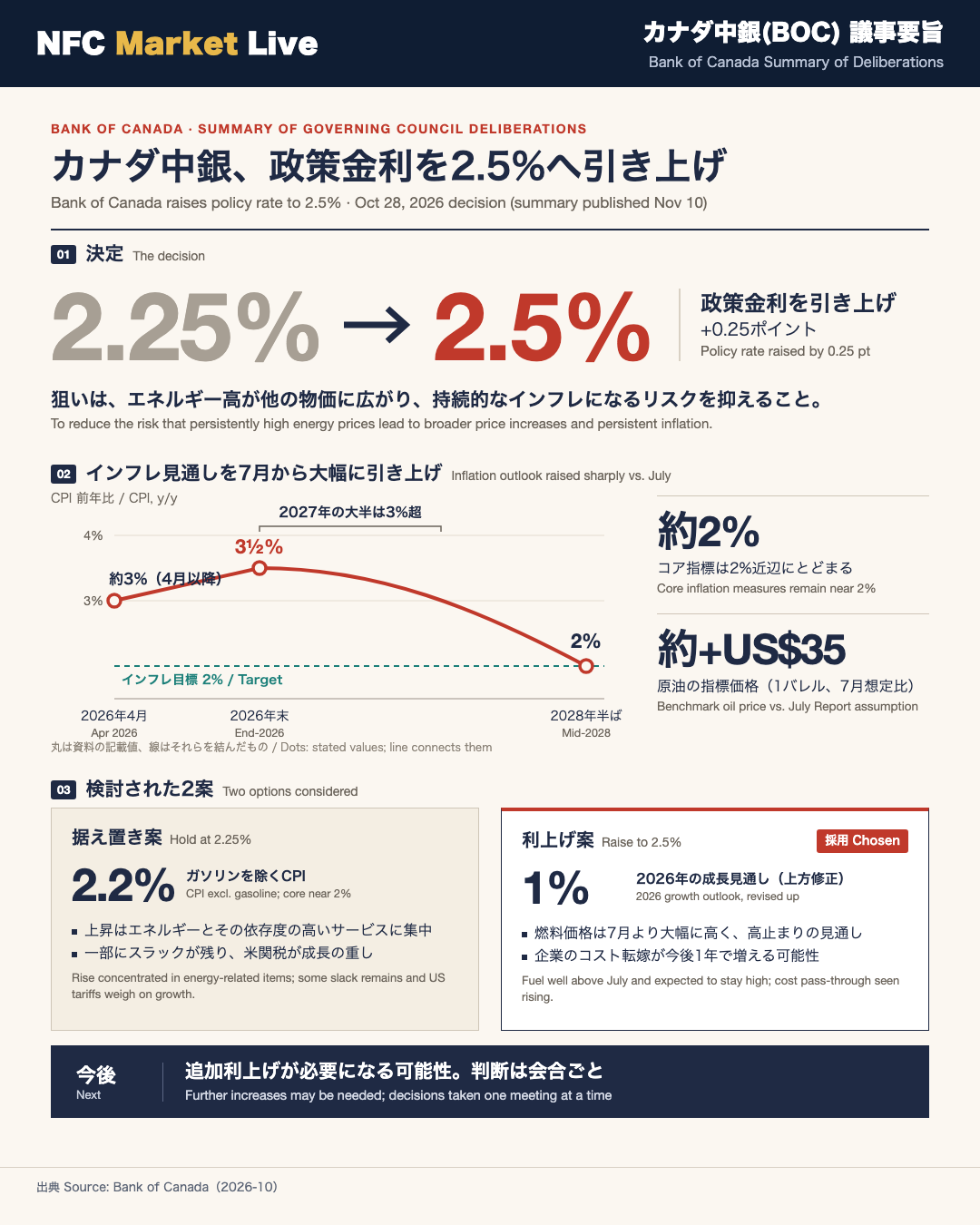
Headline: Policy rate raised from 2.25% to 2.5%
The Bank of Canada’s Governing Council is the body that sets the policy interest rate. The minutes of its October 28, 2026 decision, released on November 11, show it weighed two options: hold at 2.25% or raise to 2.5%. It raised the rate to reduce the risk that persistently high energy prices lead to broader price increases in other goods and services and become persistent inflation.
“While monetary policy cannot lower global energy prices, it can prevent them from leading to generalized inflation.”
Comparison with the September decision
| Item | September minutes | October minutes |
|---|---|---|
| Policy rate | Held at 2.25% | Raised to 2.5% |
| Inflation stance | Looking through gasoline effects | Pass-through risk judged to have increased |
| Further moves | A response might be needed if energy spills over | Further hikes acknowledged as possible |
Context for non-Canadian readers
The Bank operates under a 1% to 3% inflation-control band, with a 2% target. The minutes note that headline CPI has hovered near 3% since April, the upper end of that band, while core measures remain near 2%. Unlike a rate decision that responds to already-broad inflation, this decision is framed as preventive: members argued that pass-through, not the first-round energy effect, is the risk to guard against.
Reading the balance
The minutes combine resilience and fragility. The growth outlook was revised up, yet US tariffs and trade uncertainty remain a drag. The Council gave priority to inflation risk.
国際経済:AI投資が支える成長と、原油高の重し
Global growth firmer than expected, but energy costs create divergence
The minutes open with Governing Council’s review of the global economy. Since the July Monetary Policy Report (MPR), the Bank’s quarterly outlook publication, global growth has been stronger than expected despite higher oil prices.
Regional picture
- United States: A solid labour market and stock-market wealth gains supported robust consumer spending, alongside continued AI-related investment. Inflation is expected to stay high through 2026, and producer prices show mounting cost pressures in supply chains.
- Euro area: Defence and infrastructure spending supports activity, but high energy costs are expected to slow growth in the second half before it strengthens in 2027 and 2028.
- China: Rebounded in Q3 on exports and government spending, while private domestic demand stayed weak.
Council expects global GDP growth to stabilize around 3% through the projection horizon.
Oil and financial conditions
The benchmark oil price is about US$35 per barrel above the July assumption, and the futures curve shifted up and out as markets expect higher-for-longer prices.
- Sovereign yields rose across most advanced economies, reflecting both higher expected policy rates and higher term premiums
- Canadian yields rose by less than US yields
- Equities were volatile on concerns about AI-sector earnings sustainability
- The Canadian dollar recovered to roughly the July assumption after some depreciation
Versus September
In September, members saw limited spillover from energy into other prices. By October, the oil outlook had moved higher and the inflation-risk discussion became heavier.
カナダ経済:成長見通しは上方修正、ただし関税リスクは残る
Growth stronger than July; 2026 outlook raised to 1%
Governing Council judged that mid-year growth was stronger than anticipated in July. GDP grew 3.3% in Q2, and recent indicators suggest about 2% in Q3. However, the escalation of trade tensions with the United States at the end of summer is expected to dampen Q4 growth.
Demand components
| Component | Assessment in the minutes |
|---|---|
| Consumer spending | Solid; mostly rising per-person consumption given slow population growth, supported by labour income and wealth |
| Exports | Energy and other goods grew strongly in Q2; US demand and new pipeline capacity help, though tariffs hurt affected sectors |
| Business investment | Rising on AI and oil and gas; the Productivity Mega Deduction and major projects help, but investment remains low as a share of GDP |
| Residential investment | Expected to stay weak on slow population growth, affordability limits, higher mortgage rates and uncertainty |
Labour market: a range of views
Conditions were described as moving sideways since the start of the year. Public sector employment fell recently while private sector employment stayed resilient. Unemployment is around 6.5%. Members saw continued slack, though the minutes note that some members believed the labour market was stronger than the headline numbers indicated.
Outlook
Growth for 2026 was revised up to 1%, strengthening to 2% in 2027 and 2028, gradually absorbing excess supply.
Versus September
September emphasized uncertainty over the recovery’s sustainability. October confirmed an improved outlook, but how businesses will ultimately adapt to US tariffs remains unclear.
インフレ見通し:コア2%近辺でも、コスト転嫁のリスクを重視
Energy-led inflation today, much higher outlook ahead
According to the minutes, headline CPI has hovered around 3% since April. The rise has been driven mainly by components directly exposed to energy markets, such as gasoline and travel services. Core measures therefore remain near 2%, and the share of CPI components rising 3% or more is near its historical average.
Projection (sharply raised from July)
- CPI to reach 3.5% at the end of 2026
- Above 3% through much of 2027
- Gradual decline to the 2% target by mid-2028
Cost pressures that Council discussed at length
Fuel is the main driver, but businesses also face higher costs for non-energy imports, including:
- Oil-derived products such as chemicals, plastics and rubber
- Semiconductors and computer components whose prices rose on strong AI-equipment demand
Pass-through to consumer prices has been limited so far. Yet members agreed that continued cost pressures would eventually reach consumer prices, citing historical experience and Bank surveys in which businesses expect to pass on a greater share over the next year. Members shared a diversity of views on the speed and extent of pass-through, but noted that even without it, the energy shock alone would keep CPI near 3% for more than a year.
Expectations
Near-term inflation expectations moved up while longer-term expectations stayed anchored. Members acknowledged that, with the pandemic fresh in memory, expectations may be more sensitive to recent price changes.
Two-sided picture
Signs of building pass-through sit alongside contained core inflation and remaining slack. That tension defined the policy debate.
政策判断:据え置き論と利上げ論の論拠
Two options, two sets of arguments
The minutes lay out the main case for each option: hold at 2.25% or raise to 2.5%.
| Case for holding | Case for raising | |
|---|---|---|
| Prices | Inflation concentrated in energy and energy-heavy services such as airfares; CPI excluding gasoline 2.2%; core near 2% | Gasoline, diesel and heating oil prices far above July and expected to stay higher for longer |
| Costs | (not cited) | Businesses mostly absorbed higher input costs so far, but experience and Bank surveys suggest pass-through will increase over the next year |
| Growth | Growth stronger than expected but some slack remains; new US tariffs weigh; business sentiment worsened after trade talks broke down | A more resilient economy means less downward pressure on prices |
| Risk | Tariff and trade-uncertainty downside | Energy prices plus pass-through raise the risk of persistent, broad-based inflation |
What tipped the balance
Members agreed that the improved growth outlook means slack will be absorbed and offset cost pressures less. Downside risks to inflation had also diminished since July. Against this backdrop, they agreed the risk that high inflation could persist and become broad-based had increased.
Different readings
The holding case rests on the observation that current inflation is narrow; the raising case focuses on the future path of cost pass-through. The minutes state that members shared a diversity of views on how fast and how far pass-through would go.
Outcome
Council decided to raise the rate to 2.5%, aiming to keep higher energy costs from spreading to other prices.
今後の道筋:追加利上げの可能性と「会合ごとの判断」
Leaving room for further hikes, but proceeding carefully
Governing Council also discussed the path for the policy rate. According to the minutes:
- There is considerable uncertainty, both about developments outside Canada and their impacts in Canada
- Uncertainty does not mean inaction, but members would need to proceed carefully to assess how developments affect the outlook
- There could be a need to increase the policy rate further, but given the uncertainty, decisions will be taken one meeting at a time with the best available information
Sources of uncertainty named
- The war in the Middle East
- Canada-US trade relations
- Global financial conditions
- The speed and extent of cost pass-through
- How businesses and households react
What to watch (based on the minutes’ language)
- Persistence of energy prices: the longer they stay high, the more likely cost increases flow through production and distribution networks into a wide range of consumer prices
- Spillover into core measures: members expect cost pressures to eventually show up there
- Business adaptation to US tariffs: judged still too early to assess
- Labour market: many indicators point to slack, though some members saw private-sector job creation as a sign of greater strength
Comparison with September
September’s minutes said a monetary policy response might be needed if energy costs spilled over. In October the Council actually raised the rate and acknowledged further increases may be needed, a step forward in stance.
Caveat on the projections
The path of CPI to 3.5% at end-2026 and back to 2% by mid-2028 rests on these uncertainties. The Council said it will continue to take them into account in setting policy.
Disclaimer: This article is for informational purposes only. All investment decisions are made solely at your own risk.