📺 Watch the Full Video Analysis
This article was automatically generated by the NFC Market Live AI analysis system. (Updated: 2026-10-05 20:37 JST)
📄 Primary Source
Banco Central do Brasil
https://www.bcb.gov.br/content/focus/focusmarketreadout/R20261002.pdf
📊 A deep dive into the Central Bank of Brazil’s Focus Market Readout dated Oct 2, 2026.
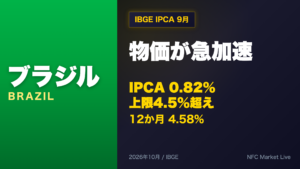
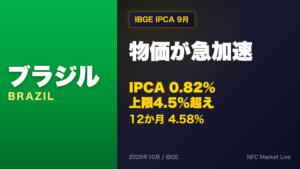
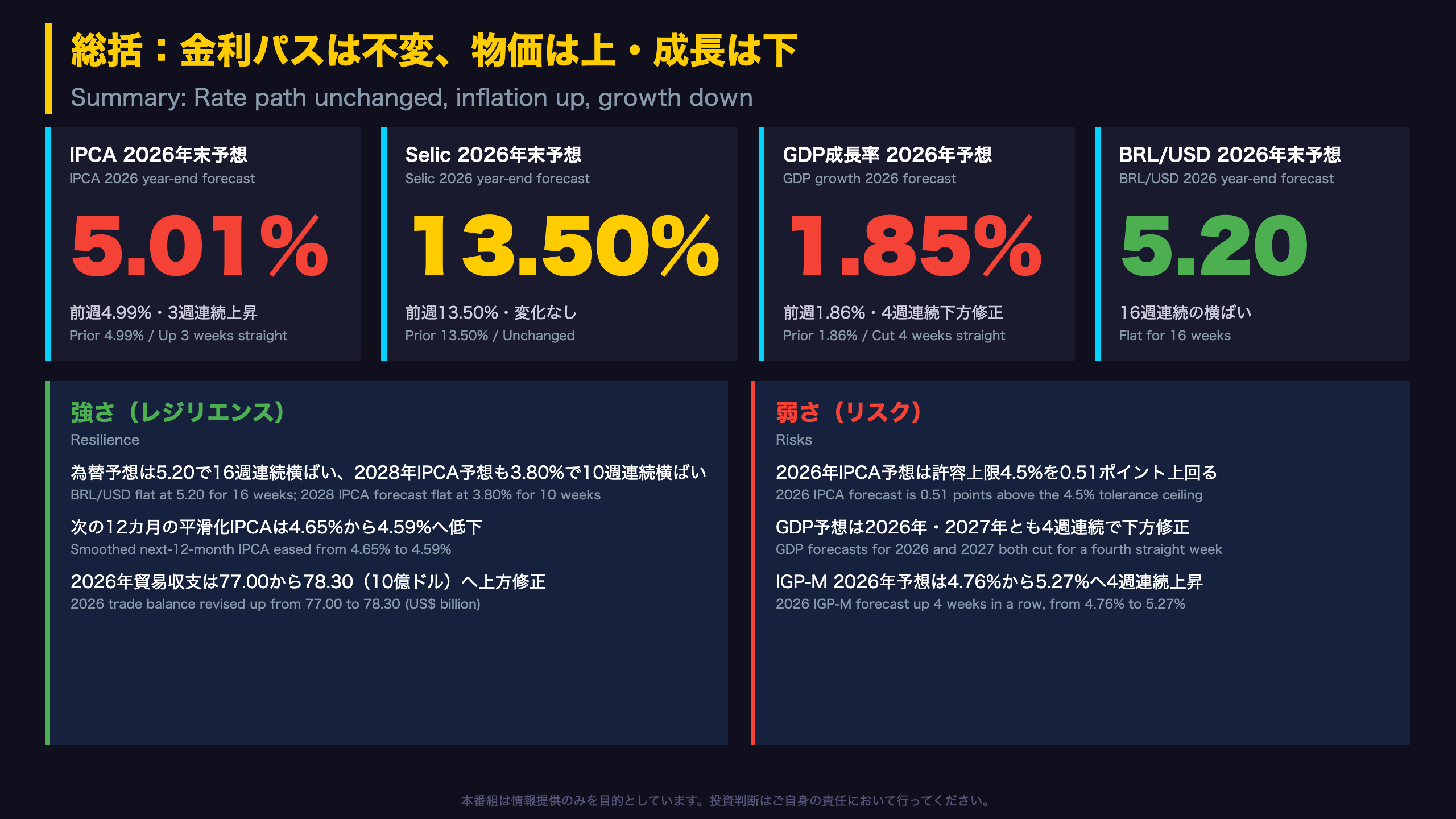
📈 The 2026 IPCA forecast rose for a third week to 5.01%, above the 4.5% tolerance ceiling.
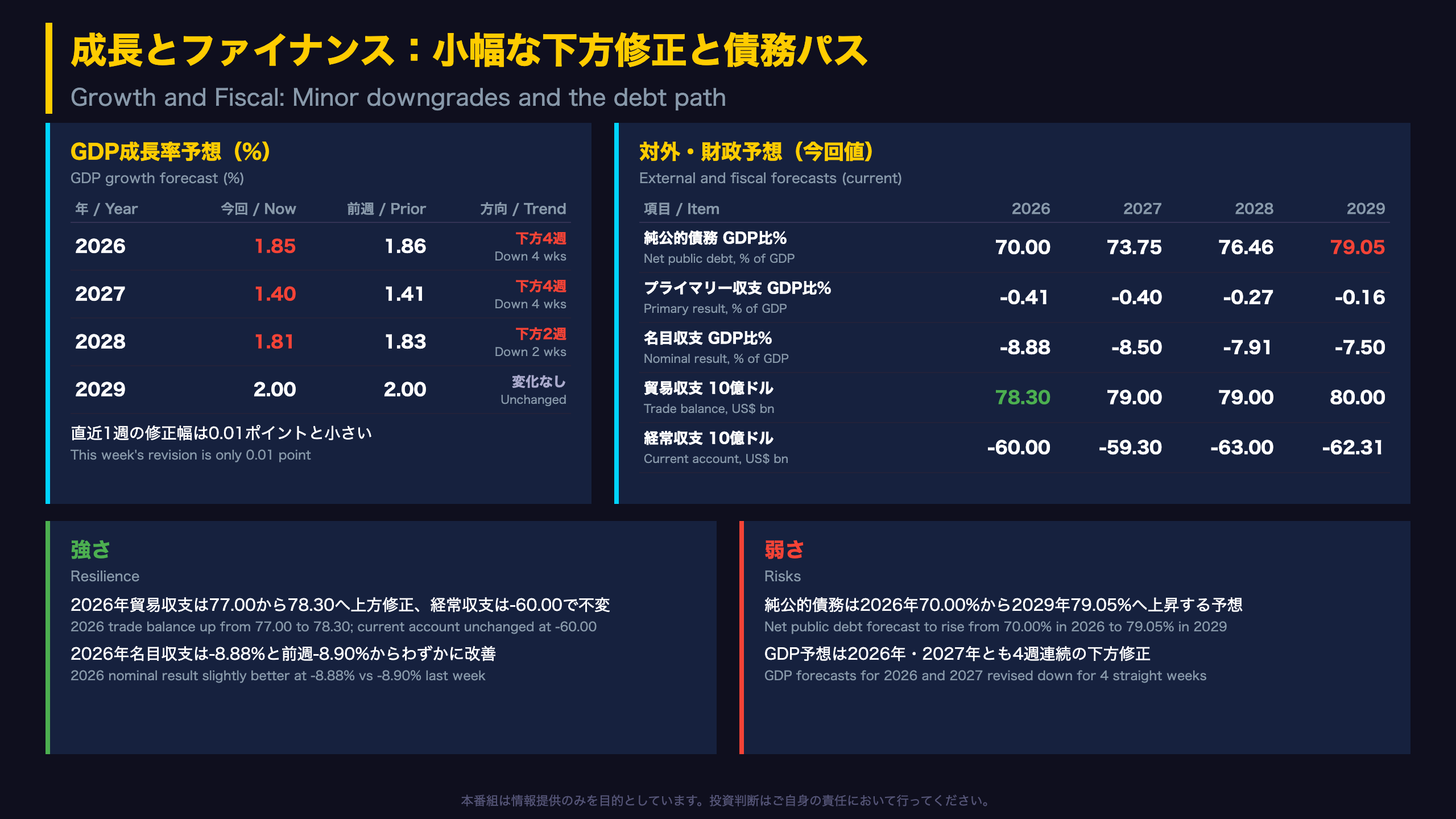
📉 GDP forecasts were cut for a fourth straight week: 1.85% for 2026 and 1.40% for 2027.
💡 Yet the Selic path was unchanged (13.50% in 2026, 12.00% in 2027), the BRL/USD forecast was flat at 5.20 for 16 weeks, and the 2028 IPCA forecast held at 3.80% for 10 weeks.
⚠️ We also cover the 12.52-point Selic vs BOJ spread and the FX and fiscal risks for yen-based investors.
総括:金利パスは不変、物価は上・成長は下
What the Focus Survey Is
The Focus Market Readout is the Central Bank of Brazil’s (BCB) weekly compilation of median forecasts from more than 130 institutions. The BCB’s monetary policy committee (COPOM) draws on it, so it works as a view of the economy through the market’s eyes, rather than a purely private poll.
Why the Numbers Matter
Brazil’s inflation target is 3.0% with a plus-or-minus 1.5-point tolerance band (1.5% to 4.5%). The 2026 IPCA forecast of 5.01% sits above the band, whereas the Fed and the Bank of Japan both aim for 2%. The year-end 2026 Selic forecast is 13.50%, far above US or Japanese policy rates.
A Balanced Reading
- Resilience: The BRL/USD forecast has stayed at 5.20 for 16 weeks and the 2028 IPCA forecast at 3.80% for 10 weeks. The 2026 trade balance forecast rose from 77.00 to 78.30 billion dollars.
- Risks: Inflation expectations are above the ceiling, and GDP forecasts were trimmed for a fourth week, to 1.85% for 2026.
Market Angle
Unchanged Selic expectations alongside higher inflation forecasts suggest the market is not yet pricing a faster easing cycle. Individual weekly moves are small (+0.02 point for IPCA), so this is a gradual drift rather than a regime break. Watch whether the 2026 IPCA forecast settles in the 5% range over coming weeks.
Selic予想パス:年末値は全期間で不変
Reading the Selic Path
The Selic is Brazil’s policy interest rate, set by the central bank’s monetary policy committee (COPOM). The Focus survey asks about 139 institutions where they see the rate at year-end, so the median acts as a market-implied easing path.
The Path in Numbers
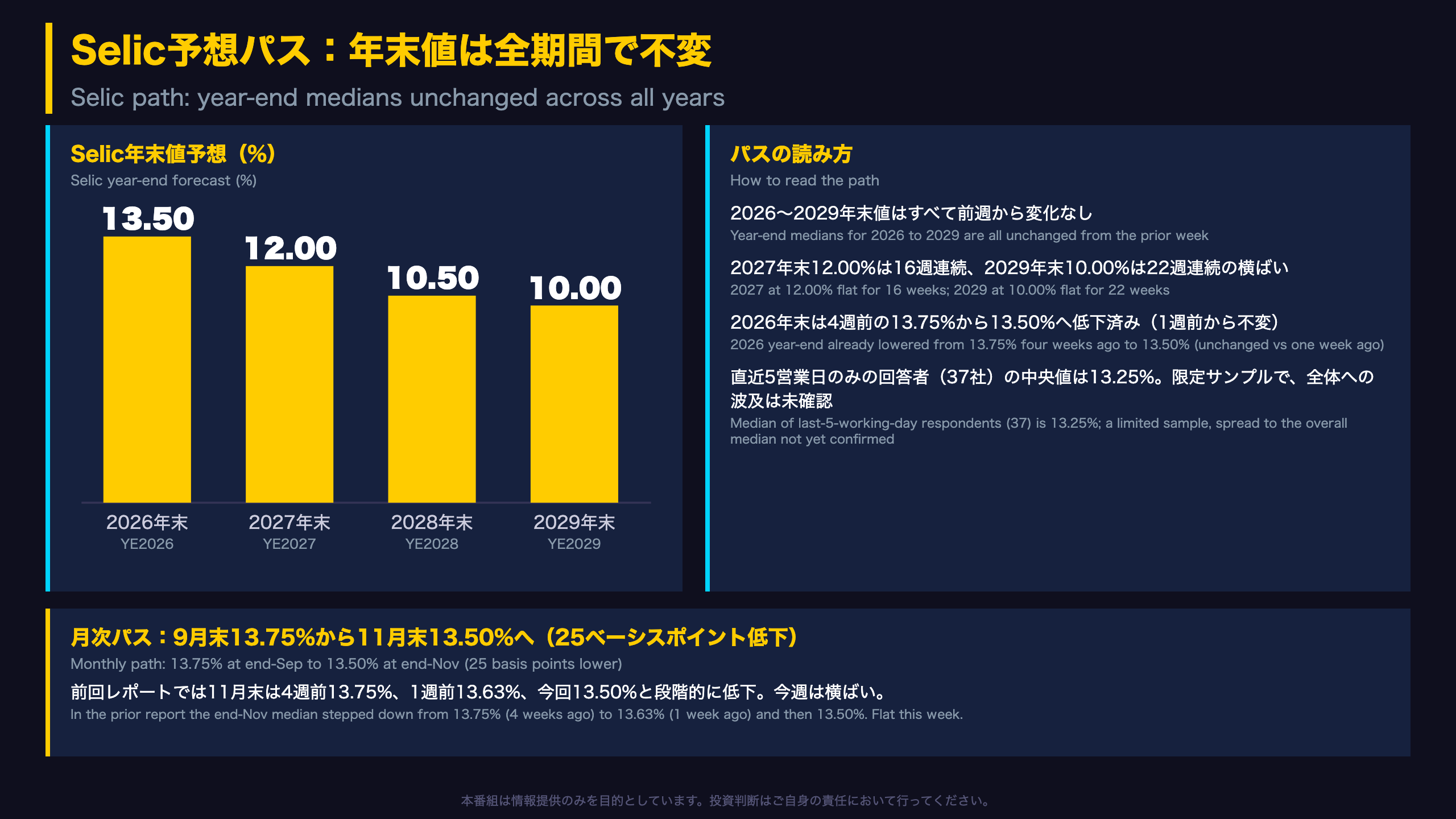
- 2026: 13.50% (unchanged for 2 weeks)
- 2027: 12.00% (unchanged for 16 weeks)
- 2028: 10.50% (unchanged for 14 weeks)
- 2029: 10.00% (unchanged for 22 weeks)
That is a cumulative 3.50 points of easing from end-2026 to end-2029. The monthly view shows 13.75% at end-September and 13.50% at end-November, consistent with a 25 basis point cut expected at the next move. The report does not say which meeting that corresponds to.
Two Ways to Read the Short-Window Data
The median of respondents in the last five working days is 13.25% for 2026, versus 13.50% in last week’s report. A bullish-for-cuts reading says the most recent forecasters are leaning toward deeper easing. The cautious reading notes only 37 responses sit behind that figure, roughly a quarter of all respondents, so the overall median may simply not have moved.
International Context
Brazil’s real policy rate is among the highest in major economies. With the 2027 IPCA forecast at 4.30% and Selic at 12.00%, the simple nominal gap is 7.70 points. By comparison, the Fed and the BOJ operate with much lower nominal rates. Higher carry can support the currency, but it also signals that inflation is a live issue.
インフレ期待:短期は上向き、中期は安定
Inflation Expectations Under the Hood
Brazil’s headline inflation gauge is the IPCA, the consumer price index published by the statistics agency IBGE. The IGP-M is a wholesale-heavy general price index often used in rent and contract indexation, so it tends to react more to commodity and exchange-rate moves.
Short Run vs Medium Run
| Horizon | Forecast |
|---|---|
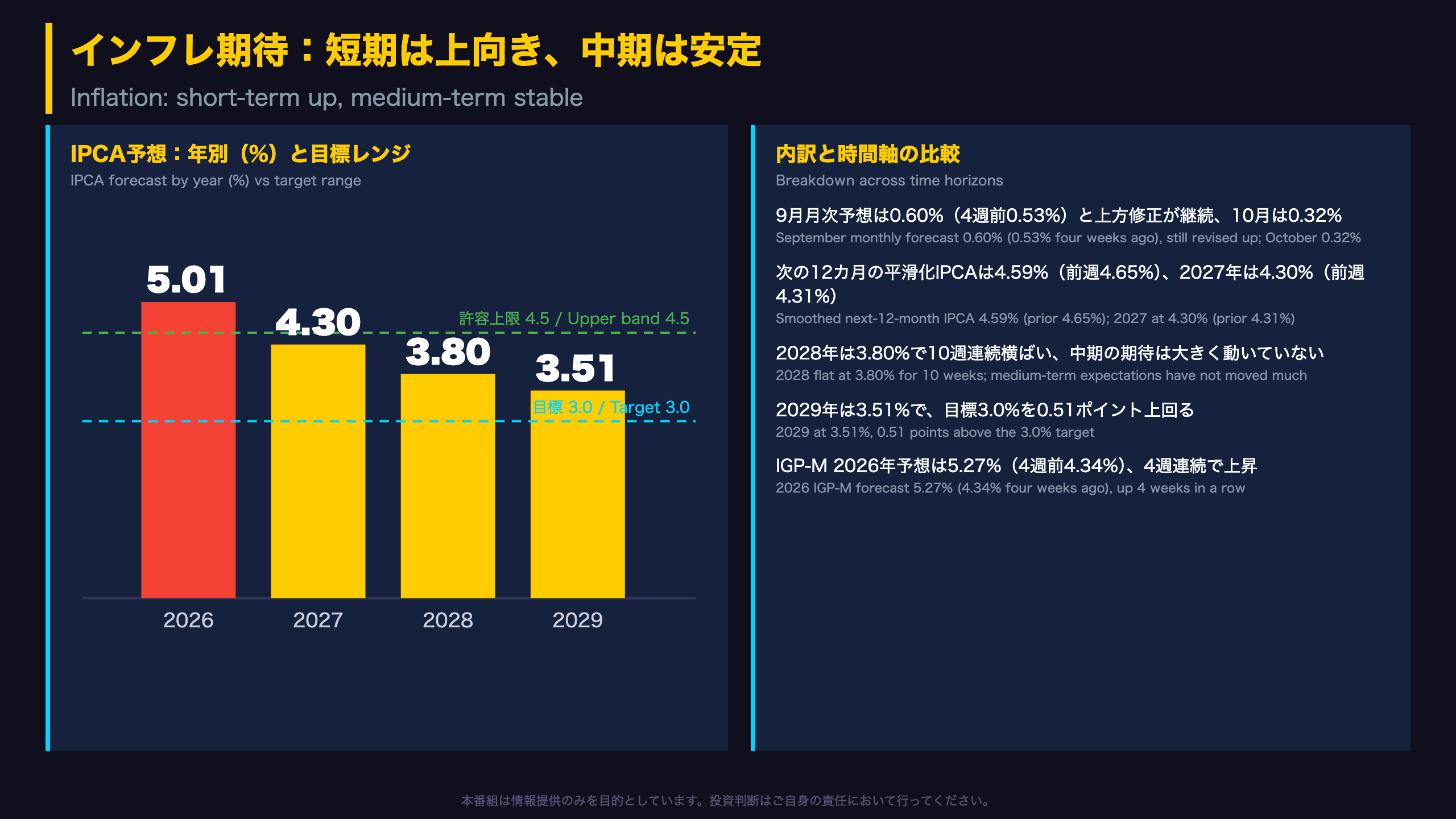
| 2026 IPCA | 5.01% (up 3 weeks) |
| 2027 IPCA | 4.30% (prior 4.31%) |
| 2028 IPCA | 3.80% (flat 10 weeks) |
| 2029 IPCA | 3.51% (prior 3.50%) |
| Next 12 months, smoothed | 4.59% (prior 4.65%) |
The September monthly forecast was lifted from 0.53% four weeks ago to 0.60%, while October is 0.32%. The 2026 IGP-M forecast climbed from 4.34% to 5.27% over four weeks, though the five-working-day median is lower at 5.06%.
Two Readings
- Steadier view: The 2028 forecast has not moved for ten weeks and the smoothed 12-month number fell. Medium-term expectations appear largely anchored.
- Cautious view: Even in 2029, the forecast is 0.51 points above the 3.0% target, and near-term upward revisions have continued.
Comparison and Market Angle
At 5.01%, Brazil’s 2026 forecast is above its own 4.5% ceiling; the Fed and BOJ both target 2%. A monthly figure is noisy, so one week of upward revisions is not enough to call a structural shift. The key question for fixed-income investors is whether the 5% handle sticks, which would argue for a slower pace of Selic cuts.
成長とファイナンス:小幅な下方修正と債務パス
Growth, External Balance and Fiscal Picture
The survey collects medians for GDP growth, the trade balance, the current account and public finances. Two Brazilian-specific terms: the primary result is the budget balance excluding interest payments, and the nominal result includes interest costs.
Growth
| Year | Today | Prior week |
|---|---|---|
| 2026 | 1.85% | 1.86% |
| 2027 | 1.40% | 1.41% |
| 2028 | 1.81% | 1.83% |
| 2029 | 2.00% | 2.00% |
Both 2026 and 2027 have now been trimmed four weeks running. Since four weeks ago, 2026 is down 0.08 point and 2027 down 0.10 point, but this week’s revision is only 0.01 point, so the pace is gentle.
External and Fiscal
- Trade balance 2026: 78.30 billion dollars (from 77.00). Current account: unchanged at a 60.00 billion deficit.
- Nominal deficit 2026: 8.88% of GDP (from 8.90%). Primary deficit: 0.41% of GDP. The roughly 8.47-point gap between them is a simple arithmetic difference, possibly reflecting interest costs.
- Net public debt: 70.00% of GDP in 2026, rising to 79.05% by 2029.
Market Angle
Brazil’s fiscal path is a recurring concern for local-currency bond investors, because rising debt-to-GDP can add to risk premia. By contrast, many developed economies with lower rates carry smaller interest burdens. A steady external position (trade surplus, FDI of 80.00 billion dollars) is a counterweight that supports the currency outlook.
BRL/JPYへの含意:金利差と為替・財政リスク
Implications for Yen-Based Investors
The Spread
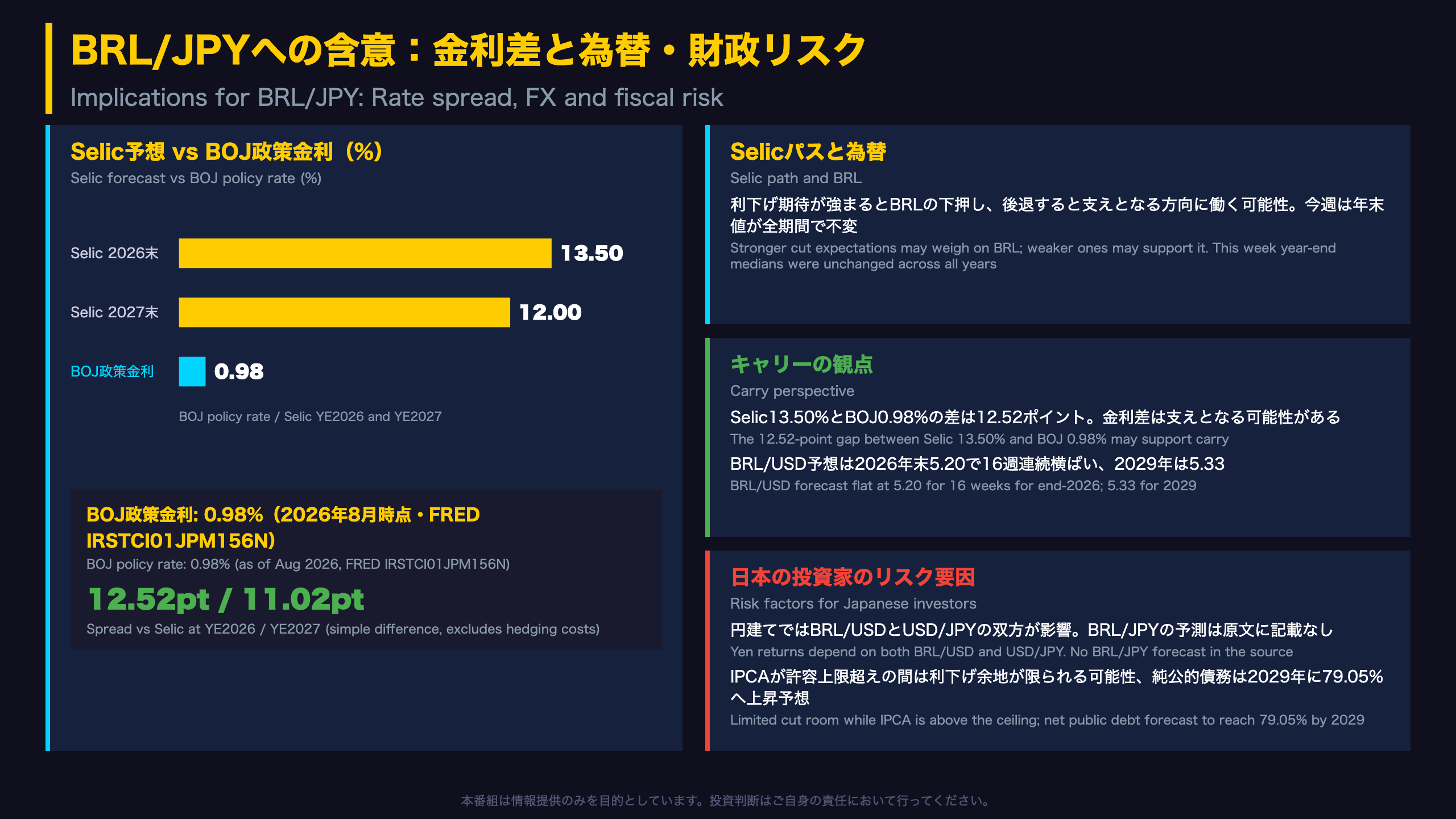
The Bank of Japan (BOJ) policy rate stands at 0.98% as of August 2026 (FRED series IRSTCI01JPM156N). Against the Focus Selic median, the gap is:
– End-2026: 13.50% vs 0.98% = 12.52 points
– End-2027: 12.00% vs 0.98% = 11.02 points
– End-2029: 10.00% vs 0.98% = 9.02 points
These are plain arithmetic differences, excluding hedging costs, taxes and spreads.
How Rates Link to the Real
Stronger expectations of Selic cuts may weigh on the BRL, while fewer cuts may support it. This week the Selic path and the exchange rate forecasts barely moved: 5.20 for 2026 (flat for 16 weeks), 5.28 for 2027 and 5.33 for 2029.
Risks to Weigh
- Currency risk: Yen returns depend on BRL/USD and USD/JPY together. The survey gives no BRL/JPY forecast.
- Inflation/rate risk: IPCA above the 4.5% ceiling may limit room for cuts.
- Fiscal risk: Net public debt is projected to rise from 70.00% of GDP in 2026 to 79.05% in 2029.
Comparison and Market Angle
The US carry gap to Japan is far narrower than Brazil’s, so Brazilian assets offer much more income but with higher currency and policy volatility. A large spread supports carry, yet it is not a guarantee of returns; the next weekly Focus will show whether 2026 IPCA settles in the 5% range.
Disclaimer: This article is for informational purposes only. All investment decisions are made solely at your own risk.