📺 Watch the Full Video Analysis
This article was automatically generated by the NFC Market Live AI analysis system. (Updated: 2026-10-09 22:09 JST)
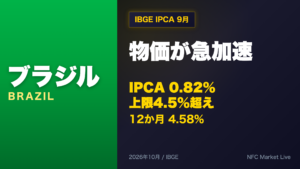
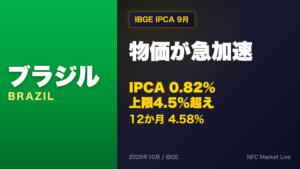
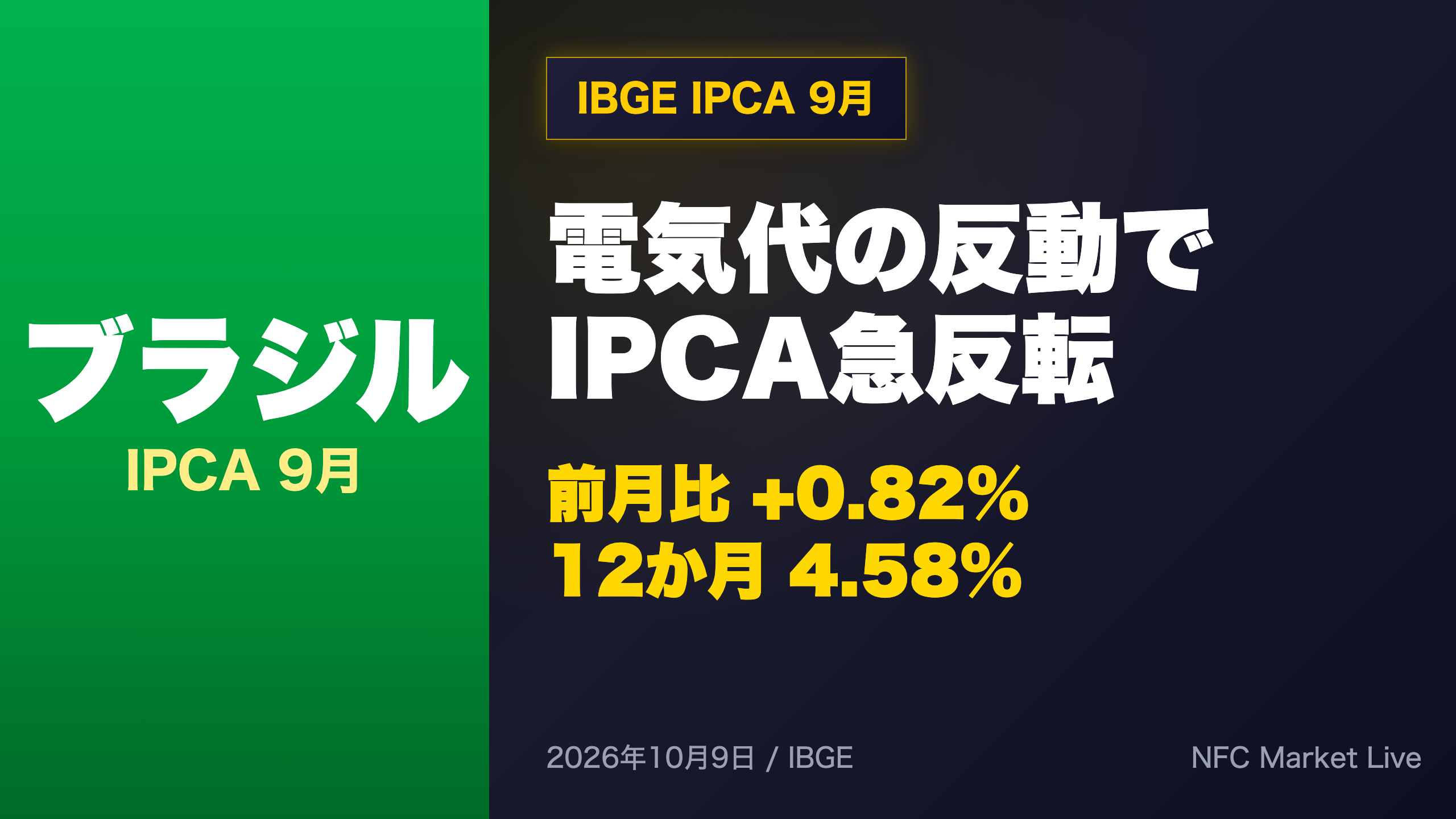
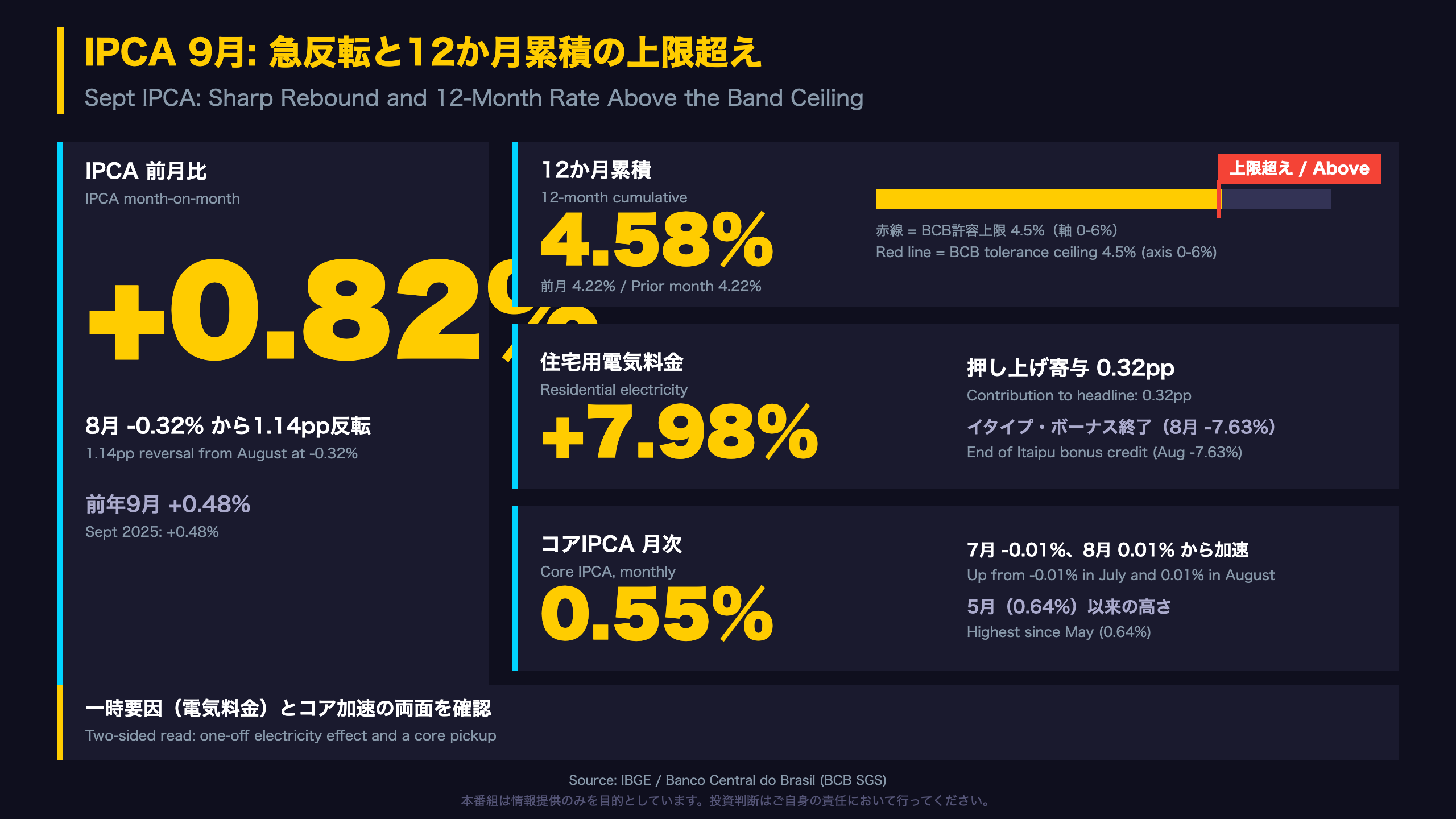
📊 Brazil’s September IPCA, released by IBGE, rose 0.82% month on month, reversing August’s -0.32%. The 12-month rate accelerated to 4.58% from 4.22%.
⚡ Residential electricity jumped 7.98% (0.32pp contribution) as the Itaipu bonus credit that cut August bills ended.
📈 Core monthly IPCA also rose 0.55%, the highest since May, and the 12-month rate now sits above the central bank’s 4.5% tolerance ceiling.
⚠️ Rebounds in volatile items such as tomatoes (+37.76%) and airfares (+9.66%) also contributed, so persistence needs confirmation.
💡 Next is the October print: October 2025 was +0.09%, so a larger monthly gain would lift the 12-month rate again.
The Ultimate Summary: 急反転と12か月累積の上限超え
What the headline number means
Brazil’s IPCA (Indice Nacional de Preços ao Consumidor Amplo) is the official consumer price index compiled by IBGE, the national statistics agency. It is the benchmark the Banco Central do Brasil (BCB) uses for its inflation target. Unlike the US CPI, the IPCA covers households earning 1 to 40 minimum wages across 10 metropolitan areas plus several cities, and it is published as a single monthly release together with the INPC for lower-income households.
Target band context
The BCB’s target is 3.0% with a ±1.5pp tolerance, so the ceiling is 4.5%. The 12-month rate of 4.58% is therefore 8 basis points above the ceiling, after sitting at 4.22% in August. Brazil’s policy rate (Selic) is 13.75% in the data pulled on October 9, versus 14.00% in the prior pull.
Two readings
- Reassuring: the 12-month rate is still below May’s 4.72% and well below September 2025’s 5.17%. The monthly jump partly reverses August’s electricity-driven deflation.
- Cautionary: core monthly IPCA (BCB series 11428) rose to 0.55%, from 0.01% in August, and all nine groups rose. That breadth means the move was not confined to a single category.
International comparison
A 4.58% print is above the 2% targets of the Fed and ECB, but Brazil’s real policy rate is high: the simple difference between Selic and 12-month IPCA is about 9.2 points. Whether this matters for the real or for rate expectations depends on how the central bank weighs one-off effects; this analysis draws no market forecast.
What to watch
October 2025 was +0.09% month on month, so any October 2026 reading above that mechanically lifts the 12-month rate. The release date is not stated in the source.
住居費の反動: 電気料金が動かした8月と9月
The electricity swing explained
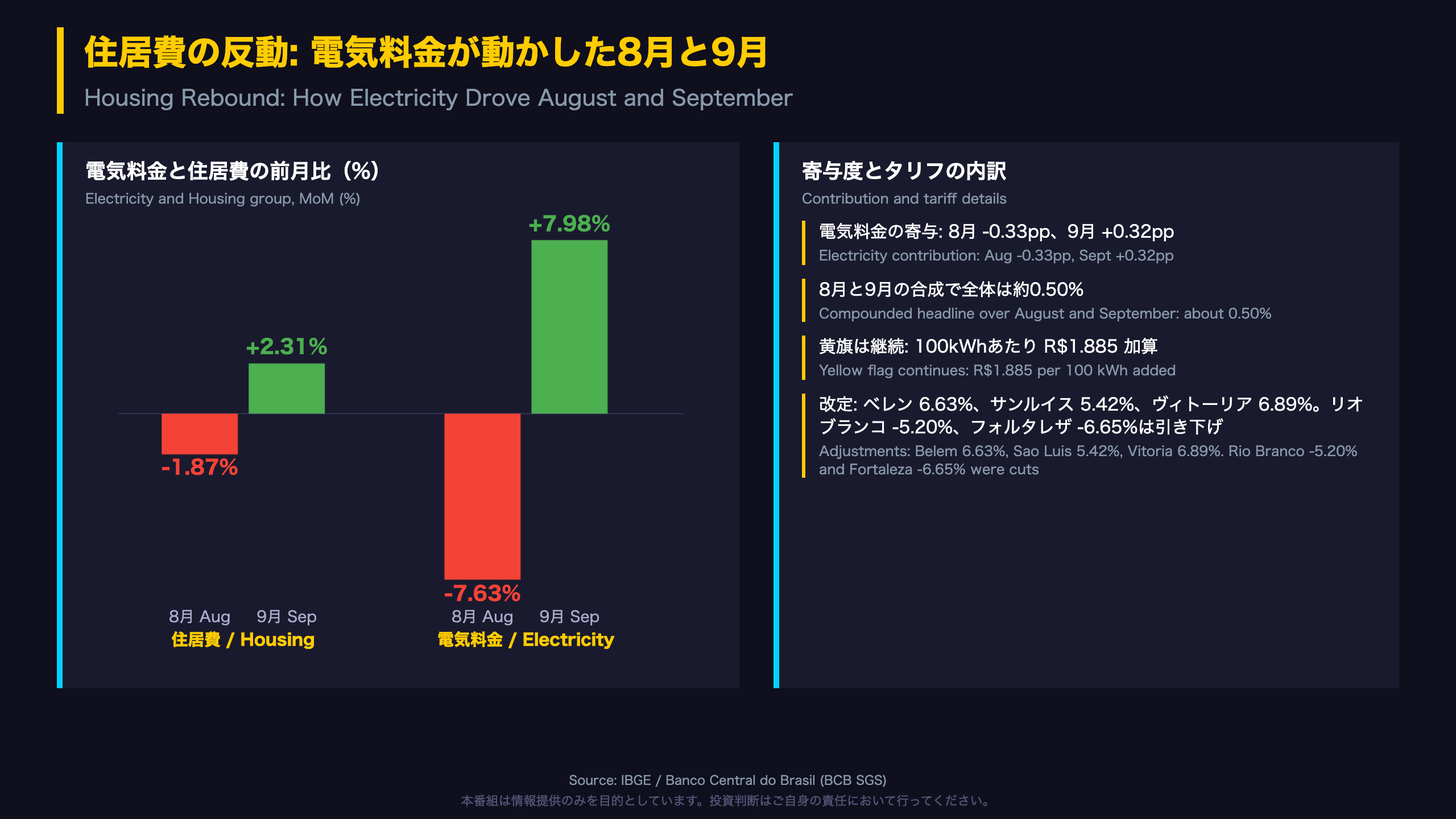
The Itaipu bonus is a credit on household electricity bills linked to the Itaipu hydropower plant, which Brazil shares with Paraguay. IBGE says the credit appeared on bills issued in August and ended in September. That is why residential electricity in the IPCA fell 7.63% in August and rose 7.98% in September. Compounding both months, the level ends close to where it started (0.9237 x 1.0798 is roughly 0.997).
Contribution view
| Item | Aug | Sep |
|---|---|---|
| Housing group | -1.87% | +2.31% |
| Electricity contribution | -0.33pp | +0.32pp |
Because electricity is a large single item, it moves the headline noticeably: it supplied 0.32 of September’s 0.82 points.
Tariff flags and regional adjustments
Brazil’s tariff flag system adds surcharges when generation costs rise. The yellow flag stayed in force, adding R$1.885 per 100 kWh. Regional distributors also adjusted tariffs (Belem 6.63%, Sao Luis 5.42%, Vitoria 6.89%), while Rio Branco and Fortaleza cut tariffs by 5.20% and 6.65% after regulator ANEEL approved the use of public asset funds.
Two readings
- One-off view: the August plunge was the weakest August housing reading since the 1994 Real Plan, so September’s rebound is largely a reversal.
- Persistence view: regional tariff adjustments continue, and the flag remains yellow.
For international readers: the US CPI has no direct equivalent, since utilities are largely regulated at state level. For FX or rates, the useful point is that this swing is mostly a base effect; this note makes no market forecast. October’s utility pricing is the next check.
食品と交通: 8月の下落からの反動
Food and transport in context
In the IPCA, food and beverages carry the largest weight alongside housing and transport, so swings in fresh produce move the headline quickly. Brazil’s fresh food prices are notably volatile because of weather and seasonality, which is why economists often look at core or services measures alongside the headline.
September’s food rebound
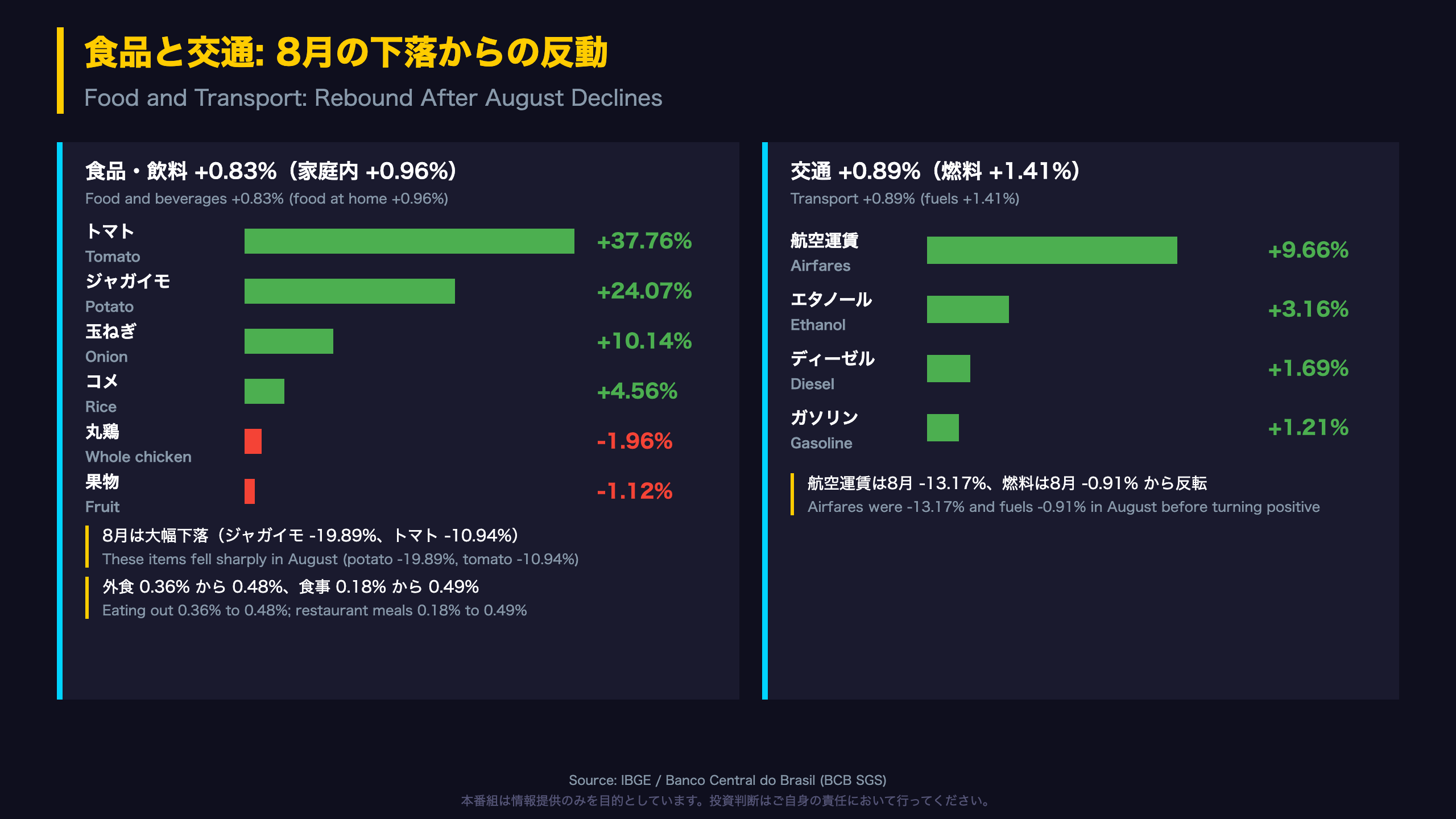
Food at home rose 0.96% after falling 0.61% in August. Tomatoes (+37.76%), potatoes (+24.07%), onions (+10.14%) and rice (+4.56%) drove the move. In August these had dropped by 10% to 20% (potatoes -19.89%, onions -11.07%, tomatoes -10.94%), so September looks like a partial rebound rather than a clear new trend. Declines in whole chicken (-1.96%), chicken pieces (-1.41%) and fruit (-1.12%) show it was not uniform.
Eating out and services signals
Food away from home accelerated to 0.48% from 0.36%, with restaurant meals rising 0.49% (from 0.18%) and snacks easing to 0.47%. Eating out is often watched as a proxy for service-sector price pressure.
Transport
Transport rose 0.89%: airfares +9.66% (after -13.17% in August) and fuels +1.41%. Airfares are among the most volatile IPCA items, so the contribution is likely to reverse in either direction.
Regional detail
Vitoria had the highest reading (1.08%, tomatoes +43.19%), Rio Branco the lowest (0.53%, airfares -14.13%).
Takeaway for global readers
The breadth is notable: all nine groups were positive. But most of the largest moves are volatile items that fell in August, so the data reads as a mix of rebound and broad pressure. No market direction is inferred here.
コア加速と上限超え: 次の確認ポイント
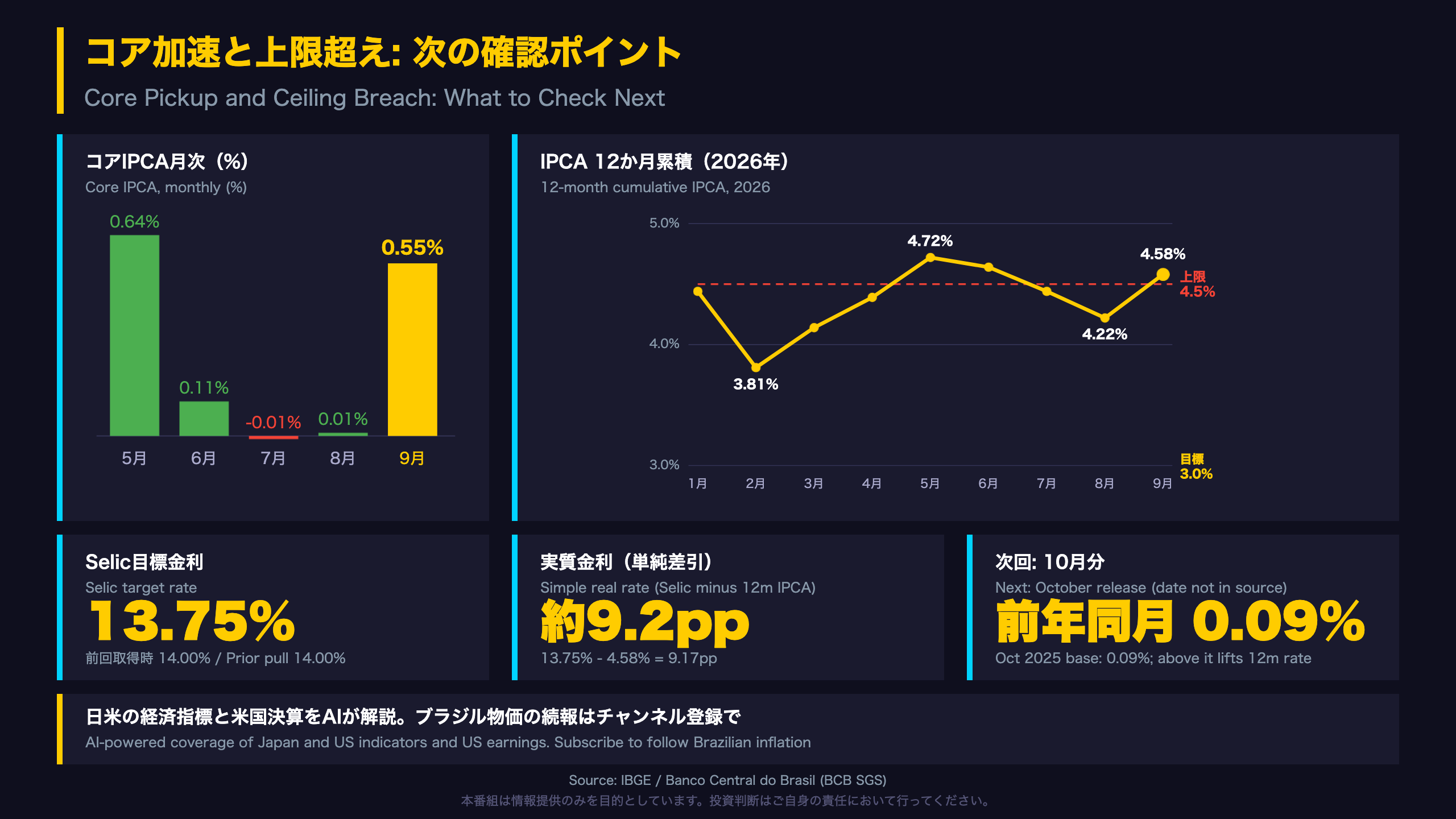
Core inflation and the policy backdrop
Core IPCA (BCB series 11428, which excludes food and energy as labeled in the data) rose to 0.55% in September after near-zero readings in July (-0.01%) and August (0.01%). The last higher print was May’s 0.64%. The September 2025 core reading was 0.00%, so year-on-year comparison is also less favorable.
The target framework
The Banco Central do Brasil follows an inflation-targeting regime: 3.0% target, +/-1.5pp tolerance. A 12-month rate of 4.58% sits 8bp above the 4.5% ceiling, after being at 4.22% in August. For context, the Bank of Japan targets 2% and the Fed 2%, so Brazil’s regime operates at a structurally higher level.
Monetary policy
The Selic target stood at 13.75% in the October 9 data versus 14.00% in the September 11 data. Subtracting the 12-month IPCA gives a simple real rate of about 9.2 percentage points, which is high in international comparison. The central bank’s policy committee, Copom, weighs headline, core and expectations; this analysis does not infer its decisions.
Regional dispersion
Goiania recorded the highest 12-month rate at 6.08% and Curitiba the lowest at 2.72%, while Sao Paulo, with 32.28% of the index weight, was at 4.75%.
Two readings
- Supportive: core was close to zero for three months before September, and the 12-month rate is below May’s peak.
- Cautionary: headline above the ceiling and a core rebound occurred together.
What to watch
October 2025 was +0.09% month on month, so any larger October 2026 print would push the 12-month rate higher. The release date is not stated in the source. A single month is not a trend; core persistence is the key check.
Disclaimer: This article is for informational purposes only. All investment decisions are made solely at your own risk.