📺 Watch the Full Video Analysis
This article was automatically generated by the NFC Market Live AI analysis system. (Updated: 2026-08-28 09:09 JST)
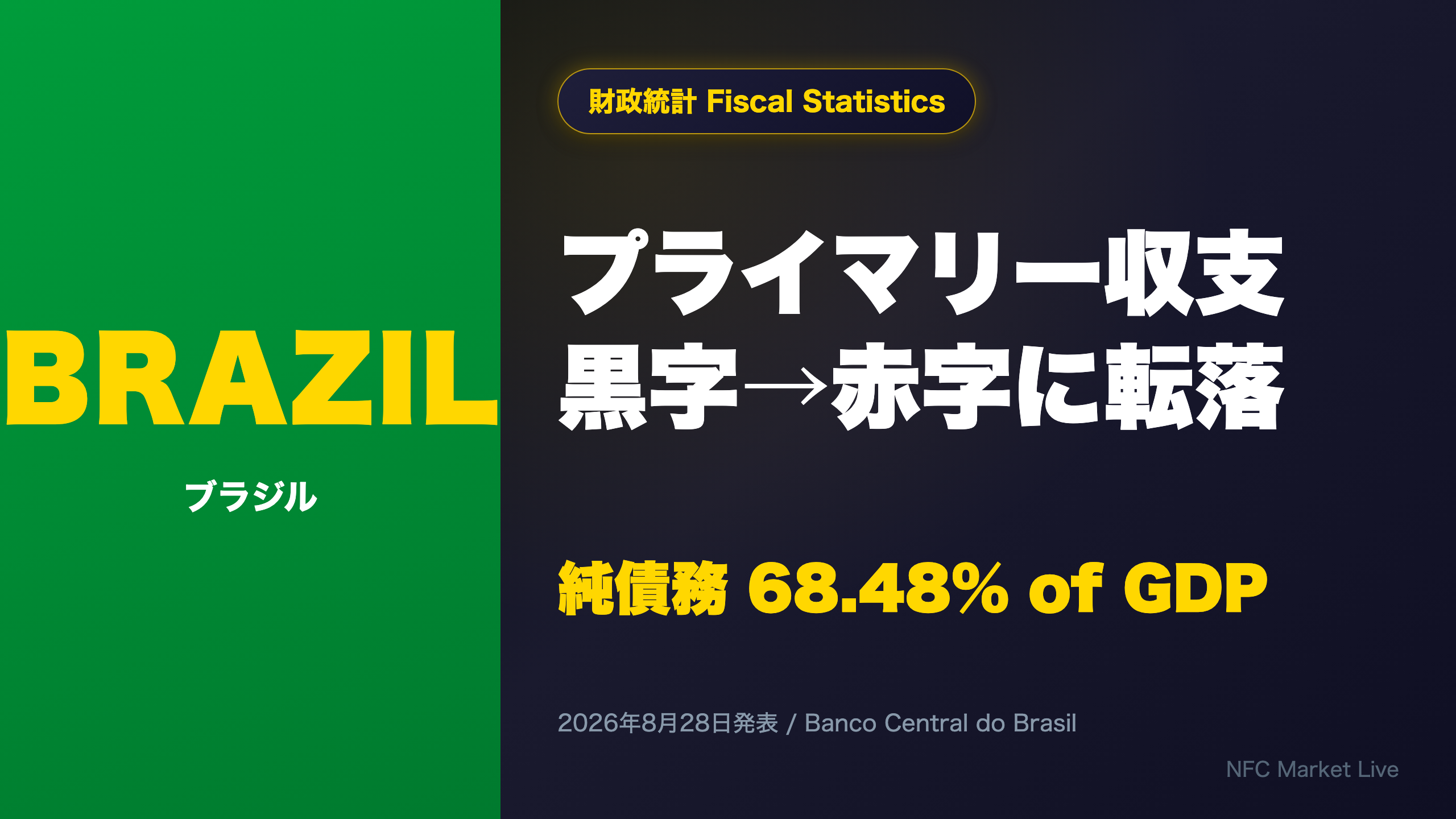
📊 Brazil’s Central Bank (BCB) released its latest Fiscal Statistics.
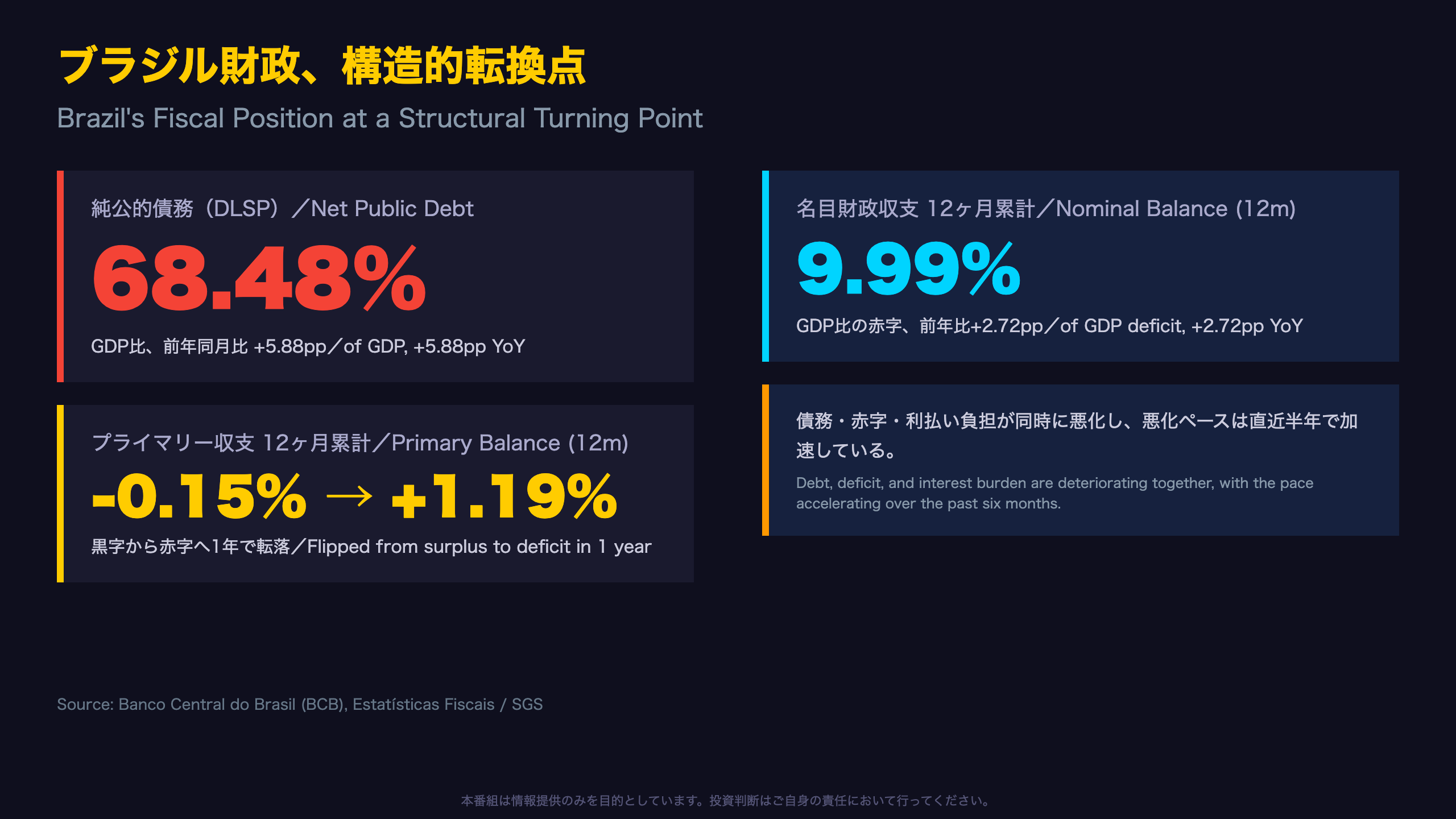
Net public debt (DLSP) climbed to 68.48% of GDP, up +5.88pp in just 12 months.
💡 The key story: the primary balance flipped from a 0.15% surplus to a 1.19% deficit (12-month accumulated, % GDP).
The nominal fiscal deficit widened to nearly 9.99% of GDP as interest burden grows.
⚠️ The pace of deterioration has clearly accelerated over the past six months — a factor to watch for BRL and Brazilian government bonds.
Full breakdown in this Deep Dive.
The Ultimate Summary:財政ポジションの構造転換
A Turning Point in Brazil’s Fiscal Position
The Banco Central do Brasil (BCB) released its June 2026 fiscal statistics, and the data shows multiple indicators deteriorating in tandem.
Understanding the Sign Convention
BCB’s primary and nominal balance series follow the NFSP (Necessidade de Financiamento do Setor Público / Public Sector Borrowing Requirement) convention, where positive values indicate a fiscal deficit (financing need) and negative values indicate a surplus. This differs from the more common IMF GFS convention where positive = surplus. Under BCB’s framework, the -0.15% reading in June 2025 was actually a surplus, while the +1.19% reading in June 2026 is a deficit.
Timeline of the Shift
- June 2025: Primary surplus (-0.15% of GDP)
- July 2025: Flipped to deficit (+0.22%), and stayed in deficit territory since
- March 2026: Deficit jumped from +0.41% to +1.06% in a single month
- June 2026: +1.19%
For international investors, this matters because Brazil’s primary balance trajectory is one of the key inputs rating agencies and bond markets use to assess debt sustainability, alongside the debt-to-GDP trend.
What’s Next
The next BCB fiscal release is expected in late September 2026. The key question: does the primary deficit stabilize, or does it continue widening as seen in the March 2026 jump?
債務水準の急上昇とペース加速
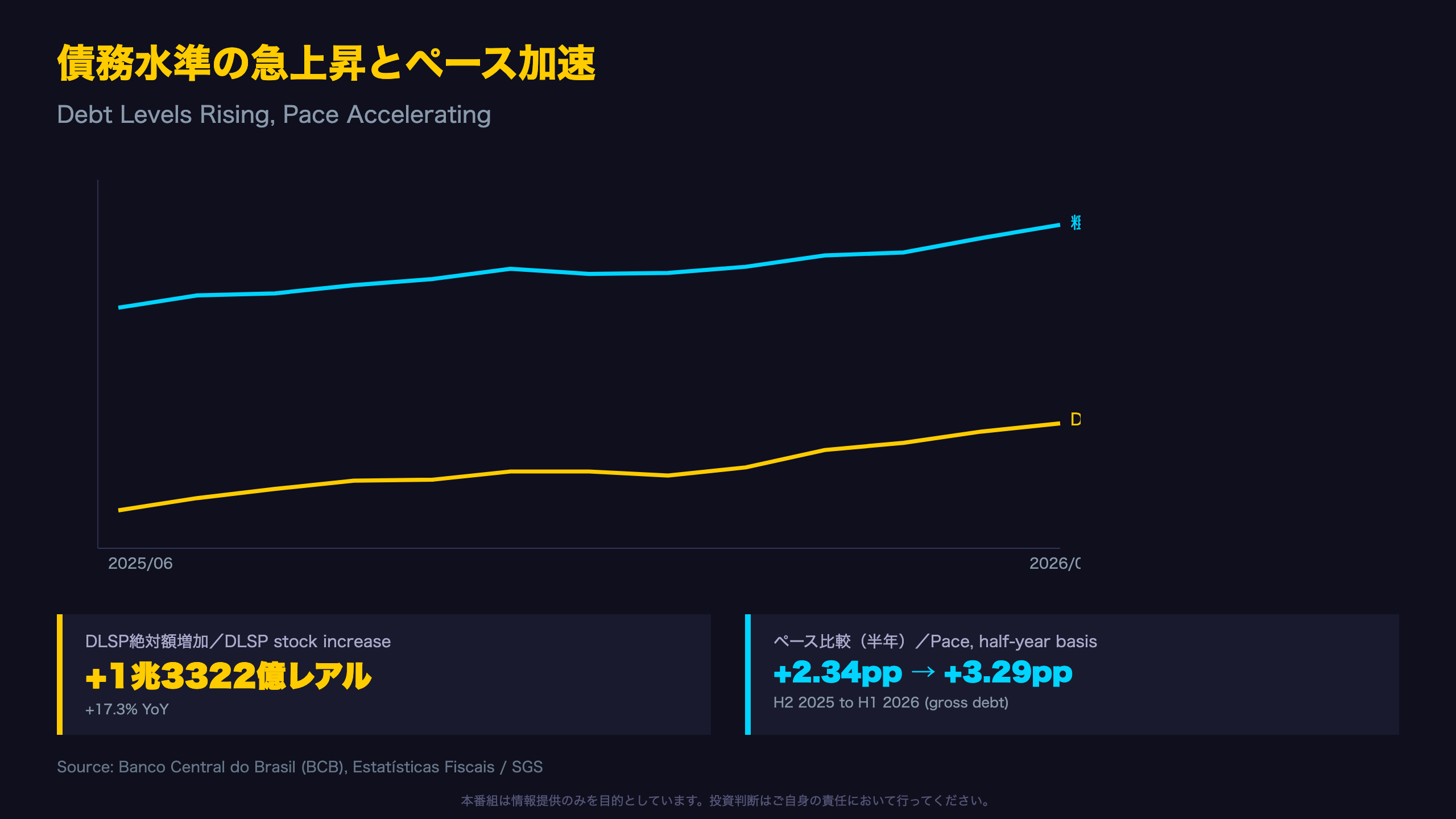
Reading the Acceleration in Debt Accumulation
Net vs. Gross Debt Spread
DLSP (net public debt) subtracts the government’s financial assets, including FX reserves, from gross debt. The spread between gross and net debt has stayed roughly stable — 13.70pp in June 2025 versus 13.45pp in June 2026 — which suggests the debt increase is being driven by growing liabilities rather than asset depletion.
Confirming the Acceleration
| Period | DLSP change | Gross debt change |
|---|---|---|
| H2 2025 (Jun-Dec) | +2.64pp | +2.34pp |
| H1 2026 (Jan-Jun) | +3.24pp | +3.29pp |
Both metrics rose faster in H1 2026 than in H2 2025, confirming this is not a single-month anomaly but a half-year-over-half-year acceleration.
The One Exception
January 2026 saw DLSP dip -0.30pp month-on-month, likely reflecting Brazil’s seasonal tax collection pattern (many taxes are concentrated early in the calendar year). This one-off dip did not reverse the broader upward trend.
International Context
For reference, Brazil’s gross debt level (near 82% of GDP) sits above the median for major emerging markets, though still below the most heavily indebted advanced economies. What matters more for markets is the trajectory and pace, both of which are currently unfavorable.
プライマリー収支の黒字転落
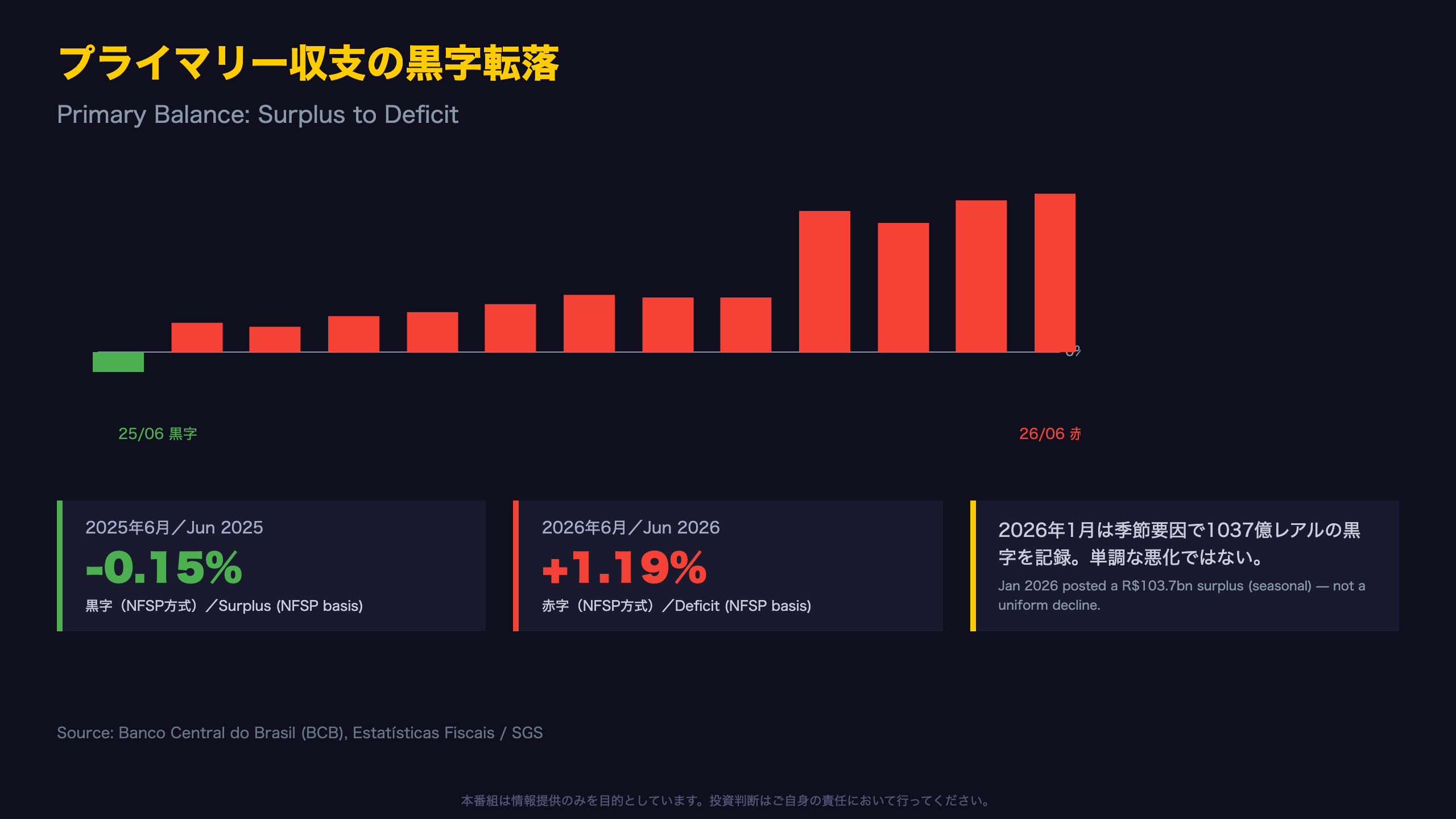
Decoding BCB’s NFSP Sign Convention
Brazil’s fiscal statistics use the NFSP (Necessidade de Financiamento do Setor Público / Public Sector Borrowing Requirement) convention, which is the inverse of the IMF’s Government Finance Statistics (GFS) standard. Under NFSP, positive values mean a financing need (deficit), while negative values mean a financing surplus.
Series name: “Resultado primário – % PIB – acumulado em 12 meses” (SGS code 5793)
This is a crucial distinction for English-speaking readers: unlike the U.S. Treasury or Eurostat conventions where a positive number typically signals a surplus, BCB’s fiscal series work the opposite way.
The Turning Point
The primary balance went from a -0.15% (surplus) in June 2025 to +0.22% (deficit) in July 2025, and has not returned to surplus since. The March 2026 jump — from +0.41% to +1.06% in a single month — is the largest single-month move in the 12-month accumulated series, hinting at either a spending surge or a revenue shortfall concentrated in that month.
An Alternative Read: Monthly Volatility
Looking at monthly flows in reais, surpluses did occur — January 2026 (-R$103.7bn, i.e., a surplus) and April 2026 (-R$24.6bn, also a surplus). This likely reflects Brazil’s seasonal tax collection calendar. So while the 12-month accumulated trend clearly shows deficit entrenchment, the month-by-month picture is not a uniform, linear decline — it’s a pattern of a deficit slowly overtaking an uneven mix of surplus and deficit months.
Why This Matters for Markets
A primary deficit — as opposed to a primary surplus — removes one of the key anchors that credit rating agencies and bond investors look at when assessing whether debt-to-GDP can stabilize over time.
名目収支と利払い負担の拡大
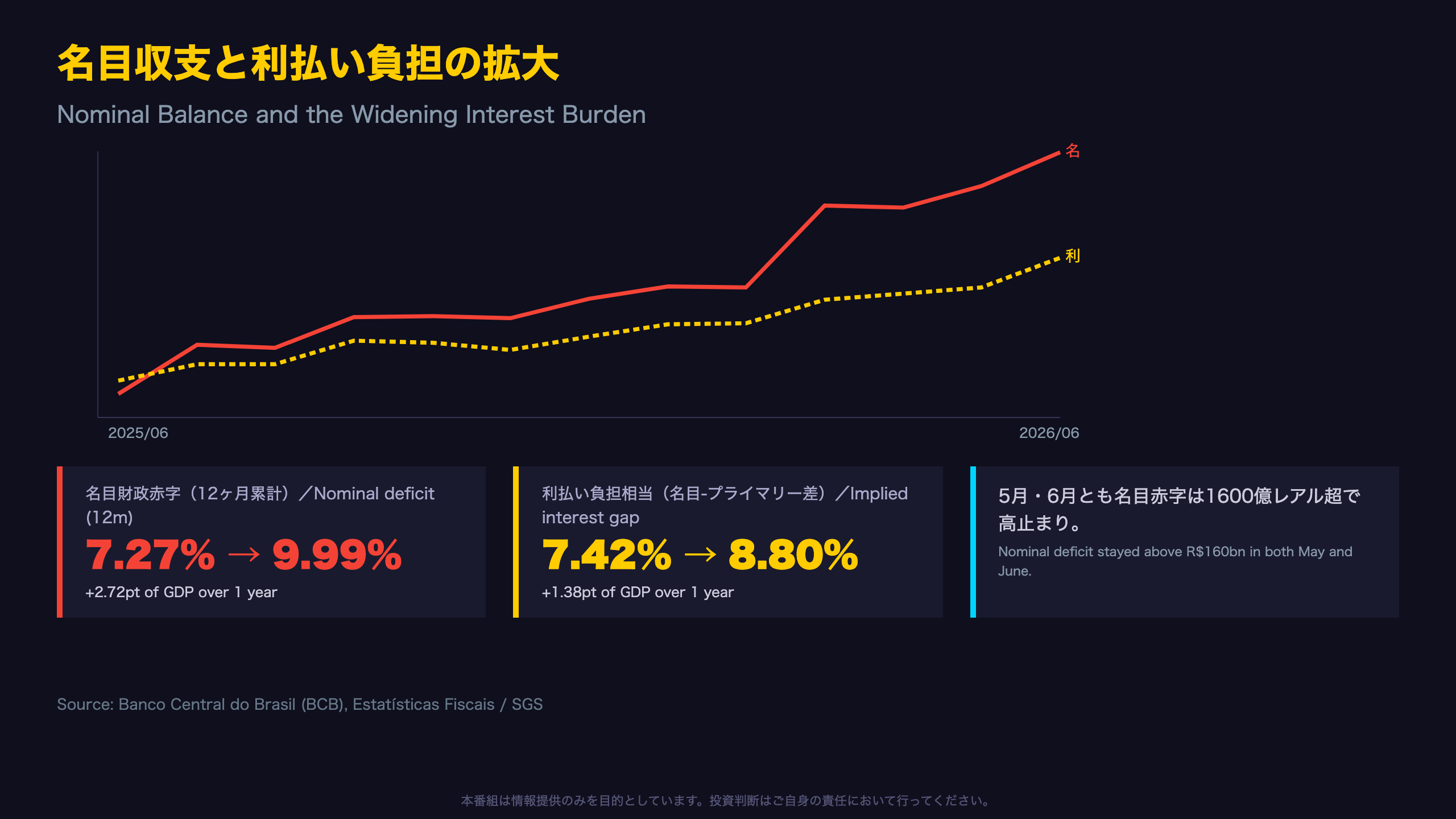
The Hidden Cost: Interest Burden
Primary vs. Nominal: What the Gap Reveals
The nominal fiscal balance equals the primary balance plus interest payments. The gap between the two therefore approximates the interest burden on government debt.
| Period | Nominal Balance | Primary Balance | Gap (≈ Interest Burden) |
|---|---|---|---|
| Jun 2025 | 7.27% deficit | 0.15% surplus | 7.42% |
| Dec 2025 | 8.34% deficit | 0.43% deficit | 7.91% |
| Jun 2026 | 9.99% deficit | 1.19% deficit | 8.80% |
Over twelve months, this implied interest burden widened by 1.38 percentage points of GDP. Since the primary balance itself deteriorated by 1.34 points over the same period, the total nominal deficit expansion (+2.72pp) appears to be roughly evenly split between rising interest costs and primary balance deterioration.
Why This Matters for International Readers
Unlike the U.S. federal deficit (which the CBO tracks similarly as primary vs. total including net interest), Brazil’s debt stock carries a notably higher average interest cost due to its historically elevated benchmark rate (Selic). A widening interest-primary gap, even without deficit spending growth, can mechanically push debt-to-GDP higher — a dynamic sometimes called “debt snowballing.”
Monthly Level Check
Monthly nominal deficits stayed above R$160 billion in both May and June 2026, down from March’s R$199.5 billion peak but still well above the roughly R$80-120 billion monthly average seen through most of 2025.
A Caveat
This dataset does not include the actual Selic rate figure, so a direct causal claim linking Selic levels to the widening interest gap cannot be made from this data alone — only the fact that the gap itself is widening is directly verifiable.
連邦 vs 地方の内訳と総括
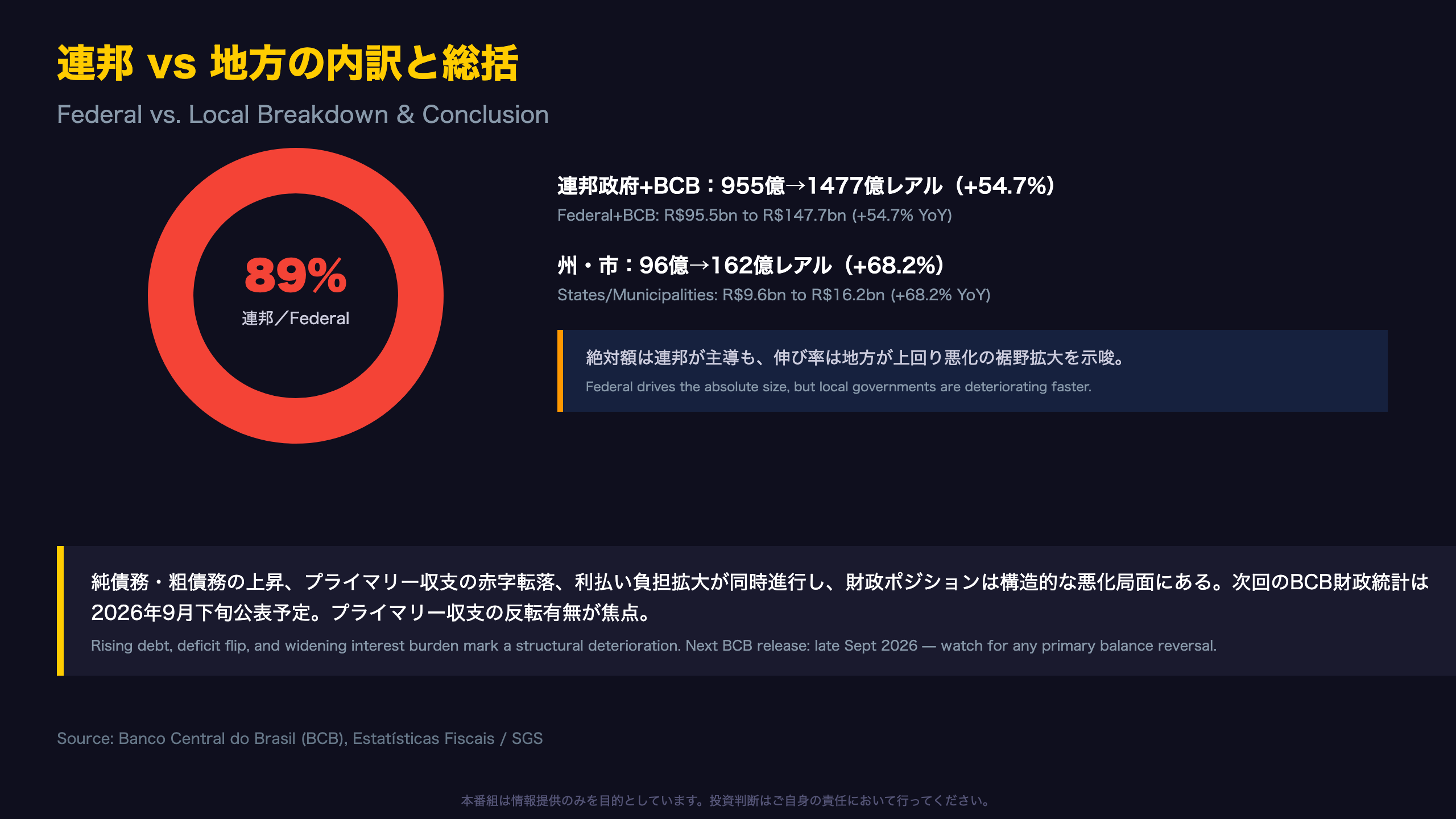
Who Is Driving the Fiscal Deterioration?
Sectoral Breakdown
Of the June 2026 nominal deficit of R$165.97 billion, the federal government plus the central bank (BCB) accounted for R$147.7 billion (88.9% of the total), while states and municipalities contributed R$16.2 billion (9.8%). This split is nearly identical to a year earlier (federal 95.5%, state/local 10.1%), meaning the federal government has consistently driven the bulk of Brazil’s deficit.
A Subtler Risk: Growth Rates
While the federal government dominates in absolute size, sub-national governments are deteriorating at a faster rate:
| Sector | Jun 2025 | Jun 2026 | Growth |
|---|---|---|---|
| Federal + BCB | R$95.5bn | R$147.7bn | +54.7% |
| States/Municipalities | R$9.6bn | R$16.2bn | +68.2% |
For context, this local/regional dynamic matters because Brazil’s states have historically been subject to fiscal responsibility rules (the Lei de Responsabilidade Fiscal, roughly analogous to U.S. state balanced-budget requirements). A faster deterioration at the sub-national level — even from a small base — could signal the strain broadening beyond federal-level policy debates in Brasília.
Balanced Takeaway
This release combines multiple deteriorating signals — rising net and gross debt, a primary balance that flipped from surplus to deficit, and a widening interest burden — that together warrant attention from anyone tracking Brazilian sovereign risk, the BRL, or local rates markets (e.g., NTN-B bonds). At the same time, January 2026’s seasonal surplus and the still-modest absolute size of sub-national deficits suggest this is not (yet) a runaway dynamic.
The next BCB fiscal statistics release is expected in late September 2026. The key threshold to watch: whether the primary balance reverses back toward surplus, or extends its current deficit trend.
Disclaimer: This article is for informational purposes only. All investment decisions are made solely at your own risk.