📺 Watch the Full Video Analysis
This article was automatically generated by the NFC Market Live AI analysis system. (Updated: 2026-08-17 20:42 JST)
📄 Primary Source
Banco Central do Brasil
https://www.bcb.gov.br/content/focus/focusmarketreadout/R20260814.pdf
Deep dive into the Banco Central do Brasil’s Focus Market Readout dated August 14, 2026.
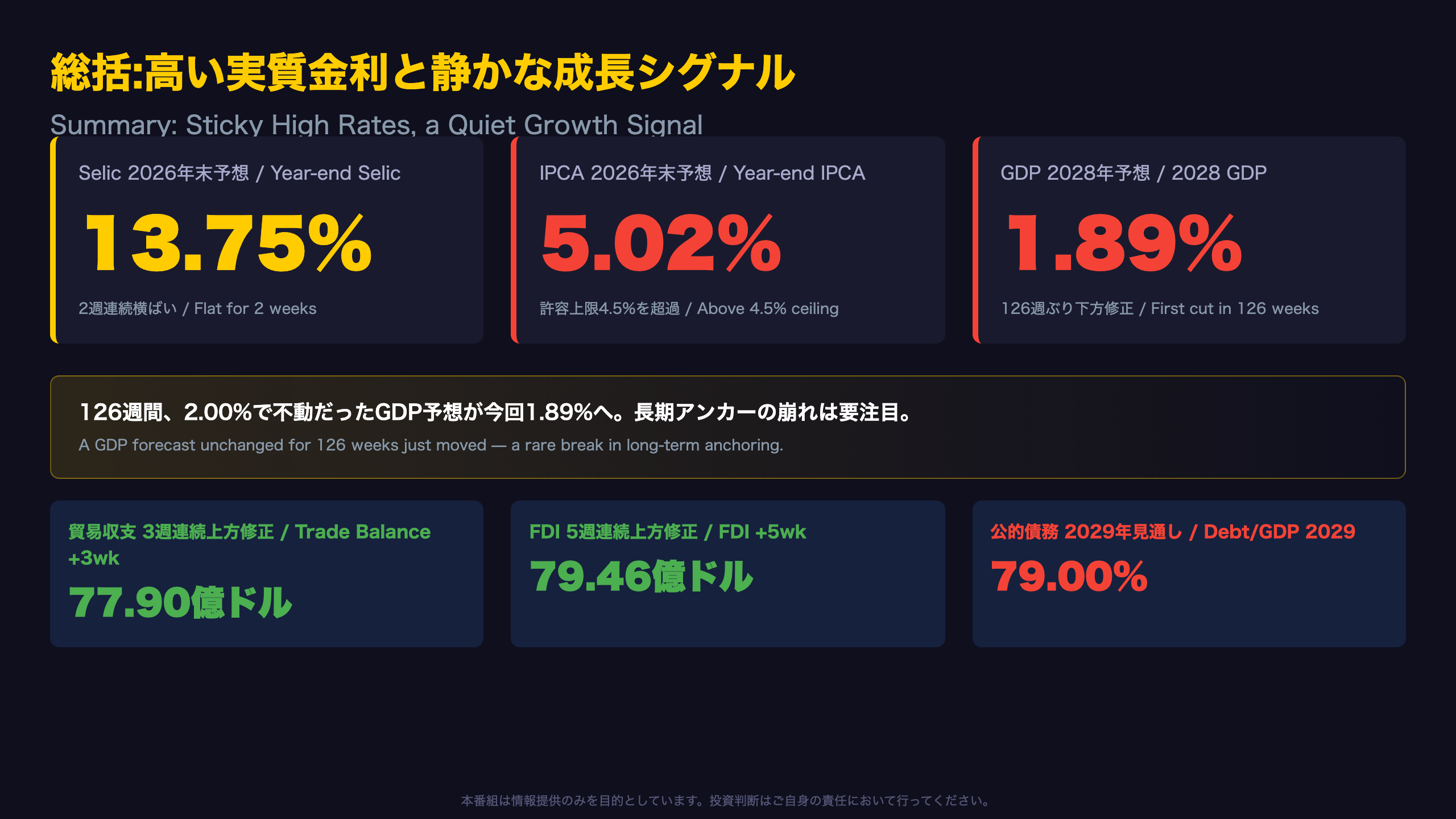
📊 Year-end 2026 Selic forecast holds flat at 13.75% for a second week
📈 2026 IPCA forecast stays at 5.02%, above the BCB’s 4.5% tolerance ceiling
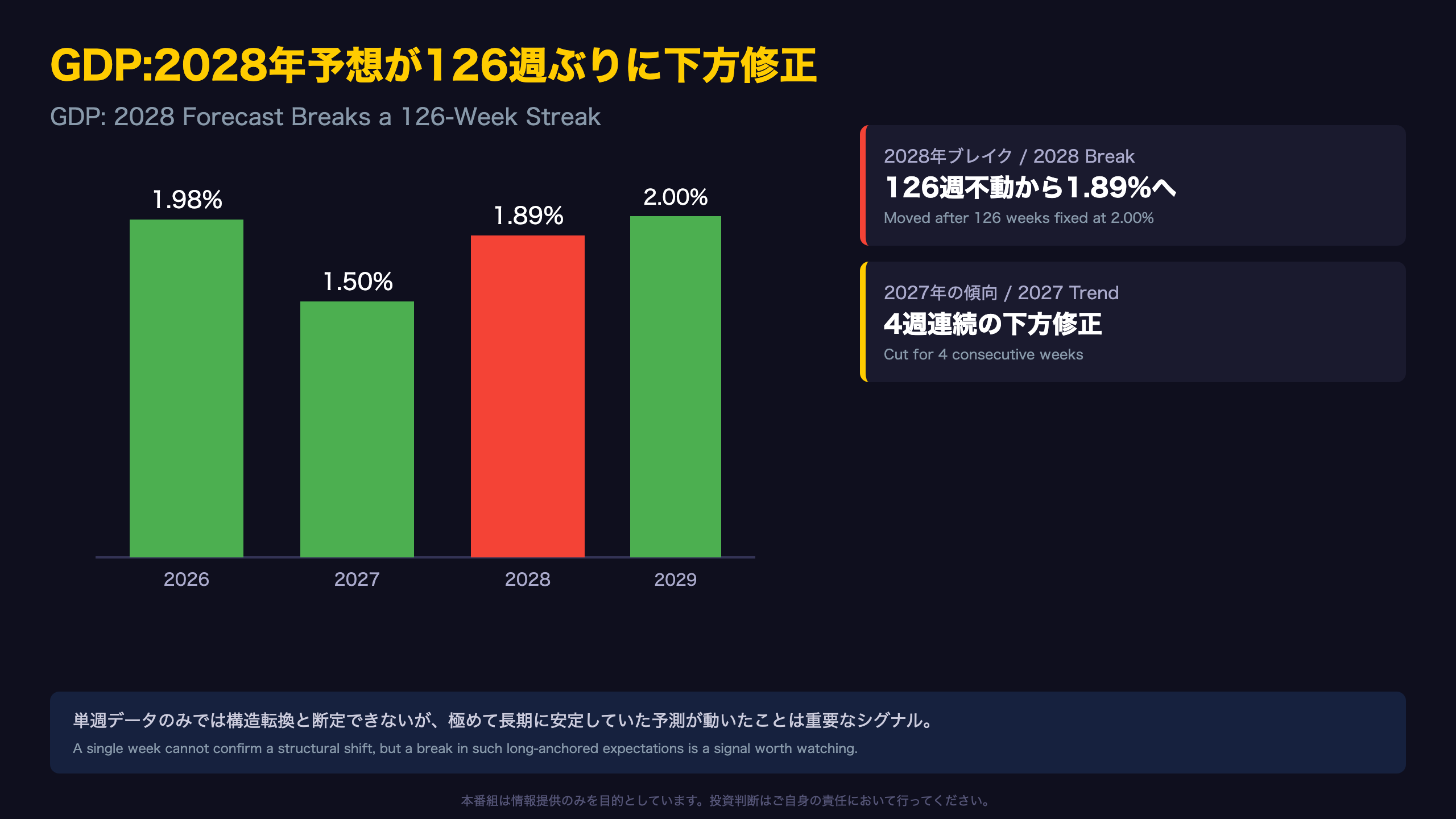
⚠️ 2028 GDP forecast breaks a remarkable 126-week stability streak, dropping to 1.89% from 2.00%
💰 Trade balance and FDI forecasts keep rising, showing external resilience
🇯🇵 We break down the ~12.9pp Selic-BOJ rate gap and what it means for BRL/JPY carry trades.
総括:高い実質金利の長期化と、成長見通しの静かな変化
What Is the Focus Market Readout?
Published every Monday by the Banco Central do Brasil (BCB), the Focus Market Readout aggregates median forecasts from more than 130 financial institutions and economists. Unlike a typical private-sector survey, this data feeds directly into COPOM’s (Brazil’s monetary policy committee) own decision-making process, making it one of the most closely watched market-expectation gauges in emerging markets — functionally comparable to the Fed’s Survey of Primary Dealers, but published weekly.
A 126-Week Anchor Finally Breaks
The most striking data point this week is the 2028 GDP growth forecast. According to the report’s own trend-tracking notation, this forecast had been locked at exactly 2.00% for 126 consecutive weeks — over two years — before moving to 1.89% this week. For context, Fed dot-plot medians rarely stay unchanged for more than a few consecutive meetings, so a 126-week unchanged streak in emerging-market forecasting is genuinely unusual, and its break deserves attention even though a single week’s move cannot confirm a new trend.
Inflation Still Above the Ceiling
Japan-based readers accustomed to near-zero inflation should note Brazil’s IPCA (its official consumer price index) is forecast at 5.02% for year-end 2026 — above the BCB’s 4.5% upper tolerance band around its 3.0% target. This contrasts sharply with the Fed’s or BOJ’s 2% targets, underscoring how far Brazil’s disinflation process still has to travel.
Resilient External Accounts
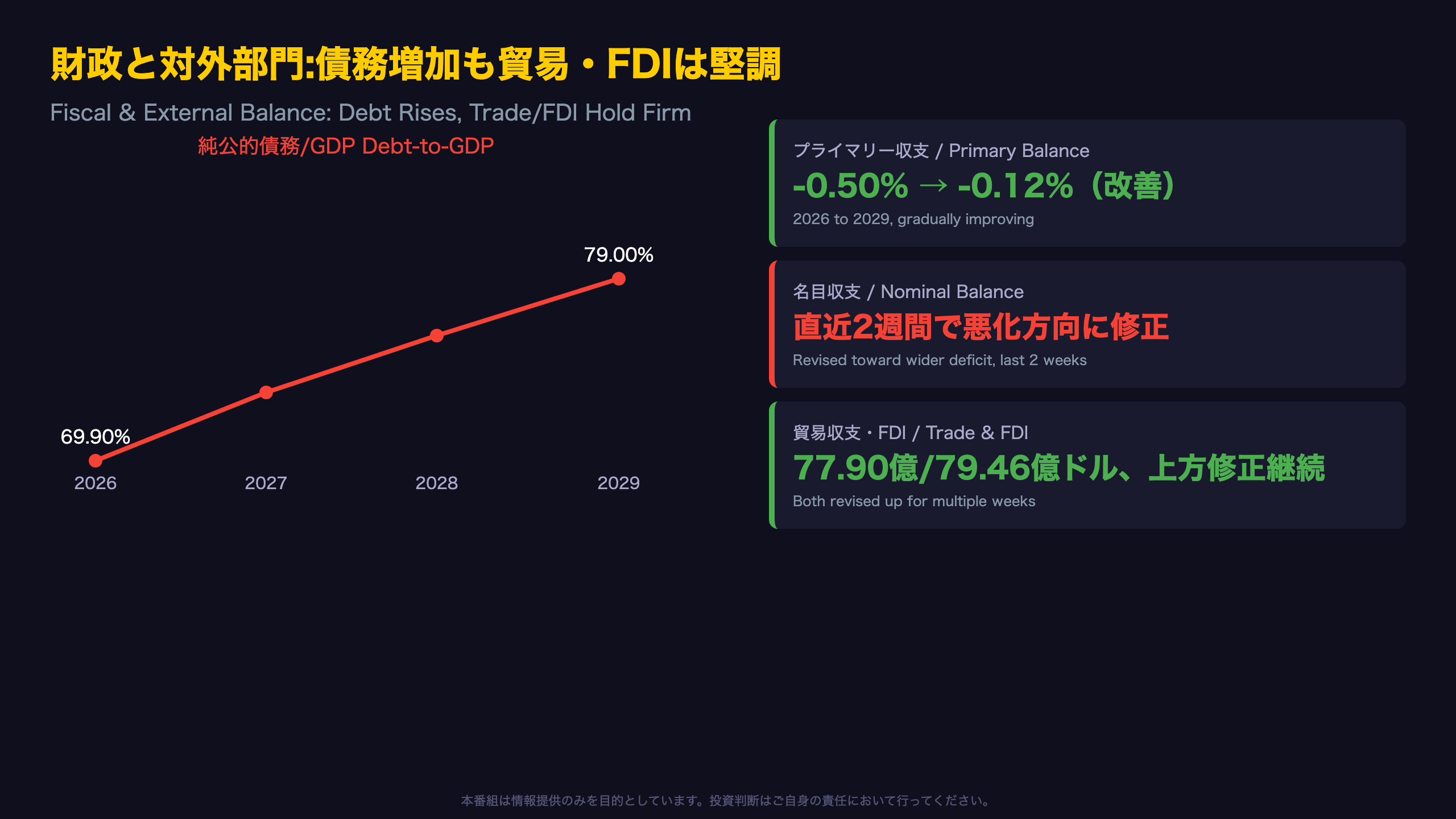
Trade balance forecasts have been revised up for three straight weeks (to $77.9bn for 2026) and FDI forecasts have risen for five straight weeks (to $79.46bn), suggesting external buffers remain intact even as growth expectations soften at the margin.
Market Implications
For USD/BRL and BRL/JPY watchers, this mixed picture argues against a simple directional read — external strength partially offsets the growth downgrade signal, while sticky above-target inflation limits how quickly the BCB can ease.
セリック金利パス:安定継続も実質金利は依然高水準
What Is the Selic Rate?
The Selic is Brazil’s benchmark policy interest rate, set by COPOM (the monetary policy committee) roughly eight times a year — functionally analogous to the Fed Funds rate or the BOJ’s policy rate, though at a vastly different level given Japan’s near-zero rate of 0.84%.
What the ‘Weeks Unchanged’ Counter Tells Us
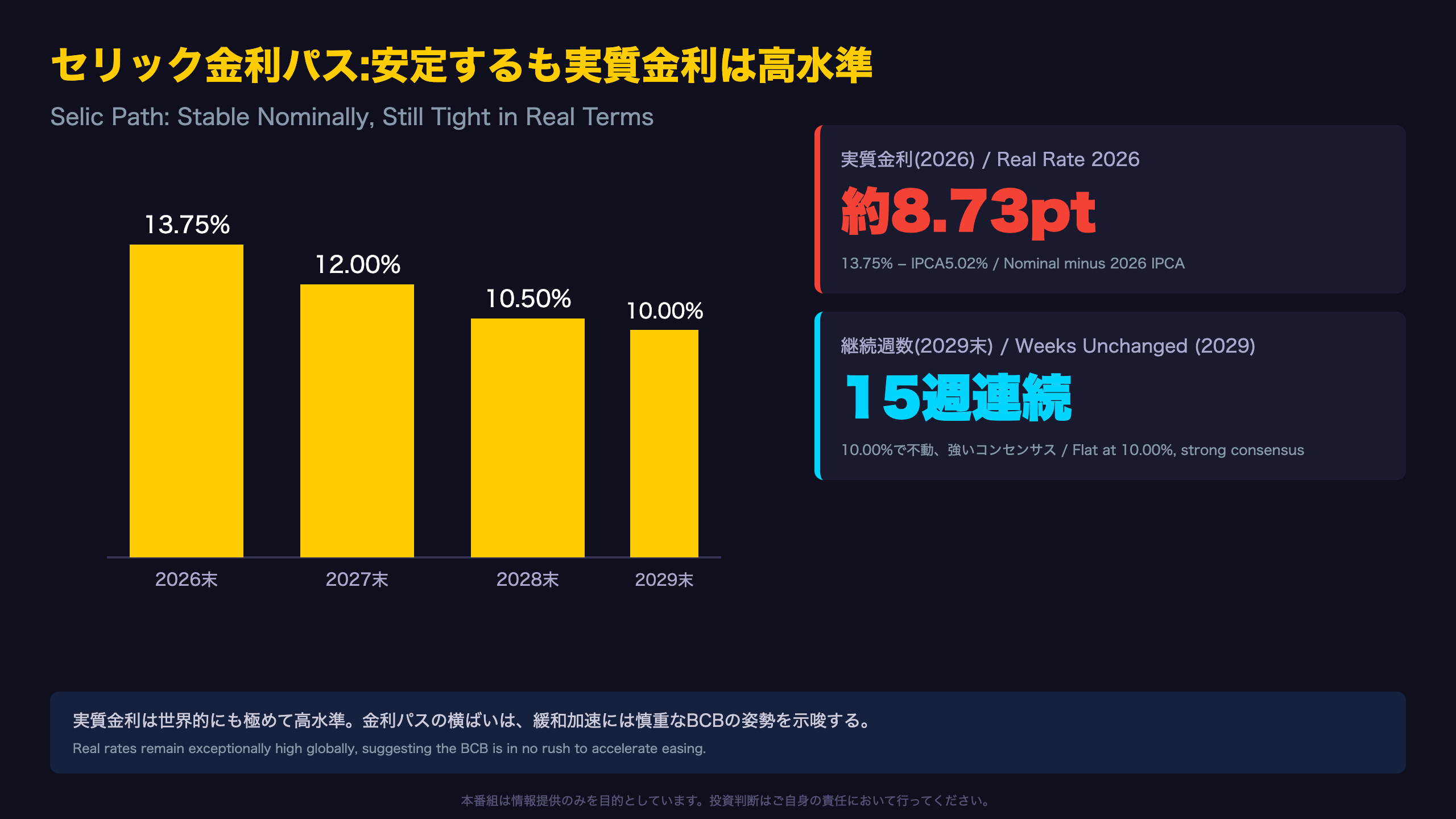
The report’s parenthetical figures track how many consecutive weeks a forecast has held steady. The 2029 year-end Selic forecast has been unchanged at 10.00% for 15 straight weeks — indicating a near-complete market consensus on where rates will ultimately settle.
The Real Rate Lens
Looking beyond the nominal rate, the real (inflation-adjusted) rate tells a sharper story: 13.75% minus the 5.02% 2026 IPCA forecast implies a real rate above 8.7 percentage points for 2026, and roughly 7.76 points for 2027. Compare this to the US real policy rate, typically in the 1-2% range, and Brazil’s restrictive stance looks exceptionally tight by global standards.
Two Readings
Bulls argue this level of real rate provides ample room to anchor inflation and defend the currency. Bears note that a prolonged period of such high real rates could be weighing on investment and consumption — a plausible, though unconfirmed, contributing factor to the 2028 GDP downgrade to 1.89%.
Looking Ahead
The next COPOM meeting’s pricing will be reflected in coming Focus reports. Watch whether the multi-week stability streaks reset — that would be the first sign of a shifting policy outlook.
IPCA:2026年末予想5.02%、許容上限4.5%を超過
The BCB’s Inflation Targeting Framework
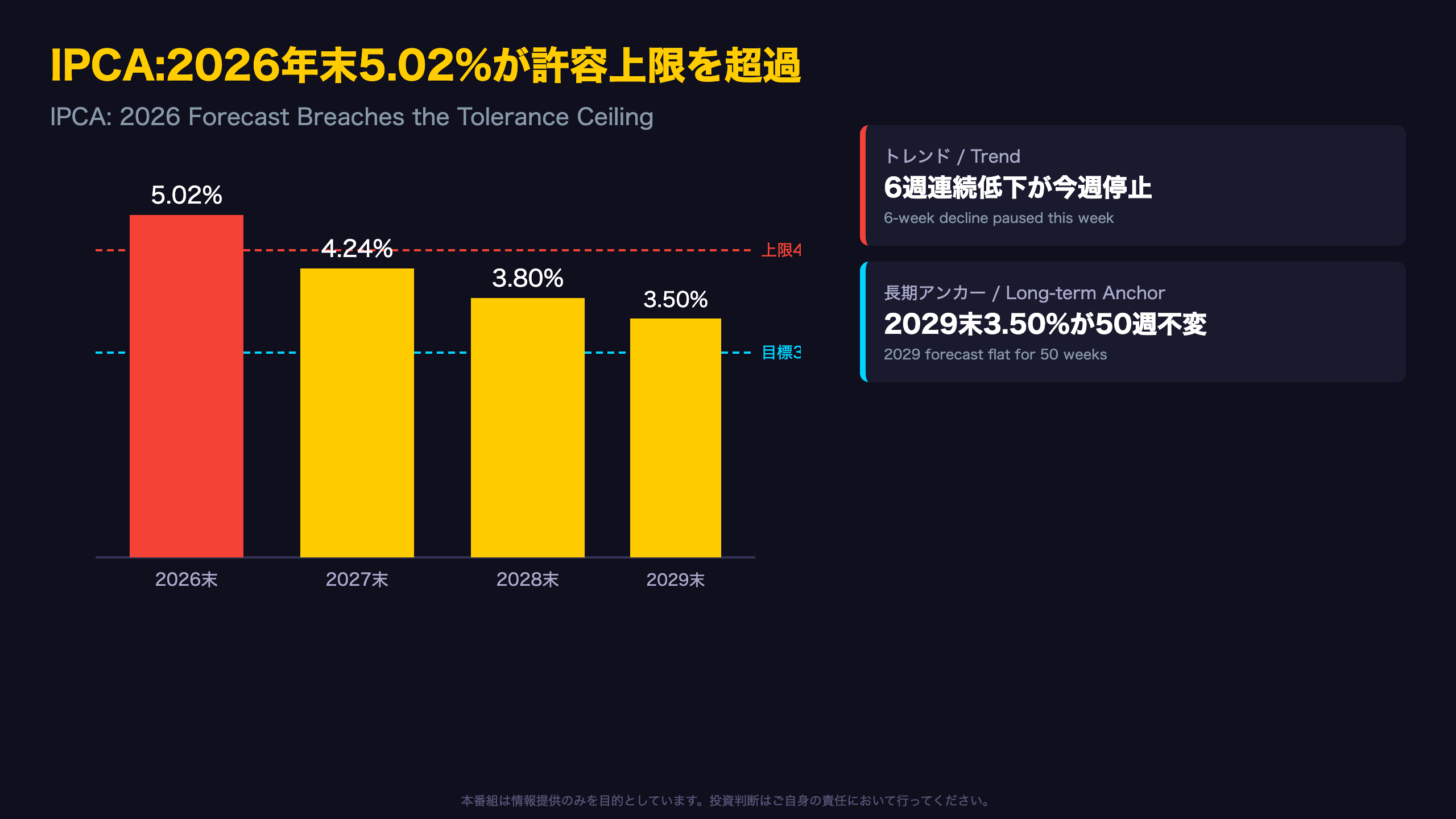
The BCB targets 3.0% CPI inflation (IPCA) with a tolerance band of 1.5% to 4.5%. This week’s 2026 year-end forecast of 5.02% sits above that ceiling — a level that puts formal target compliance out of reach for this year.
Trend Check: A Six-Week Decline Pauses
Last week’s report (Aug 7) showed a sixth consecutive weekly decline (5.16% → 5.03% → 5.02%). This week’s data shows the forecast holding flat at 5.02% instead of falling further — a pause that may suggest disinflation expectations have hit a temporary plateau.
A Sub-Index Worth Watching: Regulated Prices
One detail not covered in the anchor script: Brazil’s regulated prices index (covering items like electricity and fuel) for 2026 has been revised down for three straight weeks, from 4.91% to 4.70%. This softening in administered prices may be partially offsetting broader inflation stickiness.
Two Ways to Read It
A bearish read emphasizes that the 4.5% ceiling breach persists through year-end 2026. A more constructive read notes that the 2029 forecast has sat at exactly 3.50% for 50 straight weeks — evidence that long-run inflation expectations remain reasonably well anchored, even as near-term inflation runs hot.
What’s Next
Watch whether the disinflation trend resumes in next week’s report (due August 24) or whether the current plateau persists — that will be the key signal for how quickly the BCB can safely ease further.
GDP:2028年予想が126週ぶりに下方修正
Reading the ‘Weeks Unchanged’ Counter
The Focus report’s parenthetical figures track how many consecutive weeks a given forecast has held steady. The fact that the 2028 GDP forecast sat at exactly 2.00% for 126 weeks is directly confirmed in the source data notation “2.00 2.00 2.00 (126)”.
2027 Deceleration Is Already an Established Trend
As noted in the anchor script, the 2027 forecast has been cut for four consecutive weeks (1.65% → 1.57% → 1.52% → 1.50%), which is a more gradual, already-established downward trend rather than a single-week anomaly.
A Blind Spot: Falling Respondent Counts
The number of respondents contributing to the 2028 forecast (84) and 2029 forecast (79) is notably lower than for nearer-term years (116 for 2026, 114 for 2027). Fewer respondents for longer-dated forecasts is normal, but it also means those forecasts can be more volatile and less statistically robust.
Two Ways to Read It
Bears may argue that prolonged high real interest rates are starting to weigh on medium-term potential growth. Bulls would point out that the 2029 forecast has remained fixed at 2.00% for 74 straight weeks, showing the market’s confidence in long-run growth potential has not yet cracked.
What’s Next
Watch whether the 2028 GDP forecast is cut further in coming weeks or stabilizes at 1.89%. The source report does not specify the drivers behind this revision (investment, consumption, trade, etc.) — that detail would need to be cross-referenced against Brazil’s official GDP release and industrial production data.
財政と対外部門:債務は増加継続も貿易収支・FDIは堅調
Three Layers of Fiscal Data
It’s worth separating three related but distinct metrics: the primary balance (before interest payments), the nominal balance (after interest payments), and the net public debt ratio, which is the cumulative result of the two.
Primary Balance: A Gradual Improvement
The primary deficit is expected to narrow steadily: -0.50% in 2026 (unchanged for 26 weeks), -0.40% in 2027 (unchanged for 21 weeks), -0.22% in 2028 (improved for 2 weeks), and -0.12% in 2029 (improved for 2 weeks) — a clearly telegraphed, market-consensus path toward fiscal consolidation.
Nominal Balance Worsens — Likely an Interest-Cost Story
By contrast, the nominal balance was revised toward wider deficits in the past two weeks for both 2026 (-8.74% to -8.79%) and 2029 (-7.24% to -7.33%). Given that the primary balance is stable or improving over the same period, this divergence suggests rising interest costs tied to the high Selic rate may be a contributing factor — though the report itself does not specify a causal driver.
External Strength: Current Account Also Improving
One detail not covered in the anchor script: the 2027 current account deficit forecast has narrowed for four straight weeks, from -$61.10bn to -$59.15bn. Combined with the trade balance and FDI upgrades, Brazil’s external accounts appear to be offsetting some of the fiscal and interest-rate pressure.
What’s Next
Watch whether net public debt continues climbing past 79% of GDP, and whether the primary balance improvement accelerates. A continued fiscal deterioration could eventually feed into a higher sovereign risk premium, affecting both the BRL and interest rate expectations.
BRL/JPYキャリー取引への含意:金利差12.9ポイント
Carry Trade Basics
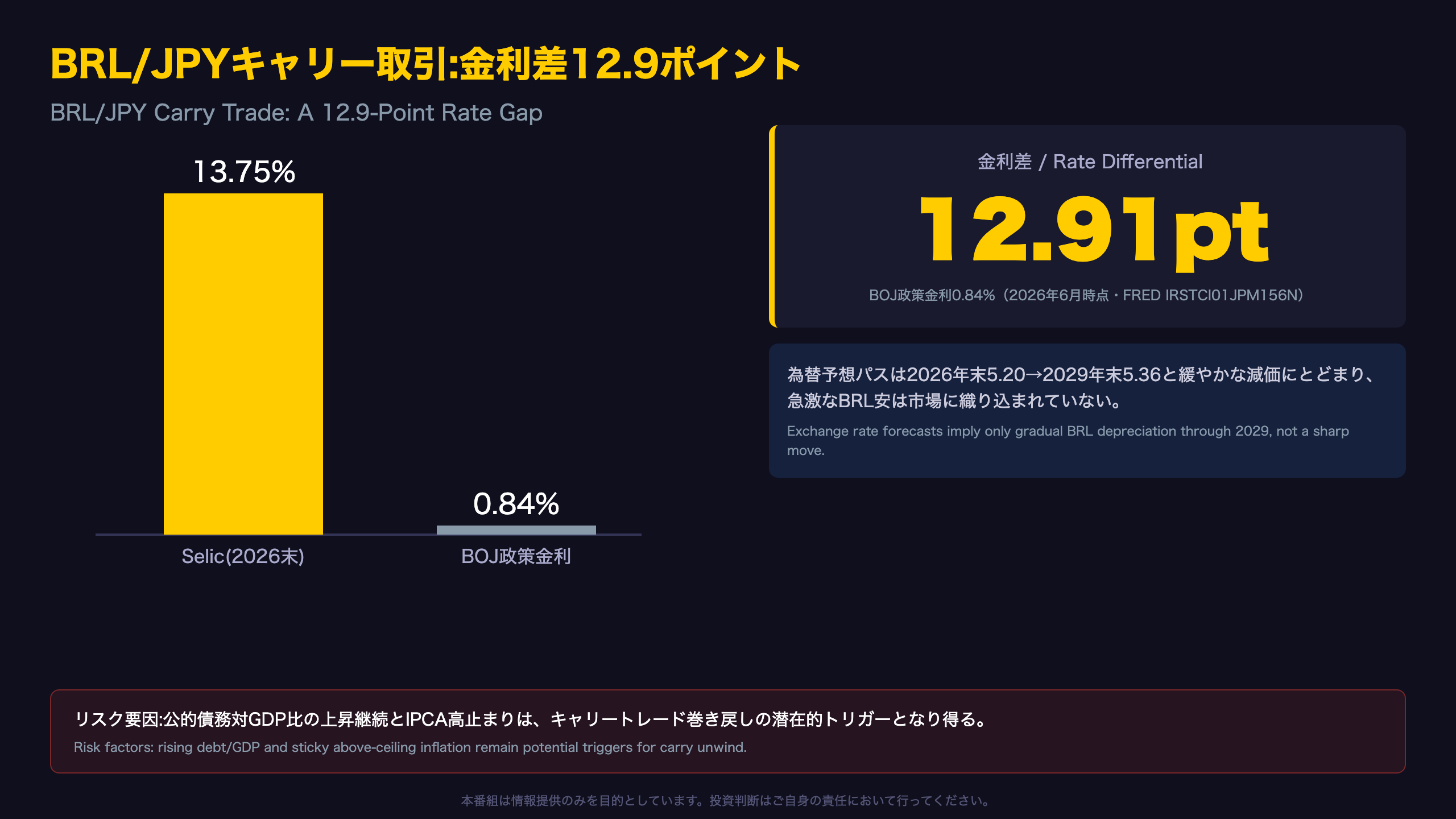
A BRL/JPY carry trade involves borrowing in low-yielding yen and investing in higher-yielding real-denominated assets to capture the interest rate spread. The larger the rate gap, the greater the theoretical return, but currency risk is ever-present.
The Rate Gap Over Time
At year-end 2026: Selic 13.75% minus BOJ 0.84% equals a 12.91-point gap. At year-end 2027: Selic 12.00% minus BOJ 0.84% (assuming no BOJ change) equals 11.16 points. While the gap is expected to narrow as the BCB eases, it remains a double-digit differential — large by any global standard.
Exchange Rate Stability as a Supporting Factor
The Focus report’s BRL/USD forecast path is fairly gentle: 5.20 (2026), 5.29 (2027), 5.30 (2028), and 5.36 (2029). The absence of a sharp depreciation scenario in market pricing is a modestly supportive signal for carry trade positioning, though it reflects consensus expectations rather than a guarantee.
Risk Factors: Debt and Inflation
That said, the continued climb in public debt toward 79% of GDP by 2029 could raise Brazil’s sovereign risk premium over time, adding to currency volatility. Persistent above-ceiling inflation (5.02% for 2026, versus a 4.5% cap) also cuts both ways: it could either delay BCB easing, or force a sharper policy reaction if inflation expectations become unanchored.
A Note for Japanese Retail Investors
For those holding Brazilian government bonds or real-denominated funds, the headline rate differential should be weighed against currency hedging costs and the potential need to reassess positions as fiscal and inflation dynamics evolve.
市場への示唆:高金利長期化とレアル資産のシナリオ
Market Implications, Chain by Chain
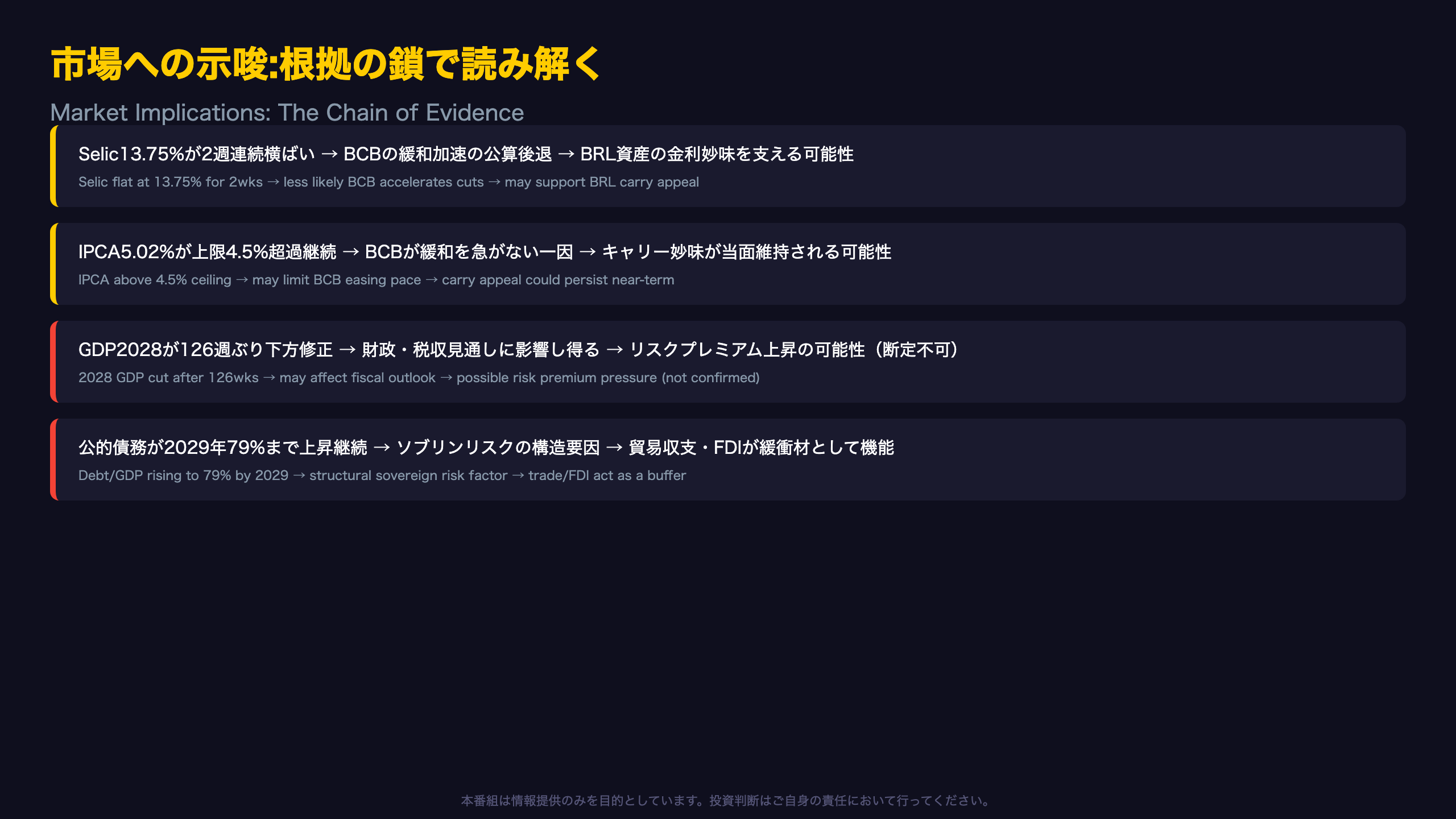
Chain 1: The year-end 2026 Selic forecast holds flat at 13.75% for two weeks → this reduces the likelihood the BCB accelerates rate cuts → a prolonged period of high rates could support the carry appeal of BRL-denominated assets for now.
Chain 2: The 2026 IPCA forecast at 5.02% remains above the 4.5% tolerance ceiling → this may be one reason the BCB is not rushing its easing pace → if the Selic stays elevated, BRL/JPY carry trade appeal could persist in the near term.
Chain 3: The 2028 GDP forecast was cut from 2.00% to 1.89% after 126 weeks of stability → softening growth expectations could affect fiscal and tax revenue outlooks → this may add upward pressure to Brazil’s risk premium, though a single week’s data cannot confirm a structural shift.
Chain 4: Public debt/GDP continues climbing toward 79% by 2029 → fiscal deterioration is a structural driver of sovereign risk premium → this could become a long-term source of BRL weakness and upward rate pressure, though resilient trade balance and FDI forecasts are currently acting as a buffer.
A General Caveat
It is commonly understood that emerging-market carry trades become more attractive as rate differentials widen, but this data alone cannot confirm the scale of future currency volatility or the certainty of the BCB’s future policy path.
Bottom Line
This week’s Focus report shows continued tight monetary conditions and persistent above-target inflation, alongside a new variable: a modest downgrade to the growth outlook. Resilient external accounts are cushioning the picture for now, but how fiscal, growth, and inflation dynamics interact over the coming weeks will be the key thing to watch.
Disclaimer: This article is for informational purposes only. All investment decisions are made solely at your own risk.