📺 Watch the Full Video Analysis
This article was automatically generated by the NFC Market Live AI analysis system. (Updated: 2026-08-25 10:38 JST)
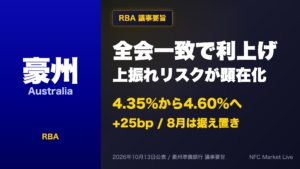
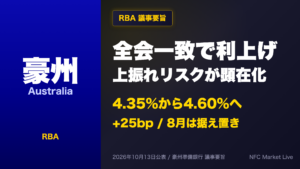
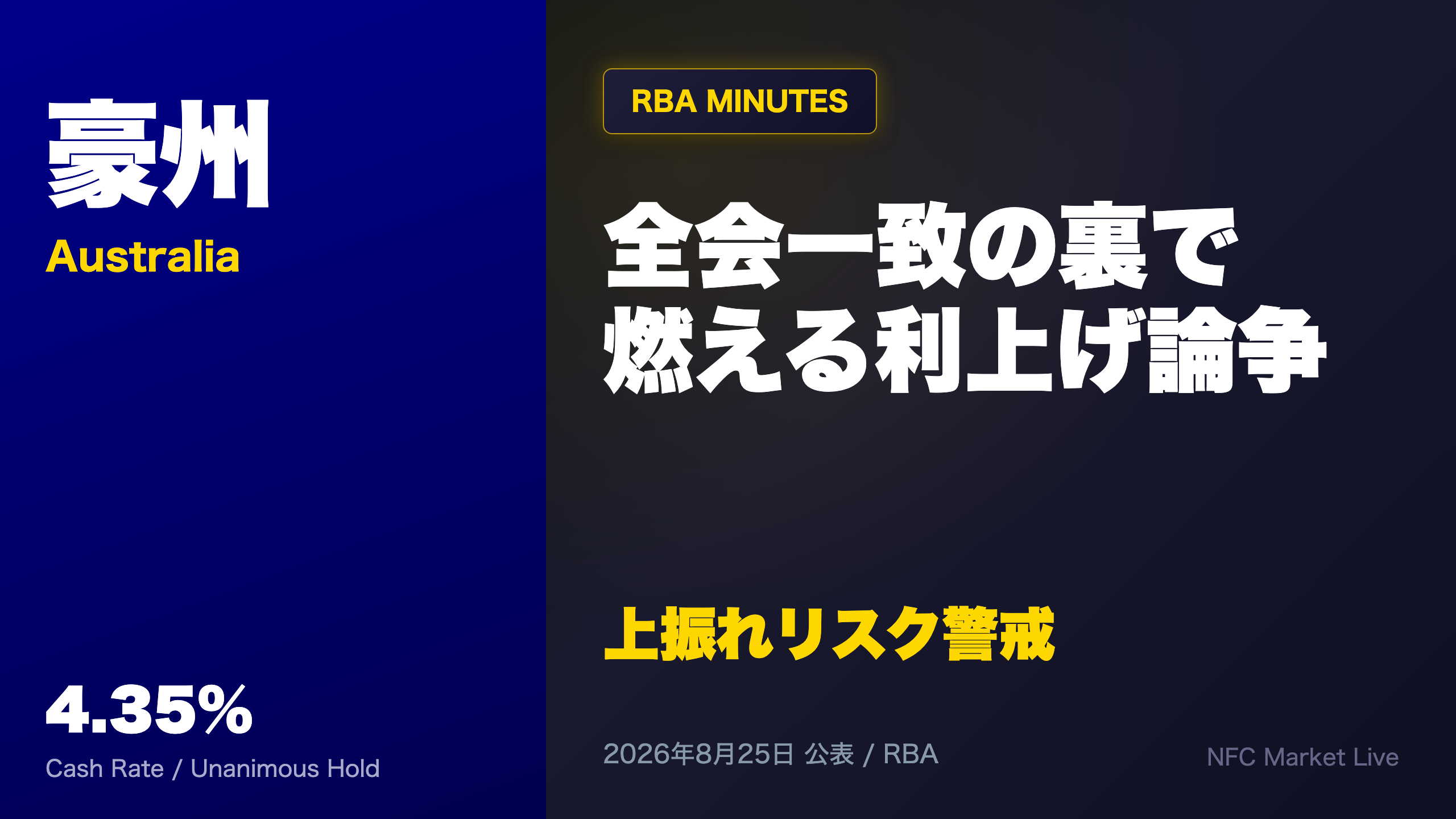
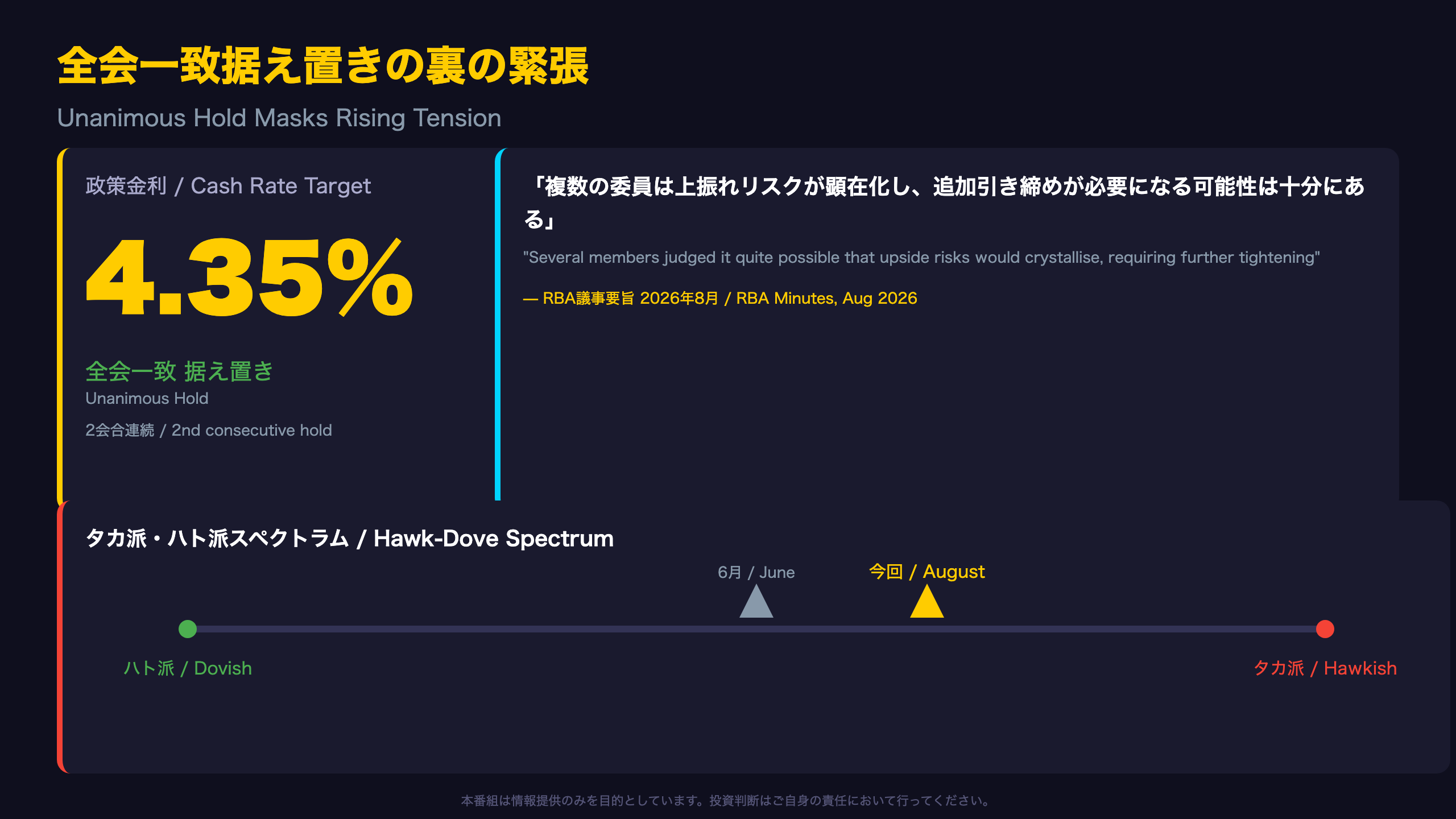
The RBA held its cash rate at 4.35% (unanimous) at its Aug 10-11, 2026 meeting. 📊
But the minutes reveal an unusually detailed case for a hike, laid out by several board members.
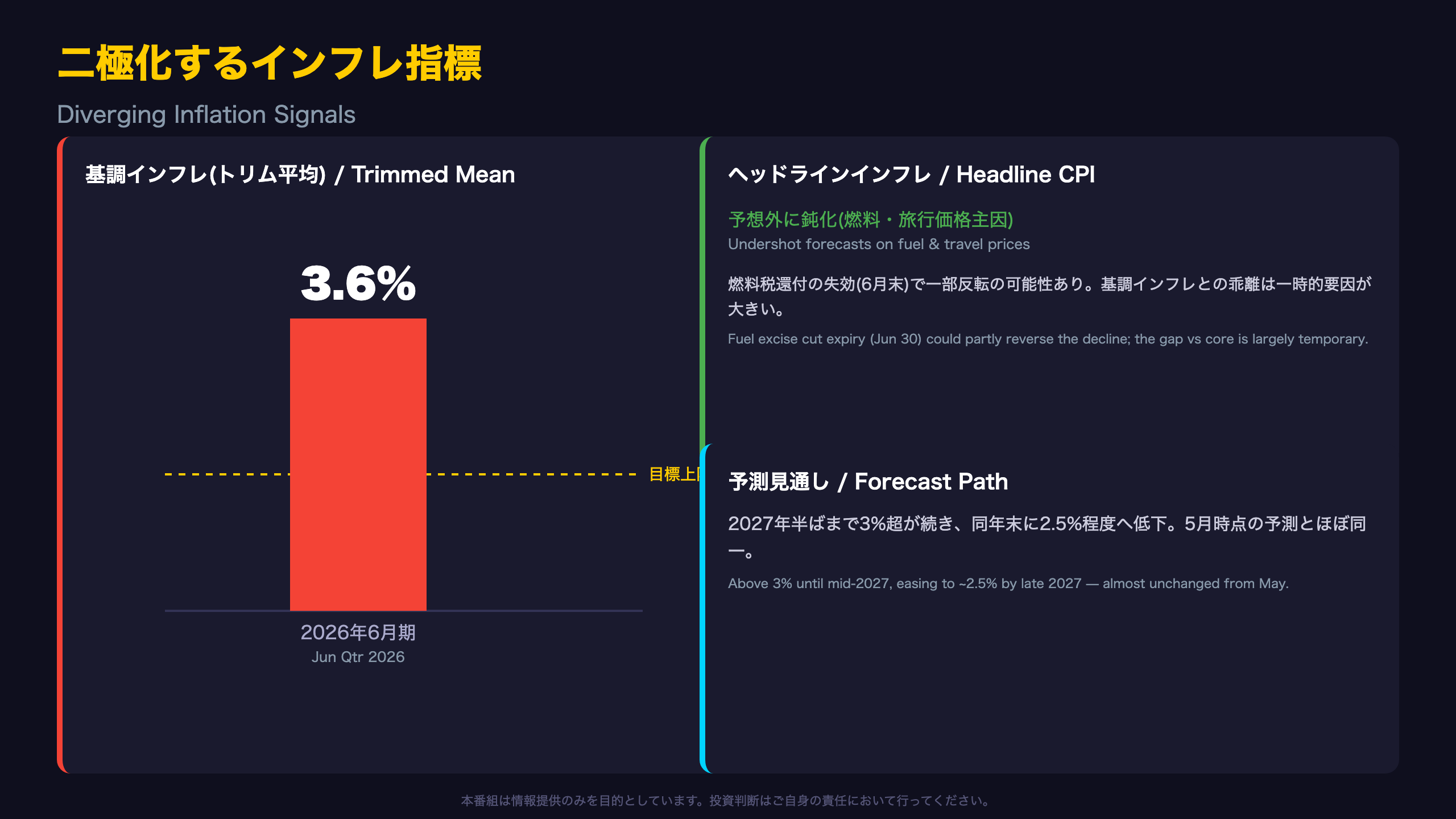
💡 Trimmed mean inflation rose to 3.6% in the June quarter, staying elevated, while headline inflation surprised to the downside on fuel and travel prices.
⚠️ The Middle East conflict reversed from June’s peace hopes back into an active risk, and the AI/data centre investment boom adds fresh upside pressure.
We break down why the minutes state several members saw further tightening as ‘quite possible.’
全会一致据え置きの裏側:上振れリスク警戒のタカ派的ホールド
Behind the Unanimous Vote: A Widening Internal Debate
The Reserve Bank of Australia (RBA) held its cash rate target unchanged at 4.35% at its August 10-11, 2026 meeting — the second consecutive hold after June. For readers unfamiliar with the RBA’s structure: unlike the US Federal Reserve’s FOMC, the RBA’s Monetary Policy Board is a relatively new body that publishes detailed minutes roughly three weeks after each decision, offering unusually granular insight into internal deliberations.
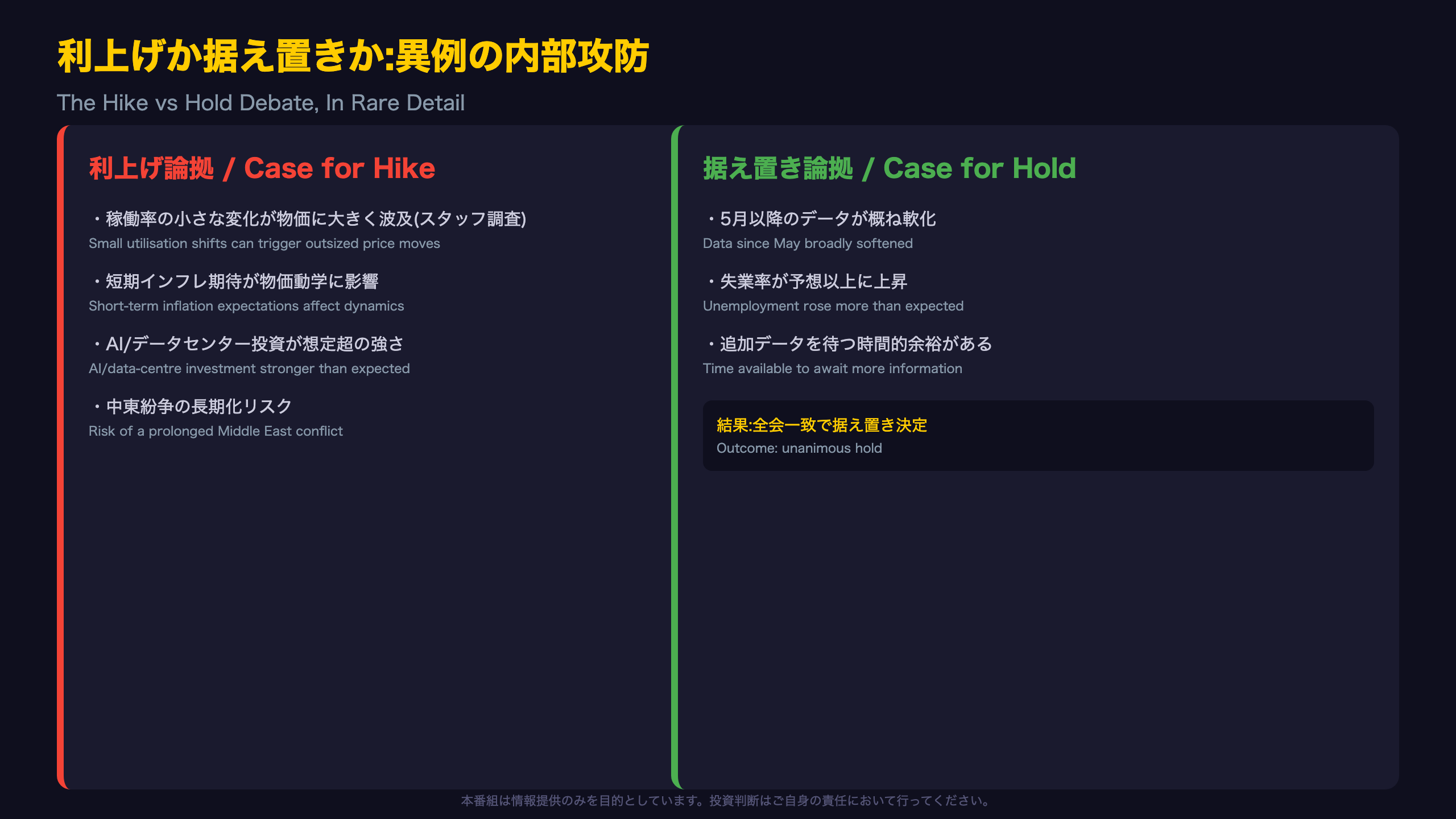
What distinguishes the August minutes is the explicit articulation of the case for a hike. The minutes cite staff research showing that “relatively significant movements in inflation can be associated with quite small changes in capacity utilisation” when the economy has limited spare capacity — an argument for pre-emptive tightening rarely spelled out in such detail previously.
Crucially, the document states: “Several members judged that it was quite possible that the upside risks to the inflation forecast would crystallise, requiring some further tightening.” This marks a hawkish shift in tone compared to June, when risk discussion was more evenly balanced.
For global investors, Australia’s 4.35% cash rate already sits at the top of the RBA’s own neutral-rate model range — meaning any further hike would push policy meaningfully into restrictive territory, with implications for AUD carry trades and AUD/USD rate differentials.
ヘッドラインは鈍化、基調は高止まり—二極化するインフレ指標
Why the Headline-Core Divergence Matters
June quarter inflation data told two different stories. Headline CPI undershot economist expectations, driven mainly by temporary factors — falling international travel prices and lower fuel costs. But the RBA’s preferred trimmed mean measure, which strips out volatile items, rose to 3.6%, only marginally below forecast.
For context, Australia’s trimmed mean is broadly analogous to the US Fed’s core PCE or the ECB’s core HICP — a smoothed gauge central banks use to see through one-off price swings. The minutes attribute the trimmed mean’s persistence to broad-based strength in market services prices and partial pass-through of Middle East conflict-related cost increases, with new dwelling prices rising notably as builders passed on higher input costs.
Compared with the May forecast round, the RBA’s trimmed mean profile is described as “very similar” — inflation is expected to stay above 3% until mid-2027 and reach only around 2.5% by late 2027, a slow grind back to the 2-3% target band.
One wrinkle for market watchers: a temporary fuel excise cut was set to expire June 30, meaning some of the recent decline in retail fuel prices — and thus part of the headline undershoot — could reverse in coming prints, a nuance easily missed if one focuses only on the headline miss.
利上げか、据え置きか—異例の詳細な内部攻防
A Rare Level of Detail in the Hike Case
Compared with prior minutes, this release is notable for spelling out the pro-hike argument with specific analytical mechanisms rather than vague references to “some members’ concerns.” Two pieces of staff research were explicitly cited:
- Under capacity constraints, small changes in utilisation can produce disproportionately large price movements.
- Short-term inflation expectations affect inflation dynamics even when long-term expectations remain well-anchored.
These findings were used to build a theoretical case for pre-emptive tightening — a concept familiar to Fed watchers as “insurance hikes,” though rarely documented this explicitly in RBA minutes. Additional upside factors cited included stronger-than-expected AI/data-centre investment, a potentially prolonged Middle East conflict, and resilient domestic demand.
The case for holding centered on buying time: May’s slightly softer inflation print and higher-than-expected unemployment rate suggested the economy was cooling as planned, so waiting for the June quarter national accounts and additional monthly data was deemed prudent.
“Several members judged that it was quite possible that the upside risks to the inflation forecast would crystallise, requiring some further tightening.”
Even with a unanimous hold, this line signals the next decision is genuinely live — investors should watch upcoming Australian CPI and labour data closely, as a hawkish surprise could move AUD rate expectations quickly.
成長鈍化と住宅市場調整—労働市場は緩やかに軟化
A Supply-Constrained Slowdown, With the Output Gap Closing Sooner
The growth outlook in these minutes resists a simple “demand is slowing” narrative. Household consumption has eased only gradually despite very weak consumer sentiment — the RBA notes that historically, the relationship between sentiment and actual spending is weak and largely contemporaneous, meaning today’s gloomy sentiment doesn’t reliably forecast tomorrow’s spending.
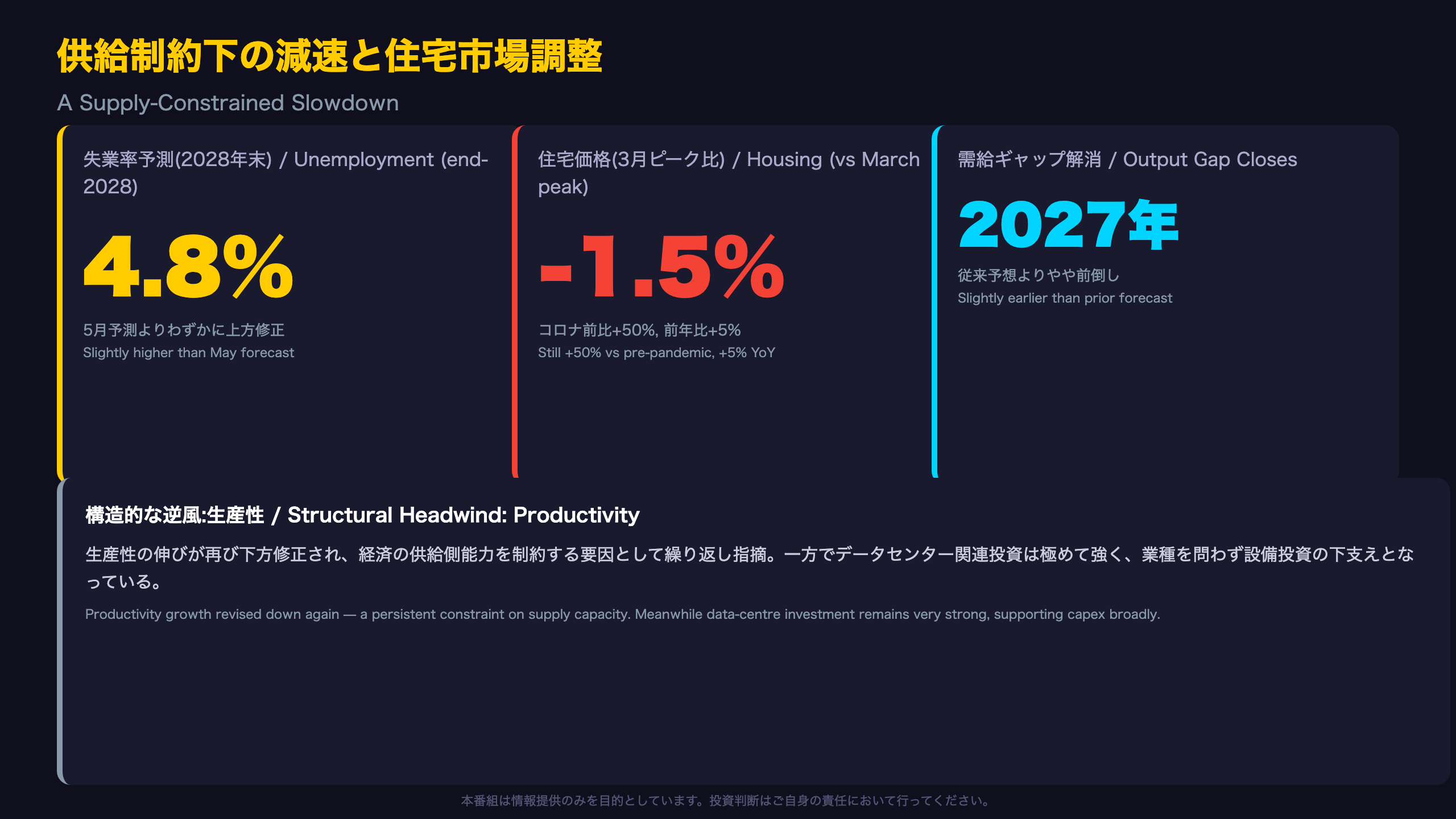
Housing prices, meanwhile, have fallen about 1.5% from their March peak. Context matters here: this follows an extended period of very strong appreciation, leaving prices roughly 50% above pre-pandemic levels and still 5% higher year-on-year. The RBA attributes the pullback to a combination of cash rate hikes, federal budget tax changes for property investors, and weaker sentiment — explicitly noting it’s hard to disentangle which factor dominates.
On the labour market, unemployment is forecast to drift up to 4.8% by end-2028 (versus a slightly lower May estimate), with labour market slack expected to emerge from late 2027 — later than the output gap itself, which is now seen closing in 2027, a touch earlier than previously projected.
A repeated downward revision to productivity growth is arguably the most structurally significant data point here: it represents a persistent constraint on Australia’s supply-side capacity, distinct from garden-variety cyclical softness, and helps explain why the RBA remains cautious about declaring victory on inflation even as headline growth cools.
中東情勢の再燃とAI投資ブーム—上振れリスクの震源地
A Two-Month Reversal on the Middle East
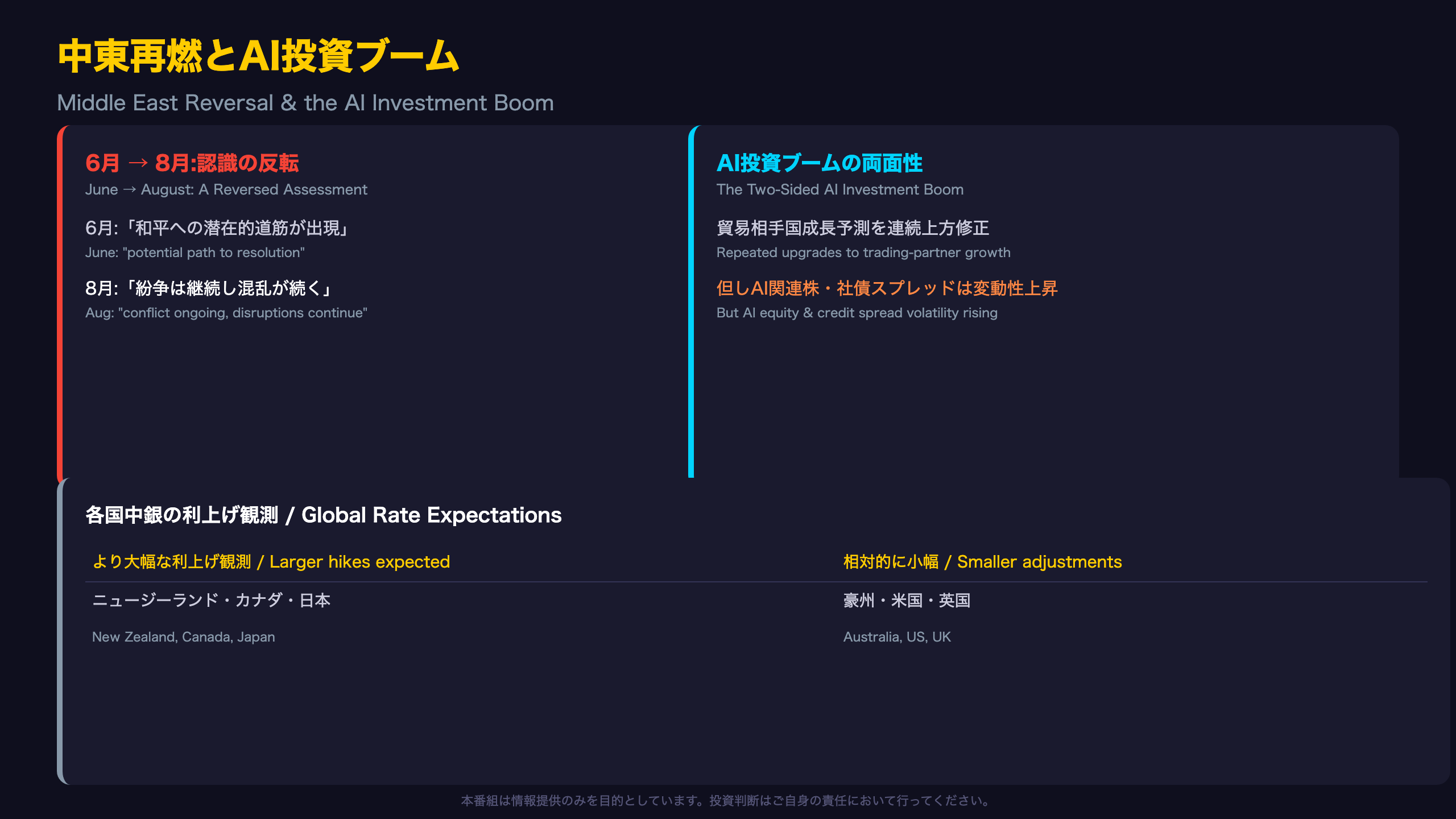
The most striking shift in these minutes is the board’s changed read on the Middle East conflict. In June, the tone was cautiously optimistic — acknowledging “the emergence of a potential path to resolution” while flagging uncertainty. By August, the assessment had reversed:
“the conflict was ongoing and continued to disrupt energy production and shipping in the region”
This matters for global macro watchers because oil inventories are now described as “much lower than at the start of the conflict” — an explicit upside risk to energy prices should disruptions persist. Even if a lasting resolution eventually emerges, the minutes note it would take considerable time to restore production and distribution to pre-conflict levels — a slow-moving supply story reminiscent of post-2022 European gas market dynamics.
The second major theme is the global AI/data-centre investment boom, which has driven repeated quarterly upgrades to trading-partner growth forecasts, especially across high-income East Asian economies. However, the minutes also flag rising volatility in AI-linked equities and widening credit spreads on bonds issued by some AI companies — a signal that this tailwind carries its own two-sided risk (a point relevant to anyone tracking Nasdaq-adjacent volatility spilling into APAC risk sentiment).
On the global rates picture, markets expect larger hikes in previously accommodative economies (New Zealand, Canada, Japan) versus smaller adjustments in Australia, the US, and the UK — positioning the RBA’s stance as comparatively moderate internationally, a useful reference point for AUD cross-currency positioning.
次回会合への布石—据え置きの猶予期間と注視すべきデータ
The Conditional Logic Behind the Hold — and What Could Break It
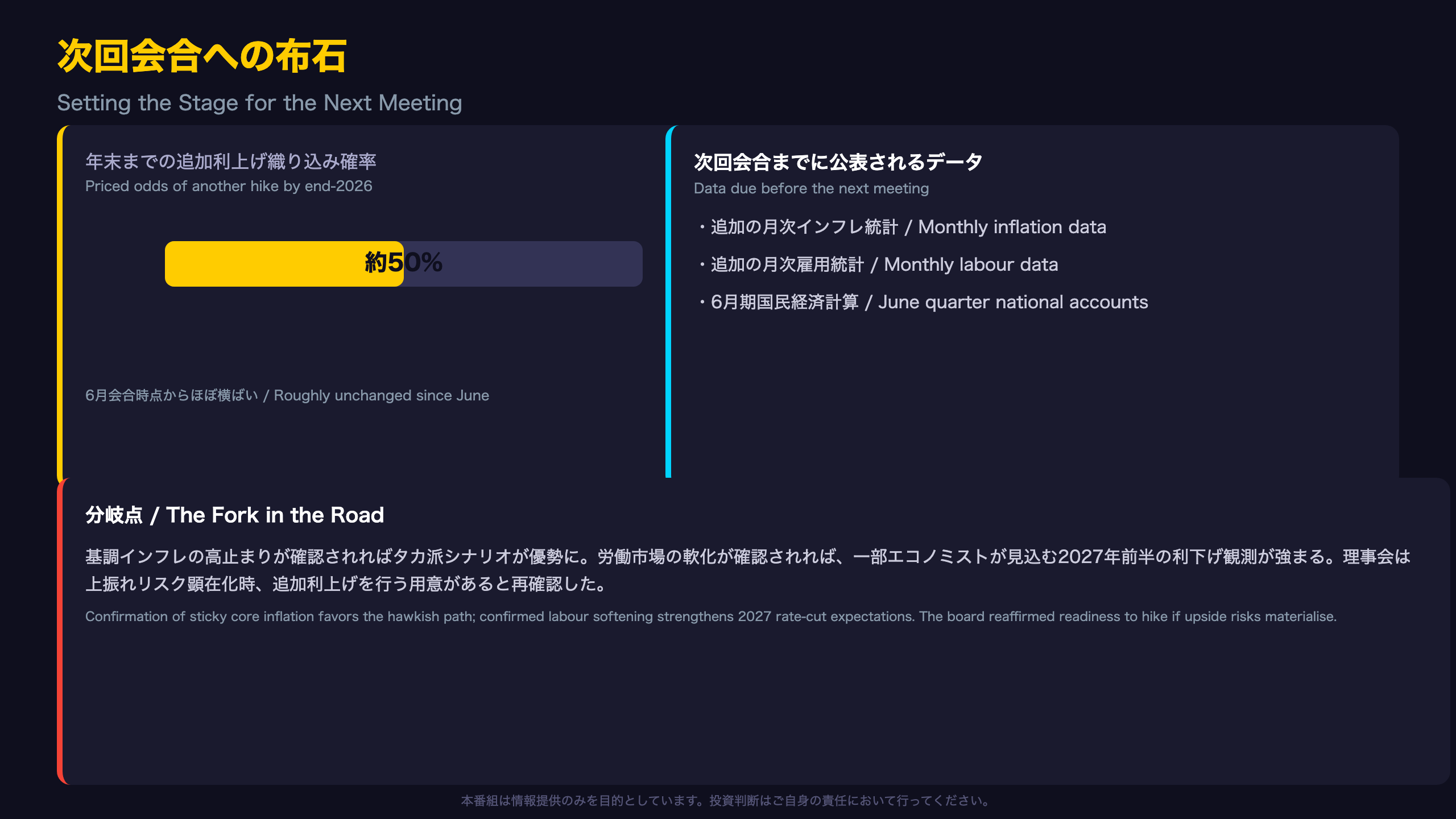
The minutes’ conclusion isn’t a simple “wait and see.” It’s structured as an explicitly conditional pause: the board is using the space created by earlier hikes to assess their full transmission through the economy, while reserving the right to act quickly if risks crystallise.
On market pricing, the roughly 50% probability of another 25bp hike by end-2026 is essentially unchanged from the June meeting — a detail worth flagging, since it suggests the hawkish shift in tone evident in these August minutes may not yet be fully reflected in current market pricing. That’s a potential source of repricing risk for AUD rates and the currency if incoming data surprises to the upside.
Some economists now expect rate cuts to begin in early 2027, aligned with the downside risks the board itself flagged: a faster-than-assessed labour market easing, a deeper housing downturn, or weaker consumption from depressed sentiment.
Three data releases will shape the next decision:
- Additional monthly inflation prints
- Additional monthly labour market data
- The June quarter national accounts (GDP, productivity, wages)
If these confirm persistently elevated trimmed mean inflation, the hawkish scenario gains weight. If labour market softening is confirmed instead, expectations for an extended hold — or even a 2027 cut — would strengthen. For AUD and Australian government bond positioning, this data window over the coming weeks is the key catalyst to watch.
Disclaimer: This article is for informational purposes only. All investment decisions are made solely at your own risk.