📺 Watch the Full Video Analysis
This article was automatically generated by the NFC Market Live AI analysis system. (Updated: 2026-08-26 10:39 JST)
📄 Primary Source
Australian Bureau of Statistics
https://www.abs.gov.au/statistics/economy/price-indexes-and-inflation/consumer-price-index-australia/jul-2026
📊 Australia’s July CPI just dropped.
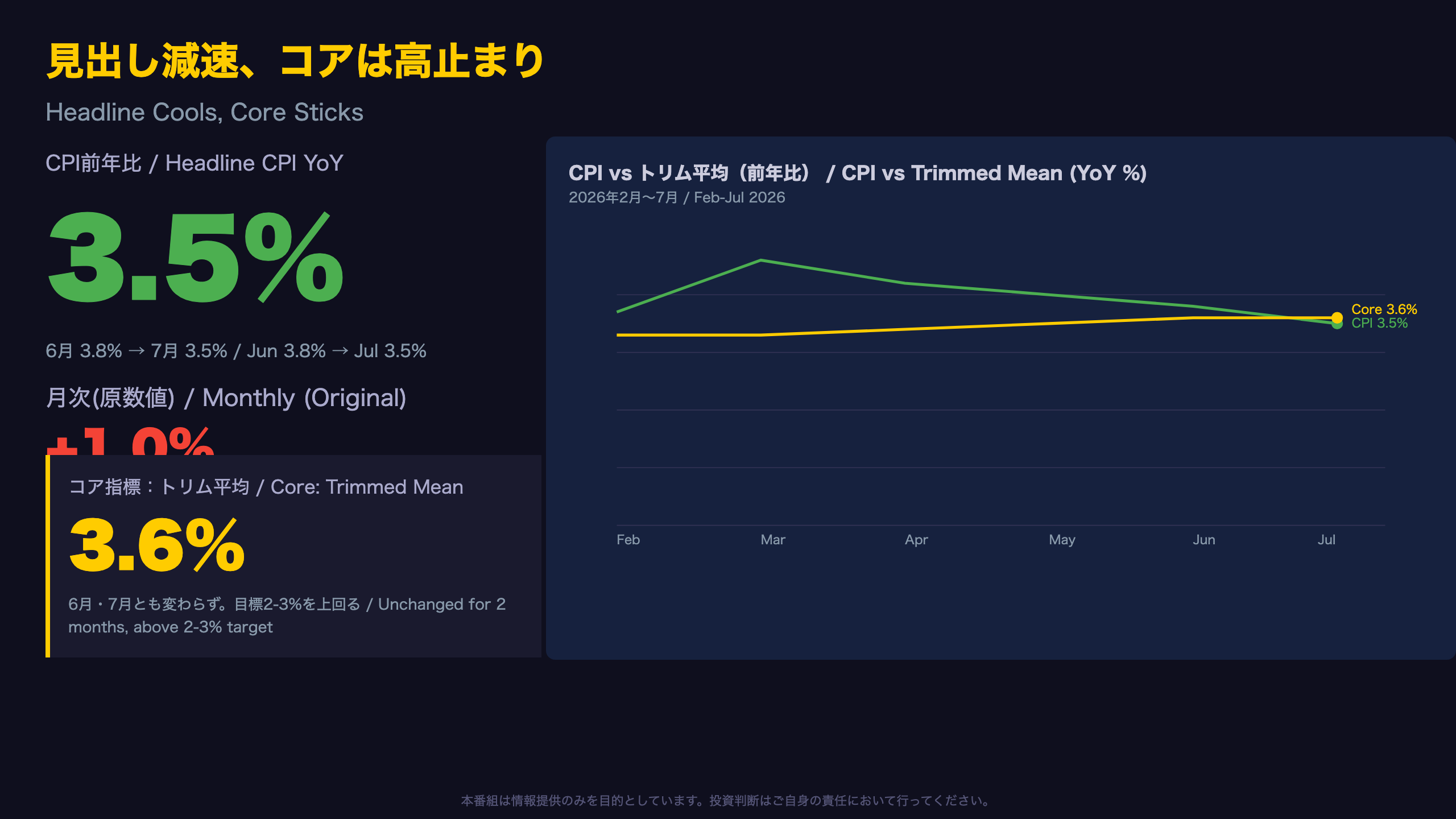
Headline inflation cooled from 3.8% to 3.5% YoY 📉
But the RBA’s preferred trimmed mean core gauge held flat at 3.6% for a second straight month ⚠️
Monthly CPI surged 1.0% (0.6% seasonally adjusted) — the fastest pace since March 🔥
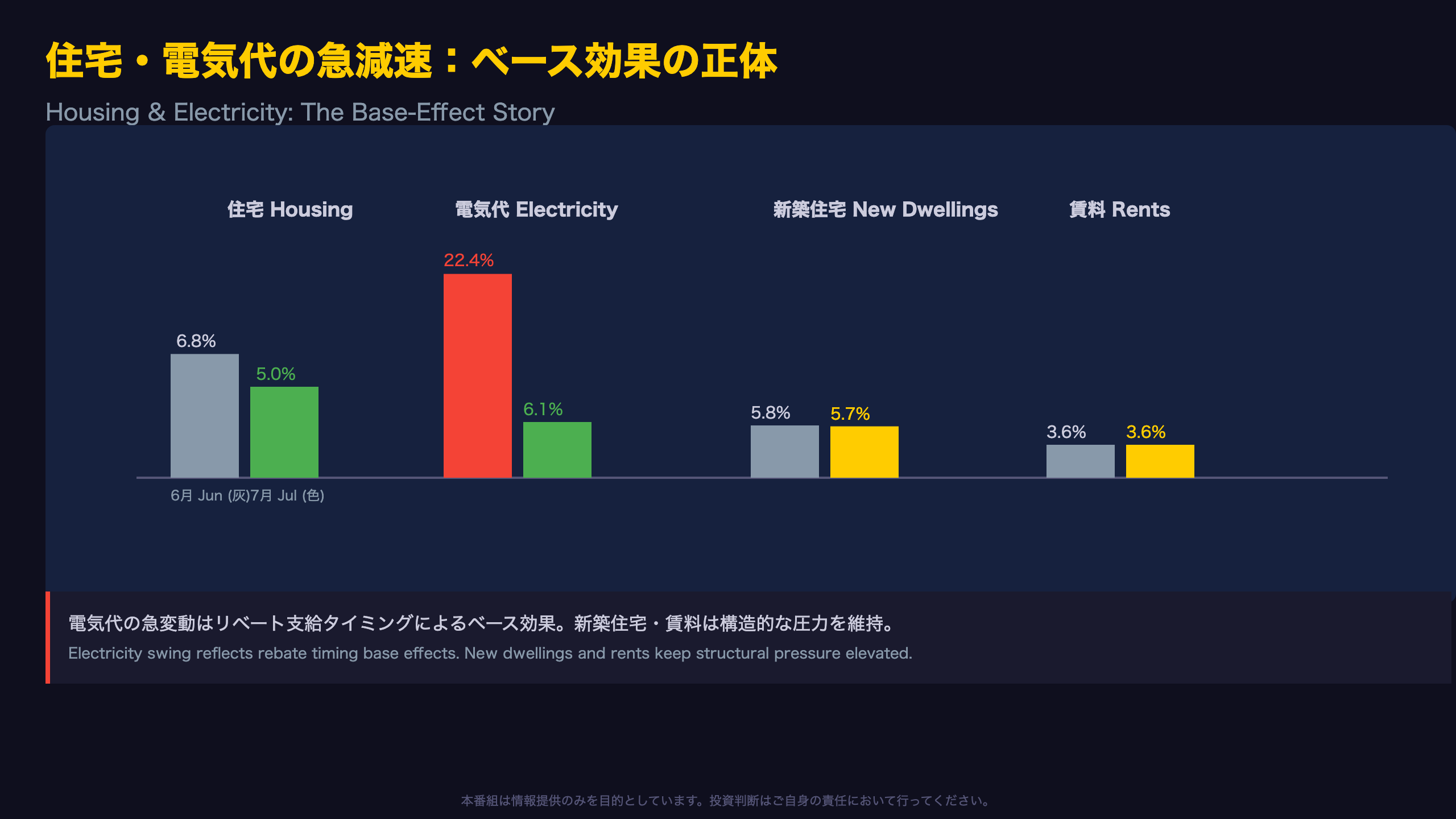
The housing slowdown is largely a base effect from expiring electricity rebates, while fuel prices reversed sharply higher.
Which signal matters more for the RBA’s next move and the Australian dollar? We break down the data. 💡
The Ultimate Summary:減速する見出し、高止まるコア
Why the Trimmed Mean Matters More Than the Headline
Australia’s monthly CPI, only fully rolled out since late 2025, gives the RBA a faster read on inflation than the old quarterly series. Among the analytical measures ABS publishes, the trimmed mean—which strips out the most extreme price movements at each end of the distribution before averaging—is the RBA’s preferred underlying inflation gauge, broadly comparable to the U.S. Federal Reserve’s core PCE.
The trimmed mean’s 2026 path: 3.3% in February, climbing to 3.6% by June, and staying at 3.6% in July—a full percentage point above the midpoint of the RBA’s 2-3% target band, unmoved for two straight readings.
Compare this to the U.S., where the Fed’s 2% target sits closer to actual PCE inflation—Australia’s underlying inflation problem looks comparatively stickier right now.
For AUD traders, a flat trimmed mean removes one of the strongest arguments for near-term RBA rate cuts, typically a modest positive for carry-sensitive currency positioning, all else equal.
住宅・電気代の急減速:ベース効果の正体
Base Effects: A Recurring Feature of Utility-Heavy CPI Baskets
Australia’s CPI treats government electricity rebates as a direct offset within the Housing component—a design distinct from the U.S. CPI, which has no equivalent nationwide utility subsidy embedded in its shelter index. As Commonwealth and state electricity rebates phased out through 2025, the year-on-year comparison spiked to 22.4% in June 2026. By July, that base normalized, dropping the annual rate to 6.1% even though electricity prices themselves fell 1.6% month-on-month.
This is a textbook base-effect distortion: the level of electricity prices didn’t collapse—the prior-year comparison point simply changed. Investors reading Australian housing inflation should treat the Housing group’s annual print cautiously until rebate-driven base effects fully roll off, likely by late 2026.
Meanwhile, new dwelling construction costs (+5.7% YoY) and rents (+3.6% YoY)—the structurally persistent components—show housing inflation pressure has not meaningfully eased, a nuance the headline deceleration obscures.
月次データの読み方:3月急伸との相似
Reading Monthly CPI Noise: Lessons from the U.S. Playbook
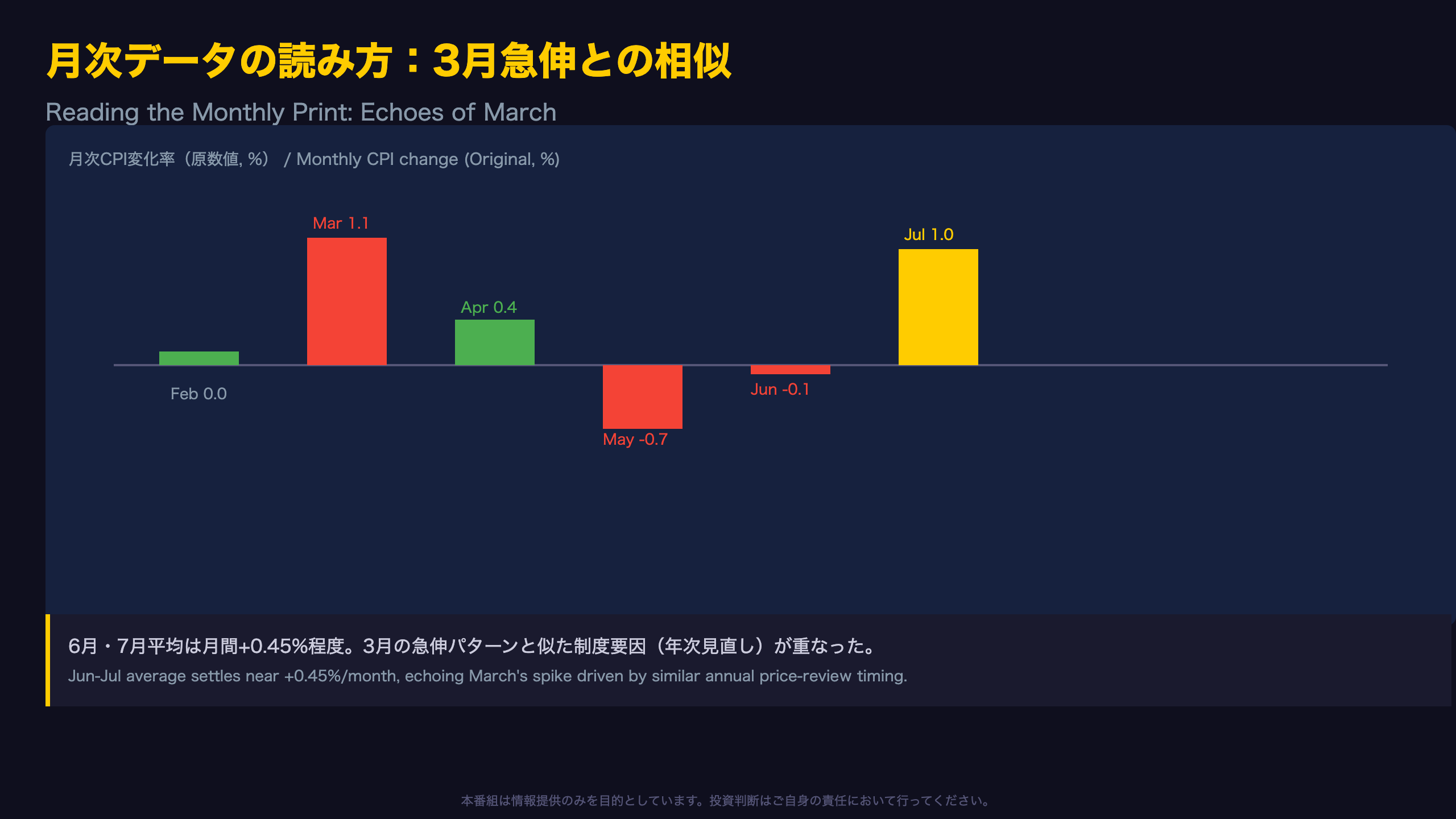
Monthly CPI series are inherently noisier than quarterly ones—a lesson U.S. investors know well from parsing MoM core CPI prints. Australia’s monthly CPI, only fully rolled out in late 2025, is still young, and July’s +1.0% (+0.6% seasonally adjusted) increase—the sharpest since March’s +1.1%—needs context.
Averaging June’s -0.1% with July’s +1.0% smooths to roughly +0.45% per month, broadly consistent with annualized inflation near the RBA’s trimmed mean of 3.6%. That’s a useful sanity check against overreacting to a single hot print, similar to how U.S. economists average multiple CPI/PCE months rather than trading off one release.
That said, the trimmed mean’s own monthly pace accelerated from +0.3% to +0.5%, and July concentrated several seasonal resets—Australia’s July 1 minimum wage increase, school holidays boosting domestic travel, and annual utility price reviews. These aren’t purely one-off noise; they’re recurring July effects investors should expect again in July 2027.
セクター深掘り:燃料の反転とコアの改善
Fuel Excise Relief: A Fiscal Lever Reversing Course
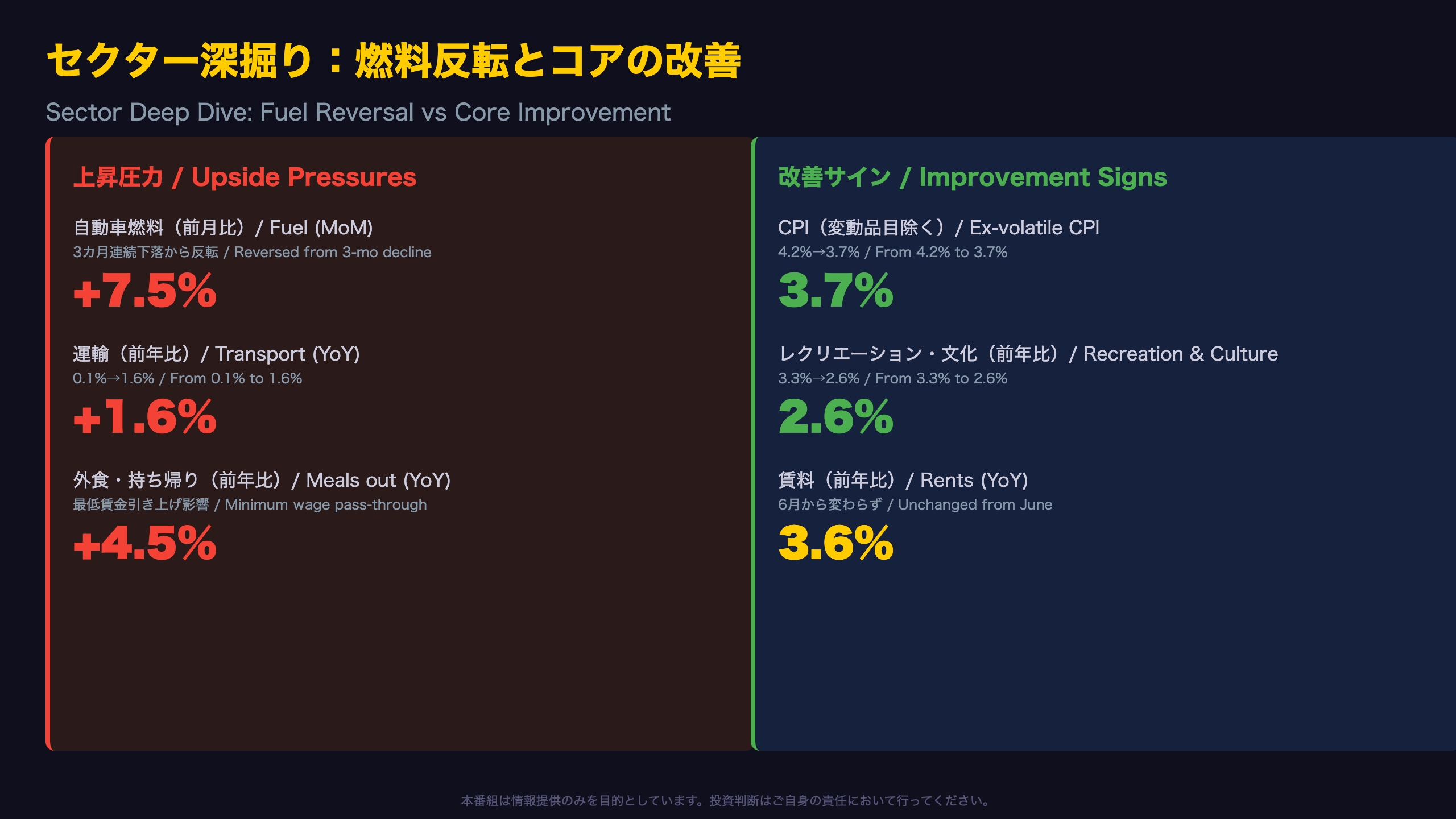
Australia’s federal government had been running fuel excise relief measures that suppressed automotive fuel prices through April-June 2026. In July, that relief partially unwound just as global oil prices rose, producing a sharp +7.5% month-on-month jump in fuel prices after three consecutive monthly declines. This pushed the Transport group’s annual rate from just 0.1% to 1.6% in a single month—a stark illustration of how fiscal policy settings, not just market fundamentals, can swing an inflation print.
This is analytically similar to how U.S. gasoline taxes or European energy-subsidy phase-outs have periodically distorted headline CPI prints in recent years.
Separately, meals out and takeaway food accelerated to +4.5% YoY, with the ABS explicitly citing July 1 minimum wage award increases as a contributor—a direct wage-to-price transmission channel worth monitoring.
Countering these upside pressures: CPI excluding volatile items fell sharply from 4.2% to 3.7%, and rents held steady at 3.6%. The picture is genuinely two-sided—temporary policy-driven cost shocks coexisting with a broader underlying moderation.
都市間ばらつきと市場への含意
City Dispersion and the Path Ahead for RBA Policy
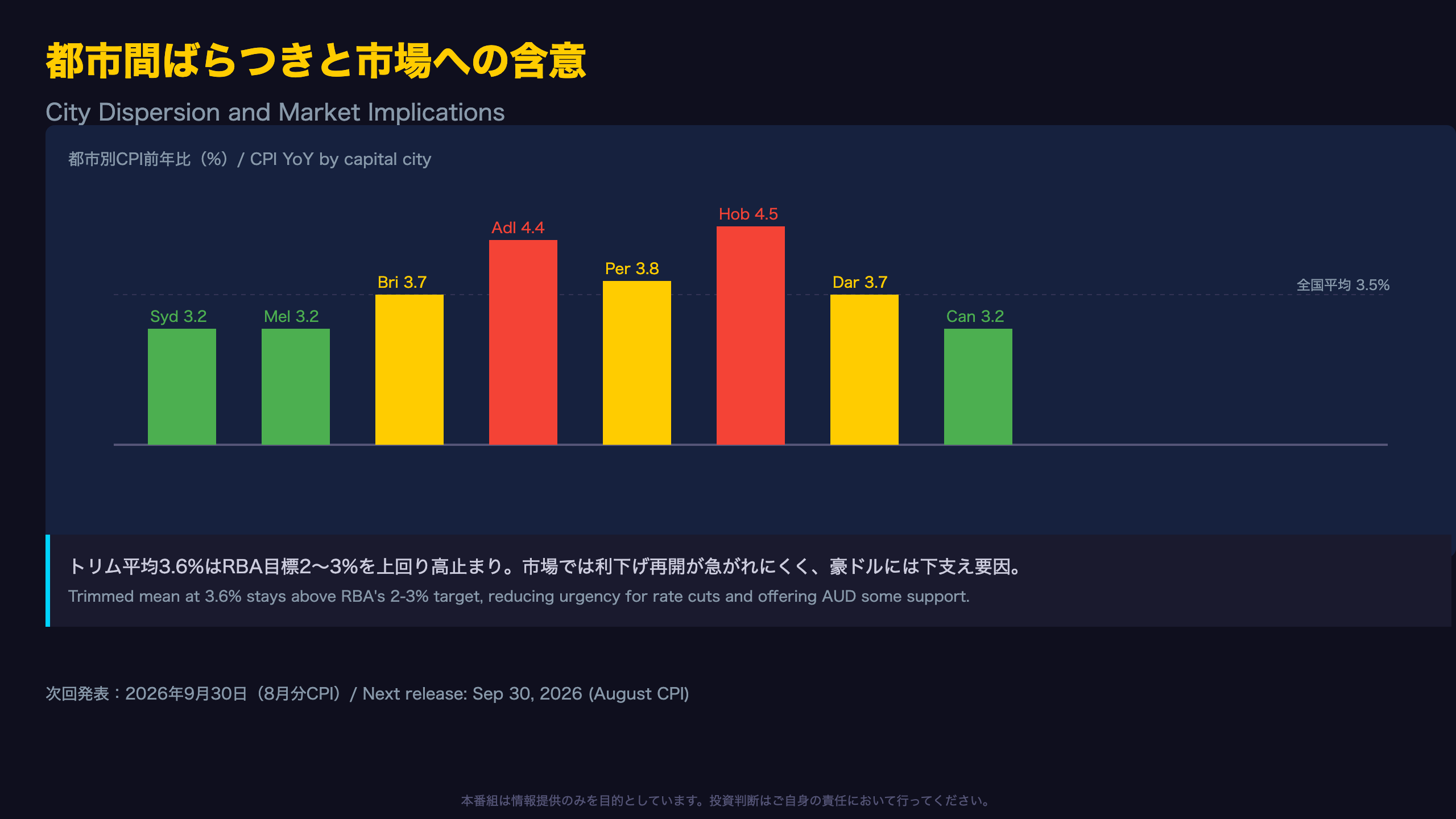
Australia’s monthly CPI, unlike the U.S. CPI-U, is compiled as a weighted average of just eight capital cities rather than a nationwide sample, which can create wider dispersion in headline readings. This month, Hobart (4.5%) and Adelaide (4.4%) ran well above the national 3.5%, while Sydney, Melbourne, and Canberra all sat at 3.2%—a 1.3-point spread between the hottest and coolest major cities.
For global macro investors benchmarking against the RBA’s 2-3% inflation target (structurally comparable to the Fed’s 2% PCE target or the ECB’s 2% HICP target), a trimmed mean stuck at 3.6% for two straight months, combined with July’s sharp monthly acceleration, leaves little room for the RBA to justify near-term rate cuts. That typically supports AUD via reduced downside repricing of interest rate differentials, though this remains a market inference rather than explicit RBA guidance.
The next CPI release, covering August 2026 data, is scheduled for September 30, 2026. Watch particularly whether the trimmed mean breaks below 3.6% or whether fuel’s rebound proves durable into the next print.
Disclaimer: This article is for informational purposes only. All investment decisions are made solely at your own risk.