This article was automatically generated by the NFC Market Live AI analysis system. (Updated: 2026-11-01 12:53 JST)
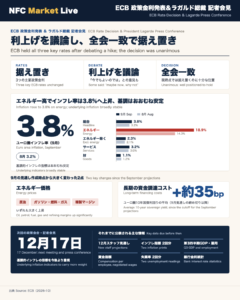
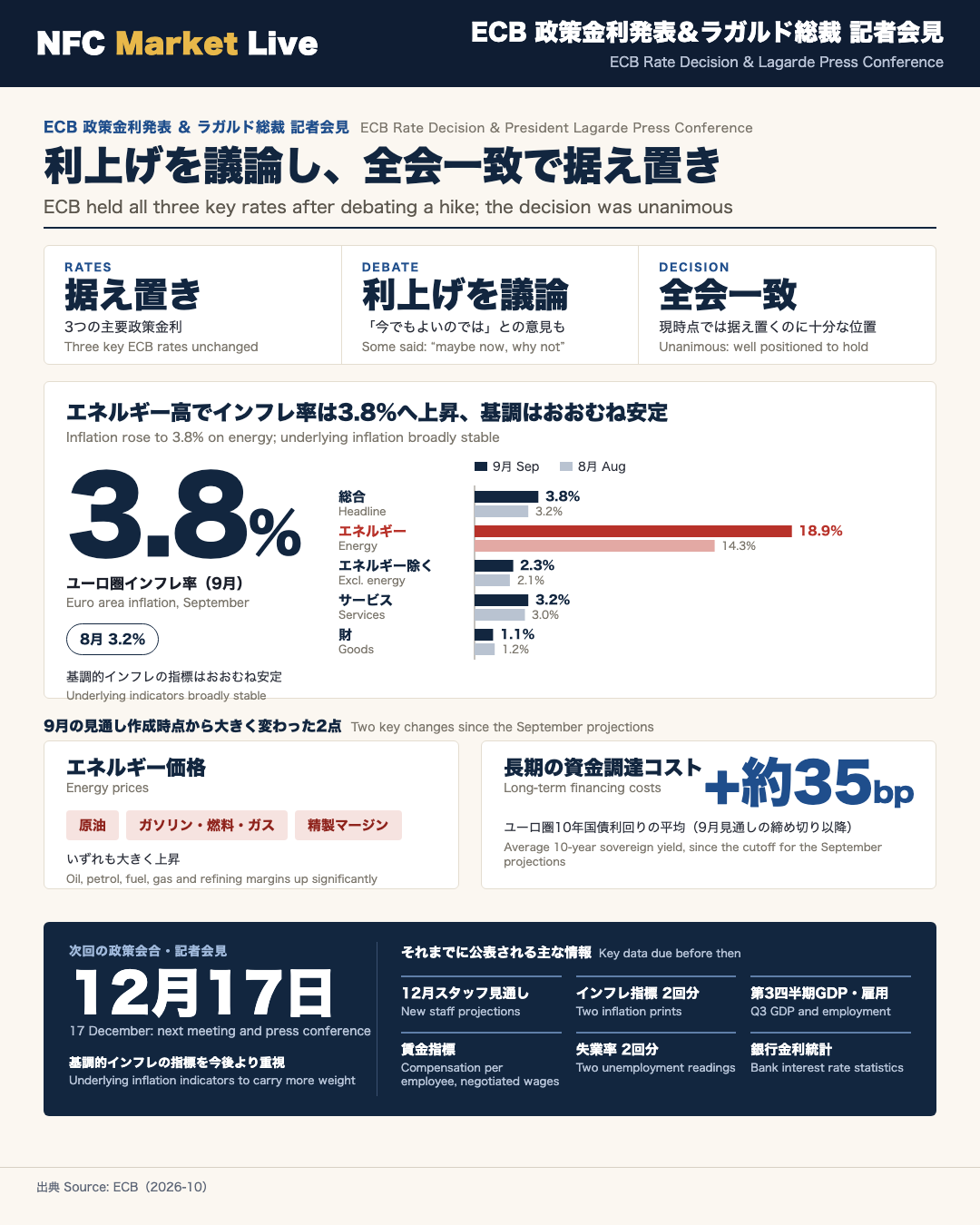
🏦 The ECB Governing Council kept its three key interest rates unchanged. President Lagarde said rising energy prices pose upside risks to the inflation outlook and downside risks to the growth outlook.
📊 Key figures
・Euro area inflation: 3.8% in September (3.2% in August)
・Energy inflation: 18.9% (14.3%); excluding energy: 2.3% (2.1%)
・Unemployment: 6.4% in August
・Compensation per employee: +3.3% in Q2 (3.6% in Q1)
💡 What was said
Lagarde disclosed that the Council debated whether a hike was appropriate. It then decided unanimously to hold, citing broadly stable underlying inflation and rising uncertainty. She named energy prices and long-term financing costs (average 10-year sovereign yields up about 35 basis points since the September projections cutoff) as the two big changes. The Council is not pre-committing to a rate path and will decide meeting by meeting.
🗓 New staff projections, two inflation prints, Q3 GDP and wage data are due before the next meeting. Lagarde also explained her plan to step down after the February Governing Council. The next press conference is on December 17.
据え置きの裏にあった「利上げ議論」――全会一致の決定とそのトーン
The decision
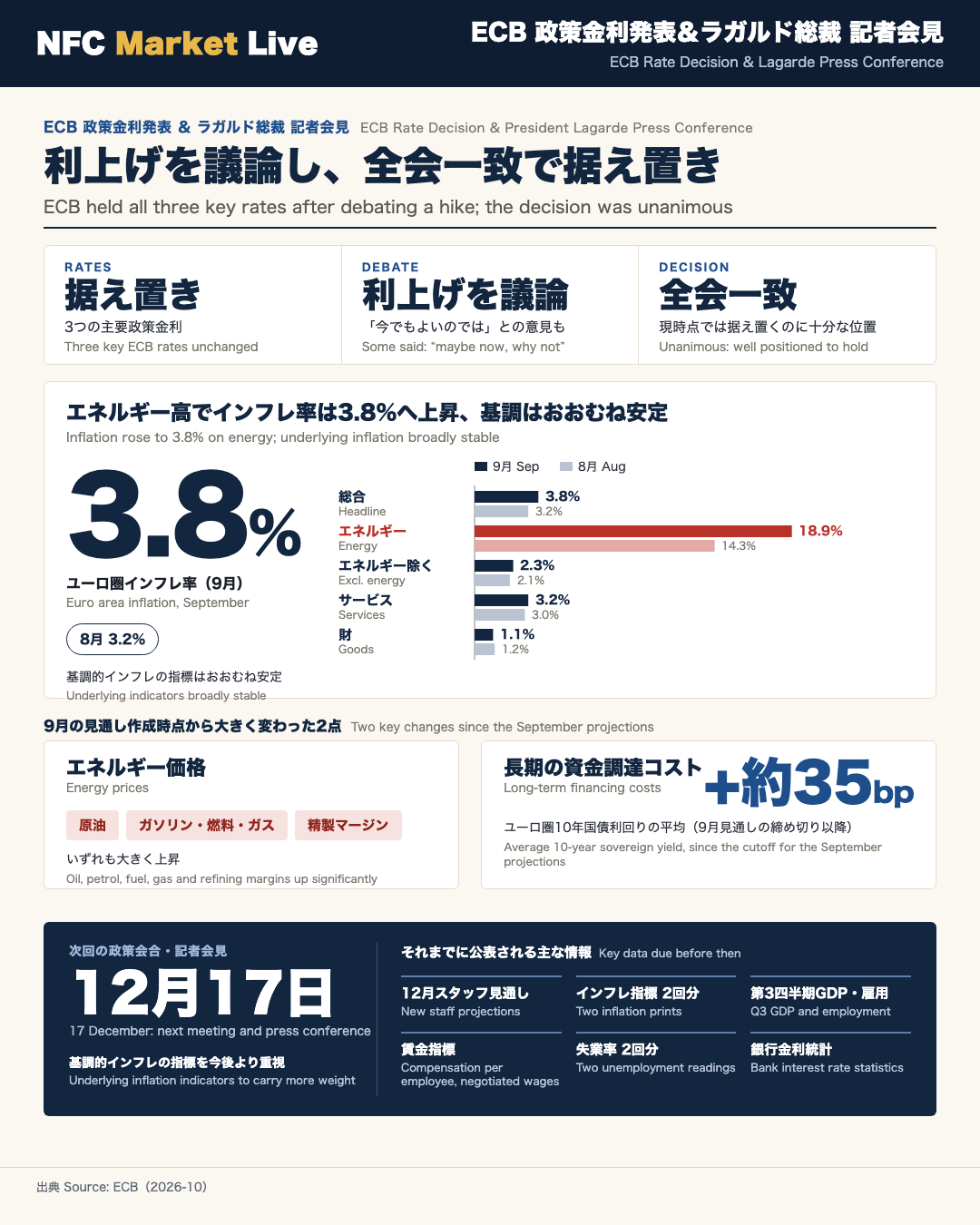
The ECB Governing Council kept all three key interest rates unchanged. President Lagarde opened by saying that energy prices have continued to rise, posing upside risks to the inflation outlook and downside risks to the growth outlook.
What the statement did not show
The most informative part of the press conference came in the Q&A. Lagarde said plainly that the Council ‘debated whether a hike was appropriate’. It then decided unanimously that it was ‘well positioned enough at this stage to hold’, citing underlying inflation that has broadly remained unchanged and rising uncertainty. She added that some views ran along the lines of ‘maybe now, why not’. So this was a hold after a live debate, not an automatic status quo.
Two changes since September
Lagarde pointed to two developments since the cutoff for the September staff projections:
– Energy prices (oil, but more so petrol, fuel, gas and refining margins)
– Long-term financing costs: average 10-year sovereign yields up by around 35 basis points
Reading the tone
For readers less familiar with the ECB: the Governing Council sets policy at meetings roughly every six weeks, and uses a ‘three-pronged’ reaction function based on the inflation outlook, underlying inflation dynamics and the strength of policy transmission. Staff projections are updated quarterly, and the next set is due in December. The familiar phrases were kept: data-dependent, meeting-by-meeting, and no pre-commitment to a rate path. Yet Lagarde also said that if incoming data confirms the current picture, ‘the sense of direction is quite clear’. That is conditional language, not a promise of a hike.
Balanced view
- Cautious side: stable underlying inflation and limited wage response argued against acting too fast.
- Alert side: a hike was actually debated, and underlying inflation indicators will take a more prominent role in the coming weeks.
エネルギー・ショックがインフレを押し上げる一方、基調は「おおむね安定」
September inflation
Lagarde said euro area inflation rose to 3.8% in September from 3.2% in August.
| Item | Sep | Aug |
|---|---|---|
| Headline | 3.8% | 3.2% |
| Energy | 18.9% | 14.3% |
| Excluding energy | 2.3% | 2.1% |
| Food | 1.3% | 1.1% |
| Services | 3.2% | 3.0% |
| Goods | 1.1% | 1.2% |
In the Q&A she recalled the energy figure as 18.8, but the prepared remarks say 18.9%, which we use here.
The tug of war
The upward drivers are clear. Diesel and petrol hit new peaks in September, partly reflecting elevated refining margins, and services inflation edged up. On the other side, Lagarde said indicators of underlying inflation have remained broadly stable, goods inflation declined and wage pressures remain moderate.
Wages and expectations
- Compensation per employee grew 3.3% in Q2, down from 3.6% in Q1; rising productivity has helped contain unit labour costs.
- The ECB’s forward-looking wage tracker points to negotiated wage growth of 2.5-2.8% for the rest of 2026 and an average of 2.6% in the first three quarters of 2027.
- Shorter-horizon inflation expectations have risen, but most longer-term measures stand around 2%.
Outlook
Energy prices have risen beyond the baseline of the September ECB staff projections. Lagarde said this is likely to raise inflation further in the near term and keep headline inflation well above target over the coming quarters, before declining energy inflation and the effects of higher interest rates support a return to target. She also noted that the early stages of the pricing chain point to upward pressures, so the message is not simple reassurance.
Why it matters for readers
The ECB targets 2% over the medium term and watches ‘underlying’ inflation, which strips out volatile items, to judge whether an energy shock is spreading into wages and broader prices. That is why the stable underlying readings and moderate wages carried so much weight in the decision to hold.
景気は底堅さと逆風が同居――AI投資と防衛・インフラ支出 vs エネルギー高と資金調達コスト
Current assessment
Lagarde said incoming data suggest the euro area economy continued to expand in the third quarter. Services recovered after weakening at the start of the Middle East conflict. Manufacturing, digital services and exports are benefiting from AI-related business investment, while government spending on infrastructure and defence is also supporting activity.
Support versus headwinds
| Supports | Headwinds |
|---|---|
| AI-related business investment | Renewed energy price rises hitting consumer confidence |
| Government spending on infrastructure and defence | Higher financing costs |
| Gradually rising productivity | Subdued growth in employment and the labour force |
Labour market
The unemployment rate remained at 6.4% in August. Employment and labour force growth stayed subdued, while productivity has gradually picked up.
Medium-term view
Over the medium term, Lagarde expects a recovery in confidence and real incomes, driven by gradually declining energy prices and a robust labour market, to bolster domestic demand. Export growth should pick up on stronger foreign demand.
Risks are to the downside
The growth risks she listed: further energy supply disruption from the Middle East conflict and Russia’s war against Ukraine, worsening global financial sentiment or bond market spillovers, fiscal uncertainty, and renewed trade tensions. She also named upside scenarios: faster adaptation by the economy and energy markets, a sustainable resolution of the conflicts, and stronger-than-expected gains from new technology adoption and structural reforms.
Structural agenda
Lagarde called fiscal sustainability ‘a crucial anchor’ and said fiscal responses to the energy shock should be ‘temporary, targeted and tailored’. She also urged swift agreement on the single currency package, noting that the legal framework for the digital euro is moving into its final stage.
Takeaway
The growth picture is neither a slump nor a boom. Private-sector investment themes and public spending are real supports, but they face energy costs and tighter credit at the same time, which is why the ECB describes the growth risks as tilted down.
金融環境は引き締まりへ――利回り上昇、株価下落、融資需要の低下
Headline message
Lagarde said financial conditions have tightened since the previous meeting: interest rates have broadly moved up while stock prices have fallen. She said this is likely to weigh on both inflation and growth.
Corporate financing
- Cost of market-based debt for firms: 4.1% in August (4.0% in July)
- Bank lending rates for firms: unchanged at 3.8%
- Bank lending growth to firms: 4.2% annual rate in August and September (4.4% in July)
- Corporate bond issuance growth: 4.2% in September (3.8% in August, 3.5% in July)
Bank credit growth is slowing while bond issuance is picking up, a shift in the funding channel.
Bank Lending Survey
Credit standards for loans to firms tightened in the third quarter, with banks citing concern about customers’ economic risks. Despite higher financing needs for inventories and working capital, corporate loan demand declined, particularly because of higher interest rates.
Mortgages
- Mortgage rates: 3.8% in August (3.5% in July)
- Mortgage lending growth: edged down to 3% in September
- Credit standards unchanged in Q3, but demand ‘declined substantially’
How to read long-term yields
In the Q&A, Lagarde stressed that the rise in long-term yields is global rather than specific to one member state or to Europe. She cited expected inflation, the expected policy rate path, and bond issuance by hyperscalers (large technology companies), which she said has not yet crowded out other issuers. Asked whether higher yields are doing part of the ECB’s work, she described long-term financing costs as a factor that ‘qualified the magnitude’ of the energy-driven rise in inflation.
Why it matters
The ECB’s decision weighs the inflation shock against the dampening effect of tighter credit. For readers: the Bank Lending Survey, published quarterly by the ECB, is a key gauge of whether banks are tightening lending standards and whether firms and households want to borrow. This quarter’s reading showed tighter corporate standards and weaker demand.
Q&Aの焦点――12月利上げ観測、フランス国債、そして「何を見て決めるか」
Where the questions clustered
Three themes dominated: (1) whether the ECB will hike in December, (2) French politics and bond markets, and (3) Lagarde’s own departure. Several journalists returned to the same topics, signalling where market interest is concentrated.
Where she answered clearly
Policy direction
Lagarde agreed with a reporter’s description of the decision as a ‘no hiking decision’, but stressed that the Council decides meeting by meeting and that it ‘does not indicate that we will not be hiking’. She added that, absent significant developments, ‘the direction of travel is quite clear’. Asked whether the ECB might restrict itself to quarterly meetings, she said no: ‘we have never restricted ourselves to that’, and there is no plan to limit the number of meetings dealing with monetary policy.
Second-round effects
She said the Council pays special attention to them, but at this point does not see a material risk beyond what was already included in the September projections.
Data before December
A new set of staff projections, two inflation prints, Q3 GDP, Q3 employment, compensation per employee and negotiated wages, two unemployment readings, two industrial production releases, the November PMIs and two rounds of bank interest rate statistics. She said underlying inflation indicators are becoming more informative and ‘will probably take a particular standing’ in the three-pronged approach.
Where she stayed general
- On French spreads, she framed the rise as part of a global increase at the long end of the curve and did not give country-specific thresholds (speed, level or contagion). She said high-debt countries must factor higher rates into fiscal plans, and that instruments exist if unwarranted and disorderly market moves threaten policy transmission, with published criteria.
- On the decline in French sovereign holdings under quantitative tightening, she said it is mechanical: redemptions are not replaced, and there is ‘no behind-the-scenes arrangement’.
Takeaway
The answers combined emphasis on a measured approach with a clear signal that vigilance remains high.
ラガルド総裁の退任表明――理由、後任、ガバナンスへの回答
What was said
Lagarde explained that she will step down as ECB President after the February Governing Council meeting in 2027. Her term would otherwise have run until October 2027, and she noted that presidents and board members cannot be renewed. In the session a journalist referred to the date as 7 February, and Lagarde said that until 7 February ‘I’m in charge’.
Why leave early
She said she wants ‘the freedom of speech, the freedom of expression and the freedom to engage on matters that are not monetary policy matters’. As ECB President she is bound by an obligation of neutrality and a single mandate, which she called ‘the price we pay for being independent’.
‘I don’t think that I can be comfortable in that neutrality at the present time.’
‘I’m interested in the truth and I see the truth being very often damaged.’
What she did not answer
Several journalists asked what she will do next, whether she would stand for office, support a candidate, or apply for positions at the European Council or Parliament. She declined to go into specifics. Asked what concerns her most about France, she said the main developments apply to all countries: energy prices and long-end financing costs.
Continuity and governance
A journalist noted that eight of 26 executive board members have left before the end of their term and asked whether that points to governance flaws. Lagarde replied that the ECB’s governance ‘has proven its solidity’ and that ‘business continuity has always been the mantra’. She said the search for her successor has already started and that there is no risk of decision-making in limbo. She also said the next press conferences will be in December and February.
Context for readers
The ECB Executive Board has six members with fixed non-renewable terms, so turnover is part of the design. Lagarde’s remarks matter for what was kept separate: she presented the departure as unrelated to the rate decision, and she stressed that the Council will keep deciding meeting by meeting on the basis of incoming data.
次の焦点――12月17日の会合までに公表される主な指標
Next meeting
The next monetary policy meeting and press conference is on 17 December. Lagarde noted that December will include a projection exercise, so the Council will have a large amount of information at hand.
The ‘mine of information’ she listed
| Area | Releases |
|---|---|
| Projections | New December staff projections (scenarios likely again) |
| Prices | Two inflation prints |
| Growth and jobs | Q3 GDP and employment, two unemployment readings, two industrial production releases, November PMIs |
| Wages | Compensation per employee, negotiated wages |
| Finance | Bank interest rate statistics for September and October |
The key focus: underlying inflation
Lagarde said underlying inflation ‘has not been very informative at the beginning of the shock’, but that the more the shock progresses, the more informative the indicators become. Within the three-pronged approach (inflation outlook and risks, underlying inflation dynamics, strength of policy transmission) underlying inflation ‘will probably take a particular standing’. She added that this does not come at the expense of the inflation outlook and risks.
How to follow it
- The conditions behind her ‘direction of travel is quite clear’ remark are underlying inflation, energy prices, the cost of financing and geopolitical developments.
- The picture now: underlying inflation broadly stable, wages moderate, longer-term expectations near 2%; energy prices and long-term yields up.
- She also said the ECB stands ready to adjust all its instruments within its mandate to stabilise inflation at 2% and preserve the smooth functioning of policy transmission.
Caveat
Lagarde repeated that the Council is ‘not pre-committing to a particular rate path’. No single release will settle the question, and readers should treat the data list as a checklist, not a forecast.
Disclaimer: This article is for informational purposes only. All investment decisions are made solely at your own risk.