📺 Watch the Full Video Analysis
This article was automatically generated by the NFC Market Live AI analysis system. (Updated: 2026-11-01 08:45 JST)
📊 Weekly Macro Review (Oct 25 – Nov 1)
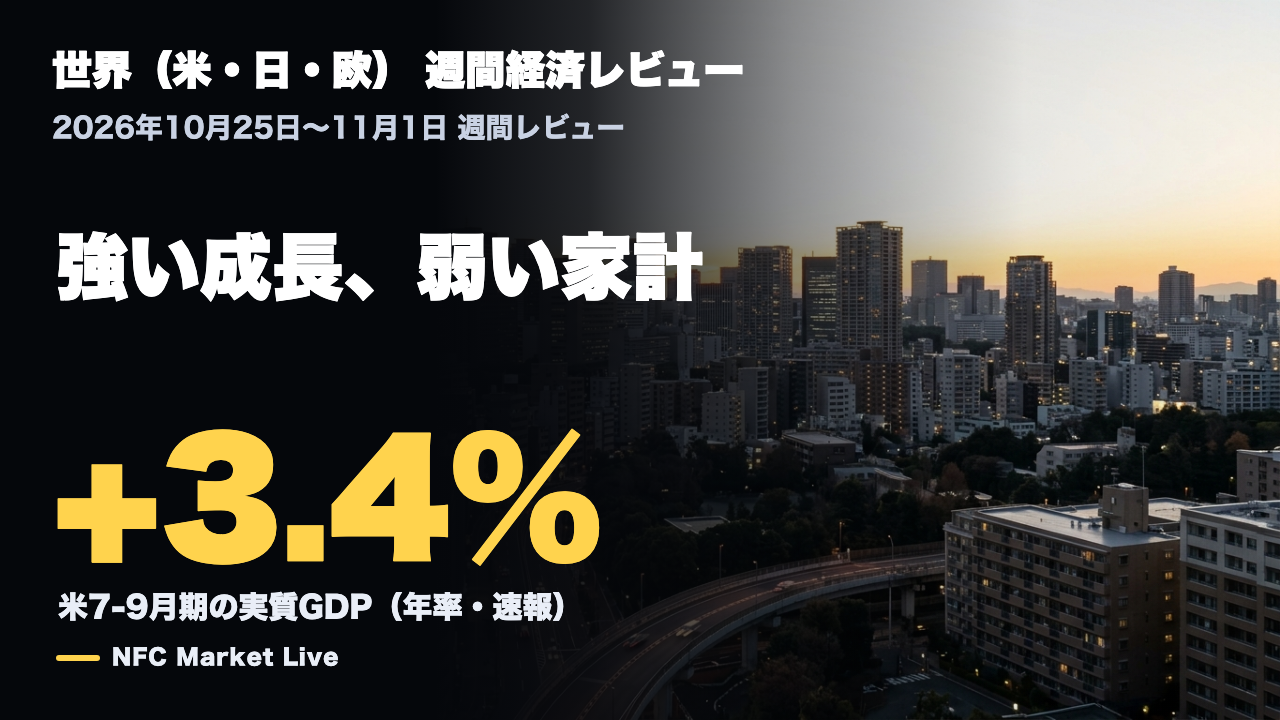
US Q3 GDP accelerated to 3.4% annualized, yet September real disposable income fell 0.3% m/m and the saving rate slipped to 3.8%.
📈 Is growth now carried by business investment rather than households? Microsoft’s capex roughly doubled y/y, while Amazon’s trailing free cash flow is negative.
⛽ Inflation: US PCE 3.6% y/y, Tokyo core-core 2.6%, Australia CPI 4.3%. Fuel is lifting headline prices; the spread into core differs by country.
🏦 The Fed and BOJ held; the Bank of Canada hiked to 2.5%.
💡 Next week: US jobs (Nov 6), Japan wages, and the BOE decision.
今週の現在地:二つの問い

This week’s Global Macro Digest covers October 25 to November 1: US third-quarter GDP, the FOMC press conference, the Bank of Japan’s Outlook Report and press conference, and Tokyo CPI. We use two questions, why strong growth sits beside weak household income and whether inflation is still only a fuel story, to build a single map of where the world economy stands, and we close with what next week’s releases can confirm.
世界経済の現在地:6つの面の見取り図
Where the world economy stands
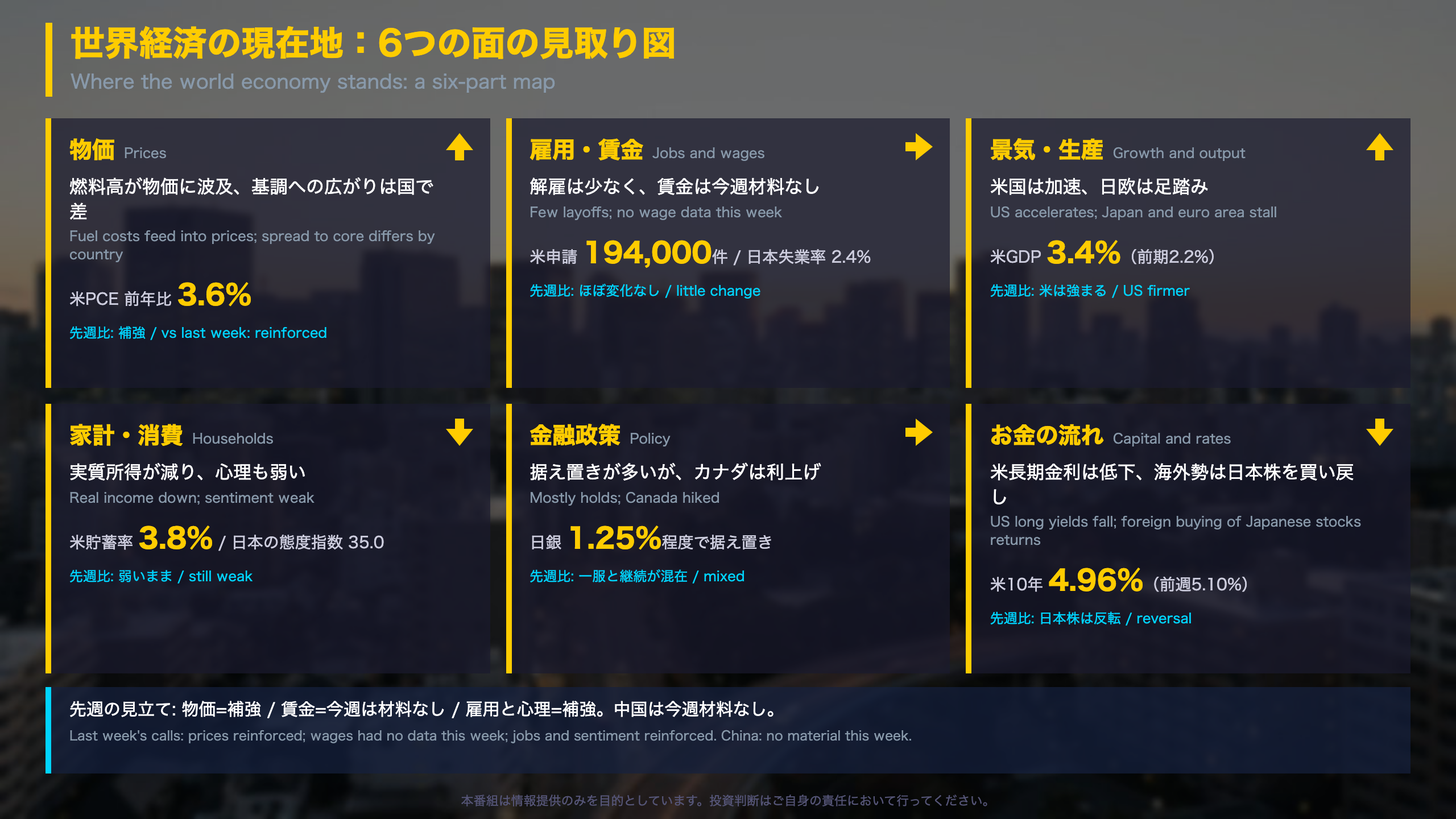
This week’s data show strength in corporate activity and the labor market, and weakness in household income and sentiment.
| Area | State | vs last week |
|---|---|---|
| Prices | Fuel costs spreading; core differs by country | Reinforced |
| Jobs and wages | Few layoffs; no wage data this week | Little change |
| Growth and output | US accelerates; Japan and euro area soft | US firmer |
| Households | Real income and sentiment weak | Still weak |
| Policy | Mostly holds; Canada hiked | Mixed |
| Money flows | US long yields lower; foreign buying of Japanese equities returns | Reversal |
Context for readers
Japan’s Cabinet Office coincident index fell 1.8 points in August, yet its official judgment stayed at ‘improving’. The euro area’s Economic Sentiment Indicator, compiled by the European Commission, slipped for a second month to 96.9 against a long-run average of 100, while employment expectations rose. Foreign investors, tracked weekly by Japan’s Ministry of Finance, bought 1.18 trillion yen of Japanese equities after a small net sale the previous week.
Two readings
- Strength view: US GDP at 3.4%, low jobless claims, Japan’s unemployment at 2.4%.
- Strain view: real disposable income down, saving rate at 3.8%, softer sentiment in Japan and Europe.
China had no material this week and is left off the map rather than guessed at.
成長は加速したのに、家計の実質所得はなぜ減ったのか
Inside the 3.4% and the September household squeeze
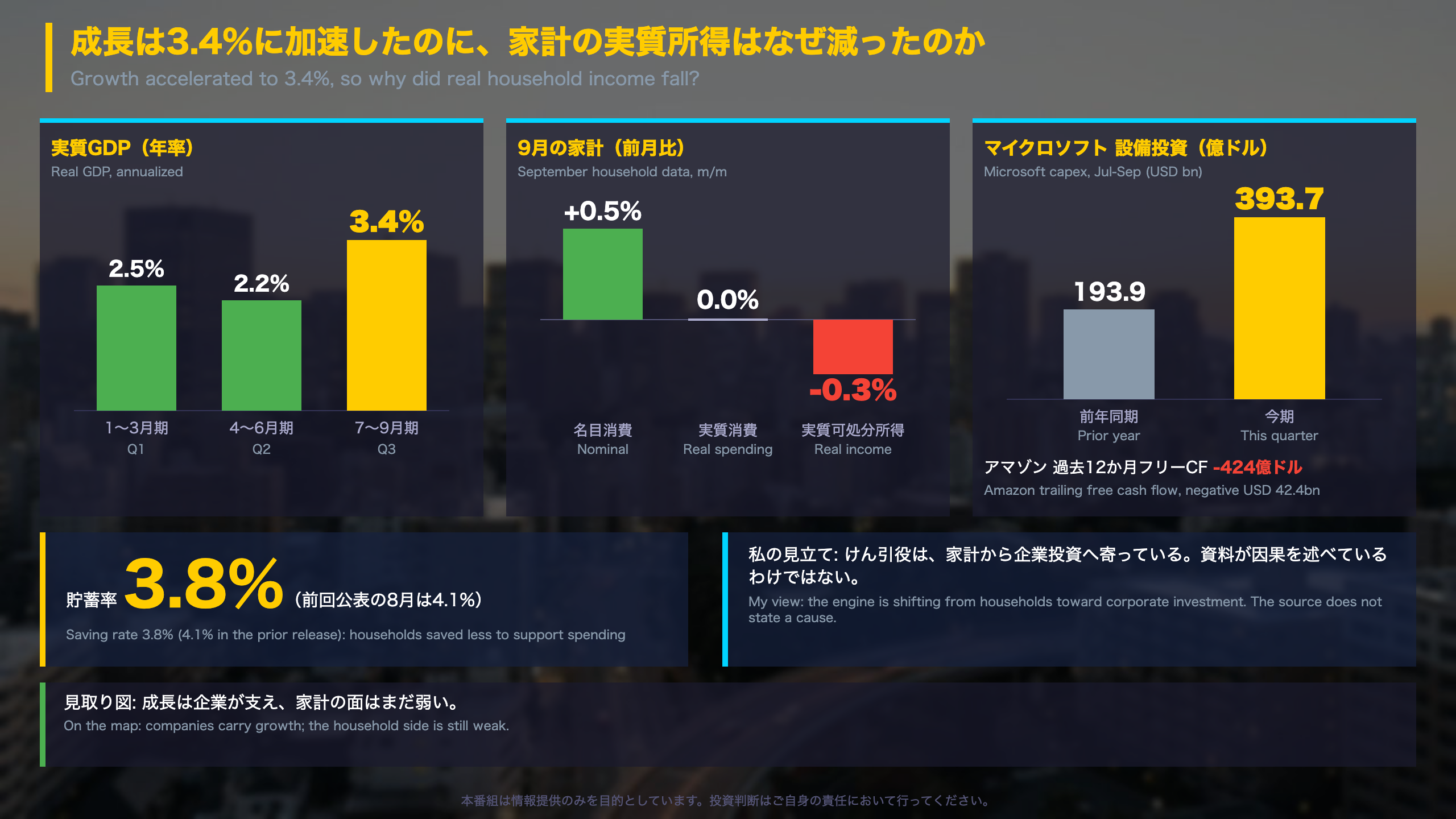
The Bureau of Economic Analysis (BEA) put third-quarter real GDP at 3.4% annualized, up from 2.5% and 2.2% in the prior two quarters. Nominal GDP slowed to 5.6% from 8.5%, and the domestic purchases price index eased to 3.0%. Private final demand rose 4.9%, but the second-quarter figure was revised up from 3.9% to 4.6% over successive estimates, so today’s number is likely to move.
The household side
| m/m, % | Jul | Aug (revised) | Sep |
|---|---|---|---|
| Real disposable income | 0.3 | 0.0 | -0.3 |
| Real consumption | 0.1 | 0.5 | 0.0 |
| PCE prices | 0.1 | 0.3 | 0.5 |
The saving rate fell to 3.8% from 4.1% in the previous release. Unlike Japan, where such releases are quarterly, US personal income arrives monthly, so one weak month can sit beside a strong quarter.
The corporate side
- Microsoft: capex $39.4bn versus $19.4bn a year earlier; operating cash flow still exceeded it.
- Amazon: trailing free cash flow is negative $42.4bn; 2026 capex guided to about $220bn.
- Alphabet: July-September free cash flow was negative $9.1bn.
Market angle
For investors in US large-cap tech, the data show a growth engine that leans on capital spending, which depends on those firms’ cash generation. We make no forecast. Next checks are the November 6 jobs report and the October personal income data on November 25.
物価の加速は、今週も燃料だけの話なのか
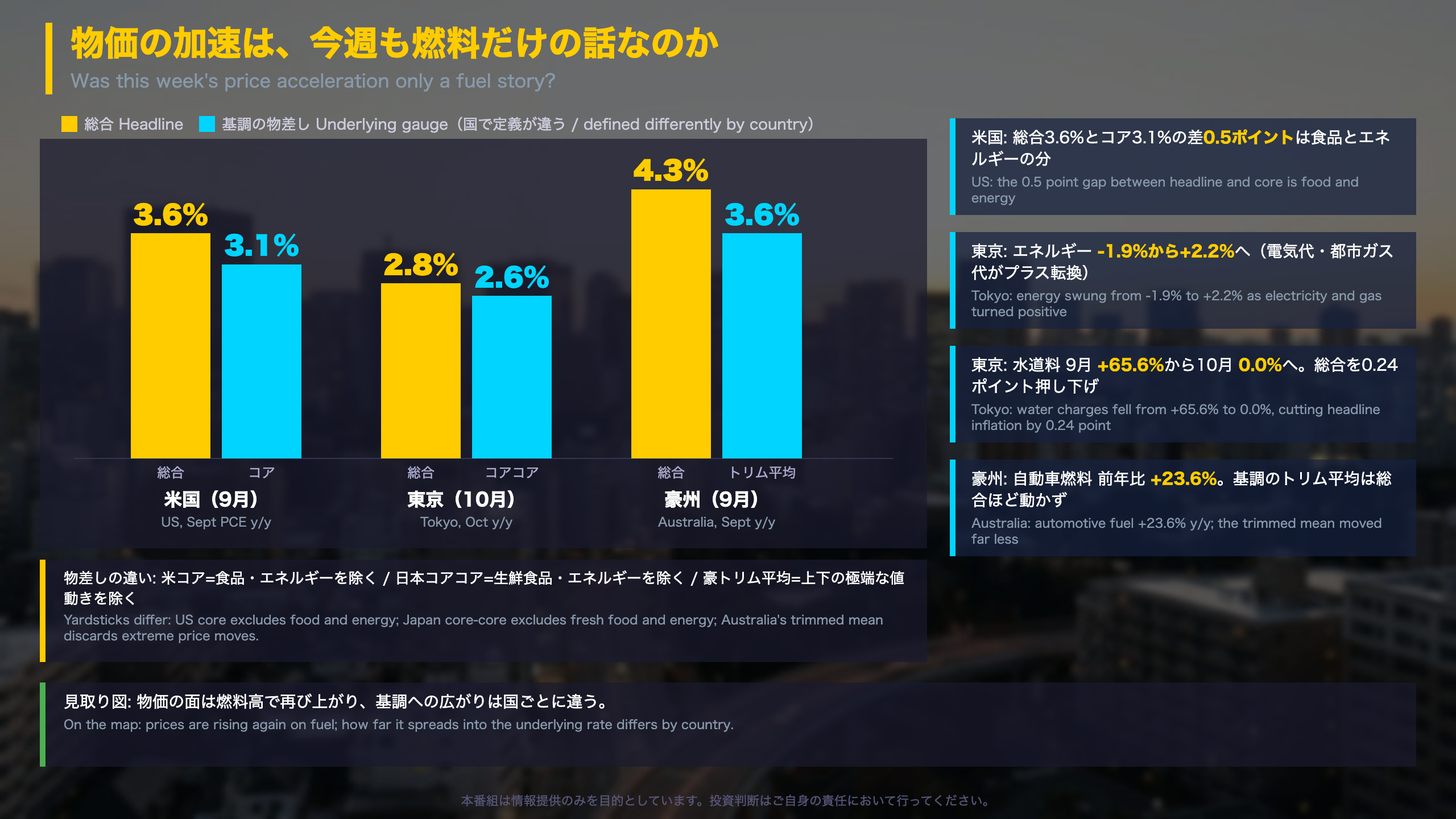
Comparing fuel pass-through in three economies
| Economy | Headline | Underlying gauge | Note |
|---|---|---|---|
| US (Sept PCE, y/y) | 3.6% (Aug 3.4%) | Core 3.1% (ex food and energy) | Monthly: headline 0.5%, core 0.3% |
| Tokyo (Oct) | 2.8% | Core-core 2.6% (ex fresh food and energy; Sept 2.9%) | Fresh food +8.6% |
| Australia (Sept) | 4.3% (Aug 4.0%) | Trimmed mean 3.6% (Aug revised 3.5%) | Automotive fuel +23.6% |
The underlying gauges are defined differently in each country, so they should not be ranked directly. The US core PCE removes food and energy; Japan’s core-core removes fresh food and energy; Australia’s trimmed mean discards the most extreme price changes.
Inside Tokyo’s reading
Tokyo is a leading indicator published about three weeks before the national figure. Energy swung from -1.9% to +2.2% as electricity and city gas turned positive. Water charges, up 65.6% in September, returned to 0.0%, which trimmed headline inflation by 0.24 point. We read most of the core-core decline as that one-off fading, though the ministry does not draw that link itself.
Australia
The Australian Bureau of Statistics attributes the 9.4% monthly jump in fuel to higher world oil prices. Services at 4.1% and non-discretionary items at 5.2% show strength beyond fuel.
Two readings
The base-effect view treats the jump as transitory; the breadth view points to Australia, where goods, services and core all moved. Euro area PPI at +8.2% in August is a warning light, but the source does not show pass-through to consumer prices.
Next checks: Japan’s national CPI on November 20, and US PCE and Australia’s October CPI on November 25.
中央銀行は現在地をどう見ているか
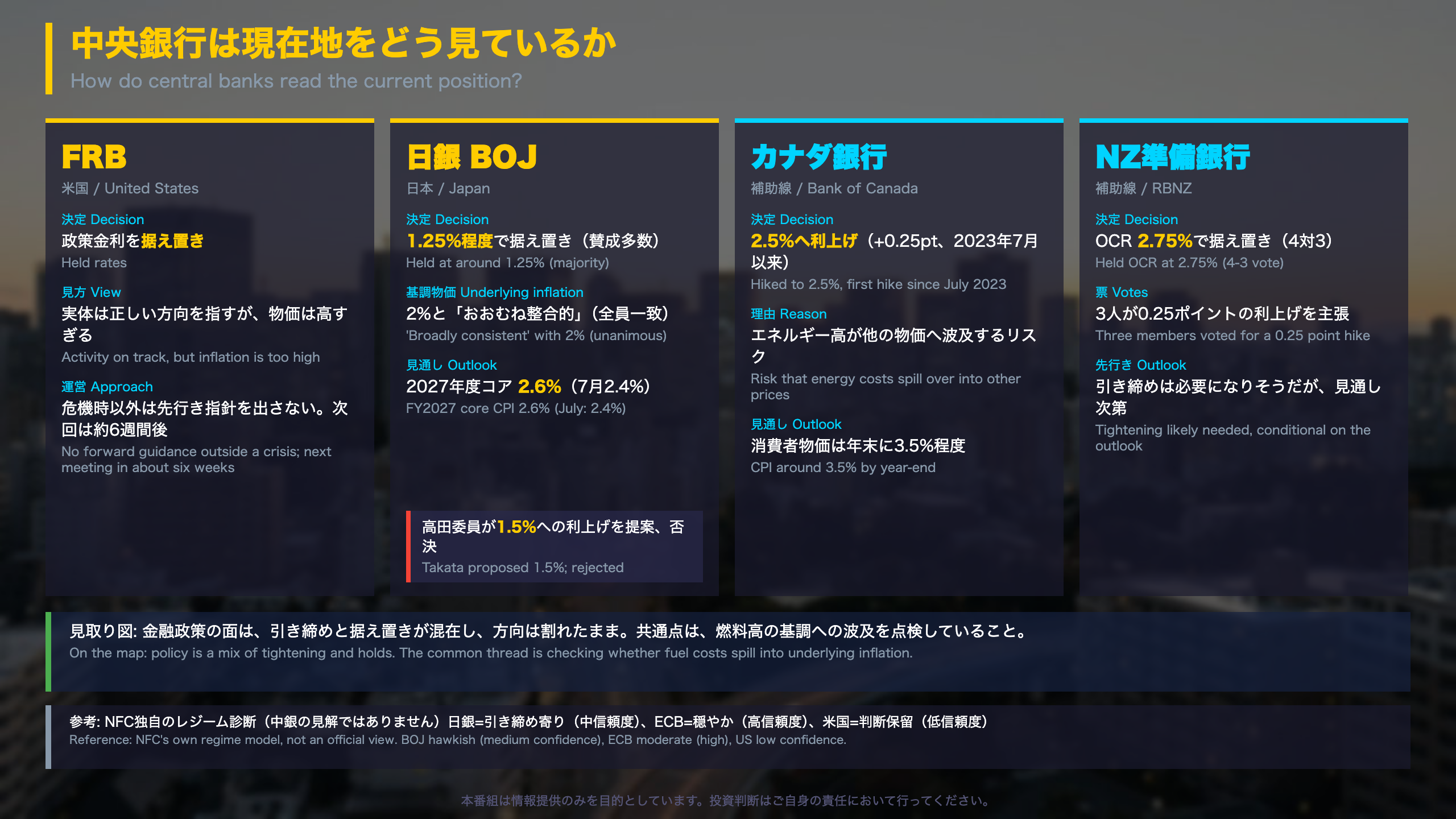
The Fed: both sides acknowledged, no forward guidance
In the press conference the chair said: “Real activity is clearly pointing in the right direction. That’s good news. But inflation is too high.” The four-week average of jobless claims was described as the lowest in a generation. On guidance, he said he does not believe in forward guidance absent a crisis, and that he submits no rate projection dot himself. The FOMC will move to eight meetings a year from next autumn.
Bank of Japan: one view of prices, a split on policy
The BOJ kept its overnight call rate target at around 1.25%. Board member Takata proposed 1.5% and was outvoted. All nine members agreed that underlying inflation is broadly consistent with the 2% target, up from a split in July. Governor Ueda still said sustained, stable achievement has not been reached. The Outlook Report’s median core CPI (ex fresh food) is 2.5%, 2.6% and 2.0% for fiscal 2026 to 2028; the 2027 figure rose from 2.4%. For readers used to the Fed’s dot plot, this median comes from a board survey published with the report.
Supporting central banks
The Bank of Canada raised its rate to 2.5%, the first hike since July 2023, to stop elevated energy prices from becoming generalized inflation. The Reserve Bank of New Zealand held at 2.75% on a 4-3 vote.
Reading
All three see fuel costs as the transmission risk. The split is over timing: confirm first, or move earlier. Our own regime model, not an official view, tags the BOJ as hawkish with medium confidence and the Fed as low confidence. We make no forecast of the next decisions.
来週、見取り図のどこが更新されるか

Next week (Nov 2 to 6), Japan time
| Day | Highlights |
|---|---|
| Mon 11/2 | Global Bond Watch; BCB Focus survey |
| Tue 11/3 | Earnings: AAPL, PLTR |
| Wed 11/4 | US JOLTS and durable goods; AMD earnings; BOJ monetary base; US trade balance |
| Thu 11/5 | QCOM, ARM earnings; Brazil central bank; BOJ minutes; Norges Bank; Bank of England |
| Fri 11/6 | Banxico; Japan monthly labour survey; MOF flows; US and Canada jobs |
Three things to check
1. US jobs report (Nov 6, 22:30 JST)
Last time September payrolls rose 29,000, while July was revised from +21,000 to -10,000 and August from +162,000 to +133,000, a combined -60,000. The 12-month average is +45,000 a month. Weekly jobless claims capture layoffs, not hiring, so the payroll count adds the missing half of the labor picture.
2. Japan’s Monthly Labour Survey (Nov 6, 08:30 JST)
The Ministry of Health, Labour and Welfare’s survey is Japan’s main wage gauge. Real wages rose 1.5% in August, the eighth straight gain, but the margin has narrowed from February’s 2.0% and June’s 2.2%. The deflator excludes imputed rent. With that price measure at 2.2%, nominal pay growth below 2.2% would push real wages negative, as simple arithmetic.
3. Bank of England (Nov 5, 21:00 JST)
Votes have moved from 8-1 in April to 9-0 in June and 6-3 in July, three members favoring a hike. Whether the split changes is the signal to watch.
Investor angle
Earnings from AAPL, AMD and others test whether AI capital spending, seen at Microsoft, Amazon and Alphabet this week, converts into profit. We offer no forecast of outcomes.
Disclaimer: This article is for informational purposes only. All investment decisions are made solely at your own risk.