
📺 Watch the Full Video Analysis
This article was automatically generated by the NFC Market Live AI analysis system. (Updated: 2026-10-22 05:17 JST)
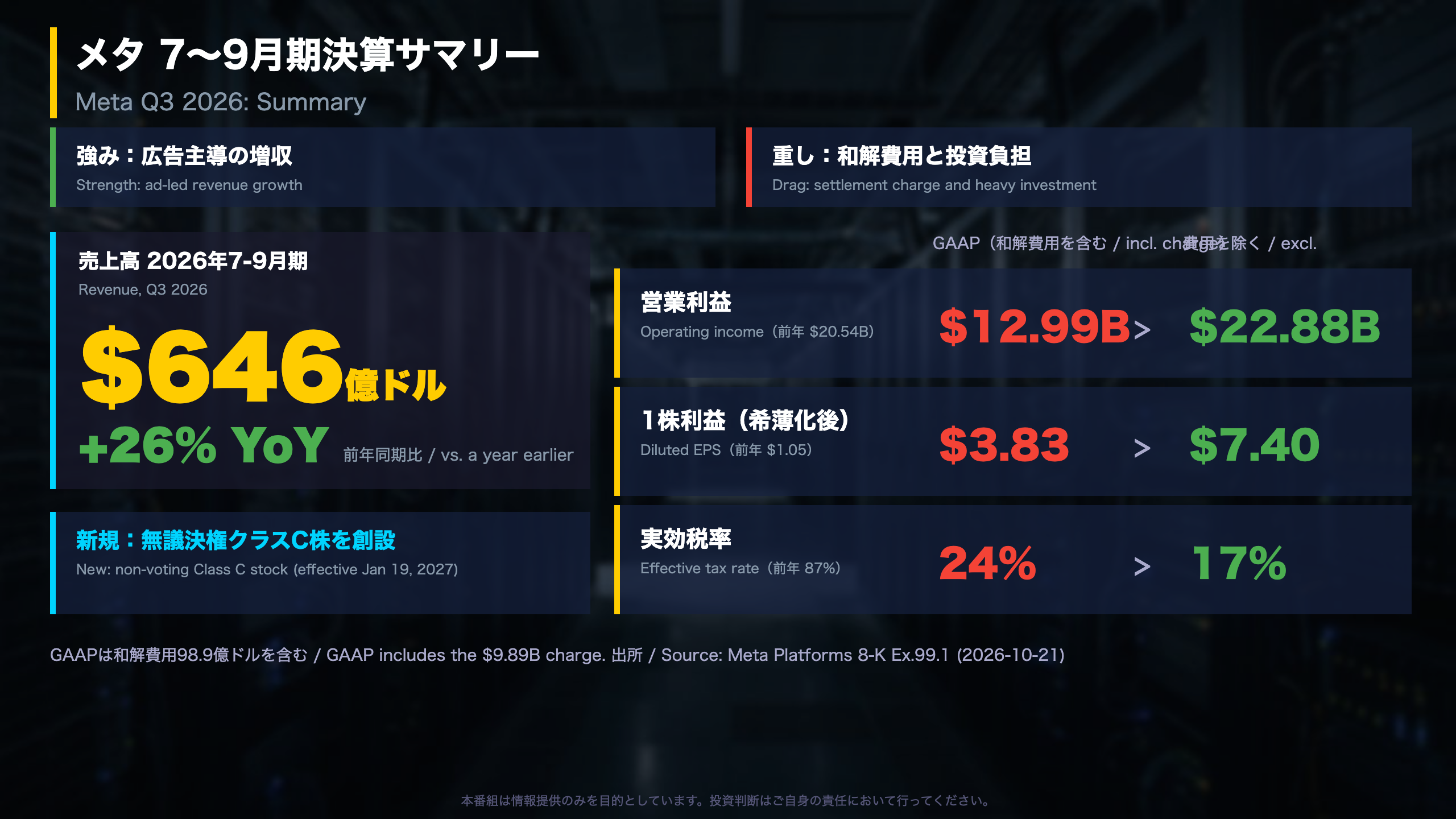
📊 Meta Platforms (META) reported Q3 2026 results: revenue of $64.6B (+26% YoY), driven by ad impressions (+10%) and average price per ad (+14%).
⚠️ A ~$9.9B settlement charge with U.S. state attorneys general pushed operating income down to $13.0B (vs. $20.5B a year ago). Excluding the charge, it would have been $22.9B, above last year.
💡 Capex reached $34.9B and free cash flow was negative $2.1B. Q4 revenue guidance is $73-76B; 2026 capex is guided to $135-145B.
📈 Meta also announced a new non-voting Class C stock. A balanced, source-based breakdown of both the strengths and the strain.
サマリー:広告急伸と和解費用・投資負担が同居
Reading Meta’s Q3 2026 headline numbers
What was reported. Meta Platforms filed its Q3 results as Exhibit 99.1 to a Form 8-K, the document U.S. public companies use to disclose material events to the SEC. Revenue was $64.6B (+26% YoY, +26% in constant currency). Operating income was $13.0B versus $20.5B a year earlier.
GAAP vs. ‘excluding the charge’
GAAP means results prepared under U.S. accounting standards. The quarter includes a $9.89B charge for an agreement with 52 state attorneys general over teen mental health and social media litigation (payments of up to about $18.59B in total). Meta’s own adjusted view shows:
- Operating income: $22.88B (vs. $12.99B reported)
- Diluted EPS: $7.40 (vs. $3.83 reported)
- Effective tax rate: 17% (vs. 24%)
A note on the +264% net income jump
Net income rose to $9.86B from $2.71B, but last year’s quarter carried a $18.95B tax provision (an 87% effective rate). The comparison base is unusually low, so operating income is the cleaner gauge of underlying momentum.
International comparison
Unlike Japanese or European issuers, which typically report on fiscal-year calendars with quarterly reports of varying detail, U.S. companies like Meta publish a press release and a detailed Form 10-Q. The 10-Q for this quarter is still to be filed.
Two readings
Bulls will point to operating income that, excluding the charge, exceeds last year. Skeptics will note total costs rose 68% against 26% revenue growth. Note that the 68% includes the one-time charge, so the pace of underlying cost growth needs to be separated out when the 10-Q arrives.
深掘り1:広告の量と価格がともに伸びた
Inside Meta’s advertising engine
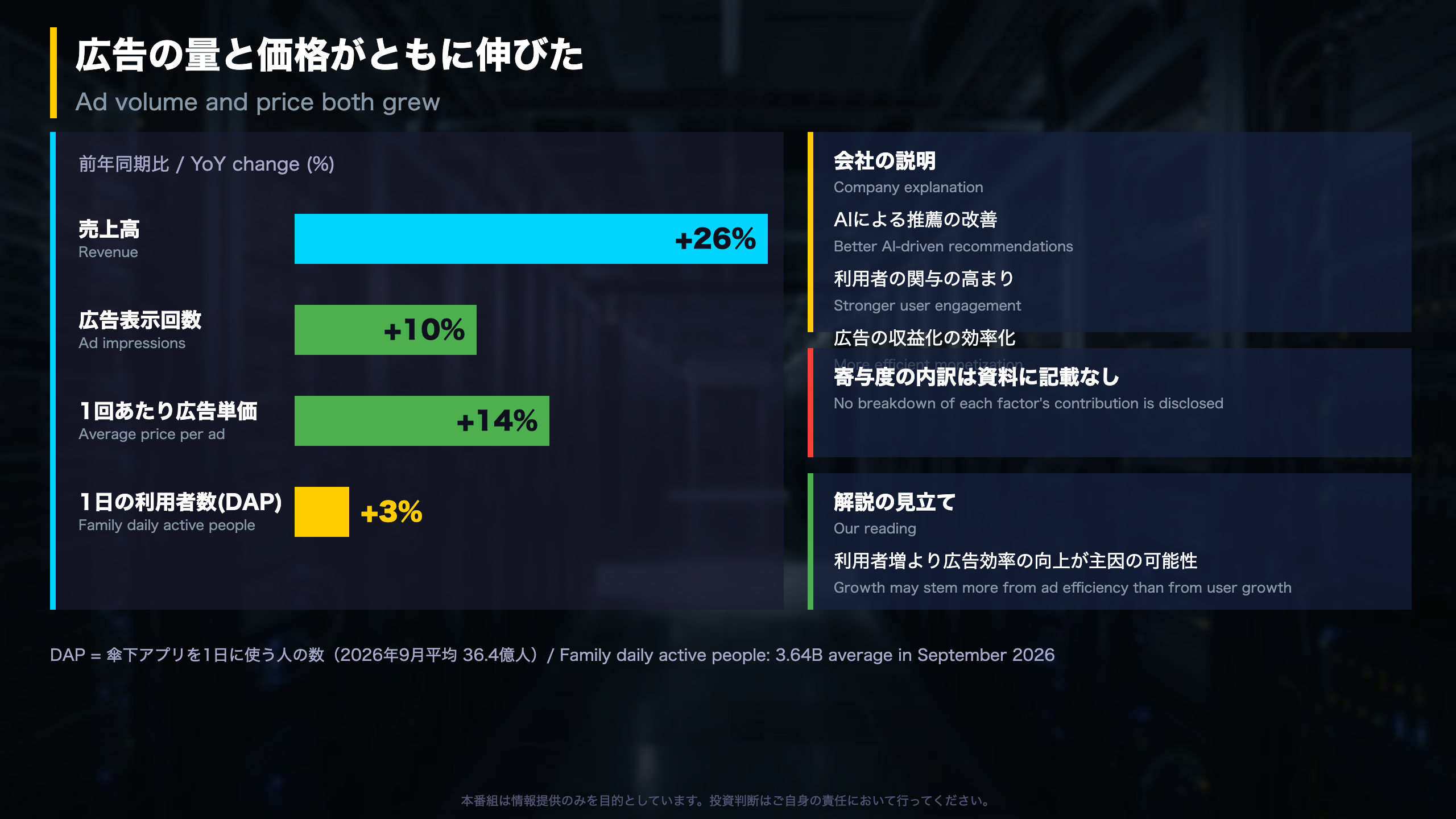
Why impressions and price matter. Meta, like other ad platforms, earns revenue from ad volume (impressions) times price. In Q3 2026, impressions rose 10% and average price per ad rose 14% YoY, with advertising revenue of $63.1B (vs. $50.1B a year earlier). FX had little effect: constant-currency growth was also 26%.
Context for English-speaking readers
The release uses ‘Family daily active people (DAP)’, a de-duplicated count of people using at least one of Meta’s apps (Facebook, Instagram, WhatsApp, Messenger) per day. DAP was 3.64B on average in September, up 3% YoY. That is far slower than ad revenue growth, which is why the quarter reads as an efficiency story rather than a user-growth story. Compare this with the approach at U.S. peers, where growth is often described via ad load and pricing.
What the company says, and what it does not
The CFO commentary credits AI for ‘stronger engagement, better recommendations, and more efficient monetization.’ The release gives no quantified attribution, so the split between volume, price and mix should be treated as unresolved until the 10-Q.
Cost side
Headcount fell 15% to 66,775, yet R&D rose to $20.1B from $15.1B and cost of revenue to $13.4B from $9.2B. This pattern is consistent with spending shifting toward compute and infrastructure, though the filing does not itemize it.
Market angle
For investors tracking ad cyclicality, two points matter: breadth (both volume and price up) and guidance (Q4 revenue of $73-76B, assuming roughly a 1% FX headwind). A deceleration in either impressions or pricing would be the first sign of strain.
深掘り2:設備投資がキャッシュを上回った
Meta’s cash flow and balance sheet: how the AI build-out is being funded
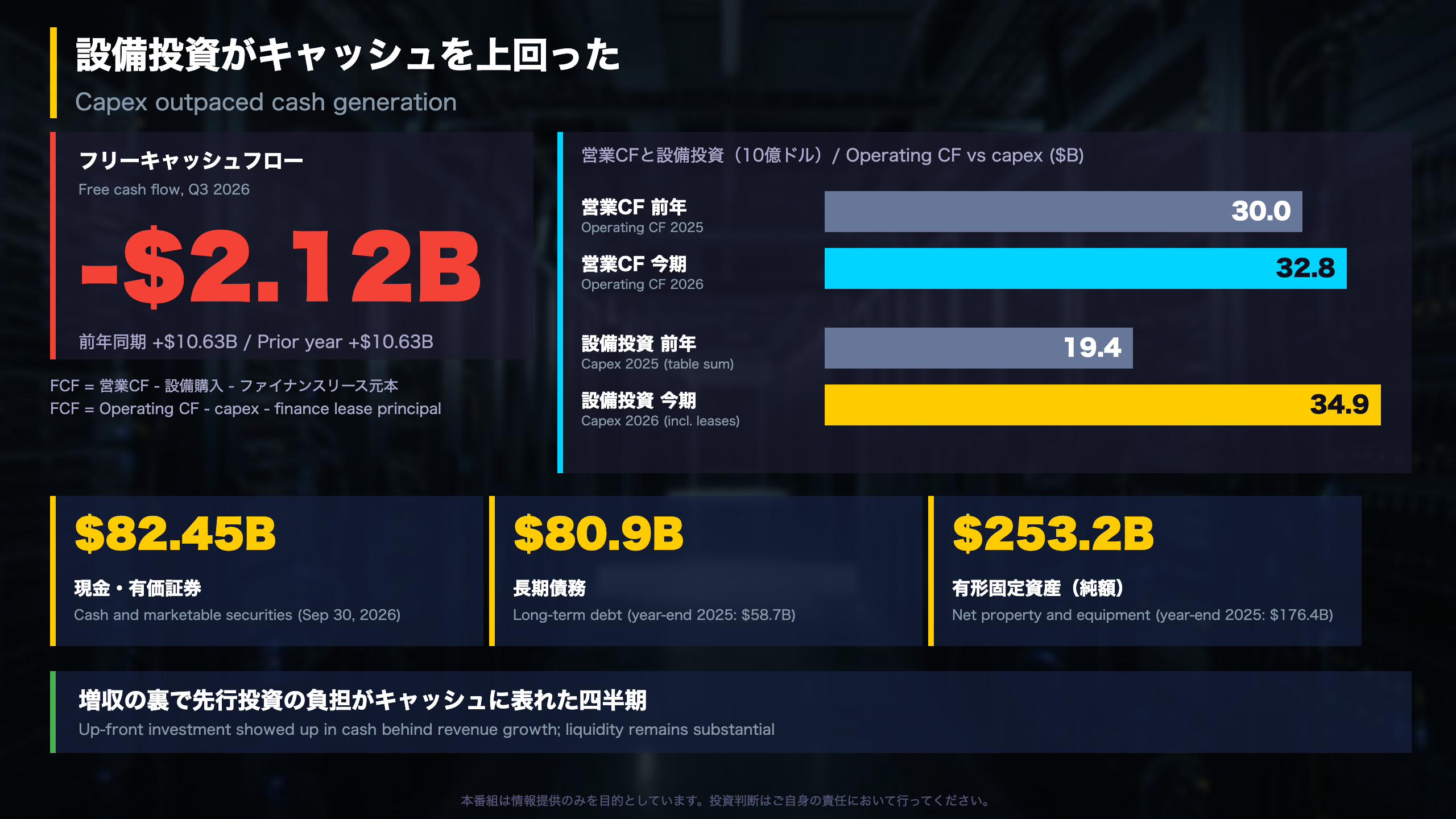
Definitions. Free cash flow (FCF) is a non-GAAP measure: operating cash flow minus purchases of property and equipment and principal payments on finance leases. Meta states it is not residual cash available for discretionary use.
Q3 and nine-month picture ($B)
- Operating cash flow: 32.8 (vs. 30.0)
- Purchases of property and equipment: 33.9 (vs. 18.8)
- Free cash flow: -2.1 (vs. +10.6)
- Nine-month FCF: 11.0 (vs. 29.5)
Funding mix
Meta issued $24.9B of long-term debt in the first nine months and made no share repurchases this quarter (vs. $3.3B a year ago and $26.2B over the first nine months of 2025). Dividends were $1.36B. Long-term debt stands at $80.9B versus $58.7B at year-end 2025, and net property and equipment rose to $253.2B from $176.4B.
International comparison
Big U.S. tech peers have also lifted capex sharply for AI infrastructure; what stands out at Meta is the pace relative to operating cash flow, which pushed quarterly FCF below zero while the balance sheet remained liquid with $82.5B in cash and marketable securities.
Two readings
Bullish: operating cash flow is growing, depreciation (up to $7.2B from $5.0B) suggests assets are being placed in service, and liquidity is ample. Cautious: buybacks have paused and leverage is rising.
What to watch
2026 capex guidance is $135-145B (low end raised from $130B). Subtracting the nine-month purchases implies a sizeable Q4 outlay, but that is our arithmetic, not company guidance.
質疑で深める:投資・見通し・クラスC株

Guidance, Class C stock and the risk backdrop
Outlook table
- Q4 revenue: $73-76B, assuming roughly a 1% FX headwind
- 2026 total expenses: $175-179B (raised to include the Q3 legal charge)
- 2026 capex: $135-145B (prior: $130-145B)
- Reality Labs 2026 loss: $18-19B; around $15B expected next year
- Q4 tax rate: 15-17%
Subtracting nine-month expenses ($127.1B) from the full-year range implies Q4 expenses of roughly $47.9-51.9B. This is our arithmetic, not a company-provided quarterly figure.
What is Class C stock?
Meta has a dual-class structure: Class B carries extra votes (held mainly by the founder) and Class A is the listed share. Starting January 19, 2027, a new listed, non-voting Class C will be created and distributed as a one-time stock dividend of one Class C share per A or B share. Meta says Class A should then trade as if a 2-for-1 split had occurred and that voting power is unchanged. The company cites capital raising, employee compensation and potential acquisitions as purposes. A Founder Alignment Agreement with Mark Zuckerberg governs his Class C sales and service conditions. Moelis advised the independent special committee and Morgan Stanley advised Meta.
Why it matters internationally
Non-voting listed shares are common in some U.S. tech companies and in parts of Europe, but are less familiar to Japanese investors, who may compare them to dual-class structures with limited governance rights.
Two readings
Supportive: more flexibility to fund AI infrastructure. Cautious: potential future dilution and continued concentration of control.
What to watch
The record and payment dates (to be set by the Board), the 10-Q, and the youth-related trials scheduled in the coming months.
Disclaimer: This article is for informational purposes only. All investment decisions are made solely at your own risk.