📺 Watch the Full Video Analysis
This article was automatically generated by the NFC Market Live AI analysis system. (Updated: 2026-10-13 09:39 JST)
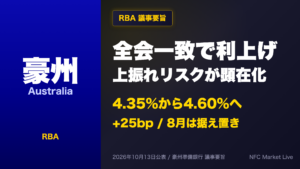
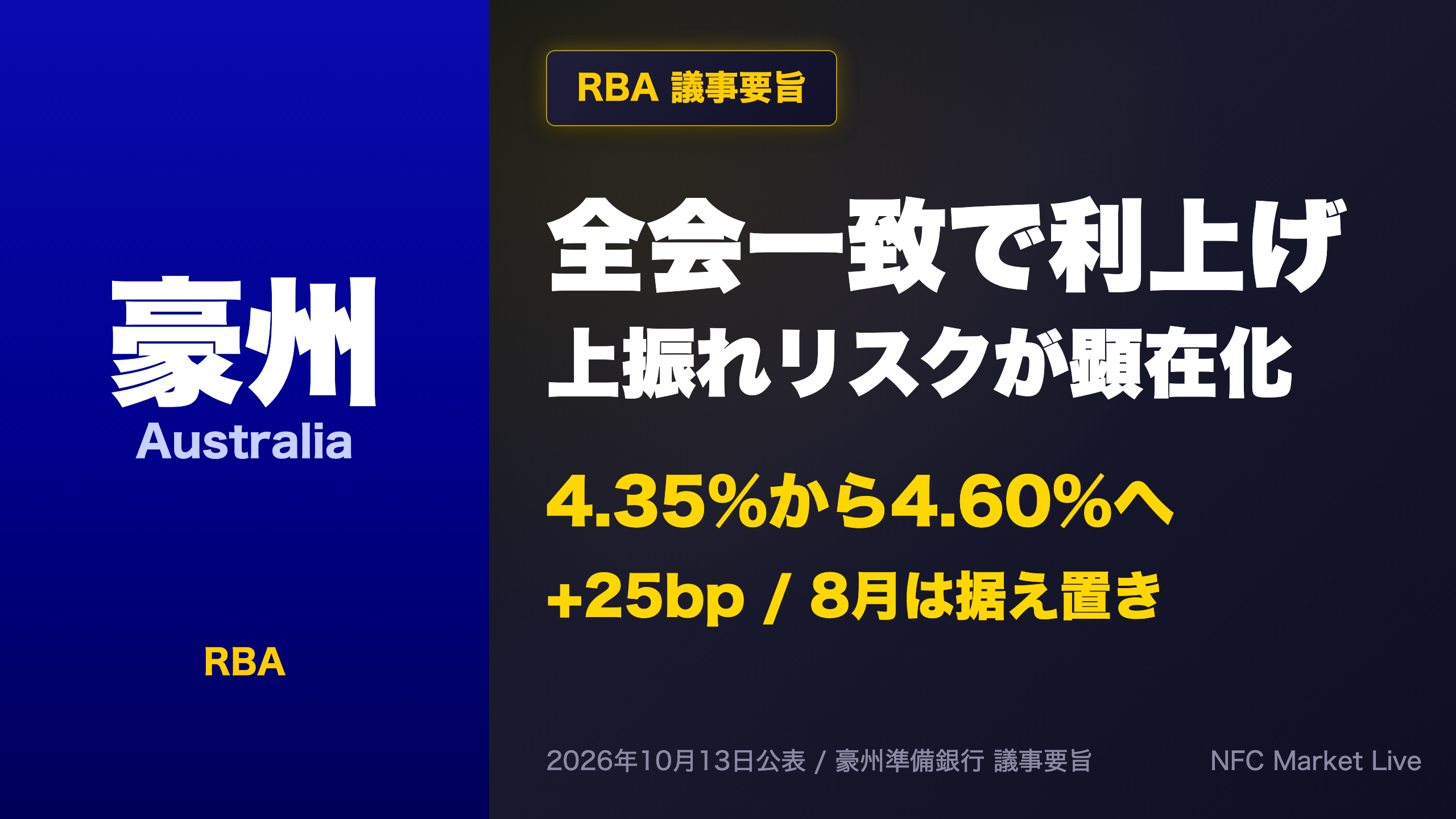
📊 A deep dive into the RBA minutes released Oct 13 (meeting of Sep 28-29). The Monetary Policy Board unanimously raised the cash rate target by 25 bp to 4.60%.
📈 The minutes say the Middle East re-escalation flagged in August had crystallised, while AI-related cost pressures and domestic capacity pressures were also building. June-quarter GDP and July inflation beat expectations.
⚠️ On the other side, housing prices fell faster than expected, new housing loans dropped sharply and household consumption slowed below trend. The Board also acknowledged the inflation-employment trade-off had deteriorated.
💡 We walk through the arguments for and against, and why the vote was unanimous. The next meeting date is not stated in the minutes.
全会一致の25bp利上げ: 政策金利4.60%へ
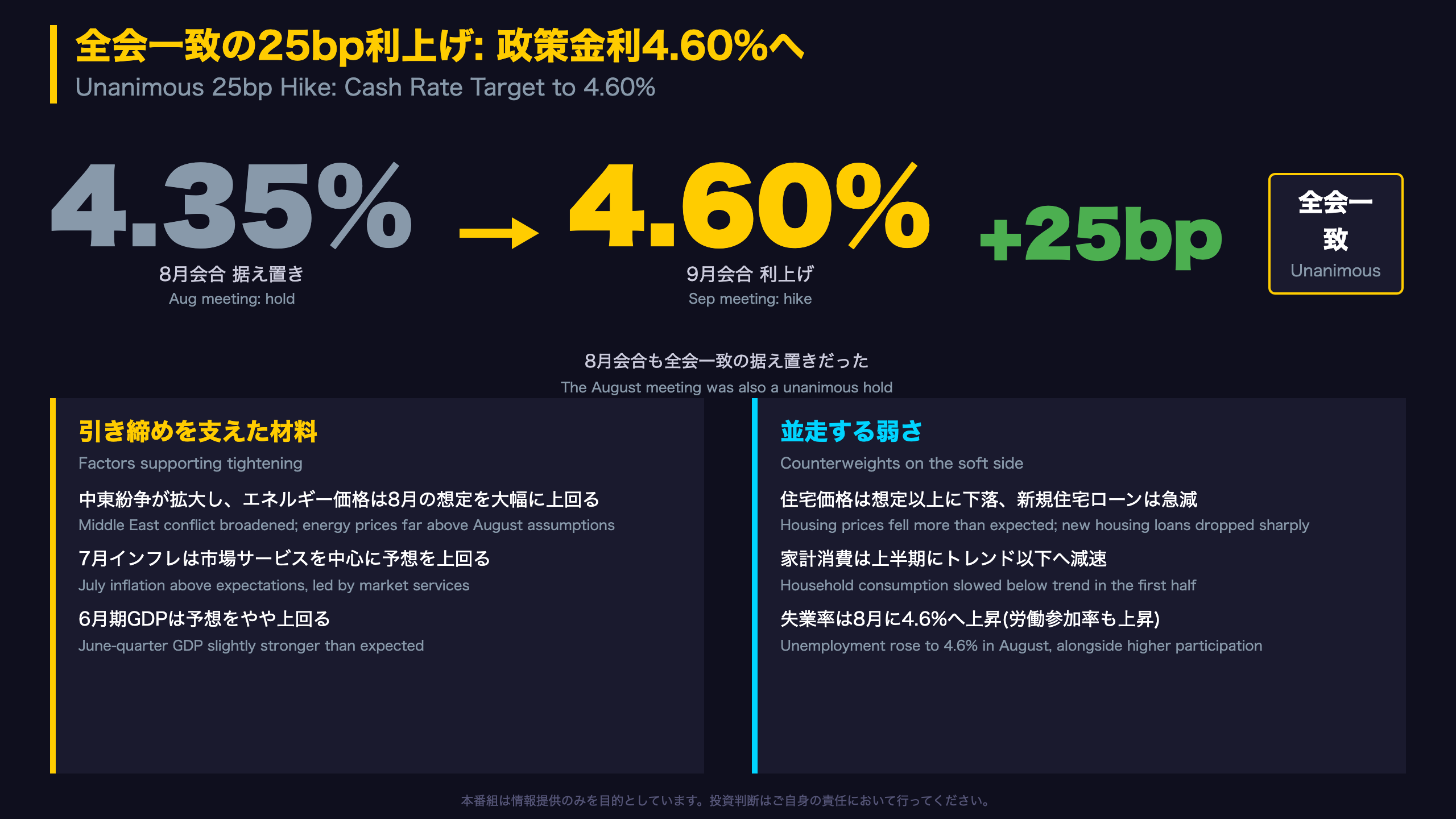
RBA Minutes, September 2026: A Unanimous Hike to 4.60%
Who and what: The Reserve Bank of Australia (RBA) is Australia’s central bank. Its Monetary Policy Board sets the cash rate target and publishes minutes about two weeks after each meeting. These minutes, released on 13 October 2026, cover the 28-29 September meeting. Unlike a data release, minutes show how the nine members weighed the evidence.
The decision
- Cash rate target raised 25 bp to 4.60%, by unanimous vote
- August: unanimous hold at 4.35%
- The August minutes noted three increases had already been delivered in 2026, which implies this is the fourth step this year
International context
The minutes say several central banks abroad had already raised policy rates, and market pricing implied tightening in most major advanced economies over 2026 and 2027. Australian market expectations had risen by less than in some other countries.
Balance of signals
- Hawkish side: energy prices well above August assumptions, GDP and July inflation above expectations
- Softer side: housing prices falling faster than expected, new housing loan commitments down sharply, consumption growth below trend
The Board decided unanimously to raise the cash rate target by 25 basis points to 4.60 per cent.
The minutes do not state the date of the next meeting.
8月の3つの上振れリスク、7週間で何が変わったか
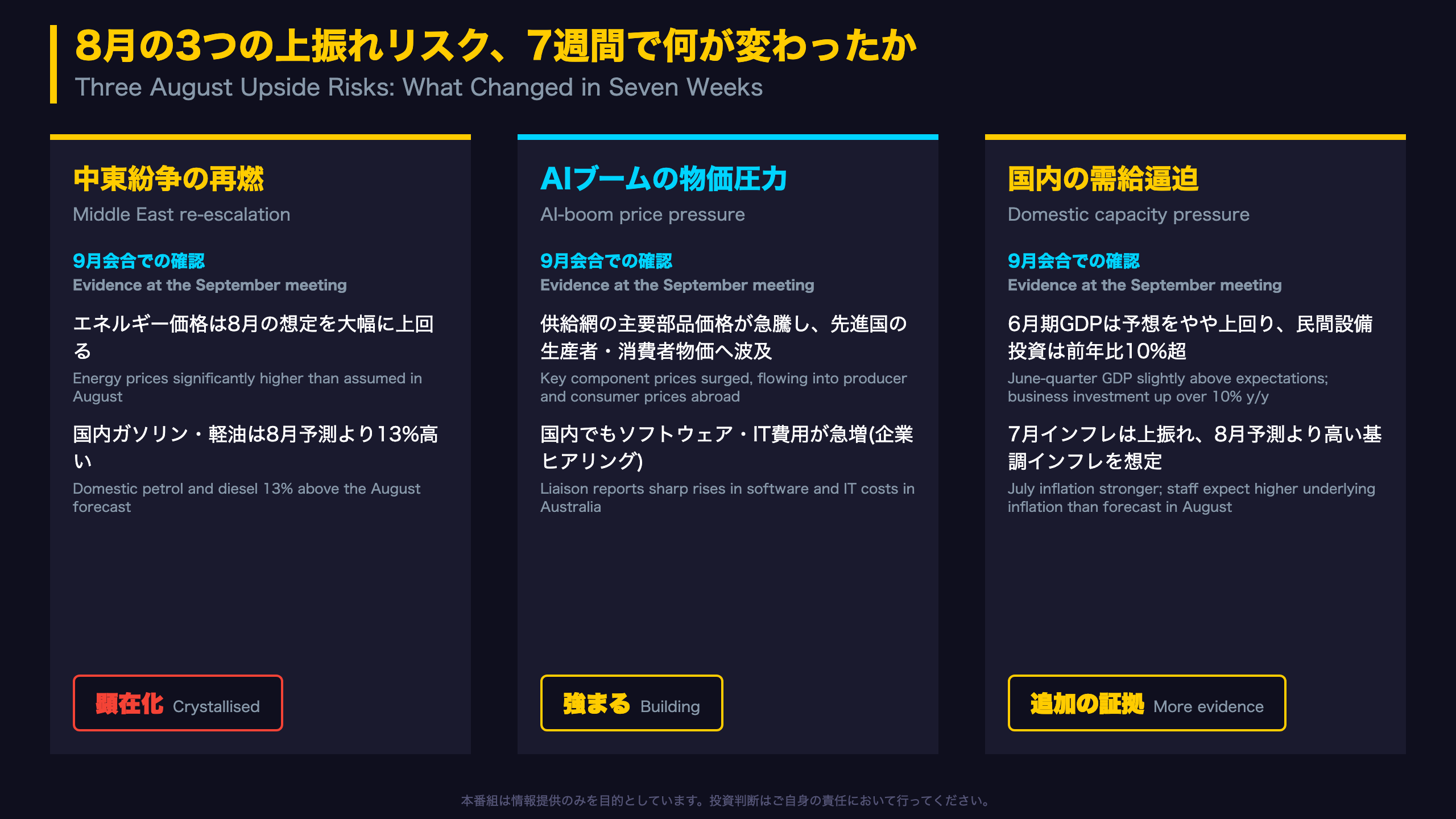
Re-testing the August risks
In August, the RBA’s nine-member Monetary Policy Board identified three upside risks to inflation: a Middle East re-escalation, price pressure from the global AI boom, and tighter domestic capacity than assumed. The September minutes check each in turn.
What changed
- Energy: shipping disruption, refinery damage and low inventories left global energy prices well above August assumptions. Australian petrol and diesel prices were 13% above the August forecast.
- AI supply chain: with demand growing rapidly and supply constrained, prices for some key components rose sharply and were increasingly flowing into producer and consumer prices in some advanced economies.
- Investment: private business investment rose by more than 10% over the year, with data centres and renewable energy facilities contributing.
Two readings
The hawkish reading is that underlying inflation was already above target in many countries, so indirect effects of higher energy prices could ultimately be larger than thought. The cautious reading is that the minutes describe pass-through abroad as limited so far, and the staff’s preliminary view was that July’s upside surprise at home more likely reflected domestic capacity pressure than cost pass-through.
Context for global readers
Australia is a commodity-linked, open economy with large Asian trade exposure. The minutes note that growth in its major trading partners had been stronger than expected, driven by AI-related activity despite the Middle East conflict and trade policy changes. That makes global conditions unusually relevant for Australian import prices.
The minutes do not give a next meeting date.
国内キャパシティ圧力: 強まる材料と緩む材料
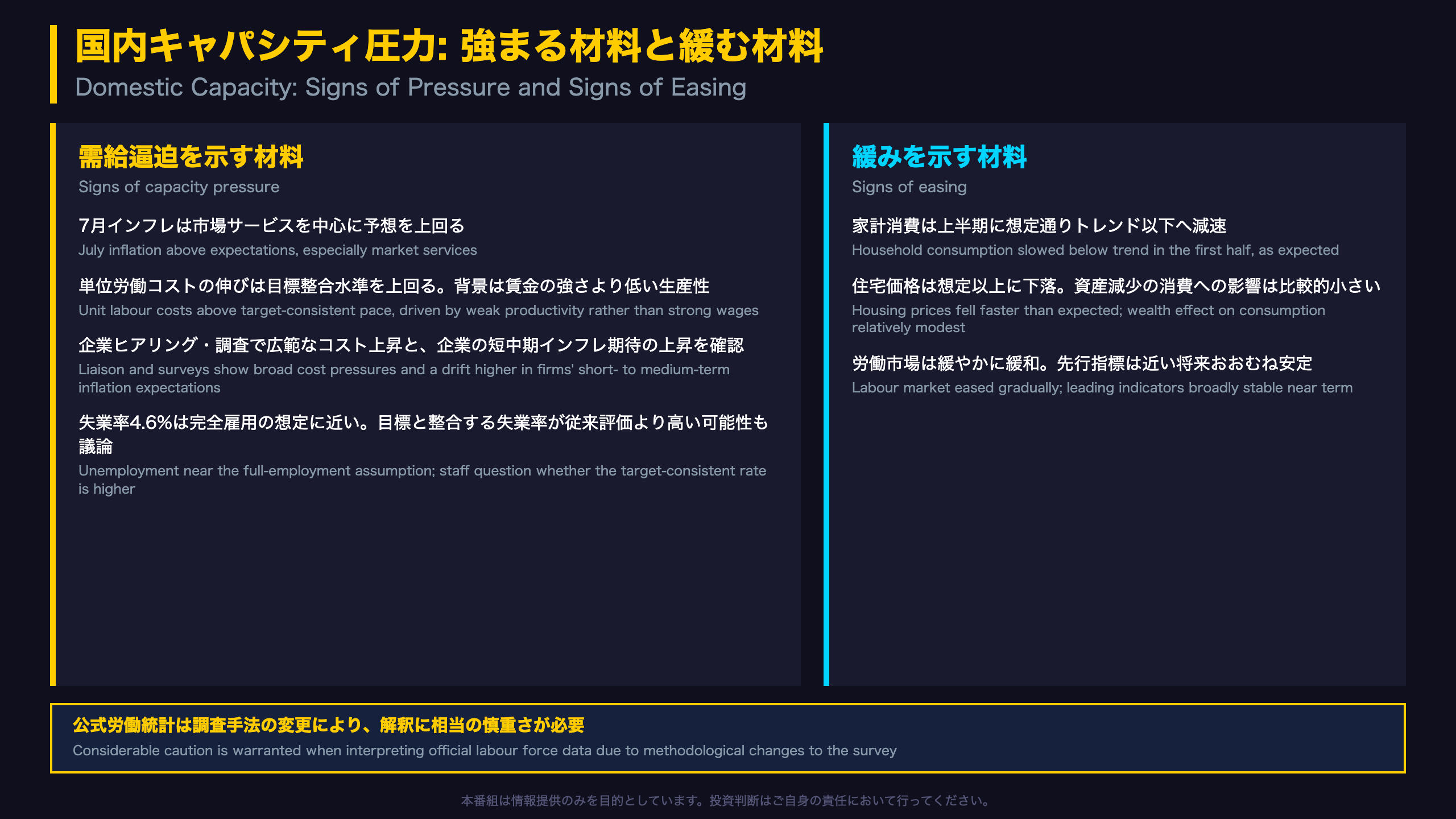
Domestic capacity: how the Board read the data
Background: Central banks judge how much “spare capacity” an economy has, because tight capacity tends to keep inflation high. The RBA’s staff assess this using unemployment, unit labour costs, business surveys and liaison with firms.
Signals of tighter capacity
- July inflation: stronger than expected, especially market services. The staff’s preliminary view was that this reflected domestic capacity pressure more than pass-through of Middle East related costs.
- Unit labour costs: growth was above a target-consistent pace, driven by subdued productivity rather than particularly strong nominal wage earnings.
- Unemployment: 4.6% in August, close to the full-employment assessment embedded in the August forecasts. The staff increasingly questioned whether the rate consistent with the inflation target is higher than previously assessed.
- Firms: surveys point to a drift higher in short- to medium-term inflation expectations of firms.
Signals of easing
- Household consumption slowed to a below-trend pace in the first half.
- Established housing prices fell faster than expected; the minutes say wealth effects on consumption tend to be relatively modest.
- Leading labour indicators pointed to broadly stable conditions near term.
Data caveat
The minutes state that considerable caution is warranted in interpreting official labour force data because of methodological changes to the survey.
Comparison
Unlike the US, where the Fed watches monthly payrolls closely, Australia’s debate here centres on productivity and unit labour costs as signs of supply constraint.
全会一致の論拠: 利上げ3点 vs 据え置き論
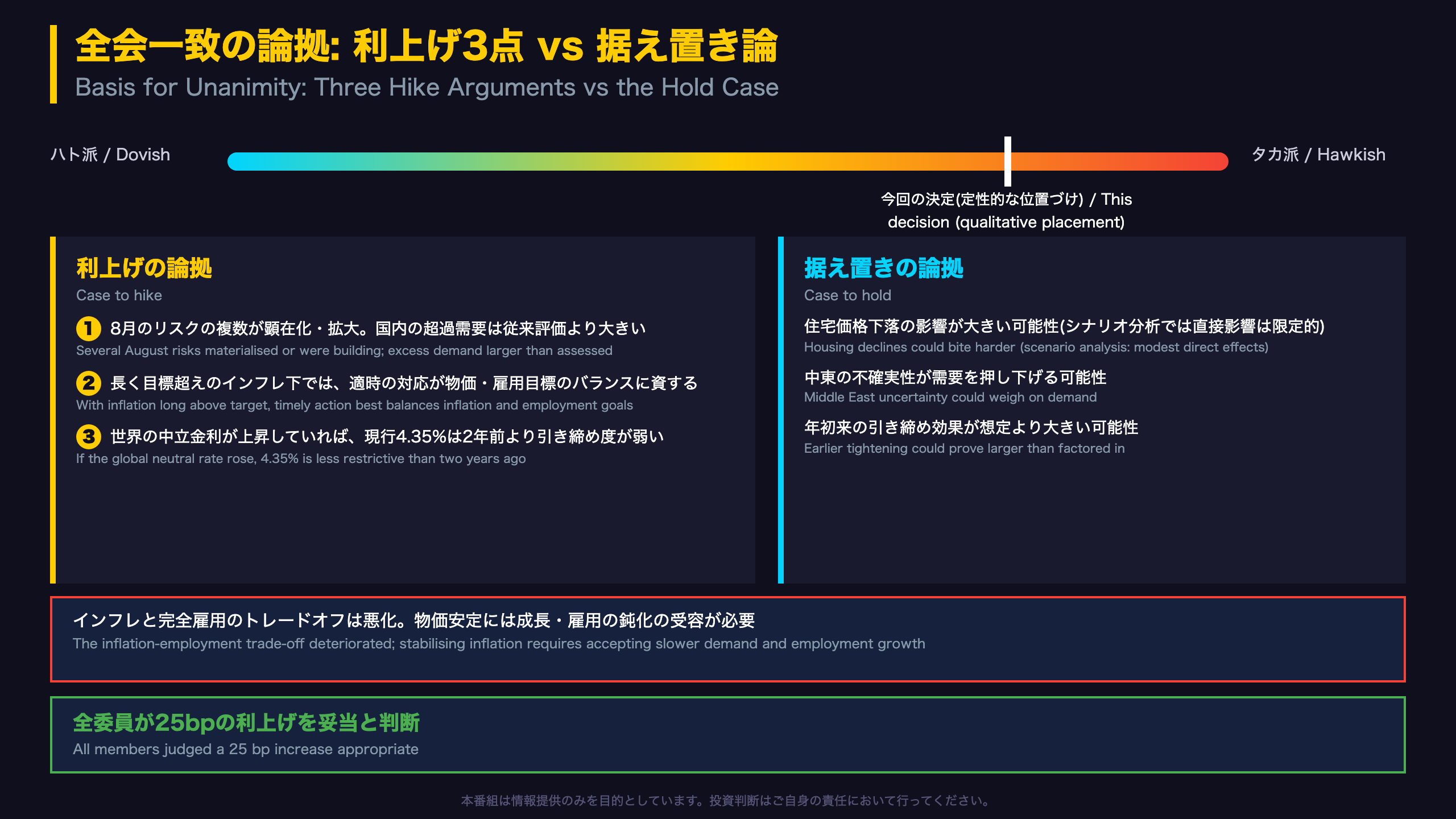
Inside the vote: hike vs hold
Why this section matters: Minutes are valuable because they list the arguments the Board weighed. In August the Board held, judging there was time to watch incoming data. In September, the weight of argument moved.
The three arguments for hiking
- Several August upside risks had materialised or were building; excess demand looked larger than assessed.
- Waiting could be costly: inflation had been above target for an extended period, and surveys and liaison showed a growing risk that firms’ medium-term inflation expectations were rising.
- The current 4.35% might not bring the economy back to balance within a reasonable timeframe if the global neutral rate is higher. Other central banks’ tightening could also loosen Australian financial conditions via a weaker exchange rate if the RBA stood still.
The case for holding
It relied on larger-than-expected downside risks: falling housing prices, Middle East uncertainty and stronger effects from earlier tightening. Scenario analysis, however, suggested even large housing price falls would have modest direct effects on activity.
Reassuring signs
Leading indicators showed no sign of a sharp near-term slowdown in the labour market, and household and business balance sheets appeared able to buffer higher rates.
The cost
Executing this strategy in an environment of more persistent adverse supply shocks would require accepting slower growth in demand and employment than would otherwise be the case.
For global readers: this is a similar supply-shock dilemma to those faced by other central banks, which the minutes note have also tightened.
金融環境と金融安定: 評価と次の注目点
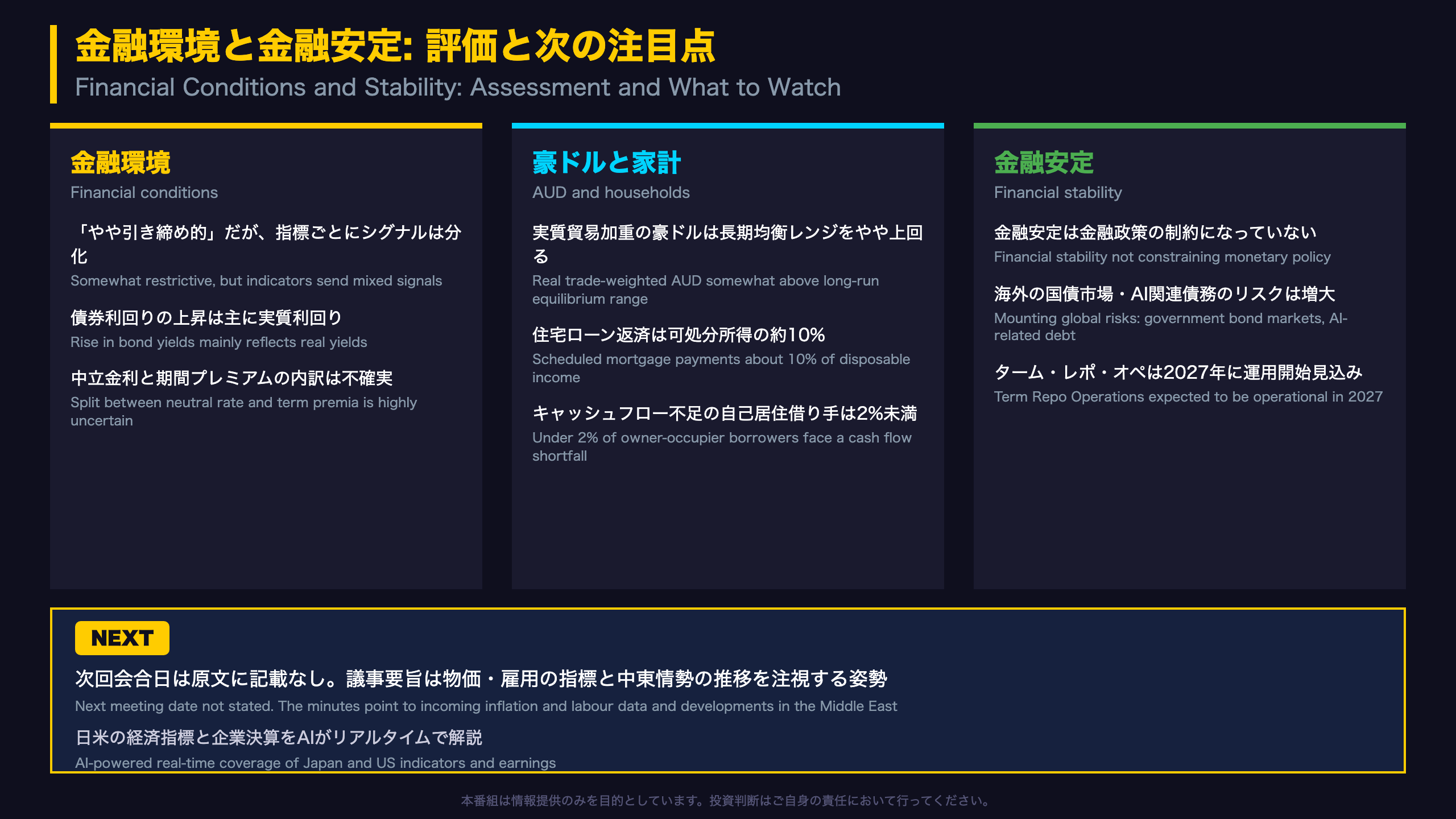
Financial conditions and stability: details
Financial conditions: somewhat restrictive, but mixed
- The cash rate sits around the top of the range of model-based central estimates of the neutral rate, while the market-implied future path lies above that range.
- Higher long-term bond yields mainly reflected real yields; long-term inflation compensation stayed consistent with targets.
- The minutes explain why the split matters: higher neutral rates imply looser financial conditions at a given policy rate, while higher term premia imply tighter ones. Yet the split is highly uncertain.
- The Australian dollar was about 5% higher since the start of the year; in real trade-weighted terms it was somewhat above its long-run equilibrium range.
Financial stability
The RBA gives advice to Australia’s financial regulators, and the minutes concluded that borrower and bank resilience meant stability concerns were not constraining monetary policy.
– Under 2% of owner-occupier borrowers faced a cash flow shortfall, well below the 2023-2024 peak.
– Very few borrowers would be in negative equity even if housing prices fell 20%.
– Global risks were judged more material than domestic cyclical risks: price-sensitive investors and leverage in bond markets, low risk premia, and AI-related debt.
Policy framework note
The Board endorsed Term Repo Operations, to be operational in 2027.
Members agreed that they would remain attentive to incoming data and the evolving assessment of the outlook and risks.
The next meeting date is not given in the minutes.
Disclaimer: This article is for informational purposes only. All investment decisions are made solely at your own risk.