This article was automatically generated by the NFC Market Live AI analysis system. (Updated: 2026-10-02 08:56 JST)
📄 Primary Source
日本銀行
https://www.boj.or.jp/statistics/boj/other/mb/base2608.pdf
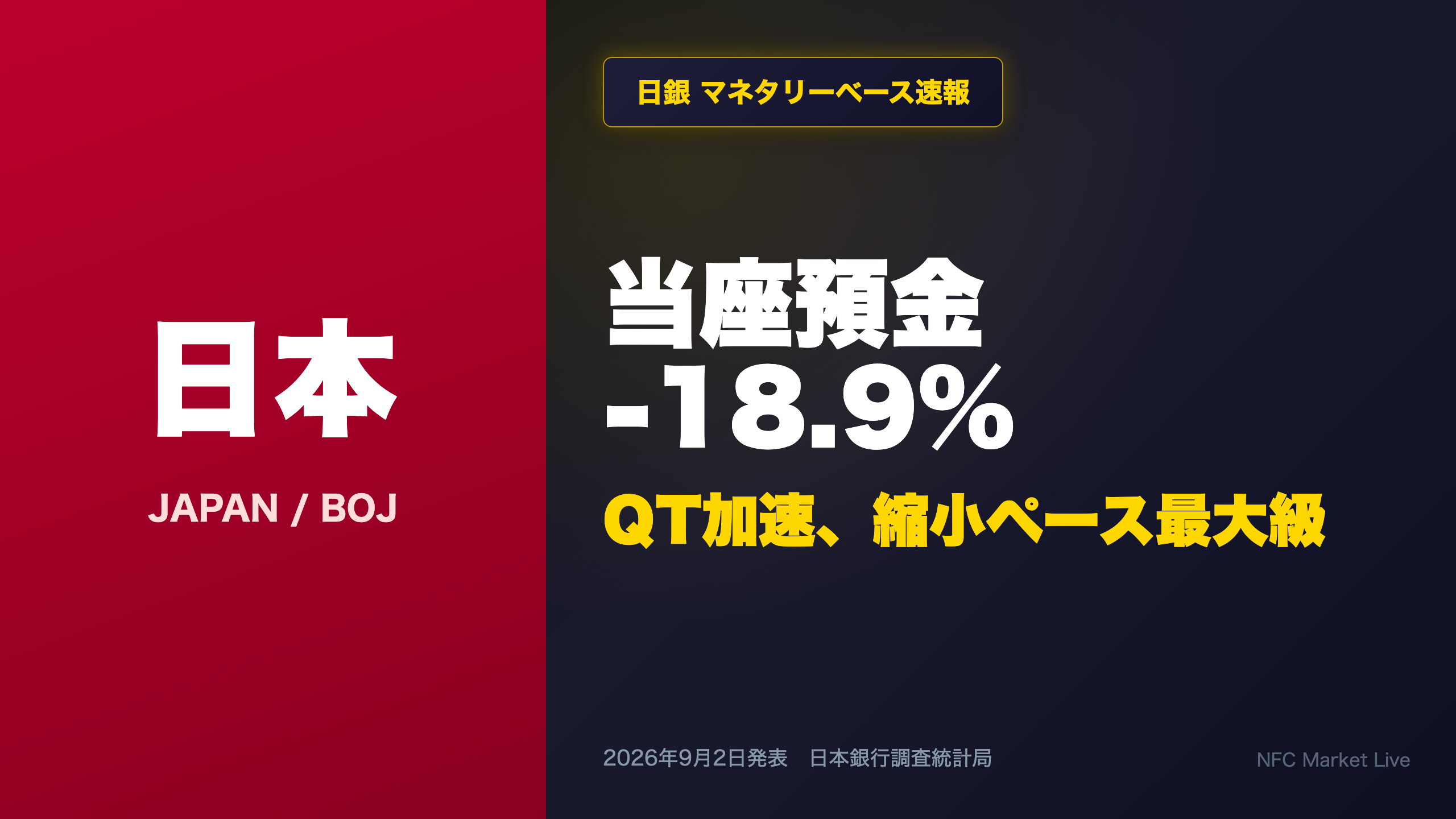
📊 The Bank of Japan released August 2026 Monetary Base data.
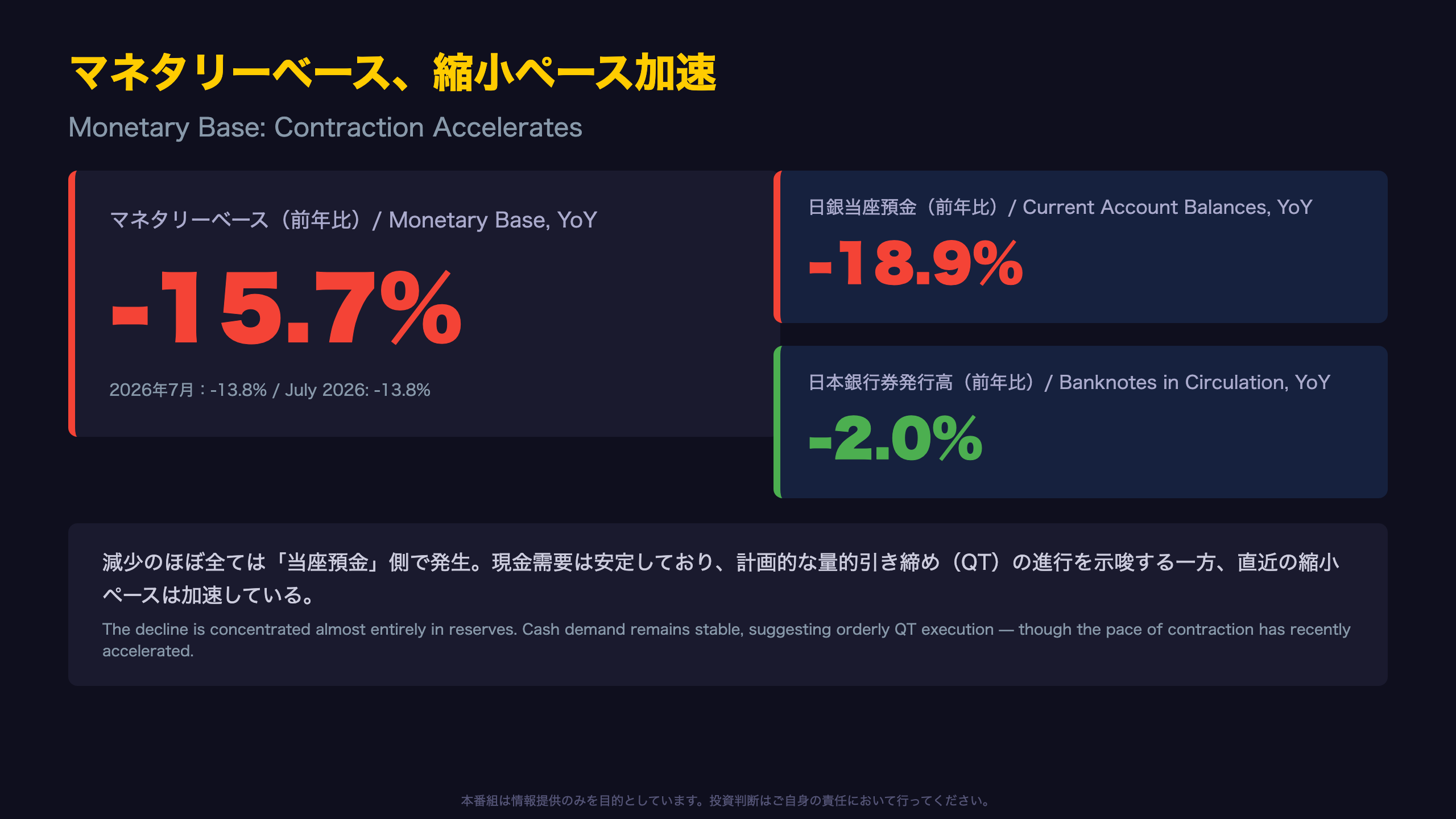
Year-on-year, the Monetary Base fell -15.7%, with current account balances (reserves) down a sharp -18.9%.
💡 The key asymmetry: banknotes in circulation stayed nearly flat at -2.0%, showing no unusual shift in cash demand. Nearly the entire decline traces to reserves — a mechanical result of BOJ’s planned JGB purchase tapering (quantitative tightening).
⚠️ The seasonally adjusted annualized monthly rate plunged to -28.8%, though this series is historically volatile — a single month shouldn’t be read as a policy pivot.
📈 We break down the transmission to JGB yields and the yen, weighing structural strength against emerging risks.
マネタリーベース、縮小ペース加速
What Is the Monetary Base?
Japan’s Monetary Base is the sum of banknotes in circulation, coins in circulation, and current account balances held by commercial banks at the Bank of Japan (BOJ) — the central bank’s reserves. It functions much like the Fed’s reserve balances, serving as a direct gauge of how much liquidity the BOJ is injecting into the banking system.
The Headline Number
In August 2026, the Monetary Base fell -15.7% year-on-year (average outstanding), deepening from -13.8% in July. This continues a multi-year arc: +1.0% in full-year 2024 (even after the BOJ ended negative rates and yield curve control in March 2024), -4.9% for 2025, and further acceleration in 2026 (Q1: -10.6%, Q2: -12.4%).
Cash vs. Reserves
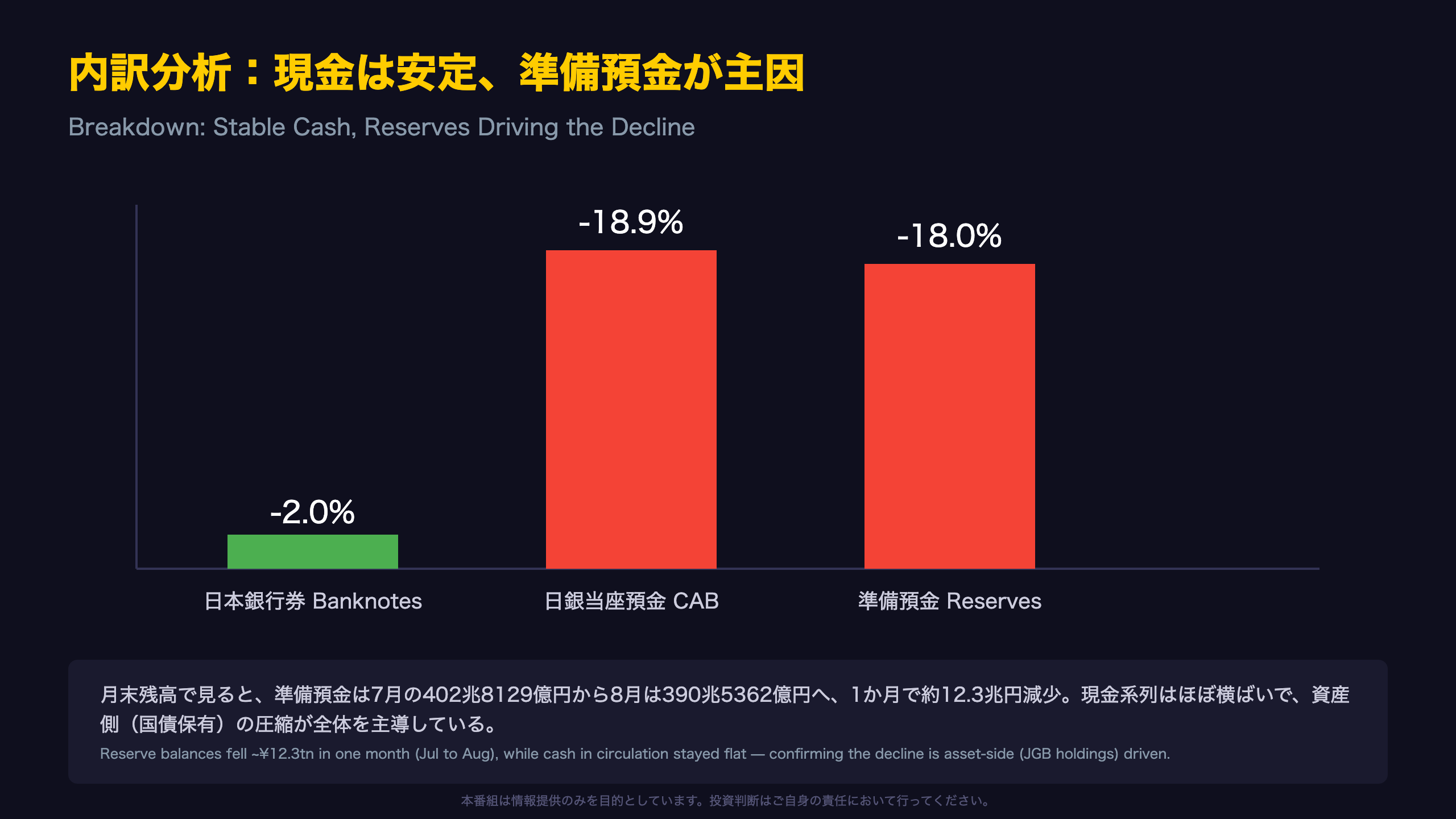
Banknotes in circulation were essentially flat at -2.0% YoY, while current account balances plunged -18.9%. This asymmetry confirms the contraction is a deliberate balance-sheet reduction (quantitative tightening), not weakening cash demand or financial stress.
Raw data: current account balances averaged roughly ¥423.4 trillion in August 2026.
The next release is due in early October 2026, covering September data.
内訳分析:現金は安定、準備預金が主因
Reserve Balances: The Epicenter of the Decline
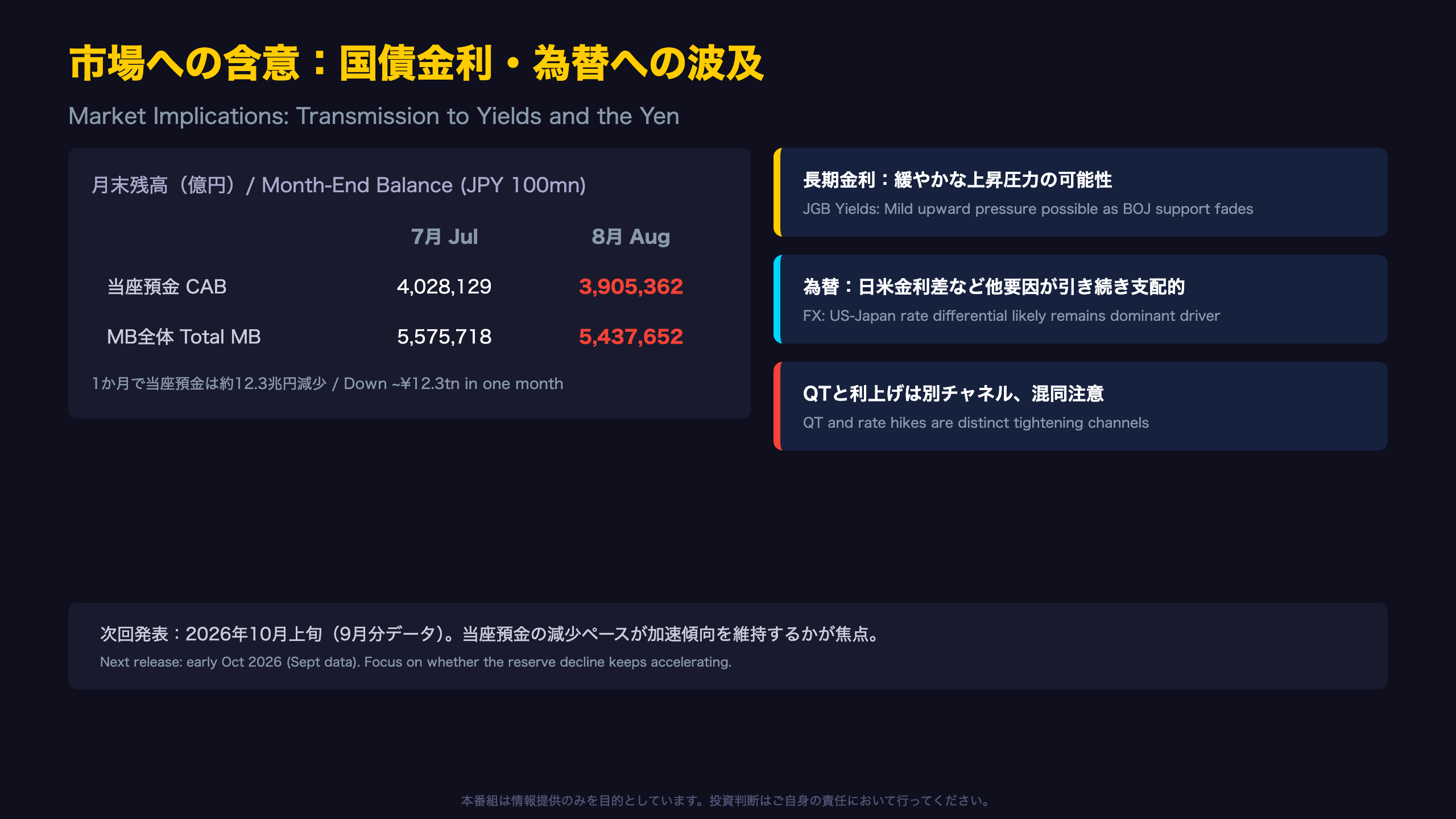
Reserve balances — the portion of BOJ current account deposits exceeding required reserves — fell -18.0% YoY in August, worse than July’s -15.3%. On an end-of-month basis, balances dropped from ¥402.8 trillion in July to ¥390.5 trillion in August, a one-month decline of roughly ¥12.3 trillion.
Coins in Circulation: The Stable Anchor
Coins in circulation fell just -1.2% YoY (vs. -1.1% in July) — a negligible change. Combined with near-flat banknote growth, this confirms underlying cash demand is unremarkable; the entire Monetary Base story is being written on the reserves side of the ledger.
A Fed Comparison
Unlike the Fed’s post-2019 \”ample reserves\” debate, the BOJ has long operated with reserves far in excess of required levels due to years of quantitative easing. A faster-than-planned drawdown raises a similar question to the Fed’s 2019 repo-market stress episode: at what point does shrinking excess reserves begin to tighten short-term funding conditions?
Two Readings
One view: ample excess reserves make near-term money-market stress unlikely. The counter-view: an accelerating drawdown could compress the cushion faster than expected, raising volatility risk in Japan’s overnight call rate.
加速するペース:季節調整済み年率-28.8%
Reading Through the Noise: Seasonally Adjusted Volatility
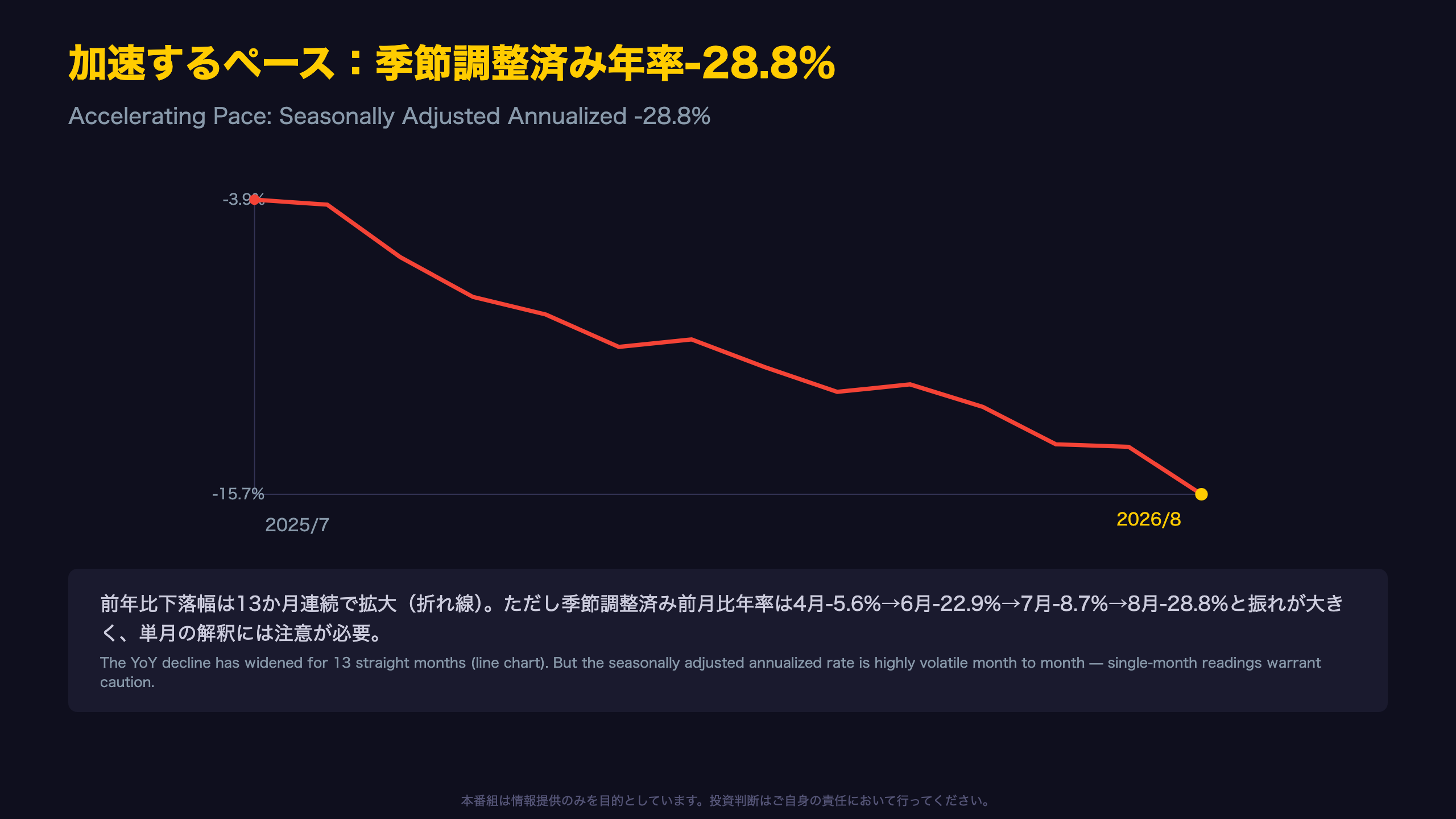
The BOJ’s seasonally adjusted, annualized month-on-month Monetary Base change is a notoriously volatile series. It swung from -5.6% in April 2026 to -22.9% in June, back to -8.7% in July, then plunged to -28.8% in August — a textbook case for why single-month readings should not be over-interpreted, much like reading too much into one month of U.S. M2 data without smoothing.
The Steadier Signal: Year-on-Year Trend
The quarterly trend tells a more reliable story: -2.5% (Q1 2025), -3.9% (Q2), -4.7% (Q3), -8.7% (Q4), -10.6% (Q1 2026), -12.4% (Q2 2026). Unlike the noisy monthly annualized figure, this cadence shows an orderly, continuously deepening contraction consistent with a pre-committed, gradual QT program rather than an abrupt policy shift.
An International Parallel
This pattern echoes the Fed’s 2017-2019 balance-sheet runoff, where the pace was also pre-committed yet single-month data fluctuated with Treasury auction and settlement timing — a useful analogy for why Japan’s August acceleration deserves caution before being read as a deliberate policy pivot.
The next data release, covering September 2026, is due in early October.
市場への含意:国債金利・為替への波及
Transmission Channels: JGB Yields and the Yen
A shrinking BOJ current account balance mechanically reflects a smaller BOJ balance sheet — specifically, fewer Japanese Government Bond (JGB) holdings, as the central bank continues tapering purchases first announced in July 2024. This is Japan’s version of the Fed’s post-2022 balance-sheet runoff, though on a different timeline given the BOJ’s historically much larger QE legacy (JGB holdings once exceeded half of outstanding issuance).
Market Implications
As BOJ bond-buying recedes, one structural pillar supporting JGB prices (and suppressing yields) gradually weakens, creating a mild upward bias for long-end yields over time. This is distinct from a policy-rate hike signal; QT and rate normalization operate through different channels. For FX markets, the US-Japan interest-rate differential and Fed policy trajectory likely remain the dominant yen drivers near term, with balance-sheet normalization a secondary, slower-moving factor.
Two Interpretations
A hawkish reading: the accelerating reserve drawdown signals the BOJ entering the faster final phase of its QT program. A more cautious reading: August’s outsized move may simply reflect JGB redemption timing rather than a deliberate pace change — a distinction that will only become clear with more data.
Next release: early October 2026, covering September data. Watch whether the July-August acceleration in current account balance reduction persists.
Disclaimer: This article is for informational purposes only. All investment decisions are made solely at your own risk.