This article was automatically generated by the NFC Market Live AI analysis system. (Updated: 2026-10-02 08:44 JST)
📄 Primary Source
総務省統計局
https://www.stat.go.jp/data/roudou/sokuhou/tsuki/pdf/gaiyou.pdf
📊 Deep dive into Japan’s August 2026 Labour Force Survey from the Ministry of Internal Affairs and Communications (MIC).
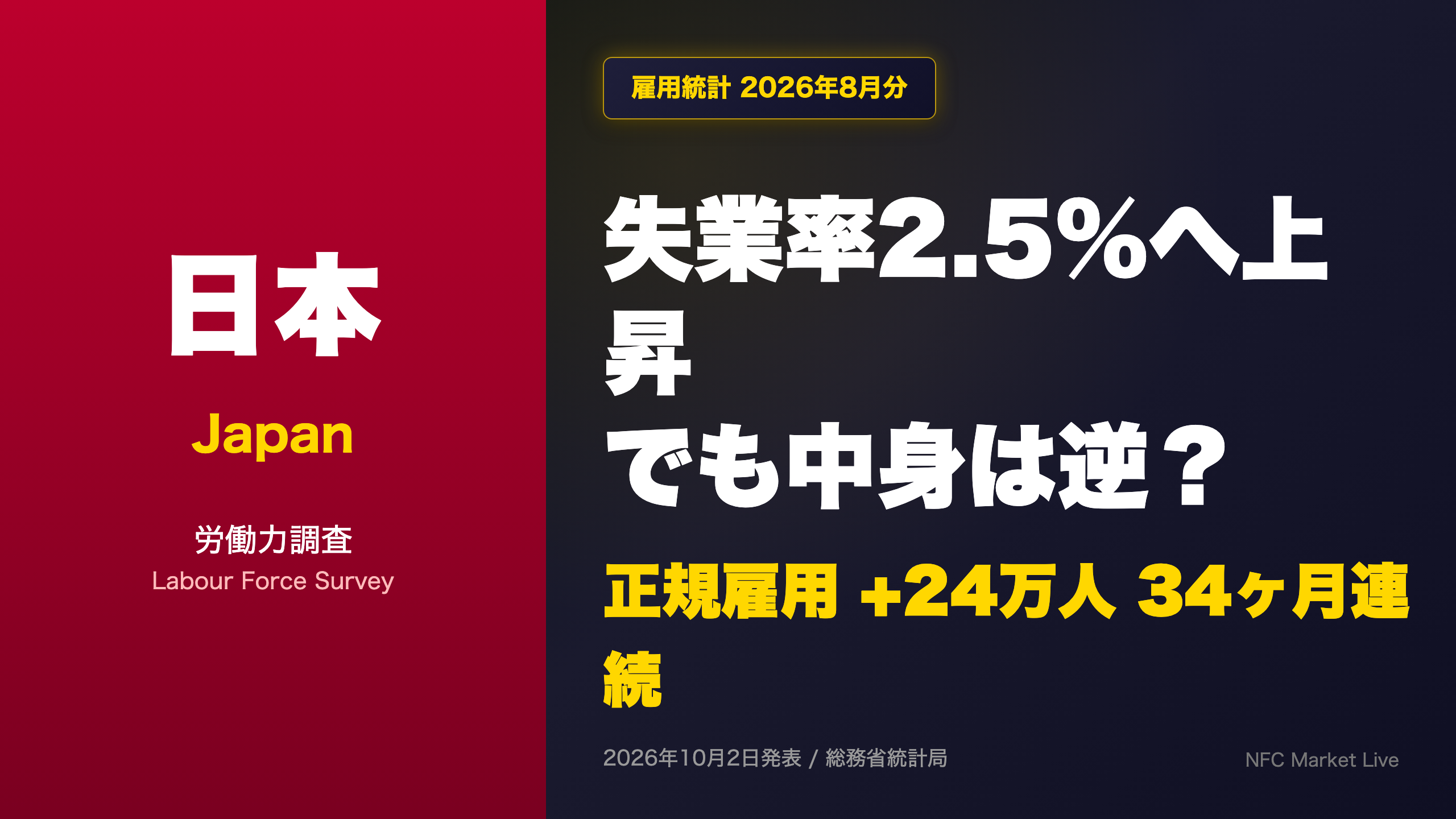
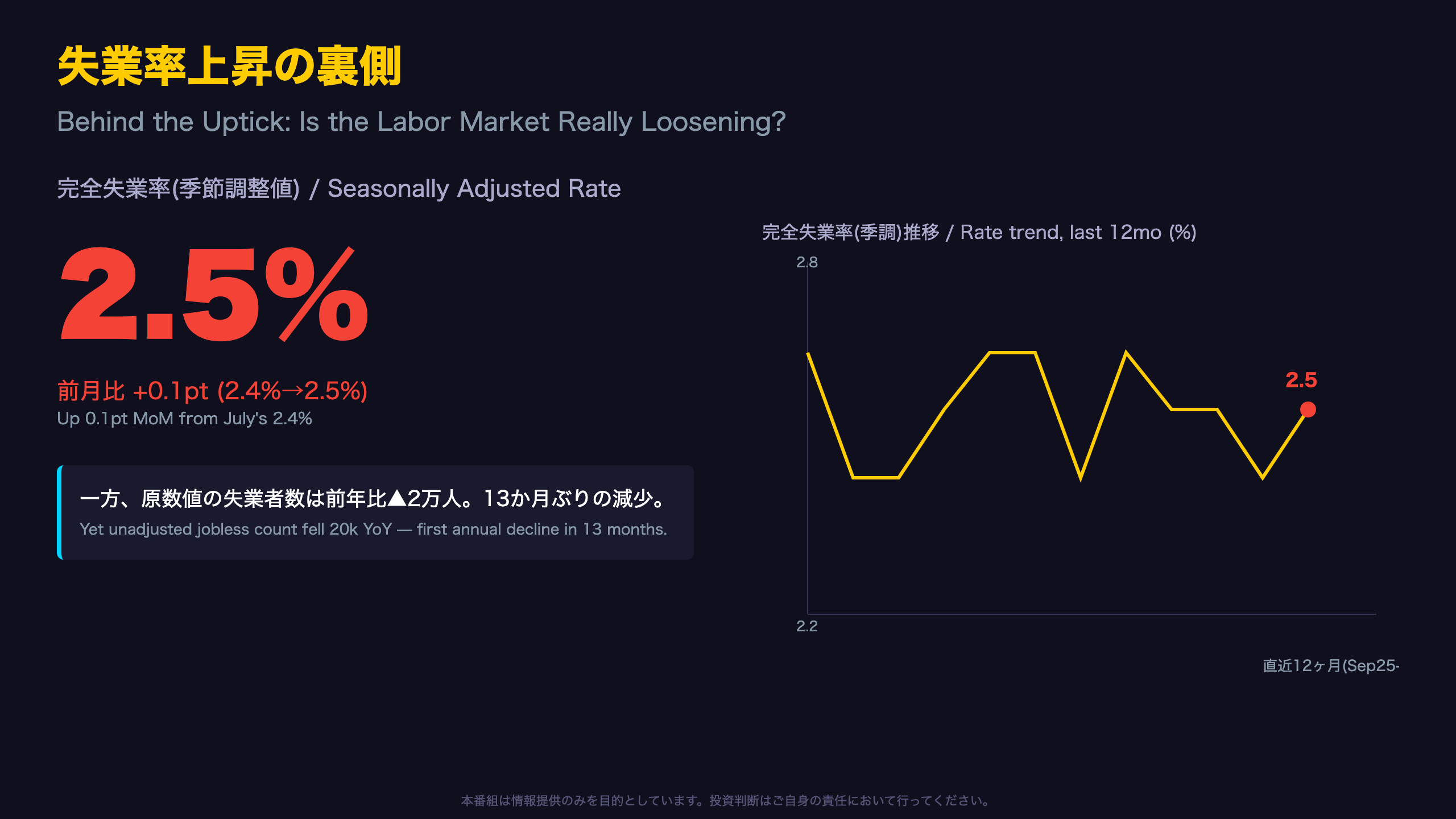
The seasonally adjusted unemployment rate rose from 2.4% to 2.5%—seemingly a red flag.
💡 But the unadjusted jobless count actually fell 20k YoY, the first annual decline in 13 months. Employee count rose +390k (54 straight months), regular employment accelerated to +240k (34 straight months).
⚠️ The rise in joblessness was driven by voluntary resignations, not layoffs—while male employment fell and retail continued shedding jobs.
We unpack what this means for the BOJ’s wage-price virtuous cycle thesis.
失業率上昇の裏側—労働市場は緩んだのか
Summary: A Tale of Two Unemployment Measures
The most striking feature of this release is that Japan’s unemployment rate tells two contradictory stories depending on which measure you use.
- Seasonally adjusted: rose from 2.4% to 2.5% (male 2.6%→2.8%, female 2.1%→2.3%)
- Unadjusted (raw) count: 1.80 million jobless, down 20,000 year-on-year — the first annual decline in 13 months
The original Japanese release states: “完全失業者数は180万人。前年同月に比べ2万人の減少。13か月ぶりの減少” (the number of unemployed fell 20,000 from a year earlier, the first such decline in 13 months).
Context for international readers: Japan’s Labour Force Survey (労働力調査), published monthly by the Statistics Bureau of MIC, is the closest equivalent to the U.S. Bureau of Labor Statistics’ household survey. Unlike the U.S. report, Japan rarely sees dramatic swings — its unemployment rate has hovered in a narrow 2.4%-2.6% band for the past twelve months, reflecting a structurally tight labor market driven by demographics (a shrinking working-age population) rather than cyclical demand swings.
Given this historical band, the one-month uptick to 2.5% is statistically unremarkable on its own. The more informative signal — which this Deep Dive unpacks — is the composition of who is becoming unemployed and why, which carries direct implications for the Bank of Japan’s assessment of wage-price dynamics and JPY-rate markets.
雇用の基礎体力—正規雇用は加速している
Regular Employment Accelerates, Underlying Hiring Stays Robust
Comparing July to August reveals a clear theme: acceleration.
| Metric | July (YoY) | August (YoY) |
|---|---|---|
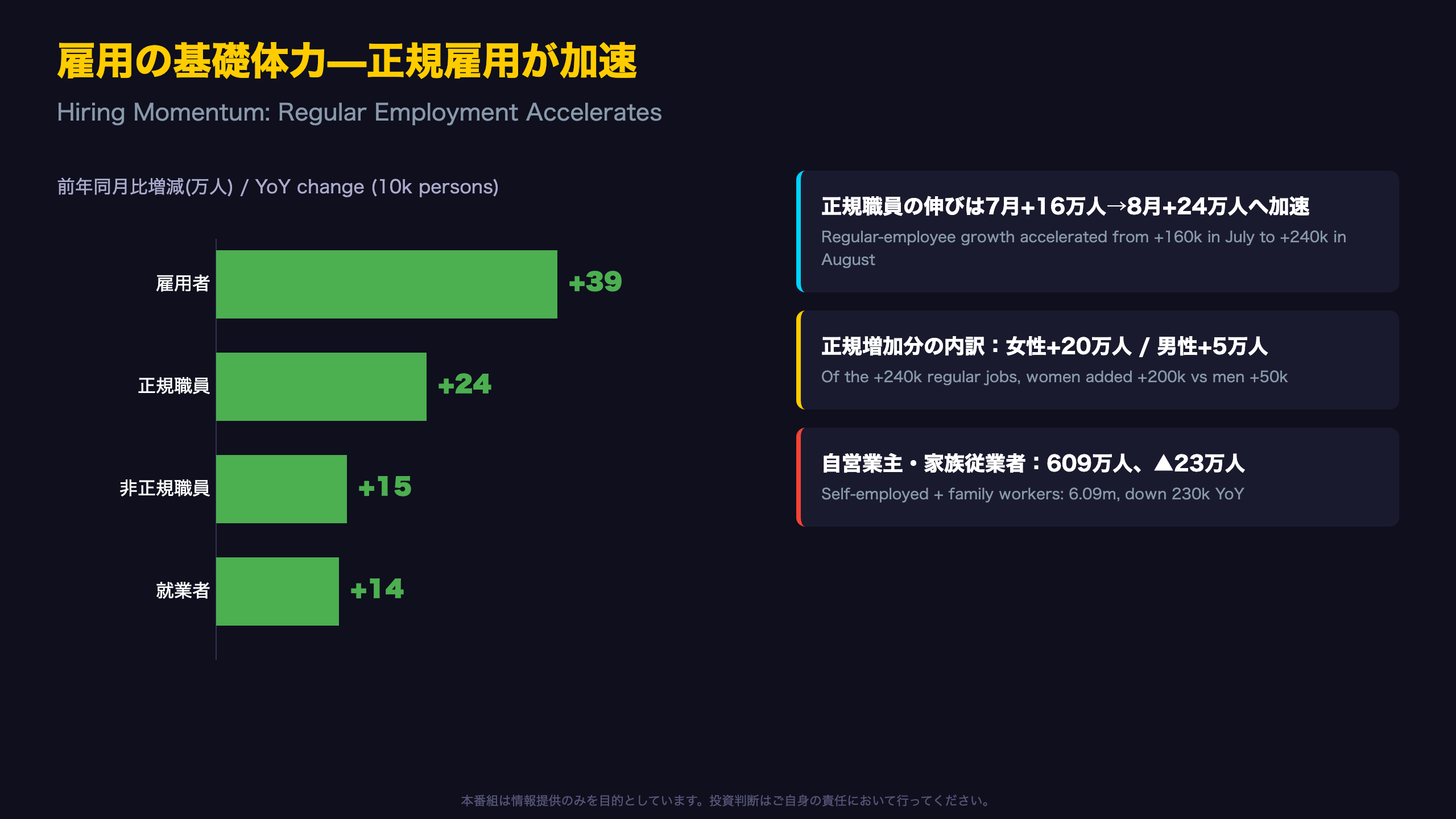
| Employees | +360k | +390k |
| Regular employees | +160k | +240k |
| Non-regular employees | +150k | +150k |
| Total employed | flat (0) | +140k |
The jump in regular-employee growth from +160k to +240k suggests Japanese firms are intensifying efforts to lock in permanent staff amid persistent labor shortages — a dynamic with no direct U.S. equivalent, since Japan’s employment system traditionally emphasizes long-term, seniority-based regular contracts (正社員) over the more fluid at-will employment common in the U.S.
Notably, the gender split is stark: of the 240k increase in regular employment, women accounted for 200k versus just 50k for men. Female labor force participation continues to be the primary engine of Japan’s employment growth, a multi-year structural trend tied to policy efforts (e.g., “Womenomics”) and demographic necessity.
Meanwhile, self-employed and family workers fell to 6.09 million, down 230k (-3.6%) year-on-year, continuing the decades-long shift from self-employment toward wage employment.
Market implication: Accelerating regular hiring is typically viewed by the Bank of Japan as supportive of sustained wage growth — a key pillar of its “virtuous cycle between wages and prices” framework underpinning the gradual policy normalization path. The next release (Sept data) arrives October 30, 2026.
失業増の正体—解雇減・自己都合増の構図
Decomposing the Quality of the Unemployment Uptick
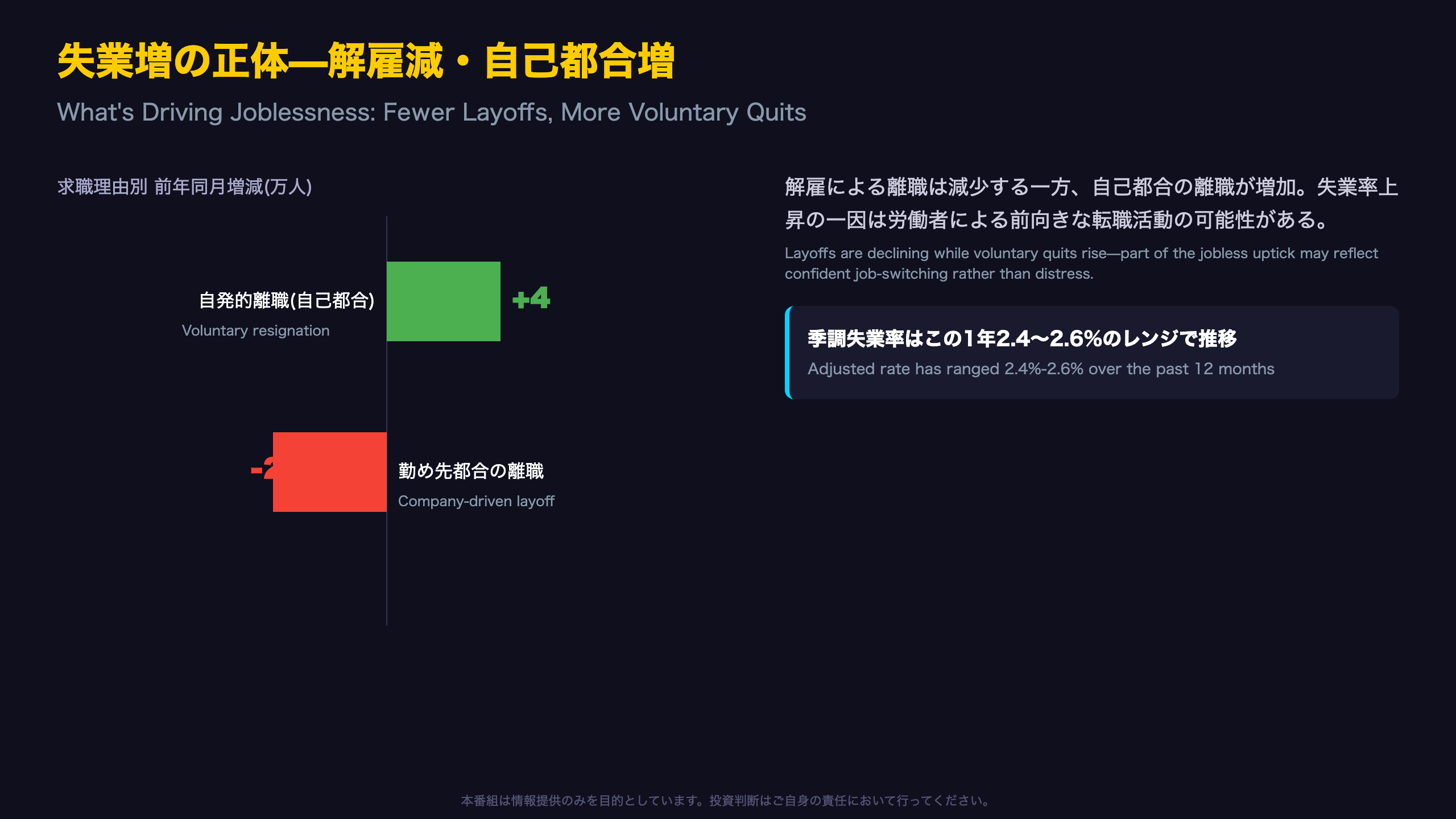
The official release states that by reason for job search, “company-related involuntary separations fell by 20,000, while voluntary (self-motivated) resignations rose by 40,000” year-on-year.
- Involuntary separations (layoffs etc.): 410,000 (of which, company-related: 230,000, -20k YoY)
- Voluntary resignations: 840,000 (+40k YoY)
- New job seekers: 450,000 (-20k YoY)
This breakdown is analytically important: a rise in voluntary resignations, rather than layoffs, is generally interpreted in labor economics as a sign of a tight, worker-friendly job market — comparable to the “quits rate” signal in the U.S. JOLTS report, where elevated quits reflect confidence that better opportunities are readily available, rather than labor market distress.
However, this remains a single-month data point and should not be treated as a confirmed trend. Both male (2.6%→2.8%) and female (2.1%→2.3%) seasonally adjusted rates rose simultaneously by 0.2 points — a detail worth monitoring.
Looking at the official seasonally adjusted time series (付表), the rate has oscillated between 2.4% and 2.6% since peaking at 2.6% in September 2025. The current 2.5% reading sits near the midpoint of that twelve-month range, not outside it.
Alternative reading: Some analysts may interpret this as unemployment having “bottomed out” and beginning to re-accelerate. The next release (September data, due October 30, 2026) will be key to determining whether voluntary-quit-driven unemployment continues, or whether the adjusted rate stabilizes around 2.5%.
産業・男女構造—医療福祉が牽引、小売は縮小継続
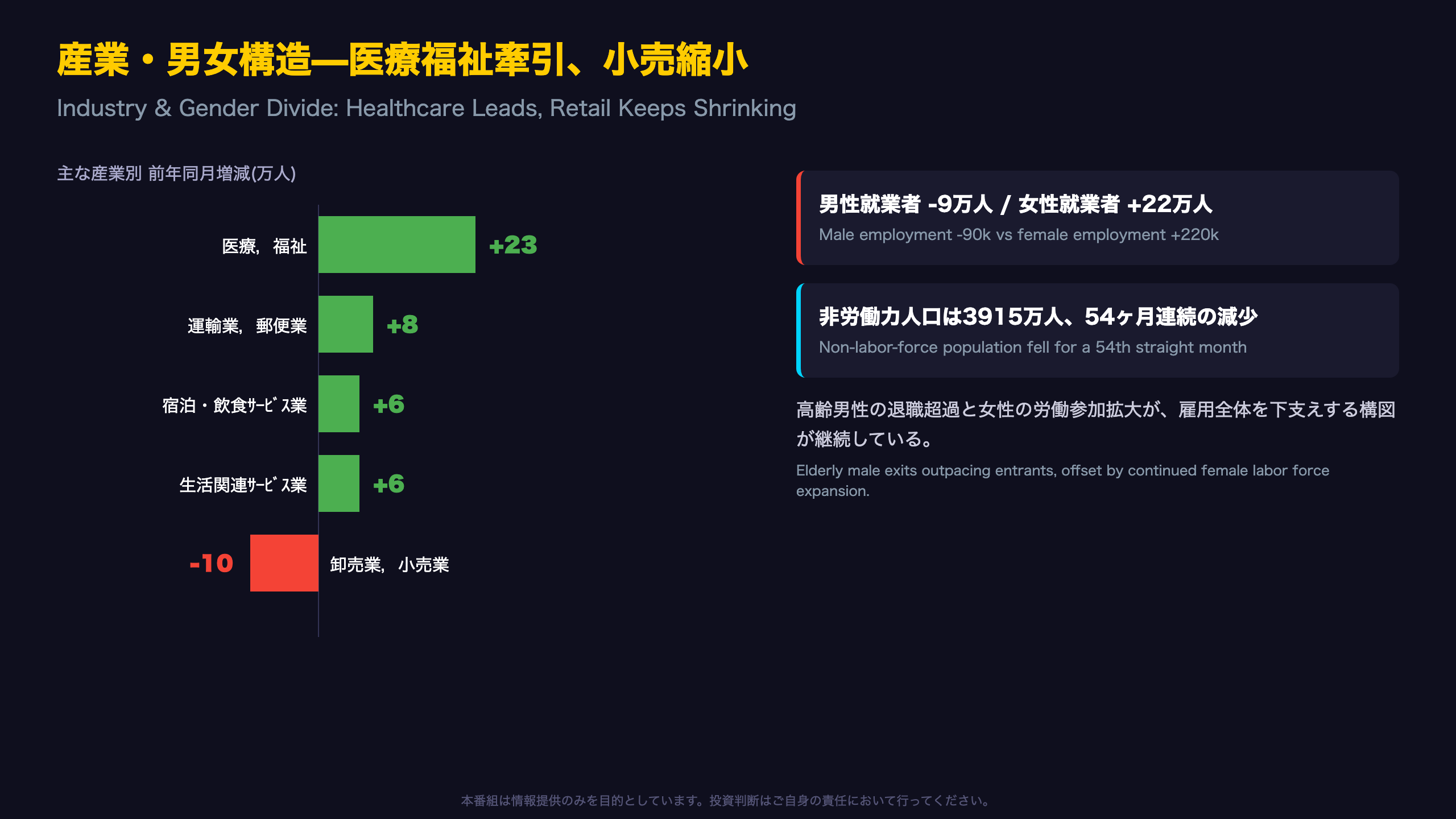
A Bifurcated Picture Across Industries and Gender
Comparing year-on-year industry employment changes (in thousands):
| Industry | July | August |
|---|---|---|
| Healthcare & welfare | +180k | +230k |
| Transport & postal | +80k | +80k |
| Accommodation & food services | 0 | +60k |
| Lifestyle-related services | +130k | +60k |
| Wholesale & retail trade | -150k | -100k |
Healthcare and welfare (医療・福祉) — Japan’s largest and fastest-growing employment sector — accelerated its gains from +180k to +230k, a structural trend tied to the country’s rapidly aging population and continuously rising demand for elder care and medical services. This sector has no direct parallel in most Western labor markets in terms of its sheer share of job creation.
Notably, accommodation and food services swung from flat in July to +60k in August, a datapoint worth watching as a proxy for inbound tourism demand and service-sector labor tightness — directly relevant to the BOJ’s focus on service-price inflation pass-through.
On the other hand, wholesale and retail trade posted its second consecutive double-digit decline (-150k in July, -100k in August), consistent with a structural shift toward e-commerce and store consolidation rather than a one-off blip.
Gender divergence: male employment fell 90,000 even as female employment rose 220,000. This asymmetry primarily reflects elderly male workers exiting the labor force outpacing new entrants, while female labor force participation continues its multi-year expansion. The non-labor-force population fell to 39.15 million, down 270,000 year-on-year — its 54th consecutive month of decline — underscoring that Japan’s labor supply continues to be stretched by drawing in previously inactive populations (women, seniors) rather than by new working-age entrants.
Market implication: this demographic-driven tightness is a key reason the BOJ views Japan’s labor market as structurally — not just cyclically — tight, supporting its gradual policy normalization bias. The next release covering September data is due October 30, 2026, alongside the Q3 (July-September) quarterly average.
総括—日銀の賃金・物価好循環判断への示唆
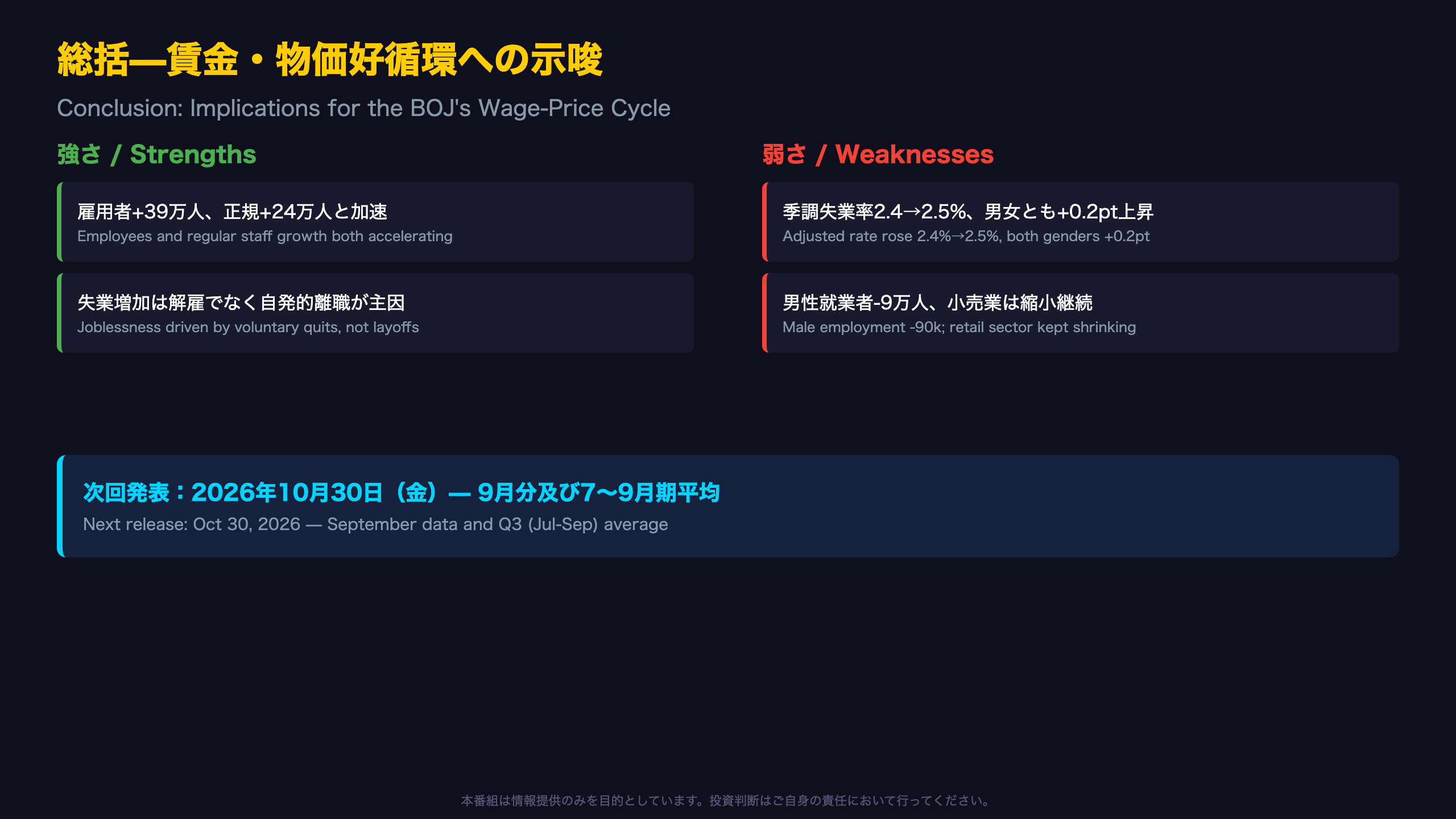
Balancing Strengths and Weaknesses: The Full Picture
Supporting signals (strength)
– Employees +390k, 54th straight month of growth, accelerating
– Regular employees +240k, 34th straight increase, clearly accelerating from July
– The jobless increase stems mainly from fewer layoffs (-20k) and more voluntary quits (+40k)
– Unadjusted jobless count fell 20k YoY, the first annual decline in 13 months
Cautionary signals (weakness)
– Seasonally adjusted unemployment rate rose from 2.4% to 2.5%, with both genders up 0.2pt
– Male employment fell 90k; male adjusted jobless rate rose from 2.6% to 2.8%
– Wholesale and retail trade posted a second consecutive double-digit decline
– Self-employed and family workers continued falling, down 230k
The official release notes the employment rate reached “62.5%, up 0.2 points year-on-year” and the 15-64 employment rate reached “80.3%, up 0.3 points” — indicating broad labor force participation continues to expand.
Market implications: For the Bank of Japan’s wage-price virtuous cycle framework — a central input into its policy normalization timeline — the acceleration in regular employment and the voluntary-quit-driven composition of joblessness are constructive signals, consistent with continued yen-supportive gradual rate normalization expectations. However, the adjusted unemployment uptick itself cannot be dismissed and will require multi-month confirmation before drawing firm conclusions. For JPY and JGB markets, this report alone is unlikely to be a decisive catalyst, but it adds to the mosaic of data the BOJ weighs ahead of its policy meetings.
Next release: September data and the July-September quarterly average are due October 30, 2026 (Friday). Key watch points: whether the adjusted jobless rate stabilizes near 2.5%, and whether employment gains broaden beyond the healthcare and welfare sector.
Disclaimer: This article is for informational purposes only. All investment decisions are made solely at your own risk.