📺 Watch the Full Video Analysis
This article was automatically generated by the NFC Market Live AI analysis system. (Updated: 2026-08-28 21:39 JST)
📄 Primary Source
Statistics Canada
https://www150.statcan.gc.ca/n1/daily-quotidien/260731/dq260731a-eng.htm
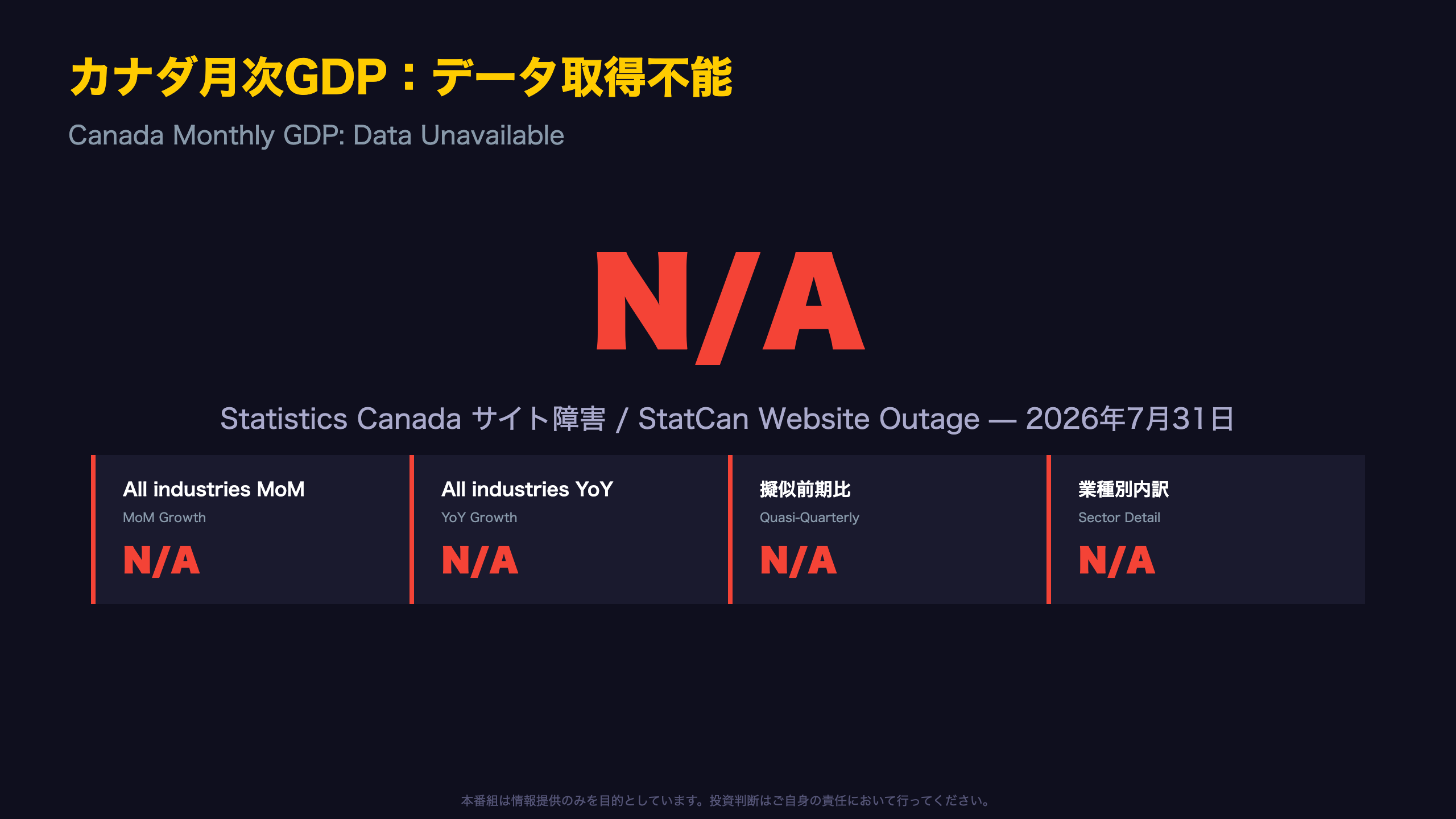
📊 Canada’s monthly GDP by industry report (StatCan CANSIM Table 36-10-0434-02) was unexpectedly unavailable due to a website outage.
⚠️ Key figures including All Industries MoM/YoY growth, quasi-quarterly GDP, and the Goods-producing vs Service-producing breakdown could not be retrieved.
💡 This data gap itself matters — it delays the update of the Bank of Canada’s Hidden Markov Model (HMM) observation variable for GDP growth.
📅 Focus now shifts to when StatCan’s site is restored and the next data release.
カナダ月次GDP速報:データ取得不能という異例事態
What Happened
The source document referenced for this analysis was Statistics Canada’s monthly GDP by industry release (CANSIM Table 36-10-0434-02, publication URL: dq260731a-eng.htm). However, upon retrieval, the page content was replaced by a website error message:
“We’re sorry! The website is currently unavailable.”
As a result, the following figures — normally available in this release — could not be retrieved and are marked as not available in the source:
- All Industries MoM% / YoY% growth
- Goods-producing vs. Service-producing sector growth rates
- Quasi-Quarterly GDP (used to reconcile with FRED’s NAEXKP01CAQ657S)
- Sector-level detail, including Mining, quarrying & oil/gas
Why This Matters for International Investors
For context, Statistics Canada (StatCan) is Canada’s national statistical agency, roughly analogous to the U.S. Bureau of Economic Analysis (BEA) or the UK’s Office for National Statistics. Its monthly GDP by industry series is one of the few high-frequency (monthly, rather than quarterly) real-activity indicators available for a G7 economy, and it feeds directly into Bank of Canada policy assessments and market GDP nowcasts.
A temporary outage in this primary data source doesn’t just delay information — it creates a genuine information gap for market participants and models relying on timely Canadian activity data, distinct from a typical “data surprise” event.
Next Steps
The next step is to re-attempt access to CANSIM Table 36-10-0434-02 to confirm restoration. The source material contains no explicit next release date, so investors should consult StatCan’s official release calendar directly.
本来注目すべきだった構造:Goods vs Service Producing
The Structure This Report Normally Reveals
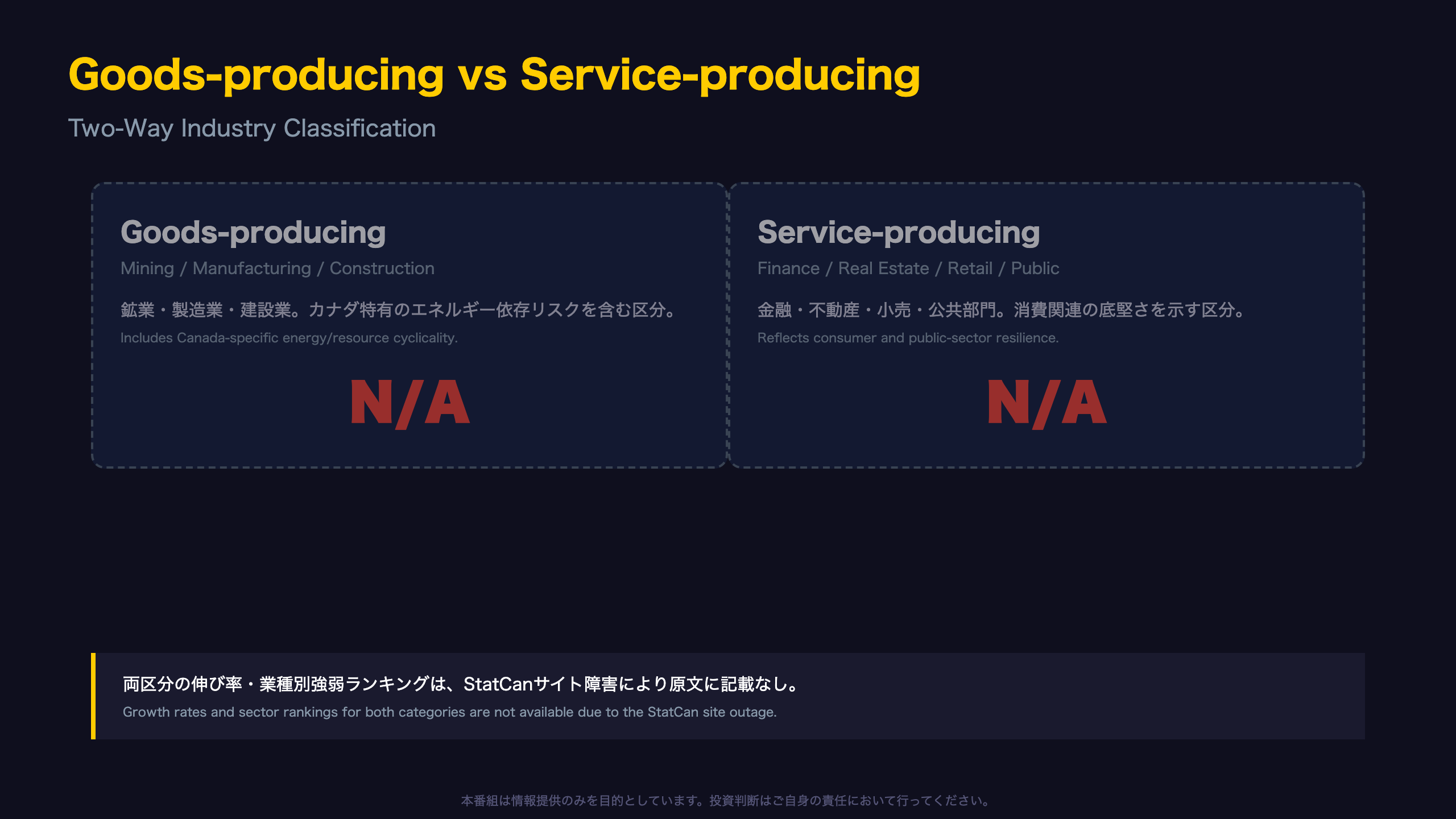
StatCan’s monthly GDP by industry series (CANSIM Table 36-10-0434-02) tracks Canada’s economic structure through two broad categories: Goods-producing industries (mining/oil & gas extraction, manufacturing, construction) and Service-producing industries (finance & insurance, real estate, retail trade, public administration).
For readers unfamiliar with Canadian data conventions: this monthly series is unusual internationally because most G7 economies (including the US) only report GDP quarterly. Canada’s monthly cadence, published by StatCan, makes it a valuable high-frequency indicator for real-activity nowcasting — comparable in spirit to the US’s monthly indicators (industrial production, retail sales) being pieced together to estimate GDP ahead of the quarterly BEA release.
Typical analysis would focus on:
– Swings in the energy/resources sector (Mining, quarrying & oil/gas) — a distinctly Canadian cyclical exposure
– Manufacturing and construction as proxies for capex cycles
– Resilience in consumer-facing services like finance and retail
What We Could Confirm This Time
In this instance, growth rates for both categories, and the ranking of positive/negative sector contributors, are not available in the source material. The page consisted solely of a StatCan system error message — no data table was present.
Per our analytical standards, we explicitly avoid concluding that “the Canadian economy weakened” or “strengthened” from this absence of data — doing so would be an unsupported causal claim (Level D reasoning), which is strictly prohibited.
An Alternative Read
While a website outage is most likely a temporary technical issue unrelated to underlying economic conditions, it also highlights an operational risk for market participants who depend on high-frequency official data feeds.
BOC HMMモデルへの示唆:観測変数の更新見送り
How GDP Feeds the HMM Framework
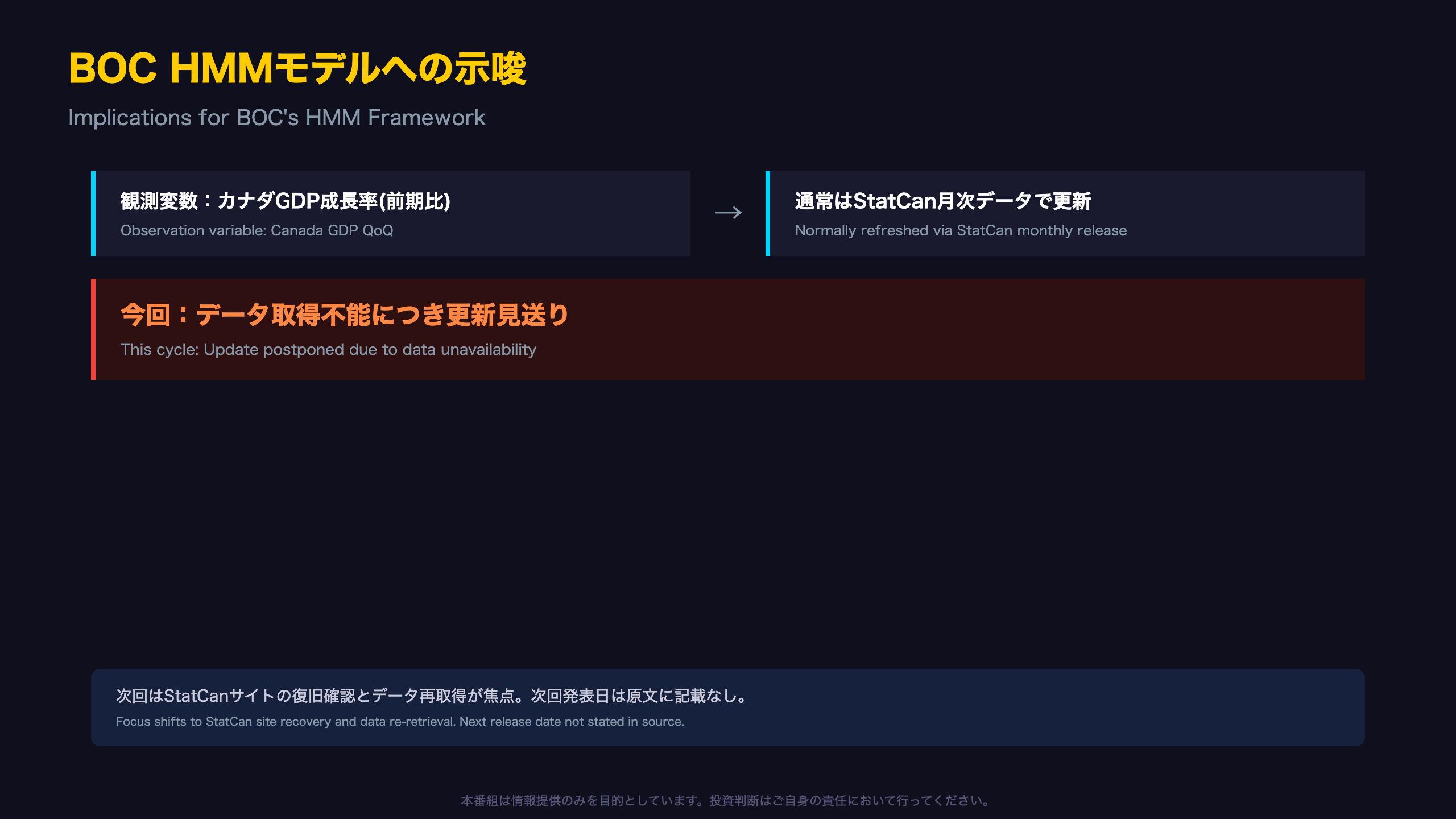
The Bank of Canada’s Hidden Markov Model (HMM) approach treats the central bank’s policy stance — Hawkish, Neutral, or Dovish — as an unobserved “regime,” inferred from observable variables such as inflation, employment, and GDP growth (quarter-over-quarter). This GDP variable is typically refreshed using the quasi-quarterly GDP figure derived from StatCan’s monthly industry-level release, and is often cross-checked against FRED’s NAEXKP01CAQ657S series for consistency with the official expenditure-based quarterly GDP.
What Happened This Cycle
Because the underlying StatCan source was unavailable due to a technical outage, this observation variable will not be updated in this cycle. Practically, this means:
- The model’s current regime classification remains anchored to the last successfully updated data point
- No assessment of GDP trend acceleration/deceleration is possible this cycle
- Sector-level contribution analysis is likewise deferred
Alternative Perspective: Transient vs. Structural Risk
A website outage is most likely a transient technical issue, and normal data access may resume on the next attempt. That said, this episode is a useful reminder that macro models relying on a single national statistical agency’s data pipeline carry a structural vulnerability to this type of incidental information gap — a consideration relevant to model robustness, independent of Canada’s actual underlying growth trajectory.
Looking Ahead
The next step is to re-attempt retrieval of CANSIM Table 36-10-0434-02 to confirm whether the data feed has been restored. The source material provided does not specify the next official StatCan release date.
Disclaimer: This article is for informational purposes only. All investment decisions are made solely at your own risk.