📺 Watch the Full Video Analysis
This article was automatically generated by the NFC Market Live AI analysis system. (Updated: 2026-08-26 16:47 JST)
📄 Primary Source
Sveriges Riksbank
https://www.riksbank.se/en-gb/press-and-published/notices-and-press-releases/press-releases/2026/minutes-of-the-monetary-policy-meeting-on-19-august-2026/
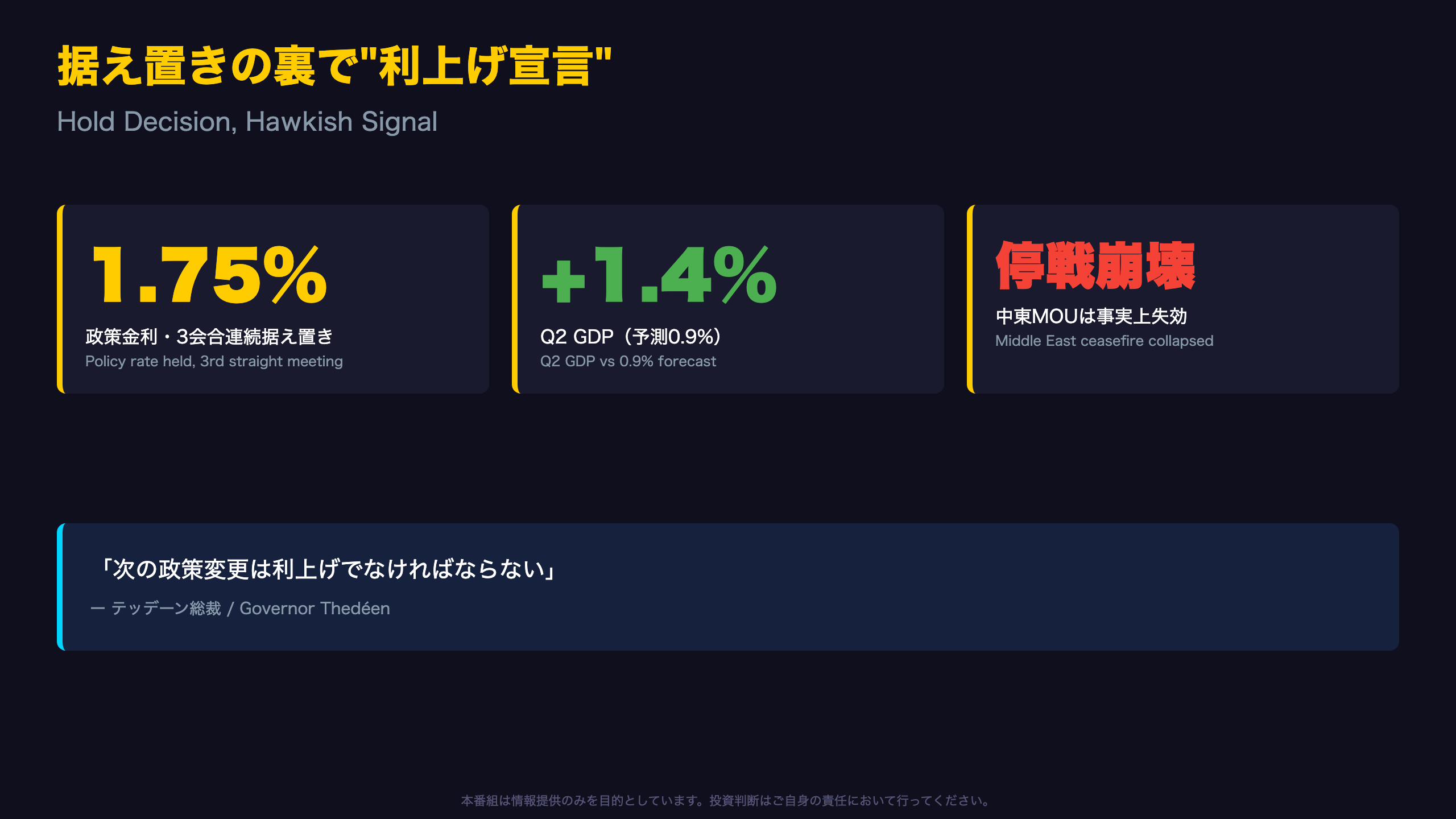
Sweden’s Riksbank held its policy rate at 1.75% for a third straight meeting on August 19, 2026 — but the details tell a far more dramatic story. 📊
The US-Iran ceasefire has effectively collapsed, yet the economic fallout has been milder than feared. ⚠️
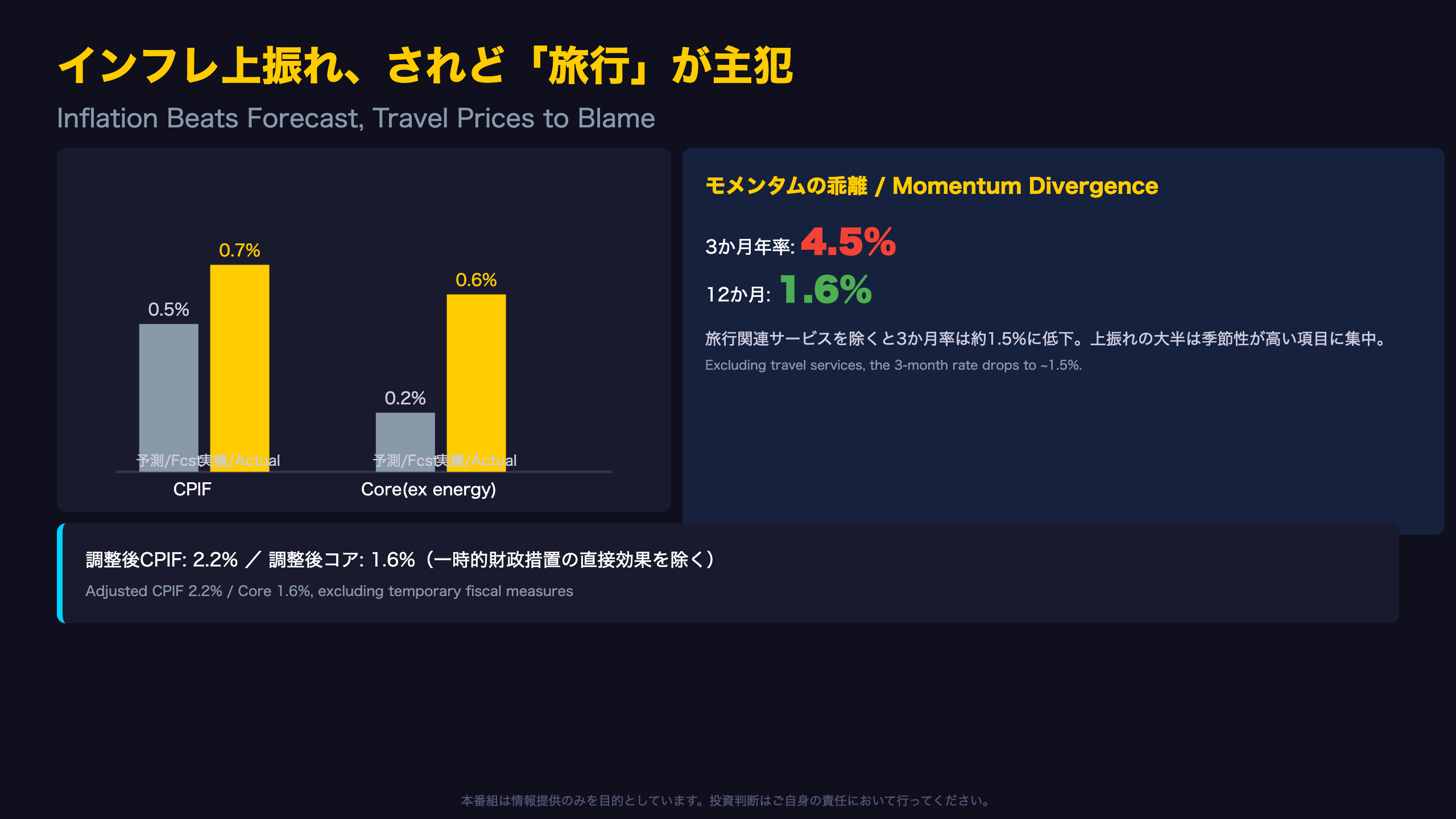
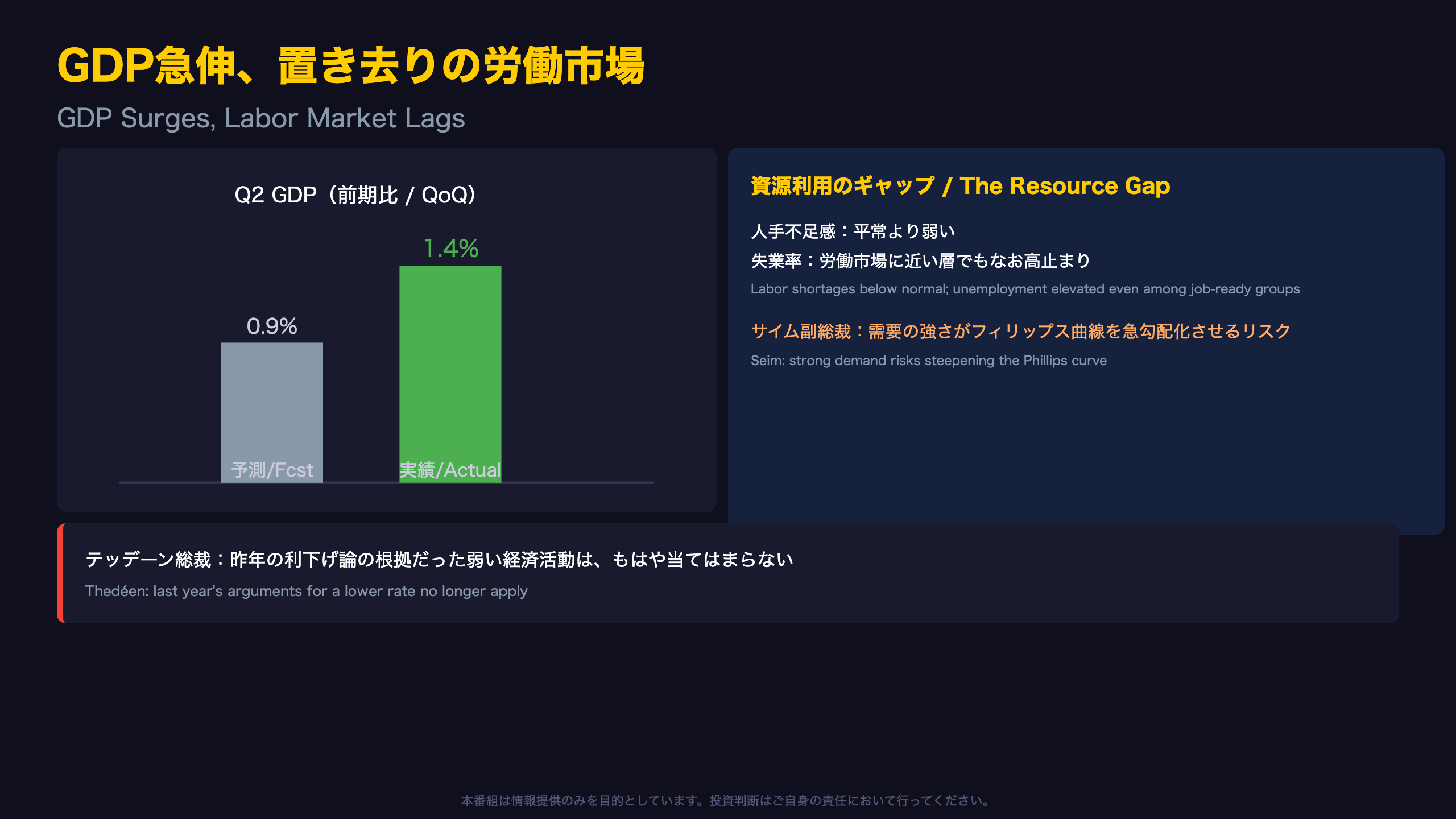
Meanwhile, Q2 GDP surged 1.4% versus a 0.9% forecast, and July inflation beat expectations too. 📈
Governor Thedéen flatly declared the next policy move needs to be a hike. We break down how domestic overheating risk overtook geopolitics as the Riksbank’s top concern. 💡
据え置きの裏で”利上げ宣言”
From 4% to 1.75%: The Rate-Cutting Cycle in Context
Sweden’s Riksbank cut its policy rate from 4% in September 2025 down to the current 1.75% through a series of reductions. Deputy Governor Hjelm still characterizes 1.75% as \”slightly expansionary,\” meaning this hold isn’t pure inertia, it’s a deliberate choice to keep some monetary stimulus in the system even as growth surprises to the upside.
\”The wind has picked up and the speed has increased… The next step will be to reduce the sail area, but the timing of this is still uncertain.\” — Governor Thedéen
That sailing metaphor captures the board’s core dilemma: growth is accelerating faster than expected, but nobody wants to tighten prematurely.
What Changed Since June
In June, the central storyline was hope around the US-Iran memorandum of understanding (MOU) potentially ending the Middle East conflict. By August, that MOU had effectively collapsed, yet instead of panic, the Riksbank’s tone became more hawkish, driven not by oil risk but by a domestic growth and inflation surprise. For context, the Bank of Japan (BOJ), European Central Bank (ECB), and Norges Bank have all already raised rates this cycle, while the Federal Reserve held steady in July, leaving the Riksbank navigating an increasingly divergent global rate landscape.
全会一致の据え置き、割れる本音
Where Does the Board’s Real Consensus Lie?
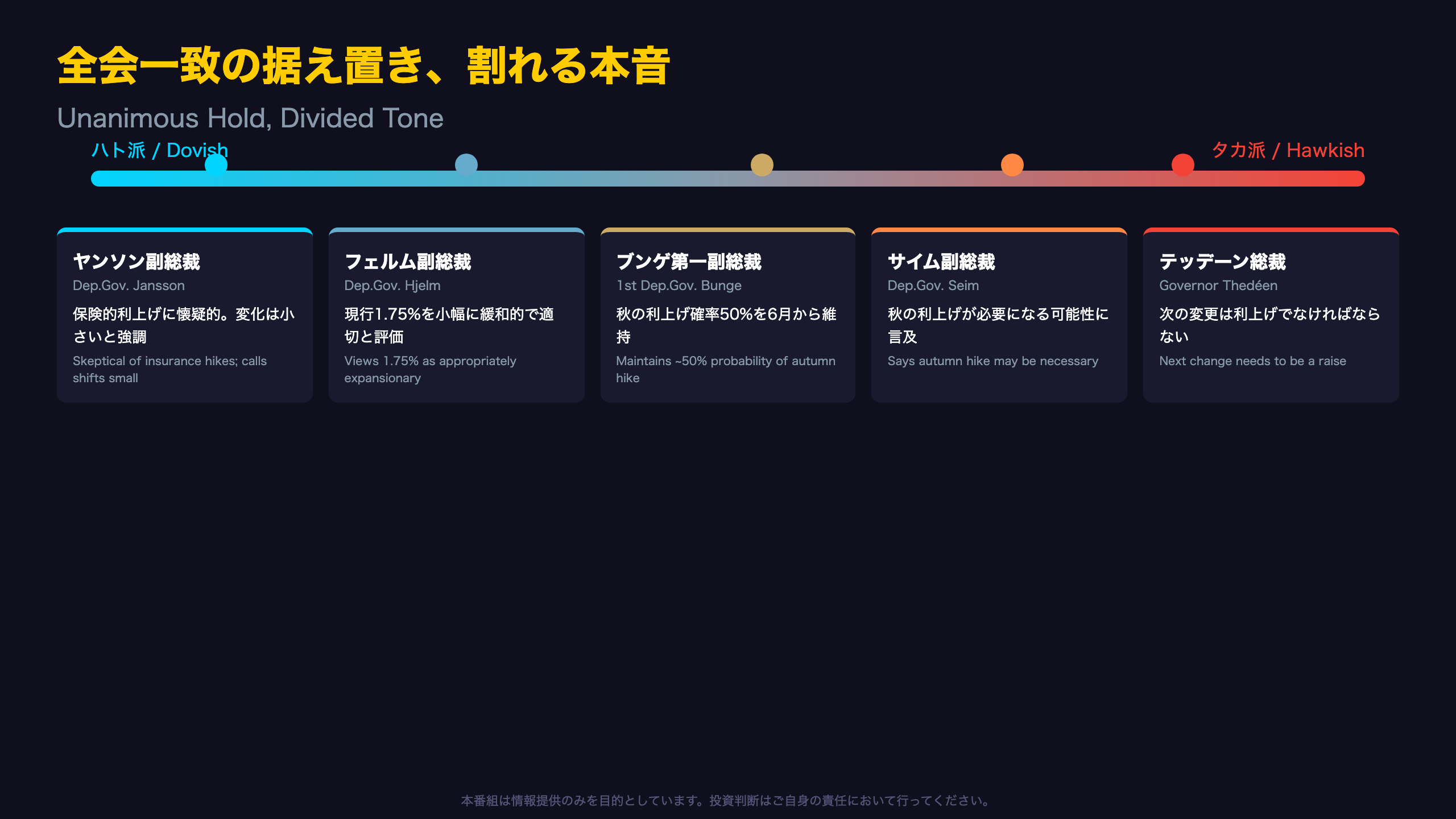
Riksbank decisions are traditionally near-unanimous, but the tone of individual statements often matters more than the vote itself as a forward indicator. First Deputy Governor Bunge explicitly argued the policy rate \”should be raised from a somewhat stimulating to a more neutral level,\” positioning her as more hawkish than a simple hold vote would suggest.
Hjelm’s Neutral-Rate Nuance
Deputy Governor Hjelm stressed that the short-term appropriate rate can diverge from long-run neutral-rate estimates, noting it’s \”no easy task\” to judge whether the current rate is actually stimulating the economy. That careful hedging leaves room to shift stance quickly if data warrants.
\”Insurance hikes may be justified if there are concerns that the inflation target has a credibility problem.\” — Deputy Governor Jansson
Jansson’s framing implicitly signals he sees no such credibility problem today, making him the intellectual anchor for the hold camp. For readers familiar with the Fed’s dot plot, Riksbank’s individual-member commentary functions similarly, offering a real-time readout of the internal debate. The key swing factor into September: whether Bunge’s neutral-rate argument or Jansson’s no-credibility-problem argument gains more adherents.
インフレ上振れ、されど「旅行」が主犯
How This Differs From the 2022 Inflation Surge
Deputy Governor Jansson specifically noted that few companies are planning to change prices more frequently or by larger margins than usual, a sharp contrast with 2022, when Riksbank’s own Business Survey captured firms saying they had \”never before experienced customers accepting price increases so easily.\” That behavioral difference is central to why the board isn’t panicking over the upside inflation surprise.
A Sub-Indicator Worth Watching: Corporate Pricing Plans
The Economic Tendency Survey, roughly analogous to the US ISM Prices Paid Index, shows corporate pricing plans have \”somewhat dampened but are still at an elevated level.\” That’s a mixed signal: cooling, but not yet back to normal.
Two Competing Readings
The dovish read: most of the inflation surprise traces to volatile travel-service prices, a seasonal quirk. The hawkish read, voiced by Deputy Governor Hjelm: some of that travel-price jump likely reflects indirect pass-through from higher energy costs, meaning it won’t fully reverse. For investors used to the US CPI’s \”supercore services\” debate, this is a strikingly similar analytical fault line.
GDP急伸、置き去りの労働市場
Will AI Reshape Hiring Plans? Bunge’s Warning
First Deputy Governor Bunge, drawing on a May speech on AI’s economic effects, warned that increased use of AI can affect companies’ recruitment plans, specifically that IT investment in AI infrastructure could make firms less inclined to hire before productivity gains materialize. The Riksbank’s own spring Business Survey found most companies see limited AI impact today, but expect much larger effects within five years.
Construction: A Sector to Watch
Construction had lagged the broader recovery, but several forward-looking indicators are now turning positive. Deputy Governor Hjelm cites both interest-rate-sensitive household consumption and construction as evidence the current 1.75% rate is still meaningfully expansionary.
A Telling Contrast With 2025
In spring 2025, facing US tariff hikes and slowing global growth, the Riksbank cut rates by a cumulative 0.5 percentage points. Governor Thedéen now explicitly states that \”last year’s arguments in favor of a lower interest rate… no longer apply,\” a rare, direct acknowledgment of policy asymmetry as conditions reverse from cutting-bias to hiking-bias.
停戦崩壊でも「抑制」された影響
What the IEA Report Actually Shows
First Deputy Governor Bunge cited the International Energy Agency’s August 2026 Oil Market Report, which found that elevated prices not only incentivized supply adjustments but also triggered a larger-than-expected demand decline. Drawn-down inventories, increased production elsewhere, alternative shipping routes, and sharply lower Chinese demand all combined to cap price increases, a textbook case of market adaptation under stress.
June vs. August: A Side-by-Side Risk Comparison
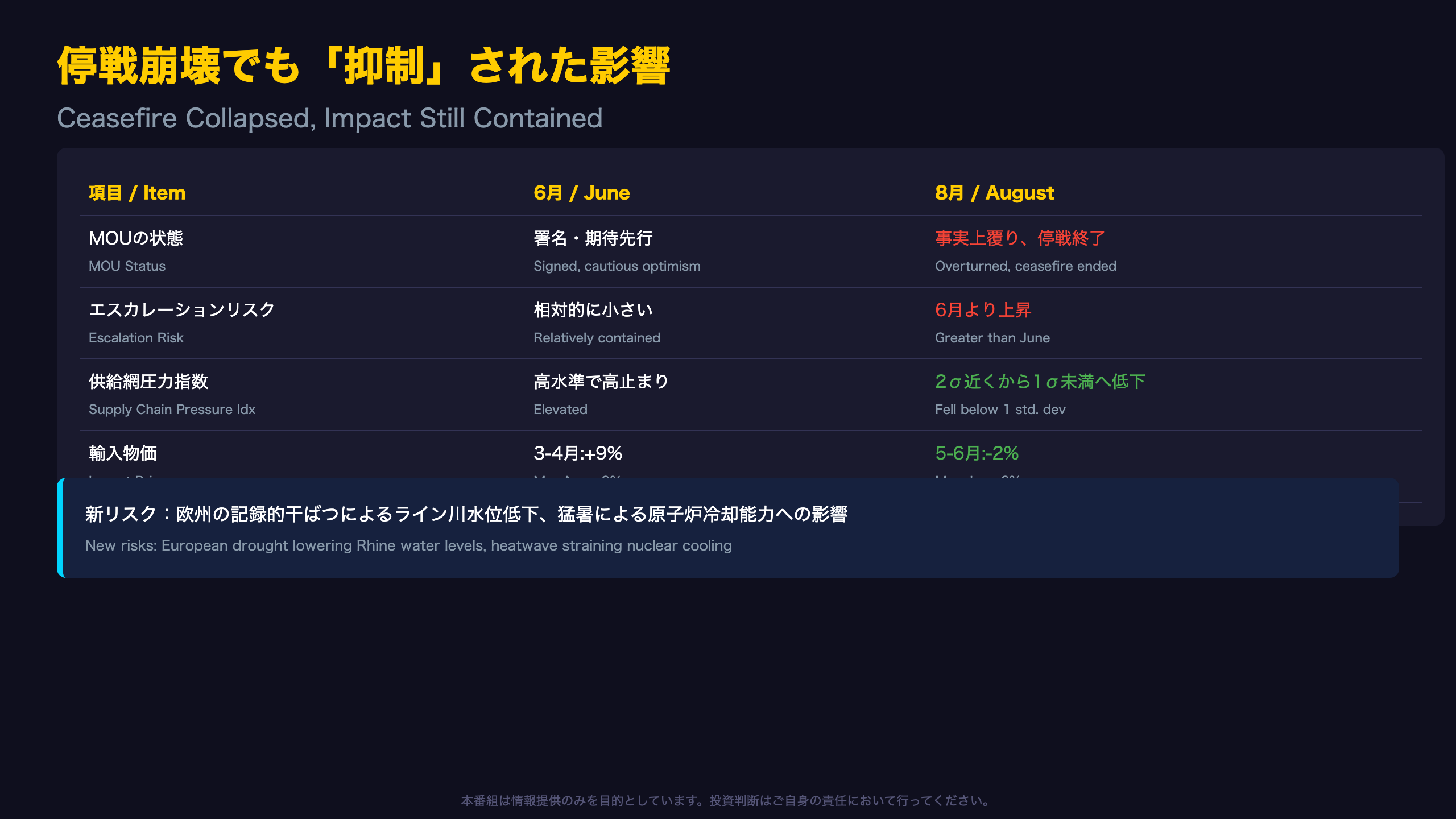
| Factor | June | August |
|---|---|---|
| MOU status | Signed, cautious optimism | Effectively overturned, ceasefire ended |
| Escalation risk | \”Relatively contained\” | \”Greater than in June\” (Hjelm) |
| Supply Chain Pressure Index | Elevated, near 2 std. dev | Fallen to below 1 std. dev |
New Risks Beyond the Middle East
Record European drought has lowered water levels on the Rhine, disrupting barge transport, while extreme heat has strained nuclear reactor cooling capacity. These are independent of the Middle East conflict, signaling that supply-side risk is diversifying rather than concentrating in one geography, a nuance investors tracking only oil-price headlines might miss.
次の焦点は9月、市場は確信度を強める
Market Pricing: A Shift in Conviction, Not Direction
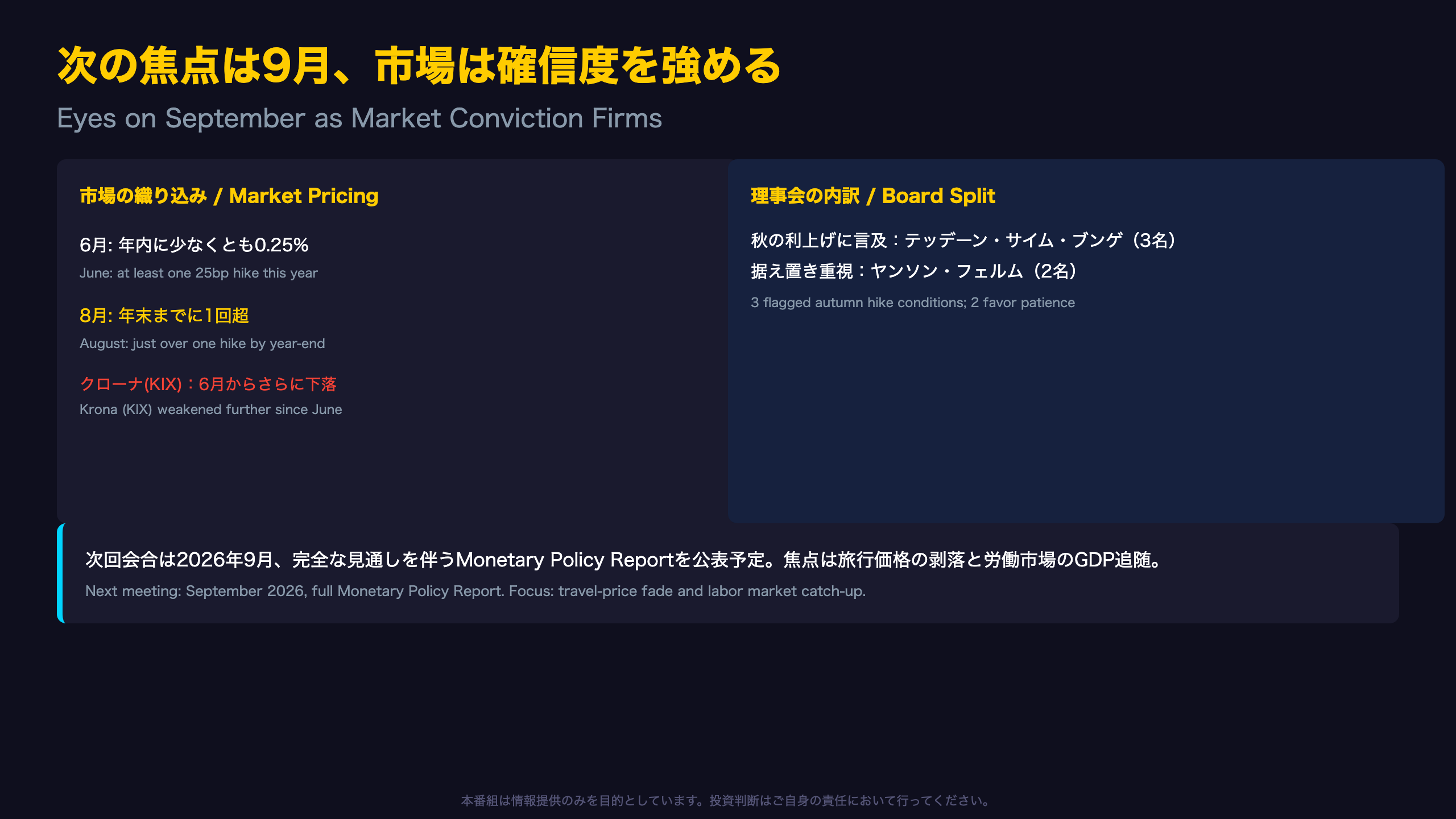
Back in June, markets priced at least one 25bp hike this year, essentially a floor estimate. By August, that had firmed into just over one hike specifically by year-end. The magnitude expectation barely changed, but conviction clearly increased, a subtle but important distinction for rates traders.
The Krona-ECB Tug of War
Market economists, not board members, flagged that continued krona weakness combined with the ECB’s ongoing tightening cycle could eventually force the Riksbank’s hand. Notably, this argument comes from the Markets Department briefing, not from any Executive Board member’s own remarks, worth keeping in mind when weighing how much it actually factors into the committee’s reaction function.
What to Watch Into September
The next meeting will bring a full Monetary Policy Report with updated forecasts. Two questions will likely determine the outcome: does the travel-services price spike fade as it typically has in past summers, and does the labor market finally catch up to the GDP surprise. For US and European investors benchmarking against Fed and ECB decisions, Sweden’s small, open economy makes it a useful bellwether for how developed-market central banks are weighing growth surprises against war-driven supply risk.
Disclaimer: This article is for informational purposes only. All investment decisions are made solely at your own risk.