📺 Watch the Full Video Analysis
This article was automatically generated by the NFC Market Live AI analysis system. (Updated: 2026-08-24 20:43 JST)
📄 Primary Source
Banco Central do Brasil
https://www.bcb.gov.br/content/focus/focusmarketreadout/R20260821.pdf
📊 Breaking down the BCB’s weekly Focus Market Readout (data as of Aug 21, 2026).
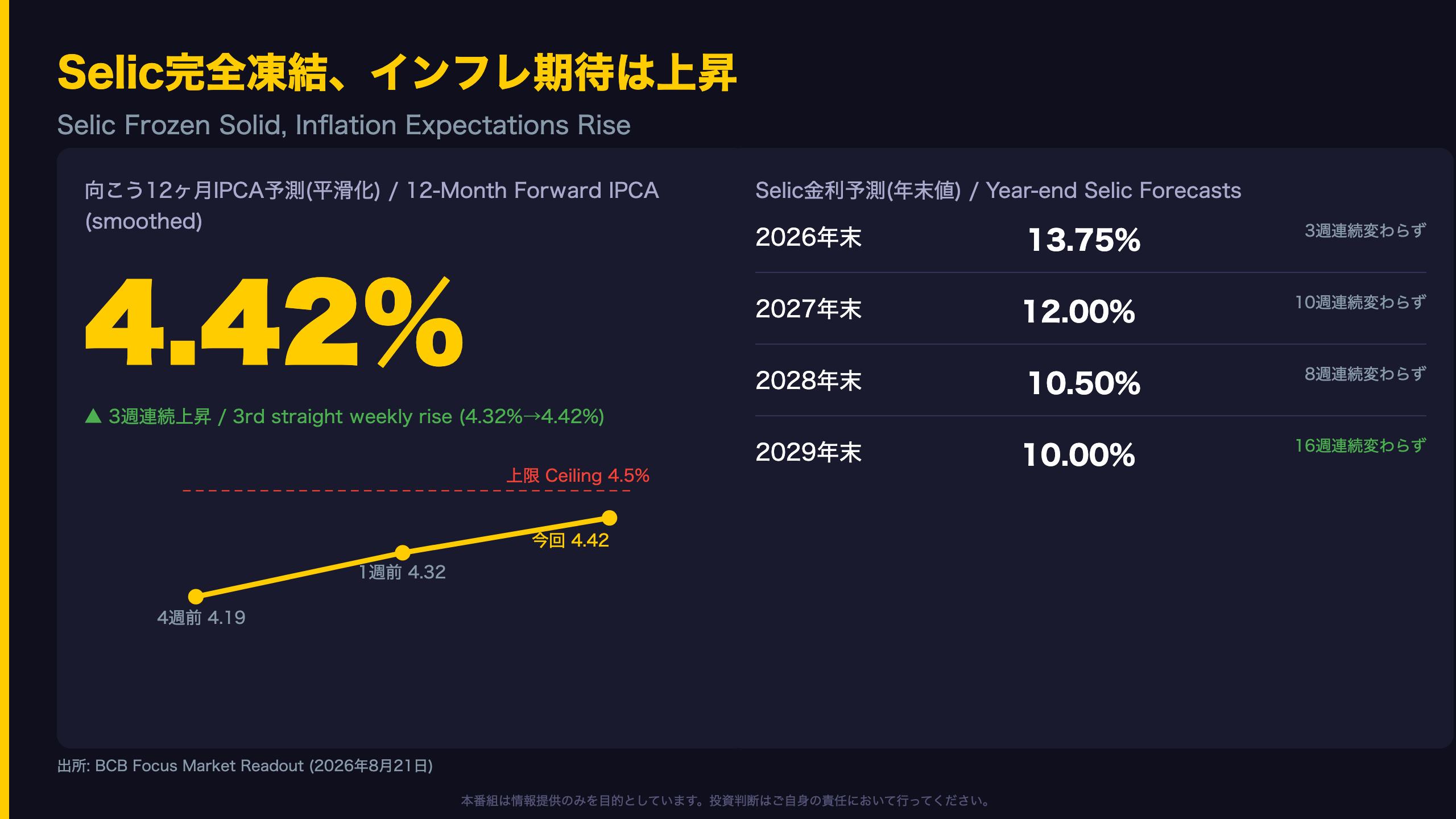
💡 Selic rate forecasts are frozen across all horizons from 2026 to 2029, with the 2029 estimate unchanged for 16 straight weeks.
📈 Yet the 12-month-ahead inflation forecast climbed to 4.42%, a third consecutive weekly rise, nearing the 4.5% ceiling.
⚠️ Near-term FX forecasts weakened for two straight weeks, while fiscal data shows short-term stability but long-term drift.
🇯🇵 The Selic-BOJ rate gap stands at roughly 12.91 points. We cover carry trade implications for Japanese investors.
Selic完全凍結、インフレ期待は上昇
Two Signals Moving in Opposite Directions
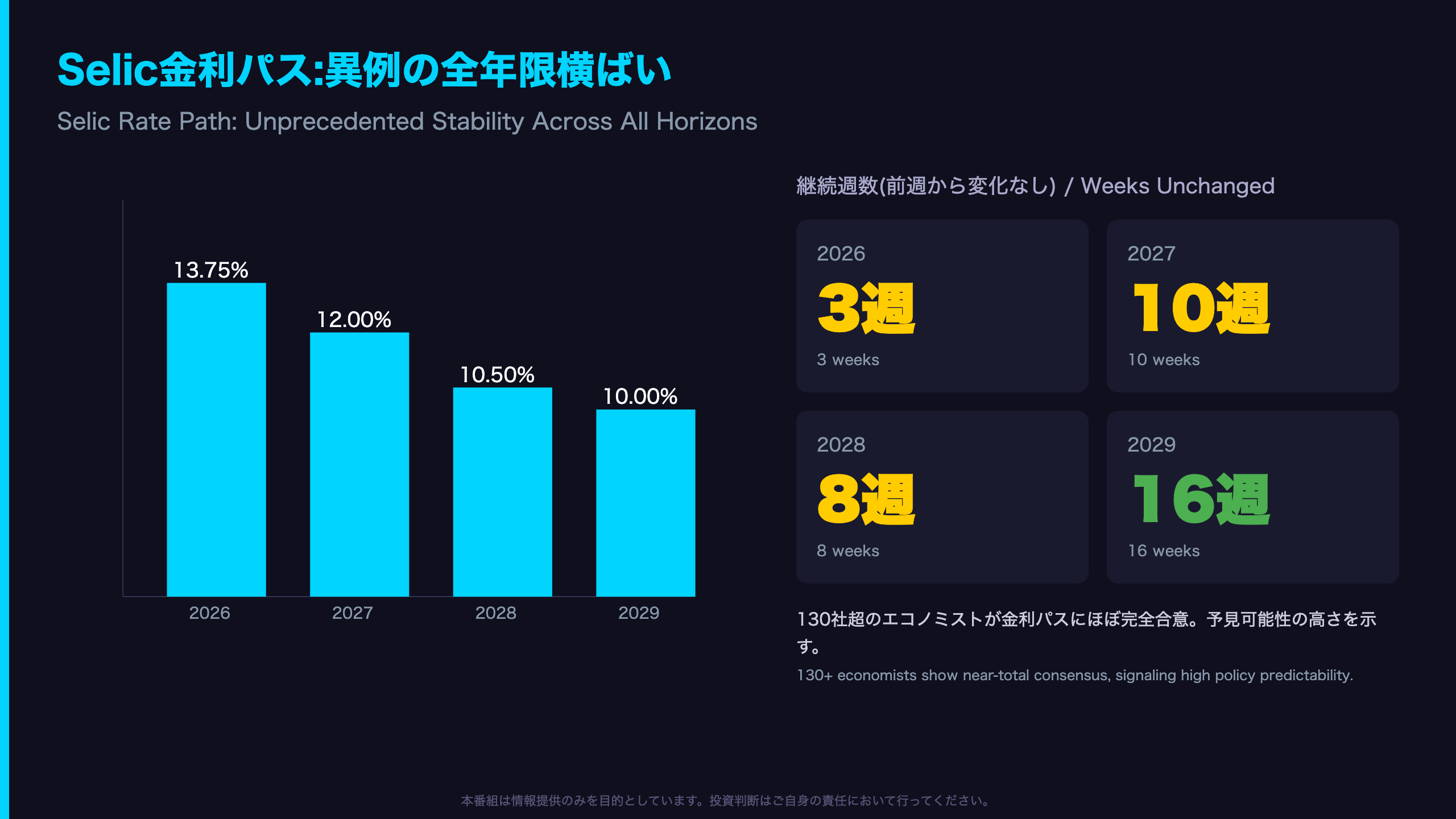
The standout feature of this week’s Focus Market Readout is that Selic rate forecasts didn’t move an inch across all four horizons—2026 through 2029—compared to the prior week. The 2029 year-end forecast of 10.00% has now held steady for 16 consecutive weeks.
From the report: “Selic Target (% p.a) … 10.00 10.00 10.00 (16) 110” — the figure in parentheses denotes the number of weeks of unchanged consensus.
Meanwhile, the rolling 12-month-ahead smoothed IPCA forecast rose from 4.19% a month ago, to 4.32% a week ago, to 4.42% today — a third consecutive weekly gain. This forward-looking gauge is watched more closely by markets than the calendar-year figures (5.02% for 2026, 4.25% for 2027) because it better reflects the policy-relevant horizon.
Context for International Readers
The Focus Market Readout is a weekly BCB-run survey of 130+ banks and economists. Unlike the Fed’s dot plot, it aggregates private forecasts rather than policymakers’ own views — but Brazil’s COPOM committee explicitly references Focus data when setting rates.
Looking Ahead
The next Focus report is expected around August 31, 2026. Whether the 12-month IPCA forecast extends its climb past 4.42% will be the key test of how durable the Selic-hold consensus really is.
Selic金利パス:異例の全年限横ばい
An Unusual Show of Consensus Among 130+ Forecasters
Comparing to the prior week’s report (dated August 14), each of the current streaks simply extended by one more week — 2027 was at nine weeks and 2029 at fifteen weeks previously. That continuity itself is the story: nothing has happened to disturb the consensus in the past seven days.
What Is the Focus Survey, Exactly?
For readers unfamiliar with Brazilian monetary policy, the Focus Market Readout is a weekly BCB-run survey of 130+ banks, asset managers and independent economists. Unlike the Fed’s dot plot, it aggregates private-sector forecasts rather than policymakers’ own projections — but the BCB’s COPOM committee explicitly reviews Focus data when setting the Selic rate, making it a genuine policy input rather than mere market color.
Respondent Depth
In the last five business days, 72 respondents weighed in on the 2026 forecast, 71 on 2027, 116 on 2028, and 110 on 2029. Longer horizons naturally attract fewer active updaters, but sample sizes remain robust across the curve.
The Risk to Watch
This frozen consensus could crack if the 12-month inflation forecast keeps climbing past 4.42% — a scenario that would force economists to reconsider the post-2026 rate-cut trajectory.
IPCA:目標上限を超えたまま高止まり
The Rules of Brazil’s Inflation Target
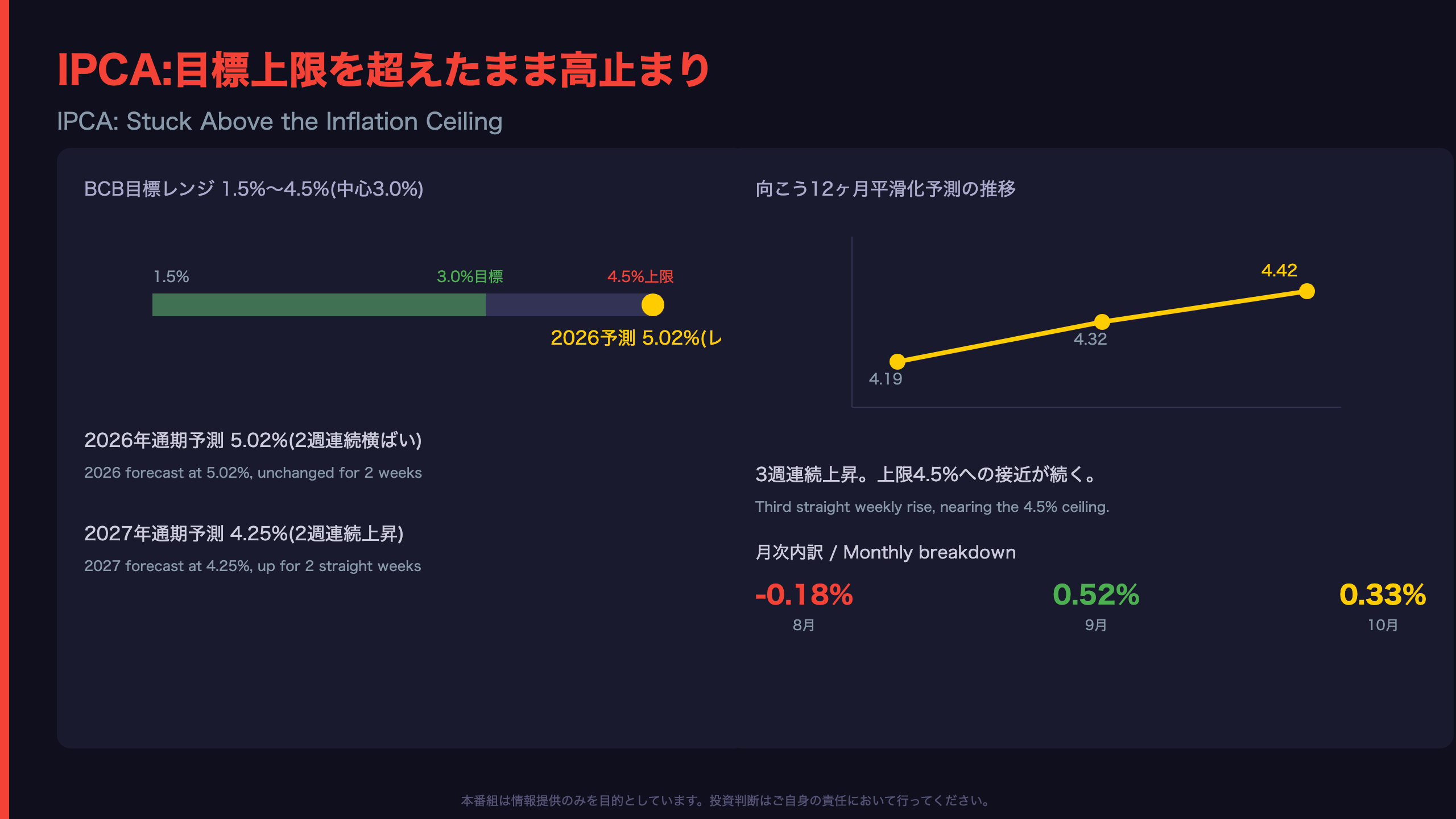
The BCB targets IPCA inflation at a 3.0% midpoint with a tolerance band of 1.5% to 4.5%, roughly comparable to how the Fed treats 2% as a flexible average target, except Brazil’s band is explicit. This year’s forecast of 5.02% sits above the ceiling and has stayed there for two straight weeks.
What the Monthly Data Shows
August’s month-on-month IPCA is expected at negative 0.18% (versus negative 0.17% a week earlier), while September is projected at 0.52% and October holds flat at 0.33%. The August dip likely reflects seasonal adjustments in regulated prices such as electricity, though drawing conclusions from one month of data would be premature.
Why the “Next 12 Months” Number Matters More
Market participants tend to weight the rolling twelve-month-ahead smoothed IPCA forecast more heavily than calendar-year figures. This measure has risen for three consecutive weeks, climbing 0.23 percentage points from 4.19% a month ago to 4.42% today.
A Partial Offset
The 2026 regulated prices forecast has fallen from 4.70% to 4.69% for four consecutive weeks, partially offsetting broader inflation pressure — a dynamic worth watching in next week’s release.
為替と対外収支:レアル軟化とファンダの改善
FX: Calm at Year-End, Choppier Up Close
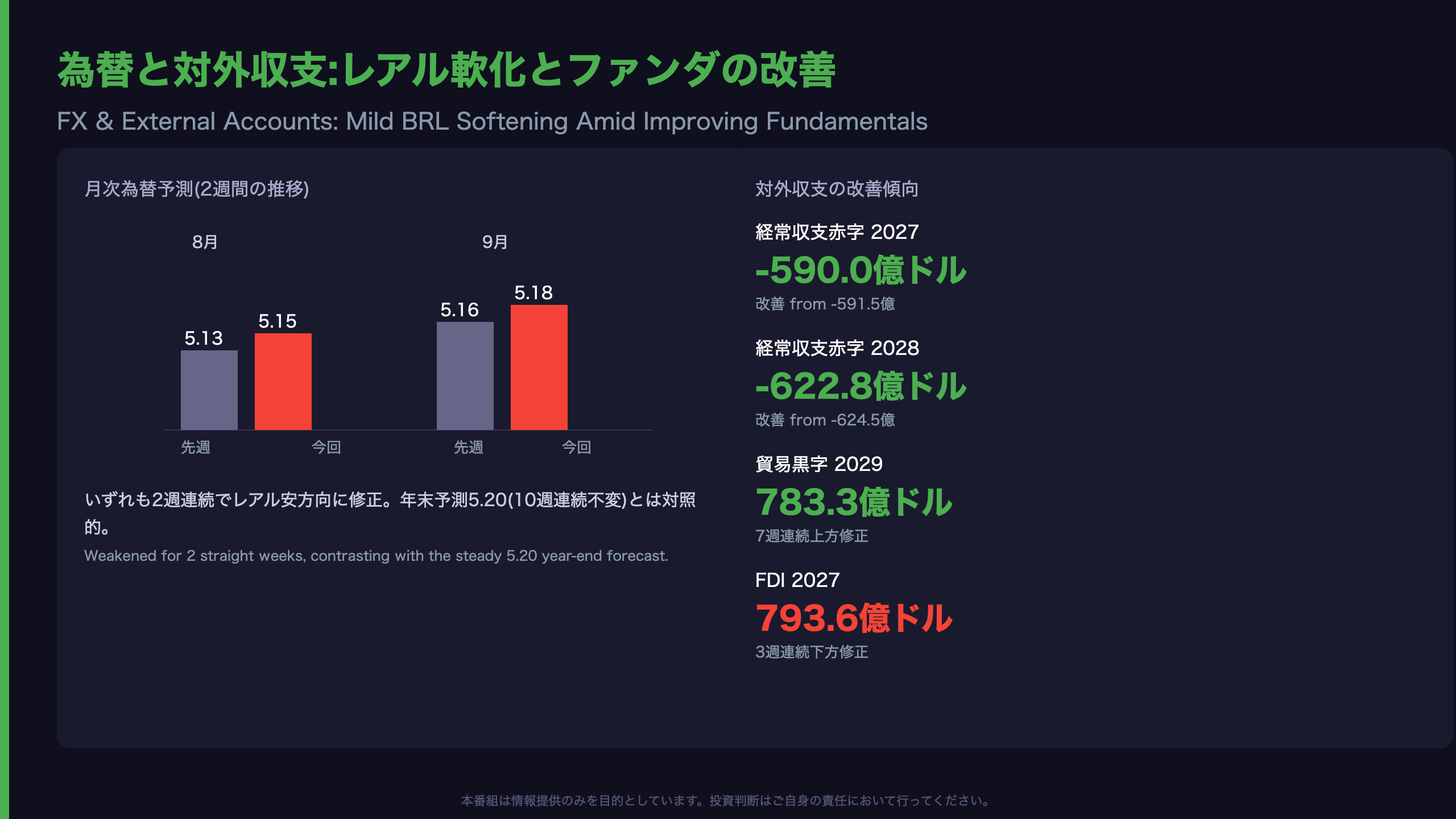
The 2026 year-end exchange rate forecast of 5.20 reais per dollar has been rock-steady for ten straight weeks. But zoom into the near-term monthly forecasts and the picture shifts: August moved from 5.13 to 5.15, and September from 5.16 to 5.18, each marking a second consecutive week of real depreciation.
External Accounts Are Improving
The current account deficit forecast for 2027 narrowed to 59.00 billion dollars from 59.15 billion, and for 2028 improved to 62.28 billion from 62.45 billion. The trade surplus forecast for 2029 has been revised up for seven consecutive weeks, reaching 78.33 billion dollars. Overall, external sector fundamentals look reasonably resilient.
A Small Caution: FDI Softening
Foreign direct investment forecasts for 2027 slipped from 79.50 billion to 79.36 billion dollars, a third straight weekly downgrade — a minor cautionary signal on capital flows, offset by stronger current account and trade trends.
Two Valid Readings
Bearish-minded observers might flag the real’s near-term softening as an early warning sign. Bullish-minded observers would point to the improving trade and current account trajectory as structural support. Both readings rely on single-week data and warrant confirmation over subsequent releases.
財政:短期安定と長期悪化の同居
Primary Balance: 27 Weeks of Unshaken Consensus
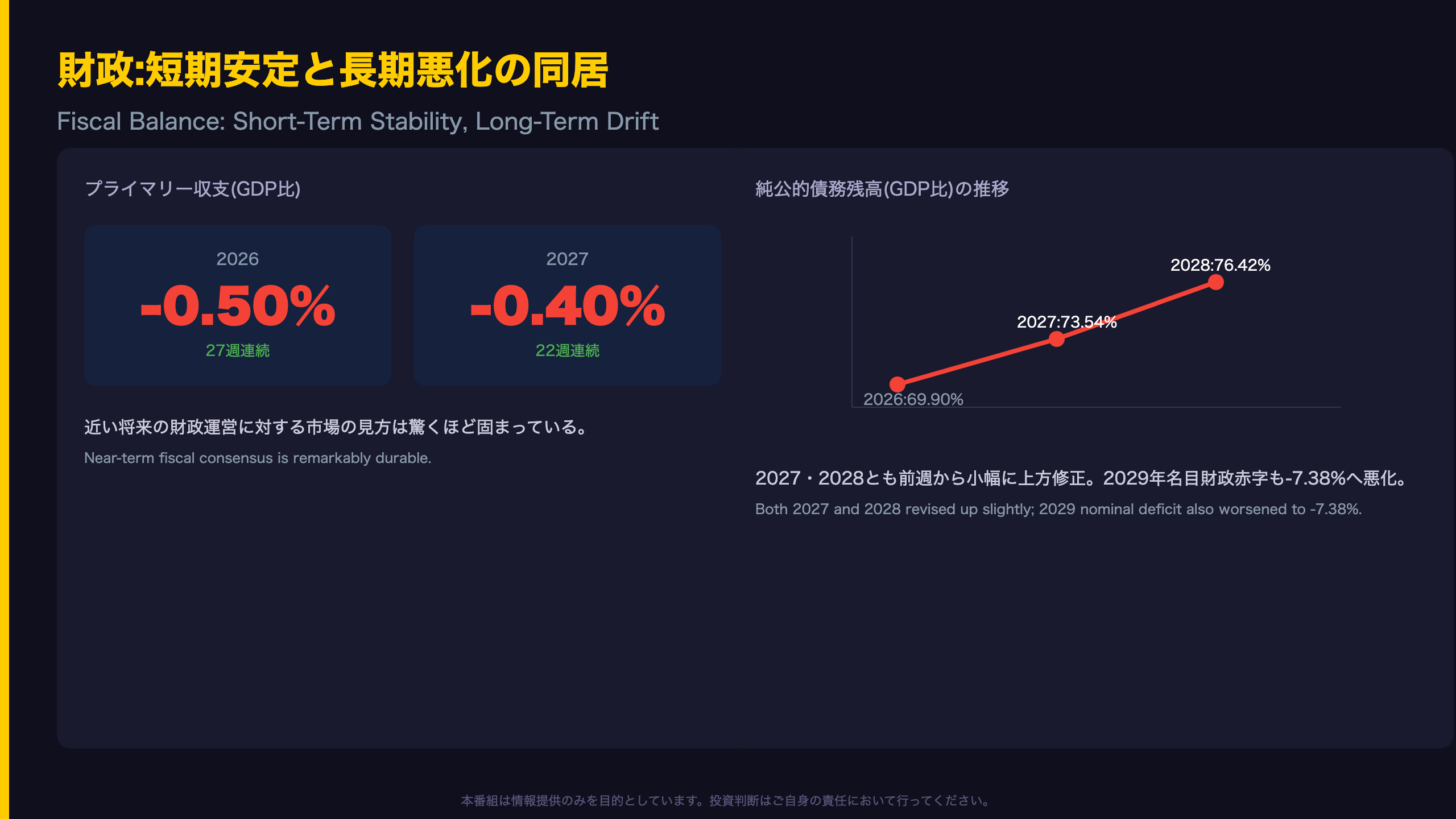
Brazil’s primary fiscal balance forecast for 2026 has sat at negative 0.50% of GDP for 27 consecutive weeks, and negative 0.40% for 2027 for 22 weeks — among the longest-running stable readings in the entire Focus survey. That durability suggests markets aren’t pricing near-term fiscal slippage risk.
But Debt Ratios Are Drifting Higher
Look further out, though, and cracks appear. The net public debt-to-GDP forecast for 2027 ticked up from 73.40% to 73.54%, and for 2028 from 76.40% to 76.42%. The 2029 nominal deficit forecast also worsened slightly, from negative 7.33% to negative 7.38% of GDP.
A Two-Layer Story
This combination — rock-solid near-term consensus alongside a slow-motion upward drift in medium-term debt ratios — suggests the market’s fiscal sustainability concerns are structural rather than tied to any immediate political risk, a pattern familiar to watchers of other high-debt emerging markets.
What to Watch Next
The next Focus release will show whether the primary balance forecast extends its stability streak to 28 weeks, and whether the debt-to-GDP upward drift continues.
BRL/JPYキャリーと日本人投資家への含意
The Real Story Behind a 12.91-Point Carry Gap
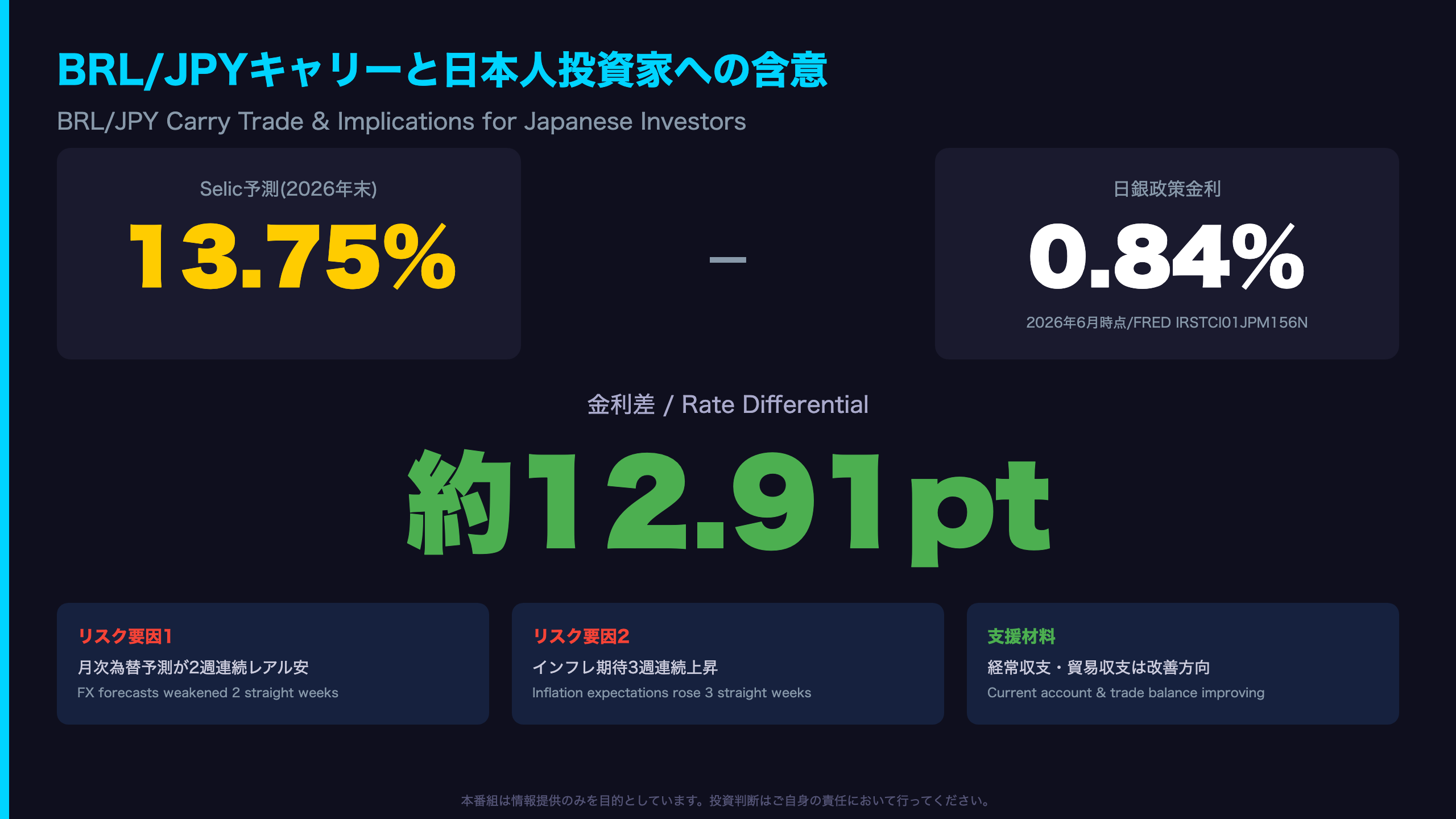
Brazil’s 2026 year-end Selic forecast of 13.75% compares to Japan’s policy rate of just 0.84% as of June 2026 (FRED series IRSTCI01JPM156N). That rate differential of roughly 12.91 percentage points places BRL among the highest-yielding major emerging-market carry trades available to Japanese investors.
Two Risk Factors From This Week’s Data
This week’s Focus report flags two things worth watching. First, near-term monthly exchange rate forecasts have weakened for two consecutive weeks. Second, the 12-month-ahead inflation forecast has risen for three straight weeks, approaching the BCB’s tolerance ceiling. If inflation keeps drifting upward, the BCB’s next rate-cutting phase could be delayed — good news for carry income, but a signal that currency volatility risk hasn’t gone away.
What This Means Practically
For those holding Brazilian government bonds or BRL-denominated assets, the rate differential implies a potentially large annualized income advantage. However, even modest real depreciation over a year could erode much of that edge. Currency hedging decisions and ongoing inflation monitoring remain essential parts of any BRL carry strategy.
The Next Data Point
The next Focus Market Readout is expected around August 31, 2026. Whether the inflation uptrend continues, and whether the Selic-hold consensus holds, will be the two most important variables to watch.
Disclaimer: This article is for informational purposes only. All investment decisions are made solely at your own risk.