📺 Watch the Full Video Analysis
This article was automatically generated by the NFC Market Live AI analysis system. (Updated: 2026-08-20 03:12 JST)
📄 Primary Source
Federal Reserve
https://www.federalreserve.gov/monetarypolicy/fomcminutes20260729.htm
📊 Deep dive into the July 28-29, 2026 FOMC minutes released Aug 20.
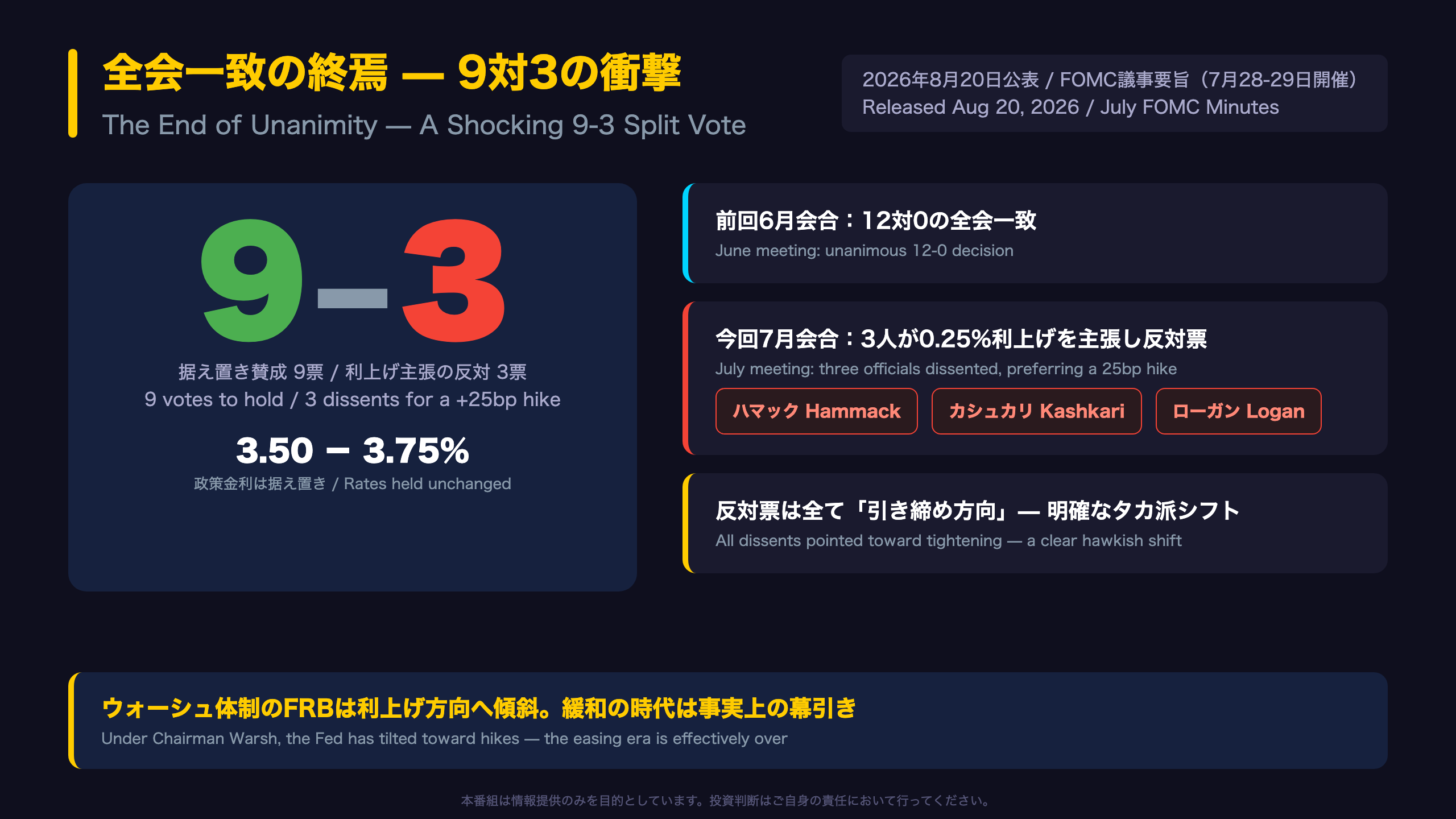
⚠️ Rates held at 3.50-3.75%, but the vote split 9-3 — Hammack, Kashkari and Logan dissented in favor of a 25bp HIKE. A stark hawkish turn from June’s unanimous 12-0 decision.
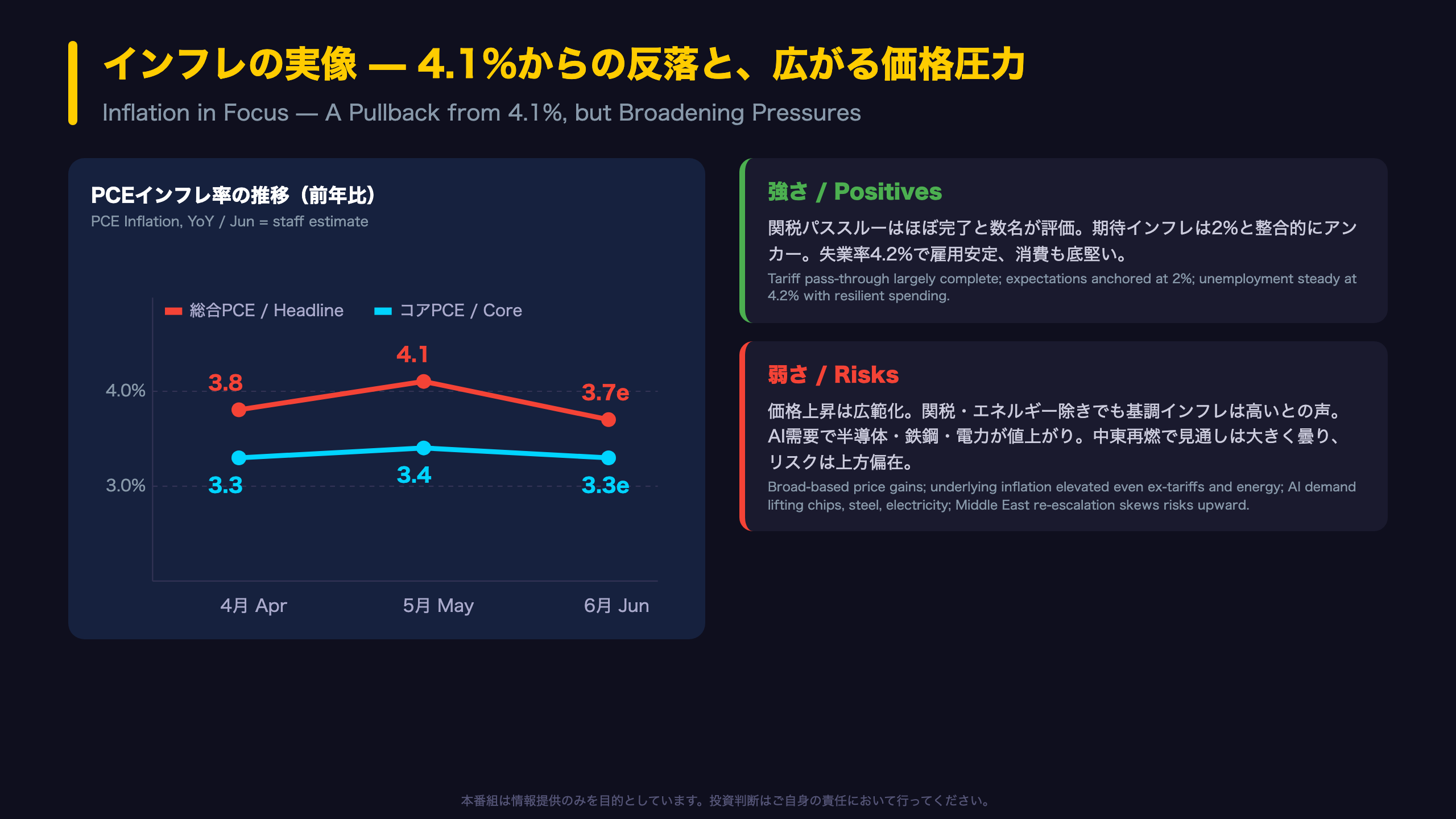
📈 Headline PCE hit 4.1% in May before an estimated step-down to 3.7% in June. Many participants judged tightening would likely be necessary if inflation does not decline. Markets fully price a hike by September.
💡 Chairman Warsh also floated cutting meetings to six per year. We break down implications for USD/JPY, US equities and Treasuries.
Next FOMC: September 15-16.
The Ultimate Summary — 全会一致の終焉、9対3の衝撃
From Unanimity to a Three-Way Dissent in Six Weeks
The biggest surprise in the July FOMC minutes was not the rate hold itself but the vote composition. The Federal Open Market Committee — the Fed’s rate-setting body of governors and regional bank presidents — voted 9-3 to keep the funds rate at 3.50-3.75%, with Cleveland’s Hammack, Minneapolis’s Kashkari, and Dallas’s Logan all dissenting in favor of a 25bp hike. June’s decision had been unanimous at 12-0.
Why the Direction of Dissent Matters
For most of the past several years, FOMC dissents skewed dovish — officials pushing for cuts. This time, all three dissents pointed toward tightening, and the minutes note that beyond the three voters, \”several participants favored an increase of 25 basis points,\” judging price pressures to be broad-based.
Markets Were Already There
According to the Desk’s report, markets assigned roughly a one-in-three probability to a July hike and had fully priced a 25bp hike by September, plus another by Q1 2027. Nominal Treasury yields rose 25-30bp over the intermeeting period, driven by real rates, partly because Fed communications were perceived as more restrictive than expected.
Notably, the median Desk survey respondent still expected no change through 2027 and a cut in early 2028 — a wide gap between market pricing and professional forecasts. For dollar-based investors, the resolution of that gap is itself a source of rate volatility. Compare this with the ECB, which has already hiked in response to energy-driven inflation: the Fed under Warsh may now be converging toward that global tightening bias.
ウォーシュ体制の幕開け — 会議室で何が変わったか
The Fed’s Quiet Institutional Revolution
Beyond the rate decision, these minutes document a structural overhaul of how the FOMC itself operates — the first tangible imprint of Kevin Warsh, who took over as Fed Chair in June 2026 declaring \”inflation is a choice\” and announcing five independent task forces on the conduct of monetary policy.
Fewer Meetings, Bigger Decisions?
The Chairman proposed moving from eight scheduled meetings per year — the norm since 1981 — to six, roughly every two months. The stated rationale: more data accumulates between meetings, and policymakers gain time for strategic issues. No decision was made, and the 2026 calendar is unaffected. But for markets, fewer meetings would concentrate event risk: each decision would carry more information and more surprise potential, similar to how quarterly-meeting central banks like the BOJ under its old schedule generated larger per-meeting volatility.
The Balance Sheet Task Force Goes Live
Most participants said the balance sheet task force’s findings would be a useful input for future deliberations, flagging issues like market functioning, financial stability, and the maturity composition of Treasury holdings. Importantly, many participants reaffirmed that the funds rate should remain the primary policy tool — a guardrail against radical balance-sheet activism.
Communication as a Tightening Tool
Nearly all members agreed to retain June’s unusually forceful pledge that the Committee \”will deliver price stability.\” Per the Desk’s market outreach, that language helped keep inflation compensation contained even as oil prices spiked — evidence that the Warsh Fed is using words themselves to do part of the tightening work, much as Draghi’s \”whatever it takes\” once did in the opposite direction.
インフレの実像 — 4.1%からの反落と、広がる価格圧力
Improving Headline, Sticky Core: Inflation’s Two Layers
PCE inflation — the Fed’s preferred gauge, broader than CPI and reweighted continuously — traced 3.8% in April, 4.1% in May, and an estimated 3.7% in June. The minutes are explicit that June’s step-down was \”led by a deceleration in consumer energy prices,\” meaning it could reverse if the Middle East conflict re-escalates. Core PCE eased just 0.1 point to an estimated 3.3% — still far above the 2% target and well above where the ECB and other peers sit even after their recent hikes.
AI as an Inflation Force
Unusually, the minutes name specific items under pressure: chips and steel for data centers, smartphones, computer equipment, software, and electricity. The AI buildout has shifted from an investment narrative to a demand shock. Some participants noted that even excluding tariff- and energy-sensitive items, underlying inflation appeared elevated — implying demand-side pressure that supply-shock explanations cannot fully cover.
The Genuine Positives
- Several participants judged tariff pass-through largely complete, with newly announced tariffs likely to have only modest effects.
- Business contacts reported absorbing costs via margin compression, and some judged consumers would resist further price increases.
- Crucially, medium- and longer-term inflation expectations remained anchored at 2%-consistent levels — the single most important firewall against a 1970s-style spiral.
- Participants agreed AI-driven productivity gains should eventually expand aggregate supply and push inflation down, though views differed on timing.
The Balance of Risk
Several participants warned that successive supply shocks have repeatedly delayed the return to 2%, and many flagged the risk that years of above-target inflation could seep into wage- and price-setting. The committee’s verdict: risks are skewed firmly to the upside — the analytical foundation for the hawkish tilt described in the next section.
利上げ論争の深層 — 「次の一手」の条件
The Weight of the Word \”Most\”
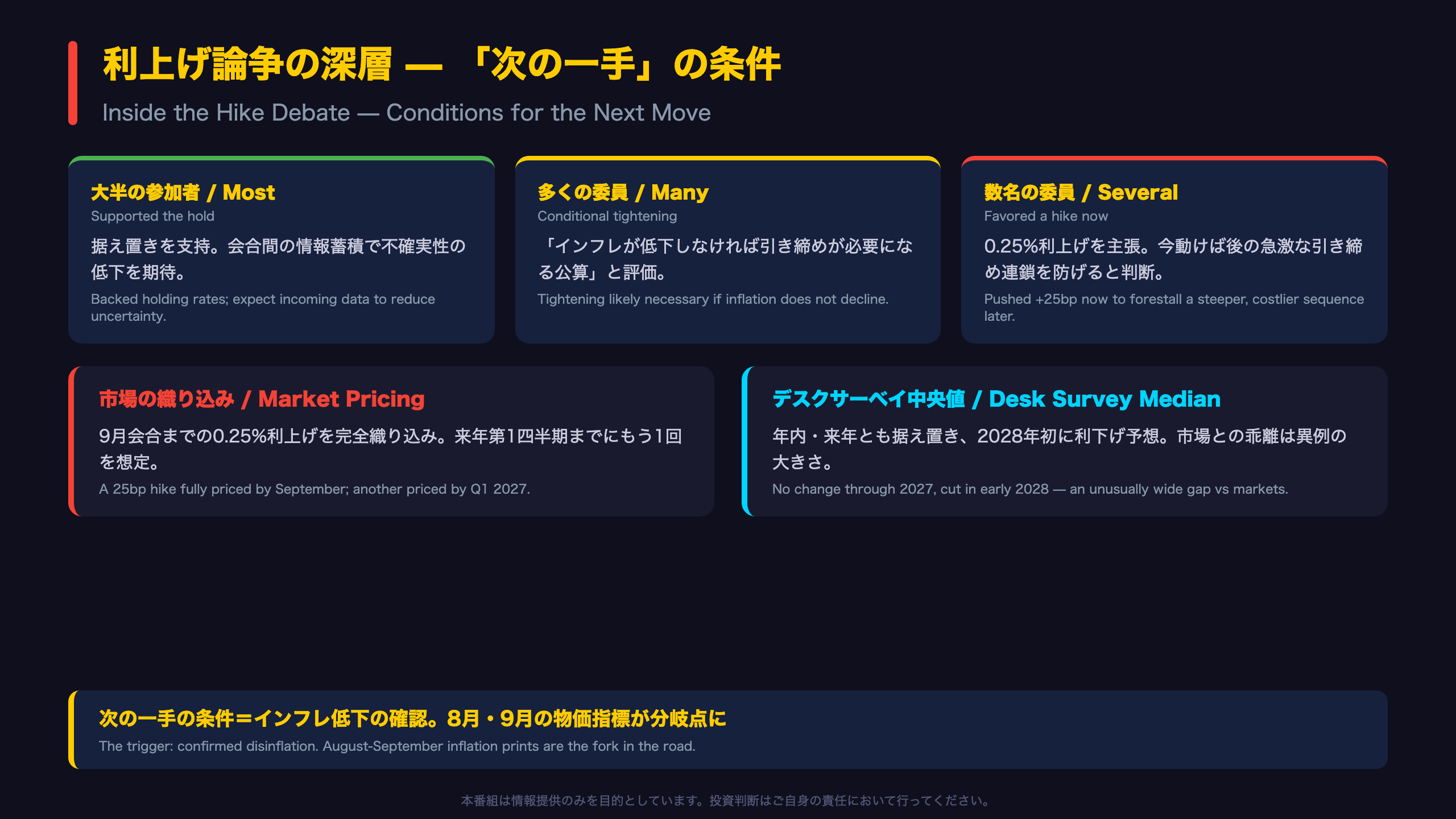
In June, even the officials who saw a case for hiking ultimately \”supported maintaining\” rates — unanimity held. In July, support for the hold slipped to \”most participants\” and three members actually voted to hike. In FOMC language, that progression signals hawks moving from opinion to action.
The Case for Pre-emptive Tightening
The minutes record that a few of the would-be hikers judged that moving now \”would likely help forestall the need for a steeper and potentially more costly sequence of tightening moves at a later stage.\” This is classic pre-emption logic — echoing the lesson of 2021-22, when a delayed Fed response forced the fastest hiking cycle in four decades. It also fits Chairman Warsh’s own record as a Fed Governor from 2006 to 2011, when he was among the more inflation-wary voices.
The Conditions Ledger
- Many participants: tightening likely necessary if inflation does not decline.
- Some: financial conditions may not be sufficiently restrictive to restore 2% inflation.
- Several: do not view the current stance as restrictive at all.
- The committee broadly expects intermeeting data to reduce uncertainty about the inflation path.
Translation for investors: if August and September inflation prints fail to cool, the bar to a hike drops sharply.
Markets vs. Surveys: An Unusual Divide
Markets fully price a 25bp hike by September plus another by Q1 2027; the median Desk survey respondent sees no change through 2027 and a cut in early 2028. Even allowing for term premium distortions in market pricing, this is an exceptionally wide gap. One side must capitulate — and the incoming inflation data will decide which. For USD-based portfolios, that makes the front end of the Treasury curve the single most information-rich asset to watch.
金融安定の警告と日本人投資家へのインプリケーション
A Dot-Com Comparison from the Fed’s Own Staff
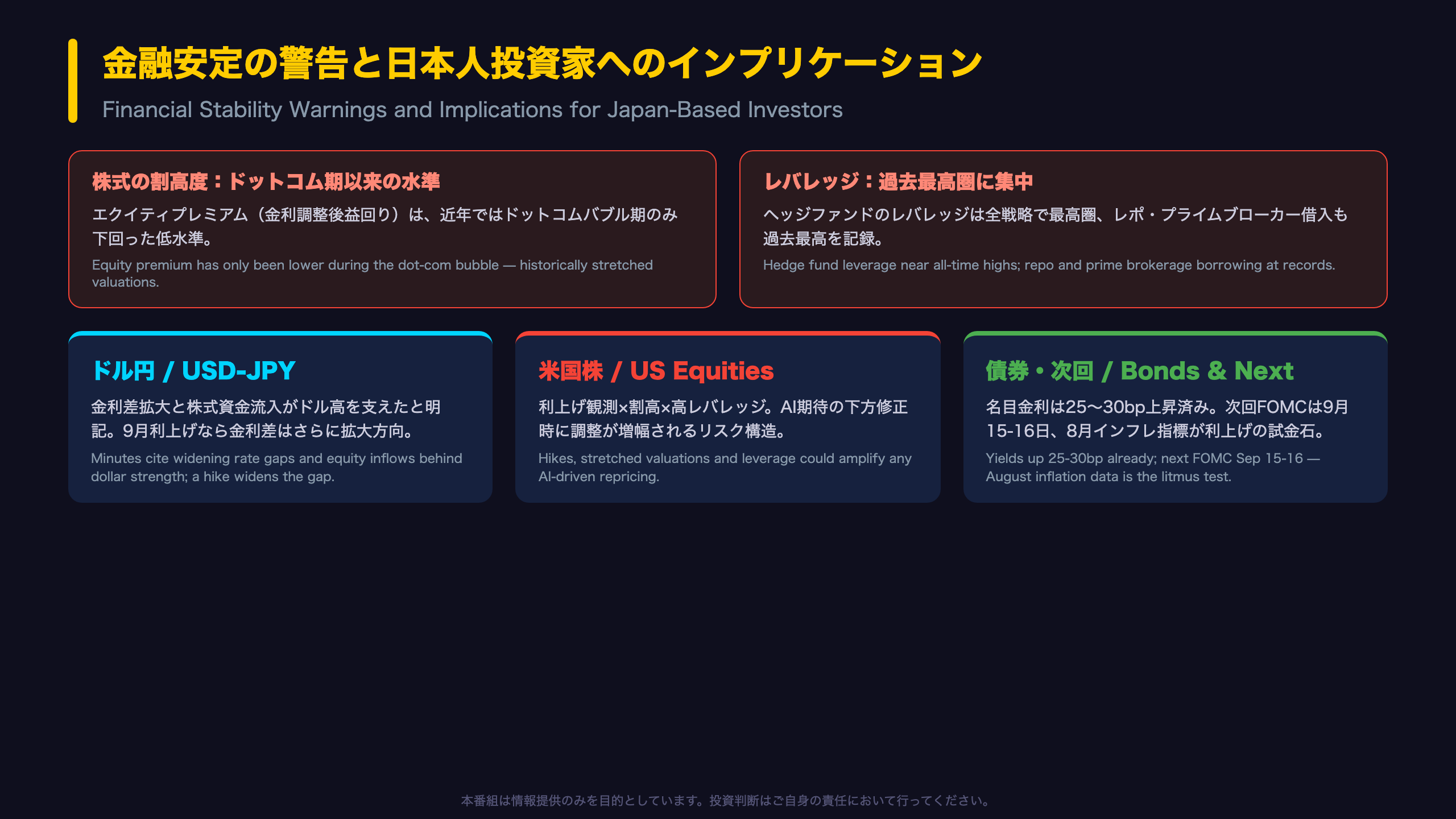
The financial stability section of these minutes deserves close attention from any US asset holder. Staff assessed that the equity premium — the forward earnings-to-price ratio adjusted for long-term interest rates — \”was at a level that has only been lower in recent history during the dot-com bubble.\” On top of that: hedge fund leverage near all-time highs across all strategies and concentrated in the largest funds; repo and prime brokerage borrowing at record levels; and life insurers heavily exposed to riskier, less liquid assets. Overall system vulnerabilities were characterized as \”notable.\” Some participants warned that a major downward revision to AI earnings assumptions could trigger a broad repricing of assets and tighten financial conditions abruptly.
Portfolio Implications, With the Chain of Reasoning
USD/JPY: The minutes state directly that widening rate differentials and heavy foreign equity inflows supported continued dollar appreciation. A September hike would widen the US-Japan short-rate gap further — while the Bank of Japan remains far below US policy rates — sustaining structural dollar support. For yen-based investors, this cushions the yen value of dollar assets but raises the cost of new dollar exposure.
US equities: Hike expectations plus historically stretched valuations plus record leverage is a combustible mix. Leverage unwinds amplify drawdowns; portfolios concentrated in AI infrastructure names carry the most repricing risk, as Korean and Taiwanese semiconductor indexes already demonstrated this period.
Bonds: Nominal Treasury yields rose 25-30bp over the intermeeting period, driven by real rates, with markets pricing further hikes. The front end of the curve is now the cleanest read on policy expectations — more informative than Fed rhetoric itself.
What to Watch Next
The next FOMC meeting is September 15-16, 2026. The August CPI and PCE releases before then are the first true test of whether disinflation resumes — and whether the fully-priced September hike becomes reality.
Disclaimer: This article is for informational purposes only. All investment decisions are made solely at your own risk.