📺 Watch the Full Video Analysis
This article was automatically generated by the NFC Market Live AI analysis system. (Updated: 2026-08-10 09:00 JST)
📄 Primary Source
財務省
https://www.mof.go.jp/policy/international_policy/reference/itn_transactions_in_securities/month.pdf
📊 Deep dive into Japan MOF’s July international securities flow data (released Aug 10, 2026).
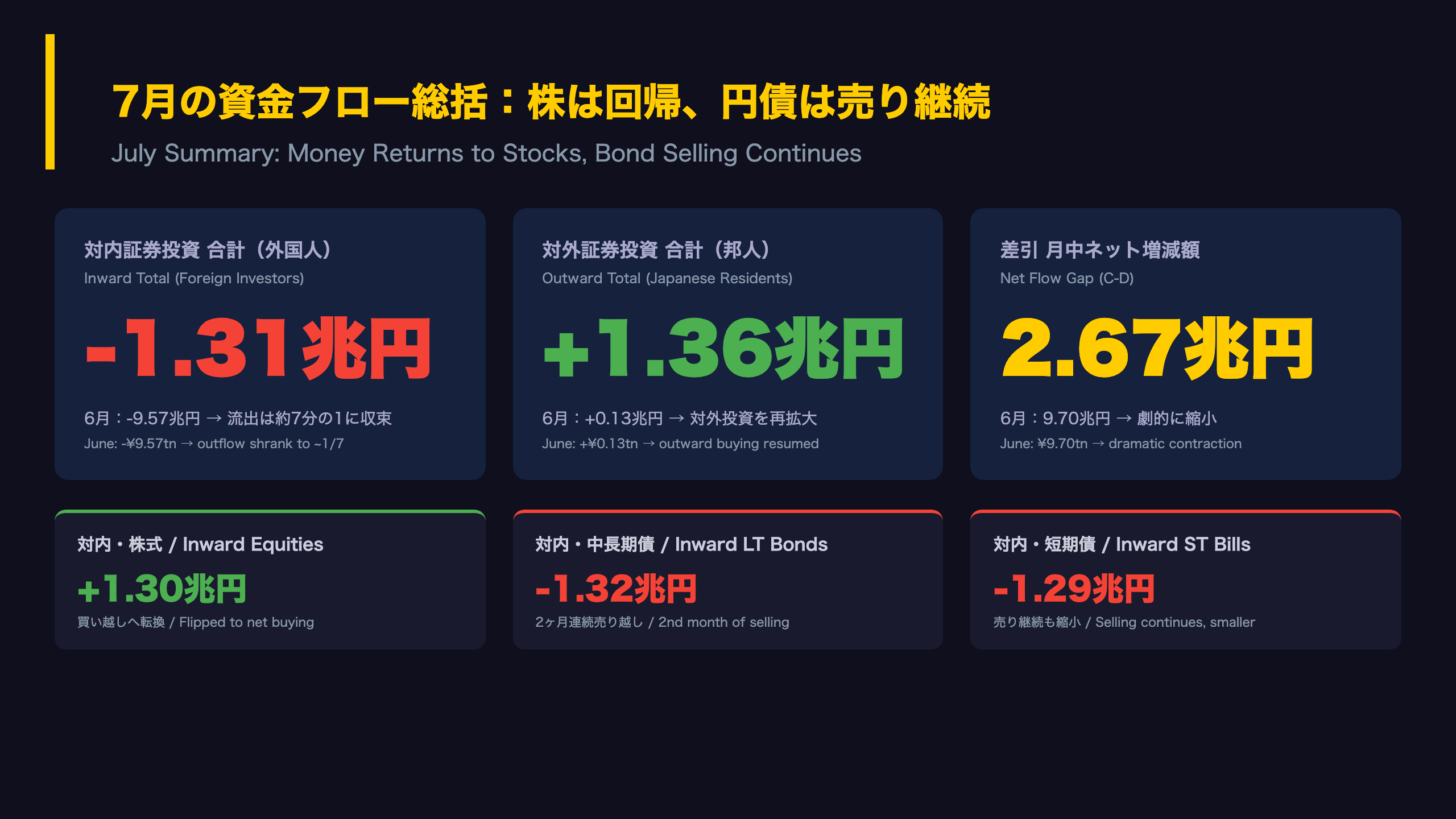
📈 Foreign investors flipped to net BUYERS of Japanese equities: +¥1.30tn, reversing June’s ¥2.99tn sell-off.
📉 But JGB selling continued for a second month: -¥1.32tn in long-term debt, -¥1.29tn in short-term bills.
💡 Japanese residents resumed outward investment (+¥1.36tn), led by banks buying foreign short-term debt and retail-driven foreign equity funds.
⚠️ Net cross-border outflow shrank sharply to ¥2.67tn from June’s ¥9.70tn—panic exodus fading, selective re-entry beginning.
Full implications for JPY, JGB yields, and Japanese stocks inside.
The Ultimate Summary:フローの二極化——株回帰と円債売り
Japan’s Capital Flow Report: What It Is and Why July Matters
Japan’s Ministry of Finance (MOF) publishes monthly data on cross-border securities transactions, compiled from \”designated major investors\”—banks, brokers, insurers, and asset managers required to report under Japan’s foreign exchange regulations. Think of it as Japan’s rough equivalent of the US TIC data, but faster and on a contract basis.
The headline: panic over, divergence begins
June 2026 saw an extraordinary foreign exodus from Japanese assets: a net disposition of ¥9.57 trillion (roughly $60bn+) spread across equities (-¥2.99tn), long-term bonds (-¥2.49tn), and short-term bills (-¥4.09tn). July’s report shows that outflow collapsing to just ¥1.31tn—about one-seventh of June’s size.
More importantly, the composition flipped. Foreigners became net buyers of Japanese equities (+¥1.30tn) while continuing to sell yen debt (-¥1.32tn long-term, -¥1.29tn short-term). For international investors, this pattern echoes episodes where global funds rotate back into Japanese stocks on valuation or governance stories while remaining wary of JGB duration amid Bank of Japan policy normalization expectations.
Caveats for global readers
The data is contract-based, not settlement-based, and does not reveal FX hedging. A foreign equity purchase that is fully currency-hedged has little direct impact on the yen. Nonetheless, the sharp shrinkage of the net outflow gap—from ¥9.70tn to ¥2.67tn—suggests the yen-negative flow pressure that dominated June has substantially eased.
Deep Dive①:外国人の日本株フロー、V字反転の中身
Anatomy of the Reversal: Foreign Flows into Japanese Equities
Why the ten-day breakdown matters
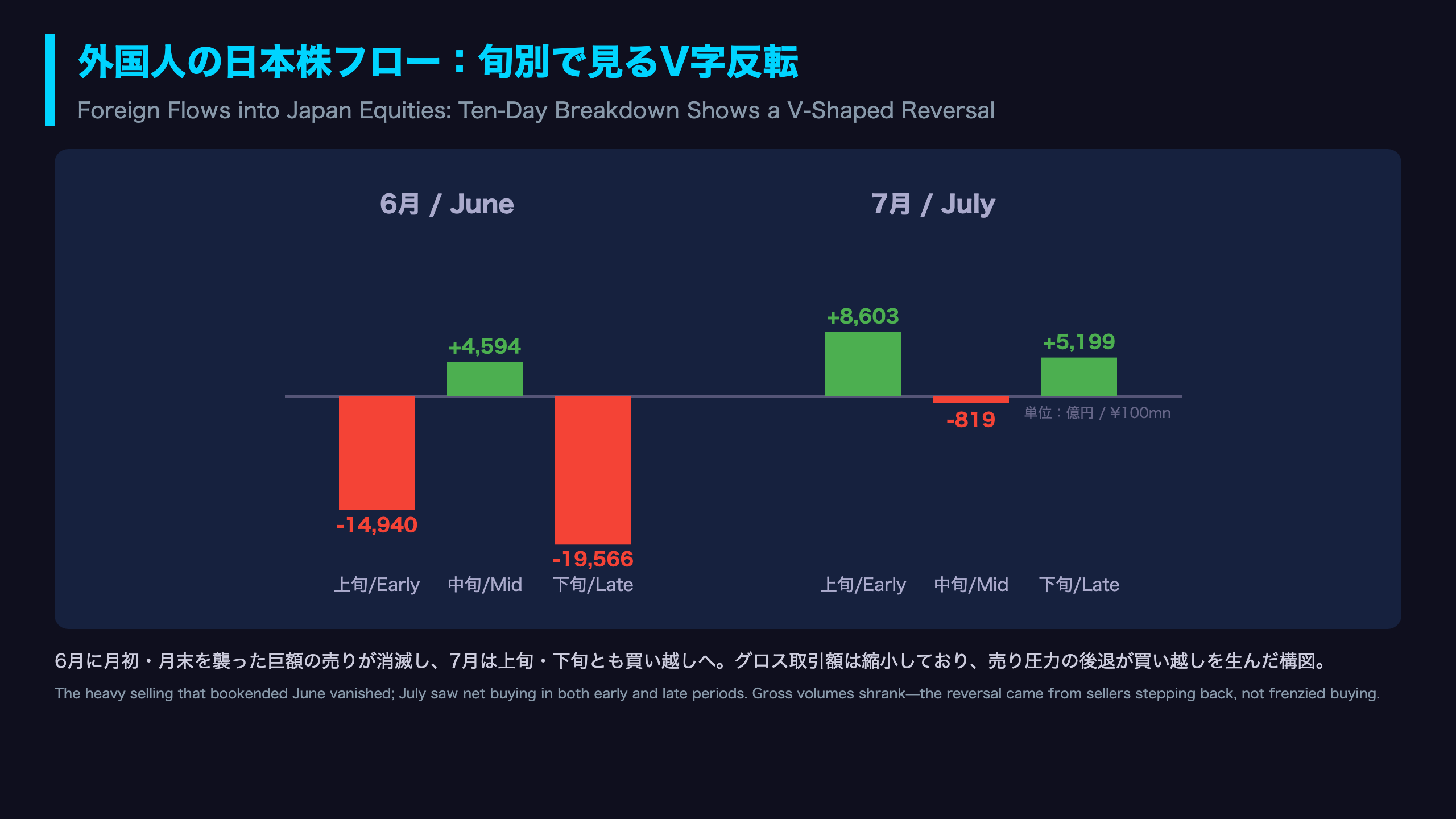
Unlike most countries’ flow data, Japan’s MOF report breaks each month into three ten-day periods (early, mid, late), giving unusually granular insight into flow timing. The June-to-July pattern shows a dramatic swing:
- June: -¥1.49tn (early), +¥0.46tn (mid), -¥1.96tn (late)
- July: +¥0.86tn (early), -¥0.08tn (mid), +¥0.52tn (late)
The heavy selling that bookended June vanished almost immediately when July began, suggesting a rapid unwind of defensive positioning rather than a slow-building recovery.
Quality of the flow: quiet accumulation
Gross activity actually shrank—foreign acquisitions fell from ¥20.9tn in June to ¥19.0tn in July, with dispositions falling even more. In market microstructure terms, the net buying emerged because sellers stepped back, not because buyers charged in. That typically indicates stabilization rather than euphoria.
The bull and bear read
Bulls will note that foreign investors have historically been the marginal price-setters in Japanese equities; their return often coincides with sustained rallies. Bears will counter that a single month of net buying—especially one driven by reduced selling—proves little, and that shrinking gross volumes could signal fading engagement with the Japan trade. The August report, due in early September, will show whether this is a genuine re-entry or merely a pause in the exit.
Deep Dive②:円債は2ヶ月連続の売り越し——下旬に売り集中
The JGB Side of the Story: Smaller Outflows, Same Direction
Two months of foreign selling
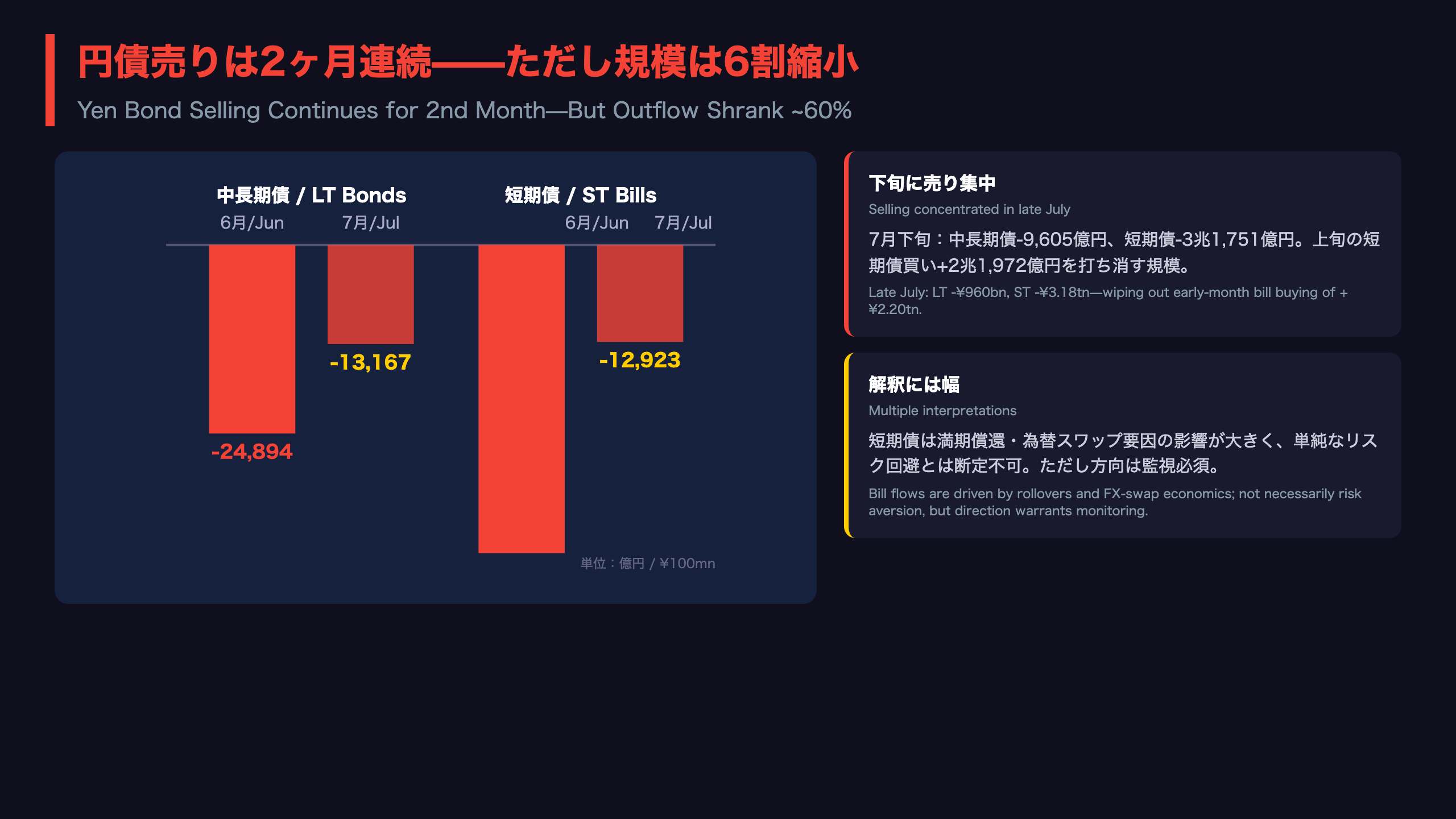
For readers less familiar with Japan’s bond market: foreign investors hold a meaningful share of Japanese Government Bonds (JGBs), particularly short-term bills, which are often used in FX-swap-related arbitrage trades. The MOF data shows foreigners sold a net ¥1.32tn of long-term yen debt in July after ¥2.49tn in June, while bill selling shrank from ¥4.09tn to ¥1.29tn. Combined bond outflows fell roughly 60%, from ¥6.58tn to ¥2.61tn—but the direction did not change.
The late-month anomaly
The intra-month pattern deserves attention. Short-term bill flows swung violently: +¥2.20tn of net buying in early July collapsed into -¥3.18tn of net selling in the final ten days. Long-term bond selling also accelerated late in the month (-¥0.96tn in the last decade vs. under -¥0.18tn in each earlier period).
Bill flows are notoriously noisy—driven by maturity rollovers and dollar-yen basis swap economics rather than directional views. A widening or narrowing of the FX swap basis can mechanically trigger large bill purchases or sales by foreign banks. So the late-July selling is not necessarily a vote of no confidence in Japan.
What to watch
If foreign long-term bond selling persists into a third month while the Bank of Japan continues reducing its bond purchases, the private sector must absorb more duration—a structural argument for higher JGB yields. Conversely, a return of foreign bill buying would suggest the swap-arbitrage channel has normalized. The distinction matters greatly for global rates markets, given JGB yields’ growing influence on US and European term premia.
Deep Dive③:邦人マネーの対外投資再開——短期債主導の1.36兆円
Japanese Money Goes Abroad Again—Led by Banks Buying Short-Term Paper
Context: why outward flows matter for FX
Japan is the world’s largest net creditor nation, and Japanese institutional flows into foreign bonds—especially US Treasuries—have historically been a major force in global fixed income and dollar-yen. The MOF’s appendix table breaks outward investment down by investor type, offering a rare window into who is doing the buying.
July’s key shift: banks rotated from selling long bonds to buying bills
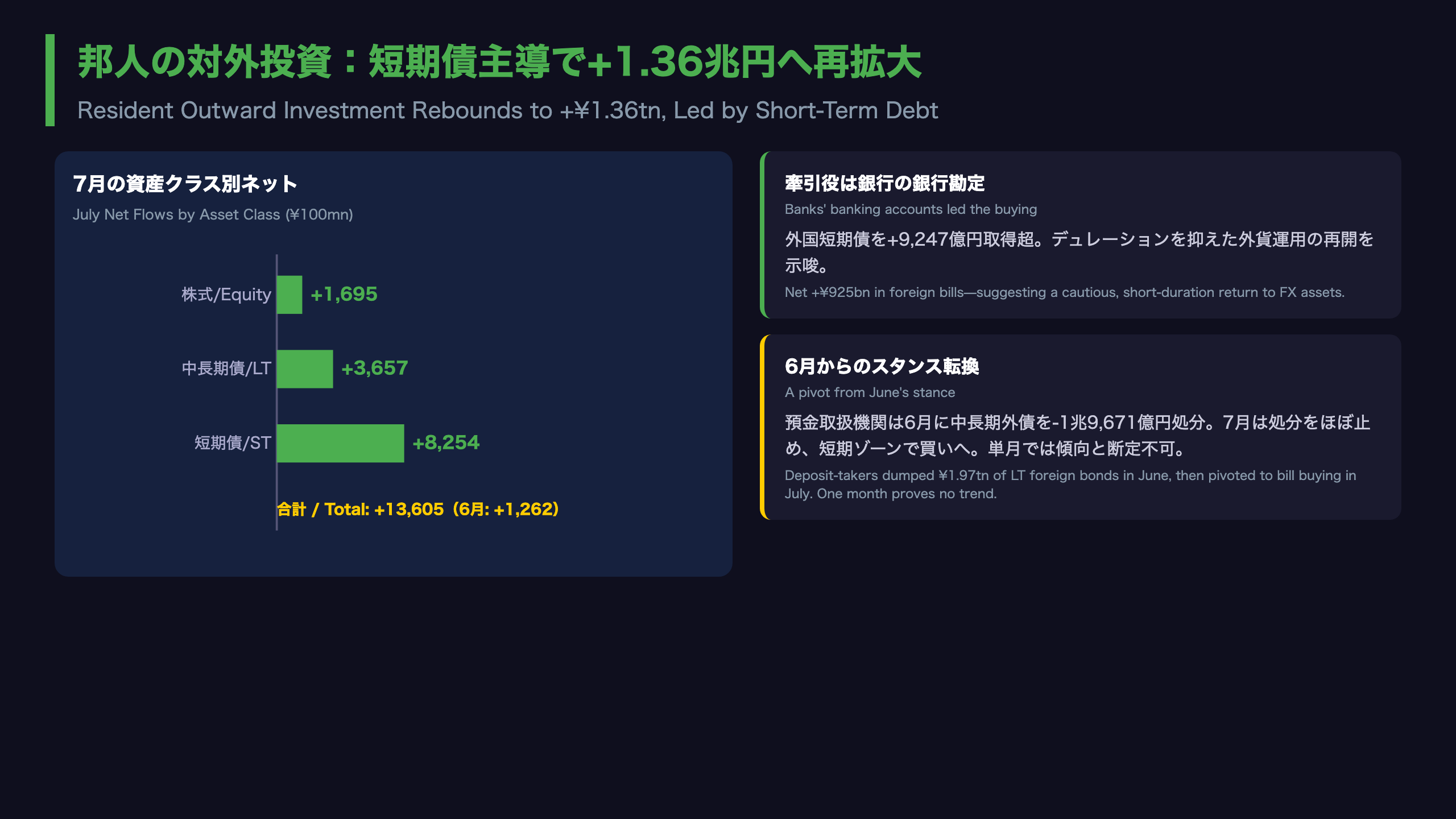
In June, deposit-taking institutions (mainly commercial banks) sold a massive ¥1.97tn of foreign long-term bonds. In July, that selling nearly stopped (-¥209bn), and instead banks’ banking accounts bought a net ¥925bn of foreign short-term debt. This pattern—cutting duration while re-entering foreign-currency assets—is consistent with banks positioning cautiously around rate uncertainty, though the report itself does not disclose motives.
The full outward picture
- Total outward: +¥1.36tn (June: +¥0.13tn)
- Equities: +¥170bn | LT bonds: +¥366bn | ST debt: +¥825bn
- Intra-month: +¥2.40tn early, -¥1.17tn mid, +¥0.14tn late
For global investors, the takeaway is that Japanese money has resumed flowing abroad after a near-standstill in June—but tentatively, and concentrated at the short end. A sustained return of Japanese lifers and banks to foreign long-duration bonds would be a much bigger signal for US Treasury demand; that has not yet appeared in this data.
Deep Dive④:部門別解剖——投信の外株買いと証券会社の大転換
Who’s Buying What: Japan’s Investor-by-Investor Breakdown
A unique feature of Japan’s MOF flow data is its appendix disaggregating outward investment by investor type—central bank, banks, trust banks, dealers, insurers, and investment trust managers. For global market watchers, this is the closest thing to a monthly x-ray of Japanese institutional behavior.
The four stories of July
-
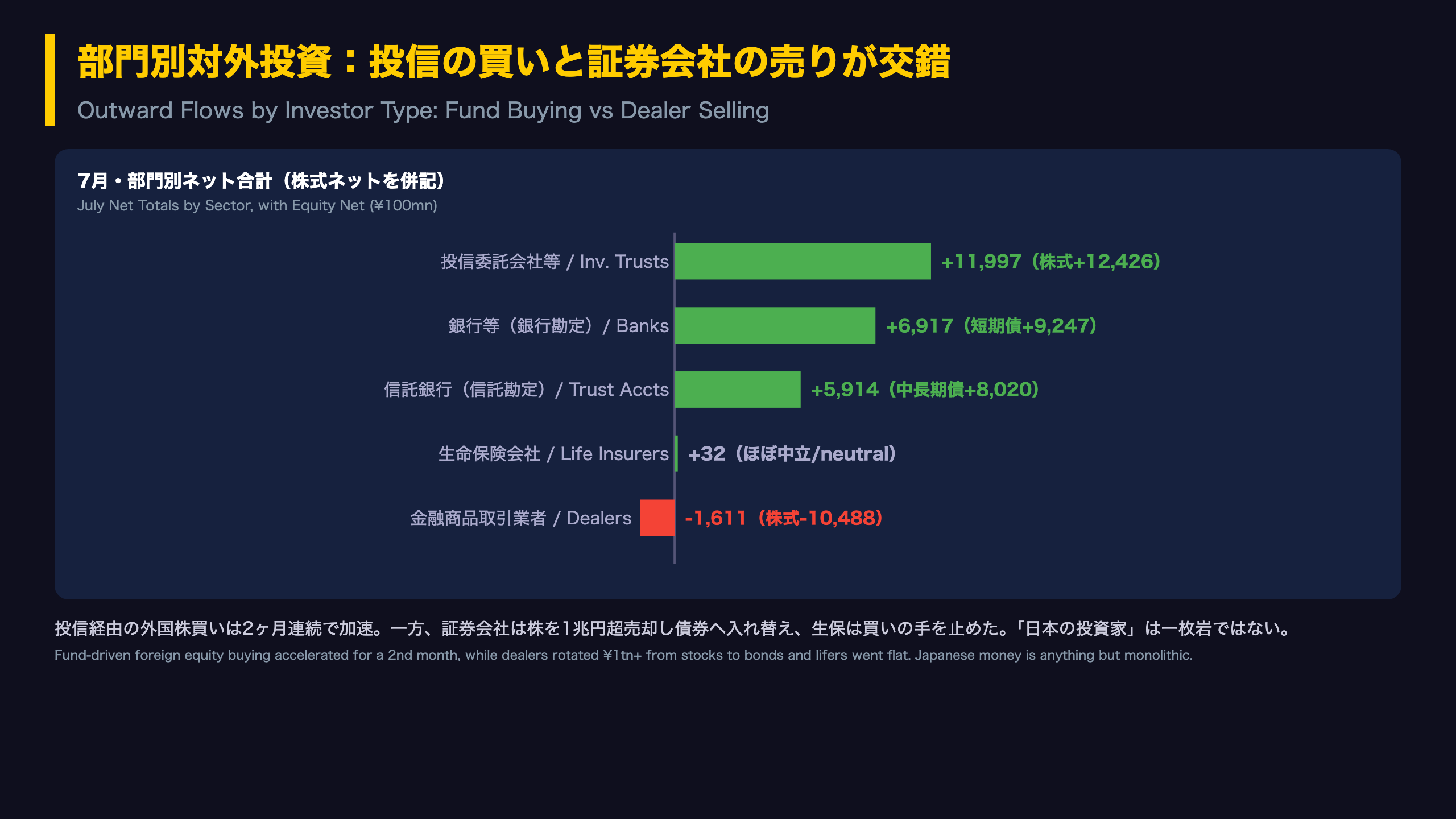
Investment trust managers (retail proxy): relentless equity buying. Net foreign equity purchases accelerated to ¥1.24tn from ¥767bn in June. Crucially, they kept buying even through June’s market turmoil—a hallmark of systematic, contribution-based flows (Japan’s NISA tax-free investment scheme is widely believed to channel household savings into global equity funds, though the MOF data does not identify the source).
-
Securities dealers: massive rotation. Financial instruments firms sold ¥1.05tn of foreign equities while buying ¥896bn of long-term bonds. Dealer flows often reflect hedging and inventory management rather than directional conviction.
-
Trust banks (pension proxy): buying foreign duration. Trust accounts added ¥802bn of long-term foreign bonds, following ¥2.30tn in June—steady institutional demand for overseas fixed income.
-
Life insurers: gone quiet. After net buying of ¥1.46tn in June, lifers were flat in July (+¥3bn). Historically, Japanese lifers’ appetite for unhedged foreign bonds has been a key dollar-yen driver, so their retreat to the sidelines is notable for FX watchers.
The divergence across sectors underscores that \”Japanese money\” is not a monolith—and the tug of war between retail equity buying and institutional caution will shape flows into the autumn.
インプリケーション:日本株・金利・円への「根拠の鎖」
Three Chains of Evidence: What July’s Flows Mean for Markets
Chain 1: Japanese equities—supply-demand support
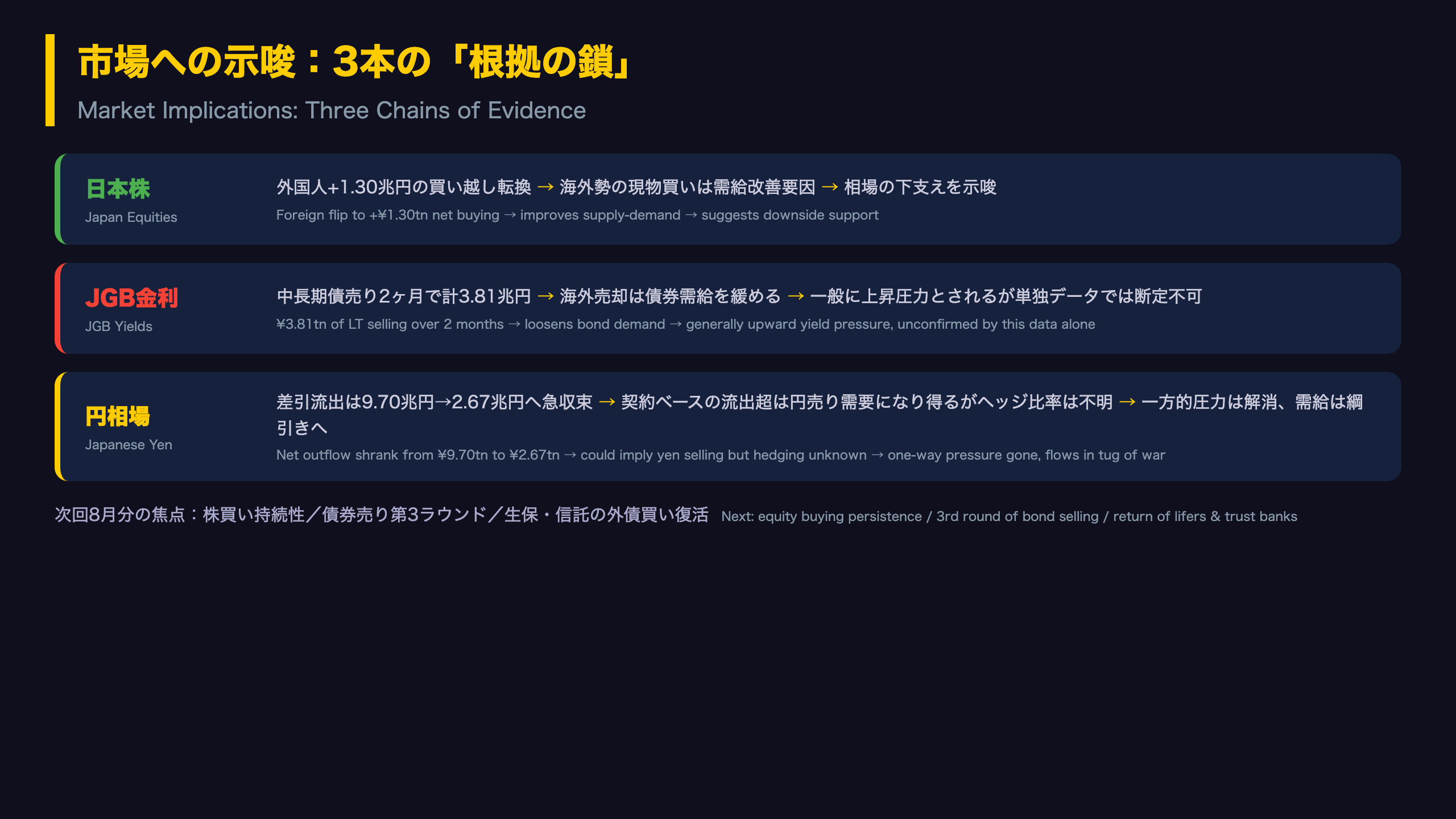
Foreign net buying of ¥1.30tn (vs -¥2.99tn in June) → foreign investors are the marginal price-setters in Tokyo, historically accounting for the majority of trading value → suggests downside support for Japanese stocks.
For context, this echoes past episodes (2013, 2023) where sustained foreign inflows preceded major Nikkei rallies—though one month is far from a confirmed regime.
Chain 2: JGB yields—upward pressure, unconfirmed
Two straight months of foreign LT bond selling totaling ¥3.81tn → reduced foreign demand loosens the JGB supply-demand balance → generally seen as upward yield pressure, though this dataset alone cannot confirm the outcome.
This matters beyond Japan: rising JGB yields raise the hurdle for Japanese investors to hold US Treasuries and Bunds, with knock-on effects for global term premia. The halving of the selling pace is the offsetting positive.
Chain 3: The yen—from one-way pressure to tug of war
Net outflow gap of ¥2.67tn (vs ¥9.70tn in June) → contract-basis outflows can translate into yen-selling demand → directionally yen-negative, but unknowable hedging ratios prevent firm conclusions.
The key change is magnitude: June’s overwhelming yen-negative flow impulse has faded. With foreign equity buying (yen-positive) offsetting bond selling (yen-negative), flows alone no longer dictate dollar-yen direction.
What to watch next
The August report (due early September) has three checkpoints: (1) a second month of foreign equity buying, (2) a third month of LT bond selling—which would suggest structural rather than tactical disposal, and (3) whether life insurers and trust banks resume foreign bond purchases, a classic driver of dollar-yen upside.
Disclaimer: This article is for informational purposes only. All investment decisions are made solely at your own risk.