📺 Watch the Full Video Analysis
This article was automatically generated by the NFC Market Live AI analysis system. (Updated: 2026-08-07 04:09 JST)
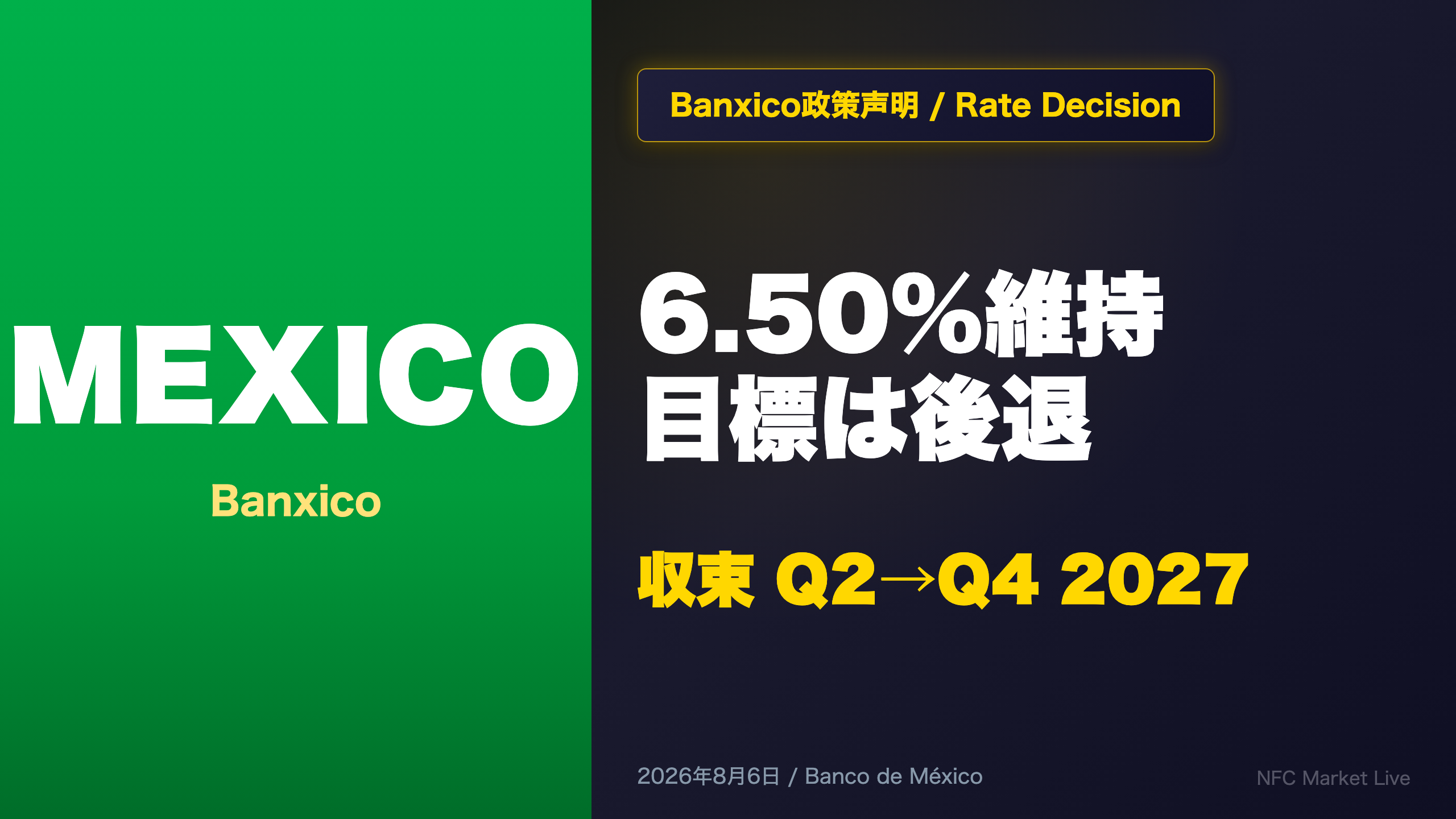
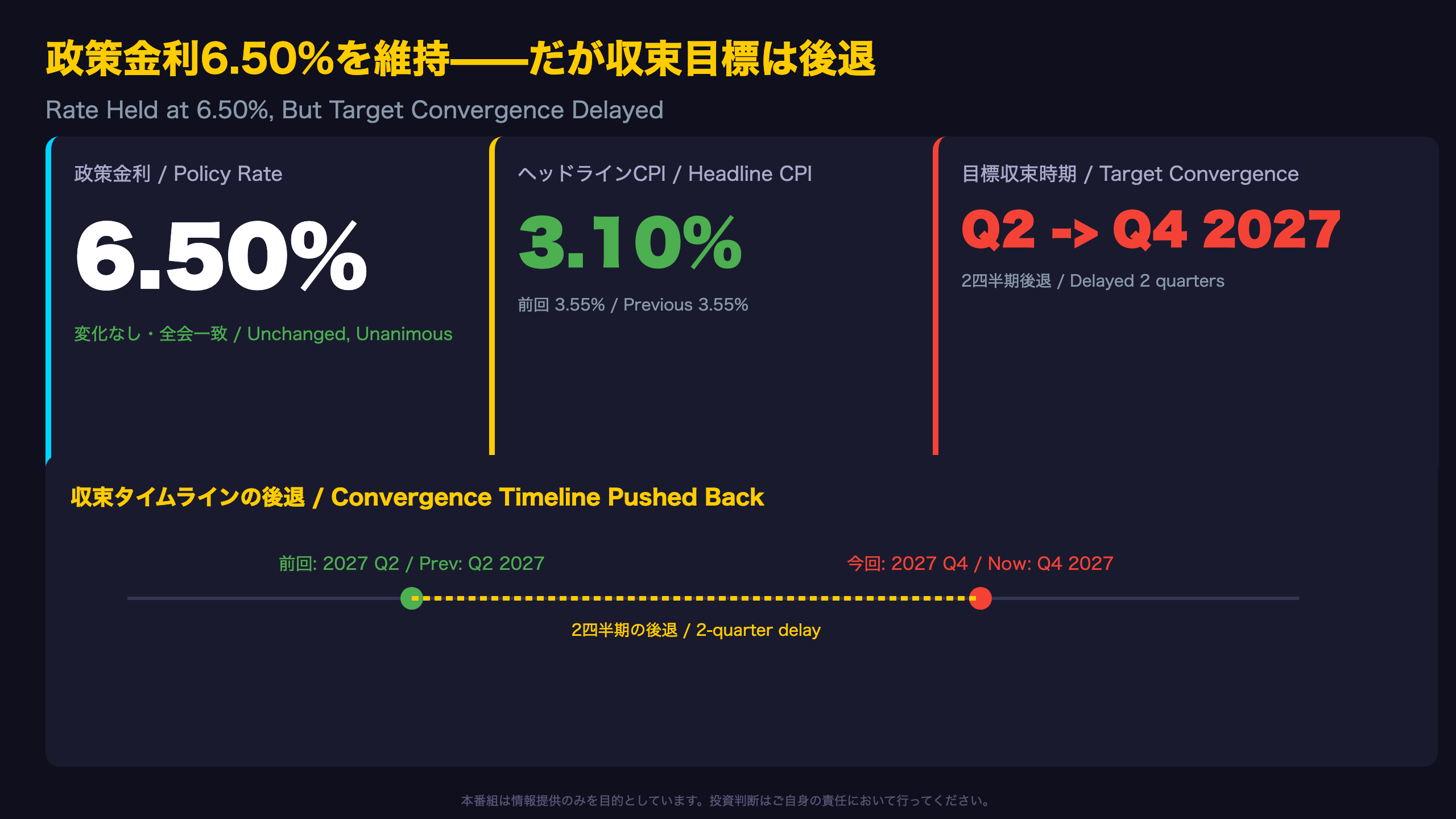
Banco de México (Banxico) held its policy rate unanimously at 6.50% on August 6. 📊
The hold itself matched expectations, but a closer read reveals something bigger.
💡 The inflation-target convergence date slipped from Q2 2027 to Q4 2027.
📉 Yet hard data looks solid: headline CPI fell from 3.55% to 3.10%, core from 4.12% to 3.95%.
💰 The peso appreciated, and the economy confirmed a Q2 reactivation.
⚠️ Optimistic Middle East language was removed; commodity prices flipped to broadly higher.
A deep dive into a statement where strength and caution coexist.
政策金利6.50%維持は想定通り、しかし収束目標は後退
Context: Who is Banxico?
Banco de México (Banxico) is Mexico’s central bank, operating under a single mandate to maintain low and stable inflation, with a point target of 3% (+/-1pp band). Its overnight rate has stood at 6.50% for consecutive meetings.
The Delay, Quantified
The most consequential change in this statement is not the hold itself — which matched consensus — but the revision to the inflation-target convergence date, from Q2 2027 to Q4 2027. The forecast table shows headline inflation for 2027 revised upward across Q1 (3.2% to 3.4%), Q2 (3.0% to 3.3%) and Q3 (3.0% to 3.2%), with core inflation revised similarly. By 2028, both measures still converge to 3.0%, suggesting the long-run disinflation path is intact — only the near-term glide path has flattened.
A Useful Comparison
Unlike the Federal Reserve, which held its own rate steady in July with US inflation running near 3%, Banxico maintains a far higher real policy rate given Mexico’s structurally higher core inflation (3.95%). This wide rate differential has historically supported carry trades into the peso, which appreciated over the review period even as US Treasury long-term yields rose.
What to Watch
Mexico’s next fortnightly CPI print and Banxico’s next statement, expected in late September, will show whether the newly “gradual” disinflation path holds or requires further revision.
文言の変化:中東情勢の楽観消失とリスク順位の入れ替え
The Missing Optimism Clause
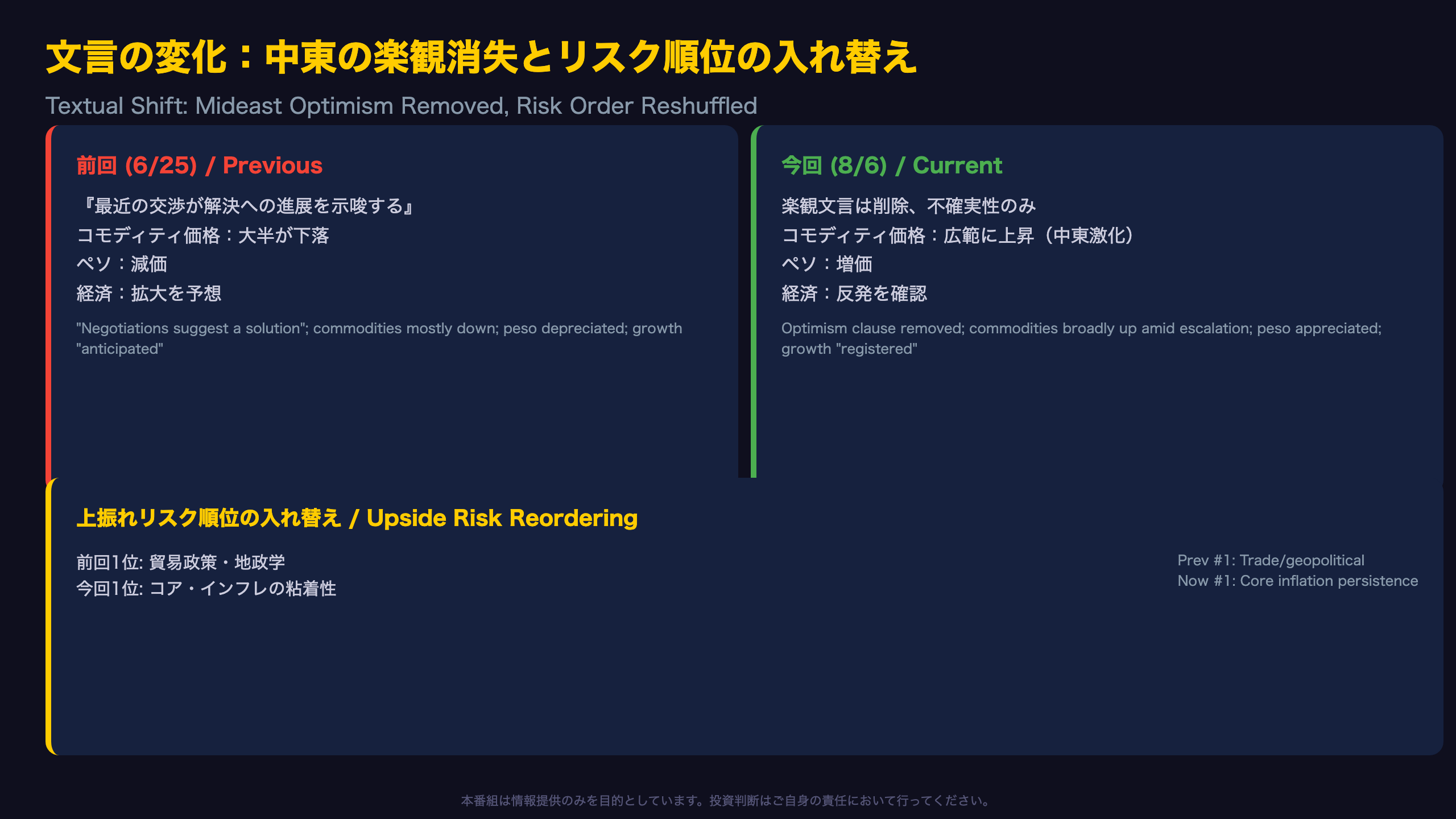
The June 25 statement included an unusually specific diplomatic reference: “recent negotiations suggest a solution is underway” regarding the Middle East conflict. That clause is entirely absent from the August 6 statement, which reverts to a flatter “uncertainty… persists.” This isn’t stylistic, it lines up with a hard data shift: commodity prices moved from “mostly decreased” in June to “increased broadly… in light of a new escalation” in August. For a net energy importer like Mexico, this reversal matters for imported inflation pressure.
Risk Ranking as a Signal
Banxico did not add or remove any risk factor from its list of five upside risks to inflation, but it reordered them. “Persistence of core inflation,” previously ranked second, now leads the list, ahead of “disruptions due to foreign trade policies or geopolitical conflicts.” Central bank statements rarely reorder risk lists without intent; this suggests the Board’s internal risk assessment has shifted from viewing inflation risk as primarily externally-driven to seeing domestically-generated price stickiness as the more pressing concern, even as headline data continues to improve.
Confirmed, Not Forecast
Notably, language describing Mexico’s own economy shifted from forward-looking to confirmatory: last time growth was “anticipated,” this time it “registered a reactivation.” Similarly, the peso flipped from “depreciated” to “appreciated” over the review window, a rare piece of unambiguous good news buried inside an otherwise more guarded statement. For USD/MXN watchers, this combination of peso strength and a still-high 6.50% policy rate reinforces Mexico’s continued appeal as a carry-trade destination, though the reordered risk list warns this could reverse if core inflation surprises to the upside.
予測テーブルの内訳:後退は2027年に集中
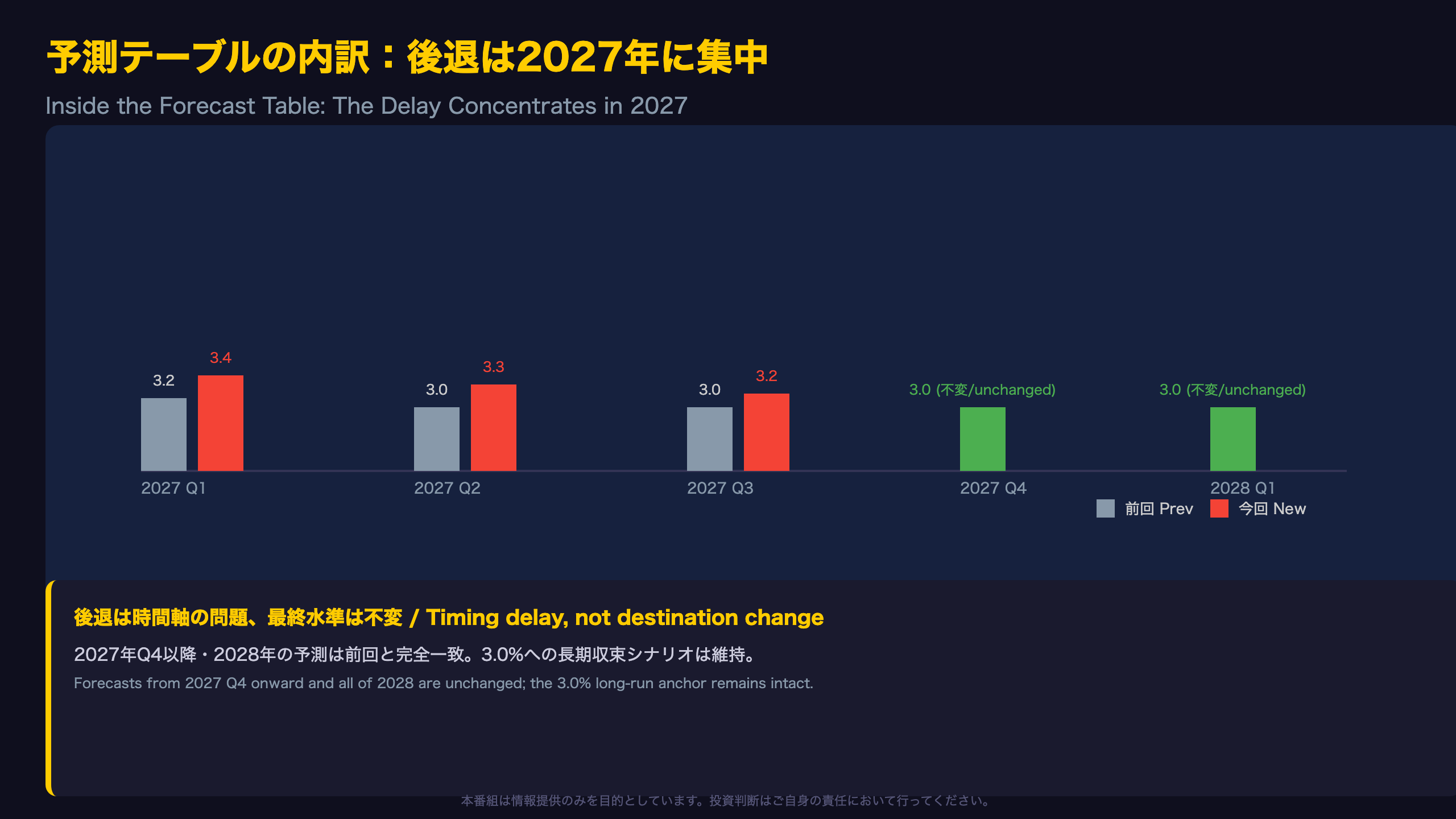
Quantifying the Scope of the Revision
The upward revision is narrowly concentrated. Comparing the forecast tables quarter by quarter (Headline / Core, %):
| Quarter | Prev Headline | New Headline | Prev Core | New Core |
|---|---|---|---|---|
| 2027 Q1 | 3.2 | 3.4 | 3.1 | 3.4 |
| 2027 Q2 | 3.0 | 3.3 | 3.0 | 3.3 |
| 2027 Q3 | 3.0 | 3.2 | 3.0 | 3.2 |
| 2027 Q4 | 3.0 | 3.0 | 3.0 | 3.0 |
| 2028 Q1-Q2 | 3.0 | 3.0 | 3.0 | 3.0 |
All of the revision sits in three quarters (2027 Q1-Q3); 2027 Q4 onward is untouched, and the long-run 3.0% anchor for 2028 is identical to the prior forecast.
Not a One-Way Revision
The memo line of seasonally-adjusted annualized figures complicates a simple “more hawkish” narrative: 2026 Q3 headline was actually revised down, from 2.8% to 2.5% annualized. This is a bumpier, not uniformly higher, near-term path, a nuance easily lost if one only reads the headline convergence date.
Two Readings, One Data Set
This table supports two coherent interpretations. The hawkish reading: core inflation stickiness is now expected to persist across three additional quarters, pushing back the timing of any future easing. The dovish counter: the long-run anchor (3.0% by 2028) is completely unchanged, implying this is a near-term timing adjustment rather than a structural reassessment. Upcoming fortnightly CPI releases through August and September will be the key test of which reading proves correct.
インプリケーション:長期化するホールド、ペソの拠り所
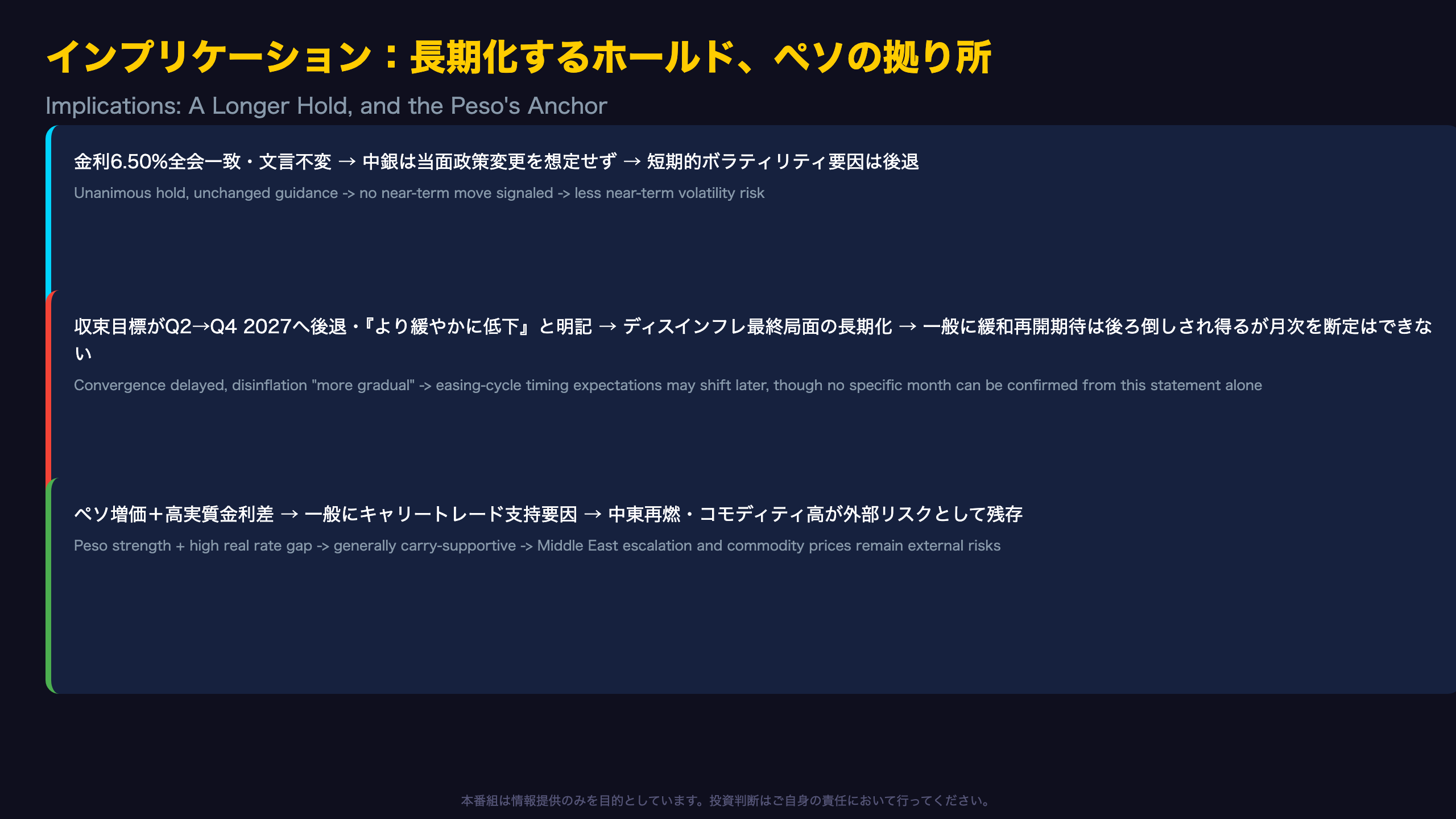
Market Implications, Chain by Chain
Policy rate: Held unanimously at 6.50%, with forward guidance language unchanged from the prior meeting, the Board signals no near-term intent to move, which reduces one source of near-term volatility for Mexican rates and the peso.
Inflation path: Convergence delayed from Q2 to Q4 2027, with new language stating disinflation will be “more gradual than previously anticipated,” the final stretch toward target may take longer than markets had priced. This generally implies market expectations for the start of a renewed easing cycle could also shift later, though this single statement cannot pin down an exact month for any future cut.
Peso and carry: The peso appreciated over the review period while the policy rate stays at a high 6.50%, a wide real rate differential is generally supportive of carry-trade demand for MXN, however the re-escalation of Middle East tensions and broadly rising commodity prices are flagged risks that could complicate this dynamic, particularly for a net energy importer like Mexico.
“The changes in economic policy by the US administration and a possible extension of geopolitical conflicts continue adding uncertainty to the forecasts.”
Banxico kept this exact warning in both the June and August statements, underscoring a structural, not one-off, concern about external policy uncertainty.
What Comes Next
The next statement is likely in late September. Fortnightly CPI prints through August and September will be the first real test of whether this quarter’s forecast delay was a one-time adjustment or the start of a more persistent pattern, a key variable for anyone positioning in Mexican rates, MXN, or Cetes.
Disclaimer: This article is for informational purposes only. All investment decisions are made solely at your own risk.