📺 Watch the Full Video Analysis
This article was automatically generated by the NFC Market Live AI analysis system. (Updated: 2026-07-30 04:25 JST)
📄 Primary Source
NFC Market Live
https://www.youtube.com/watch?v=cyexh4Ikrp4
Fed Chair Kevin Warsh held his second FOMC press conference.
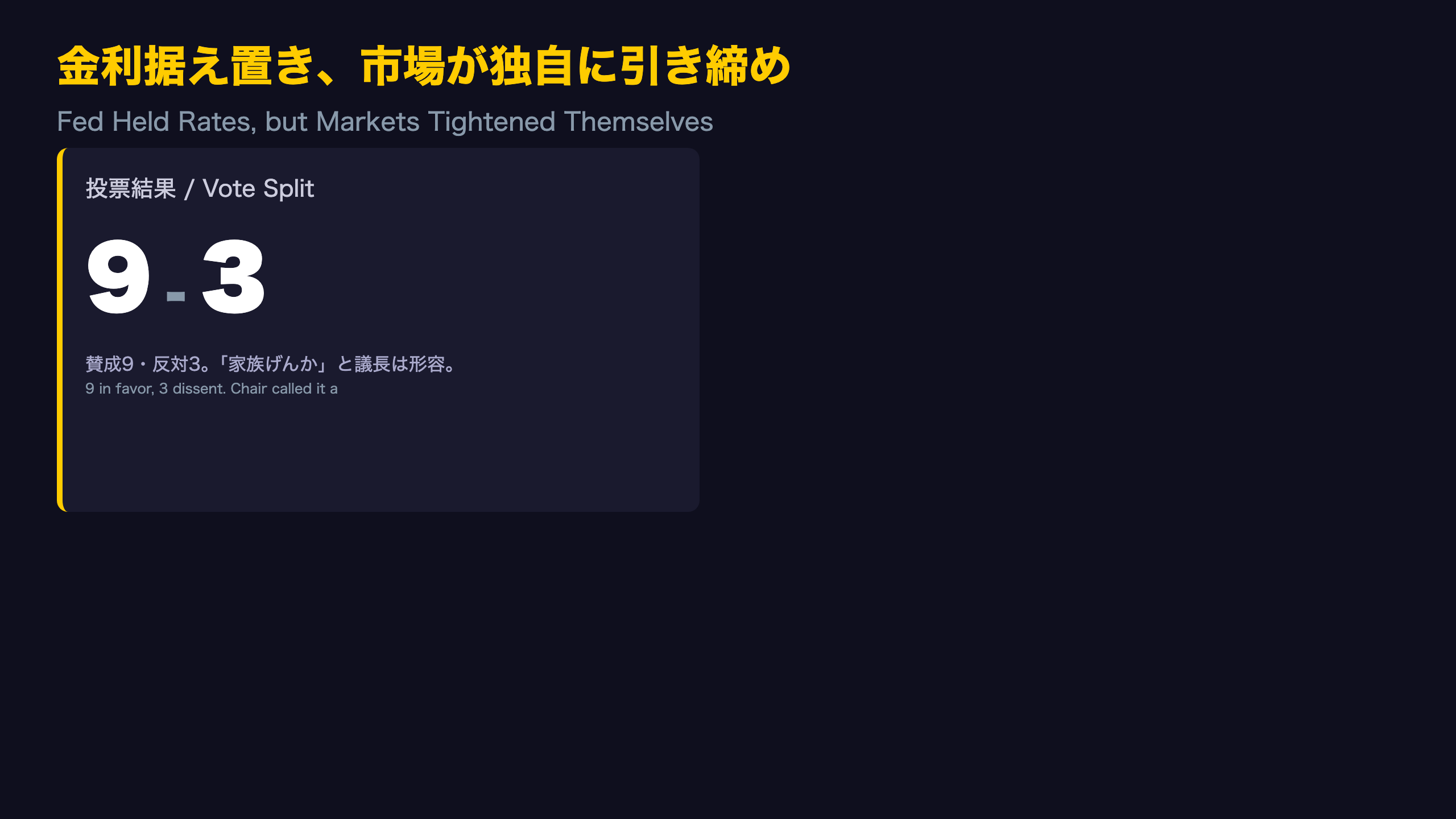
📊 FOMC voted 9-3 to hold rates at 3.50-3.75%
⚠️ Inflation has stayed above the 2% target for 63 straight months
📈 Meanwhile AI-related capex surged nearly 20% year-over-year
💡 The biggest story: the Fed’s quiet abandonment of forward guidance. Treasury yields rose to a top-decile move over the last two decades in just 42 days—without a single rate change from the Fed.
We break down what Warsh said, what he avoided saying, and what it means for markets.
金利据え置き、されど市場は独自に引き締めた
Beyond the Rate Hold: A Story of “Inaction as Action”
The headline decision—holding the federal funds rate steady at 3.50-3.75%—was largely expected by markets. The real story lies in the vote split and the Fed’s evolving communication style under new Chair Kevin Warsh.
Key Figures
| Metric | Value |
|---|---|
| Policy rate range | 3.50-3.75% |
| Vote | 9-3 (3 dissents) |
| Months above inflation target | 63 consecutive |
| AI-related capex growth | ~20% YoY |
| Days since last meeting | 42 |
“Playing the ball, not the referee”
Warsh used a memorable sports metaphor: market participants are “learning to play the ball, not the referee.” In other words, markets are reacting to actual economic data rather than to Fed rhetoric—a shift he called “a change for the better.” For readers unfamiliar with U.S. monetary policy communication norms, this marks a significant departure from the post-2008 era, when the Fed under Bernanke, Yellen, and Powell relied heavily on explicit forward guidance (dot plots, calendar-based guidance) to steer market expectations.
Statistical Caveat
The claim that inter-meeting Treasury yield moves rank in the “top decile” over two decades is a qualitative characterization; no specific basis-point figure was disclosed in the transcript. Readers should treat this as directional color rather than precise quantification.
Reporters pushed back on whether withdrawing forward guidance leaves markets under-informed—a tension that will likely resurface at the next FOMC meeting as investors test how much the Fed will tolerate market-driven tightening before stepping in.
新議長の運営スタイル:フォワードガイダンス放棄という賭け
The Fed as Observer, Not Oracle
The key to understanding Warsh’s communication shift lies in the words he repeated throughout the press conference: “unfiltered” and “direct.”
A Deliberate Break from Precedent
Since the 2008 financial crisis, the Fed under Bernanke, Yellen, and Powell built a communication toolkit centered on forward guidance—dot plots, calendar-based commitments, and detailed press conference signaling—designed to proactively shape market expectations. Warsh explicitly acknowledged stepping back from this: “we’ve been somewhat spare in our work… when we pulled back from forward guidance.”
Direct Quote
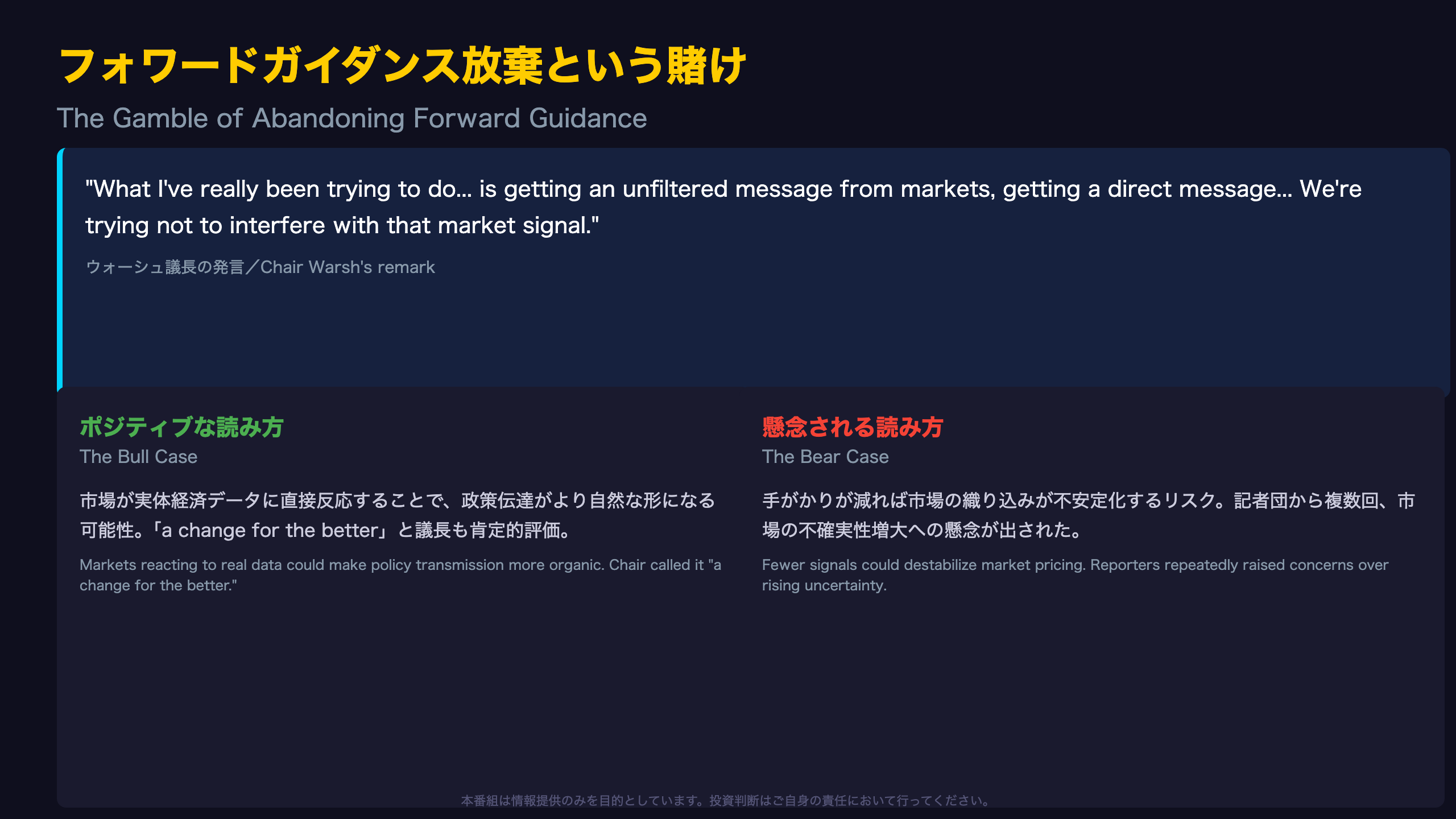
“What I’ve really been trying to do… is getting an unfiltered message from markets, getting a direct message… We’re trying not to interfere with that market signal.”
This represents an inversion of the traditional approach: rather than the Fed telegraphing its reaction function to guide markets, the Fed is now treating market reactions themselves as the primary input into its own decision-making.
Bull Case vs. Bear Case
Bull case: If markets react to real economic data rather than mechanically parsing dot plots and Fed rhetoric, the monetary transmission mechanism could become more organic and less prone to “Fed-induced” distortions.
Bear case: Reporters repeatedly pressed him on whether this approach risks leaving markets under-informed, especially given that a rate hike is nearly fully priced in for the next meeting per market pricing referenced in the Q&A. Warsh himself conceded “reform isn’t easy,” acknowledging transition risk.
For U.S.-focused investors, this is a meaningfully different communication regime than what markets experienced under Powell—one worth monitoring closely heading into Jackson Hole, which Warsh described as “a blank piece of paper” at this stage.
「動かないFed」の裏で市場が動いた42日間
The Gap Between an Unmoved Policy and a Moving Market
The most concrete numbers of the entire press conference came not from Warsh, but from a reporter’s question.
Three Numbers Reporter Neil Irwin Put on the Table
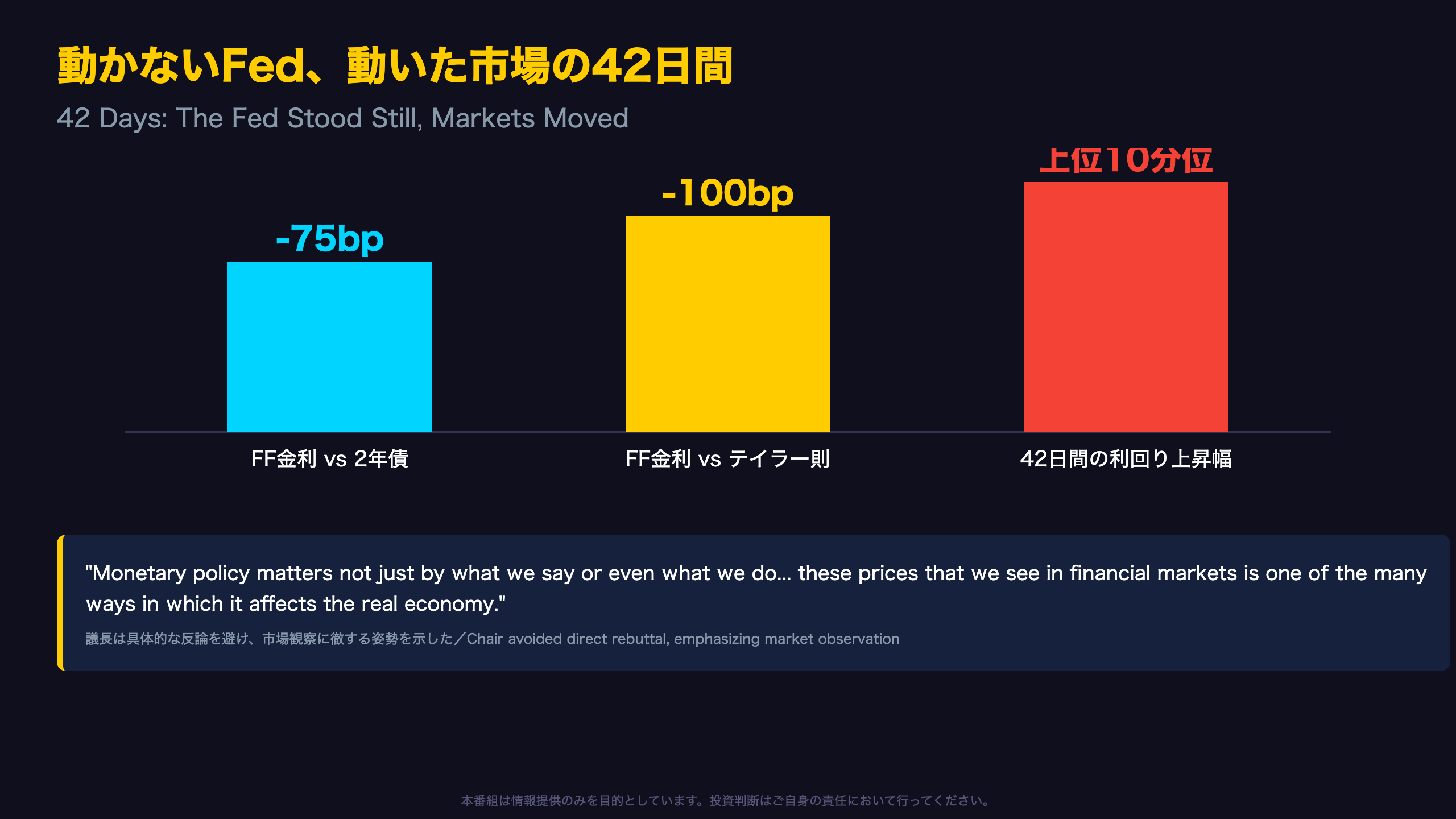
- The fed funds rate sits 75 basis points below the 2-year Treasury yield
- It sits roughly 100 basis points below most Taylor Rule estimates
- The inter-meeting yield increase ranks in the top decile of the past two decades
These figures suggest markets are increasingly pricing in the view that the Fed will eventually need to tighten further. It’s worth noting these are the reporter’s framing—Warsh did not explicitly confirm or validate these specific figures himself.
How the Chair Responded
Warsh prefaced his answer by calling “interpreting markets … an imperfect business,” then argued that market signals were broadly consistent with the FOMC statement’s characterization of strong capex, solid productivity, and a steady labor market. Notably, he never directly addressed how closely policy should track these market-implied levels.
“Monetary policy matters not just by what we say or even what we do. Monetary policy matters by how it affects the real economy… these prices that we see in financial markets is one of the many ways in which it affects the real economy.”
Implication for the Next Meeting
Warsh referenced the next meeting as being “seven or eight weeks” away. If the gap between market-implied rates and actual Fed policy continues to widen, that meeting could become a significantly higher-stakes event than typical FOMC gatherings—something U.S. rates traders should watch closely.
9対3の分裂と「family fight」文化

The Double-Edged Sword of “Family Fight” Rhetoric
Warsh used the phrase “family fight” multiple times during the press conference—a deliberate rhetorical choice that seems designed to contrast his leadership style with that of his predecessors.
What Was Clarified vs. What Remained Vague
Clarified:
– The vote was 9-3, with a clear majority
– Broad agreement existed on “the powers, the tools, the authority to deliver stable prices”
– The discussion was described as “active, robust”
Left Vague:
– The specific arguments made by the three dissenters
– Whether dissenters favored tightening or a different policy stance
– How this internal divide might resolve at future meetings
Direct Quote
“You characterized accurately there was a disagreement about a decision today. I would say that doesn’t sort of capture the full essence of the discussion.”
This remark can be read as Warsh pushing back against reducing a complex internal debate to a simple vote tally.
A Cautious Read
Withholding dissent details is consistent with longstanding Fed practice of not over-personalizing individual governors’ positions—the FOMC traditionally avoids turning policy debates into public personality clashes. That said, the sheer volume of reporter questions on this topic (from the FT’s Claire Jones and others) signals that markets are actively trying to map the hawk-dove balance on the committee, information that could matter for pricing the next several meetings.
AI CapExブームの光と影
Is AI Investment a Savior or a New Source of Inflation?
Business investment tied to artificial intelligence was clearly the topic Warsh spoke about with the most energy.
The Numbers
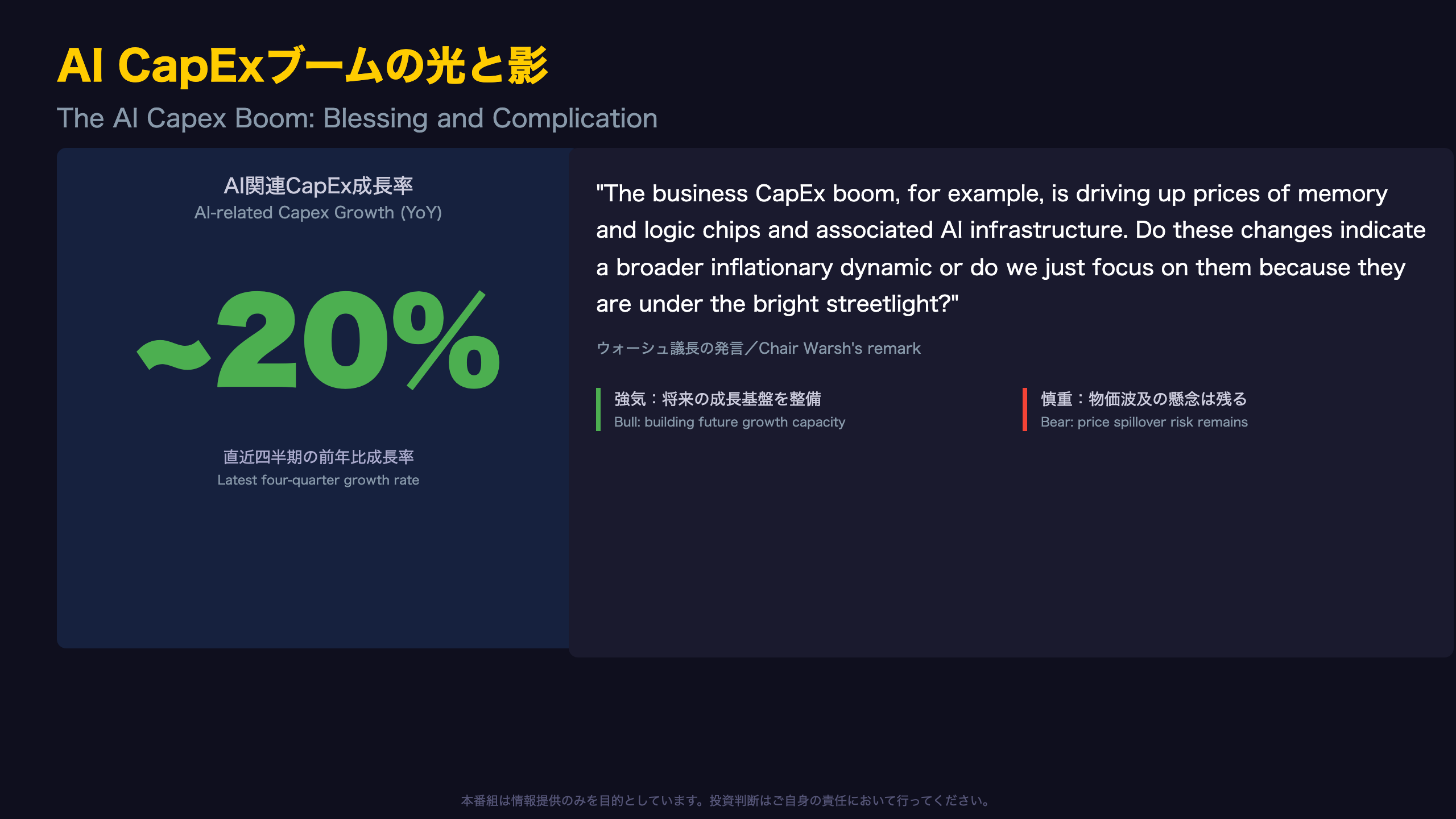
The “AI-related category of high-tech equipment and software” posted four-quarter growth of nearly 20% year-over-year. Warsh called this “remarkable,” crediting it with helping sustain healthy manufacturing output—a notable divergence from broader U.S. manufacturing trends in recent years.
One of Four Core Questions
Warsh opened the press conference by outlining four questions the committee debated. The third centered directly on this dynamic:
“The business CapEx boom, for example, is driving up prices of memory and logic chips and associated AI infrastructure. Do these changes indicate a broader inflationary dynamic or do we just focus on them because they are under the bright streetlight?”
The “streetlight” metaphor is a classic reference to the streetlight effect—the cognitive bias of searching where the light is brightest rather than where the answer actually lies. It suggests Warsh himself is wary of overreacting to visible, headline-grabbing price moves.
Bull and Bear Reads
Bull case: CapEx growth is “preparing the ground for future growth,” potentially easing medium-term inflation pressure by expanding supply capacity—a genuinely constructive dynamic for U.S. growth investors.
Bear case: If semiconductor price increases spill over from AI infrastructure into broader downstream goods, a narrow supply shock could morph into more generalized inflation. Warsh himself declined to resolve this, noting “the precise timing and magnitude of effects on the supply side remain hard to predict.”
This remains single-sector, recent-quarter data—drawing a firm structural conclusion at this stage would be premature.
Q&Aで浮き彫りになった「Action vs Talk」のギャップ
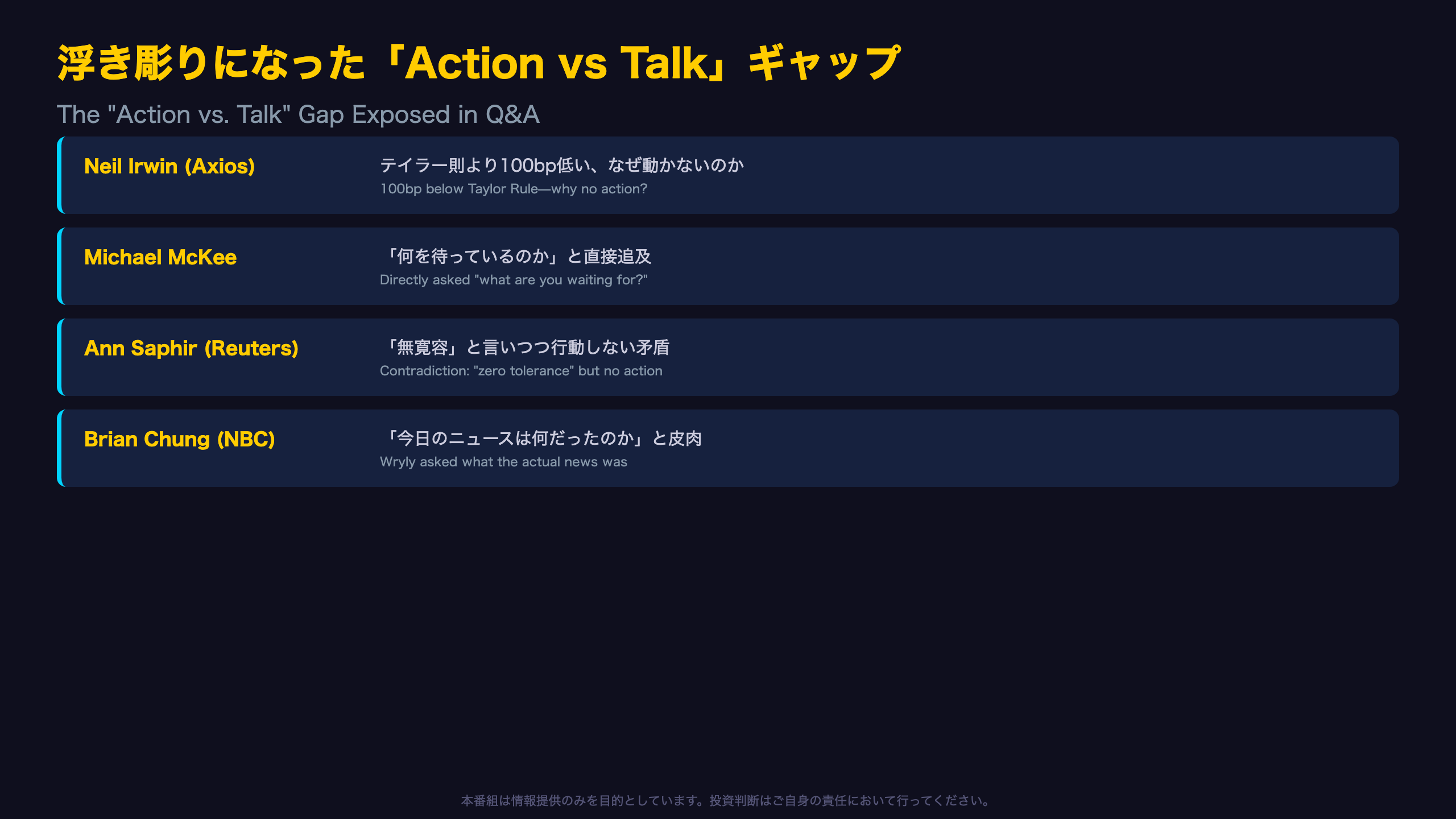
Four Reporters, One Question: “Why Aren’t You Acting?”
The most striking pattern in the Q&A session was how many reporters, from different angles, converged on the exact same core question.
The Convergence Pattern
| Reporter | Core Question |
|---|---|
| Neil Irwin (Axios) | Fed funds is 100bp below Taylor Rule—why not act? |
| Michael McKee (Bloomberg) | Directly asked “what are you waiting for?” |
| Ann Saphir (Reuters) | Isn’t “zero tolerance” for inflation contradicted by inaction? |
| Brian Chung (NBC) | Was there actually any news today at all? |
The Chair’s Defensive Pattern
Warsh repeatedly fell back on the phrase “we’re in the performance business,” essentially asking to be judged by results rather than words.
“We are focused like a laser on making sure we can do it. But the suggestion that we’re going to be able to do it with our magic wand is one I want to disabuse you and everyone else of.”
This can be read as an attempt to justify a deliberate, patient process against reporters’ expectations of swifter action—a defensive posture that, for international observers, echoes similar tensions seen historically at the ECB and BOJ when facing criticism over policy inertia.
A Level-B Inference
The fact that multiple reporters, independently, converged on the same line of questioning suggests that media and market attention is currently fixated on perceived Fed slowness to act. That said, this reflects reporter framing rather than confirmed market positioning—whether professional investors actually share this view would need to be verified against rate futures and options market data heading into the next meeting.
インプリケーション:静かな引き締めと市場のボラティリティ
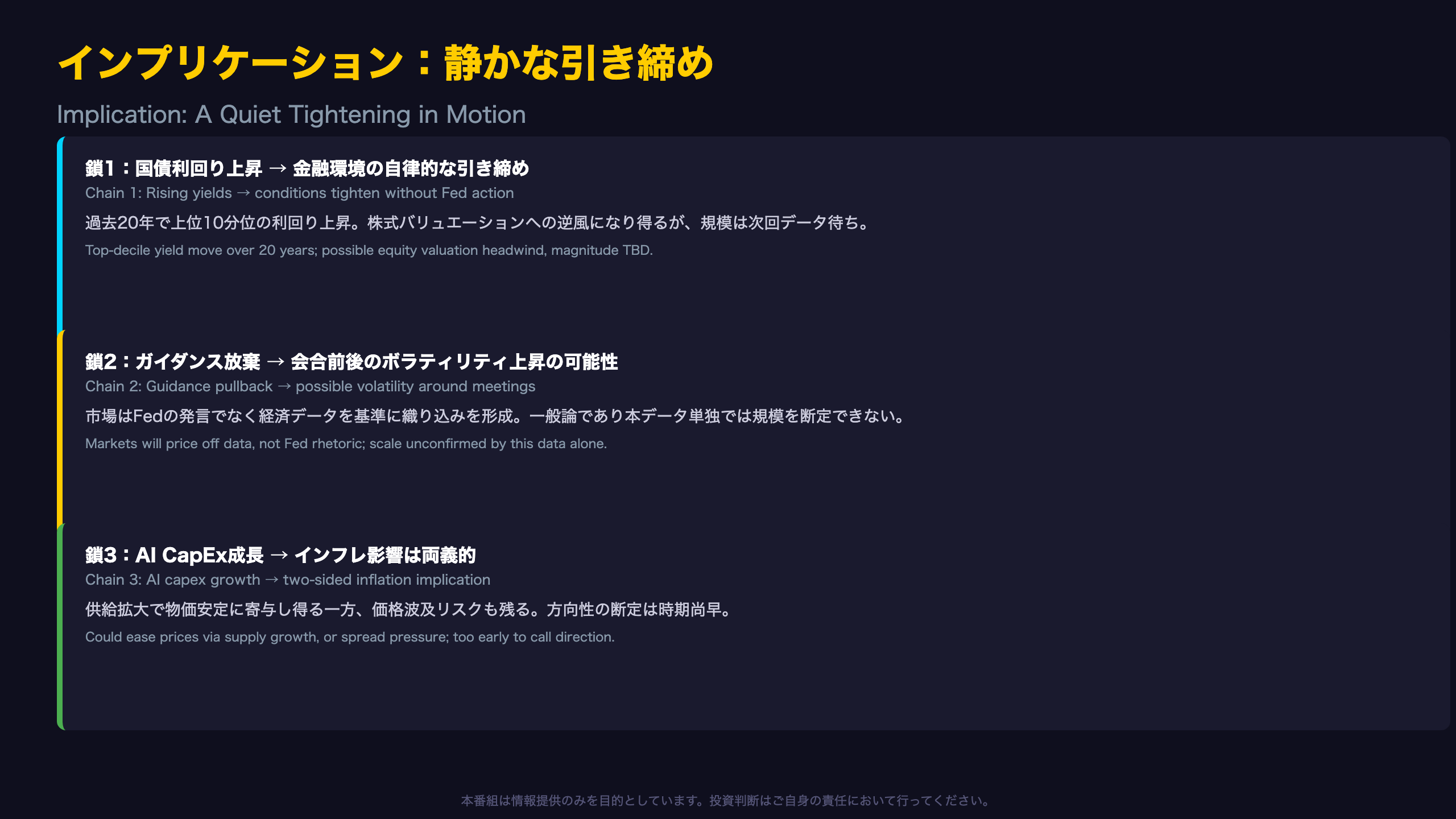
The Chain of Reasoning: Market Implications from This Press Conference
Chain 1: Treasury Yield Moves
“Treasury yields posted a top-decile move over the last two decades in just 42 days” → financial conditions have tightened independent of any Fed rate change → this could act as a valuation headwind for U.S. equities, particularly growth stocks sensitive to real rates. That said, since the transcript does not specify exact basis-point figures, the true magnitude of this tightening needs confirmation from incoming data before drawing firm conclusions.
Chain 2: Abandonment of Forward Guidance
The explicit policy of avoiding “forecasting” and steering clear of forward guidance → markets will increasingly price the next FOMC meeting based on incoming economic data rather than Fed rhetoric → implied volatility in U.S. rate futures and options markets could rise around future FOMC dates. It is generally believed that reduced forward guidance correlates with higher near-term volatility, but this single press conference alone cannot confirm the scale of that effect.
Chain 3: AI Capex and the Inflation Puzzle
“AI-related capex up nearly 20% year-over-year, with rising memory and logic chip prices” → this could either support medium-term price stability through supply expansion, or become a new source of broader inflation if price pressures spread beyond the AI supply chain → this carries two-sided implications for the U.S. dollar and semiconductor-related equities, and it would be premature to assert a clear directional call at this stage.
Bottom Line
This press conference represents an early test of a new Fed operating philosophy: delegating short-term market pricing power to the market itself by deliberately withholding forward guidance. Whether this experiment succeeds will hinge on how closely market pricing tracks the Fed’s actual decision at the next meeting, roughly seven to eight weeks out.
Disclaimer: This article is for informational purposes only. All investment decisions are made solely at your own risk.