📺 Watch the Full Video Analysis
This article was automatically generated by the NFC Market Live AI analysis system. (Updated: 2026-07-30 02:41 JST)
📄 Primary Source
Bank of Canada
https://www.bankofcanada.ca/2026/07/summary-of-governing-council-deliberations-fixed-announcement-date-of-july-15-2026/
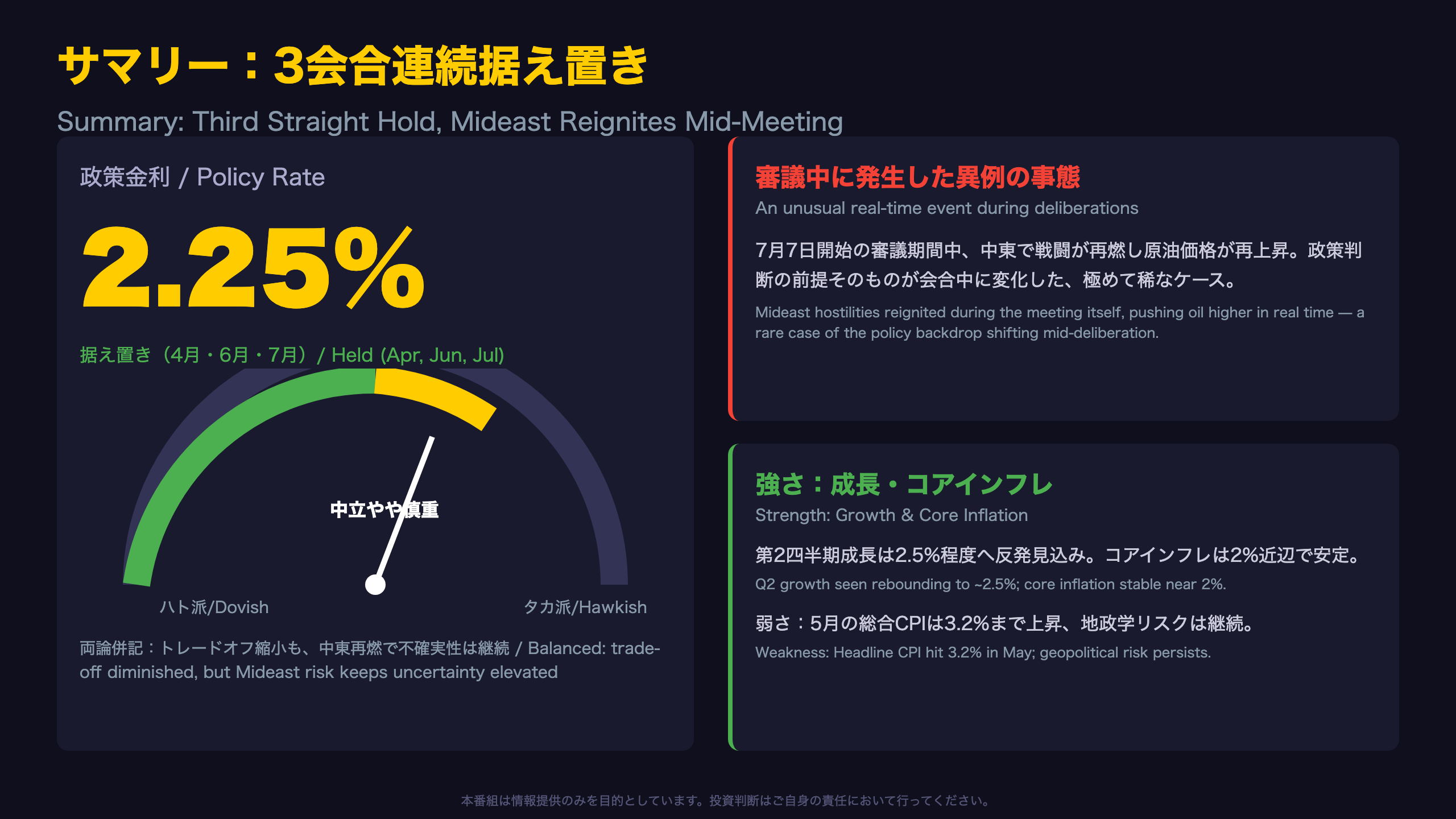
The Bank of Canada held its policy rate at 2.25% on July 15 — a third straight hold. But the standout detail in these minutes: Middle East hostilities reignited in real time, right in the middle of Governing Council’s deliberations.
📊 Headline inflation rose to 3.2% in May on gasoline, while core measures held near 2%.
📈 Q2 growth is expected to rebound to about 2.5%, and the Council said the growth-inflation trade-off has diminished.
⚠️ Yet oil prices turned higher again mid-meeting, keeping uncertainty elevated.
💡 A rate cut is possible if US trade curbs hit; hikes are possible if oil-driven inflation broadens. Full breakdown inside.
サマリー:3会合連続据え置き、審議中に中東再燃
A Live Geopolitical Shock Mid-Meeting
The most remarkable feature of this Summary of Deliberations is that Governing Council’s meetings, which began July 7, were interrupted in real time by a reignition of Middle East hostilities. The original text explicitly states hostilities re-escalated during Governing Council’s deliberations — an unusually rare instance of a live geopolitical shock intruding directly into a monetary policy meeting.
Context for international readers
The Bank of Canada (BOC) publishes a Summary of Governing Council Deliberations roughly two weeks after each rate decision — comparable to the U.S. Federal Reserve’s FOMC minutes, though generally shorter and without individual voting records (BOC operates by consensus).
Key figures
- Policy rate: held at 2.25% for a third straight meeting (April, June, July)
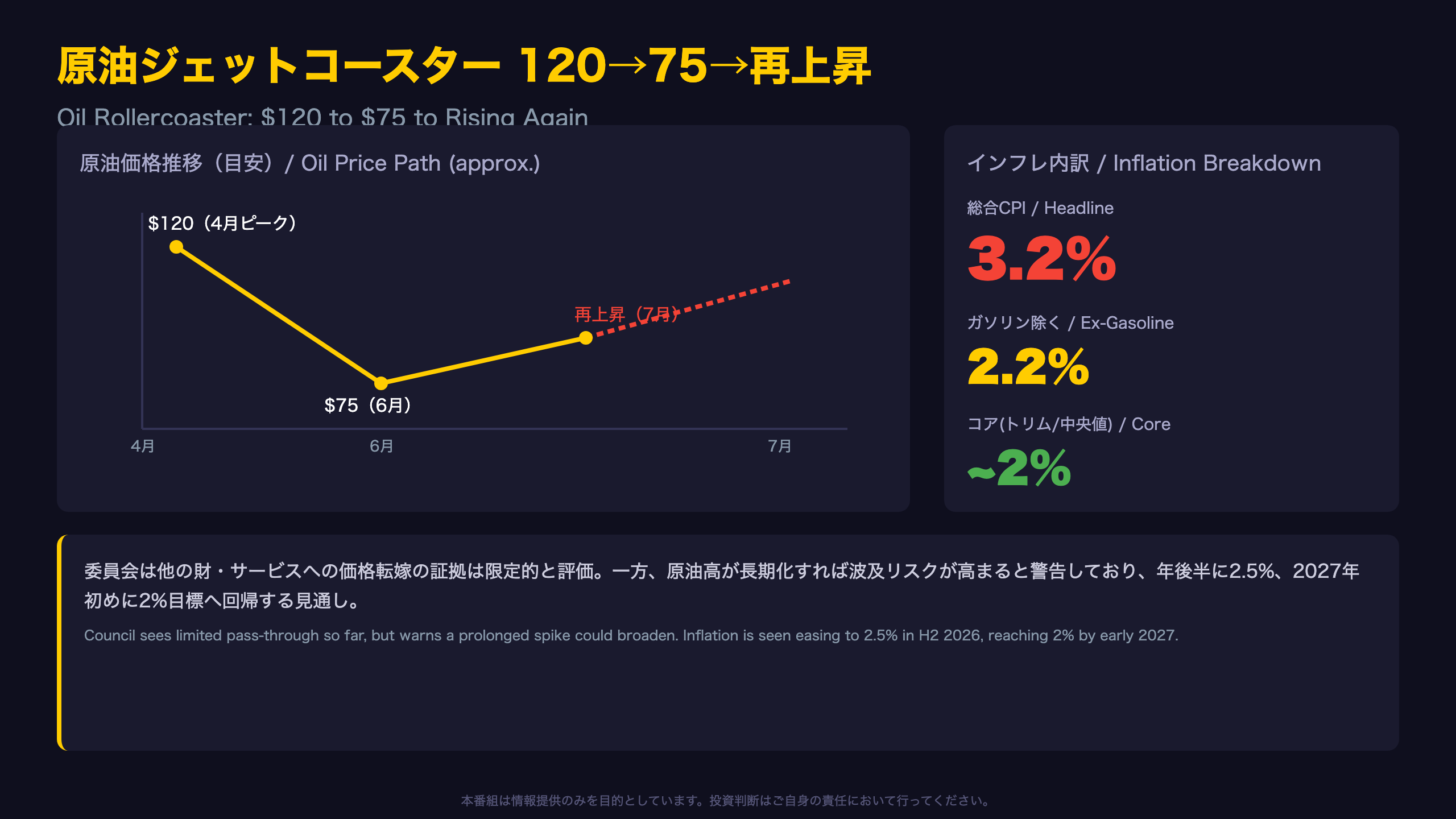
- Oil price: peaked near US$120/barrel in April, fell to about US$75 after a June U.S.-Iran interim deal, then rose again in July
- Headline CPI: 2.8% in April to 3.2% in May, driven by gasoline
- Core measures (CPI-trim/median): stable near 2%
Members agreed that the trade-off facing monetary policy had diminished (original text)
This assessment was formed just before the ceasefire broke down again — meaning the next Summary (expected around September) will need to reconcile this optimism with a deteriorating oil-price backdrop. Bulls can point to core-inflation stability and a rebounding GDP path; bears can point to renewed oil volatility and unresolved CUSMA trade uncertainty as reasons for caution.
原油ジェットコースター:120→75→再上昇のインフレインパクト
The 100-Dollar Oil Rollercoaster
The July minutes chronicle an unusually volatile three months in oil markets.
| Period | Oil price (approx.) | Driver |
|---|---|---|
| April (peak) | ~US$120/barrel | Middle East war intensifies |
| June | ~US$75/barrel | U.S.-Iran interim agreement |
| July (mid-meeting) | Rising again | Ceasefire collapses, hostilities resume |
This swing fed directly into headline CPI, which accelerated from 2.8% in April to 3.2% in May. But the Bank’s preferred core measures, CPI-trim and CPI-median, both held near 2%, and inflation excluding gasoline was just 2.2%. The original text states pass-through evidence to other goods and services has been limited so far.
Reduced global refining capacity was keeping refinery margins high, which was holding up gasoline prices (original text)
For context, this is analogous to how the U.S. Federal Reserve distinguishes headline PCE from core PCE when energy prices spike, a framework familiar to U.S.-focused investors. The Bank’s July Monetary Policy Report projects inflation easing to about 2.5% in H2 2026 and reaching the 2% target by early 2027, assuming oil continues to normalize. The key swing factor for the next Summary, due around September, will be whether the renewed oil spike shows up in July or August CPI, testing the Bank’s look-through commitment.
停滞から回復へ:GDPは第2四半期に2.5%反発
From a Stalled Year to a Rebound
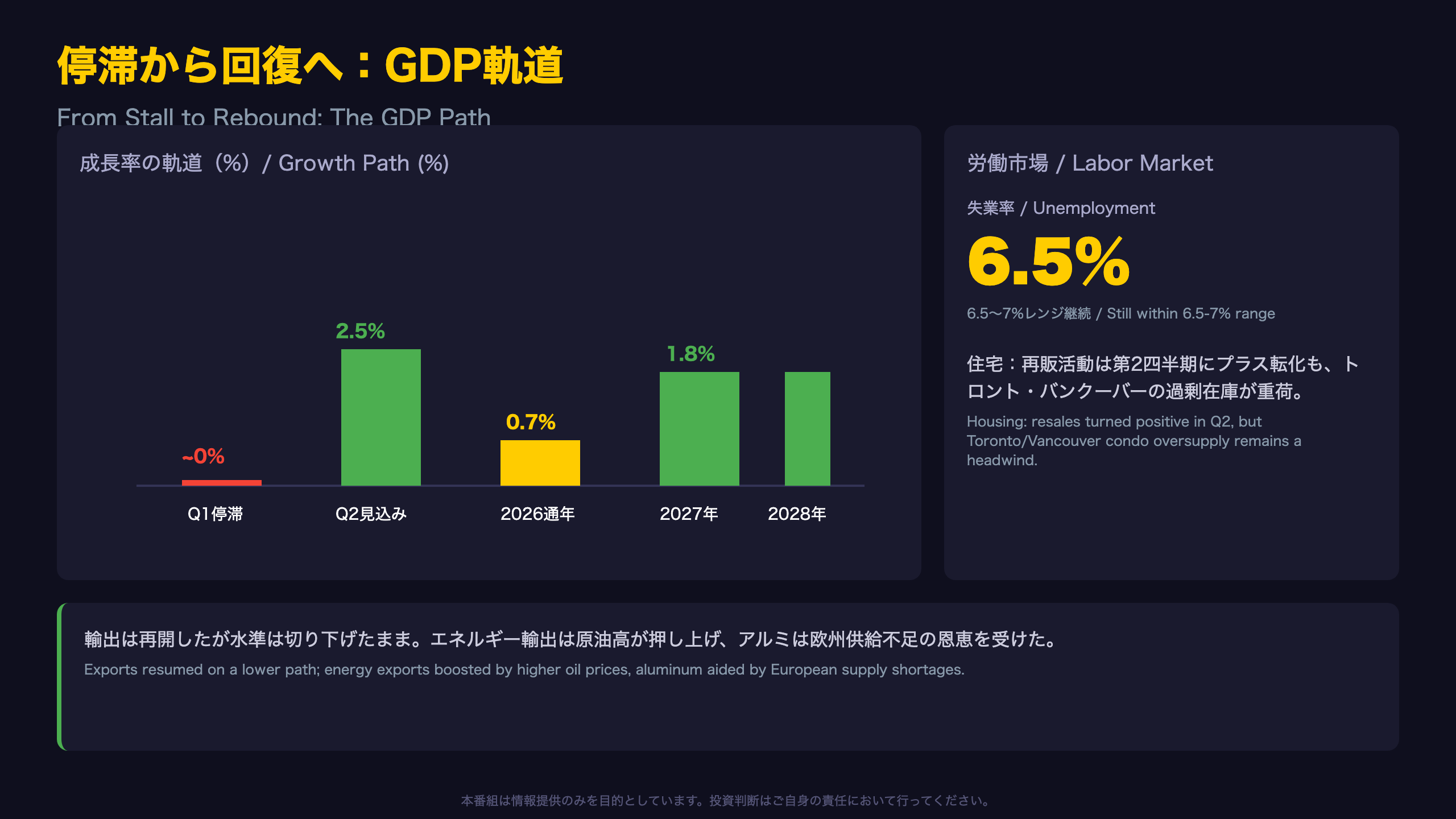
Canada’s GDP was essentially flat from Q1 2025 through Q1 2026, the minutes explicitly state the economy had stalled, acknowledging quarter-to-quarter volatility but no net growth over a full year.
The growth path ahead
- 2026 (full year): 0.7%
- 2027: 1.8%
- 2028: 1.8%
- Q2 2026 (near-term estimate): rebound to about 2.5%
Notably, exports resumed though on a lower path, language suggesting the level of exports remains below pre-conflict trend even as growth resumes. Sectors directly hit by U.S. tariffs are still below pre-trade-conflict levels, even as aluminum exports benefited from European supply shortages and elevated global prices.
In housing, resale activity returned to positive growth in Q2, but a large condo inventory in Toronto and Vancouver plus slower population growth remain headwinds, a dynamic somewhat analogous to U.S. regional housing gluts, though Canada’s population-growth channel driven largely by immigration policy is a distinctly Canadian variable international investors should track.
Employment recovered in May and June, pulling unemployment to 6.5%, aided by summer hiring of students. Still, the jobless rate has held in a 6.5-7% band for nearly a year, suggesting underlying labor-market slack has not meaningfully closed, a nuance that tempers the otherwise encouraging GDP rebound story.
二つの綱引き:中東発インフレ vs 米通商発の成長減速
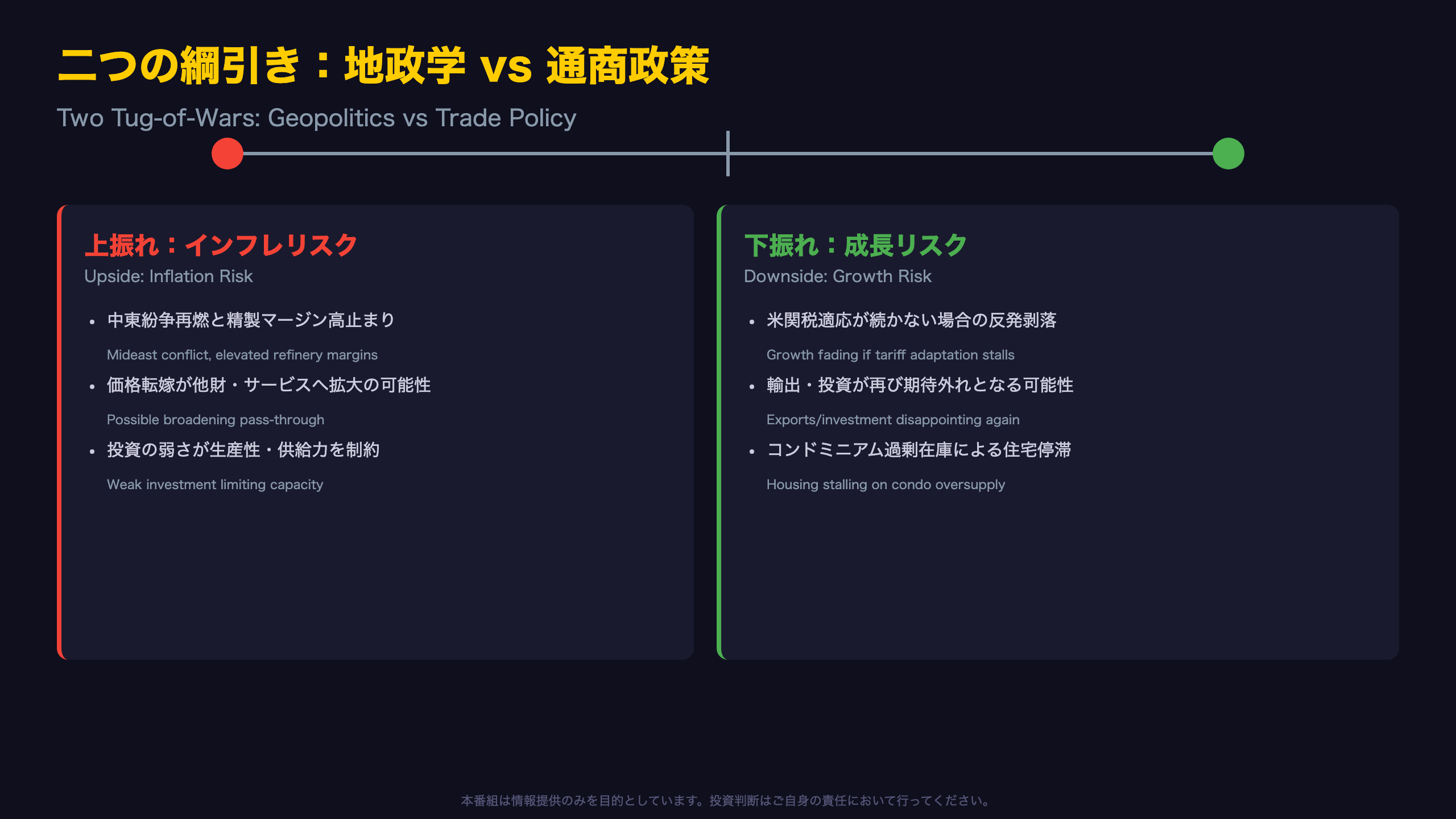
Two Tug-of-Wars: Geopolitics vs. Trade Policy
Unusually, this Summary organizes risks in explicit bullet form, itself a signal that views inside Governing Council are not fully unified.
Upside (inflation) risks
- Renewed Middle East conflict and persistently elevated refinery margins
- Possible broadening of cost pass-through to other goods and services
- Weak business investment constraining productivity and capacity
- Excess supply potentially smaller than assumed in the forecast
Downside (growth) risks
- Growth pickup fading if businesses stop adapting to U.S. tariffs
- Exports and investment disappointing again, as they have before
- Housing recovery stalling amid large Toronto/Vancouver condo inventories
- Consumer resilience eroding if labor-market softness persists
Notably, the text states Council was confident about the Q2 rebound but that a range of views existed among members about its durability beyond the near term. This range of views phrasing is meaningfully different from full consensus language used elsewhere, a subtle tell of internal disagreement. International readers should note CUSMA functions similarly to a NAFTA successor treaty subject to periodic renegotiation, its shift to annual reviews institutionalizes a recurring source of policy uncertainty for Canadian exporters.
政策判断:トレードオフ縮小も「機動的」対応を堅持
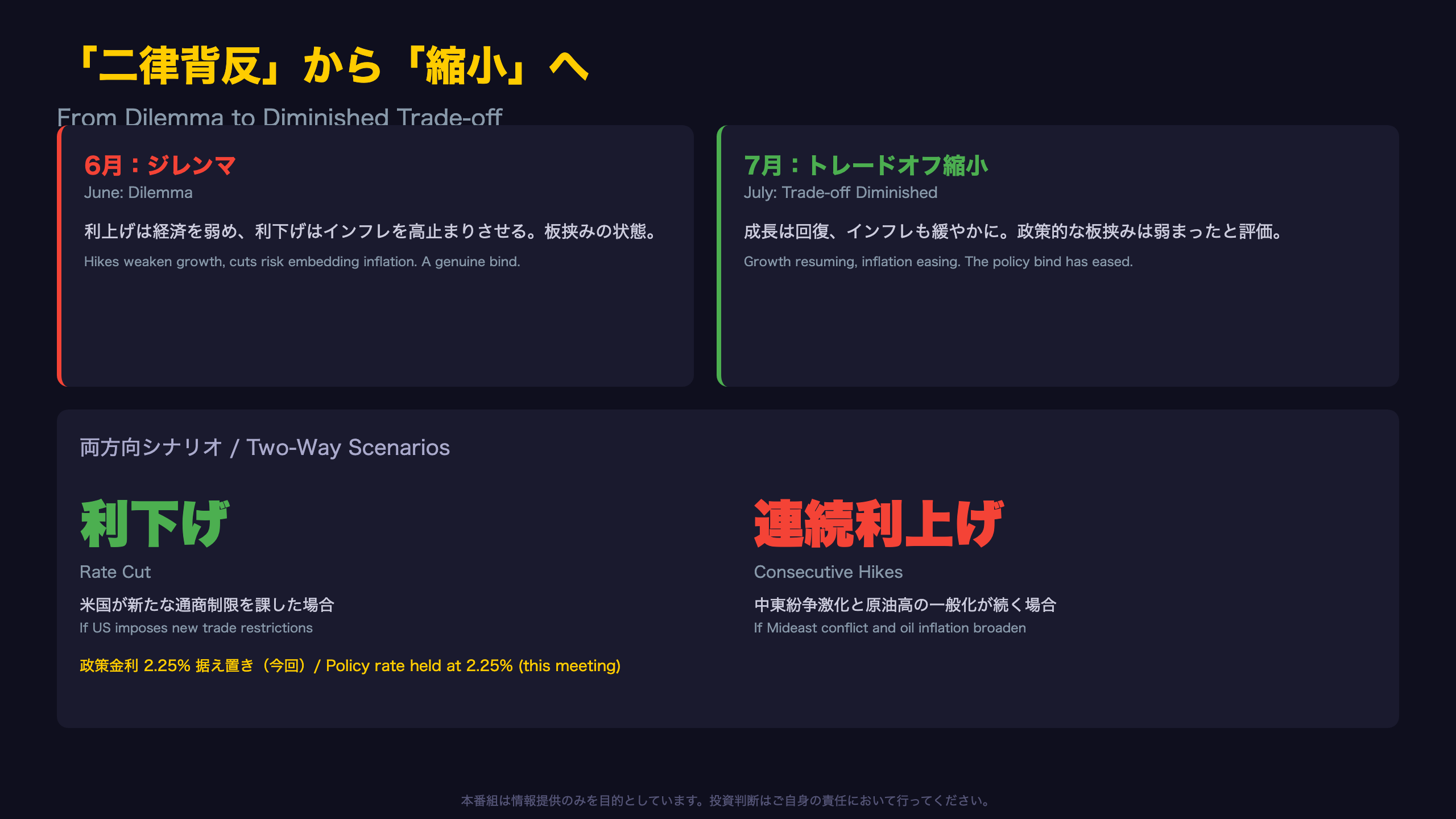
From Dilemma to Diminished: The June-to-July Tone Shift
The June minutes documented a genuine policy dilemma: weak growth pulling toward rate cuts, oil-driven inflation pulling toward hikes. The original June text framed it starkly, raising interest rates in response to higher energy prices would further weaken the economy, while lowering interest rates to support growth would increase the risk that inflation remains high.
By July, the tone had measurably shifted: growth was resuming and inflation was easing, and the trade-off facing monetary policy had diminished. This is a meaningful evolution in the Bank’s own self-assessment of its policy bind, comparable to how the U.S. Federal Reserve occasionally signals a shift from a difficult trade-off framing toward greater confidence language in FOMC minutes.
Why the BOC held again (per the text)
- Growth is expected to rebound in Q2
- Inflation is projected to return to the 2% target by early 2027
- The current policy stance was appropriate for sustaining the recovery and bringing inflation back to target
Crucially, this assessment was reached just before Middle East hostilities flared up again during the meeting itself, meaning the diminished trade-off narrative may already be under renewed pressure by the time of the next Summary. The Council explicitly preserved two-way flexibility, a rate cut is on the table if new U.S. trade restrictions emerge, while consecutive hikes remain possible if oil-driven inflation broadens, language that echoes the nimble policy stance first articulated in June.
市場へのインプリケーション:据え置き継続でも警戒すべき変数
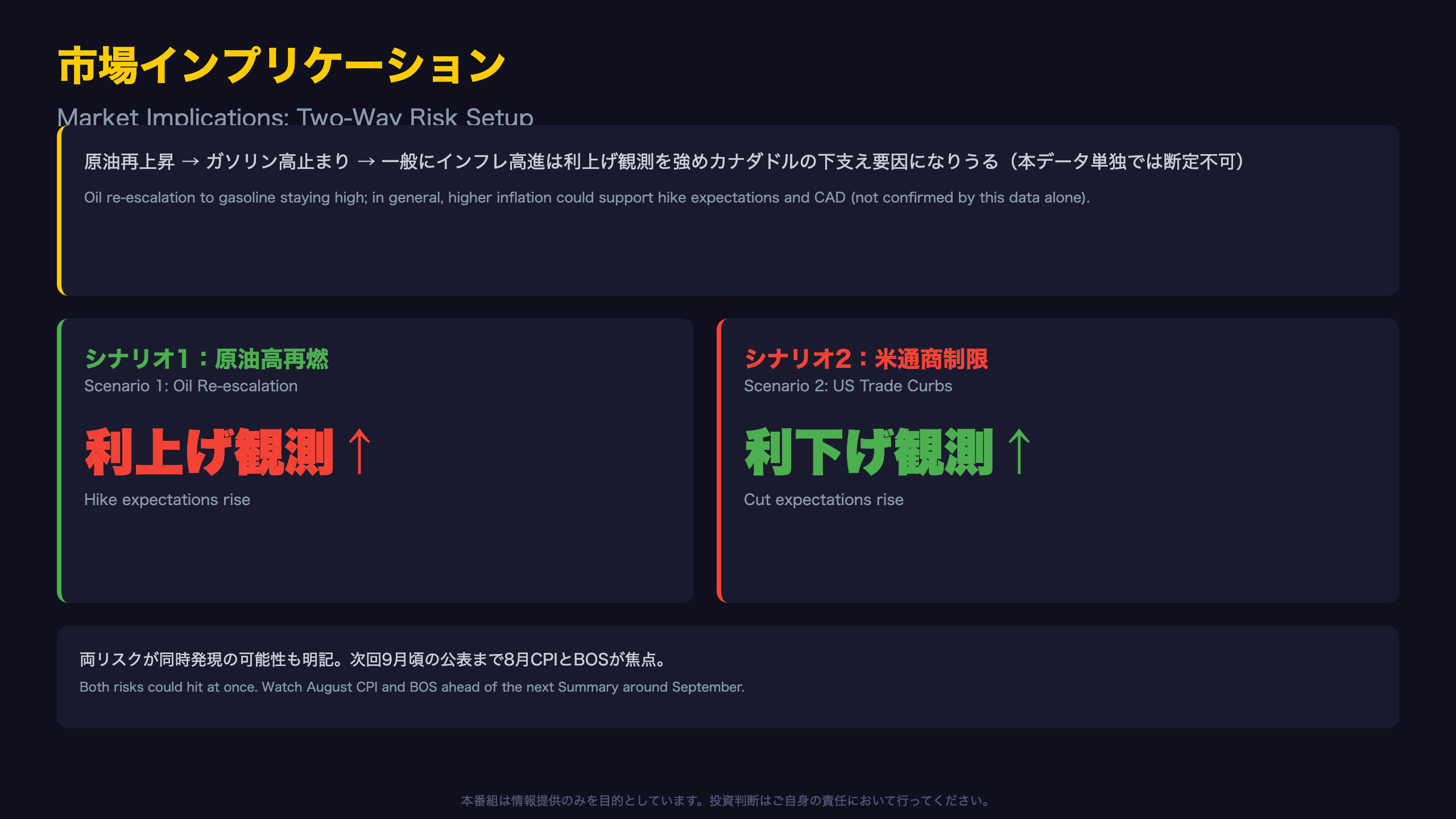
Reading Market Implications Through the Chain of Evidence
Scenario 1: Oil price re-escalation persists
Middle East hostilities reignited, pushing oil prices higher again, combined with already-elevated refinery margins, gasoline prices likely stay high. In general, persistently high inflation is thought to strengthen the case for future rate hikes and could support CAD, though this single data point alone cannot confirm that outcome.
Scenario 2: New US trade restrictions materialize
CUSMA has shifted to annual reviews, keeping new US tariffs a live possibility, downward pressure on exports and investment would intensify. In general, materializing downside growth risk is thought to strengthen the case for rate cuts and could weigh on CAD, though this cannot be confirmed from this data alone.
What to watch next
The minutes explicitly note both risks could materialize at the same time, an important caution against building a one-directional market position around this Summary. Ahead of the next Summary, expected around September, watch for August CPI and the Business Outlook Survey; the critical fork in the road is whether cost pass-through broadens beyond gasoline. For USD/CAD and Government of Canada bond-yield watchers, note that the yield differential with US Treasuries, which the Bank explicitly links to CAD depreciation, is itself sensitive to incoming Fed communications, not just BOC decisions, making this a genuinely two-way, cross-border risk setup rather than a purely domestic one.
Disclaimer: This article is for informational purposes only. All investment decisions are made solely at your own risk.