📺 Watch the Full Video Analysis
This article was automatically generated by the NFC Market Live AI analysis system. (Updated: 2026-06-29 20:40 JST)
📄 Primary Source
Banco Central do Brasil
https://www.bcb.gov.br/content/focus/focusmarketreadout/R20260626.pdf
Deep dive into Brazil’s BCB Focus Market Readout dated June 26, 2026. Over 130 market participants now see the Selic rate ending 2028 at 10.50% — a hawkish revision — while 2026 IPCA inflation holds stubbornly at 5.33%, well above the 3.0% target. We analyze the rate cut path, BRL/JPY carry trade dynamics, fiscal deficit risks, and what this means for Japanese investors holding Brazilian assets.
The Ultimate Summary:BCB Focus 6月26日版の総合評価
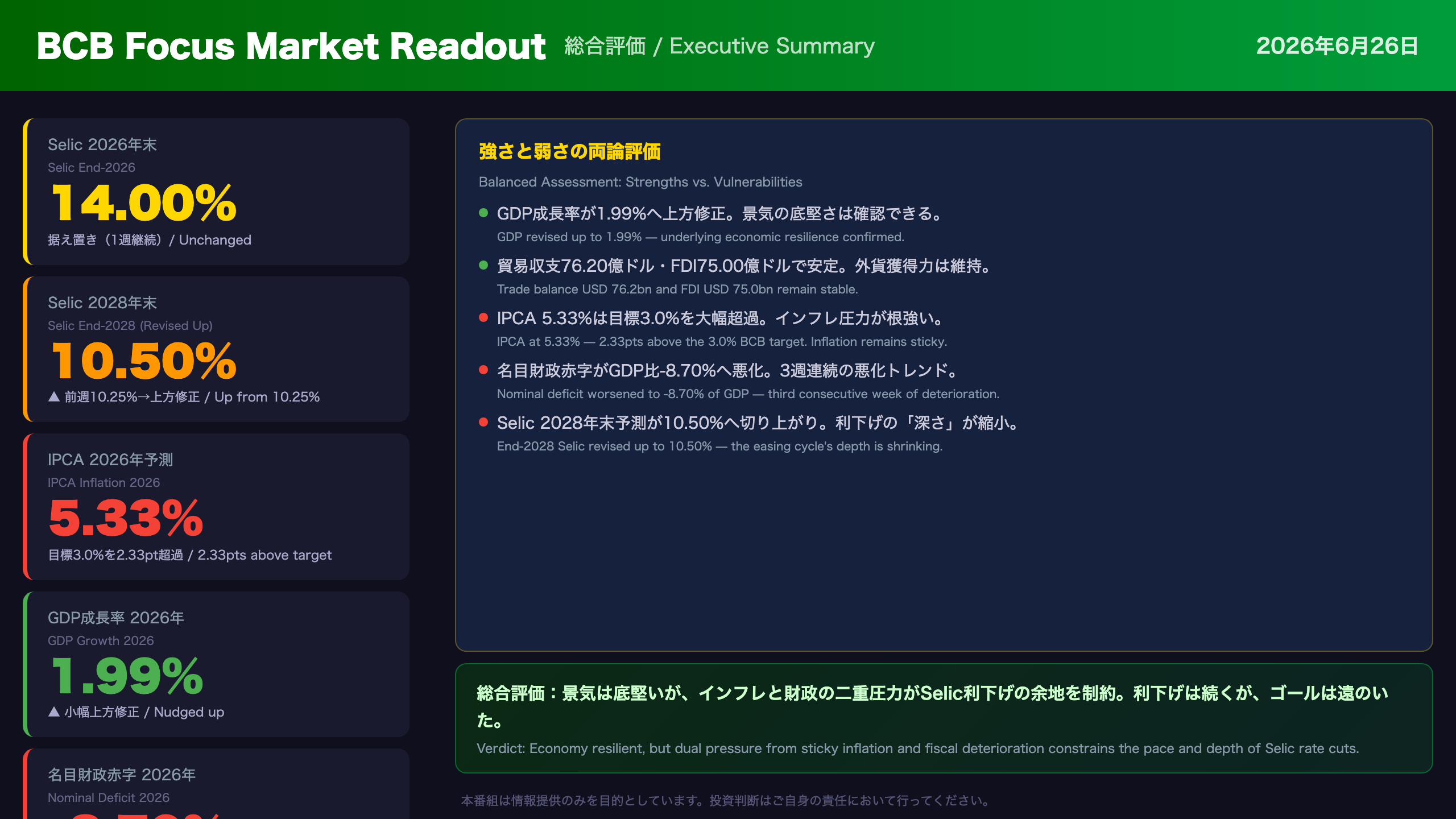
BCB Focus Market Readout — June 26, 2026: Executive Summary
What Is the BCB Focus Report?
The BCB (Banco Central do Brasil) Focus Market Readout is a weekly survey of over 130 financial institutions — banks, asset managers, and research firms — operating in Brazil. It aggregates median forecasts for key economic indicators including inflation (IPCA), GDP growth, the Selic policy rate, and the BRL/USD exchange rate. Crucially, the BCB’s COPOM (Monetary Policy Committee) formally references this data in its policy deliberations, making it one of the most policy-relevant market surveys in any emerging economy.
This Week’s Core Message
The June 26 edition delivers a nuanced verdict: “Rate cuts are on track, but the terminal rate has moved higher.” The Selic forecast for end-2026 holds at 14.00%, but the end-2028 forecast was revised up from 10.25% to 10.50% — a hawkish signal embedded within an ongoing easing cycle.
Strengths
- GDP resilience: 2026 growth revised up to 1.99% (from 1.98%), continuing a multi-week upward trend.
- Trade balance: Stable at USD 76.20bn for 2026, reflecting Brazil’s commodity export strength.
- FDI: Holding at USD 75.00bn for 2026, suggesting continued foreign investor confidence.
Vulnerabilities
- Sticky inflation: 2026 IPCA at 5.33% — 2.33 percentage points above the 3.0% target. Even the 2027 forecast of 4.17% sits near the upper tolerance band of 4.5%.
- Fiscal deterioration: The 2026 nominal deficit forecast worsened to -8.70% of GDP (from -8.60%), marking three consecutive weeks of deterioration.
- Higher terminal rate: Markets now see the Selic bottoming at 10.50% in 2028, up from 10.25% — reducing the total magnitude of the easing cycle.
Bottom Line
Brazil’s economy is resilient but constrained. The dual pressure of above-target inflation and a widening fiscal deficit limits the BCB’s room to cut aggressively, even as growth holds up.
Selic金利パス:利下げサイクルの「深さ」が縮小
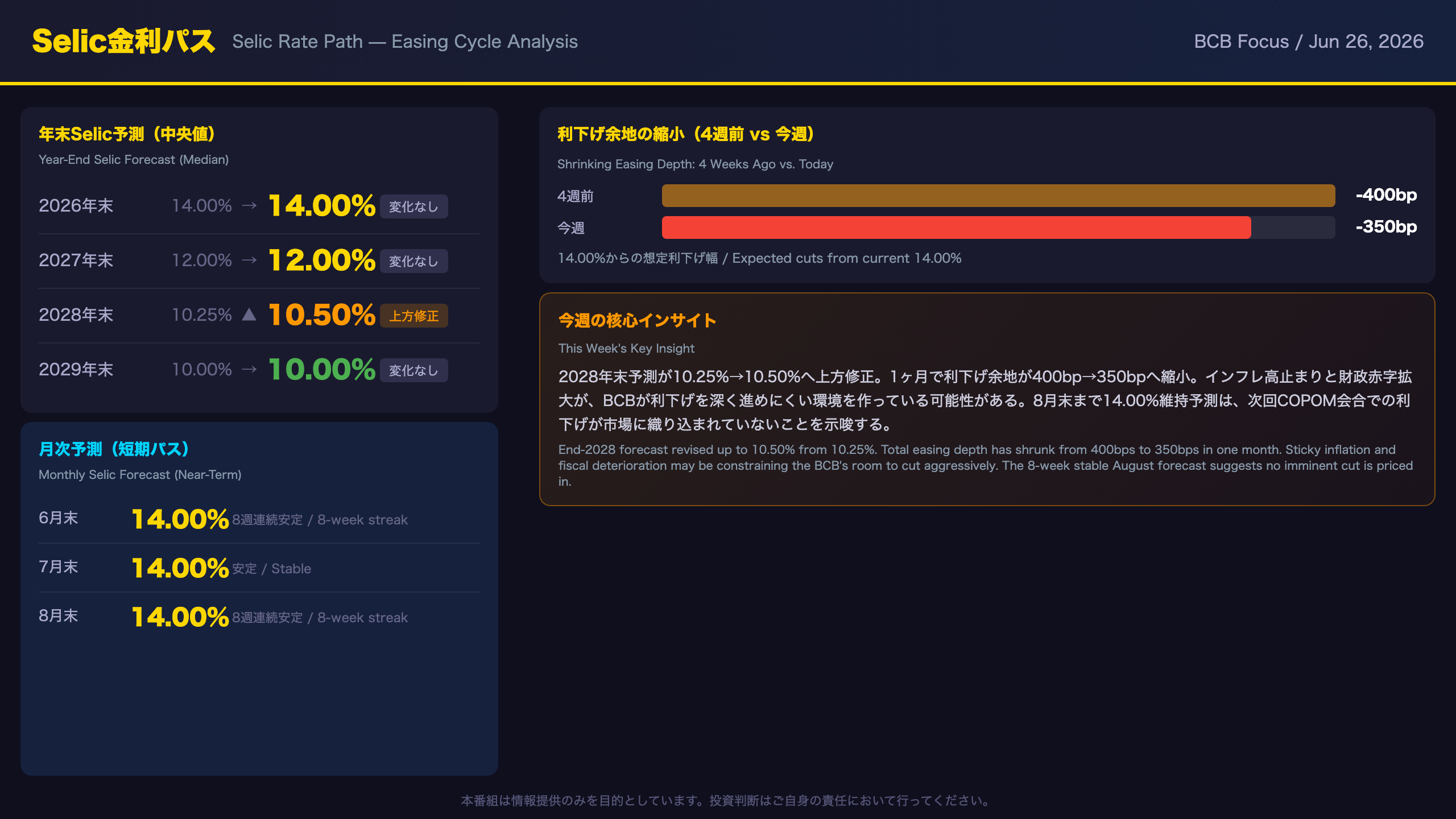
Selic Rate Path: Detailed Analysis
The COPOM and Selic Rate — Context for International Readers
The Selic rate is Brazil’s benchmark overnight interest rate, set by the COPOM (Comitê de Política Monetária), the BCB’s monetary policy committee. It is the Brazilian equivalent of the Fed Funds Rate or the ECB’s deposit facility rate. At 14.00%, the Selic is one of the highest policy rates among major emerging economies, reflecting Brazil’s persistent inflation challenge.
Year-End Forecast Trajectory
| Year | 4 Weeks Ago | Last Week | This Week | Change |
|---|---|---|---|---|
| End-2026 | 13.25% | 14.00% | 14.00% | Unchanged |
| End-2027 | 11.25% | 12.00% | 12.00% | Unchanged |
| End-2028 | 10.00% | 10.25% | 10.50% | Revised Up |
| End-2029 | 10.00% | 10.00% | 10.00% | Unchanged |
The Shrinking Easing Cycle
Four weeks ago, markets expected the Selic to fall from 14.00% to 10.00% — a 400 basis point easing cycle. This week’s data implies only 350 basis points of cuts to a terminal rate of 10.50%. In just one month, the expected depth of easing has shrunk by 50 basis points.
Monthly Forecasts Signal No Imminent Cut
The August 2026 Selic forecast holds at 14.00% for the eighth consecutive week. This suggests markets are not pricing in any rate cut at the next COPOM meeting — a notable contrast to the aggressive easing expectations seen earlier in the year.
Why Is the Terminal Rate Rising?
While a single data point cannot confirm causation, the combination of sticky IPCA inflation (2027 forecast nudged up to 4.17%) and a widening fiscal deficit (-8.70% of GDP) likely constrains the BCB’s ability to cut deeply. A higher structural neutral rate — driven by fiscal risk premium — may also be a contributing factor, though this interpretation goes beyond what the Focus data alone can confirm.
Comparison to Other EM Central Banks
For context, Brazil’s 14.00% Selic compares to Mexico’s Banxico rate of approximately 9.0% and India’s RBI repo rate of approximately 6.5% (as of mid-2026). Brazil’s rate premium reflects both its inflation history and fiscal risk profile.
インフレ(IPCA):目標超過が続く構造的圧力
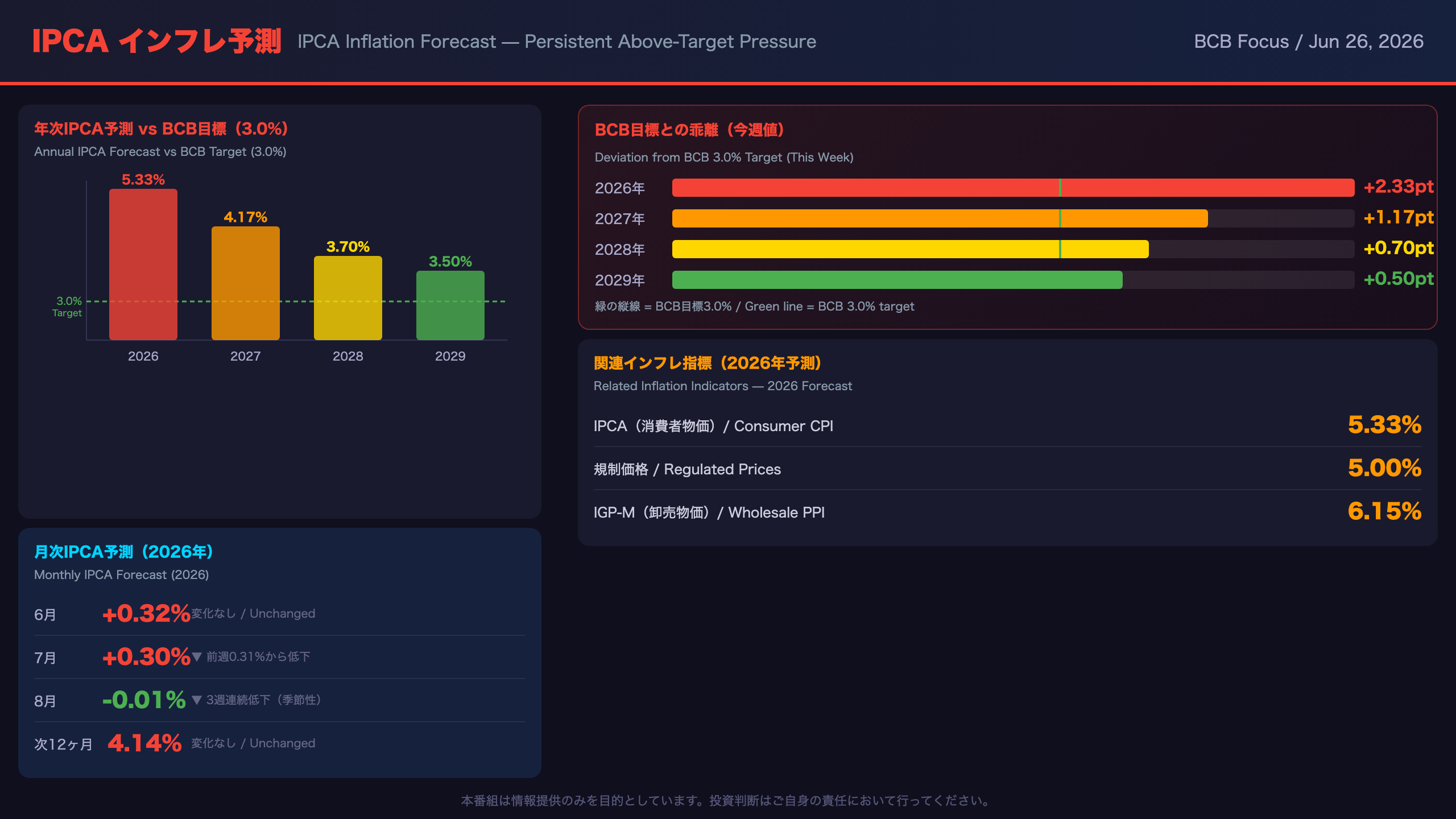
IPCA Inflation Forecast: Persistent Above-Target Pressure
What Is IPCA?
IPCA (Índice Nacional de Preços ao Consumidor Amplo) is Brazil’s official consumer price index, published monthly by IBGE (Brazilian Institute of Geography and Statistics). It is the BCB’s primary inflation gauge and the reference for the inflation targeting framework. Brazil’s current target is 3.0% with a tolerance band of 1.5% to 4.5%.
Annual Forecast Summary
| Year | 4 Weeks Ago | Last Week | This Week | vs. 3.0% Target |
|---|---|---|---|---|
| 2026 | 5.09% | 5.33% | 5.33% | +2.33pts |
| 2027 | 4.02% | 4.15% | 4.17% | +1.17pts |
| 2028 | 3.66% | 3.70% | 3.70% | +0.70pts |
| 2029 | 3.50% | 3.50% | 3.50% | +0.50pts |
For comparison, the US Fed targets 2.0% PCE inflation. Brazil’s 5.33% 2026 forecast is more than double the Fed’s target, reflecting structurally higher inflation dynamics in Brazil driven by regulated prices, currency pass-through, and fiscal expansion.
Monthly IPCA Forecasts (2026)
- June: 0.32% (unchanged)
- July: 0.30% (down from 0.31%)
- August: -0.01% (down from 0.02%, third consecutive decline)
- Next 12 months smoothed: 4.14% (unchanged)
The August dip into negative territory likely reflects seasonal agricultural price deflation and should not be interpreted as a structural trend reversal.
Regulated Prices: The Uncontrollable Component
Regulated prices (energia elétrica, fuel, public transport) are forecast at 5.00% for 2026. These prices are set by government agencies and are largely immune to BCB monetary policy — making them a structural floor for inflation that limits how quickly IPCA can converge to target.
IGP-M: Upstream Pressure Signal
The IGP-M (wholesale price index) forecast for 2026 stands at 6.15%, above IPCA. This upstream pressure may suggest continued pass-through risk to consumer prices, though the relationship between IGP-M and IPCA is not always direct.
The Bull Case on Inflation
Despite current above-target readings, markets do expect gradual convergence: 5.33% → 4.17% → 3.70% → 3.50% over four years. This suggests market participants retain some confidence in BCB’s eventual ability to bring inflation toward target — a meaningful signal of institutional credibility.
財政・経常収支:拡大する赤字とBRLへの圧力
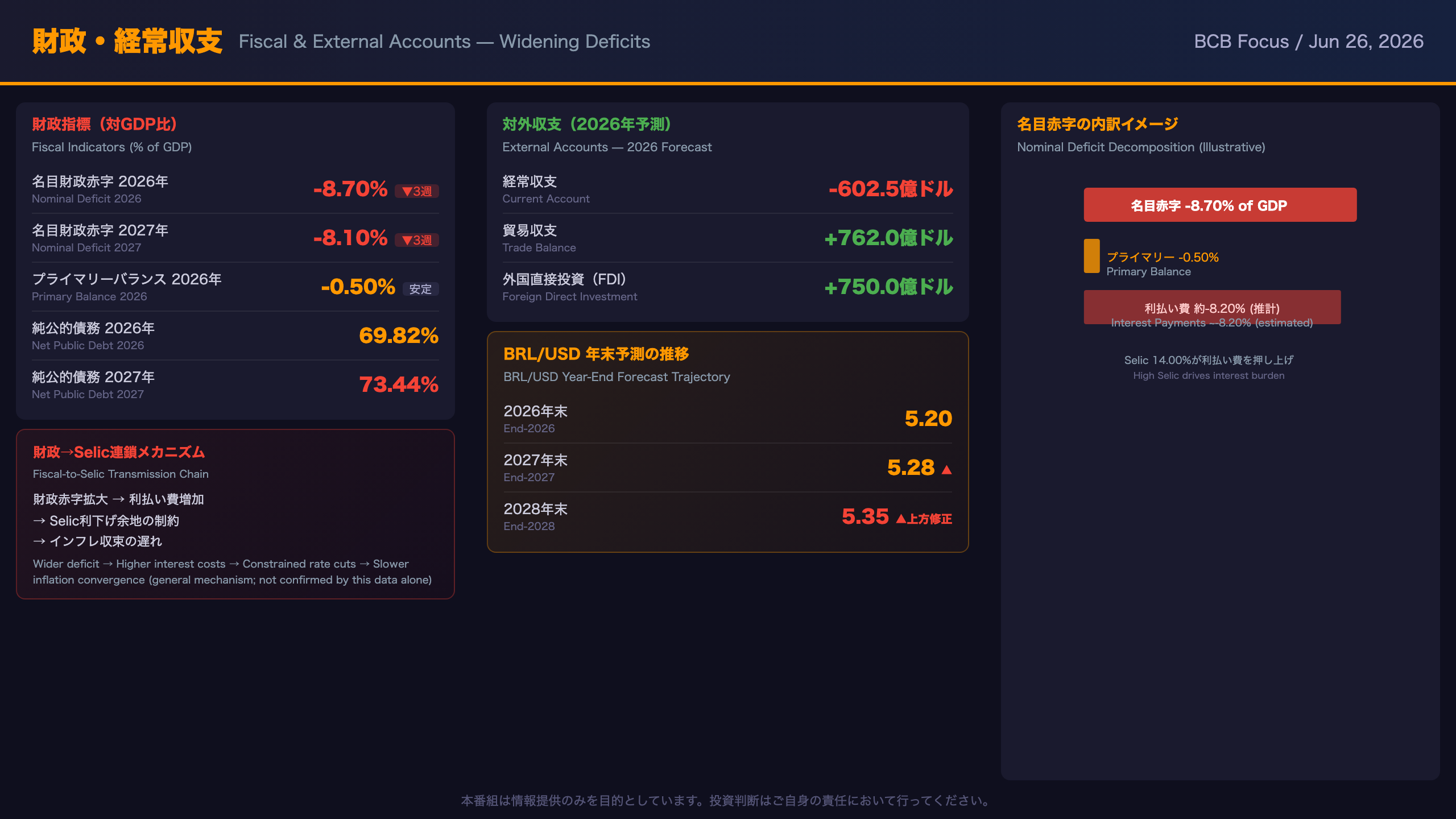
Fiscal and External Accounts: Widening Deficits and BRL Pressure
Brazil’s Fiscal Framework — Context
Brazil operates under a fiscal framework that targets a primary balance (revenue minus non-interest spending). The primary result is the metric the government formally targets, while the nominal result includes interest payments on public debt. With the Selic at 14.00%, Brazil’s interest burden is exceptionally high — the gap between the primary balance (-0.50% of GDP) and the nominal deficit (-8.70% of GDP) of approximately 8.2 percentage points represents the interest cost on public debt.
Fiscal Deterioration Trend
| Indicator | 4 Weeks Ago | Last Week | This Week | Trend |
|---|---|---|---|---|
| Nominal Deficit 2026 (% GDP) | -8.50% | -8.60% | -8.70% | 3-week deterioration |
| Nominal Deficit 2027 (% GDP) | -8.00% | -8.07% | -8.10% | 3-week deterioration |
| Primary Balance 2026 (% GDP) | -0.50% | -0.50% | -0.50% | Stable |
| Net Public Debt 2026 (% GDP) | 69.80% | 69.80% | 69.82% | Gradual rise |
The Interest Burden Trap
The 8.2 percentage point gap between the primary balance and nominal deficit is almost entirely attributable to interest payments. At a 14.00% Selic rate, Brazil’s government faces enormous debt servicing costs. This creates a self-reinforcing dynamic: high rates → high interest costs → wider nominal deficit → higher debt-to-GDP → higher risk premium → rates stay elevated.
External Accounts
- Current Account: 2026 forecast at -USD 60.25bn (widened from -USD 59.60bn last week)
- Trade Balance: Stable at USD 76.20bn for 2026 — Brazil’s commodity exports (soybeans, iron ore, oil) provide a strong buffer
- FDI: USD 75.00bn for 2026 — more than sufficient to finance the current account deficit
BRL/USD Forecast Trajectory
| Period | 4 Weeks Ago | Last Week | This Week |
|---|---|---|---|
| End-2026 | 5.16 | 5.20 | 5.20 |
| End-2027 | 5.25 | 5.27 | 5.28 |
| End-2028 | 5.30 | 5.30 | 5.35 |
The end-2028 BRL/USD forecast was revised up to 5.35 from 5.30 — a gradual but consistent depreciation trend. A weaker BRL raises import costs and can sustain inflation pressure through currency pass-through, potentially constraining the BCB’s ability to cut rates aggressively.
BRL/JPYキャリートレードと日本人投資家への含意
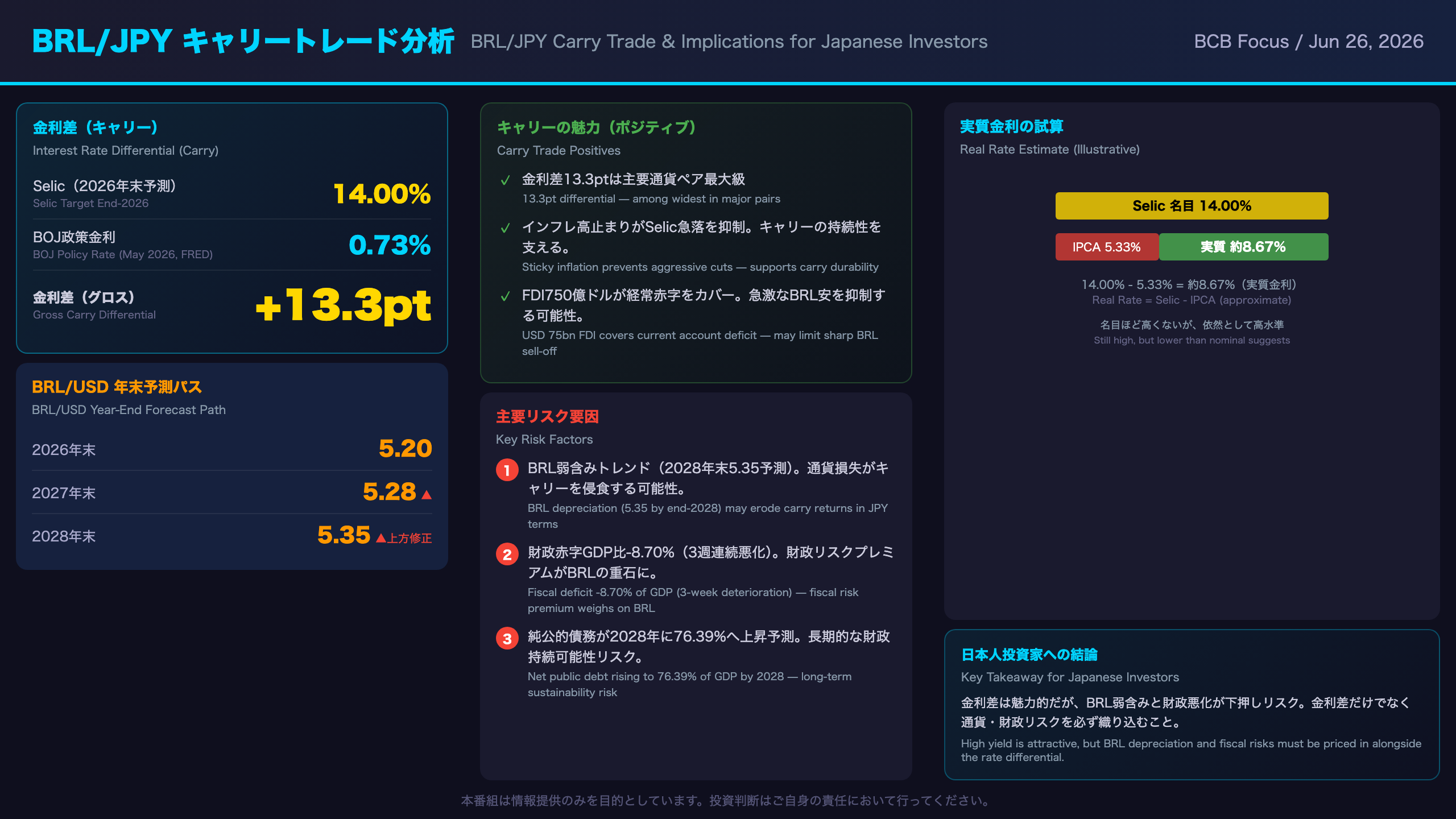
BRL/JPY Carry Trade and Implications for Japanese Investors
The Carry Trade Mechanics
A carry trade involves borrowing in a low-interest-rate currency (JPY) and investing in a high-interest-rate currency (BRL). The profit is the interest rate differential, minus any currency depreciation. With the Selic at 14.00% and the BOJ rate at 0.73%, the gross carry is approximately 13.3 percentage points — among the highest available in any major currency pair globally.
Rate Differential Summary
| Metric | Value | Source |
|---|---|---|
| Selic Rate (End-2026 Forecast) | 14.00% | BCB Focus |
| BOJ Policy Rate | 0.73% | FRED IRSTCI01JPM156N (May 2026) |
| Gross Carry Differential | ~13.3 pts | Calculated |
Why the Carry Remains Attractive
- Persistent high Selic: Above-target inflation (5.33%) means the BCB is unlikely to cut aggressively. The August forecast has held at 14.00% for 8 consecutive weeks.
- FDI buffer: USD 75bn in FDI inflows is expected to more than cover the current account deficit, providing a natural support for the BRL.
- Commodity export strength: Brazil’s trade balance of USD 76.2bn reflects strong commodity exports (soybeans, iron ore, crude oil), providing structural FX support.
Why the Carry Is Risky
- BRL depreciation trend: The end-2028 BRL/USD forecast was revised up to 5.35 from 5.30. A weaker BRL erodes JPY-denominated returns.
- Fiscal deterioration: The nominal deficit at -8.70% of GDP (and worsening) raises fiscal sustainability concerns that may weigh on BRL sentiment.
- Real rate is lower than nominal: Selic 14.00% minus IPCA 5.33% = real rate of approximately 8.67% — still high, but not as exceptional as the nominal rate suggests.
- Rising debt trajectory: Net public debt rising from 69.82% to 76.39% of GDP by 2028 increases long-term fiscal risk.
For Japanese Investors Holding Brazilian Government Bonds (NTN-F / LTN)
Brazilian government bonds (Tesouro Direto) offer high nominal yields but expose investors to BRL/JPY currency risk. The Focus data suggests:
– Short-term: Selic stability at 14.00% supports bond prices and yields
– Medium-term: BRL depreciation (5.20 → 5.28 → 5.35 by 2028) could offset yield gains in JPY terms
– Long-term: Fiscal deterioration is a risk factor that warrants monitoring
This analysis is for informational purposes only. Currency and sovereign risk assessment requires comprehensive due diligence beyond this single data source.
市場インプリケーションと今後の注目点
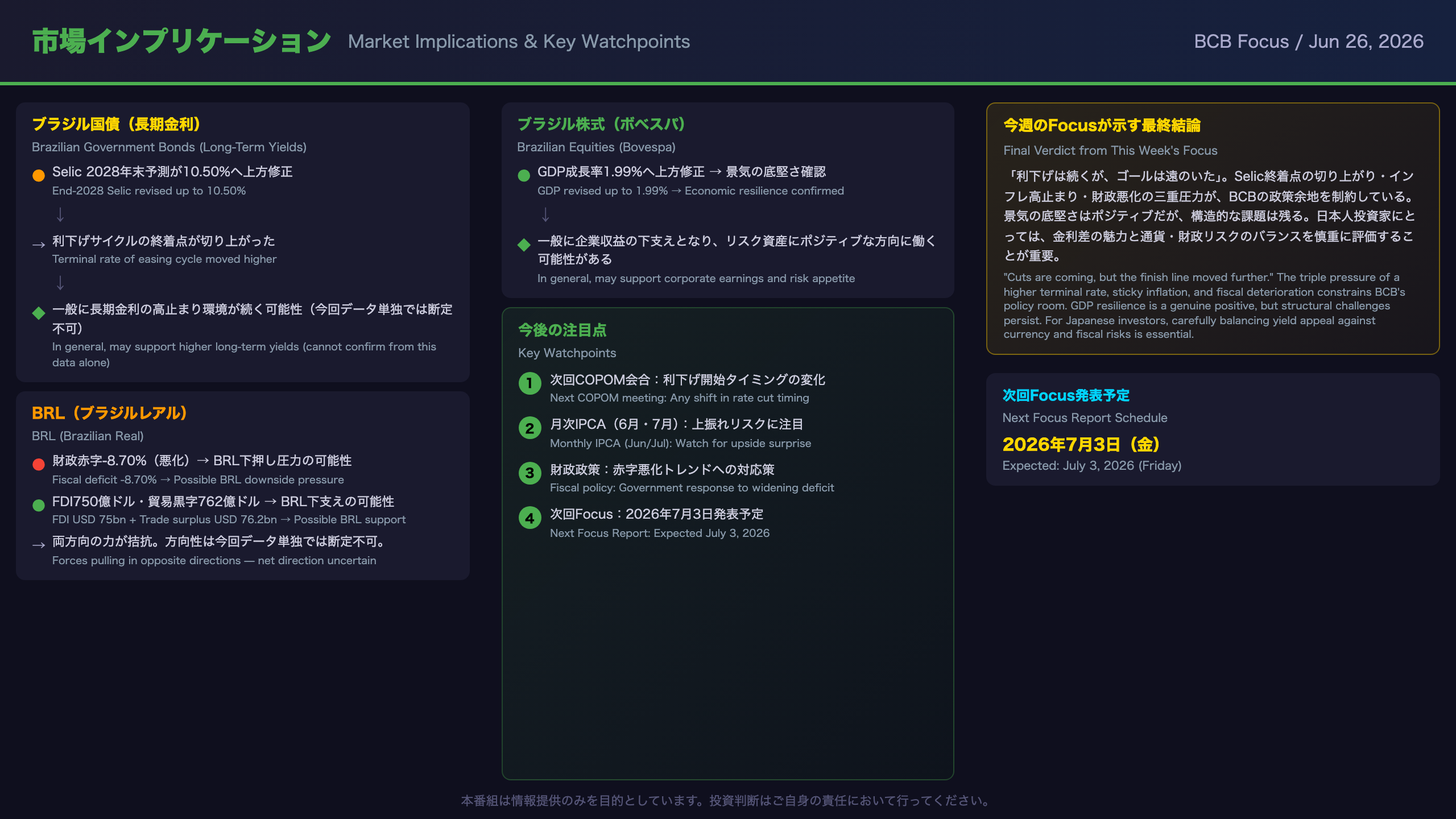
Market Implications and Key Watchpoints
The “Evidence Chain” Framework
All market implications below follow the format: [Data Fact] → [Economic Mechanism] → [Market Implication]. Where the mechanism relies on general theory rather than this specific data, it is explicitly noted.
1. Brazilian Government Bonds (Long-Term Yields)
End-2028 Selic revised up to 10.50% → Terminal rate of easing cycle has moved higher → In general, this tends to support higher long-term bond yields in Brazil. However, this single data point cannot confirm the direction of actual market yields.
2. BRL (Brazilian Real)
Nominal deficit deteriorated to -8.70% of GDP (3-week trend) → Rising fiscal risk premium → In general, this tends to exert downward pressure on the BRL.
FDI of USD 75bn and trade surplus of USD 76.2bn remain stable → External account support → May limit sharp BRL depreciation.
These two forces are pulling in opposite directions. The net BRL direction cannot be determined from this data alone.
3. Brazilian Equities (Bovespa / IBOV)
GDP growth revised up to 1.99% → Stronger economic activity → In general, supports corporate earnings and risk appetite for Brazilian equities. This is a positive signal, though single-week data revisions should not be over-interpreted.
4. BRL/JPY Carry Trade
13.3pt Selic-BOJ differential → Theoretical carry remains attractive → However, BRL depreciation trend (5.35 by end-2028) increases currency loss risk that may offset yield gains.
Key Watchpoints for the Coming Weeks
- Next COPOM Meeting: The August Selic forecast has held at 14.00% for 8 consecutive weeks, suggesting no imminent cut. Watch for any shift in this forecast.
- Monthly IPCA Releases: June (0.32%) and July (0.30%) forecasts are the near-term benchmarks. An upside surprise would push back the start of the easing cycle.
- Fiscal Policy Announcements: Will the government announce fiscal consolidation measures to address the widening nominal deficit?
- BRL/USD Spot Rate: Whether the spot rate tracks or diverges from the 5.20 year-end forecast will be a key signal.
Next Focus Report
The next BCB Focus Market Readout is expected on July 3, 2026 (typically released on Mondays with the previous Friday’s data).
Disclaimer: This article is for informational purposes only. All investment decisions are made solely at your own risk.