This article was automatically generated by the NFC Market Live AI analysis system. (Updated: 2026-11-04 10:50 JST)
📄 Primary Source
日本銀行
https://www.boj.or.jp/statistics/boj/other/mb/base2610.pdf
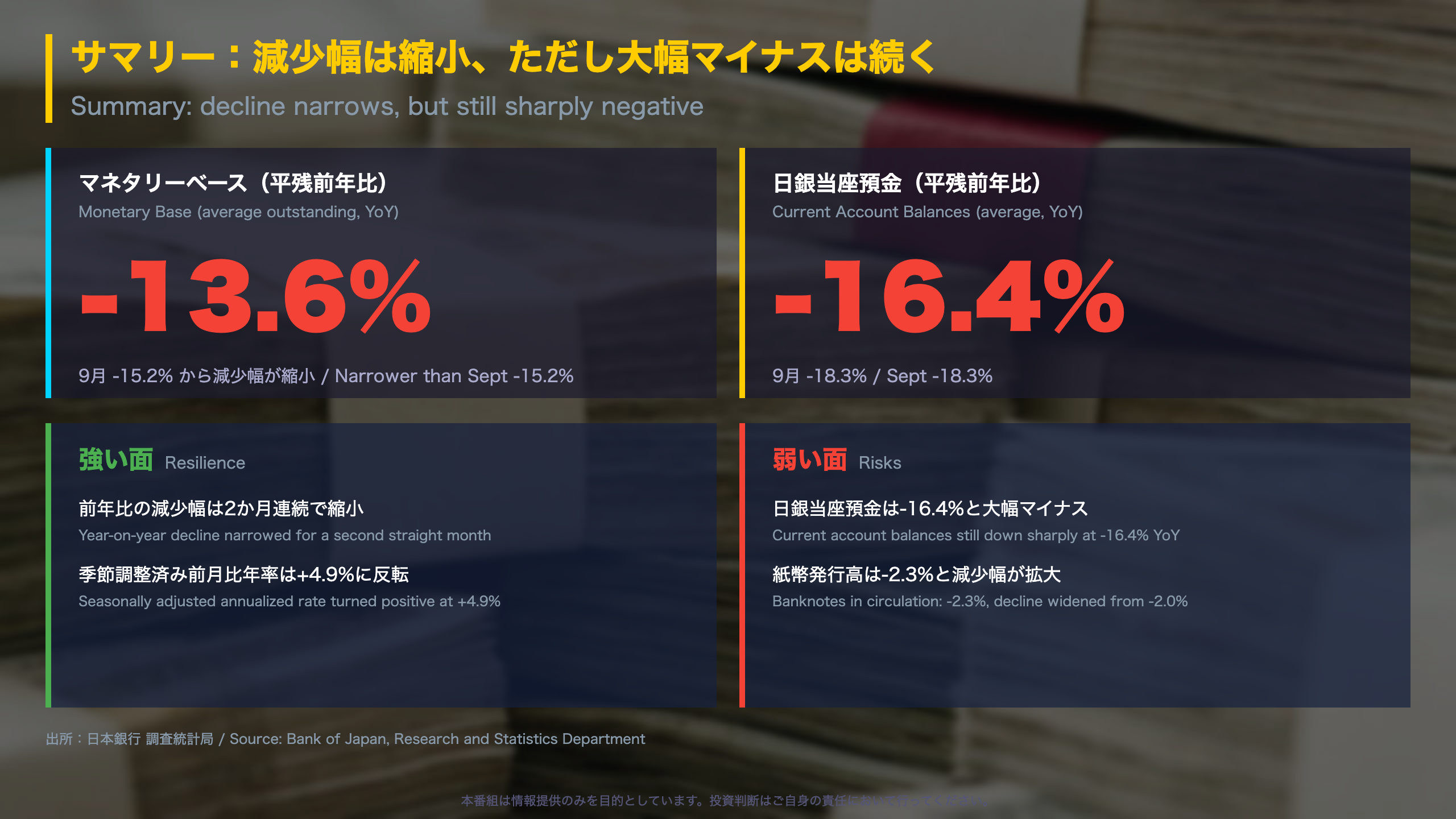
📊 The BOJ’s October monetary base (average outstanding, YoY) fell 13.6%, a smaller decline than September’s -15.2%.
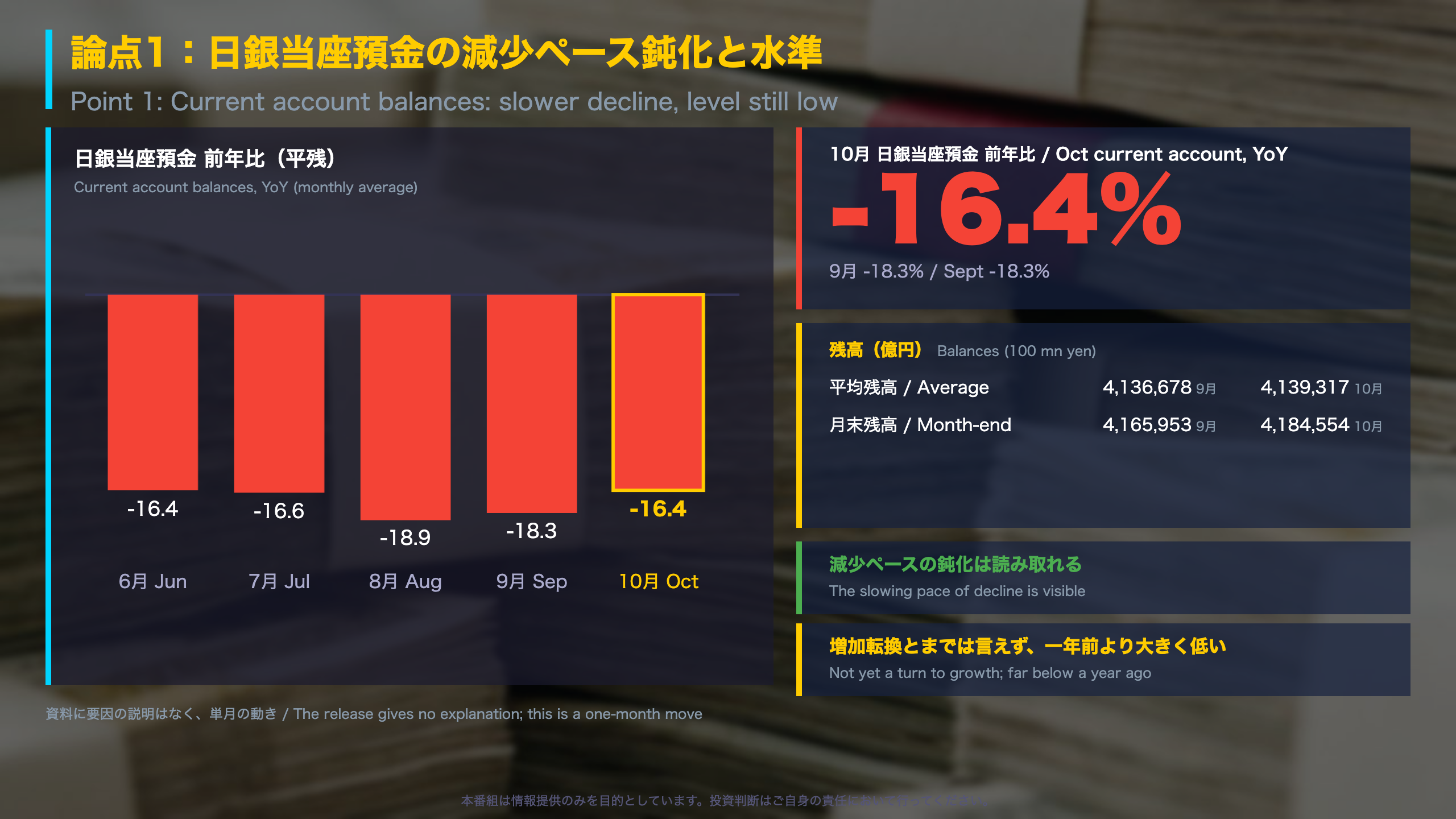
💡 Current account balances were down 16.4% (Sept: -18.3%), and the seasonally adjusted annualized monthly rate turned positive at +4.9%, the first plus in the table since Aug 2025.
⚠️ However, the monthly average was nearly flat from September, the annualized series is highly volatile, and the YoY level remains deeply negative.
🔎 Next: the November data. Watch whether the narrowing in current account balances continues.
サマリー:減少幅は縮小、ただし大幅マイナスは続く
Japan’s Monetary Base, October 2026: Context
What it is. The monetary base is the money the Bank of Japan (BOJ) supplies directly: banknotes, coins and the deposits banks hold at the BOJ. It is a quantity measure, not a price signal, and the release itself says nothing about interest rates or the yen.
Headline. The October average fell 13.6% year on year, versus -15.2% in September. That is a second consecutive month of narrowing after the -15.7% trough in August. The monthly average level was nearly flat, at 5,325,717 (100 million yen).
Why the comparison matters
The release comes from the BOJ’s Research and Statistics Department each month. The nearest US analogue is the Federal Reserve’s reserve balances plus currency in circulation, which the Fed reports weekly in its H.4.1 release. Japan’s base is dominated by current account balances (4,139,317) rather than cash (banknotes: 1,140,632).
Independent read
- Constructive: the year-on-year pace, the month-end level and the annualized rate all improved together, which suggests a tendency toward slower contraction.
- Cautious: the Jul-Sep quarterly figure was -14.9%, the widest in the series shown, and the monthly average level was flat.
Market angle
Because this is a quantity series, any link to JGB yields or the yen needs outside information that is not in the release. Investors typically watch it as a gauge of how fast reserves are being drained. The November data will show whether the narrowing persists. The release gives no publication date, but recent releases came at the start of each month.
論点1:日銀当座預金の減少ペース鈍化と水準
Current Account Balances and Reserve Balances: What the Sub-Indicators Show
Terminology. Current account balances are the deposits financial institutions hold at the Bank of Japan (BOJ). Reserve balances are the portion held by institutions subject to the BOJ’s reserve requirement system. The US analogue is the reserve balances that banks hold at the Federal Reserve.
| Item | Sept | Oct |
|---|---|---|
| Current account, YoY | -18.3% | -16.4% |
| Current account, avg (100 mn yen) | 4,136,678 | 4,139,317 |
| Reserve balances, YoY | -17.3% | -15.2% |
| Reserve balances, avg (100 mn yen) | 3,828,930 | 3,821,699 |
Observations
- The YoY contraction in current account balances peaked at -18.9% in August and has narrowed for two months.
- The average level of current account balances rose slightly in October while reserve balances edged down. The release does not explain the difference, so it should not be over-interpreted.
- For context, annual figures were +1.5% in 2024 and -5.6% in 2025, so today’s pace of decline is much steeper than last year’s average.
Two readings
- Constructive: higher balances and a narrower YoY decline appeared together, consistent with a gradual stabilization.
- Cautious: the move is one month long and the level is still far below a year ago.
What to watch
The November data will show whether the narrowing continues. A reading better than -16.4% would extend the pattern, while a wider decline would suggest October was a one-off. The release says nothing about interest rates or the yen, so market conclusions need outside information.
論点2:季節調整済み年率の反転と紙幣の動き
Seasonally Adjusted Annualized Rate and Cash Trends
How to read the column. The release’s column (a) shows month-on-month changes, seasonally adjusted and annualized, similar in spirit to how US GDP growth is quoted at an annual rate. Annualizing magnifies single-month moves, which is why the series is so choppy.
2026 monthly path (%)
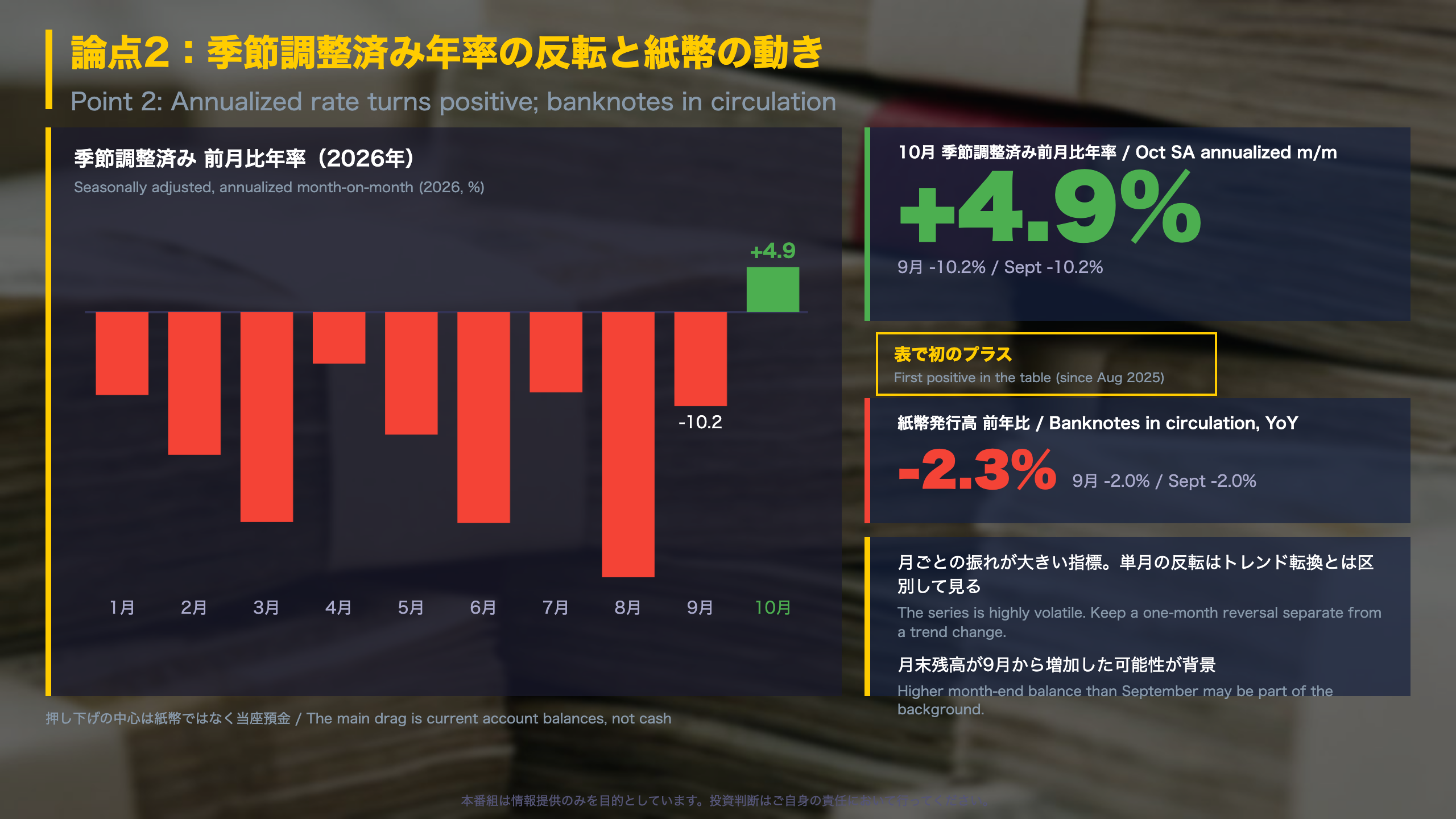
Jan -9.0 | Feb -15.5 | Mar -22.8 | Apr -5.6 | May -13.3 | Jun -22.9 | Jul -8.7 | Aug -28.8 | Sep -10.2 | Oct +4.9
- October is the first positive print in the table, which runs from August 2025.
- Quarterly readings were -14.4% in Apr-Jun and -17.4% in Jul-Sep, so the underlying pattern before October was still one of contraction.
Cash in circulation
- Banknotes in circulation: -2.3% YoY in October (Sept -2.0%). That is the widest decline since January (-2.8%), although the series had narrowed from -2.8% to -1.7% between January and May.
- Coins in circulation: -1.1% (Sept -1.2%).
- Compared with the -16.4% in current account balances, cash is a minor drag on the monetary base.
Two readings
- Constructive: a positive annualized rate together with higher month-end balances points in the same direction.
- Cautious: the swing between -28.8% in August and +4.9% in October shows how noisy the series is, and one positive month does not by itself indicate a change in trend.
Takeaway
For investors, the key is whether the November print stays positive or reverts. The release contains no comment on interest rates or the yen.
質疑で深める:改善は本物か、次に何を見るか
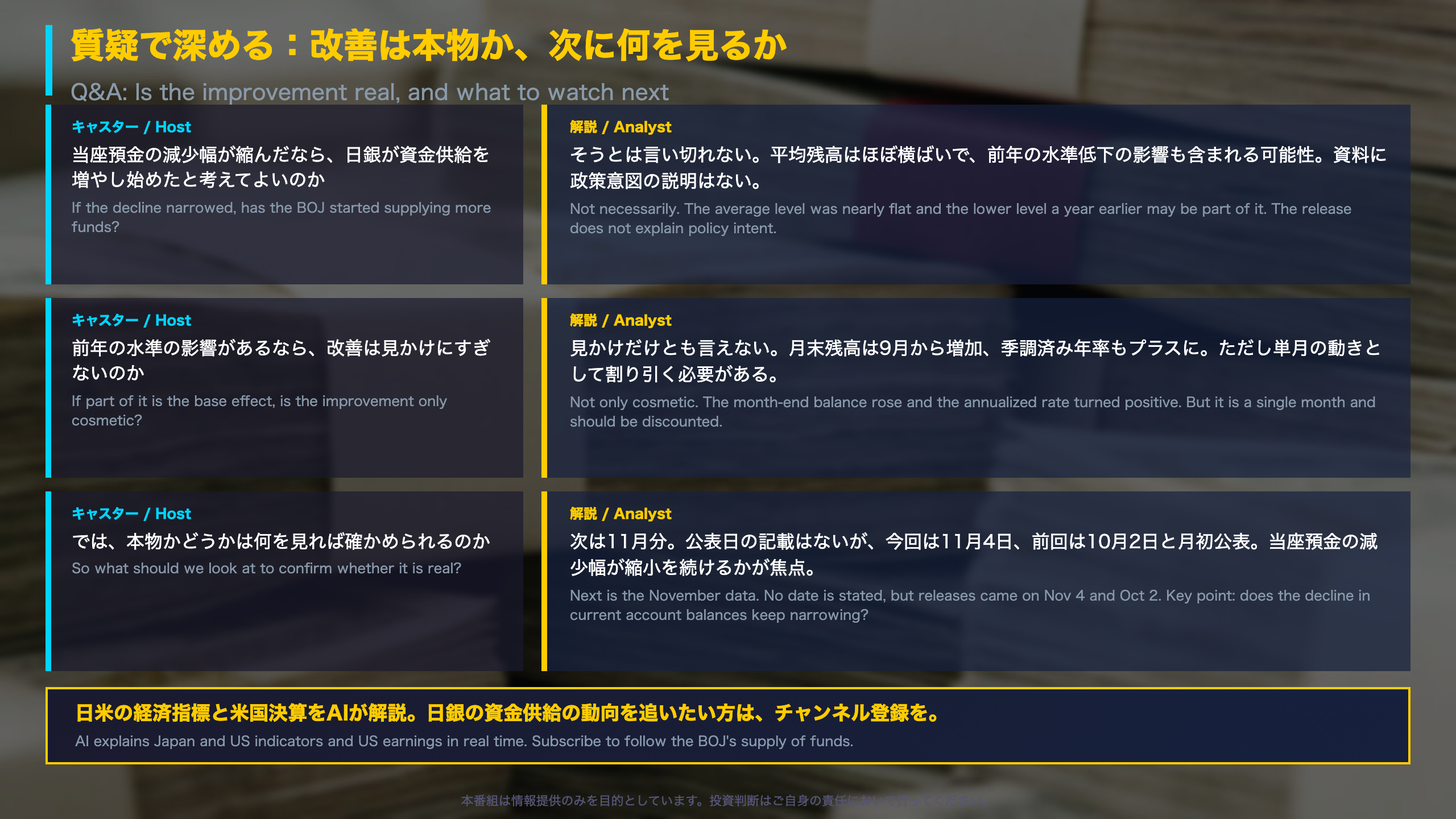
How to Read a Quantity Indicator: Q&A Wrap-Up
A reminder on scope. The monetary base measures the volume of funds the Bank of Japan (BOJ) supplies. The release makes no reference to interest rates or the yen, and it contains no statement of the BOJ’s policy intent. Any inference about stance has to be labeled as interpretation.
Three-month snapshot (figures from the release)
| Item | Aug | Sept | Oct |
|---|---|---|---|
| Monetary base, YoY | -15.7% | -15.2% | -13.6% |
| Current account, YoY | -18.9% | -18.3% | -16.4% |
| SA annualized m/m | -28.8% | -10.2% | +4.9% |
Observation thresholds
- If the November YoY reading for current account balances is better than October’s -16.4%, the narrowing trend continues.
- If it widens again, October may have been a one-month move.
Bull and bear reads
- Constructive: three indicators (YoY pace, month-end level, annualized rate) improved together, which suggests a tendency, not just noise.
- Cautious: the monthly average level was flat, and part of the YoY improvement could be a base effect from a lower level a year earlier.
Longer view
Annual readings were +1.0% in 2024 and -4.9% in 2025. October 2026 stands at -13.6%, so the contraction is far deeper than a year ago even after the recent narrowing.
What is next
The November data is the next checkpoint. The release does not state a date, but the last two came out on October 2 and November 4, early in each month. For global investors, this is a liquidity-volume gauge: useful context for Japan’s financial conditions, but not a direct rate or FX signal.
Disclaimer: This article is for informational purposes only. All investment decisions are made solely at your own risk.