📺 Watch the Full Video Analysis
This article was automatically generated by the NFC Market Live AI analysis system. (Updated: 2026-08-23 17:43 JST)
📊 This week’s (Aug 16-23) global macro review.
🚨 The biggest surprise: the Fed’s July FOMC minutes revealed a 9-3 vote, a sharp reversal from a unanimous June decision, as three regional presidents pushed for a rate hike.
📈 US jobs and business sentiment stayed resilient, while Japan’s domestic demand weakened and UK headline/core inflation diverged — a global pattern of divergence.
💡 Next week: US PCE inflation data, a key input for the September FOMC.
⚠️ This program is fully AI-generated. Investment decisions are your own responsibility.
オープニング:週間経済レビュー
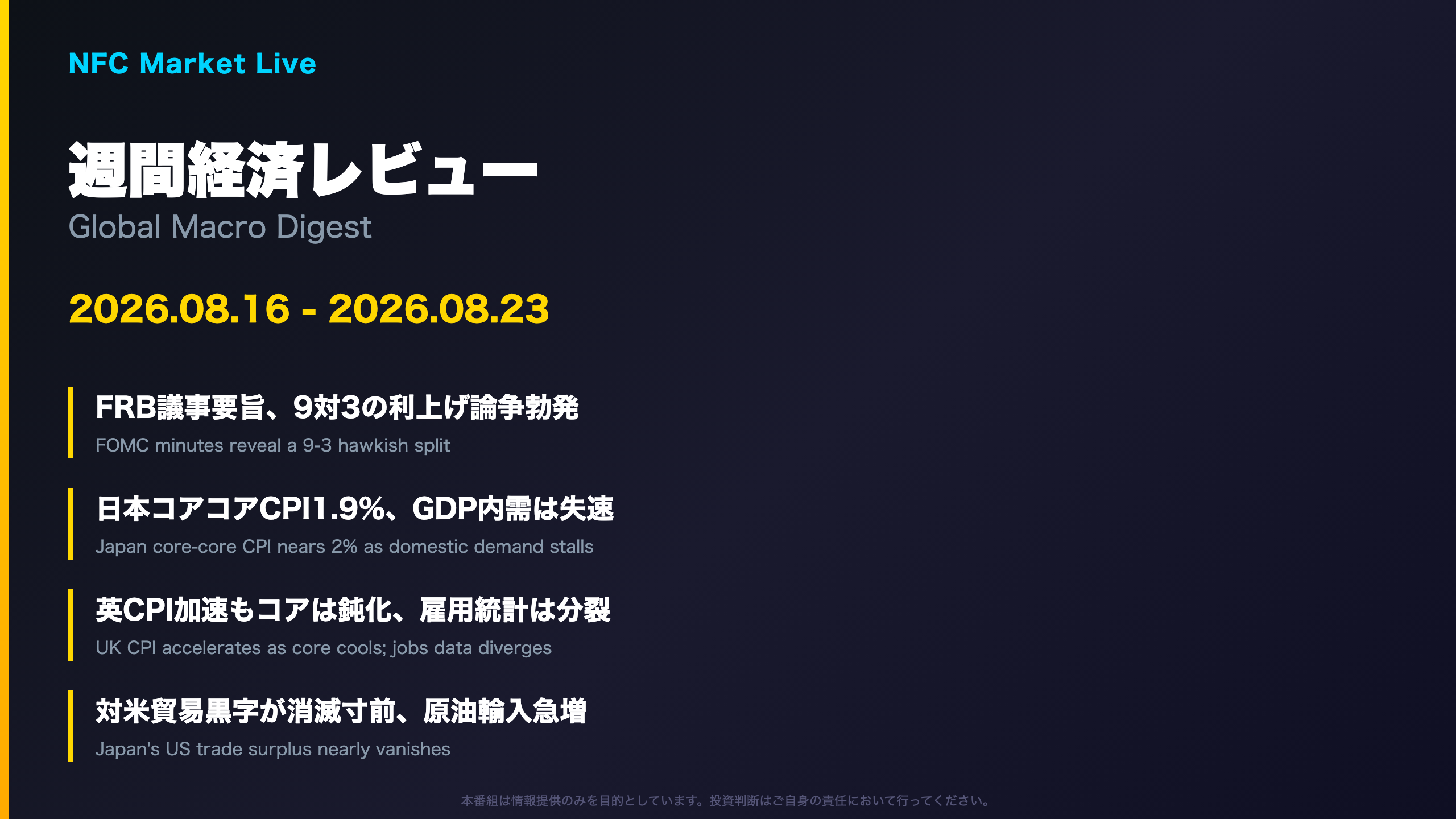
This Week’s Focus
Between August 16-23, 2026, major economies released a dense cluster of macro data and central bank documents. The headline story was the Fed’s July FOMC minutes (released Aug 20), which revealed a surprising 9-3 vote split — a sharp reversal from June’s unanimous decision.
What This Episode Covers
This review walks through the US inflation debate, diverging price and growth trends in Japan and Europe, a snapshot of where major central banks currently stand, and next week’s key calendar events — all presented with a balanced view of strengths and risks, avoiding both permabear and permabull framing.
今週の総括:タカ派再燃と実体経済のまだら模様
Surprise vs. Consensus This Week
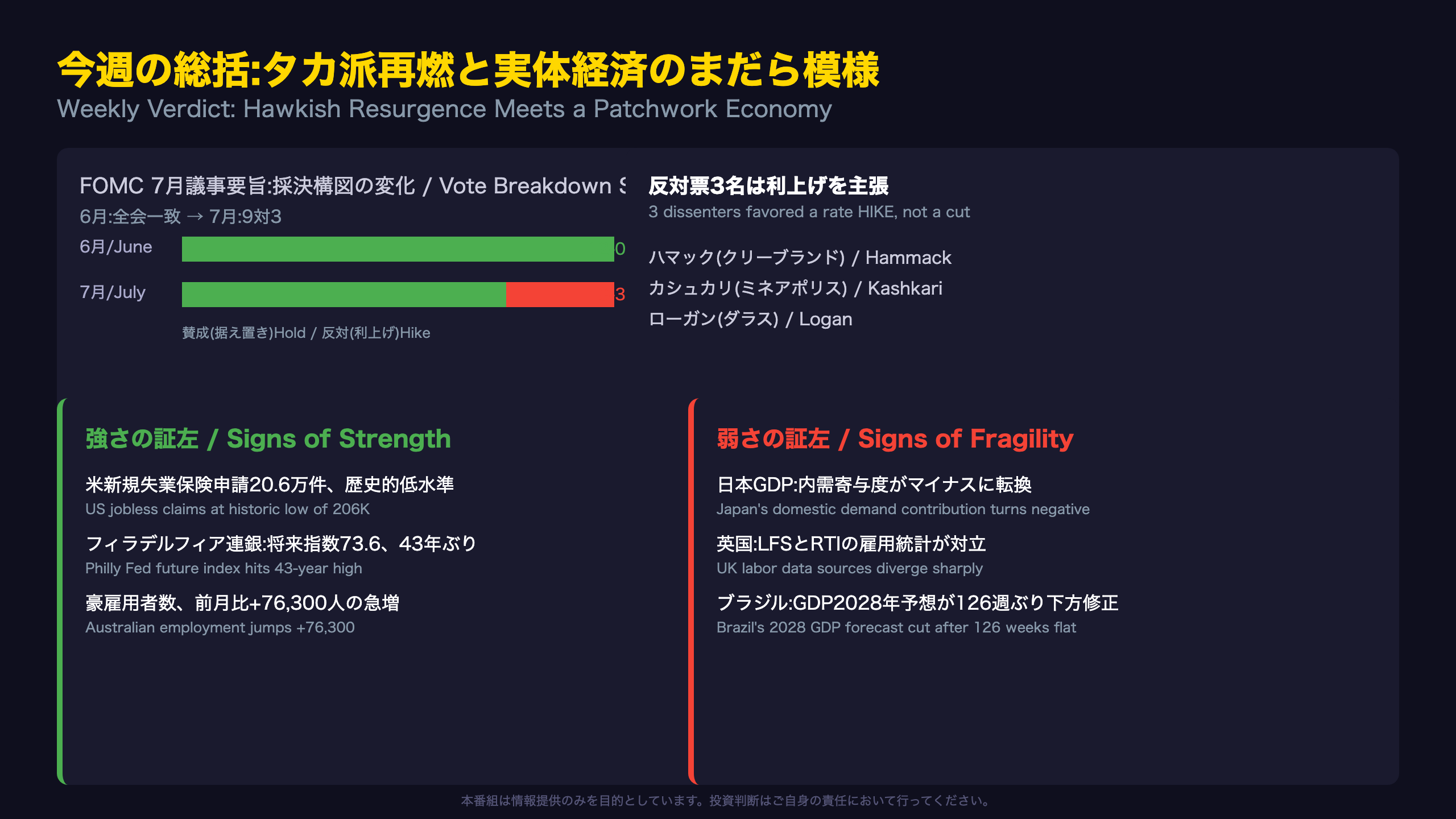
The week’s biggest surprise came from the Federal Reserve. The FOMC minutes from the July 28-29 meeting, released August 20, revealed a 9-3 vote — a sharp reversal from the unanimous 12-0 decision just six weeks earlier in June. Three regional Fed presidents (Cleveland’s Hammack, Minneapolis’s Kashkari, and Dallas’s Logan) dissented in favor of a 25bp rate hike, not a cut — an unusual directional shift after years of dovish dissents.
Meanwhile, Mexico’s Banxico held its policy rate at 6.50% for a second consecutive meeting, exactly as markets expected, while the ECB maintained its meeting-by-meeting, data-dependent stance.
Balancing Strength and Weakness
Signs of resilience: US initial jobless claims held at a historically low 206,000. The Philadelphia Fed’s manufacturing index hit 47.4, a five-year high, while its future activity index surged to 73.6 — the strongest reading since 1983. Australian employment jumped by 76,300 in June.
Signs of fragility: Japan’s Q2 GDP grew a headline +0.3% q/q, but domestic demand contribution turned negative and business investment fell for a second straight quarter. In the UK, a widening gap between the Labour Force Survey and HMRC payroll data (RTI) has begun to raise questions about the reliability of official employment statistics themselves.
A Balanced Read, Not a Binary One
This week resists a simple “hawkish resurgence = overheating” or “pockets of weakness = recession” narrative. A common thread across the UK and Canadian inflation reports was energy-price volatility tied to Middle East tensions — a reminder that geopolitical shocks, not domestic demand alone, are shaping several countries’ headline inflation prints simultaneously.
米国:FOMC分裂とインフレの粘着性
The Case for a Preemptive Hike
The FOMC minutes state that hawkish dissenters believed hiking now “would help forestall the need for a steeper, potentially more costly series of tightening steps later” — an argument echoing lessons from the Fed’s delayed 2022 response, and consistent with Chair Warsh’s inflation-hawk background from his 2006-11 Board tenure.
Understanding the Fed’s Preferred Gauge: PCE
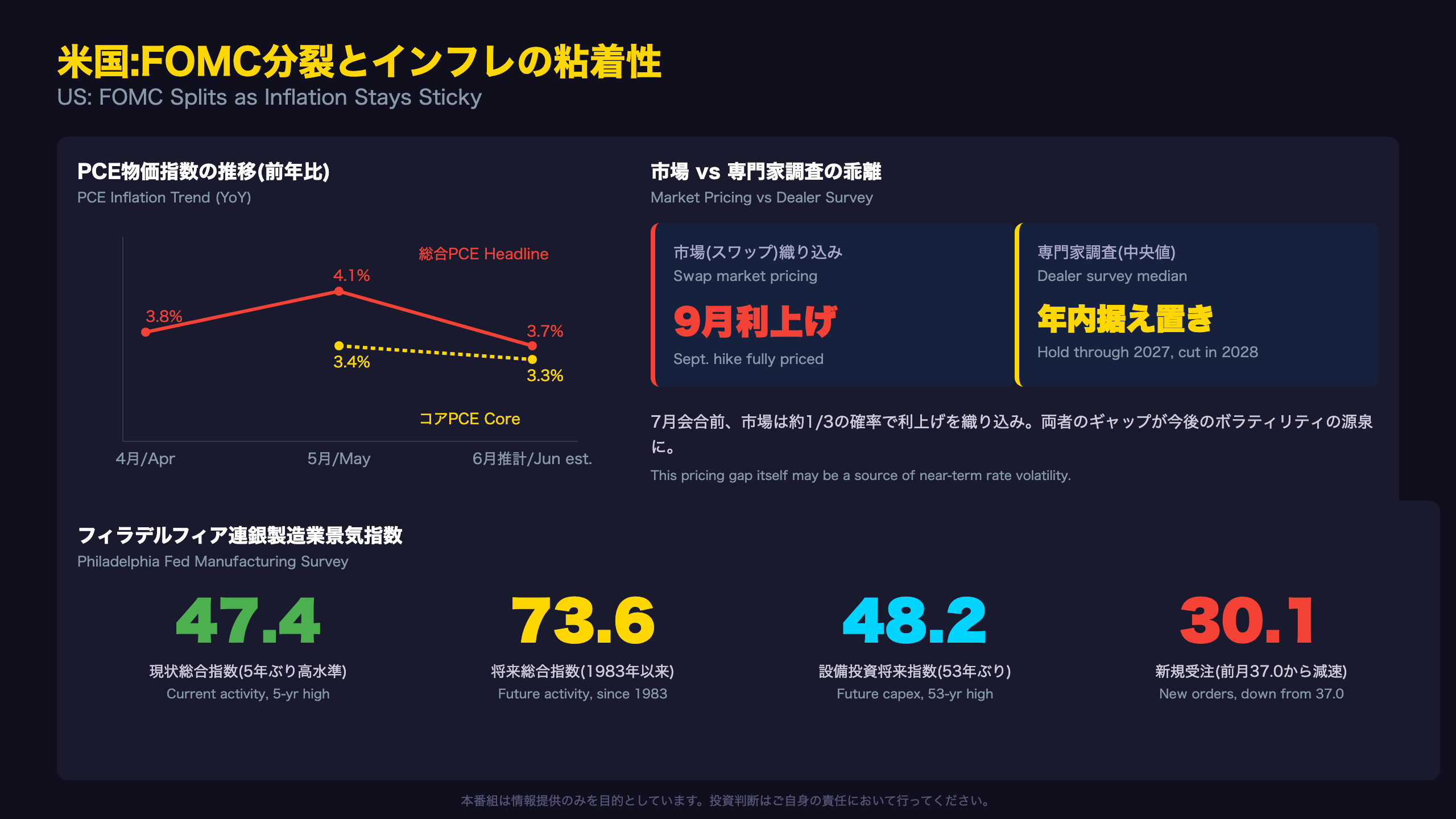
Unlike the CPI most retail investors follow, the Fed targets the Personal Consumption Expenditures (PCE) price index. Headline PCE fell from 4.1% in May to an estimated 3.7% in June — but that decline was driven almost entirely by falling energy prices. Core PCE, which strips out food and energy, edged down just 0.1 point to an estimated 3.3%, showing the underlying stickiness hasn’t resolved.
A Striking Market-Fed Gap
Fed staff’s own trading desk survey found markets had priced in roughly a one-third probability of a hike ahead of the July meeting, and had fully priced a 25bp hike by September. Yet the median primary dealer surveyed still expects rates to hold steady through 2026 and 2027, with the next cut not until early 2028.
Institutional Reform Underway
Chair Warsh floated reducing FOMC meetings from eight to six per year — a structural change to the committee’s cadence unseen since 1981. No decision was made, but it signals an institutional shake-up beyond rate-setting itself.
Philly Fed: Sentiment at Multi-Decade Highs
The regional survey’s current index hit 47.4, the highest since April 2021, while the future activity index leapt to 73.6 — a reading not seen since August 1983. Capital expenditure expectations hit a 53-year high. However, new orders and shipments are moderating, suggesting a gap between corporate optimism and near-term demand.
世界に広がる「分裂」:物価と労働市場の二極化
UK: Anatomy of a Gas Price Shock
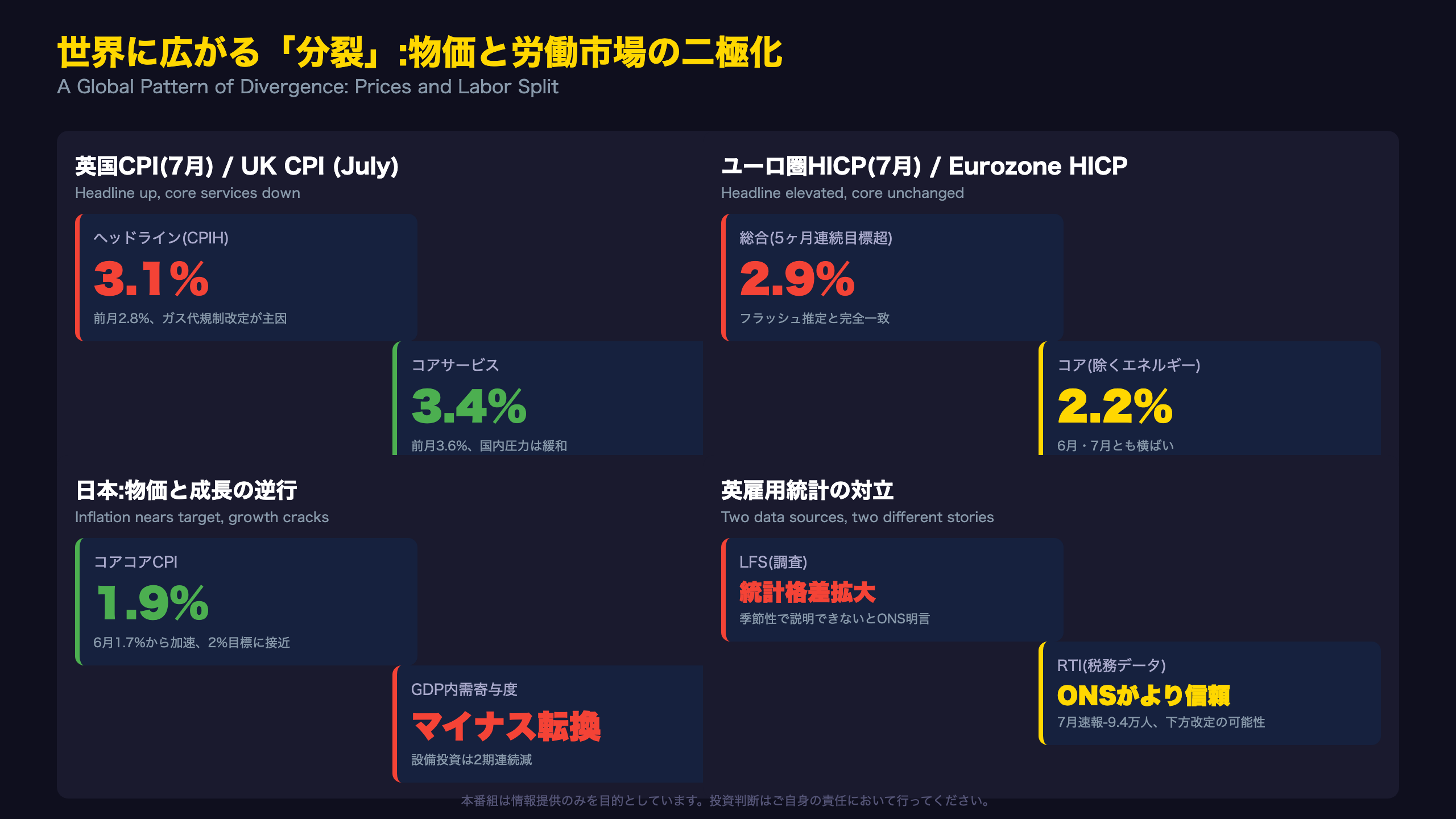
UK gas prices rose 14.7% year-on-year, the fastest pace since October 2022. The ONS explained that Ofgem’s Q3 price cap, calculated from wholesale prices between February 18 and May 18, was “the first assessment period where prices had been affected by the outbreak of the conflict in the Middle East.” A geopolitical shock from months earlier is only now reaching household bills through the UK’s regulated tariff mechanism. Notably, core services inflation eased to 3.4%, the metric the Bank of England watches most closely.
Eurozone: What an Unchanged Core Really Means
Eurozone HICP’s flash and final estimates matched exactly at 2.9%, and core (ex-energy) was flat at 2.2% for both June and July — evidence that only the headline moved while underlying pressure stayed anchored. Still, “super-core” (also ex-food/alcohol/tobacco) ticked up from 2.4% to 2.5%.
Japan: Inflation Nears Target as Growth Cracks
Japan’s core-core CPI (the BOJ’s preferred underlying gauge) accelerated to 1.9% in July from 1.6% in June. Yet Q2 GDP showed real growth of just +0.3% q/q with a negative domestic demand contribution and business investment falling for a second straight quarter. Separately, Japan’s trade surplus with the US has shrunk roughly 62% from its November 2025 peak amid a stunning +1,489% y/y surge in US crude oil imports.
UK Labor Data: When Statistics Disagree
A widening gap between the Labour Force Survey (LFS) and HMRC’s real-time payroll data (RTI) has become a story in itself. The ONS stated the divergence “does not appear to be explained by seasonality” and has flagged RTI as currently the more reliable gauge — a statement with real policy weight for the BOE’s rate debate.
中銀政策マップ:据え置き優勢もタカ派圧力が浮上
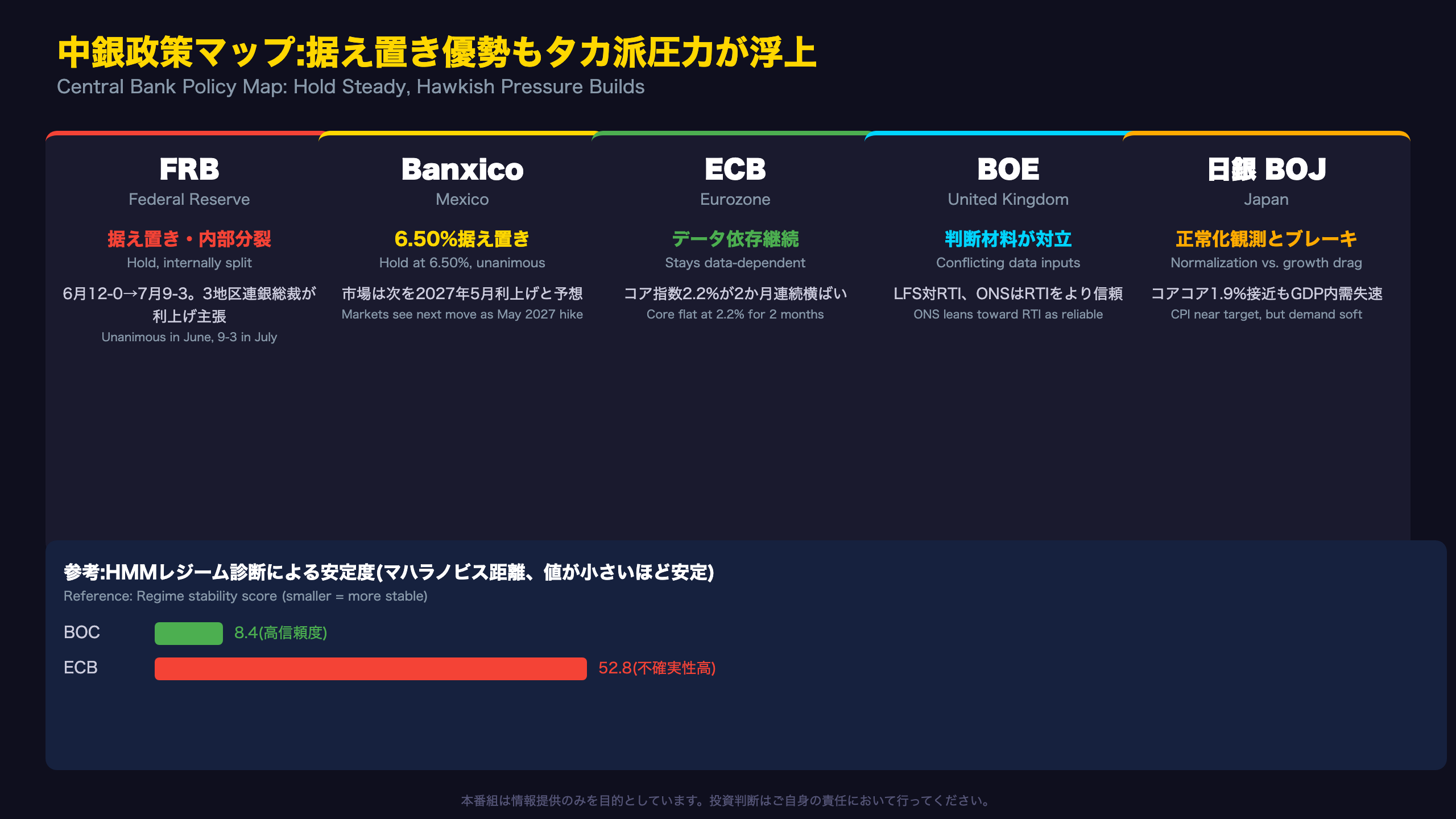
“On Hold” Doesn’t Mean “In Agreement”
On the surface, the Fed, Banxico, ECB, and BOE all held rates steady in their most recent decisions. But the internal dynamics differ sharply. The Fed’s June meeting was unanimous (12-0); by July it had split 9-3, with three hawkish dissenters publicly arguing for a hike. Banxico’s hold, by contrast, was unanimous.
The Widening Market-Central Bank Communication Gap
For the Fed, swap markets have essentially fully priced a hike by September, while the median primary dealer surveyed still expects rates on hold through 2027, with the next move — a cut — not until early 2028. A similarly wide gap exists at Banxico: swap markets now see the next move as a hike in May 2027, six months later than projected back in June.
What the Regime-Detection Model Suggests
NFC Quant Desk’s proprietary 10-central-bank Hidden Markov Model-based regime classifier currently rates the Bank of Canada as the most stable policy regime (Mahalanobis distance 8.4, confidence 0.63), while the ECB shows the largest deviation from its historical center (distance 52.8, confidence 0.32) — a signal of elevated policy uncertainty, not a forecast of any specific action.
The Bank of Japan’s Balancing Act
Japan’s core-core CPI closing in on 2% supports the case for further policy normalization, but the same week’s GDP report — showing negative domestic demand and a shrinking US trade surplus — argues for caution.
今週の番組制作費:34番組・週合計5,087円
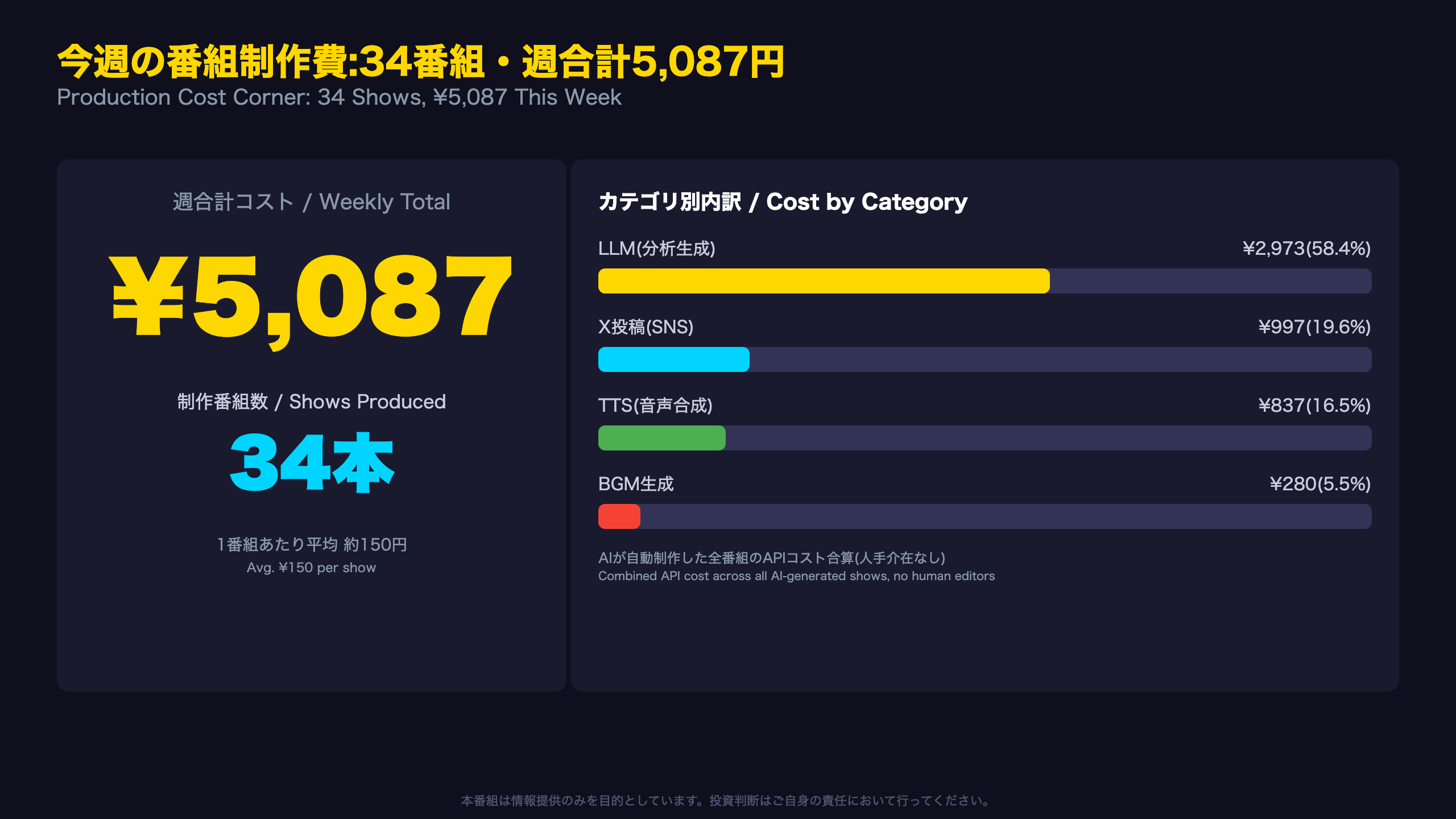
Cost Breakdown by Category
NFC Market Live’s fully AI-automated production system generated 34 programs this week (Aug 16-22) at a combined cost of ¥5,087. The breakdown:
| Category | Cost | Share |
|---|---|---|
| LLM (text generation) | ¥2,973 | 58.4% |
| X (social posting) | ¥997 | 19.6% |
| TTS (voice synthesis) | ¥837 | 16.5% |
| BGM generation | ¥280 | 5.5% |
LLM costs dominate because Deep Dive-style analytical shows require substantial computation to parse source reports, balance opposing viewpoints, and generate multi-slide narratives.
Per-Show Economics
Dividing the weekly total across 34 shows yields an average cost of roughly ¥150 per program. High-profile releases requiring deeper analysis — such as Japan’s national CPI or industrial production reports — can run into the ¥300+ range, while simpler formats cost well under ¥100.
Why This Matters for Investors
This is a transparent look at what it costs to run a fully automated, AI-driven financial news operation covering video, blog, and social media simultaneously, without human scriptwriters or editors in the production loop.
来週の注目カレンダー(8/24-8/28)
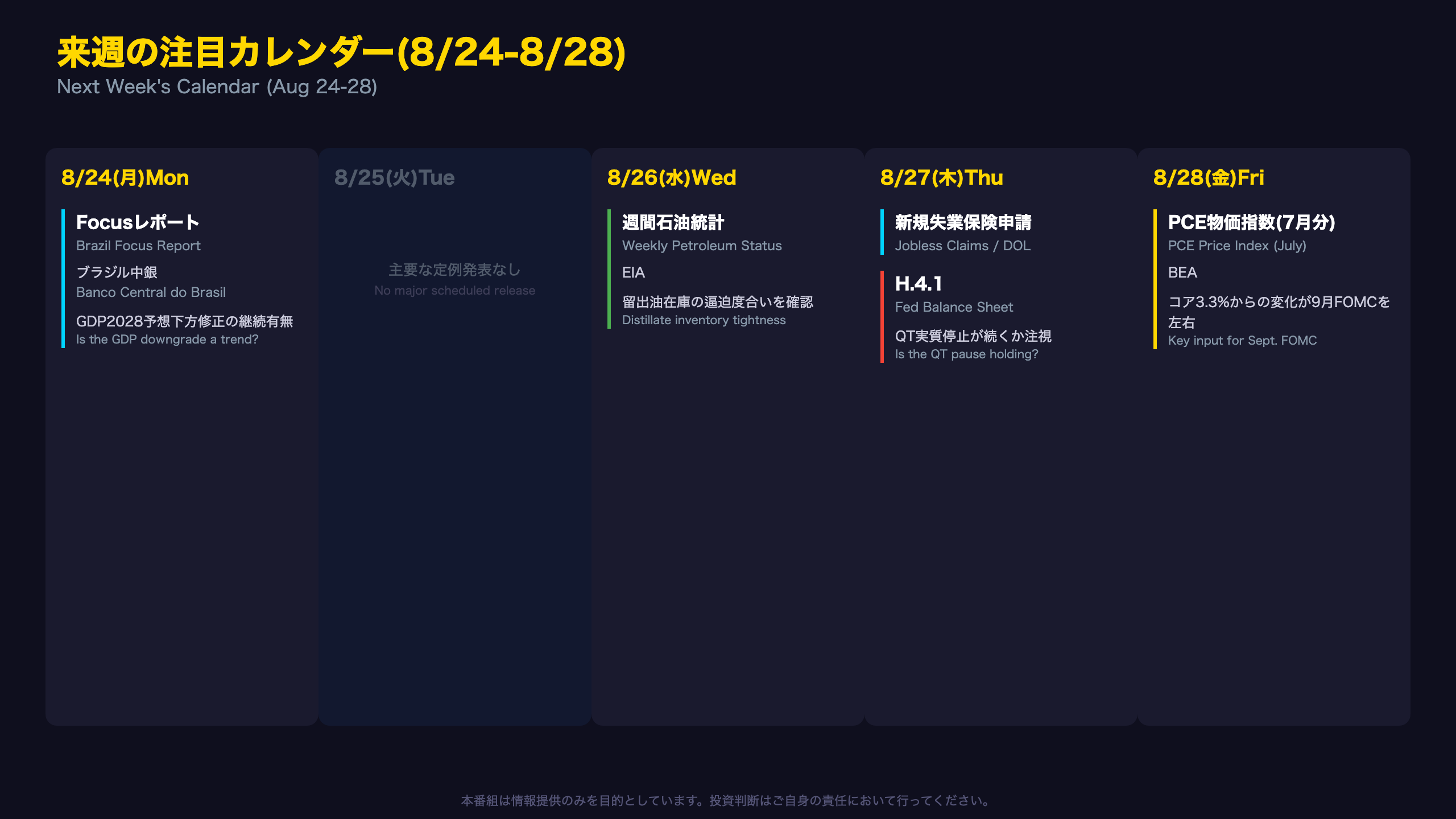
Next Week’s Calendar in Detail
| Date | Event | Source |
|---|---|---|
| Mon 8/24 | Focus Market Readout | Banco Central do Brasil (BCB) |
| Wed 8/26 | Weekly Petroleum Status Report | EIA |
| Thu 8/27 | Initial Jobless Claims | US Dept. of Labor |
| Thu 8/27 | H.4.1 (bank reserves / QT tracker) | Federal Reserve |
| Fri 8/28 | PCE Price Index (July)* | US BEA |
*The PCE Price Index is the Fed’s preferred inflation gauge (distinct from CPI) and is typically released around month-end.
The Chain of Reasoning Behind Each Release
Brazil’s Focus Report (8/24): This week’s edition revealed the 2028 GDP growth forecast broke a remarkable 126-week streak at 2.00%, dropping to 1.89%. Whether this is a one-off blip or the start of a new downward trend will only become clear over the next several weeks.
EIA Petroleum Data (8/26): This week’s release showed US distillate inventories running about 13% below the five-year seasonal average, an unusually tight level heading into autumn refinery maintenance season.
DOL Claims & Fed H.4.1 (8/27): This week’s initial jobless claims of 206,000 remained historically low, even as continuing claims drifted gently upward. Separately, the Fed’s balance sheet data showed securities holdings ticking up week-over-week, evidence some read as a de facto pause in quantitative tightening.
PCE Price Index (8/28): The July FOMC minutes explicitly noted an estimated core PCE of 3.3% for June. Where the official July print lands will heavily influence the momentum behind the three hawkish dissenters ahead of the September FOMC meeting.
Scenario Thresholds to Watch
If core PCE prints above 3.3%, expect the hawkish camp’s argument to gain further traction. A drop into the low-3% range would likely revive “hold” expectations.
Disclaimer: This article is for informational purposes only. All investment decisions are made solely at your own risk.