This article was automatically generated by the NFC Market Live AI analysis system. (Updated: 2026-11-18 09:07 JST)
📄 Primary Source
財務省
https://www.customs.go.jp/toukei/shinbun/trade-st/gaiyo2026_10.pdf
📊 A walkthrough of Japan’s October trade statistics (preliminary), released by the Ministry of Finance on Nov 18.
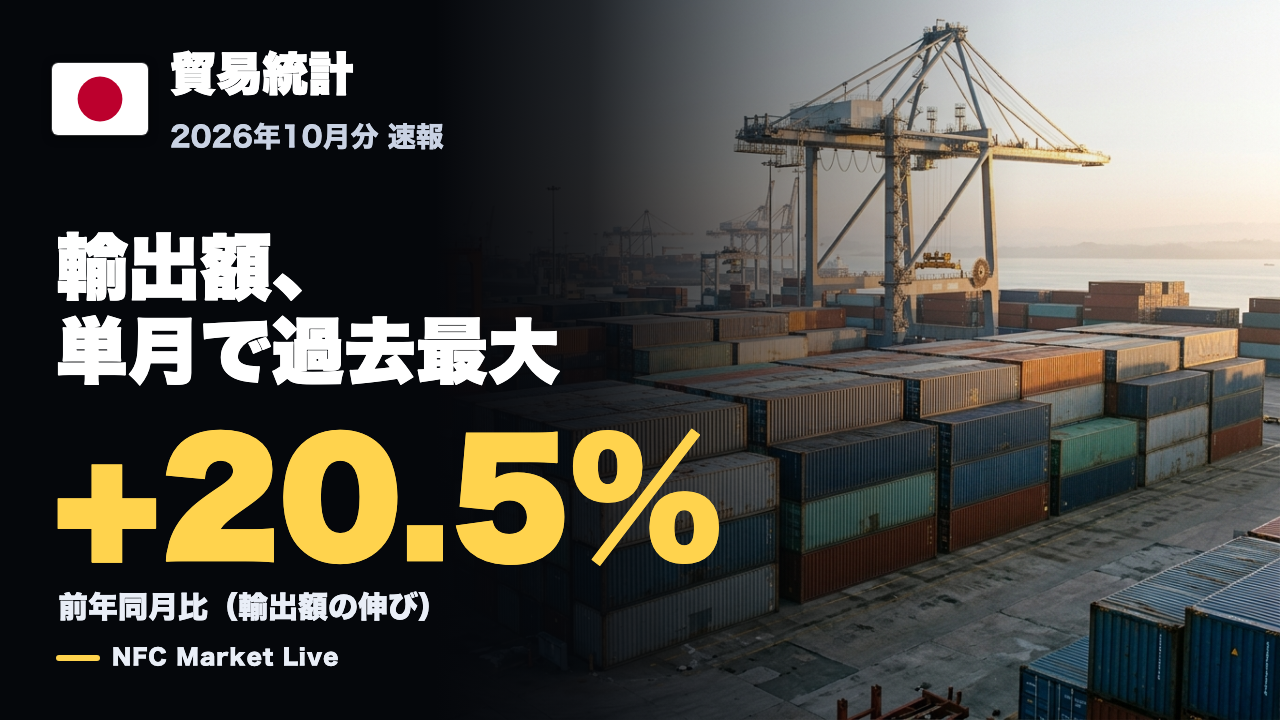
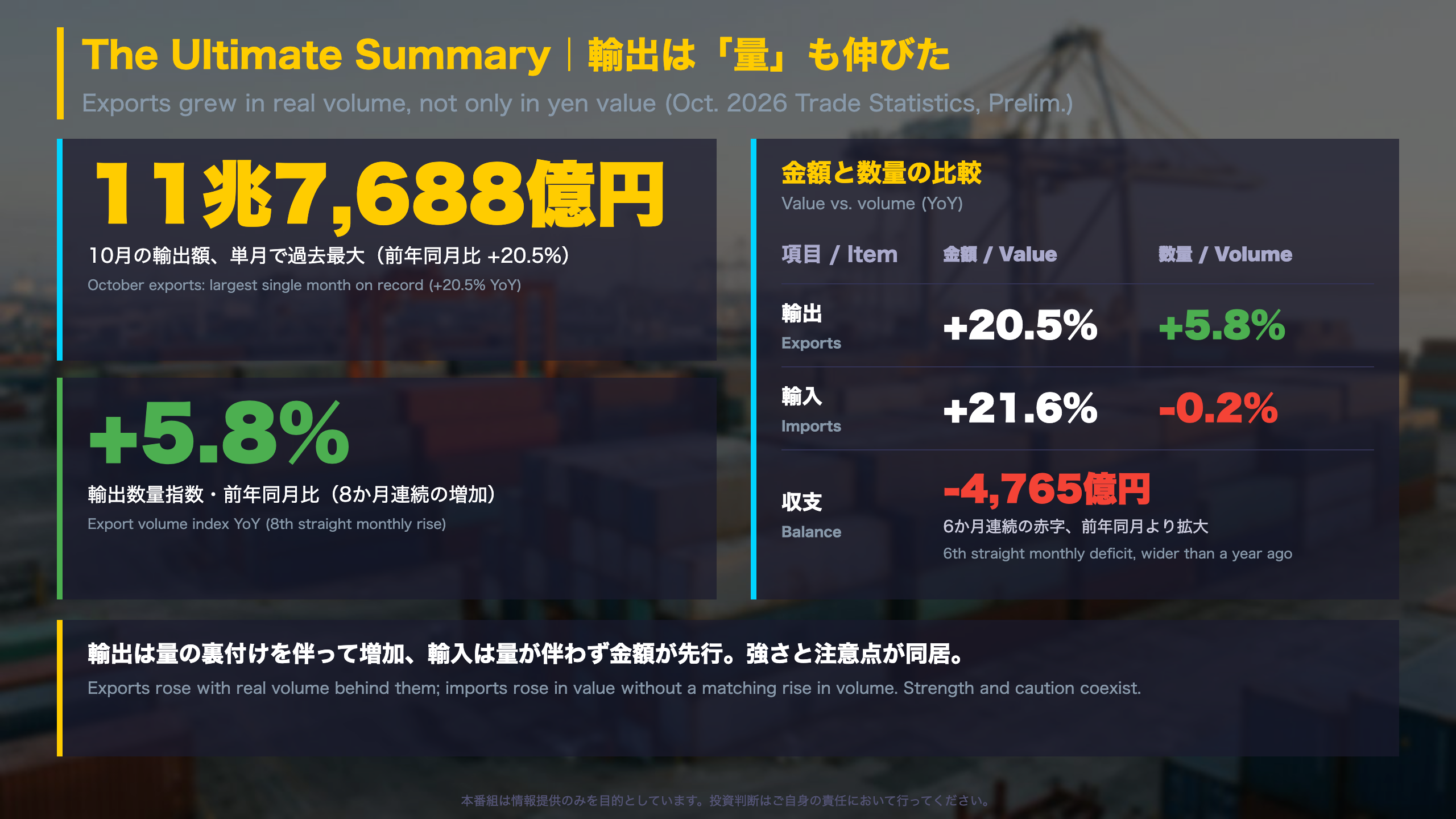
📈 Exports reached 11.77 trillion yen (+20.5% YoY), the largest single month on record. The export volume index, which strips out price effects, rose 5.8%, an 8th straight gain.
⚠️ Imports rose 21.6% in value but the volume index slipped 0.2%. Crude oil (+60.5%) was the biggest driver of import growth.
💡 Auto exports to China fell 53.3%. The November data will show whether the volume gains continue.
The Ultimate Summary|今回の最大の発見:輸出は「量」も伸びた
Japan’s October Trade Data at a Glance
Who publishes this? Japan’s Ministry of Finance (MOF) releases the monthly trade statistics on a customs-clearance basis, roughly three weeks after month-end. The first release is a preliminary (速報) estimate and is revised the following month. By comparison, the US Census Bureau and BEA publish goods and services trade about five weeks after month-end.
Key figures
- Exports: 11.77 trillion yen, +20.5% YoY, the 14th straight monthly rise and the largest single month in the series that began in January 1979.
- Imports: 12.25 trillion yen, +21.6% YoY, the 9th straight rise, also a record.
- Balance: a deficit of 476.5 billion yen, the sixth consecutive monthly deficit and wider than a year earlier.
- Volume indices: exports +5.8% (8th straight rise); imports -0.2% (2nd straight fall). The volume index removes price effects, so it is a cleaner read on real quantities.
Context
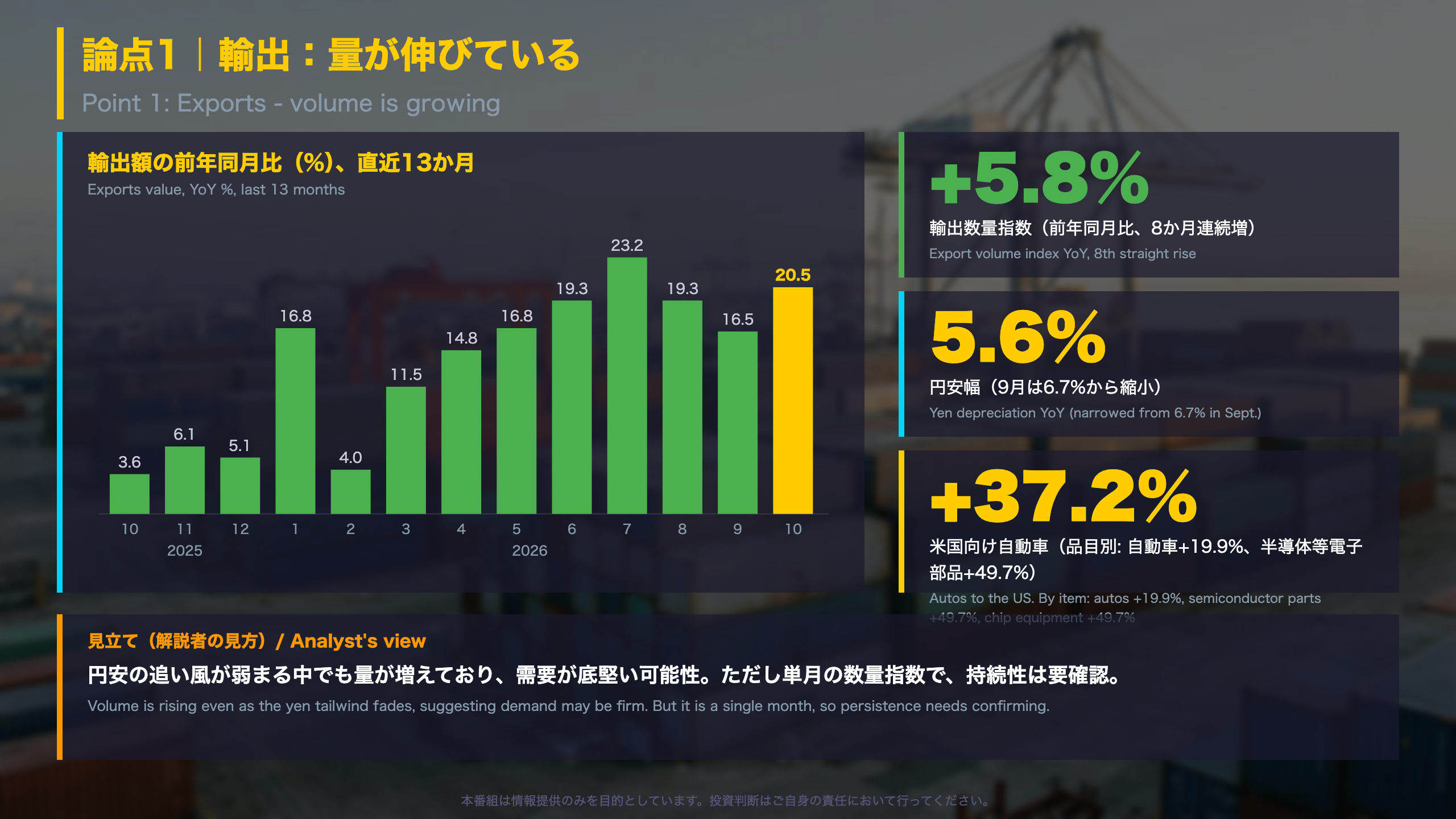
The average customs rate was 157.84 yen per dollar, 5.6% weaker than a year ago, but less of a depreciation than in September (6.7%). That means the currency tailwind to yen-denominated export values narrowed even as export growth re-accelerated, a point that favors a volume-led reading.
Two readings
The constructive view: exports are rising in both value and volume, with broad strength across the US, EU and Asia. The cautious view: the export volume figure is a single month, imports show value growth without volume growth, and China-bound autos fell 53.3%.
What to watch
The November release will show whether volume gains persist. This is a data walkthrough, not a forecast; the report itself gives no outlook for markets or policy.
論点1|輸出:量が伸びている / Exports: Volume Is Growing
Inside Japan’s Export Surge
What drove the increase
The Ministry of Finance reports each item’s contribution to the headline growth rate. In October, autos (+19.9% YoY, 3.3 points) and semiconductor parts (+49.7%, 3.2 points) contributed almost equally, with chipmaking equipment (+49.7%, 1.8 points) a third driver. In September, semiconductor parts were slightly ahead of autos (3.3 vs 2.4 points), so autos have caught up.
Regional picture
- United States: 2.17 trillion yen (+23.9%), a record; autos +37.2% were the largest single contributor (9.8 points), while pharmaceuticals fell 64.8%.
- EU: 1.11 trillion yen (+22.1%), led by autos (+43.8%).
- Asia: 6.41 trillion yen (+22.0%), the 15th straight rise, powered by semiconductor parts (+52.6%) and chipmaking equipment (+41.1%).
- China: +13.3%, with equipment exports up but autos down 53.3%.
Volume vs. currency
The volume index rose 5.8% while the yen was only 5.6% weaker than a year earlier, versus 6.7% in September. If the yen’s tailwind were the main story, export values should have lost momentum; instead they re-accelerated (+16.5% in September, revised, to +20.5%). That points to volume, and potentially firm demand, as a contributor.
Caveats
This is a single month, and the report provides no item-level volumes. Compared with the US, where trade data are published about five weeks after month-end and show goods and services together, Japan’s customs-based release is faster but covers goods only. We do not offer a market forecast here.
論点2|輸入:金額は膨らむが数量は減少 / Imports: Value Up, Volume Down
Reading Japan’s Import Bill
Value without volume
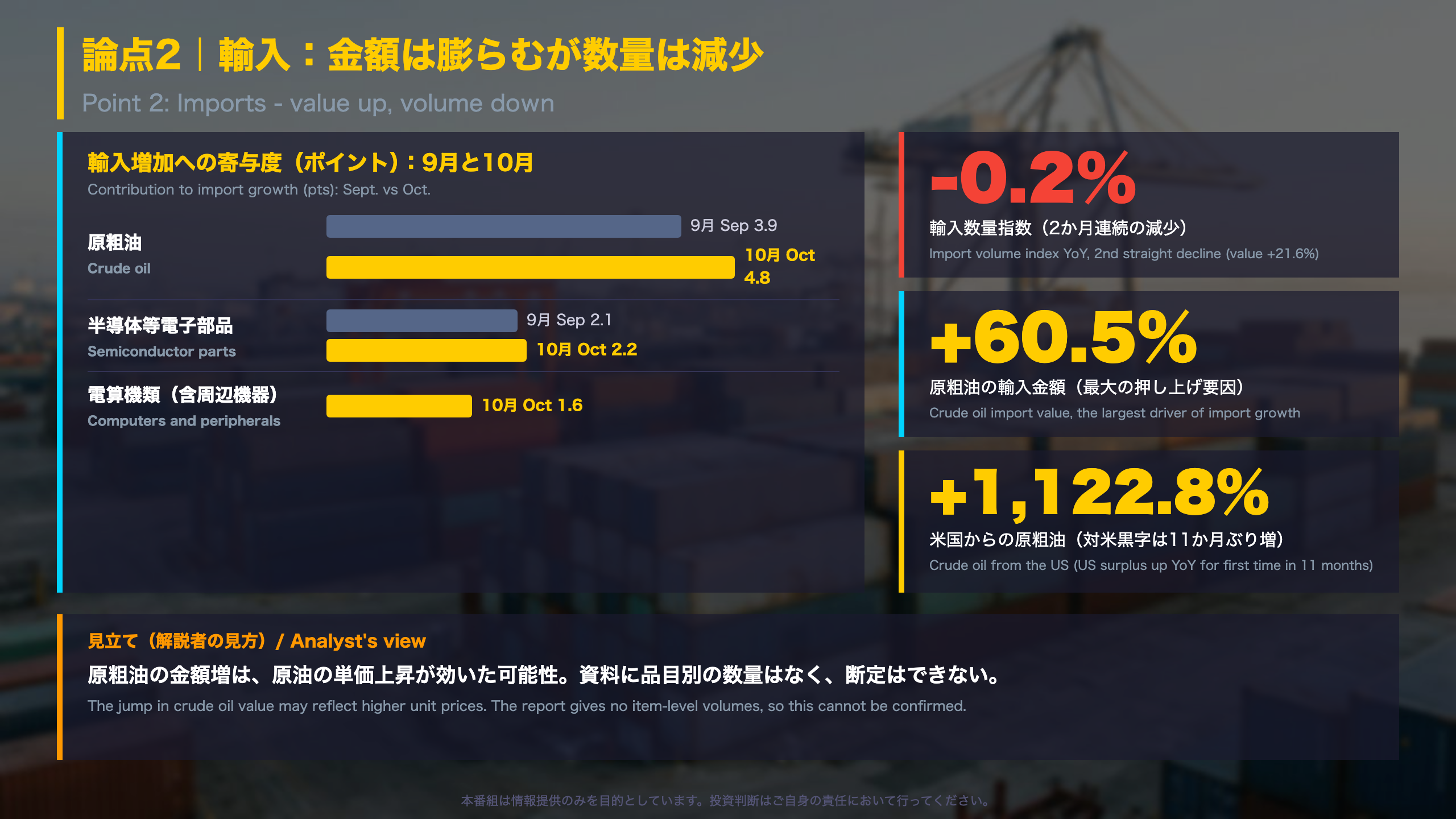
Imports rose 21.6% in value for a ninth straight month, but the volume index fell 0.2%, the second consecutive decline. Value outpacing volume is typically consistent with higher unit prices and/or currency effects. The yen was 5.6% weaker YoY, which alone seems too small to explain the gap, so price effects, such as higher crude prices, may have played a role. The MOF release does not break out item-level prices or volumes, so this remains an inference.
Top contributors
- Crude oil: +60.5% (4.8 points; 3.9 in September).
- Semiconductor parts: +60.0% (2.2 points).
- Computers and peripherals: +52.7% (1.6 points).
The US bilateral picture
Crude imports from the US rose 1,122.8% YoY (15.6 points), versus +819.7% in September (31.4 points), while aircraft imports fell 86.7%. Total US imports grew 19.7%, down from +44.8% in September. Exports to the US rose 23.9%, so Japan’s surplus with the US was 690.5 billion yen, up 34.1% from a year earlier and the first increase in eleven months.
Other bilateral balances
Japan ran a 905.3 billion yen deficit with China (67th straight month), a 113.6 billion yen deficit with the EU, and a 188.3 billion yen surplus with Asia as a whole.
Context for global readers
Japan imports nearly all of its crude oil, so the energy bill is a major driver of the monthly balance. The US Census Bureau’s goods balance is a useful comparison, but Japan’s data are customs-based and published sooner. We do not provide a market forecast.
質疑で深める|赤字は問題か、輸出の強さは続くか / Q&A: Reading the Deficit
Follow-up: How to Read the Deficit
A deficit is not the same as weak exports
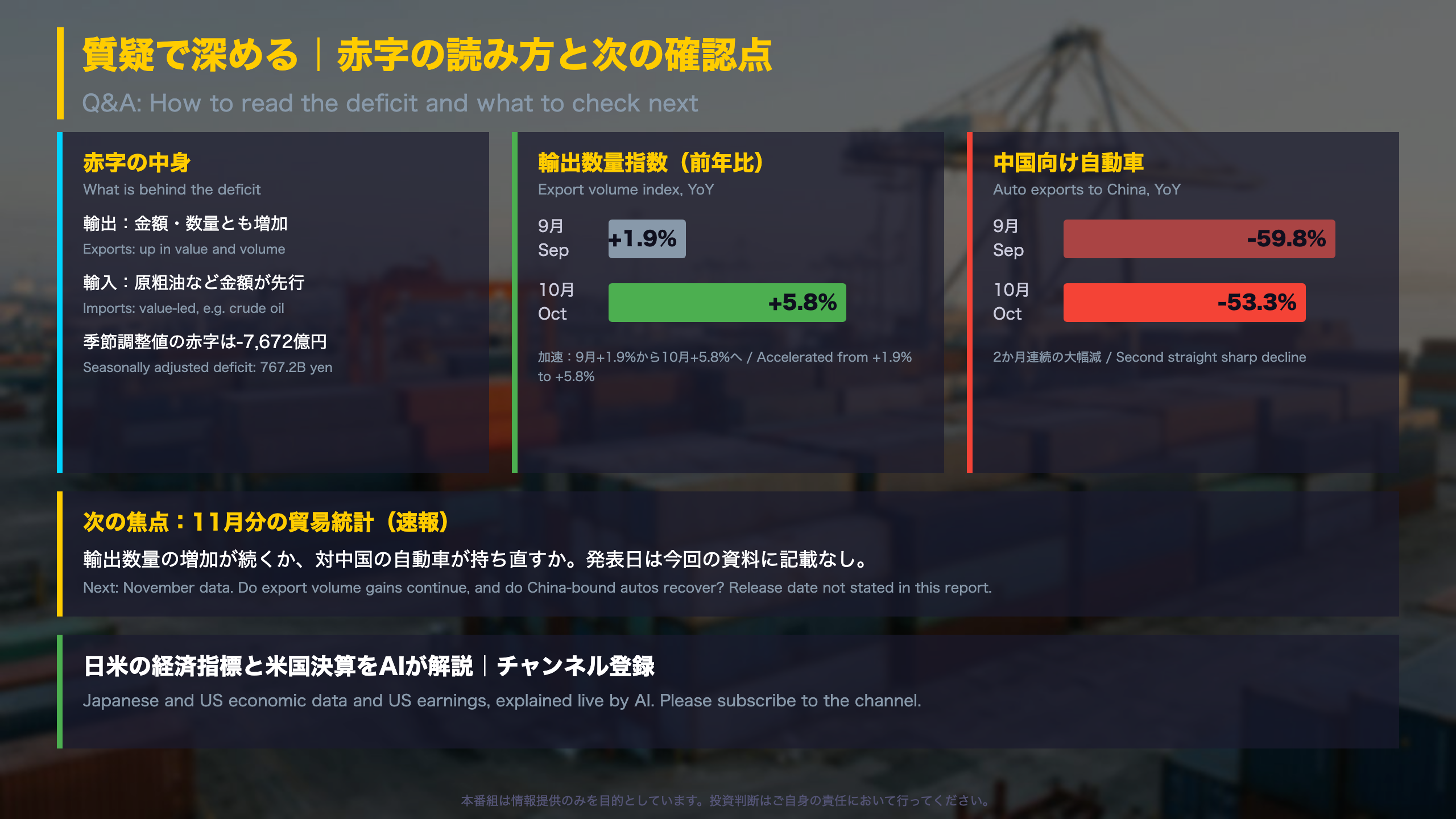
The trade balance is exports minus imports. In October, exports grew 20.5% but imports grew slightly faster (21.6%), leaving a 476.5 billion yen deficit. On a seasonally adjusted month-on-month basis, exports rose 3.3% and imports 3.5%, giving a deficit of 767.2 billion yen. The September deficit was revised to about 556.5 billion yen from 536.5 billion yen.
Volume trend
| September | October | |
|---|---|---|
| Export volume (YoY) | +1.9% | +5.8% |
| Import volume (YoY) | -1.6% | -0.2% |
Export volume accelerated, while imports continue to show value growth outpacing volume. For comparison, the US trade balance is also affected by energy prices, but Japan’s structural reliance on imported fuel makes its balance more sensitive to oil prices and the yen.
The China piece
Exports to China rose 13.3%, but autos fell 53.3% (2.7 points of drag), after -59.8% in September. Chipmaking equipment (+42.6%, 3.7 points) offset much of it. The regional picture is therefore uneven even though the headline is strong.
What to watch next
The November release will show (1) whether export volume keeps rising year on year, (2) whether import volume stabilizes, and (3) whether China-bound auto shipments recover. The release date is not stated in this report. This is not a market forecast; it is a checklist drawn from the data.
Disclaimer: This article is for informational purposes only. All investment decisions are made solely at your own risk.