This article was automatically generated by the NFC Market Live AI analysis system. (Updated: 2026-11-10 09:07 JST)
📄 Primary Source
財務省
https://www.mof.go.jp/policy/international_policy/reference/balance_of_payments/preliminary/pg202609.htm
📊 Japan’s Ministry of Finance released the preliminary September balance of payments on Nov 10.
The current account surplus came in at ¥2.37 trillion — about ¥2 trillion smaller than a year earlier.
📉 The trade balance swung to a ¥187.5bn deficit as imports (+17.8% YoY) outpaced exports, driven by oil prices up 46.6% in yen terms and a weaker yen at 156.41/USD.
📈 Exports still rose for a 13th straight month, led by semiconductors (+49.4%) and chip equipment (+43.9%).
💡 Primary income, Japan’s biggest earner, narrowed to ¥3.55 trillion on weaker direct investment income.
⚠️ Foreign investors sold Japanese equities but bought ¥5.63 trillion of medium/long-term bonds — a striking rotation.
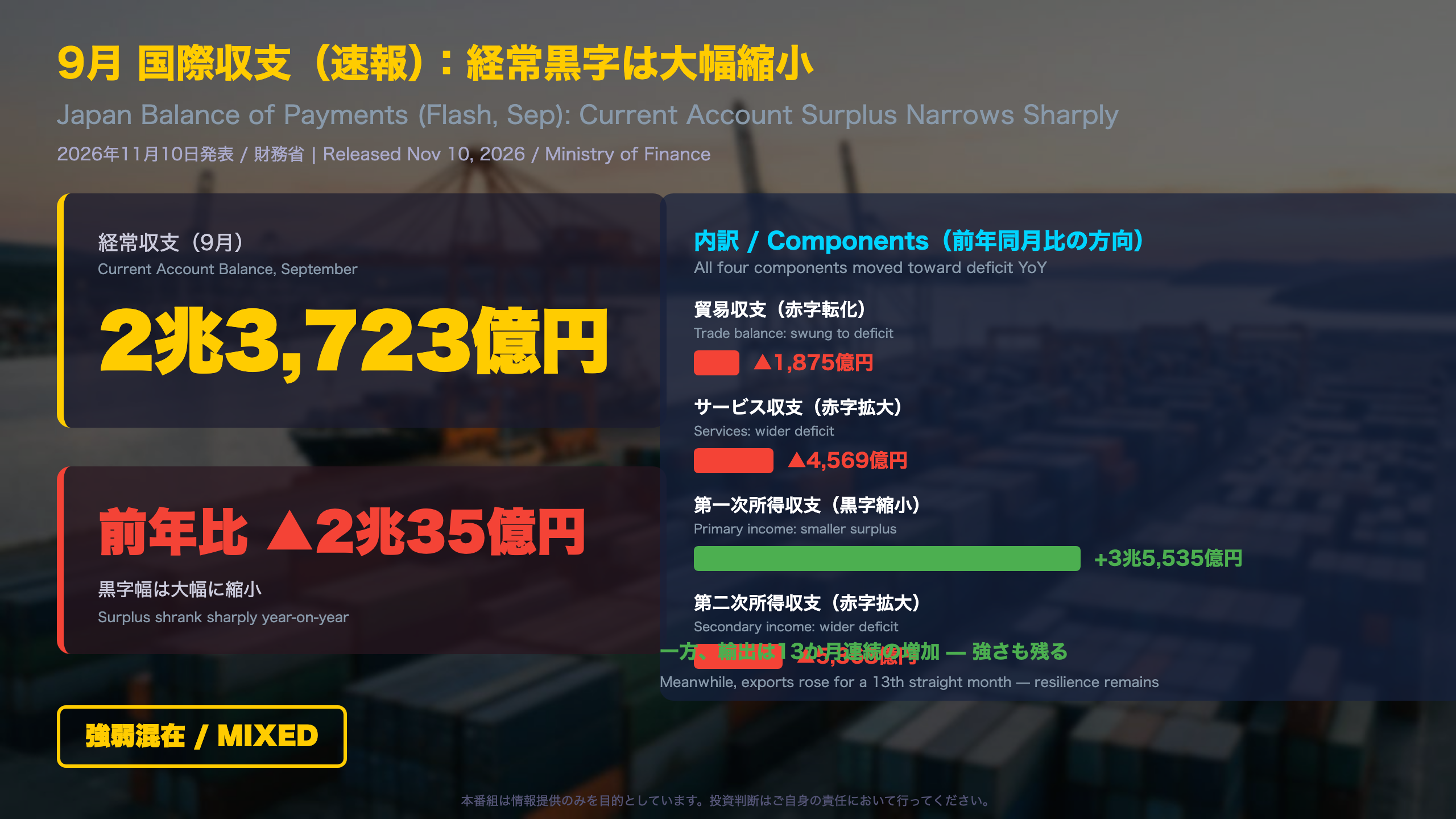
9月の経常収支サマリー:黒字2兆3,723億円、前年から2兆円縮小
Japan’s Current Account: Surplus Halves From the Prior Month
Japan’s Ministry of Finance (MOF) publishes the balance of payments monthly, and the preliminary September reading landed on November 10. For context, Japan is structurally a current-account-surplus country — unlike the United States, which runs persistent deficits — and the composition of that surplus has shifted over the past decade from trade in goods toward primary income: interest and dividends earned on Japan’s massive stock of overseas investments.
September’s surplus came in at ¥2.37 trillion, down ¥2.0 trillion from a year earlier and roughly half of August’s ¥4.06 trillion. All four components moved in the deficit direction year-on-year:
- Trade balance: −¥187.5bn, swinging into deficit
- Services balance: −¥456.9bn, a wider deficit
- Primary income: +¥3.55tn, a surplus ¥1.32tn smaller YoY
- Secondary income: −¥536.8bn
Why it matters for markets
The current account is a key structural input into yen valuation debates. A persistently large surplus — especially income-driven — has historically been cited as a floor under the yen. A month in which the income surplus shrinks sharply while trade swings to deficit raises questions about that cushion, though one month does not make a trend: August’s income surplus actually expanded ¥910.5bn YoY. The October flash, due in early December, will show whether September was noise or the start of a softer run.
深掘り①:貿易収支の赤字転化 — 価格要因が主導、輸出の中身は強い
Trade Deficit Returns — But Volumes Tell a Different Story
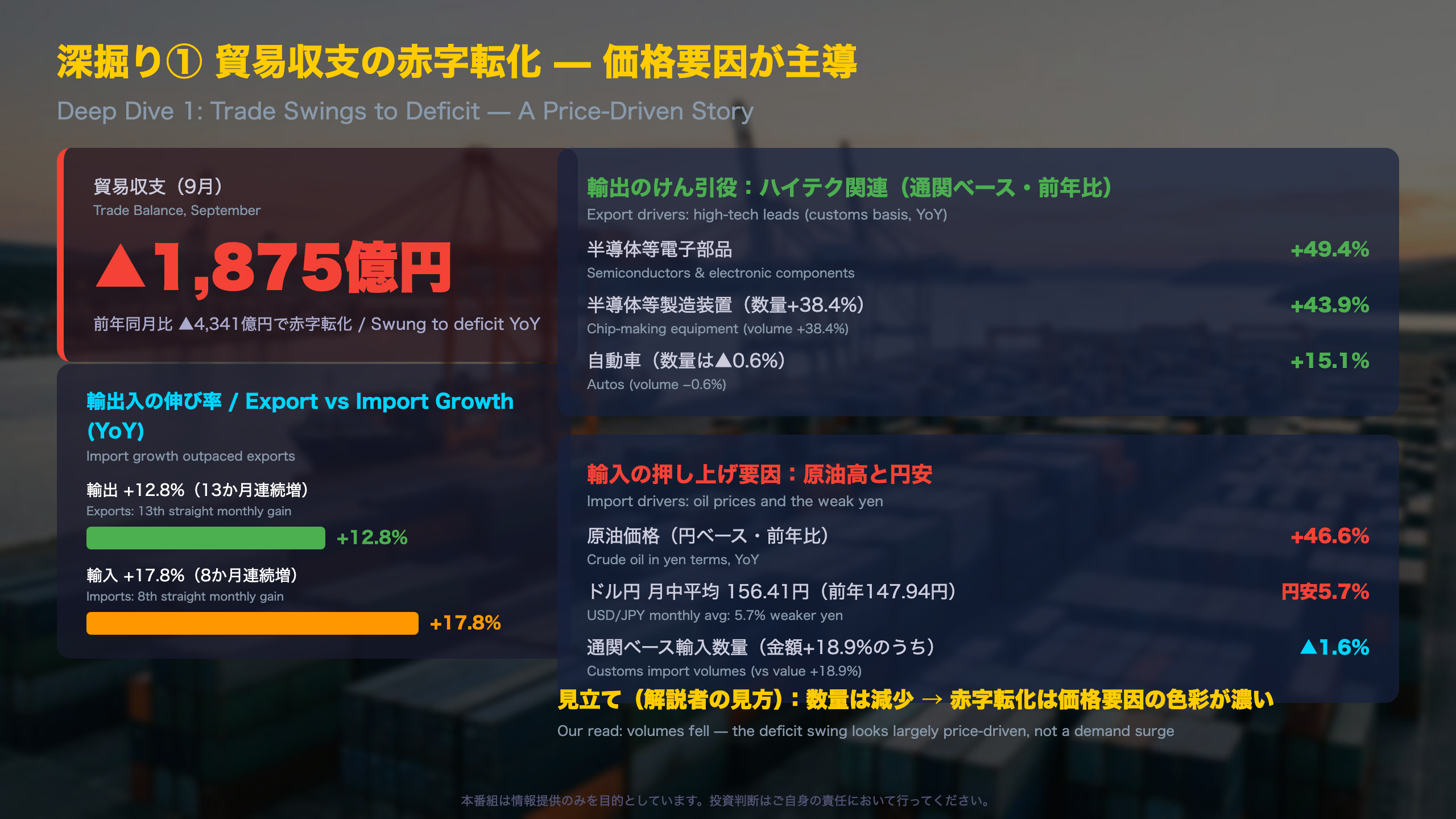
Japan’s trade balance (balance-of-payments basis) swung to a ¥187.5bn deficit in September, a ¥434.1bn deterioration from a year earlier. Exports reached ¥10.73tn (+12.8% YoY, a 13th straight monthly gain) while imports hit ¥10.92tn (+17.8%, an 8th straight gain).
Price vs. volume decomposition
The companion customs-basis trade data reveals the key nuance: import values rose 18.9%, but import volumes fell 1.6% — the entire increase came from prices (+20.8%). Two forces drove this:
- Oil: Crude averaged $100.37/barrel, up 37.4% YoY in dollar terms and +46.6% in yen terms
- Currency: The yen averaged 156.41/USD, 5.7% weaker than a year earlier
For readers used to U.S. trade data, this is the equivalent of a terms-of-trade shock, not a demand surge. Japan imports nearly all of its energy, so dollar oil prices and the yen exchange rate mechanically dominate the monthly trade line.
The export bright spot
Semiconductor and electronic components exports surged +49.4% YoY, and chip-making equipment rose +43.9% with volumes up 38.4% — real, not just price-driven, growth tied to the global AI capex cycle. Shipments to Asia (+17.3%) and North America (+23.8%) both expanded.
Market take
A price-driven trade deficit is less alarming than a volume-driven one, but it still removes a source of yen demand at the margin. Watch oil prices and the yen average rate in the October report as the swing factors.
深掘り②:稼ぎ頭・第一次所得収支の縮小と、対内マネーの対照的な動き
Primary Income: The Engine Sputters — Or Does It?
Primary income is the cornerstone of modern Japan’s external surplus: the dividends and interest flowing back from decades of accumulated overseas direct and portfolio investment. Think of Japan as a giant global asset manager — its trade account may swing, but income from foreign holdings has reliably delivered ¥3–5 trillion a month.
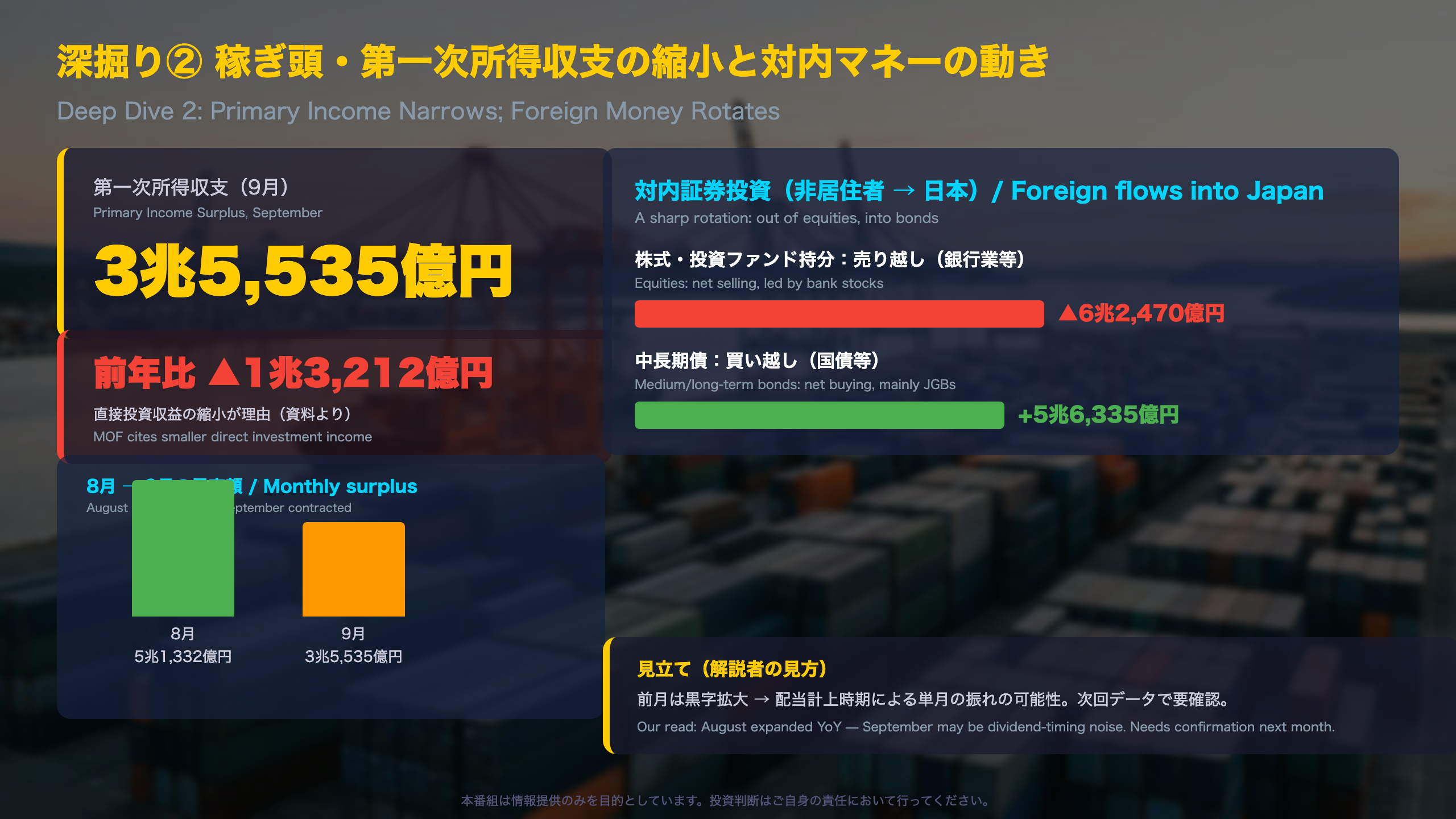
In September that engine produced a ¥3.55 trillion surplus, down ¥1.32 trillion YoY, with the MOF citing smaller direct investment income — i.e., reduced profits from overseas subsidiaries. Context matters, though: in August the income surplus expanded ¥910bn YoY to ¥5.13tn. Dividend remittance timing routinely injects month-to-month noise, so one soft month is not yet a trend. Notably, the decline came despite a 5.7% weaker yen, which normally inflates the yen value of foreign earnings — implying the underlying drop in income was larger than the headline suggests.
The financial account: a striking rotation
The more market-relevant story may be in cross-border flows. Foreign investors:
- Sold ¥6.25 trillion of Japanese equities net (led by selling in bank stocks)
- Bought ¥5.63 trillion of medium/long-term bonds net (mainly JGBs)
That is a near one-for-one rotation from Japanese stocks into Japanese government debt in a single month. Meanwhile, Japanese firms executed ¥2.15tn of net outward FDI — capital that, over time, feeds future primary income. For global investors, the October report (due early December) will show whether both the income dip and the equity selling extended into the new quarter.
質疑で深める:日本の「稼ぐ力」は落ちたのか

The Verdict: Not a Decline in Earning Power — Yet
Putting the ¥2 trillion contraction in perspective
The YoY deterioration decomposes as: primary income −¥1.32tn, trade −¥434bn, services −¥203bn, secondary income −¥45bn. Two mitigating facts argue against reading this as structural decay: import volumes actually fell 1.6% (making the trade swing a price shock), and the income surplus had expanded YoY just one month earlier.
The services account: Japan’s quiet structural story
The services deficit widened to ¥456.9bn, driven by the \”other services\” category — where Japan’s payments for cloud computing, software licenses, and digital advertising to overseas platforms reside (often dubbed Japan’s \”digital deficit\”). Meanwhile the tourism tailwind paused: inbound visitors fell 5.0% YoY to 3.10 million in September, the second straight YoY decline, even as outbound Japanese travelers rose 6.3%. Japan earns on travel and pays on digital services — both sides of that ledger deserve attention.
Checklist for the October report (due early December)
- Primary income: a second straight contraction would elevate concern
- Inbound visitors: a third consecutive YoY decline would signal a real inflection
- Oil & yen: the two mechanical swing factors for the trade line
- Foreign flows: whether the equity-selling / JGB-buying rotation persists
For global macro watchers, Japan’s current account remains a surplus story — but September showed how quickly the mix can shift when energy, currency, and dividend timing all move at once.
Disclaimer: This article is for informational purposes only. All investment decisions are made solely at your own risk.