This article was automatically generated by the NFC Market Live AI analysis system. (Updated: 2026-11-10 09:01 JST)
📄 Primary Source
日本銀行
https://www.boj.or.jp/mopo/mpmsche_minu/opinion_2026/opi261030.pdf
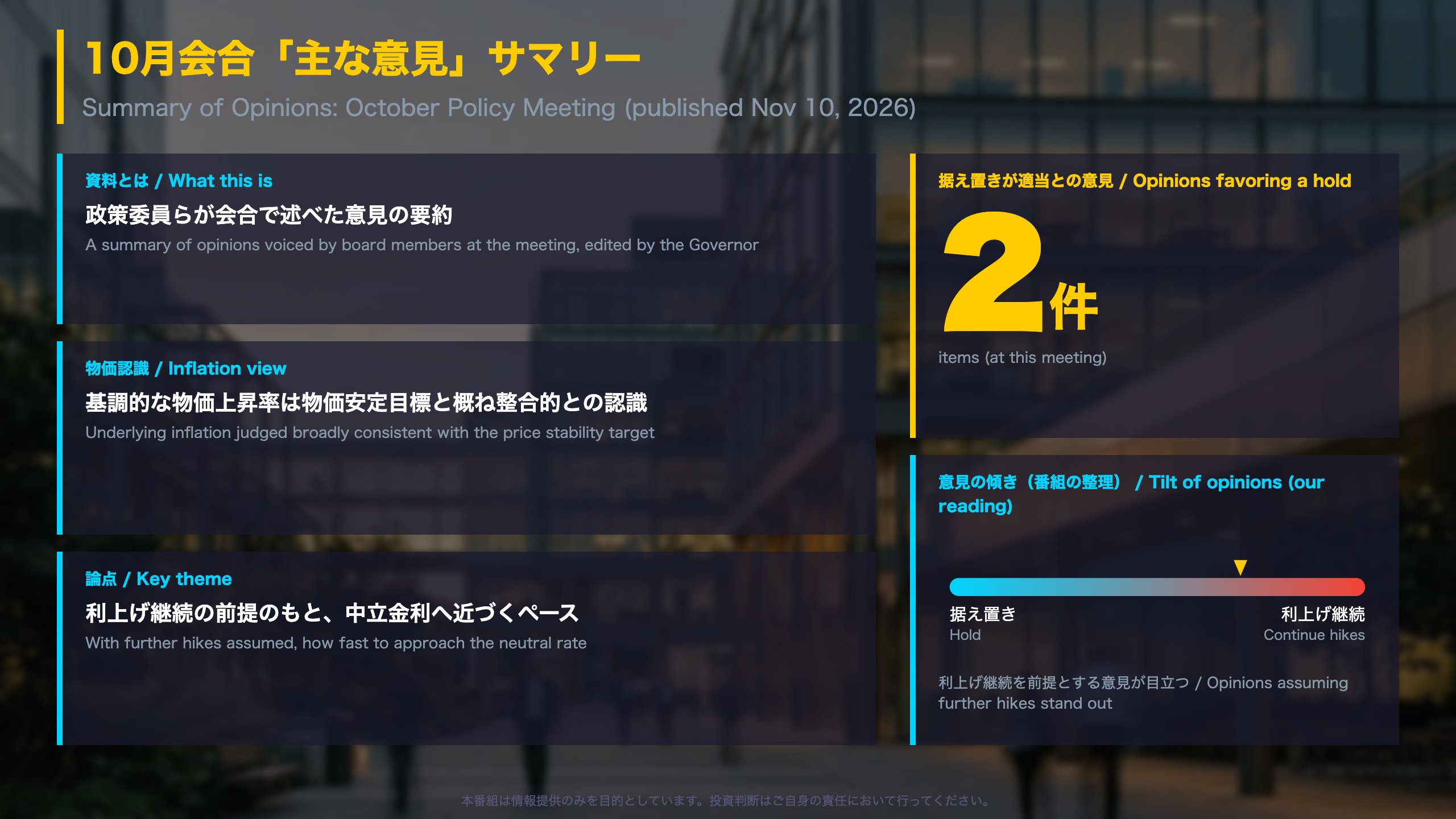
📊 The BOJ released its Summary of Opinions from the Oct 29-30 policy meeting.
Underlying inflation was judged broadly consistent with the price stability target, while two opinions favored holding rates at this meeting.
💡 Opinions assuming further hikes stood out, but views on how fast to approach the neutral rate differ: three favored moving sooner, others saw no need to rush or warned of lagged effects.
⚠️ Next focal point cited: next spring’s wage negotiations.
サマリー:10月会合「主な意見」
What this document is
The BOJ’s ‘Summary of Opinions’ compiles views that each Policy Board member and government representative expressed at a Monetary Policy Meeting. Each speaker condenses their own remarks, and the Governor, as chair, edits them by topic. Because the views are anonymous, the document is best read for how widely a view is shared, not who said it. It differs from the fuller minutes, which are released later.
Why it matters
The BOJ is the central bank of the world’s fourth-largest economy and has been normalizing policy after years of ultra-low rates. This document is one of the few windows into how board members weigh inflation, wages and the pace of tightening, in the same spirit as the minutes the US Federal Reserve publishes after FOMC meetings.
Key points from the October 29-30 meeting
- Underlying inflation was described as ‘broadly consistent’ with the 2% price stability target.
- Two opinions said holding rates was appropriate at this meeting.
- Several opinions assumed that rate hikes would continue, with the main debate on how fast to approach the neutral rate, the level that neither stimulates nor restrains the economy.
- Government representatives (Ministry of Finance and Cabinet Office) asked the Bank to judge its ETF disposal guideline appropriately and expressed expectations for policy aimed at the 2% target.
Context against the US
The Fed frames its debate around a neutral rate and a dual mandate. In Japan, the discussion centers on whether underlying inflation can be anchored near 2%, because members noted that the anchoring is weaker than in the US and Europe after a long period of near-zero inflation.
What to watch
Several opinions point to next spring’s wage negotiations as the near-term test of whether inflation settles near the target. The document gives no date for the next meeting, and this summary does not forecast market moves.
深掘り1:物価と賃金の見方
How the judgment shifted since September
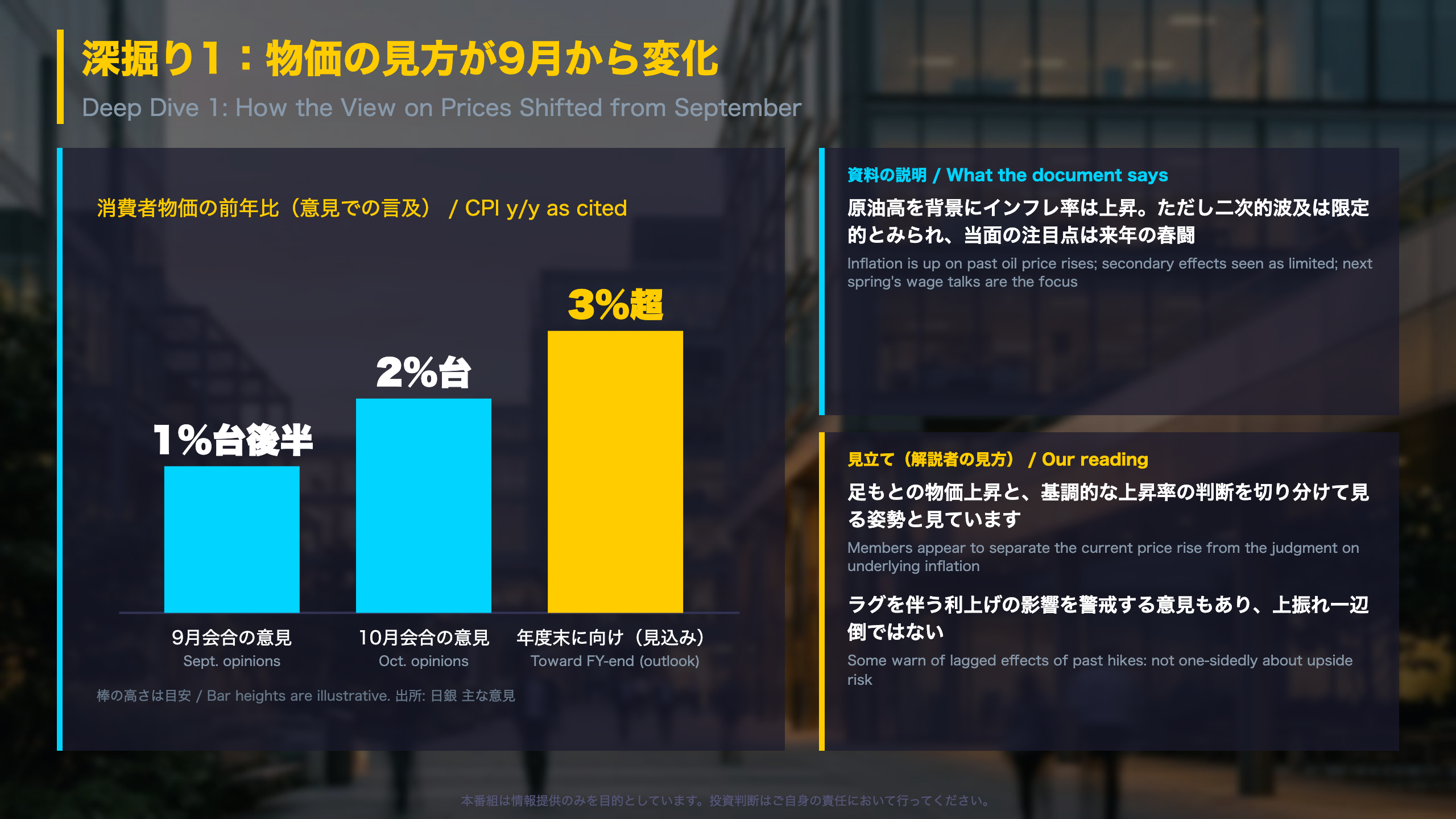
In the September opinions, members described underlying inflation in varied terms: ‘quite close to 2%’, ‘broadly at 2%’, and ‘will soon reach 2%’. This time, the document states that underlying inflation can be judged ‘broadly consistent’ with the price stability target. Multiple opinions pointing the same way suggest the assessment has become more aligned.
Wages and corporate voices
- Some firms said they plan wage increases next year similar to this year’s. One opinion concluded that wage growth consistent with the 2% target is ‘quite likely’ to continue.
- Another opinion said next year’s wage increase is unlikely to rise much above this year’s, so the risk of second-round effects from current price rises is ‘not high’.
- One opinion noted that consumer prices, held down by government measures, need to be watched for their effect on wage talks.
Context for English-speaking readers
Japan’s CPI has been affected by government measures such as energy subsidies, so the BOJ pays close attention to ‘underlying’ inflation, a concept built from a range of indicators rather than one headline figure. Unlike the US, where the Fed tracks core PCE and the CPI, the BOJ does not publish a single target series for this concept. Members also noted that inflation expectations in Japan are anchored less firmly than in the US and Europe, because inflation was near zero for so long.
Two ways to read it
- Upside-risk view: Inflation has entered the 2% range, with an opinion expecting more than 3% toward fiscal year-end.
- Caution view: Lagged effects of past hikes could pull the economy and prices down, and wage dynamics are still to be confirmed.
What to watch
Next spring’s wage negotiations (Shunto) are the focal point. They help show whether the wage-price loop keeps running at a pace consistent with the target. This is a description of the document, not a market forecast.
深掘り2:中立金利へ近づくペース
Background: what is the neutral rate?
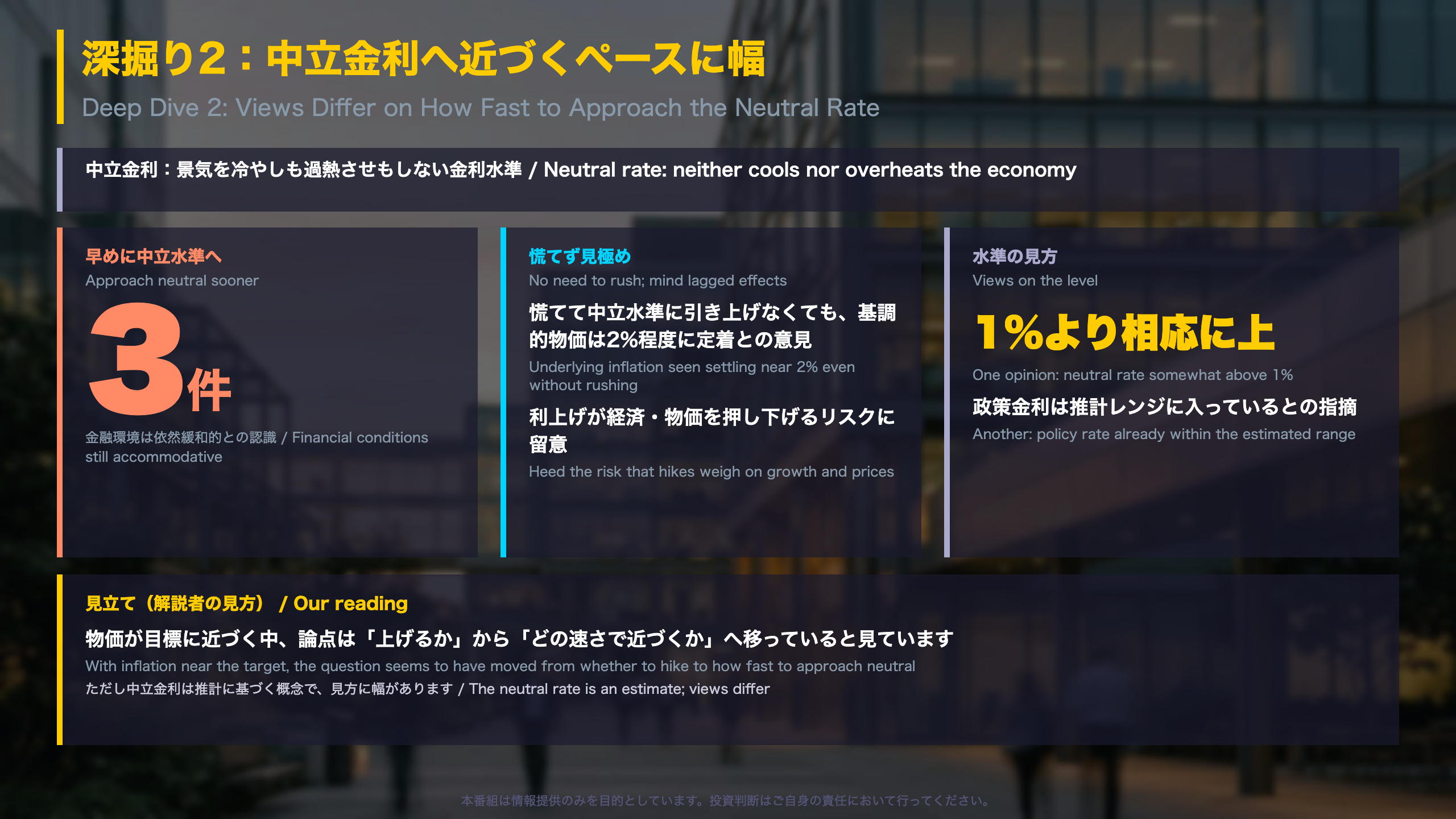
The neutral rate is the policy rate at which monetary policy neither stimulates nor restrains the economy, much like r-star in the Fed’s framework. It cannot be observed directly, so the BOJ publishes an estimated range. The October document shows members disagreeing less about the direction of policy than about how quickly to approach that estimate.
The ‘sooner’ camp
- Three opinions argued for reaching neutral earlier. One said the effects of past hikes ‘have not materialized’ because firms are more resilient to higher rates and financial conditions remain accommodative.
- One member advocated hurrying ‘leisurely’, a phrase meaning moving steadily but not abruptly, with a check on financial conditions after each hike.
- Another opinion called for a regime shift to a level that allows flexible moves in both directions.
The ‘no need to rush’ camp
- One opinion said that even without rushing to neutral, underlying inflation would settle near 2%.
- Another noted the policy rate is already within the estimated neutral range and cautioned that further hikes could push down growth and inflation.
- One opinion put the neutral rate ‘somewhat above 1%’.
Framework for financial conditions
A member proposed assessing conditions along three axes: the real interest rate gap, corporate finance and bank lending, and asset prices. The member added that rising equity prices owe mostly to global AI demand rather than monetary policy.
Other item: ETF holdings
Two opinions suggested reviewing the pace of ETF sales, begun in January, saying they had proceeded smoothly. For readers unfamiliar with it, the BOJ accumulated large ETF holdings under past easing and began disposing of them this year.
What to watch
For markets and rate observers, the data points to watch include how corporate conditions and lending respond to hikes. This note does not forecast outcomes.
質疑で深める:ペース差の背景と政府の姿勢
Government representatives: how the focus shifted
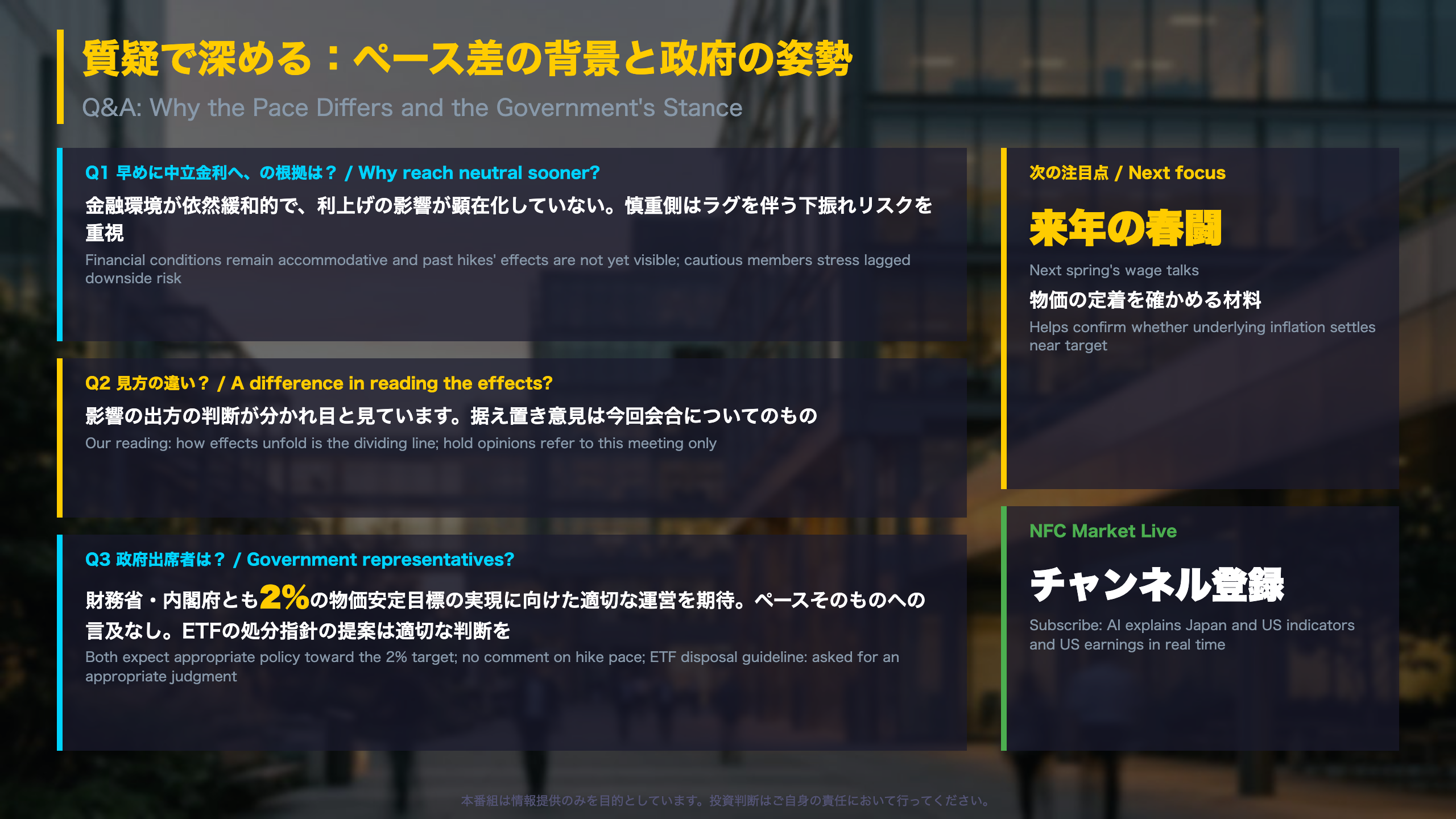
Two government representatives attend BOJ meetings: one from the Ministry of Finance (MOF) and one from the Cabinet Office. They can state views and submit motions, but only the nine Policy Board members vote. The government’s line is that the BOJ should pursue the 2% target in close coordination with the government.
| September opinions | October opinions | |
|---|---|---|
| MOF | Asked the Bank to judge a proposed policy rate change appropriately and to explain it carefully to markets | Asked the Bank to judge the proposed ETF disposal guideline appropriately |
| Cabinet Office | Called for accountability, a check on cumulative effects of past hikes, and use of the BOJ’s neutral rate estimate | Said the economy is at a fork toward a virtuous growth cycle and stressed settling inflation at the target level |
Why the ETF item matters
The BOJ bought ETFs for years as part of its easing and began disposing of them in January this year. Two board opinions in October said the sales have gone smoothly and suggested revisiting the annual pace, while noting governance effects of central bank equity holdings. The government side said the proposal was based on past disposal results and asked for an appropriate decision.
Why the pace debate matters
Board members who favor reaching the neutral rate sooner point to accommodative financial conditions and firms’ resilience. More cautious members stress lagged effects of past hikes. Both camps appear to support further hikes in principle; the two hold opinions refer to this meeting specifically.
Compared with the Fed
The Fed explicitly publishes a policy-rate path (the dot plot). The BOJ does not, so documents like this one are among the few ways to gauge how wide the range of views is.
What to watch
Spring wage negotiations are cited as the near-term check on whether wages and prices keep rising together. The document does not state the next meeting date. This note is descriptive and does not forecast market moves.
Disclaimer: This article is for informational purposes only. All investment decisions are made solely at your own risk.