📺 Watch the Full Video Analysis
This article was automatically generated by the NFC Market Live AI analysis system. (Updated: 2026-11-07 00:15 JST)
📄 Primary Source
University of Michigan
http://www.sca.isr.umich.edu/
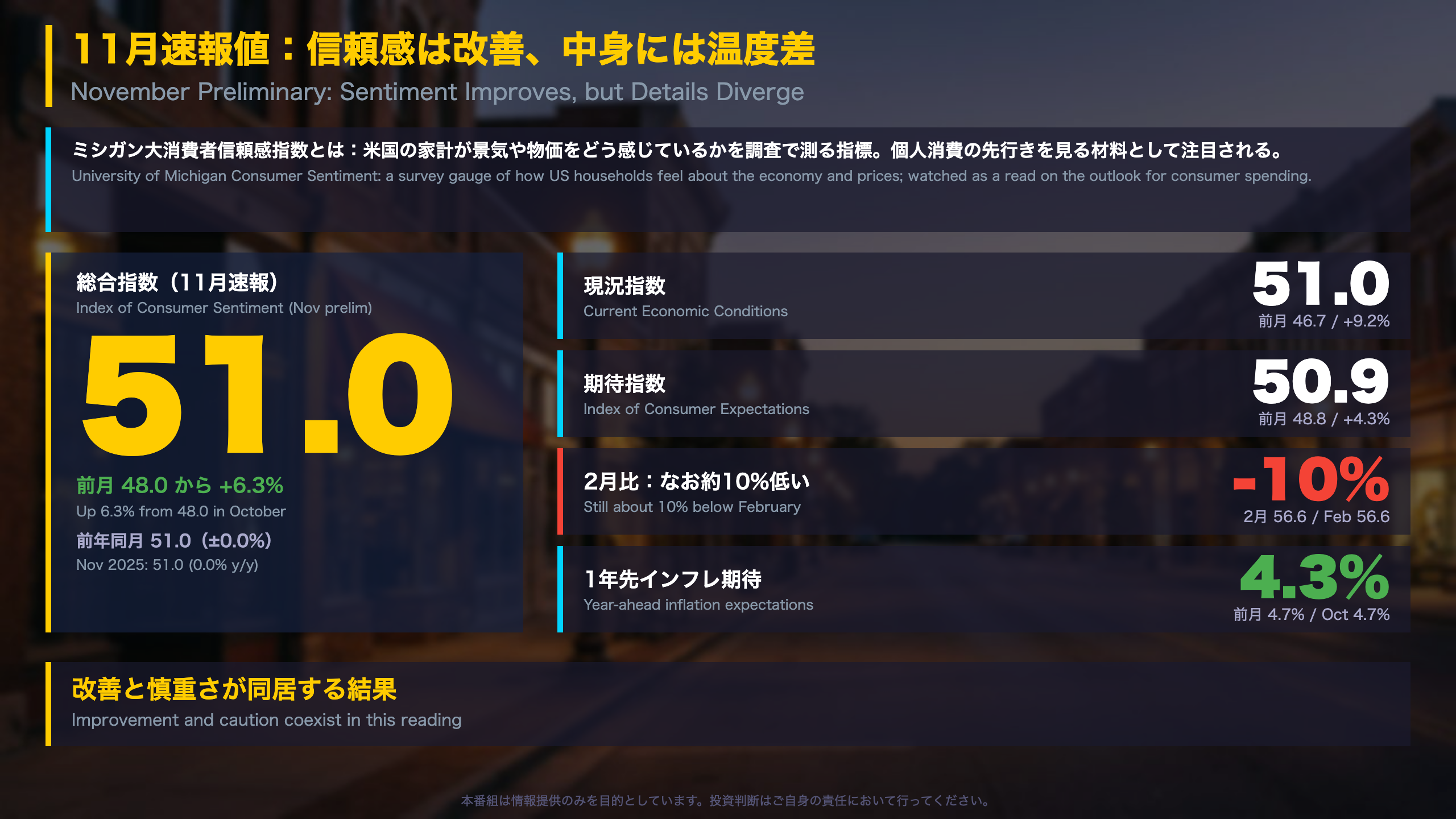
📊 University of Michigan’s preliminary November survey: consumer sentiment rose to 51.0 from 48.0 in October.
📈 Current conditions rose to 51.0 and expectations to 50.9, so all three indexes improved month over month.
⚠️ Sentiment is still about 10% below February, fell 5% among consumers with the largest stock portfolios, and about 57% spontaneously said high prices have eroded their living standards, the most since May.
💡 Year-ahead inflation expectations eased to 4.3% from 4.7%, and long-run expectations to 3.4%, but both remain above 2024 levels.
Next up: the final November reading on Friday, Nov 20, at 10am ET.
11月速報値:信頼感は改善、中身には温度差
Michigan Sentiment, November Preliminary: Better Headline, Mixed Details
What the survey is
The University of Michigan’s Surveys of Consumers polls US households on their finances, business conditions and price expectations. It is released in two steps each month: a preliminary read around mid-month and a final read about two weeks later. The Conference Board publishes a rival confidence gauge, but it uses a different questionnaire and methodology, so the two should not be compared level for level.
The numbers
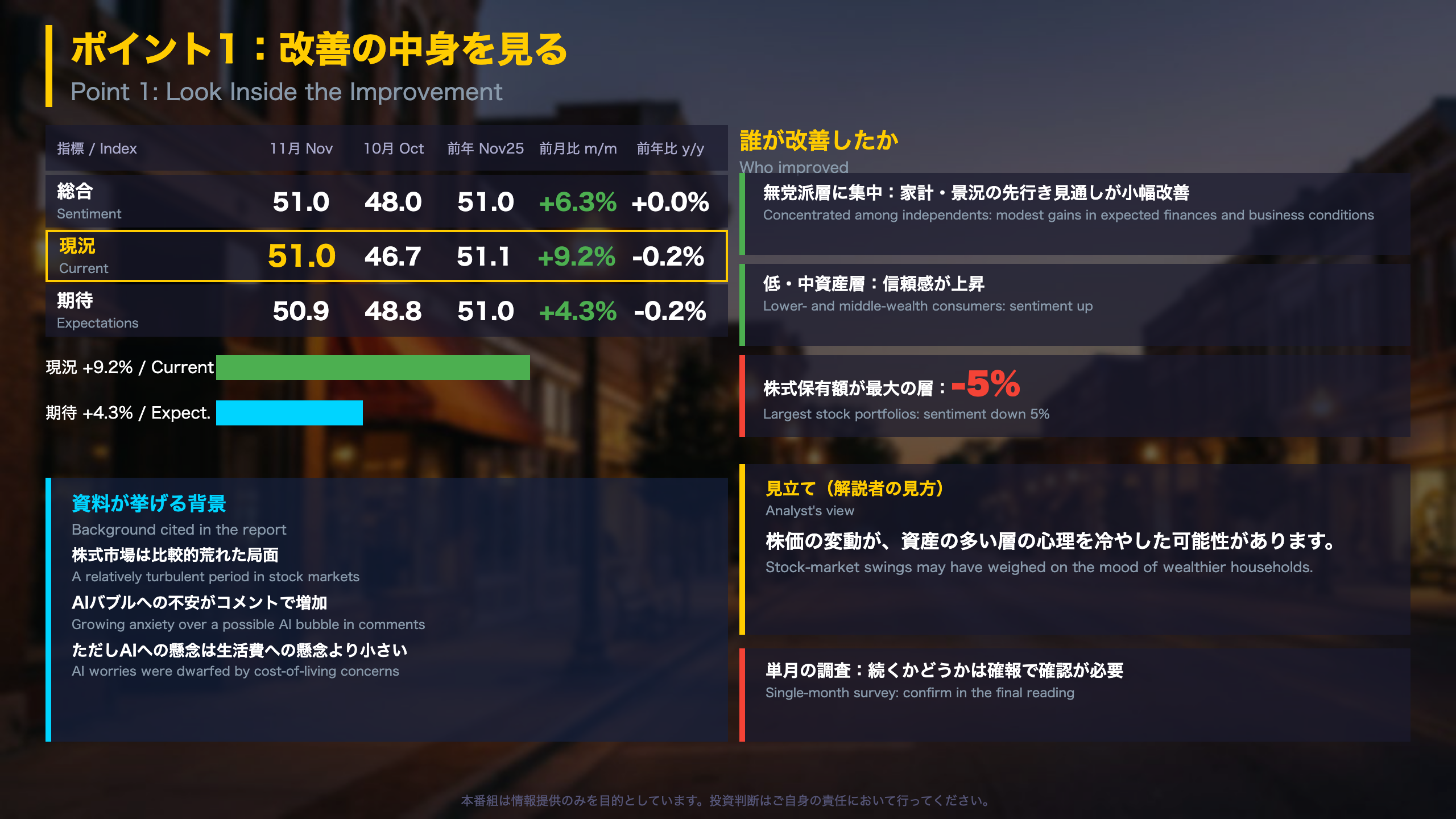
- Overall sentiment: 51.0 (October 48.0, +6.3% m/m, unchanged y/y)
- Current conditions: 51.0 (46.7 in October, +9.2%)
- Expectations: 50.9 (48.8 in October, +4.3%)
Context
The 2026 path has been volatile: a trough of 44.8 in May, a rebound to 55.2 in July, then three straight lower readings through October. November’s 51.0 follows that decline but stays about 10% below February, and far below the 71.8 recorded in November 2024.
Two readings
Constructive: every index rose, and year-ahead inflation expectations eased to 4.3%.
Cautious: the level equals a year ago, and director Joanne Hsu notes that cost-of-living worries remain at the forefront across the population.
What to watch
The final November reading is due Friday, November 20, at 10am ET. Investors and policymakers track both the sentiment level and the inflation-expectations components of this survey as inputs on household behavior.
改善の中身:現況の戻りが大きく、資産層で明暗
Inside the Improvement: Current Conditions Rebound, Wealth Groups Diverge
Sub-index detail
The Michigan survey splits sentiment into a current-conditions index (how households rate their finances and buying conditions now) and an expectations index (their outlook for finances and the economy).
| Month | Current | Expectations |
|---|---|---|
| Aug 2026 | 51.9 | 51.5 |
| Sep | 50.9 | 46.3 |
| Oct | 46.7 | 48.8 |
| Nov (prelim) | 51.0 | 50.9 |
Current conditions fell in October and recovered in November, while expectations have now risen two months in a row from a September low of 46.3.
Who improved
According to director Joanne Hsu, modest gains in expected personal finances and business conditions were concentrated primarily among independents. Sentiment lifted for lower- and middle-wealth consumers but fell 5% for those with the largest stock portfolios, following a relatively turbulent period in stock markets.
Two readings
- Constructive: gains reached beyond one group, and both sub-indexes rose.
- Cautious: stock-heavy households moved lower, and comments show growing anxiety over a possible AI bubble. The report adds that AI worries were dwarfed by cost-of-living concerns.
Takeaway
A link between market volatility and wealthier households’ mood is plausible but not stated in the report. Because this is a single preliminary month, the November 20 final reading is the first check on whether the split persists.
物価への見方:インフレ期待は低下、生活費の重さは残る
Inflation Expectations: Lower, but Still Above Reference Points
Why this component matters
The Michigan survey asks households what inflation they expect over the next year and over the next five to ten years. Central bankers, including the Federal Reserve, watch these long-run readings for signs that price expectations are becoming entrenched. By contrast with Japan’s CPI or the Tankan survey, this is a household opinion measure, not a price statistic.
Year-ahead expectations (median)
| Period | Level |
|---|---|
| Nov 2025 | 4.5% |
| Feb 2026 | 3.4% |
| May | 4.8% |
| Aug | 4.0% |
| Sep | 4.6% |
| Oct | 4.7% |
| Nov (prelim) | 4.3% |
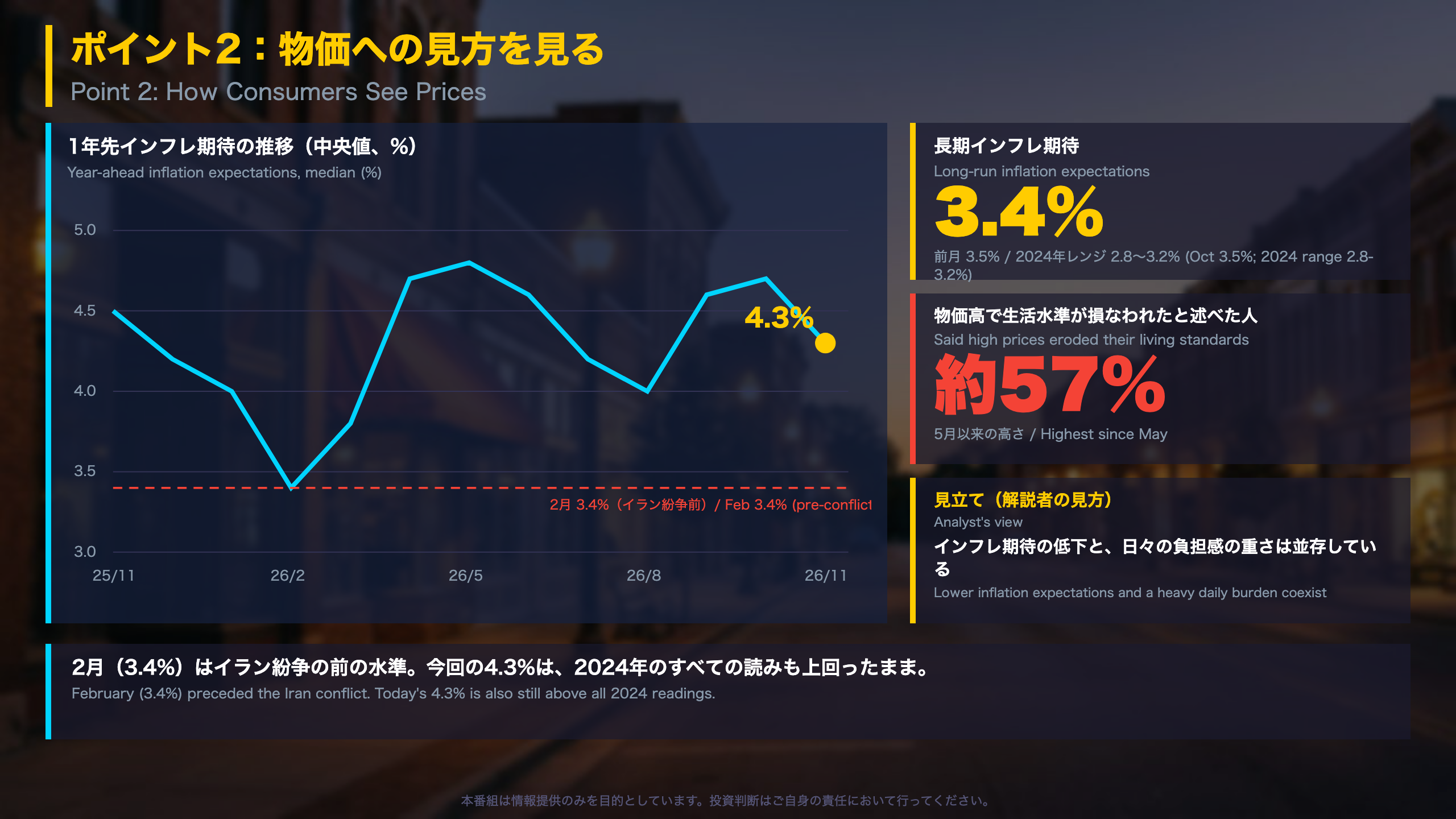
November’s 4.3% is the lowest since August but remains well above February’s 3.4%, which the report says preceded the Iran conflict, and above every 2024 reading.
Long-run expectations
They edged down to 3.4% from 3.5%, still above the 2024 range of 2.8% to 3.2%. Over the past year of data, the peak was 3.9% in May 2026.
Cost of living
About 57% spontaneously said high prices have eroded their living standards, the highest since May and up from 46% in February. The report says these concerns lead across the population.
Reading
Lower expectations and a heavy felt burden can coexist: the first is a forecast, the second is a lived experience. Michigan also published a special report on October 23 on the risk that long-run expectations become entrenched.
質疑:この改善は転換と言えるか
Q&A Follow-Up: What Would Confirm a Turn?
The 2026 path
| Month | Sentiment |
|---|---|
| Jan | 56.4 |
| Feb | 56.6 |
| Mar | 53.3 |
| Apr | 49.8 |
| May | 44.8 |
| Jun | 49.5 |
| Jul | 55.2 |
| Aug | 51.7 |
| Sep | 48.1 |
| Oct | 48.0 |
| Nov (prelim) | 51.0 |
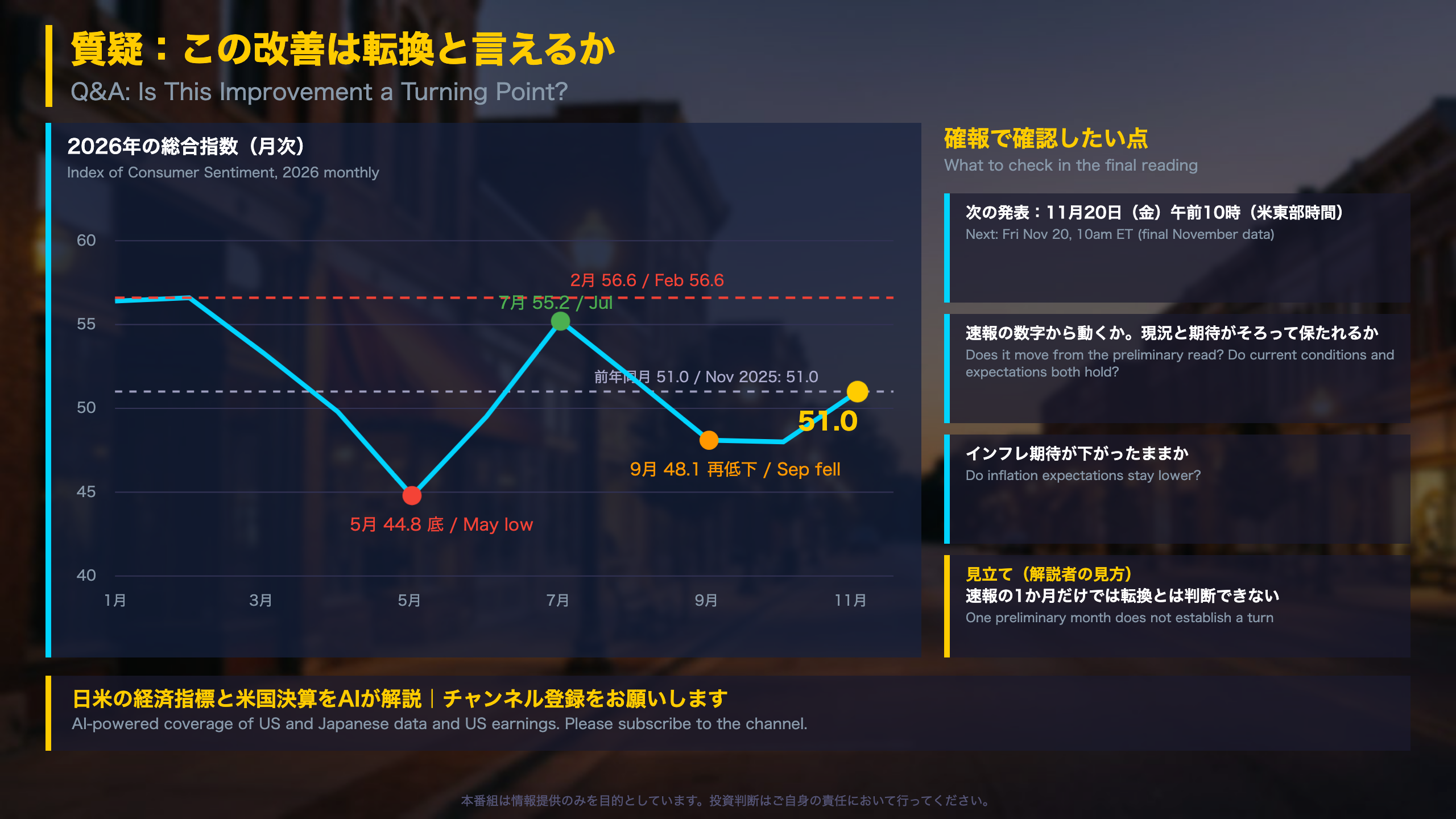
Sentiment bottomed at 44.8 in May, recovered through July, then fell for three straight months. November’s bounce follows that slide. The 51.0 reading matches November 2025 exactly.
Two interpretations
- Stronger: all three indexes rose and year-ahead inflation expectations eased.
- Weaker: the level is flat versus a year ago, remains about 10% below February, and the July rebound did not hold.
What to check in the final reading
- Whether the headline moves from the preliminary 51.0, since preliminary data can be revised.
- Whether current conditions (51.0) and expectations (50.9) both hold.
- Whether year-ahead (4.3%) and long-run (3.4%) inflation expectations stay lower.
Calendar
The final November figures are due Friday, November 20, at 10am ET. For a Japan-based comparison, think of this as a household-sentiment survey alongside the Cabinet Office’s consumer confidence index, though the methodologies differ. Michigan’s October 23 special report on the risk of entrenched long-run inflation expectations offers further background.
Disclaimer: This article is for informational purposes only. All investment decisions are made solely at your own risk.