📺 Watch the Full Video Analysis
This article was automatically generated by the NFC Market Live AI analysis system. (Updated: 2026-11-06 08:44 JST)
📄 Primary Source
厚生労働省
https://www.mhlw.go.jp/toukei/itiran/roudou/monthly/r08/2609p/dl/pdf2609p.pdf
📊 Japan’s Ministry of Health, Labour and Welfare released the September 2026 Monthly Labour Survey (preliminary) on November 6.
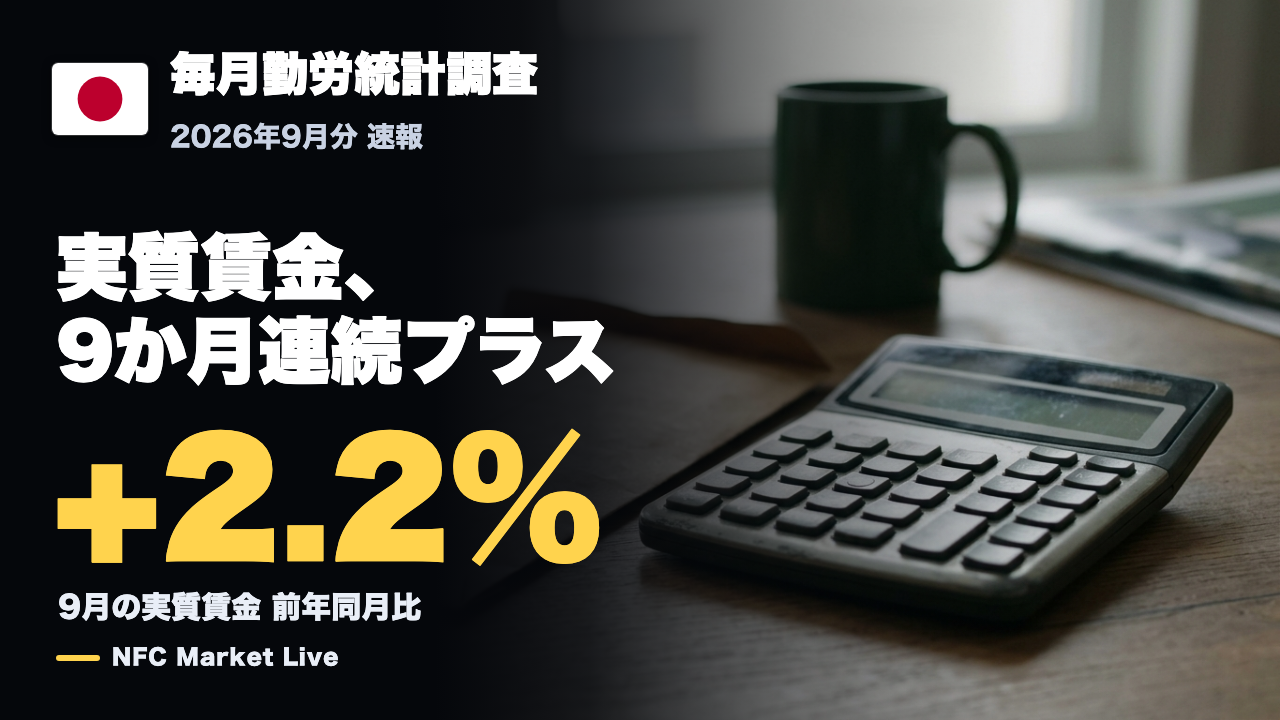
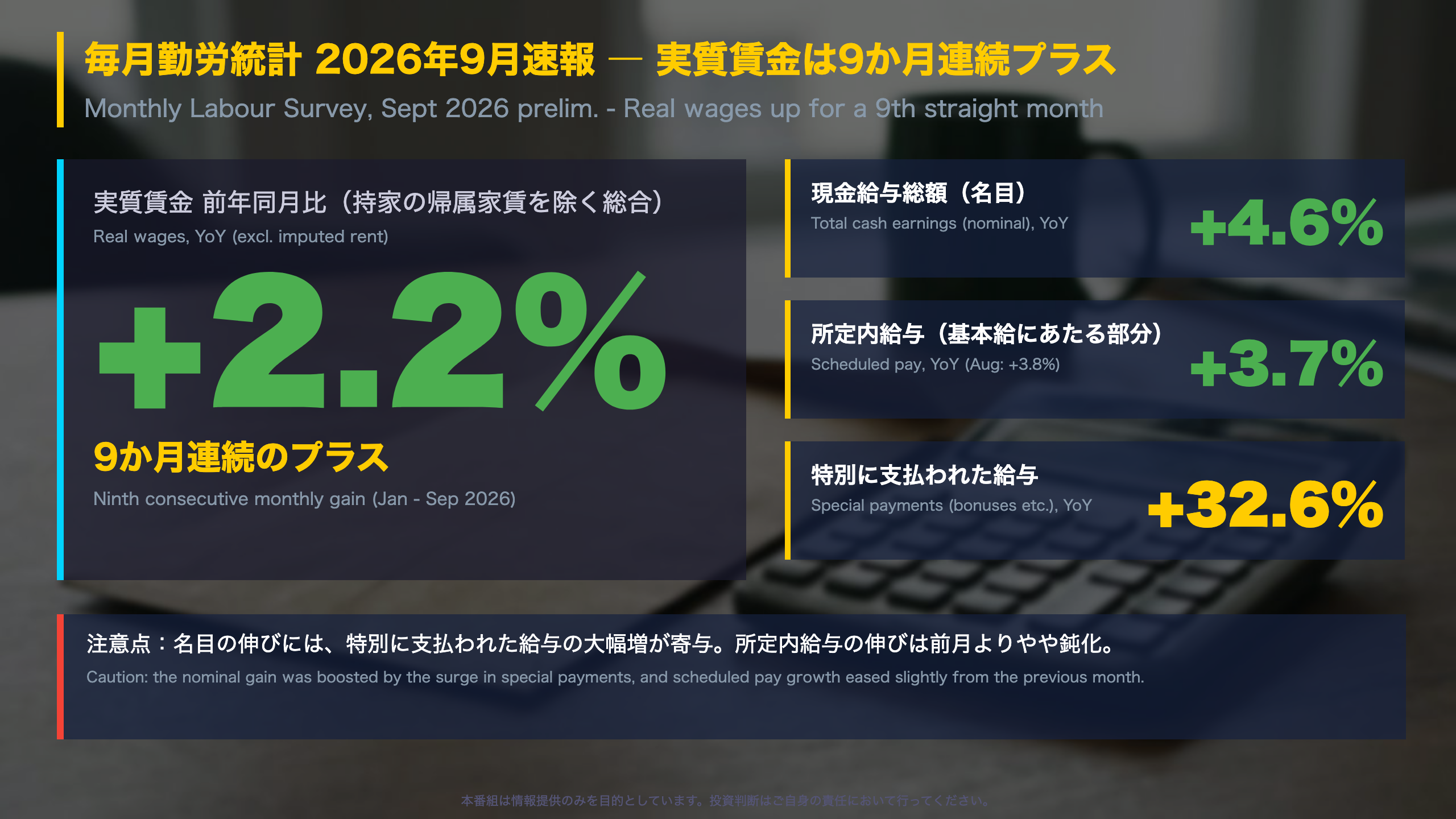
📈 Real wages (excluding imputed rent) rose 2.2% year on year, the ninth straight monthly gain. Nominal total cash earnings were up 4.6% and scheduled pay rose 3.7%.
💡 Special payments such as bonuses jumped 32.6%, contributing to the nominal gain. Real regular pay slowed to +1.1% from +1.6% in August as prices rose 2.4%.
⚠️ Preliminary figures can be revised. Next: September final data on Nov 25 and October preliminary data on Dec 8.
サマリー:実質賃金は9か月連続プラス、名目の中身には注意点
Japan’s September Wage Data: What the Headline Does and Does Not Say
Who publishes it. The Monthly Labour Survey comes from Japan’s Ministry of Health, Labour and Welfare (MHLW). It covers establishments with five or more employees; this month’s sample was 33,034 establishments with a 67.9% response rate. It is Japan’s closest counterpart to the average earnings data in the US employment report.
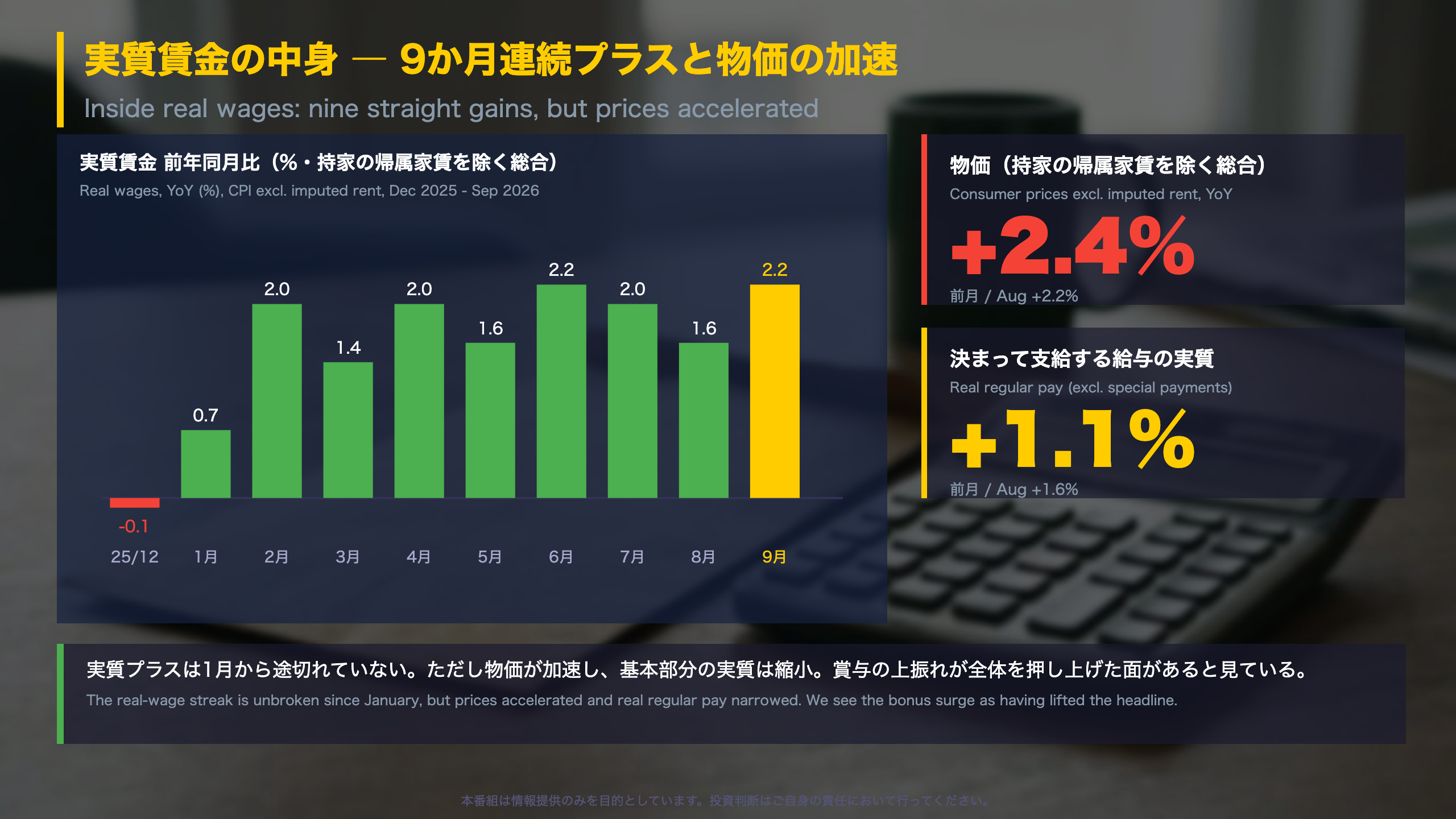
The headline. Real wages, nominal pay deflated by consumer prices excluding imputed rent, rose 2.2% year on year, the ninth consecutive monthly gain counted from January 2026. December 2025 was -0.1%, so the streak is clean. On the all-items CPI basis used for international comparison, real wages rose 2.3%, versus -0.3% for US real hourly earnings in MHLW’s comparison table.
Why the Bank of Japan watchers care. Policymakers look for evidence that wage gains are broad and persistent rather than driven by one-offs. That is why the split between scheduled pay (3.7%) and special payments (+32.6%) matters more than the headline.
Caveats.
– Preliminary figures are revised. August real wages were first reported at +1.5% and later revised to +1.6%.
– Special payments are volatile month to month.
– The report does not offer a policy view, and this summary does not forecast one.
What to watch: September final data on November 25 and October preliminary data on December 8.
解説①:名目賃金の中身 ― 所定内給与と特別給与
Unpacking Nominal Pay: Core Versus Noise
Key readings (establishments with 5+ employees, all workers):
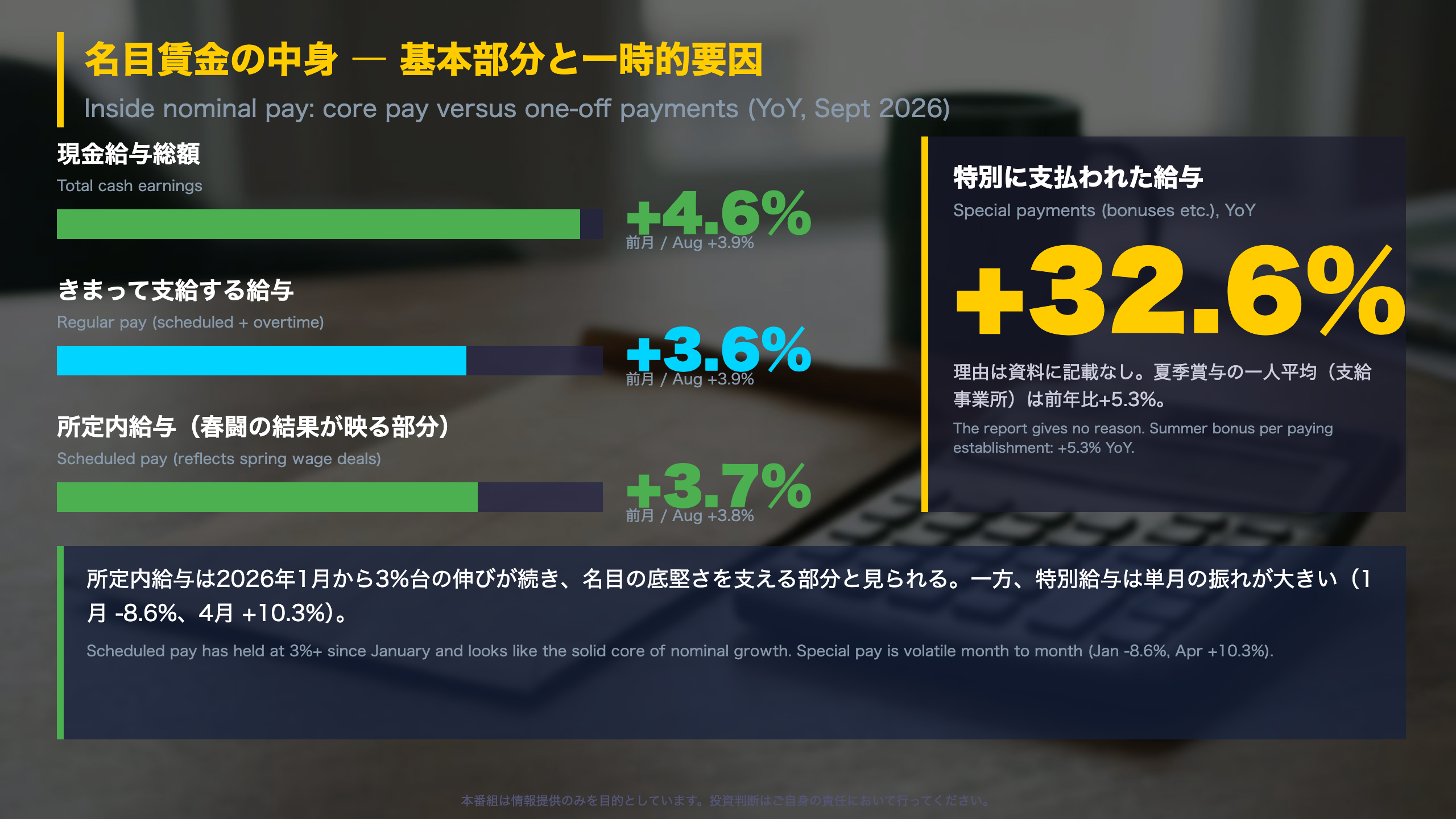
– Total cash earnings: +4.6% YoY (¥311,409), up from +3.9% (revised) in August.
– Regular pay (“scheduled” plus overtime): +3.6%, down from +3.9%.
– Scheduled pay: +3.7% (¥279,182). This is the figure that most directly captures annual base-pay settlements.
– Overtime pay: +3.6%.
– Special payments (bonuses and similar): +32.6% (¥12,258).
Summer bonus supplement. MHLW’s special tabulation shows the average summer bonus at paying establishments rose 5.3% to ¥448,765, with 85.1% of employees working at establishments that paid one. That 5.3% is the largest increase among 2022-2026 in the table.
Industry dispersion. Finance and insurance (+12.5%), academic and professional services (+8.5%), information and communications (+6.8%) and manufacturing (+6.0%) are well above average, while personal services and entertainment fell 1.2%.
International context. Japan’s wage settlements are decided mainly in the annual spring talks known as shunto. Unlike the US, where hourly earnings respond continuously to the labour market, Japan’s scheduled pay shows a step-up each spring, so a steady 3%-plus reading through the year is informative about how deeply settlements have spread.
Two readings. Constructive: same-establishment data (+4.4% total, +3.3% scheduled) also run high. Cautious: special pay is highly volatile (-8.6% in January, +10.3% in April), and the same-establishment sample is small. The first checkpoint is the September final data on November 25.
解説②:実質賃金の中身 ― 物価と基本部分の実質
Real Wages, Inflation and Hours Worked
Level. The real wage index (deflated by CPI excluding imputed rent, 2020 = 100) is 83.7, up 2.2% year on year. Deflating by the headline CPI gives 85.4, up 2.3%. MHLW publishes both because the ex-imputed-rent CPI better reflects goods and services people actually pay for, while the headline CPI supports international comparison.
Inflation edged up. CPI excluding imputed rent was +2.4% (August: +2.2%) and headline CPI +2.2% (August: +2.0%).
Real regular pay. Deflating only regular pay (excluding special payments), real growth was +1.1% for all workers, down from +1.6% in August. Full-time workers: +1.5% (August +1.8%); part-timers: +1.6% (August +2.0%). On a seasonally adjusted month-on-month basis, regular pay was flat (0.0%), while total cash earnings rose 1.6%.
Hours and jobs. Total hours worked were 132.7 per month, down 1.4% year on year, versus +0.5% in August. Scheduled overtime hours fell 1.0%, yet overtime pay rose 3.6%. Employment rose 0.8%, the part-time ratio was 31.44% (+0.30 point), and part-time hourly pay rose 5.4% to ¥1,463.
Perspective. Real wage gains in Japan have now persisted since January, in contrast to the -0.3% US reading in MHLW’s table. But monthly data are noisy, and one month of slower real regular pay is not a trend. The next datapoints are the revised September figures (Nov 25) and October preliminary data (Dec 8).
質疑:実質プラスは強いと言い切れるか、次の注目点
Q&A Addendum: Reading the Data Both Ways
Context. Investors often ask whether Japanese wage data “support” or “hinder” further normalisation by the Bank of Japan (BOJ). The BOJ has described a virtuous cycle of wages and prices as a precondition for sustained 2% inflation, so wage data are scrutinised closely. The MHLW report itself offers no policy view, and nothing below is a forecast.
Constructive evidence
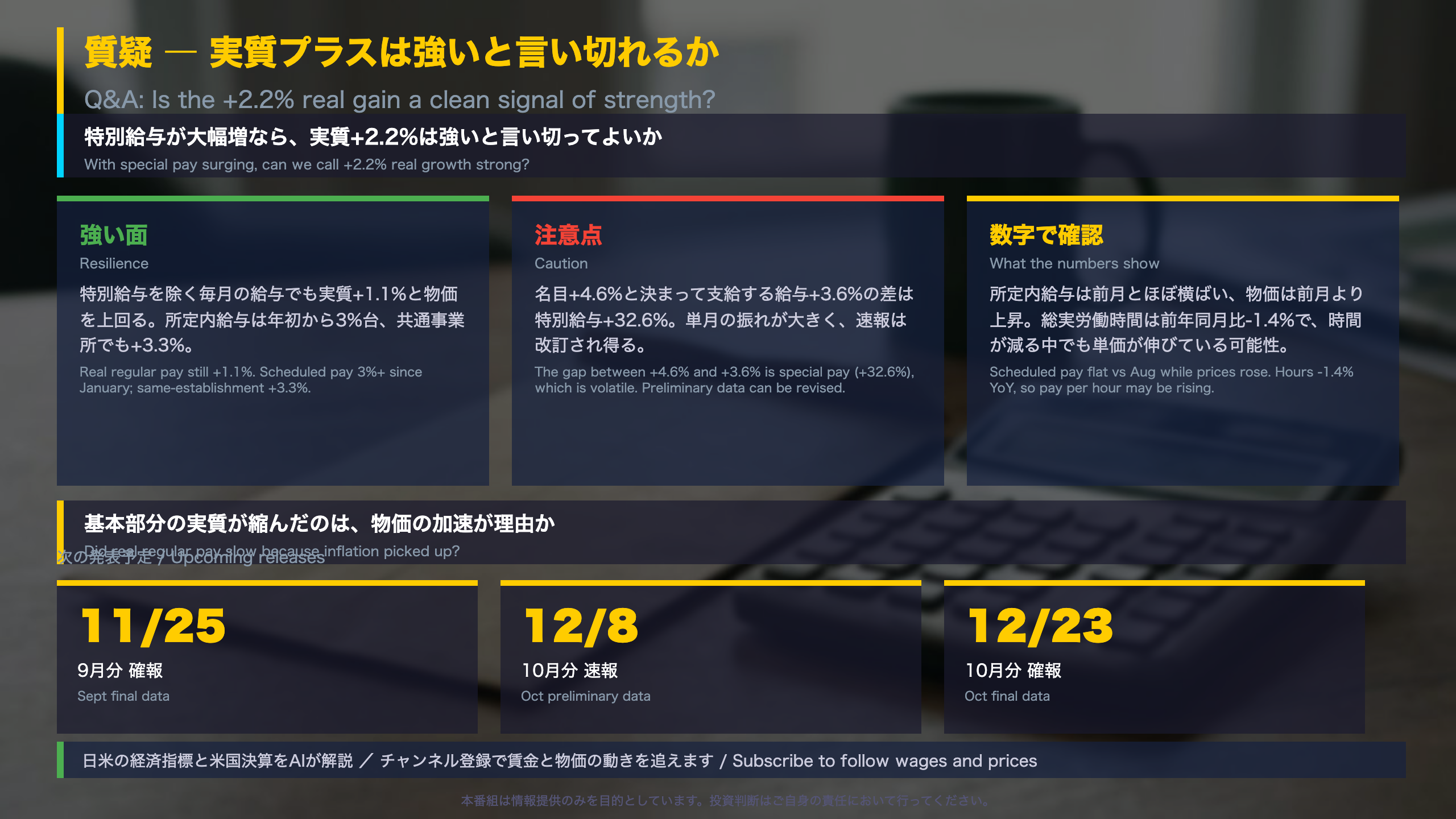
– Real wages up nine straight months.
– Scheduled pay at or above 3% every month this year (September +3.7%).
– Same-establishment comparison: total pay +4.4%, scheduled pay +3.3%.
– Part-time hourly pay +5.4%.
– Summer bonus per paying establishment +5.3%, the largest in the 2022-2026 table.
Cautionary evidence
– The gap between total earnings (+4.6%) and regular pay (+3.6%) is due to special payments (+32.6%), a volatile line.
– Real regular pay slowed to +1.1% from +1.6%.
– CPI excluding imputed rent accelerated to +2.4%.
– Hours worked fell 1.4%.
– Preliminary data are revised: August special pay moved from 0.0% to +1.8%.
Comparison with the US. MHLW’s table shows Japanese real wages at +2.3% in September (headline CPI basis) versus -0.3% for US real hourly earnings, though the series are built differently.
Calendar: September final data (Nov 25), October preliminary (Dec 8), October final (Dec 23), November preliminary (Jan 7). The key test is whether scheduled pay and the real-wage gains persist once the special-pay noise fades.
Disclaimer: This article is for informational purposes only. All investment decisions are made solely at your own risk.