📺 Watch the Full Video Analysis
This article was automatically generated by the NFC Market Live AI analysis system. (Updated: 2026-11-05 06:49 JST)
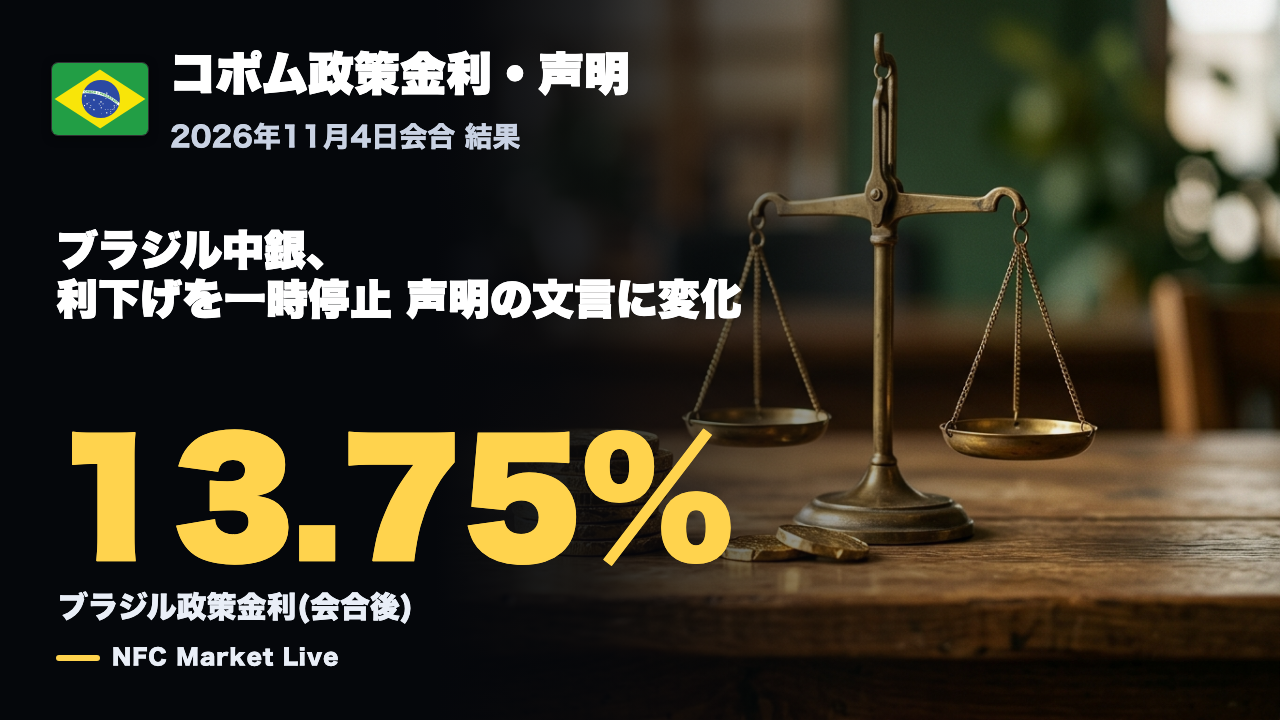
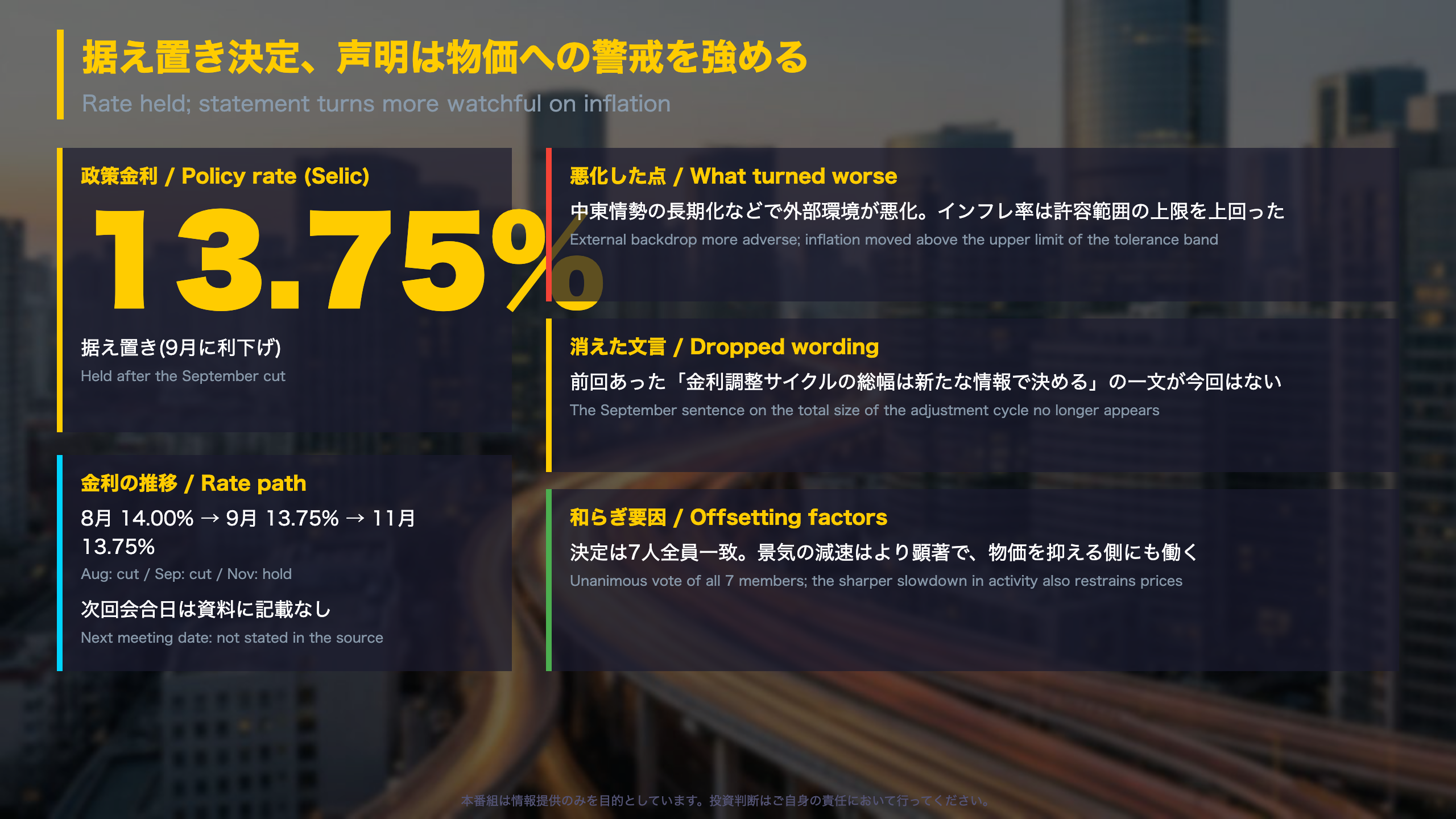
📊 Brazil’s central bank policy committee (Copom) held the Selic rate at 13.75% on November 4, pausing after the September cut.
⚠️ The statement says the external environment has become more adverse and inflation is above the upper limit of the tolerance band. The sentence on the total size of the adjustment cycle, present in September, is gone.
📈 The Copom’s projection for Q2 2028 rose from 3.2% to 3.5%, and market expectations for 2027 inflation climbed to 4.8%.
💡 On the other hand, the vote was unanimous and the sharper slowdown in activity helps restrain prices. We compare the two statements line by line.
据え置き決定、声明は物価への警戒を強める
What happened
The Copom, the monetary policy committee of Banco Central do Brasil (BCB), held the Selic at 13.75% on November 4, 2026. It had cut rates at the August 5 meeting (to 14.00%) and again on September 16 (to 13.75%), so this is the first pause in the sequence we compare.
Reading the statement
- External backdrop: from “remains uncertain” in September to “has become more adverse”, citing the prolonged Middle East conflict, upward pressure on oil prices and tighter policy in advanced economies.
- Inflation: headline and underlying measures accelerated and now sit above the upper limit of the tolerance band. In September they were below it.
- Focus survey (the BCB’s weekly poll of market economists): 2026 expectations rose from 4.9% to 5.2%, and 2027 from 4.3% to 4.8%.
Why a Brazil statement reads differently from a Fed statement
The Copom statement itself carries a table of the committee’s own IPCA projections (IPCA is Brazil’s official consumer price index) and its model assumptions, such as the exchange rate (R$5.15 to R$5.20 per dollar) and the electricity tariff flag (yellow to green for December). That makes line-by-line comparison unusually informative.
Balance of the evidence
The hawkish side: higher inflation, higher expectations, an upward projection revision. The offsetting side: a unanimous vote by all seven members, a more pronounced slowdown in activity and a labor market that the text now says shows signs of cooling at the margin.
What to monitor
The source does not give the next meeting date. The observable items are the wording of the next statement and the path of the Focus survey versus the target. This article describes official documents only and does not forecast markets.
1点目:消えた「調整サイクル」の一文
The line-by-line comparison
Central bank statements are often boilerplate, so the changes matter more than the headline. Comparing the August, September and November Copom statements:
- Activity: from “gradual moderation” to “more pronounced moderation”, mainly in cyclical sectors.
- Labor market: from “tight” (aquecido) to “resilient, but showing signs of cooling at the margin”.
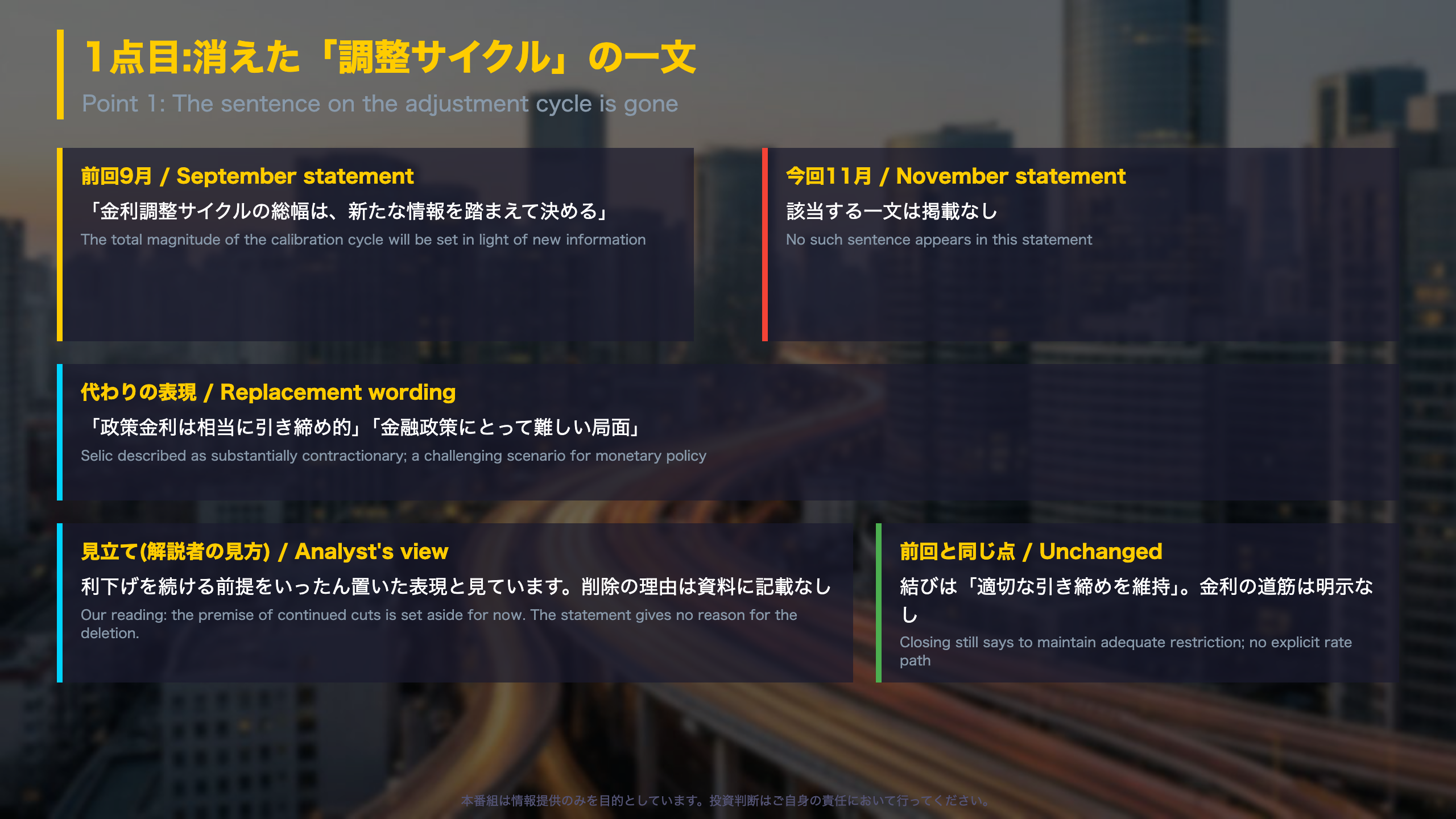
- Calibration-cycle sentence: present in August and September, absent in November. The earlier text read: the total magnitude of the calibration cycle will be set in light of new information.
The closing paragraph
September cited a significant increase in uncertainty, de-anchored expectations and elevated risks. November lists a “substantially contractionary” Selic, higher inflation expectations and a more pronounced slowdown, and calls the picture “challenging”.
Context for non-Brazil watchers
In Brazil, “calibration cycle” is the BCB’s term for the easing sequence. Dropping the sentence is comparable to a central bank removing forward-guidance language, though here the document gives no reason and no path. The vote was unanimous, as in September.
Two readings
- Hawkish reading: the omission, plus higher expectations and projections, suggests the premise of continued cuts has been set aside for now.
- Balanced reading: the statement also adds tighter financial conditions to the downside risks and states that the slowdown is sharper, so it does not close the door on easing.
The source does not state the next meeting date. Market implications are outside the scope of this official-document review.
2点目:物価見通しの引き上げ
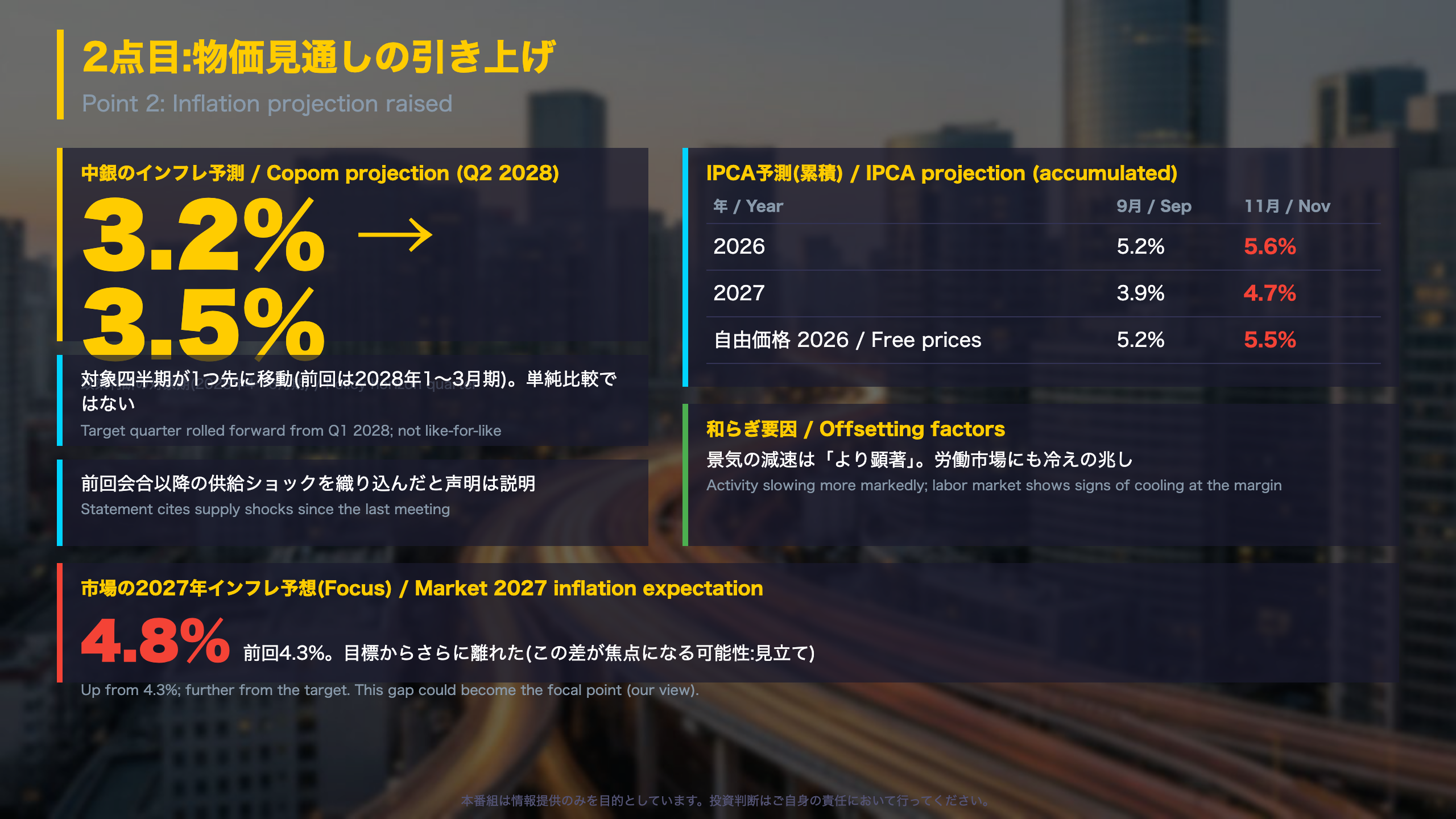
Three vintages of the projection table
The Copom publishes its own IPCA projections (four-quarter accumulated change) inside the statement:
| IPCA | Aug | Sep | Nov |
|---|---|---|---|
| 2026 | 5.1% | 5.2% | 5.6% |
| 2027 | 3.8% | 3.9% | 4.7% |
| Policy horizon | Q1 2028: 3.2% | Q1 2028: 3.2% | Q2 2028: 3.5% |
The August and September revisions were small. November’s upward move is large for both 2026 and 2027.
Sub-components
For 2026, the free-price component (IPCA livres) is projected at 5.5% and administered prices at 6.0%, versus 5.2% and 5.3% in September. Administered prices (utilities, fuel and similar items set by regulation or contract) saw the larger upgrade.
Assumption changes
The exchange rate assumption moved from R$5.15 to R$5.20 per dollar. The oil-price rule is unchanged. The December electricity flag assumption moved from “yellow” to “green”.
The statement attributes the revision to “supply shocks that materialized since the last meeting”.
Why the horizon matters
The relevant horizon rolled forward one quarter, so 3.2% to 3.5% is not strictly like-for-like. By comparison, the Fed publishes projections only quarterly in a separate document, while the Copom embeds its table in every statement.
Two readings
- Inflation-focused: projections, survey expectations (2027: 4.3% to 4.8%) and realized inflation all moved the same way.
- Growth-focused: activity is slowing more markedly and the labor market is cooling at the margin, forces that restrain prices.
The next meeting date is not stated in the source. This is a documentary comparison, not a market forecast.
質疑で深める:利下げは終わりか
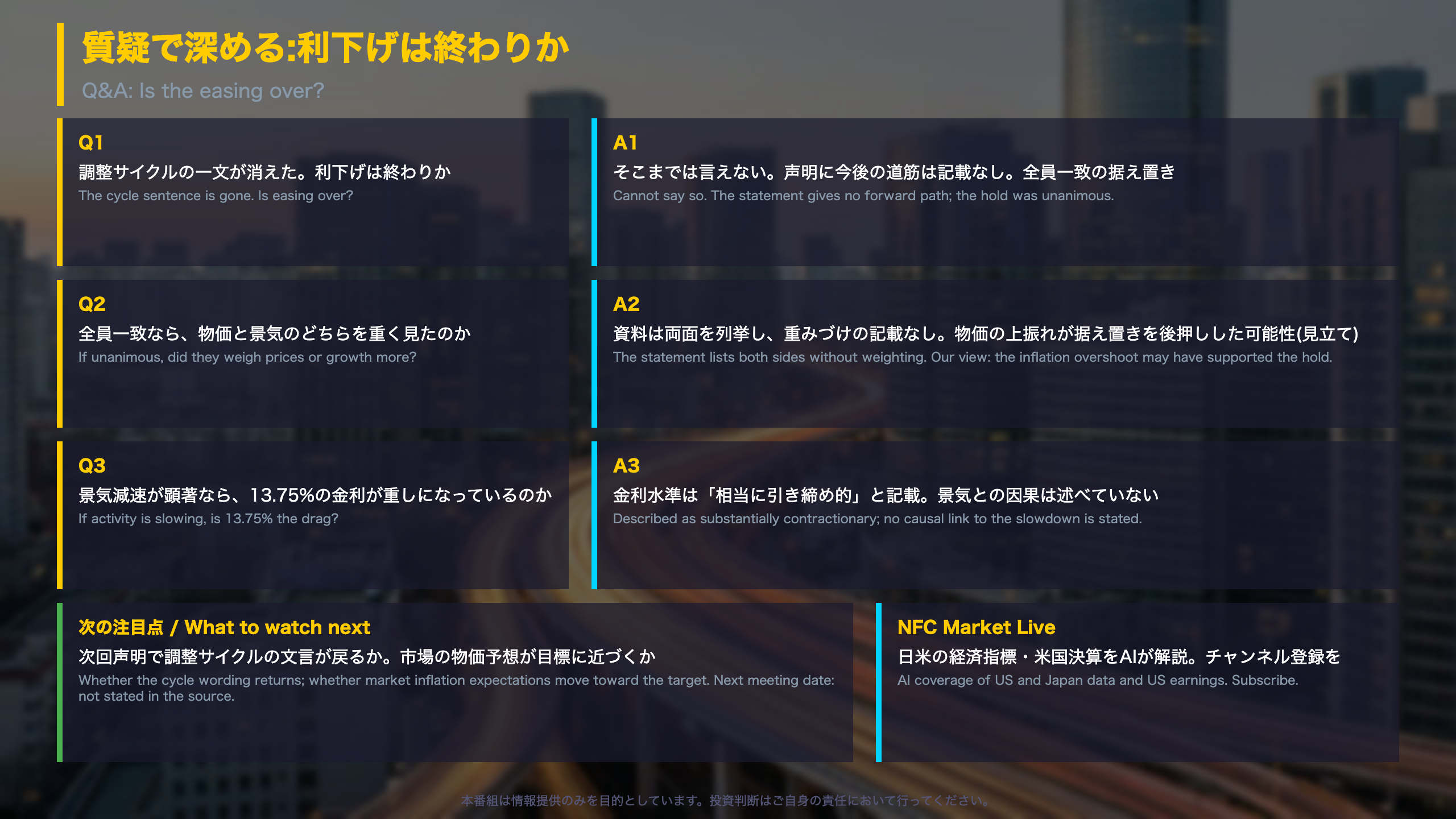
Supplement: the vote and the risk assessment
All seven members voted for the hold, including Governor Gabriel Galípolo. The same seven voted in August and September, and there has been no dissent in the three statements compared here.
The risk framework is unchanged
The statement keeps its assessment that inflation risks are “higher than usual, with an upside asymmetry”. Upside risks: longer-lasting de-anchoring of expectations, stickier services inflation, a persistently weaker currency and demand stimulus. Downside risks: a sharper domestic slowdown, a global slowdown and lower commodity prices. In November, “tighter financial conditions” was added to the global slowdown item.
“The Committee will continue to monitor developments in order to maintain adequate restriction to ensure inflation converges to the target.”
Reading guide for international investors
The Selic is the policy rate; the Copom meets roughly every six weeks. Unlike the Fed’s SEP, the Copom puts its projection table into every statement, so changes in the horizon quarter and assumptions are visible immediately. The statement itself calls the policy stance “substantially contractionary”, but it does not link that to the slowdown.
Two readings
- Inflation-first: projections, survey expectations and realized inflation moved together, and the cycle sentence was dropped.
- Growth-first: the slowdown is sharper, the labor market is cooling, and the downside risk list grew.
What can be verified next
- Whether the calibration-cycle wording returns.
- Whether the Focus 2027 expectation (4.8%) moves toward the target.
- How the Q2 2028 projection (3.5%) is revised.
The next meeting date is not stated in the source. This is a document review, not a forecast.
Disclaimer: This article is for informational purposes only. All investment decisions are made solely at your own risk.